
“Compressors make everything sound better.” That’s a line I heard my first day working at the local studio as the cable boy. The studio owner and the engineer would add compression to everything, and it felt great.
When I first started playing acoustic guitar, I realized there were some pros and cons to using compression, but they were fundamentally right; it does make everything sound better in the studio.
Now, when you take that same principle and apply it to a live experience, then things get a bit more complicated. You have to weigh in the dynamics and the response of the instrument; don’t forget you’re still expressing yourself.
Well, after playing a bunch of them, I handpicked only the best ones for acoustic and put together this piece, so you won’t have to go through that yourself.
Top 3 - Best Acoustic Compressor Pedals
Preview | Product | Price |
|---|---|---|
 | ||
 | ||
 |
These compressor pedals made my acoustic instruments sound better, and they can surely do the same thing for you.
Let’s do it!
Best Compressor Pedals for Acoustic Guitar
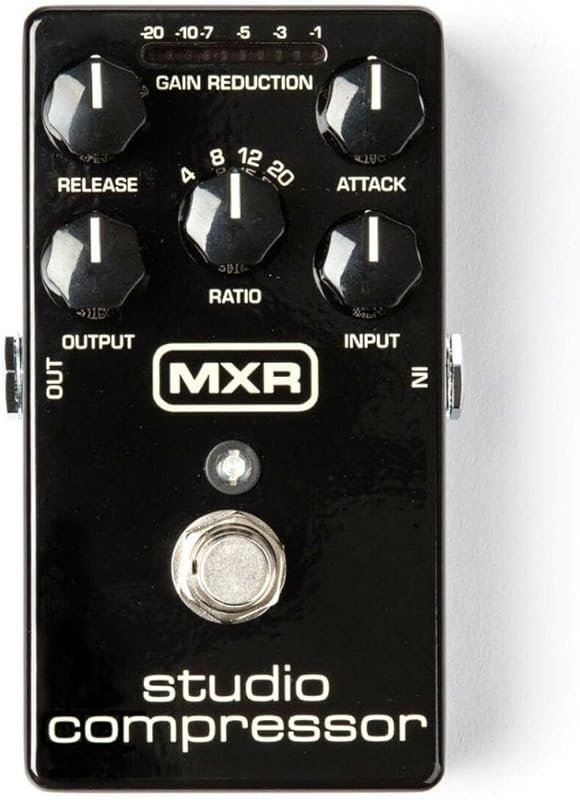
1. MXR Studio Compressor M76
The MXR Studio Compressor isn’t far from having studio gear on your pedalboard. I have to say this is one of the cleanest compressors I’ve tried on any of my guitars; it’s just pristine.
What I liked the most about this pedal is the meter at the top. You can see in real time how much it’s taking out of your signal, just as if you had a vu-meter in front of you. This is super handy to make on-the-fly adjustments (given that you know your way around compressors).
I started with the threshold pretty low and the attack fairly high. The compressor became fast enough to avoid big transients in my playing, and the result was smooth and unnoticeable. Moreover, since you have input and output dedicated knobs, you can treat compression and volume as two separate things. It also allows you to make up for any volume loss with compression.
For example, I could go back and forth between instruments and keep them all sounding at the same level. That’s not an easy accomplishment. In the same vein, I could go from fingerpicking to strumming and get the same volume as well.
I do have to say that, in that scenario, I lost some dynamics. For example, I like playing an old one-hit-wonder song called “Hey There Delilah” by the Plain White T’s, and this pedal allowed the fingerpicked section to be as loud as the strumming, using just my fingers.

That’s a good and a bad thing at the same time. If I wanted to build up the momentum for the song to reach the chorus, I couldn’t do it with the guitar’s natural volume. On the other hand, when playing a gig, this song doesn’t get lost.
I would say this is the perfect compression pedal for any acoustic strummer who wants to have control over every aspect of the sound and achieve a clean, compressed, punchy tone with lots of headroom.
If it fits your budget, give it a try; it’s a perfect candidate.
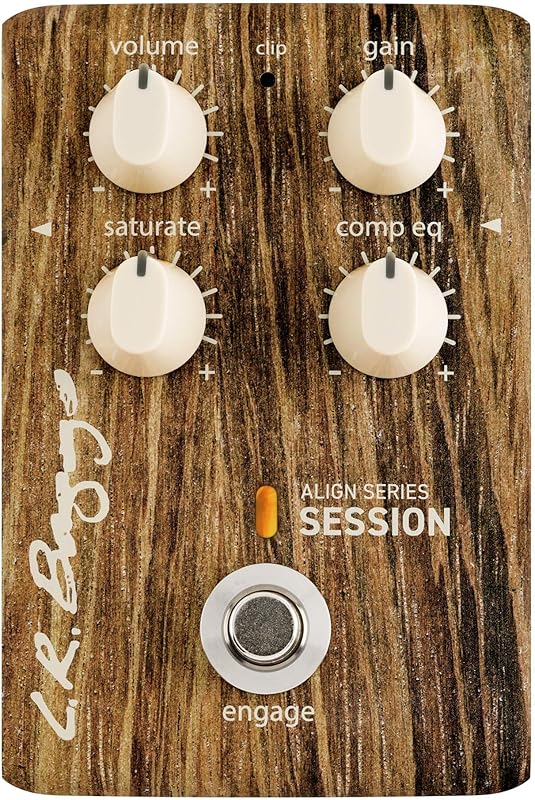
2. LR Baggs Align Session
The Align series by LR Baggs is all you need to rip it with your acoustic on stage. Plus, they look really cool with that wood copy pattern on them. I had the pleasure of using this pedal along with the EQ and the reverb, and the three of them made quite a difference to my overall tone.
But let’s get a little deeper into it because the LR Baggs Align Session isn’t an ordinary compressor.
The magic here occurs with the saturation knob. Yes, I know, finding saturation in a compressor pedal is like finding a “clean” knob on an overdrive pedal. That said, the midrange complexity and rich harmonic overtones that this knob brings to any guitar are worth leaving it on most of the time. Furthermore, it has a smooth effect on the low-end, adding round and beautiful warmth to the overall sound.
Nevertheless, it can be dialed back if you’re looking to add punchiness. The same happens with the amount of compression; there’s a very fine line between musical and squashed, so you have to be very careful with the knobs.
The one thing that, in my opinion, is subpar with this pedal is the noise level. I mean, if you want to really push your guitar and keep it clean, you’ll be lifting much of the white noise that’s below your tone. That’s definitely not something you’d want, especially when it’s loud and constant.
You can work your way around it, though, by playing with the volume, gain, and comp eq knobs. If something gets a little too much, just dial it down and push the volume knob up. You’ll make up for the compressor’s volume loss after it cuts off the peaks and big transients.
Finally, let me say that if you love the sound of your acoustic guitar, you’ll love it even more with this EQ. On the other hand, it’s not too good at coloring the sound to make it more beautiful.
Give it a try and see for yourself if it fits your needs and budget.
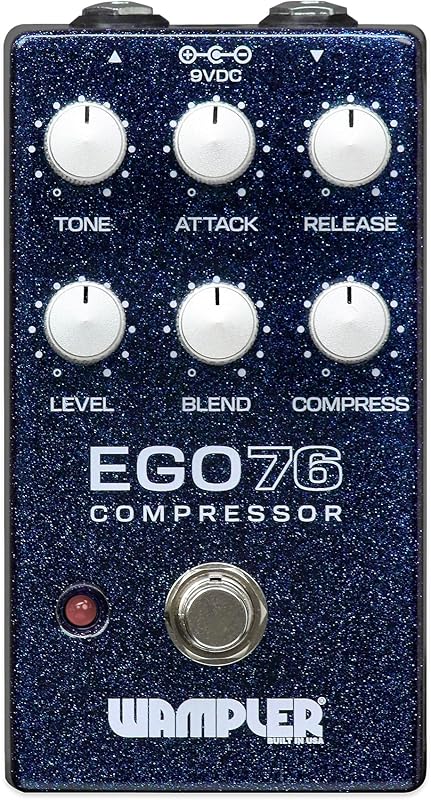
3. Wampler Ego 76
When it came out in 1967, the 1176 peak limiter and compressor revolutionized the industry completely. It was one of the very first pieces of gear featuring FET transistors inside instead of almighty valves. But that’s not what made the 1176 stand out from the pack; its musicality was the defining factor for its historical longevity.
I remember the first time I worked in a big studio; they had an LA-2A and a couple of 1176s, and they would just run everything through them, even with zero compression, just for its amazing tone.
Well, I’m not here to tell you that Wampler could cage that magic inside this little box. Nevertheless, this pedal sounds great, resembling that kind of color coming from the hardware found in studios around the world.
Another very important thing about this pedal is that it comes with six knobs to control every aspect of the compression. For example, you can get some Andy Summers-approved tones with the compress knob and help with the volume loss with the level knob.
I wish this pedal would come with meters so you can see when the compressor kicks in and how much it cuts, but my ears were a good compass anyway. I’m telling you, the Wampler Ego 76 behaved like a musical, warm, great-sounding compressor; I just didn’t want to turn it off!
Speaking of which, there’s a blend knob available to bring in what we call ‘the New York tone,’ which is punching in all the ratios at the same time. Imagine if you could just bring in some of that to make your tone tighter and keep it a bit more dynamic and jinglier instead of squashed and inexpressive.
Well, I tried “Skinny Love,” which is one of my favorite acoustic covers of all time and I could go harder or easier with my strumming hand and keep it musical and beautiful at an even volume.
Having a crowded pedalboard is no excuse because Wampler also released the Wampler Mini Ego 76, a mini version with the same tone and versatility in a smaller package.
If it fits the budget, it will surely get the job done.
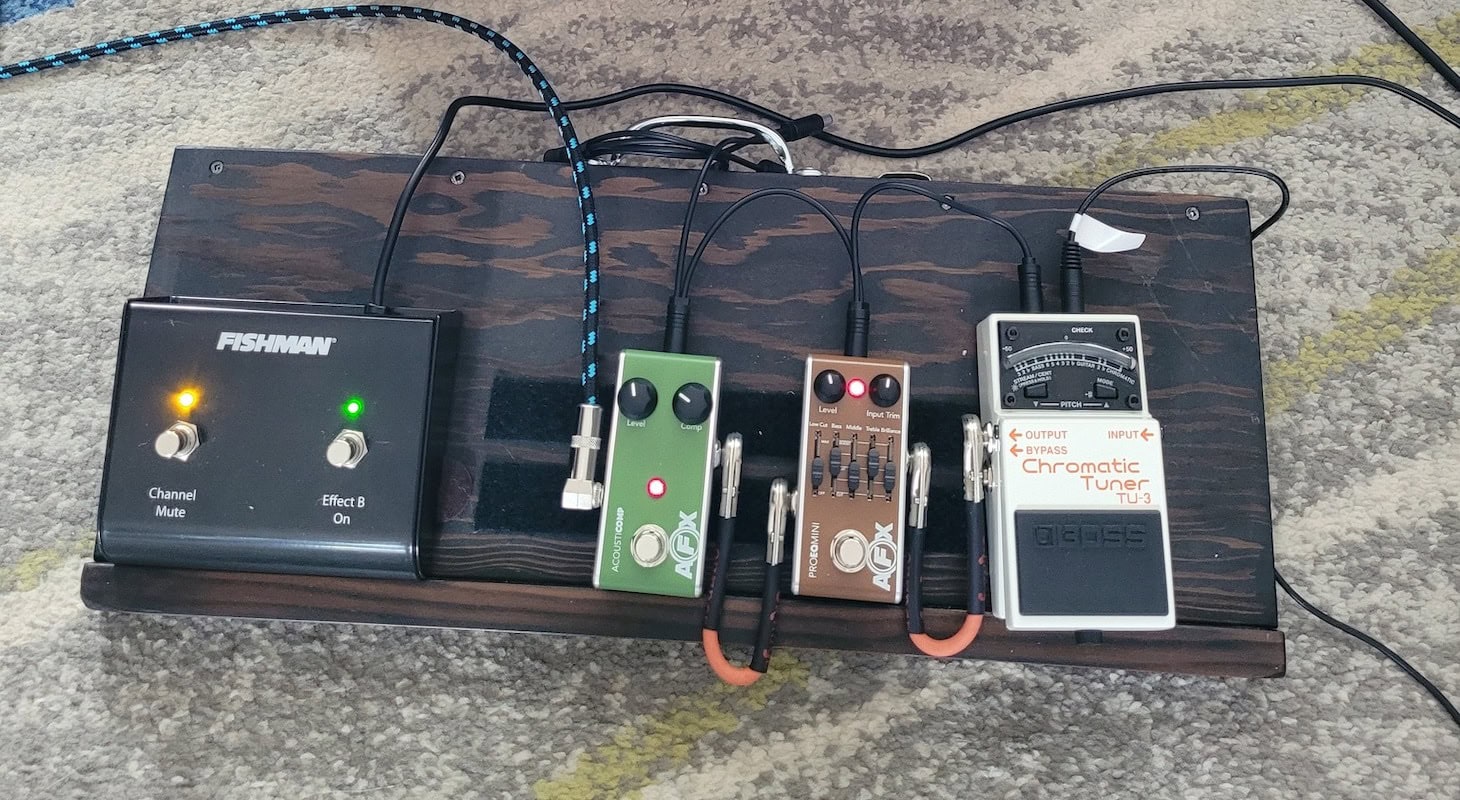
4. Fishman AFX AcoustiComp Mini Compressor
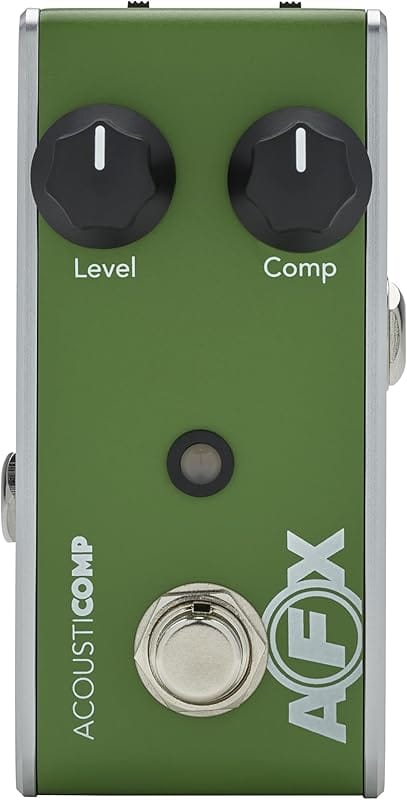
Fishman has been making amazing products for acoustic guitars for decades. As a player, I’ve been using Fishman all my adult life, and I have never had any bad results with them. Plus, their AURA line was pioneering in all-in-one solutions for acoustic players, and the compressor circuit inside this tiny gadget comes straight from that line.
First things first, this is as tiny as it is powerful. It will take up very little space on your pedalboard, but it’s ready to cover all your compression needs with just two knobs: level and compressor.
The first knob will allow you to adjust the guitar’s level, and the second the level of compression. I was fiddling with these two for less than a minute, and it was already giving me great results. Furthermore, if you just plug it in and use it with everything at noon, you’ll have enough dynamics to preserve your expression and enough compression to fill the gap between loud strumming and soft fingerpicking.
Did I do it? Of course I did. I went to the music store and didn’t just play “Wonderwall” by Oasis, I also played “Blackbird” by The Beatles, and they sounded punchy, strong, and in-your-face. I maxed out the comp knob, and it got just a little too squashed, losing all dynamics.
That said, the level knob was very handy to preserve the overall volume even when you’re pressing that much over the wave’s peaks.
I tried many different positions for the two knobs, and the Fishman AFX AcoustiComp remained musical and usable most of the way. Also, it’s worth noting that the back of the pedal has a switch to turn on an internal buffer or make it a true-bypass unit.
In my opinion, it’s one of those set-it-and-forget-it kind of pedals rather than a versatile unit to use with different instruments or presets during a show.
If you’re looking for versatility, though, you can get the same compression quality and far more options with presets, going for something bigger and shinier like the Fishman Aura Spectrum DI.
I have an unwritten personal rule of thumb: if it’s Fishman, it’s good, period. This pedal is no exception to that rule.
The Bottom End
A good compressor pedal can be the single item to change your playing experience, especially in a live situation. I mean, playing acoustic guitar is hard enough, to add another layer of complications by not having something as simple as a compressor.
In a sense, if you think about it, every record you’ve ever heard probably had a compressor on vocals and acoustic guitars, so even if you didn’t know it, you’re very familiar with compressed sounds.
So, all I can say is choose wisely and dial it in perfectly; the rest is (properly compressed) music history.
Happy playing!
