
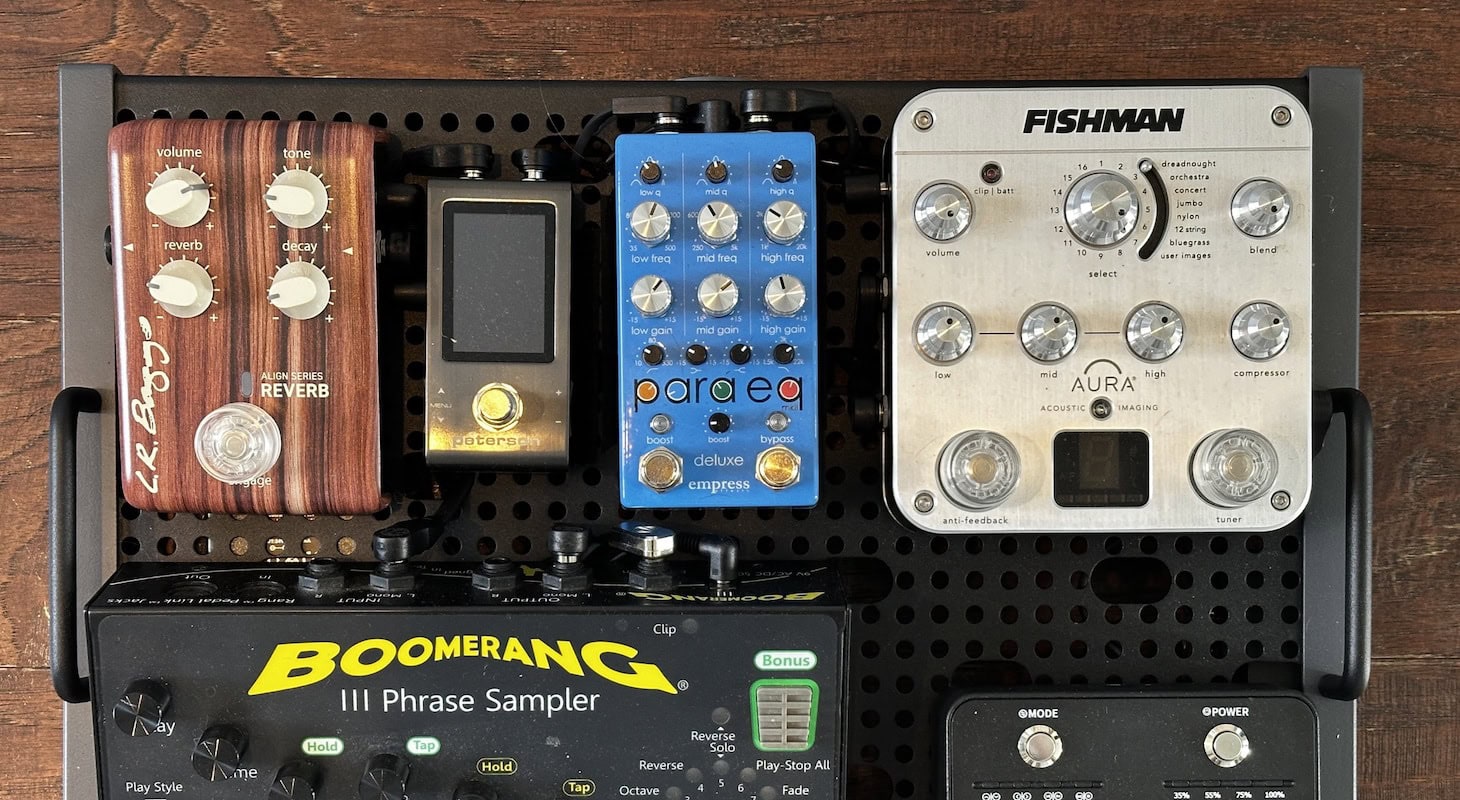
I know, EQ pedals aren’t flashy, don’t make quirky noises, and won’t push your playing into the Twilight Zone as other, color-filled stomp boxes. That said, I’d say that, after your tuner, there’s no other pedal more important than an EQ for your board. This is especially true if you play acoustic guitar.
We’ve all been there. You start hearing that low rumble creep up from your feet all the way to your chest, and you know it’s going to take the soundman and you half an hour to get rid of it without killing the guitar’s tone; if you’re very lucky.
With an EQ pedal on the stage, you can just bring down that frequency and work your way around the rest of the faders (or knobs) to rescue your guitar’s low-end.
Top 3 - Acoustic EQ Pedals
Preview | Product | Price |
|---|---|---|
 | ||
 | ||
 |
I mean, we invest, rehearse, and play for decades to sculpt our uniqueness into art; don’t let an unwilling soundman (of which there are many) ruin it for you.
Trust me, I’ve been there, and this pedal saved my life more than once.
Let’s go!
Best EQ Pedals for Acoustic Guitar
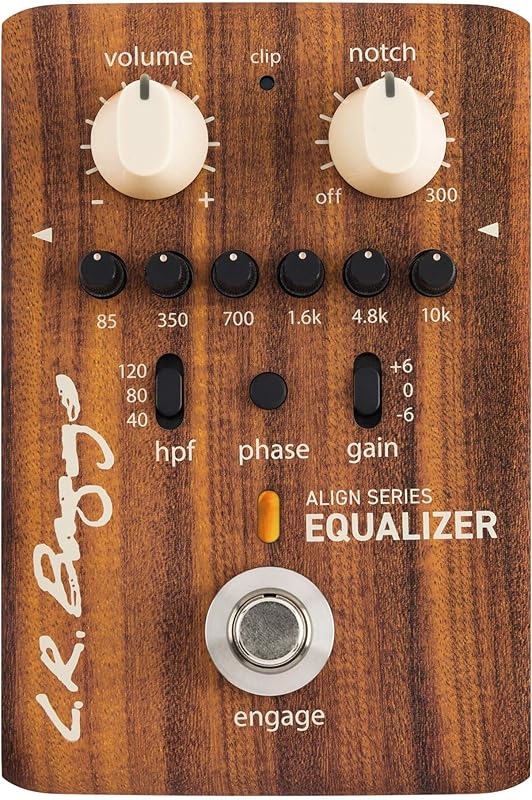
1. LR Baggs Align EQ
The LR Baggs Align EQ is not perfect, but it’s a great piece of gear. It saved me from a multitude of problems on small stages where the PA is literally next to you. Yes, it’s like trying to fight a cosmic war with a spoon: there’s absolutely nothing you can do about it.
This pedal solves it with one ingenious knob on its face called the notch. It’ll attack the feedback without removing everything that’s cool about your guitar’s sounds. That’s something that I would have spent all my savings on while I was playing in local pubs growing up.
I once even played a gig with my back to the audience because it was the only way to stop feedback!
Old anecdotes apart, I loved that feature about the Align EQ, but that’s far from all you can do with this pedal. The EQ section is quite something. You get six bands to play with; they are conveniently chosen to be exactly what you need. For example, I loved the first one at 85Hz because you don’t need that frequency 90% of the time, but what if you could just lower it instead of erasing it from the spectrum?
I know, massive low-end. Believe me, my all-mahogany Martin D15m loves this pedal. I had the same feeling about the choice of high-pass and low-pass filters. They’re perfectly dialed in for acoustics.
Now, if you want to know what I don’t like so much about this pedal, let me tell you that an XLR output would have been a great addition. I mean, I know there’s another pedal in the Align series that works as a DI, and they want you to buy that one too. That said, for the price and the features, it’s a pity.
If you’re after a very good-sounding EQ with plenty of features and a certified hum-exterminator knob, you have to try this pedal.
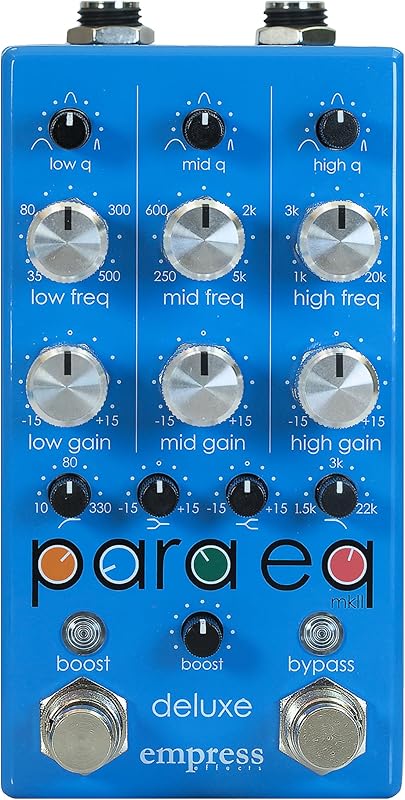
2. Empress ParaEQ MkII Deluxe
Let me tell you, right off the bat, that this EQ pedal isn’t for the faint of heart. It’s a tone-shaping tool that will transform the sound of your instrument entirely. Plus, it comes packed with a 30dB boost. That’s enough juice to set the place on fire!
That said, this unit is as loud as it is silent. Yes, I know, it sounds like a tongue twister, but it’s not. You cannot hear this thing at all, because it’s dead quiet… until it roars.
But let’s rewind a little, shall we? The first (and biggest) difference between this pedal and 90% of the EQ pedals in the market is that this is a parametric equalizer rather than a graphic one. It resembles the one in your DAW more closely than it does any other pedal.
This means that, instead of having a set frequency for each fader, you can choose the frequency range, the Q or bell type, and the gain level. Plus, you have a high-pass and a low-pass filter, and two types of mid boost for lower and higher mids.
I was able to make my Baby Taylor sound big and lush, and my Martin sound like a parlor, ready for fingerpicking. I’m telling you, there’s absolutely nothing you can’t do with this pedal in terms of equalizing. Plus, the result is always musical and usable. For example, it sounded great on my acoustics, but also to help my ukulele cut through the mix with a little more body than it was born with.
Moreover, the second I engaged the boost, I was propelled to the center of the mix with cannon-like force. It helped me get more volume without degrading the sound or adding distortion to the signal.
I played “Wish You Were Here” and looped the base just to engage the boost for the lead lines on top, and I was in acoustic heaven.
If your budget allows it, this made-in-Canada Empress ParaEQ is perfect for any and all scenarios.
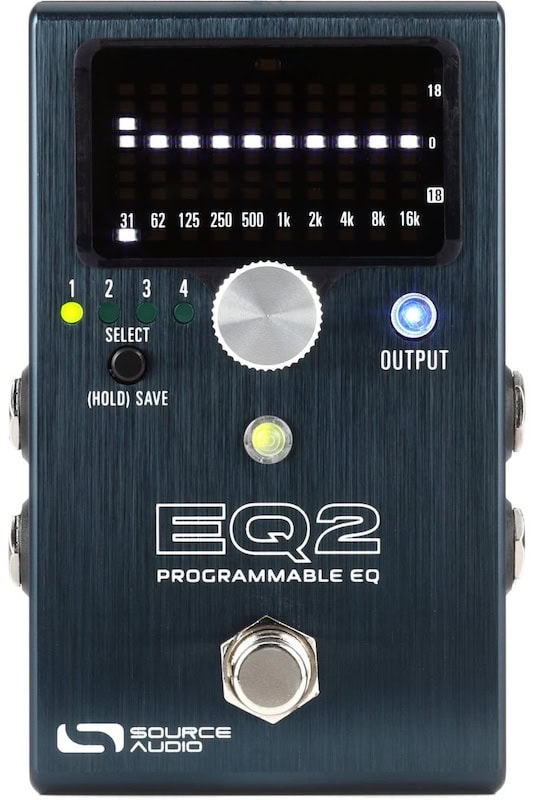
3. Source Audio EQ2
There’s no other pedal on the market that’s this size and can get even close to the Source Audio EQ2 in terms of versatility. It’s just amazing how you can use a single pedal to work your way around more than one instrument. In my case, I have three presets: one for the Martin D15m (big dreadnought), one for the Baby Taylor (parlor-sized guitar), and one for the ukulele (soprano).
You can just recall them right away and tweak them to the infinite from the very capable app and computer software. This pedal isn’t just an equalizer; it’s also a noise gate (which you can fine-tune from the software or app as well).
I do have to say that this pedal can be a little tricky when playing live. I mean, one of the best things you can do with an EQ pedal is to arrive early, do some sound checking, and do the final touches to the bands so you can match the room.
Well, although it’s very easy to recall presets, any changes on the fly are definitely more challenging than moving faders you can see and manipulate with your hands. I’m telling you, the single-big-silver-knob approach isn’t bad for preset recall, but it’s too much to handle on the fly while on stage.
The worst part is that, if you double-press on the knob, you’ll flatten the whole thing, deeming the pedal useless. Trust me, I’ve been there, and it’s no bueno.
That said, being this size, fully stereo, and MIDI compatible is nothing short of amazing. Moreover, I went into the software and sent a mix to my in-ears and a different mix to the FOH. That way, I could blast my brain with my guitar super high, and the people in the audience didn’t have to suffer for my insecurities.
I also loved the output knob and how it can help level the volume between instruments. You know it’s not the same to strum a full-bodied Martin dreadnought than to strum a soprano ukulele.
If it’s within your budget and you need a pedal with many fine-tuning options, or you’re a multi-instrumentalist, this pedal is worth checking out.
4. Boss EQ200
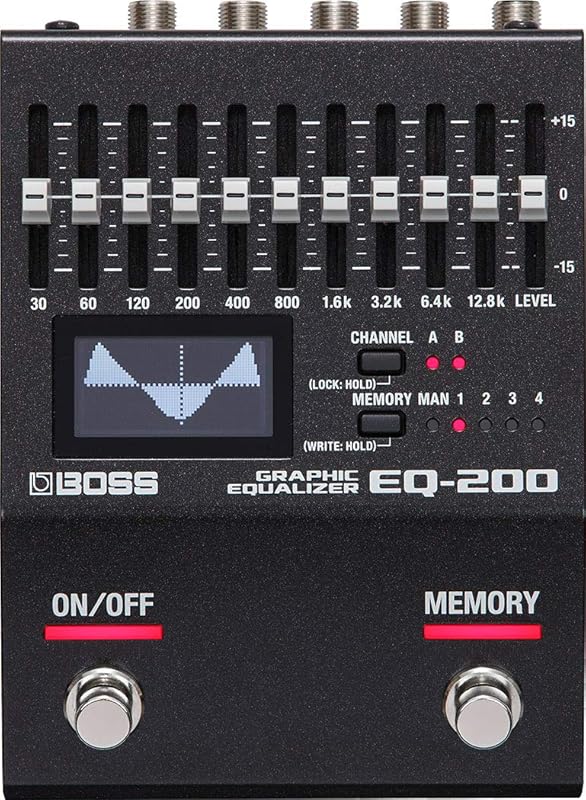
The 200 series by Boss is very powerful. I mean it, if you’ve ever played the RV-200 or DD-200, you’ll know it’s like diving into an ocean of options and swimming to shore. Yes, there’s so much the Boss EQ200 can do, I don’t even know where to start.
Maybe the beginning would be good, right?
What blew my mind initially about this pedal isn’t that you can store presets and then recall them on the fly, but that you can do that with real faders. I found it very handy to arrive at a venue with the sound of my instrument 80% dialed in and fine-tweak it as the show goes on. I crouched many times to make that tiny adjustment that was going to change it all during the show. There’s nothing better than real faders for that.
Beyond faders, though, the engine inside this thing is monstrous. It runs two EQs in parallel at all times, and you can commute between them as if they were channels from the pedal itself. It's wonderful to send more than one mix out. One thing I often did was to put my time-based and modulation effects on one side and use it as a stereo splitter to create a dry-wet combination.
The screen is very handy as well. I was able to tell what the curve was all the time just by looking at it. That, and the ability to make tiny fader adjustments, make this a versatile pedal for live and studio use. Taking out the booming bottom end from my acoustics was never easier. I could even choose the frequency for each preset. Cutting off growl from a dreadnought at 70 to 120 Hz is very different from doing it to a parlor or a nylon-string guitar.
Well, I created every preset with that in mind, and the only thing I needed was to check my instruments as soon as I walked on stage.
Finally, just like its more affordable sibling, the quintessential EQ pedal, the Boss GE-7, it’s built like a tank and can withstand the hardships of the road easily.
If it fits your budget, give it a try; it’ll surprise you.
The Bottom End
Adding an EQ pedal to your acoustic guitar pedalboard is a smart move. It will soon become the unsung hero behind your successful gigs. Believe me, it can be a lifesaver in difficult scenarios.
These pedals can be the single difference between a catastrophic and an OK gig and will make your instrument sound at its best.
Choose wisely and use that secret weapon to your advantage. It’s time to make your acoustic cut through to the front of the stage; it’s time to shine.
Happy (perfectly equalized) playing!
