
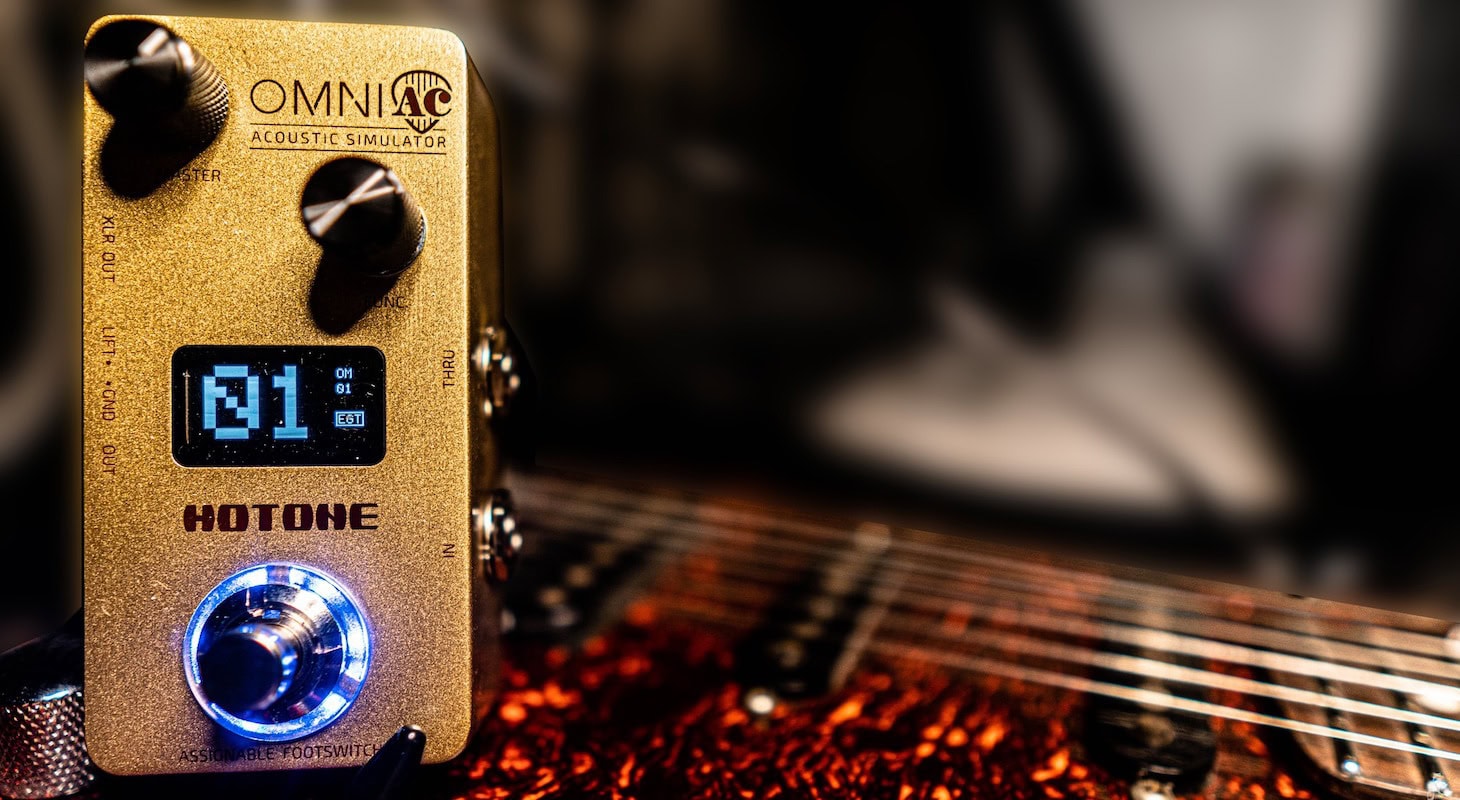
We’ve all been there. Playing a set where every song but one demands an electric guitar. One pesky song requires an acoustic tone. I’ve been in cover bands that inserted “Wonderwall” into their 90s set, and country bands bringing in a big ballad for one or two slow numbers toward the end.
If you’re anything like me, the idea of bringing a whole extra guitar just for one song is annoying. I tend to attend gigs with two electrics anyway - one main guitar, one backup - why bother bringing a whole extra instrument?
Add to that the difficulty of soundchecking an extra guitar. Acoustic guitars are notoriously hard to mix right on top of it. What’s the solution?
Well, if you don’t have a roadie to carry your extra guitar and a guitar tech to soundcheck it, you might want to consider the humble acoustic simulator pedal.
Why Buy an Acoustic Simulator?
First things first: acoustic guitars don’t sound as good amplified as they do when unplugged.
That’s why recorded acoustic tones are done with a microphone, not an amp. I’ve seen plenty of photos and videos of guitar players in the studio strumming away at big American dreadnaughts with a microphone in front of the sound hole.
Because modern live music demands amplification, many acoustic guitars come with pickups to allow players to plug into an amp or a DI box that runs into the PA.
Acoustic simulator pedals exist to give electric players the chance to wield acoustic tones without having to switch guitars. Specifically, they emulate the plugged-in tone of an acoustic guitar with a pickup.
I’ve learned that an acoustic simulator won’t magically turn my Les Paul into a pre-war Martin acoustic.
However, it will offer a viable imitation of an amplified acoustic guitar, and will sit in a live mix not unlike an acoustic guitar.
The best use case for these pedals, in my experience, is in a live band where I have to play a single acoustic song, an acoustic part mid-song, or a short passage that demands an acoustic-like texture. Similarly, when the venue is particularly loud, I want to avoid using a true acoustic guitar altogether in the name of minimizing unpleasant feedback mid-show.
4 Best Acoustic Simulator Pedals
1. Hotone Omni AC
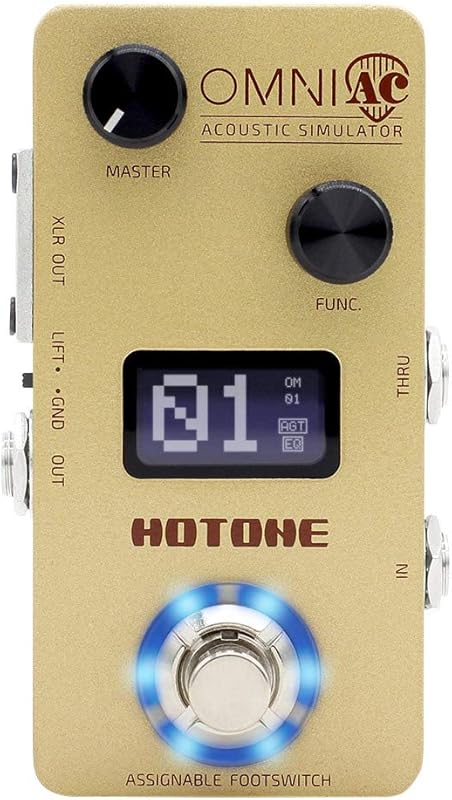
The Hotone Omni Acoustic is a conveniently sized (and priced) acoustic simulator. Like many tone-simulating pedals, it claims to offer a range of viable tones to cover different guitars, acting as a guitar collection in a box.
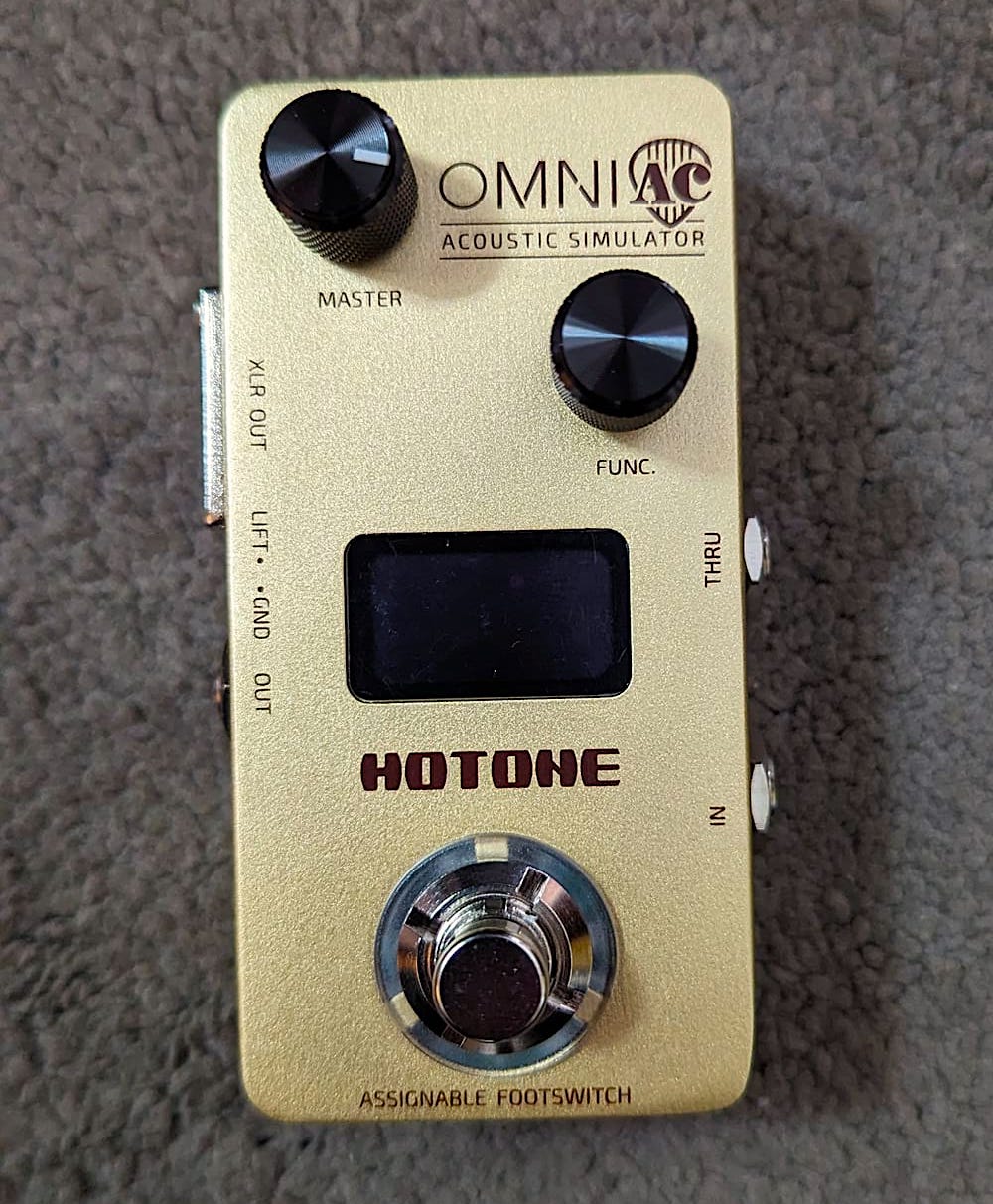
Hotone Omni AC
Upon trying it out, I was less than impressed by this claim.
The first thing I noticed was the convenient XLR out. As I suspected, this pedal is designed to go into your PA mixer, not your guitar amp. Accordingly, I needed to use a signal splitter to get the most out of it. I can see this being OK if you were running an amp sim or a Helix, but it’s a little annoying to run so many extra cables for one song.
Having said that, I prefer to run acoustic guitars through the mixer or into the PA, so there’s not much difference there.
The gold flake paint job on this pedal is pretty cool, and definitely looks the part in my opinion.
It took some time to find a usable acoustic guitar sound on this pedal, however. I found that the pickups in my Les Paul were too hot, and too compressed, to offer a convincing acoustic tone. All the acoustic guitar tones just sounded like weird clean EQing to me.
However, on my 335, and with some adjustments to my playing technique, I found that I was able to conjure some pretty convincing acoustic tones. Open chords sounded best on the setting designated “D-02”, which I’m pretty sure means a dreadnought.
I actually wound up using the built-in nylon tone for the intro to “Chicken Fried” at a country gig, and the dreadnought tone was perfectly usable in the end.
The acoustic bass tones are actually a little more convincing than the acoustic guitar tones. I plugged in a Fender Precision bass and found the upright emulator to be the closest sound to the real thing of the lot!
I can’t see myself using the headphone out: I own an acoustic guitar, so if I want an acoustic tone at home, I’ll just play that.
The LED display is nice and bright, and was easy to read on stage, and it took my daisy chained power supply just fine.
Overall, a very useful pedal, especially for the price.

2. Boss AC-3
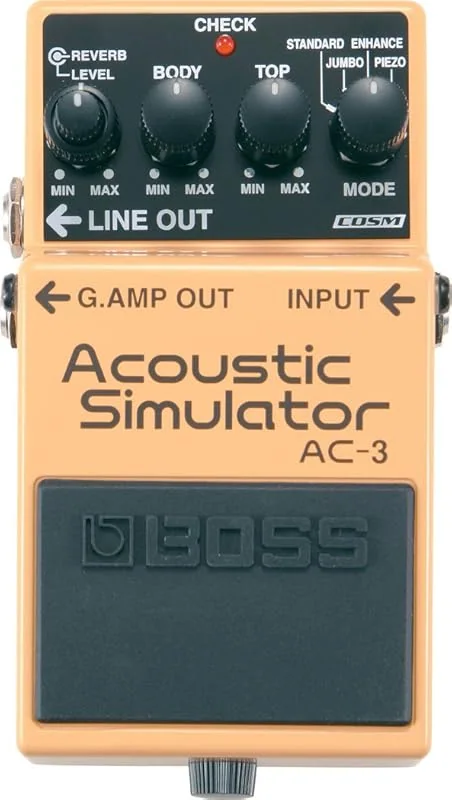
If we’ve ever spoken before, you know I’m a big fan of Boss pedals. I love the durable construction, no-nonsense usability, and reliably excellent tones. I’ve seen Boss gear on the pedalboards of everyone from beginner players in high school to arena-headlining pros.
The Boss AC-3 is, at least for most guitar players around my age, the first pedal we think of when we consider acoustic simulation.
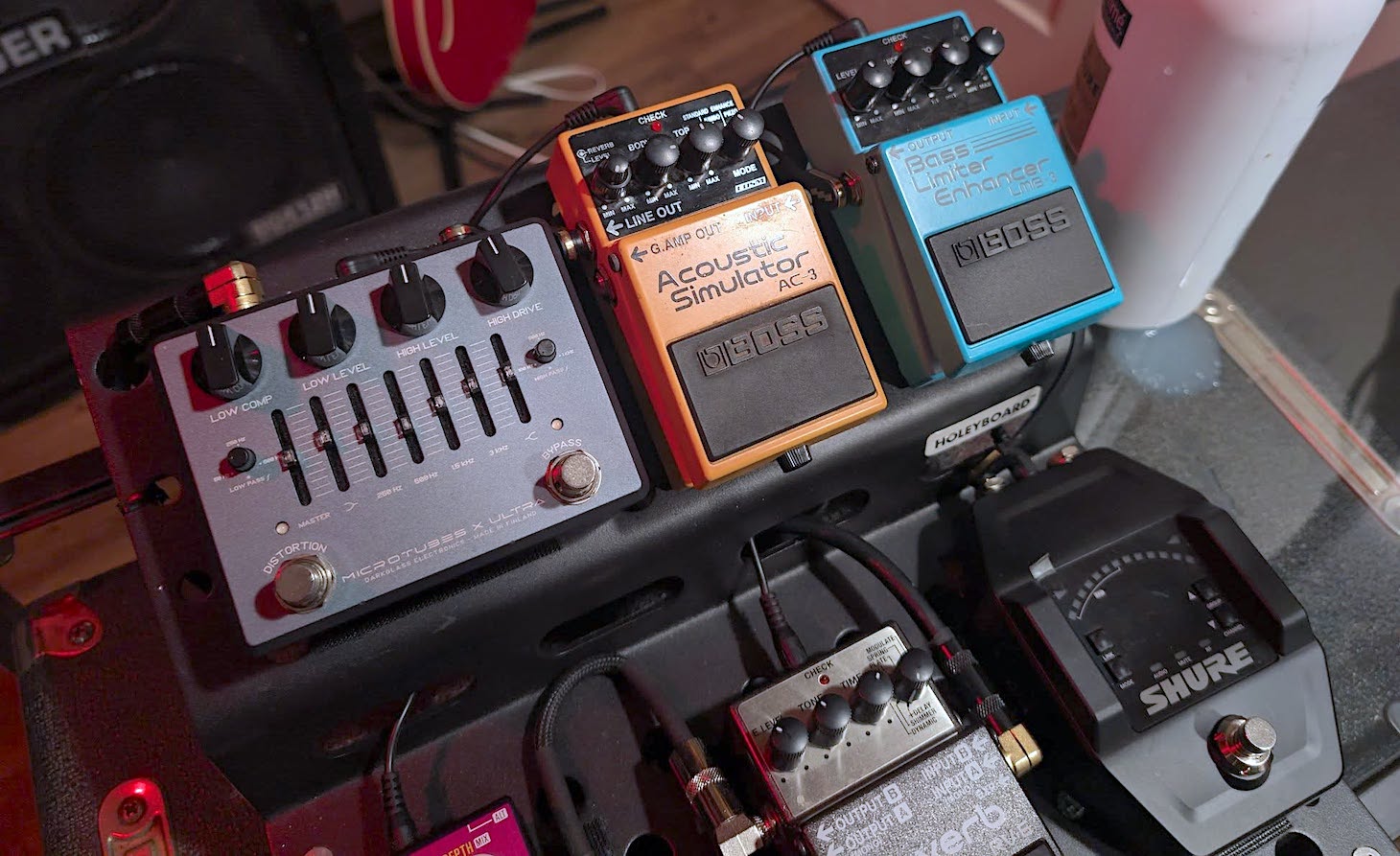
Boss AC-3 as part of my pedalboard.
Out of the box, the look is classic Boss. Big, friendly switch to step on and protect the battery compartment. The controls across the top are a little more complex than usual for a Boss pedal, but really they just control reverb and EQ. The knob farthest to the right lets you choose between different acoustic voices, including the love-it-or-hate-it tone of Piezo pickups.
I appreciate the option to run this pedal with either the line out into the PA or into a clean guitar amp. I prefer the sound into my Hughes & Kettner running extra clean than into the PA, and it means I can just A/B the “acoustic” signal against my typical electric tone.
As predicted, my Les Paul is far too hot for this pedal, so I tried it with my 335. At first, with all the knobs at twelve o’clock and the “standard” mode selected, the sound was too fizzy and bright. It sounded nothing like an acoustic guitar.
However, when I switched to my neck pickup, rolled off a little of my guitar’s tone, and started tweaking the “body” knob on the pedal, I was really impressed. I was able to get rid of the unwanted presence and sizzle in the tone and get a usable acoustic sound.
The Body knob really just increases the acoustic-like resonance. There is a sweet spot for every guitar, and I had to adjust it a little between Standard and Jumbo mode. The Top knob seems to increase or decrease presence and character.
The Piezo tone, at least with my guitar, wasn’t really usable. I’ve never been a fan of the plugged-in Piezo sound, finding it too icy and brittle for my liking. If I was in a band doing covers of Skid Row’s acoustic ballads, I might find a use for it, but I preferred the Standard setting by far.
The secret sauce here was the included reverb. It doesn’t behave like an extra reverb pedal, offering cavernous, swirling ‘verb. Instead, it feels more like the natural, blooming reverberation of a big-bodied acoustic guitar coming out of the amp. It’s a nice effect, and it’s a critical piece of the puzzle in making convincing acoustic guitar sounds.
The pedal responds very well to manipulation of the tone and volume knobs on my 335. I had to roll off both a little to get the nice, musical acoustic strumming tone I like to use live.
I set the reverb about 9 o’clock, the Top and Body at 10 and 2 o’clock respectively, and used the Standard or Jumbo setting depending on the sound I’m going for.
This, in an A/B setup through my amp on a clean setting, wound up being perfect for a live cover of Queen’s “Crazy Little Thing Called Love”: I had an acoustic tone for the intro and most of the song right up until the electrified solo, which was only a footstomp away.
3. MOOER Acoustikar
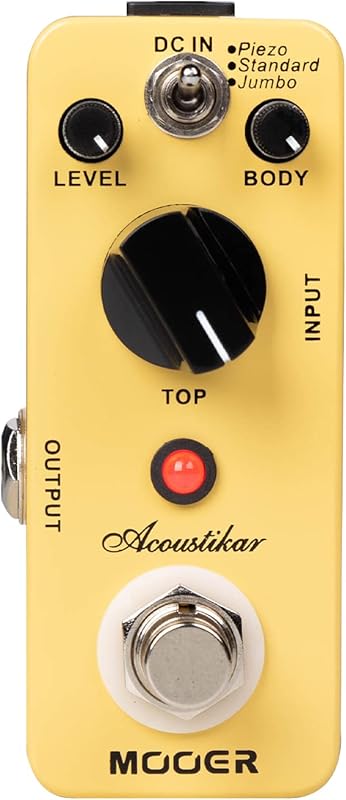
Mooer’s Acoustikar promises convincing acoustic emulation in a mini pedal.
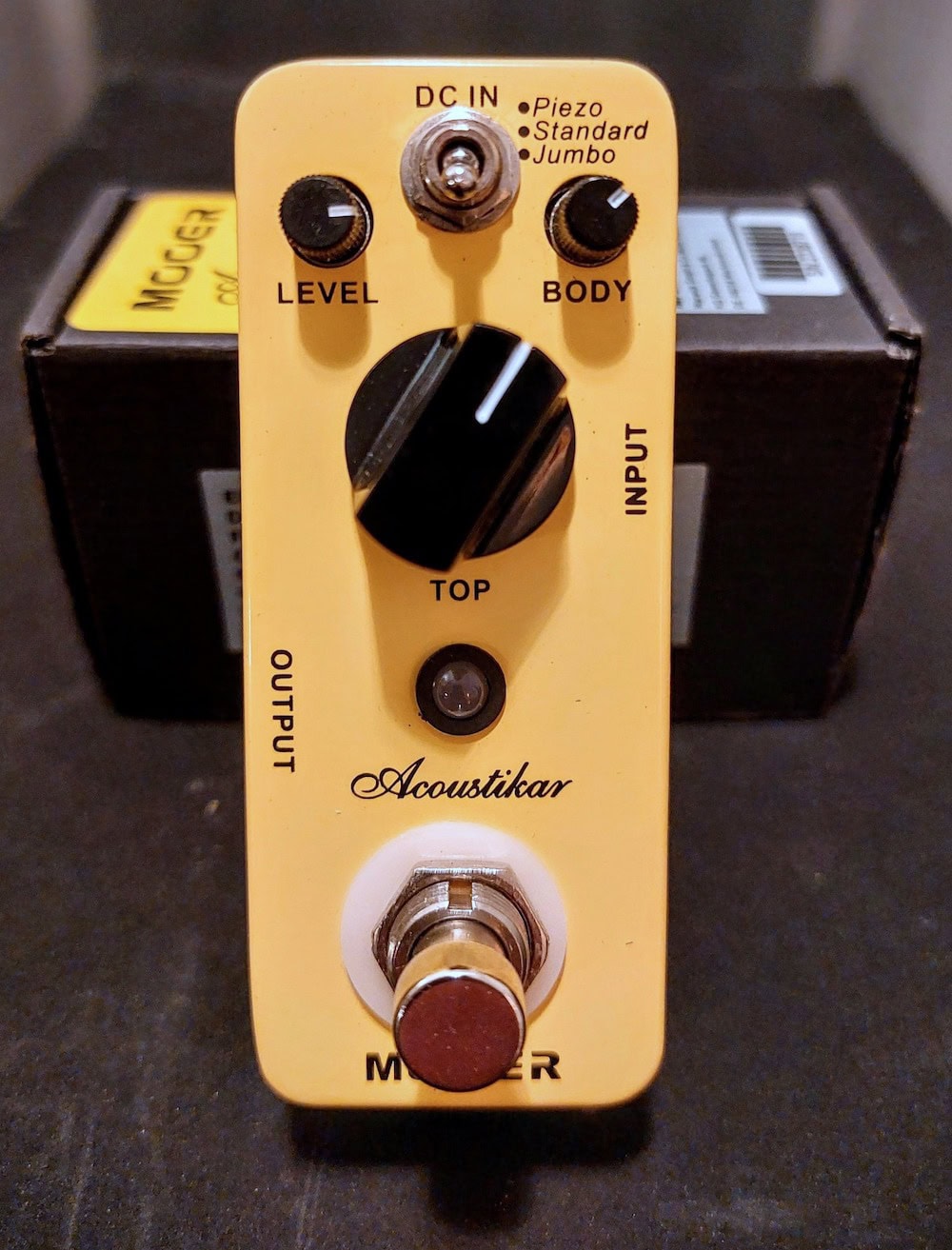
MOOER Acoustikar
At this very competitive price point, it’s hard to argue against picking it up just to try it out.
As with other mini pedals, it demands a standard 9 volt power supply.
I was disappointed to see no line level or XLR out, so I was unable to run it into a mixer as I would an acoustic guitar.
I tried it out with my 335 and my Hughes & Kettner Tubemeister set as clean as possible.
The controls clearly emulate the Boss AC-3, with Top, Body, and a guitar selector.
Of the three tones on offer - Piezo, Standard, and Jumbo - I found Jumbo by far the most useful. The piezo tone doesn’t really remind me of a Piezo-equipped acoustic. It sounds more like an unplugged electric guitar than an 80s Ovation or similar instrument.
The Standard mode felt a little flat and uninspiring. Its tone reminded me of how my acoustic guitar sounds when I desperately need to change its strings.
The Jumbo mode, however, with some twiddling of the Body and Top knobs, offered a fairly impressive emulation of a plugged-in big-bodied acoustic guitar. It isn’t quite as percussive and full-bodied as a real acoustic guitar, but it’s definitely usable for a live setting.
I had to Velcro this tiny pedal to my board in order to prevent it from getting kicked around mid-gig, but it worked just fine in a band setting.
Although Mooer claims that the Akoustikar can deliver multiple usable acoustic emulations, really, the only useful sound I found was the Jumbo setting. This was more than enough for the limited use case I have.
I actually had the most fun with this when running it with a chorus and a short delay to do Tom Petty’s “Free Fallin” at a gig. It worked great for that chiming, ethereal '80s heartland rock sound.
4. NUX Optima Air
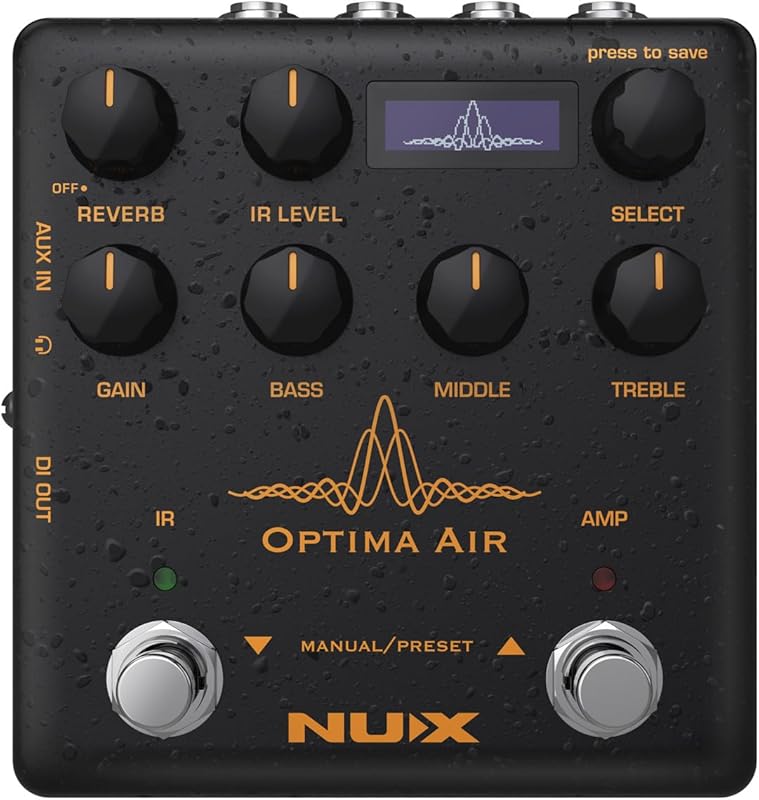
This is more than just a pedal - the Optima Air is a preamp as well as IR Loader, so you can run it right into the in-house PA at a gig. I’m trying to minimize my load-ins (at least until I can afford a roadie… it’ll happen one day, right?) so that in and of itself is pretty tempting.
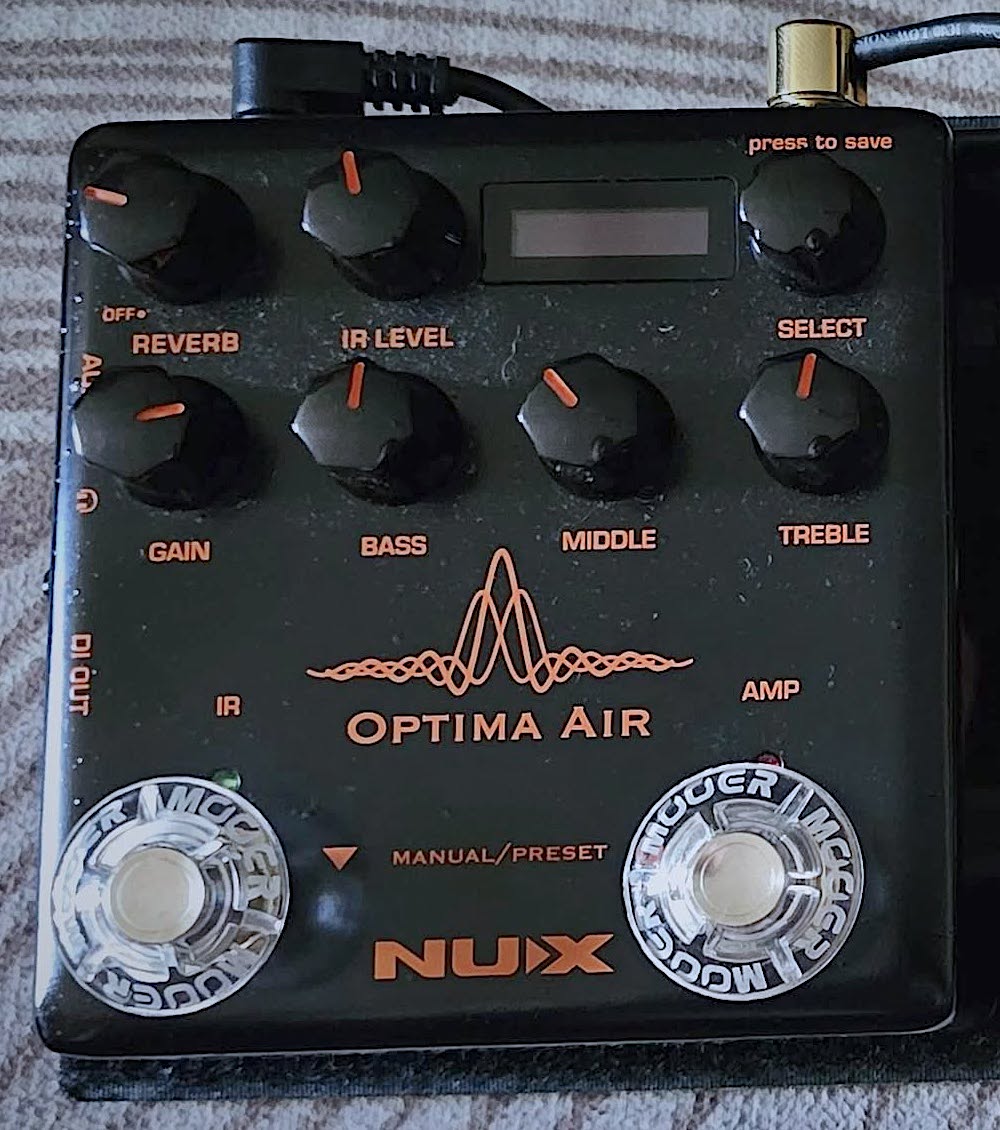
NUX Optima Air
The Optima Air works best, unsurprisingly, with an actual acoustic guitar. To me, it makes a plugged-in acoustic sound like an unplugged acoustic, just through the PA speakers. It’s a cool experience. However, I’m much more interested in how it handles an electric guitar signal.
I tried it with my 335 on the neck pickup, running the Nux on its “number two” setting: preamp plus the Gibson Hummingbird IR designed to capture the flat-top dreadnought tone.
The tone blooms nicely, and the chords ring out the way I’d expect from a big, vintage American acoustic. A little reverb helps give it some more convincing body.
It’s a very complex pedal, and programming custom modeling requires the use of a computer as well, plugged into the pedal’s micro USB slot.
I prefer a simple plug-and-play approach, but with the Optima Air, it’s entirely possible to coax totally usable clean, acoustic sounds from your electric guitar, and easily switch to electric tones. No amp required: it just goes straight into the PA.
Most players I know who use the Optima Air use it for worship playing, where minimizing gear clutter is a clear priority.
The Optima’s “acoustic” tone isn’t quite as spiky and hot as other acoustic simulation tones I’ve used in the past, which is a welcome shift.
Although the acoustic simulation here won’t fool the ears of other guitar players, it will absolutely do the job for the sake of a short acoustic section during live performance.
The Other Option: Acoustic Pickups for Electric Guitar
Although using an extra pedal is a simple, inexpensive way to add acoustic textures to an electric rig, there are other options for doing so.
I’m fascinated, for example, but the Fishman Powerbridge. For all intents and purposes, it provides a Piezo bridge pickup for an electric guitar, in this case a Telecaster. I remember Dan Hawkins using one on his Les Paul during the Darkness’ reunion tour over a decade ago.
On its own, that doesn’t offer an acoustic tone, especially through Hawkins’ full stack of Marshall Super Leads. However, the Powerbridge plus, for example, the Nux Optima Air delivers some seriously convincing acoustic tones.
The other option, albeit one that is far more expensive than a new pedal is to use a hybrid guitar. It’s much easier to make an acoustic-like guitar with an electric pickup than vice versa. That’s what the Fender Acoustasonic series is.
Of course, by far the easiest of these approaches to try out is still a simple acoustic simulator pedal!
Play Acoustic Tones on Your Electric Guitar!
Sometimes, I don’t want to drag a whole extra guitar to a gig and use it for soundcheck just for one song, or one part.
In that case, a simple pedal that I can add to the rig is a far preferable option.
With the advent of viable acoustic simulator pedals, it’s totally possible to achieve usable acoustic tones on your favorite electric guitar, be it a Telecaster or a 335.
Best of all, most of these pedals are affordable enough that it’s worth just trying them out!
