
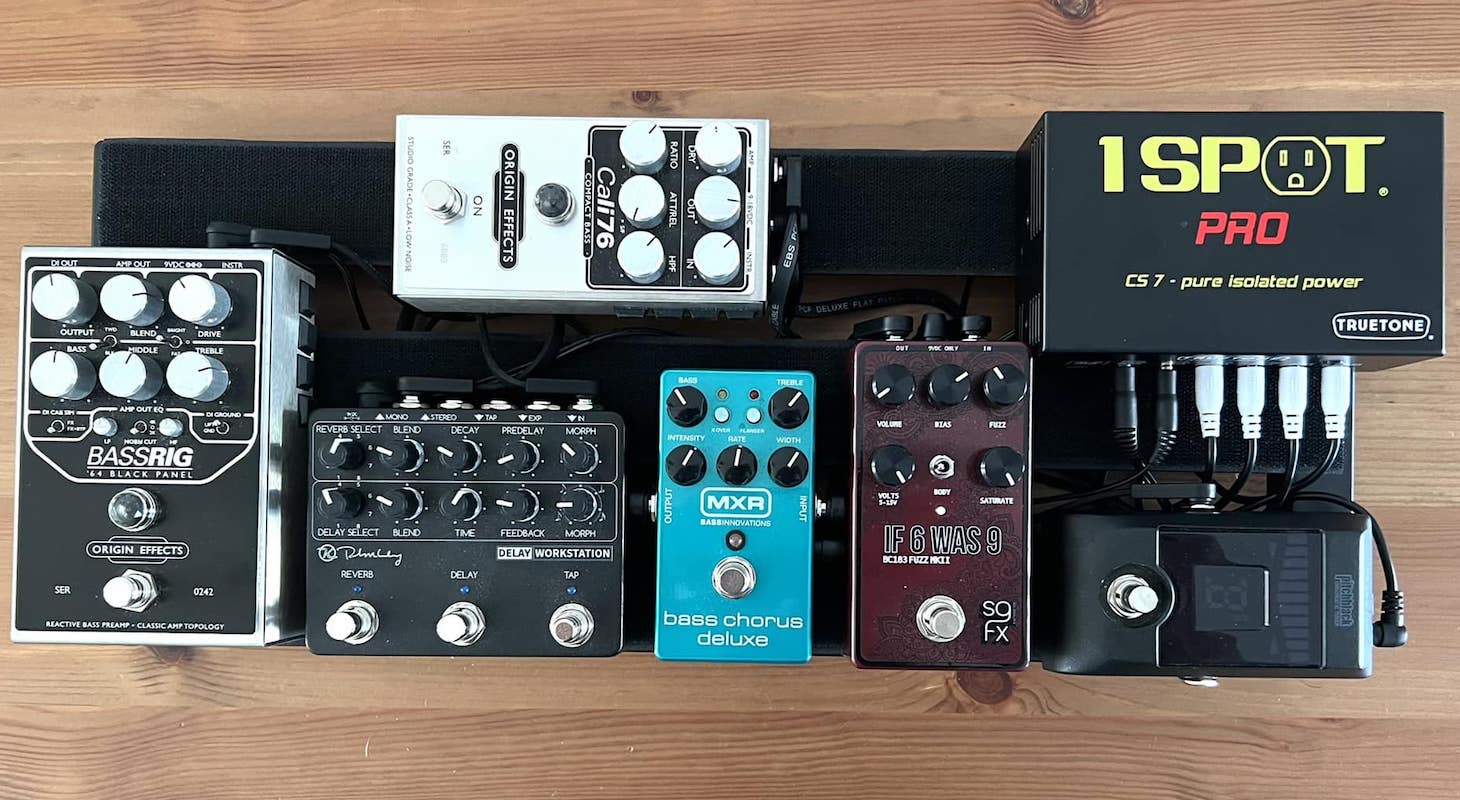
“Hey, what about adding some Chorus?” was almost a forbidden line after its overuse in the ‘80s and ‘90s. Yes, there was a time when every decent bass line that got under the spotlight was modulated, and the top 40 was a display of warbly melodies.
Although the 2000s and 2010s buried Chorus behind big pals like Phaser and Flanger, the revival of late ‘80s/early ‘90s music (and fashion) brought our old friend the Chorus with it.
As you would expect, the market stepped up to the challenge of making cool chorus pedals for modern bass players that could respond to current needs with cutting-edge technology.
Top 3 - Bass Chorus Pedals
Preview | Product | Price |
|---|---|---|
 | ||
 | ||
 |
Believe me, it’s a great time to be alive and add chorus to your bass. Pedals are now so much better than they were back then.
So, I dove deep and came back up with five pearls that can take your bass sound to the next level.
Don’t look at me like that; it wasn’t easy! I had to play Journey, The Police, The Cure, and a bunch of other songs by bands that live way back in a lost alley of my mind. Yes, I’m old enough to revisit chorus after enjoying the original wave.
Let’s modulate it like kings and queens, shall we?
Let’s do it!
Best Bass Chorus Pedals – From Subtle Swirl to Thick Modulation
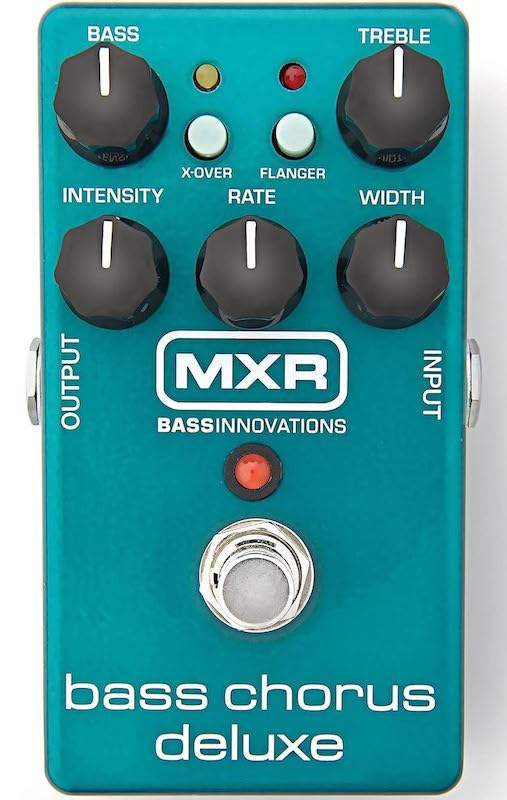
1. MXR M83 Bass Chorus Deluxe
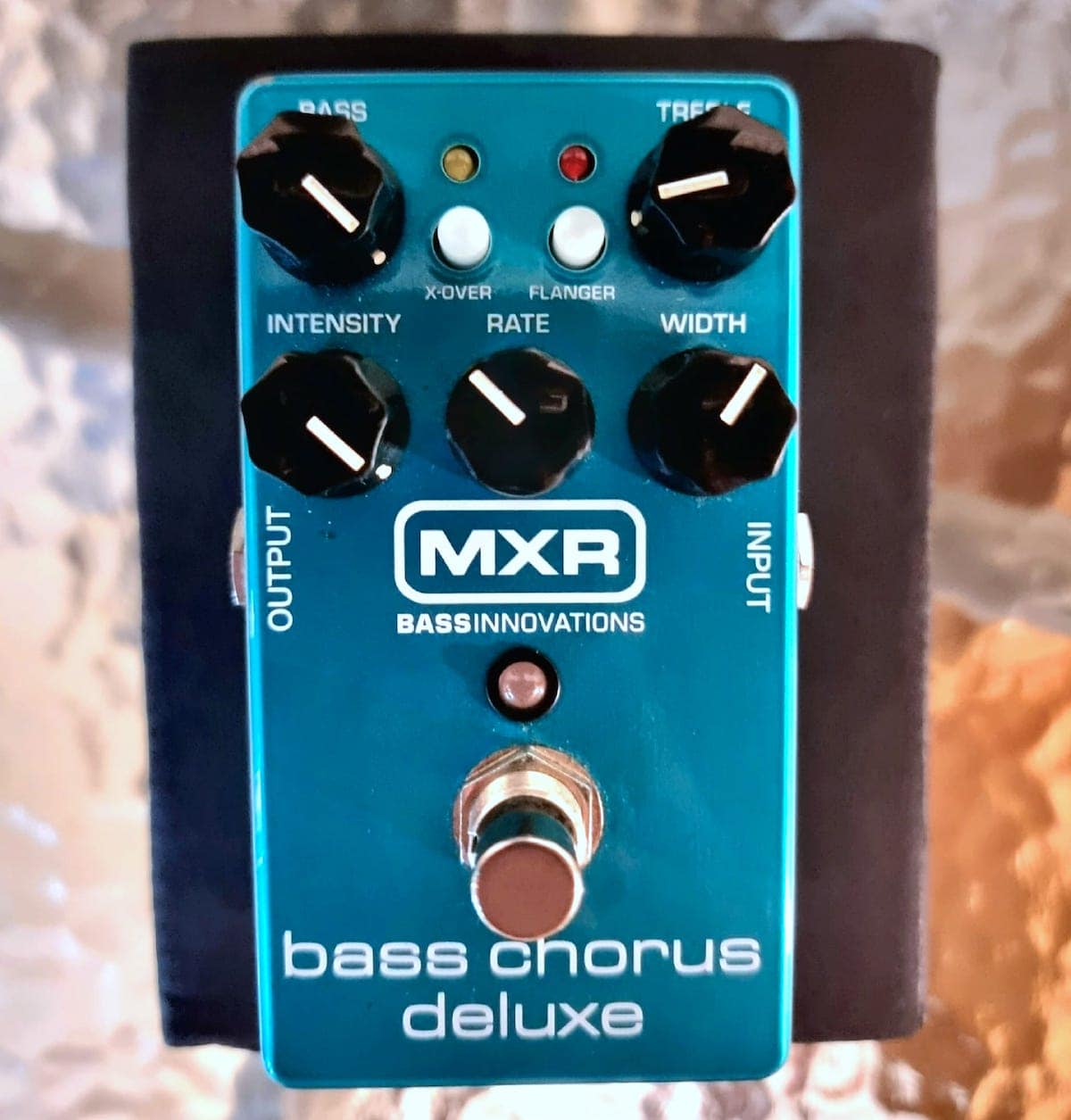
This MXR M83 is one of the most interesting chorus pedals I’ve seen in a long time. It’s packed with so many features that it makes it hard to believe that it is a true-bypass, real bucket-brigade technology gizmo with a 100% analog circuit.
MXR M83 Bass Chorus Deluxe
I mean, I plugged in my Music Man and right away I got a nice sound. All knobs set at noon got me playing melodic lines and some early Metallica arpeggios effortlessly.
But let me tell you this: there’s a lot under the hood in this pedal!
To begin with, I tried dialing some ‘80s post-punk kind of vibe using the Intensity knob (that regulates the depth of the effect) right around 2 o’clock. I set the Rate knob (which controls speed) at around 10 o'clock, and the Width knob (which controls the thickness) at around noon. The keyword was lush. It’s as if you were about to get your hands wet.
Perhaps it’s not as notorious as I would like it to be, but it did an amazing job at creating a subtle three-dimensionality to my tone.
To try and make it more in-your-face, I set everything on 10, and what I got was this psychedelic tone that would have made Jimi Hendrix jealous. Singular notes sang while the warbly background wasn’t muddy but weird. In a good way.
The EQ is cool because it not only cuts but also boosts the effect on that frequency. This means you can get more in the low-end than the high-end and vice versa. It is handy for songs in which you want to be a wall with the drummer in the chorus and play loosely in the verse.
Speaking of that, I just loved the Flanger effect. It was like “Who turned on the heat?” because things got warm, nasal, and so eighties-like that I think my hair went big and colorful on its own. I played some righteous New Order bass lines, and I was in eighties heaven.
The other button, X-Over, takes the effect away from the bottom end, and as a result, it gives you a glassy chorus tone with enough edge to make any melody cut through.
The one thing I didn’t like was the slight volume boost when engaged, but other than that, this pedal is a complete steal at this price. Go try one today.

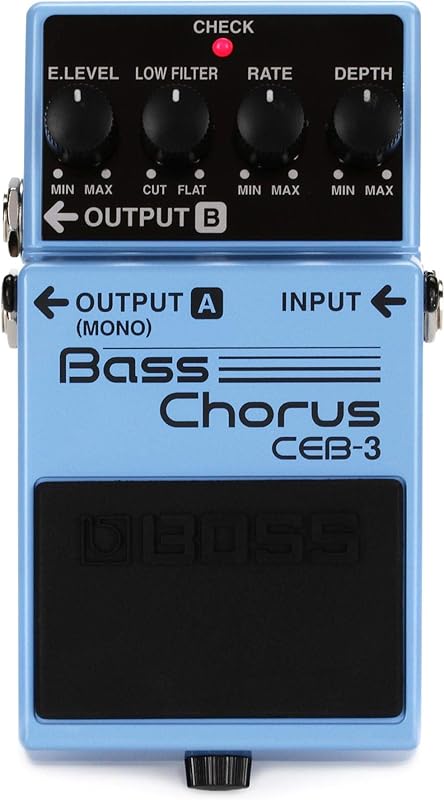
2. Boss CEB-3 Bass Chorus
For those of us who have been doing this for some decades, we know that you can never go wrong with a Boss pedal. They are road-worthy, easy to fix, cheap to buy, and can be acquired mostly anywhere in the world.
Well, on top of all that, let’s say that Boss makes great-sounding pedals and that they built the first ever chorus pedal, the mythical CE-1.
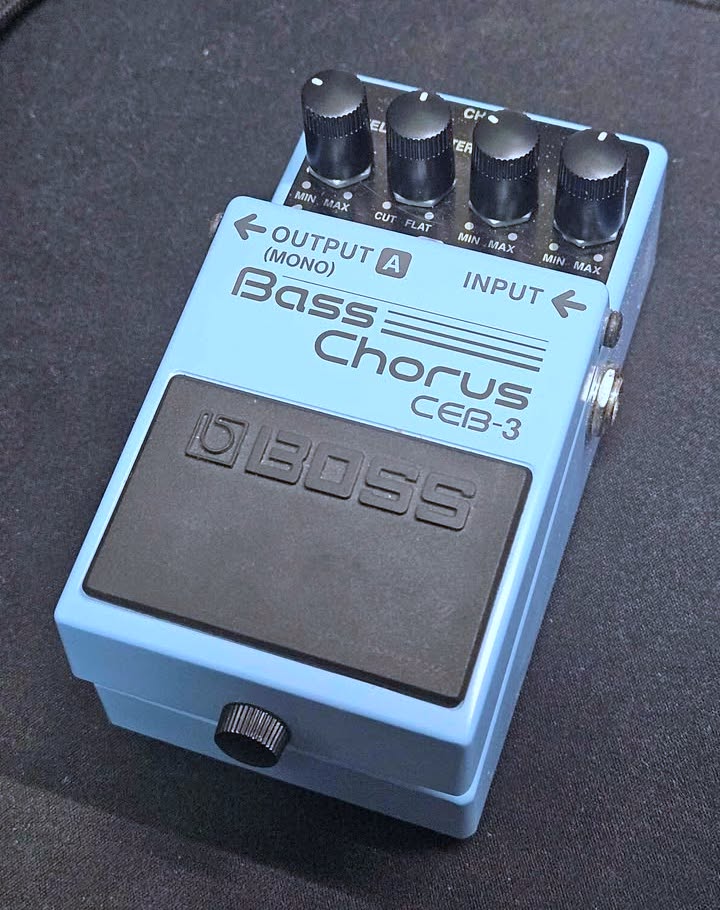
The CEB-3 follows that healthy Boss tradition of making affordable pedals for professional musicians. It sounds arena-ready right out of the box.
Boss CEB-3 Bass Chorus
Speaking of which, I plugged it into my Ampeg combo (1x15, of course) and played with my Music Man StingRay with all knobs set at noon. The result was an instant Nirvana-era chorus. It doesn’t sound as natural or subtle as others on this list, but it has that great raspiness that made the ‘90s such a great time to be a musician.
To take it further into that territory, I maxed the Effect Level knob and I swear my shirt turned into flannel and my smile grew wider. It’s the perfect chorus sound to play “Aneurysm”, “Come as You Are”, and “Smells Like Teen Spirit”.
Once I nailed that tone, I played a bit with the Low Filter, which allows you to take the effect out of the lower frequencies. Again, it is super useful to lock that rhythm bass line with the kick drum. If you modulate the low-end in that scenario, it sounds warbly and weird when you want it to be solid, punchy, and powerful.
Turning it clockwise allows modulation in the low-end, and anticlockwise gives it the opposite effect. So, if you max the Effect level and the Rate (speed) and Depth knobs, you can get crazy lead tones while keeping the low end tight.
Finally, I guess the only deception I had with this pedal is that it isn’t stereo, but allows you to take a dry out from output B so you can send it to two different amps or the amp and the PA. This configuration allows you to crank the pedal and still retain your bass tone.
Again, you can’t go wrong with this (or any other Boss) pedal. Go try one, they’re everywhere.
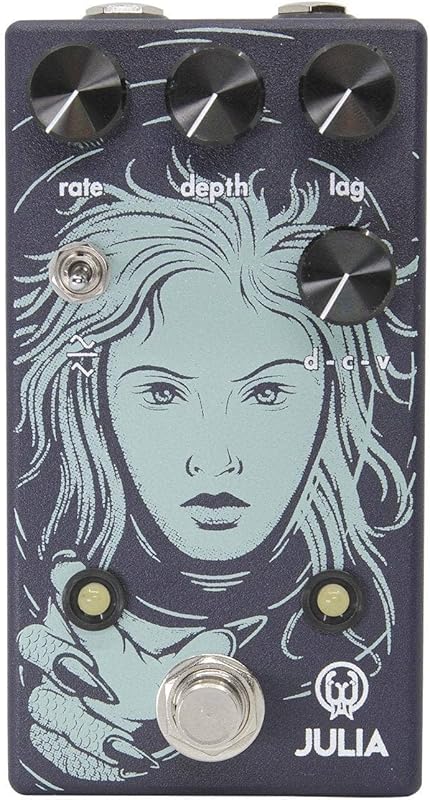
3. Walrus Audio Julia V2 Analog Chorus/Vibrato
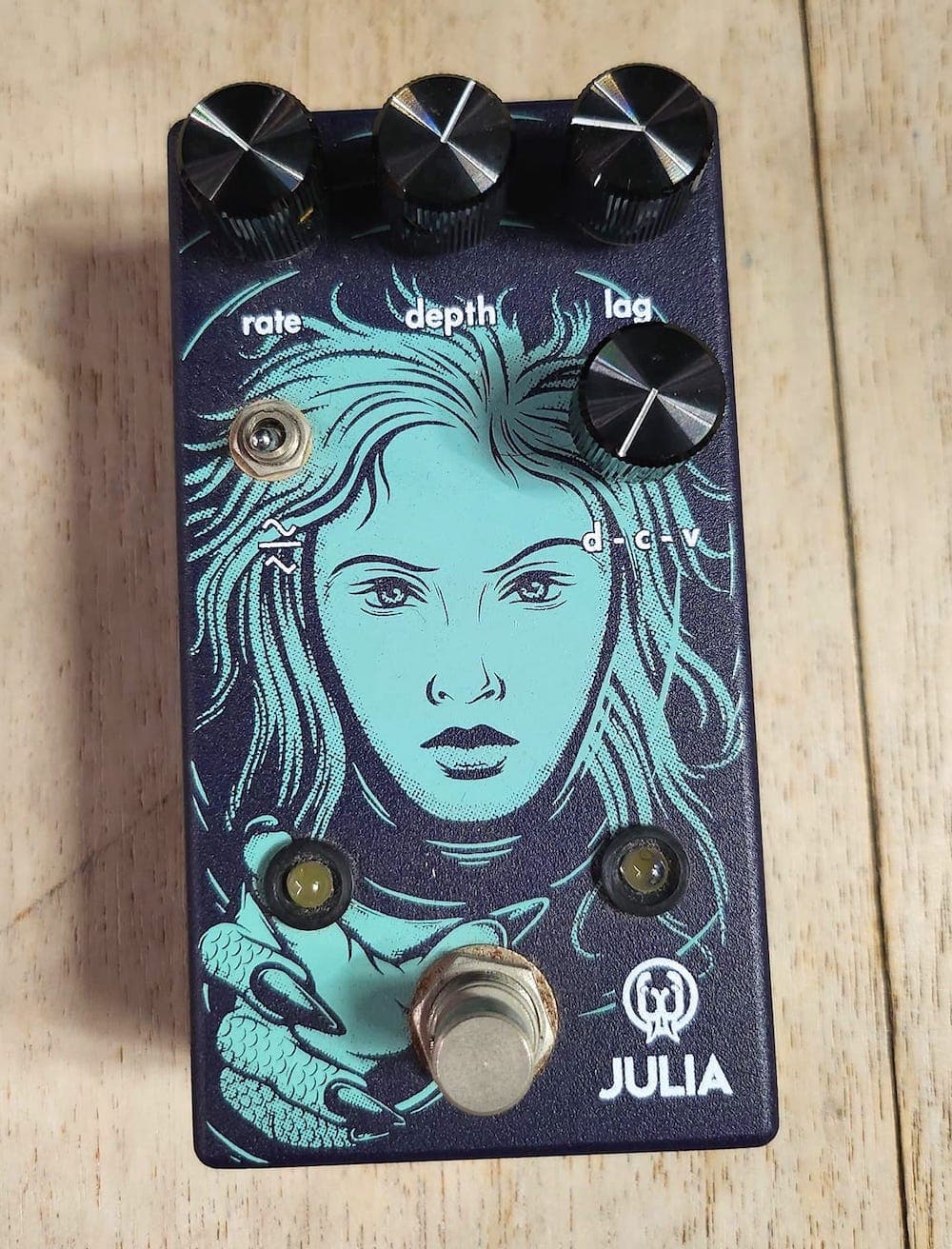
This pedal is the second iteration of the Walrus Audio Julia. It adds some fun features to the original design. Besides the custom graphics made by designer Adam Foster, it comes in a fancy pull-string bag. This gives the Julia that “expensive pedal” look and feel.
But I wanted to put this Julia V2 to the test to see if that fancy packaging translated to the sound and features. Boy, was I blown away by this little tone machine.
Walrus Audio Julia V2
I plugged my StingRay straight in and tried it with everything at noon. The perfect audio to play some lines with the pick. The attack was enhanced by this nuanced, not-so-bright chorus effect that made everything slightly more layered and interesting. Think of The Cure’s “Just Like Heaven”, for example.
The pedal offers a cool interplay between the Rate and Depth knobs and the Lag knob. This dial works over the delay time of the LFO. I know it’s complicated, technical, and we’ll talk about it later. What’s important is that this knob constricts the sound to make it dark, tight, and austere in low settings, and huge, warbly, and watery when cranked.
I went from Cliff Burton tone all the way to psychedelic madness with the twist of a knob. Moreover, the D – C – V knob (stands for Dry, Chorus, Vibrato) lets you blend in how much of the effect you want. So, using the vibrato with the depth all the way up, the Lag at 10 o’clock, and the rate at noon gave me a beautifully layered tone to play lead lines. Think of something thick and warbly like the bass line in Alice in Chains’ “Rooster”.
Finally, the small switch changes the waveform from sine to triangle, which changes the effect from subtle to dramatic. Believe me, it’s like moving from Kraftwerk to The Cure.
The only thing I didn’t like about this pedal is that the rate light never goes out, even if the effect is off. I had to put a little tape on top to avoid distractions.
Other than that, this pedal is as versatile as it gets.
4. Ampeg Liquifier Analog Chorus
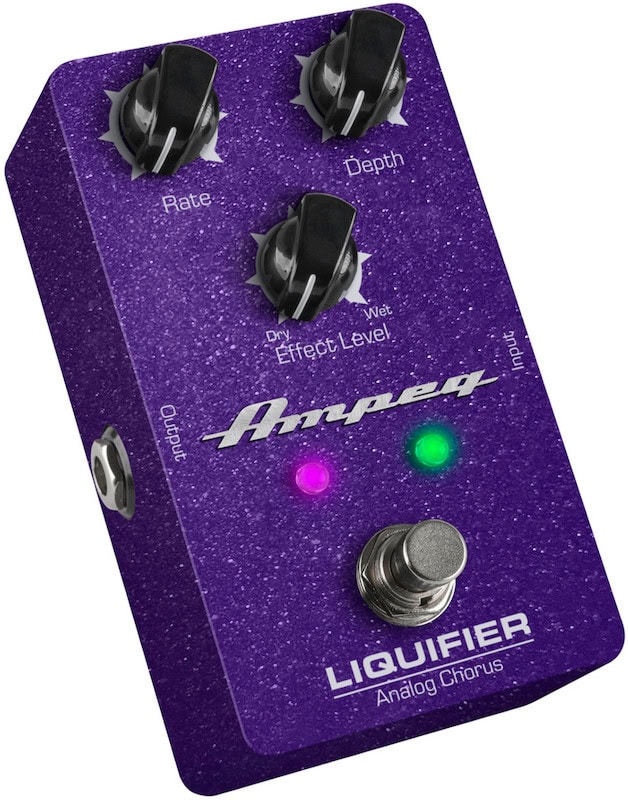
Sometimes, you just need a simple pedal that can do the job with no bells and whistles or strange hidden knobs, just a great, lush, rich chorus sound.
If that sounds like the kind of pedal you’re after, read on.
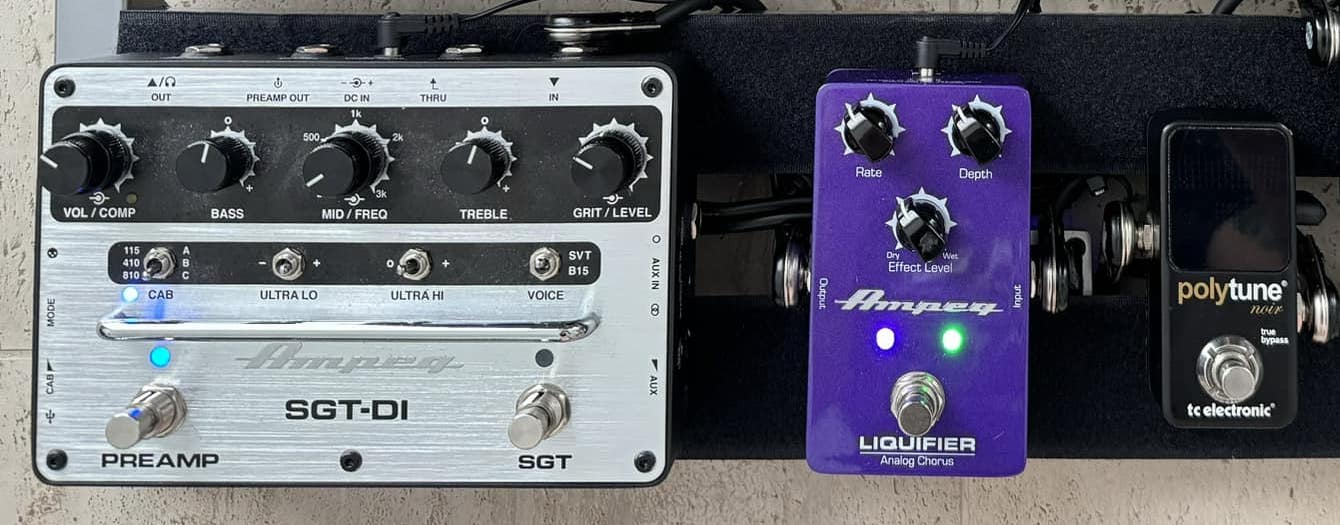
Ampeg Liquifier on my pedalboard.
Ampeg has a reputation among bass players for having a unique sound. Plus, if you’ve ever played with an SVT head, you know they’re as easy as it gets. Well, this pedal uses the same no-frills approach to tone.
So, again, I plugged in my Music Man, and we were off to the races. I set the three knobs at noon and felt like Sting playing “Wrapped Around Your Finger” with all the ‘80s mojo he had. Yes, this pedal is easy to use but very responsive; if you push it, there will always be more.
So, I did what you’d do too, I cranked the Depth knob and went all-in with the Effect Level knob. The whole thing grew to mammoth proportions. It might have been a bit too loose in the low-end, making it a little too warbly for my 15” speaker, but I imagine it will sound amazing through a 2x10”.
Finally, to finish my test, I played “Don't Stop Believin'” by Journey, and the result was quite close, with that moving midrange becoming mesmerizing with every note. Oh, and the flashing light for the rate is very welcome, and it won’t stay on when the pedal is off.
If you want an affordable chorus pedal with a great sound and not too many options, you have to give this Ampeg Liquifier a try; you’ll be playing Prince’s “Diamonds & Pearls” all afternoon.
5. Electro-Harmonix Bass Clone
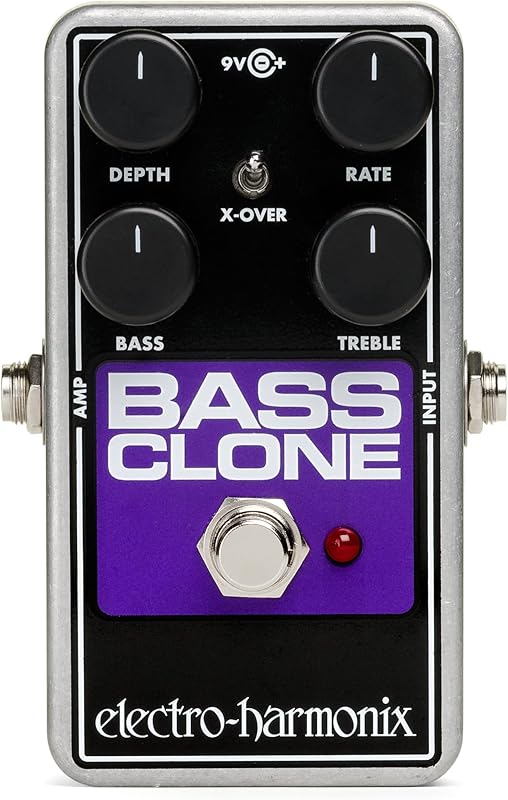
I grew up listening to Nirvana’s meteoric ascent to fame and jumped into a few mosh pits singing their songs. That little teenager still hiding inside of me took this pedal with both hands and appreciated it the way any Nirvana fan would.
But the Bass Clone is way better for bass players than using a regular guitar pedal because it’s been optimized for us. I borrowed my guitar player’s one a million times to record stuff, but could never get away with a tight low end. I always ended up recording wet dry lines to make it work.
Those problems are gone with this pedal. Let me tell you why.
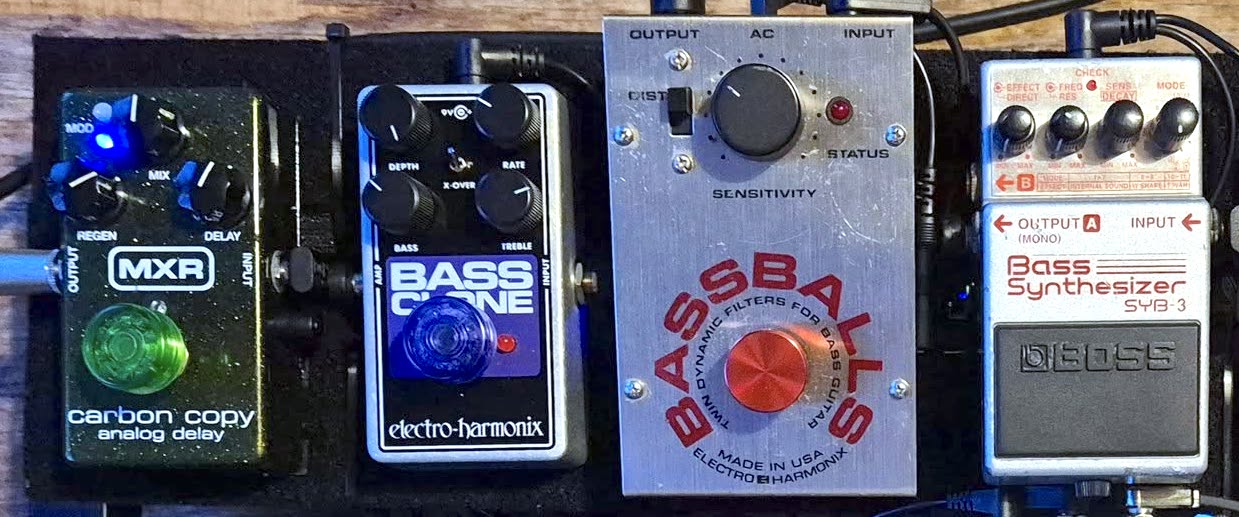
Electro-Harmonix Bass Clone on my pedalboard.
I started out this trial plugging in my P-Bass because, hey, I’m a nineties kid, remember? Of course I have a P-Bass at home. So, I dialed everything at noon, and there it was, the familiar, warm, warbly chorus effect from the Small Clone. I activated the middle switch called X-Over, and the low end got tight and punchy while the higher notes were warbly and weird. In a good way.
By increasing the depth knob, I got a much broader sweep, and the effect was more noticeable washing over the high notes. I tried “Breña” by A Perfect Circle, and the tone was very close. The power and punchiness were there, while the warbly weirdness appeared only above the tight lows.
Once I nailed that tone, I played a bit with the equalizers. This pedal comes with bass and treble controls. I was pleased to find out that, while the treble control affects the effected and the dry signal (more on that later), the bass control only affects the dry. So, if you engage the X-Over and dial the bass all the way up, you have a tight, huge sound that only gets modulated as you go up on your fretboard.
This is ideal for playing on top of fuzz and distortion. You can get the same midrange and low-end while having a crazy tone for leads or cool licks.
I played “The Dope Show” by Marilyn Manson with it in that setting, and it sounded phenomenal.
I removed the fuzz, killed the X-Over switch, brought up some of that high end, and I was playing “The Fish” by Yes in no time.
For the price, this pedal is a complete steal. Go try an EHX Small Bass Clone today. In my opinion, it’s one of the best bang-for-the-buck bass chorus pedals on the market today.
What is a Chorus Pedal and How Does It Work?
I went through some technical mumbo jumbo above that I’m ready to clarify right now. So, what’s chorus and how does it work?
To begin with, chorus is a modulation effect that’s made by copying the original dry signal, delaying it a bit (20 to 50 milliseconds), and modulating it using a Low-Frequency Oscillator. Yeap, that’s the LFO we talked about above. Then, both signals (dry and wet) are played together.
The rate and depth controls are for the LFO; those decide how fast and deep the effected signal goes. Moreover, remember the Lag knob in the Julia pedal? Well, it controls the lag between the effected and the dry signals.
That’s the crucial thing about chorus; it’s always a combination of the original and the effected signals. If you have only the wet, it’s called vibrato.
Digital vs. Analog Chorus: Which One’s for You?
All analog effects using a bucket brigade chip tend to be warmer, darker, noisier, and distort easily. This chip is what the pedal uses to copy the original signal. Analog delays using the same technology follow the same path.
Digital choruses, on the other hand, use DSP technology to copy the signal. This results in a cleaner clone affected by the modulation. So, digital chorus pedals are usually cleaner, crisper, clearer, and more versatile. Yes, you can do many more things to a signal in a DSP realm to modify tone.
If you’re in search of the traditional, warbly, dark, raspy chorus tone, analog is your path. On the other hand, those who want a chorus effect that stays clean and crisp no matter what you throw at it, and that can offer you plenty of options, that’s clearly the digital path.
Where to Put Chorus on Your Pedalboard?
Let me start by saying there’s no right or wrong here and that all that happens is you get different tones you might like or not.
- First in the chain – I love to put my chorus pedal first in the effects chain because everything else I do to the signal will interact with the chorus. This is especially fun with analog chorus pedals.
- After gain pedals – This is a good way of getting that not-so-harsh chorus sound because the gain isn’t applied over an already modulated signal. So, the LFO acts upon the distorted/overdriven signal, which is compressed with no peaks. If you want a dramatic effect, put it before the gain pedals; you’ll notice a huge difference.
- Before/after delay & reverb – Delay and reverb aren’t so common in bass players. Nevertheless, if you’re to use those, I would place my chorus before the delay and reverb and after the gain stages. This will give you a lush tone that cascades beautifully. Putting it after delays can help you affect the repeat. This is great to paint soundscapes with warbly, cool, weird atmospheric tones.
Let’s Talk about the Effects Loop
If your amp has an effects loop, I would definitely put my chorus pedal through it.
- It lowers noise – When a pedal is noisy on your pedalboard, you can try a better power supply, better cables, or you can put it in the effects loop. This will soften the effect to make it smoother and quieter.
- You can crank it – Since the effects level is usually set from the effects loop, you can crank the pedal and lower the overall effects loop volume. That way, the effect will behave like it’s on full blast, but you can dial in how much of it you want in the signal.
The only problem is that you can either run two very long cables from the amp to the front of the stage, so you can turn the effect on and off traditionally, or you can set it and forget it and leave it on the whole show.
I guess you could run back to the amp and turn it on and off, but the audience will think you’ve gone loco.
The (Modulated) Bottom End
Chorus pedals are making the comeback of the century. Yes, you can now buy them from a plethora of brands offering you cutting-edge technology and a myriad of great features. Furthermore, some pedals above offer chorus, vibrato, and flanger.
So, if you have the itch to make your bass tone a bit more layered, interesting, and with a sense of motion, you need to try a chorus pedal out.
Who knows, we might come across a signature model with your name in it soon!
Happy (modulated) playing!
