
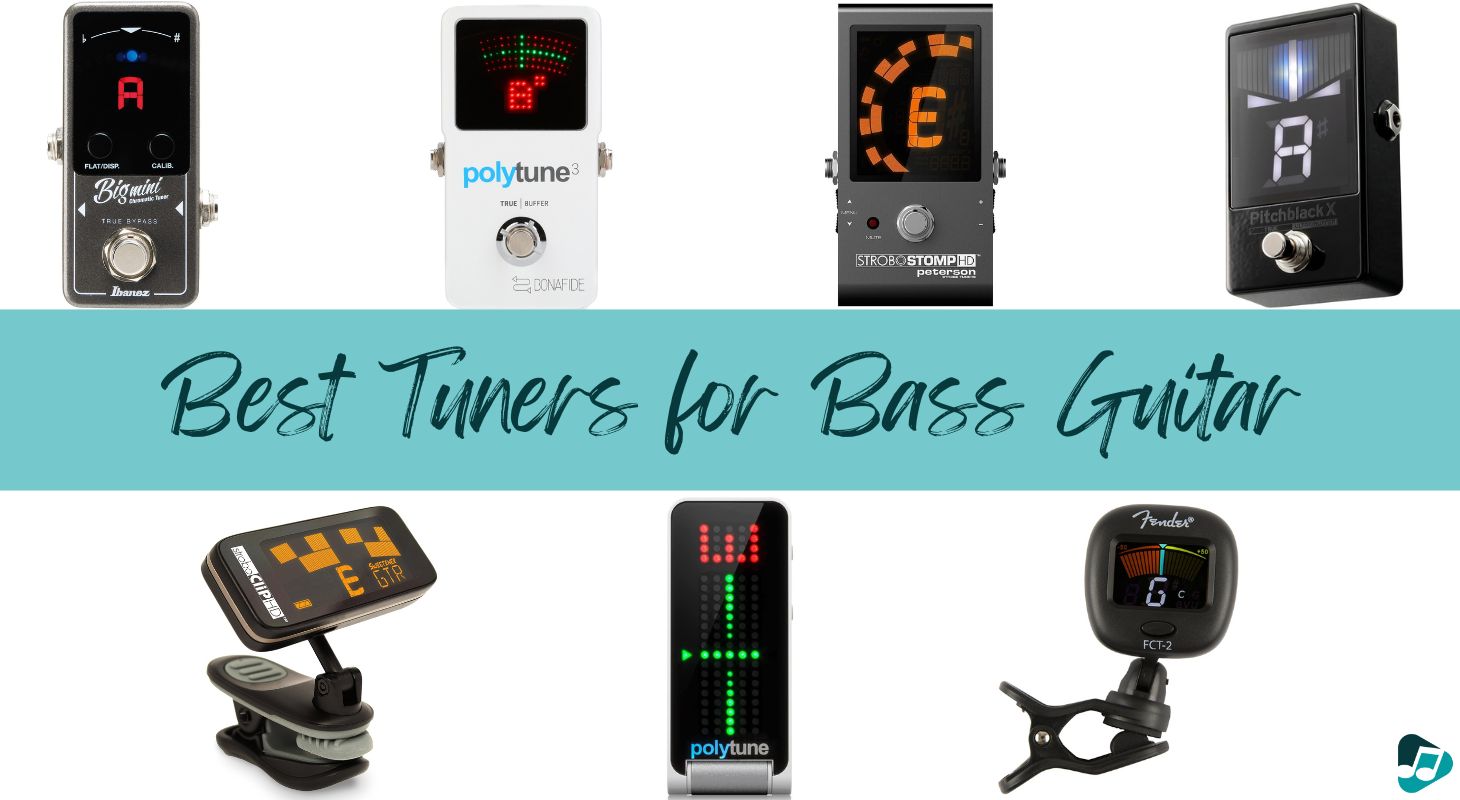
The worst case scenario for any musician is their instrument being off pitch. This is doubly true when you’re playing live.
I’ll never forget the glare our lead singer gave me when I played a clanging, off-key note (it was a G# instead of a C) mid-show about a decade back. It haunts me to this day.
The easy solution to this is to use a reliable tuner. It doesn’t matter how good your tone or your playing is if the notes sound even slightly off.
Top 3 - Tuners for Bass Guitar
Preview | Product | Price |
|---|---|---|
 | ||
 | ||
 |
While buying a tuner isn’t as exciting as buying an instrument, an amp, or a pedal, it should still be taken seriously. You need a tuner that is accurate, easy to use, and comes with a few tuning options.
In this article, I’ll run through some of the better options on the market today.
Pedal Tuners (the type I personally recommend)
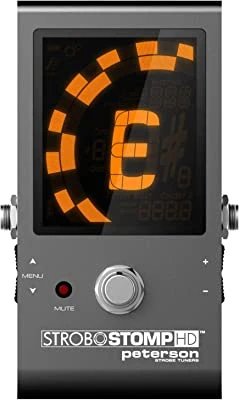
1. Peterson StroboStomp HD
The Peterson StroboStomp HD is an excellent, professional grade tuner. This is the tuner for players who want zero compromise when it comes to tuning accuracy.
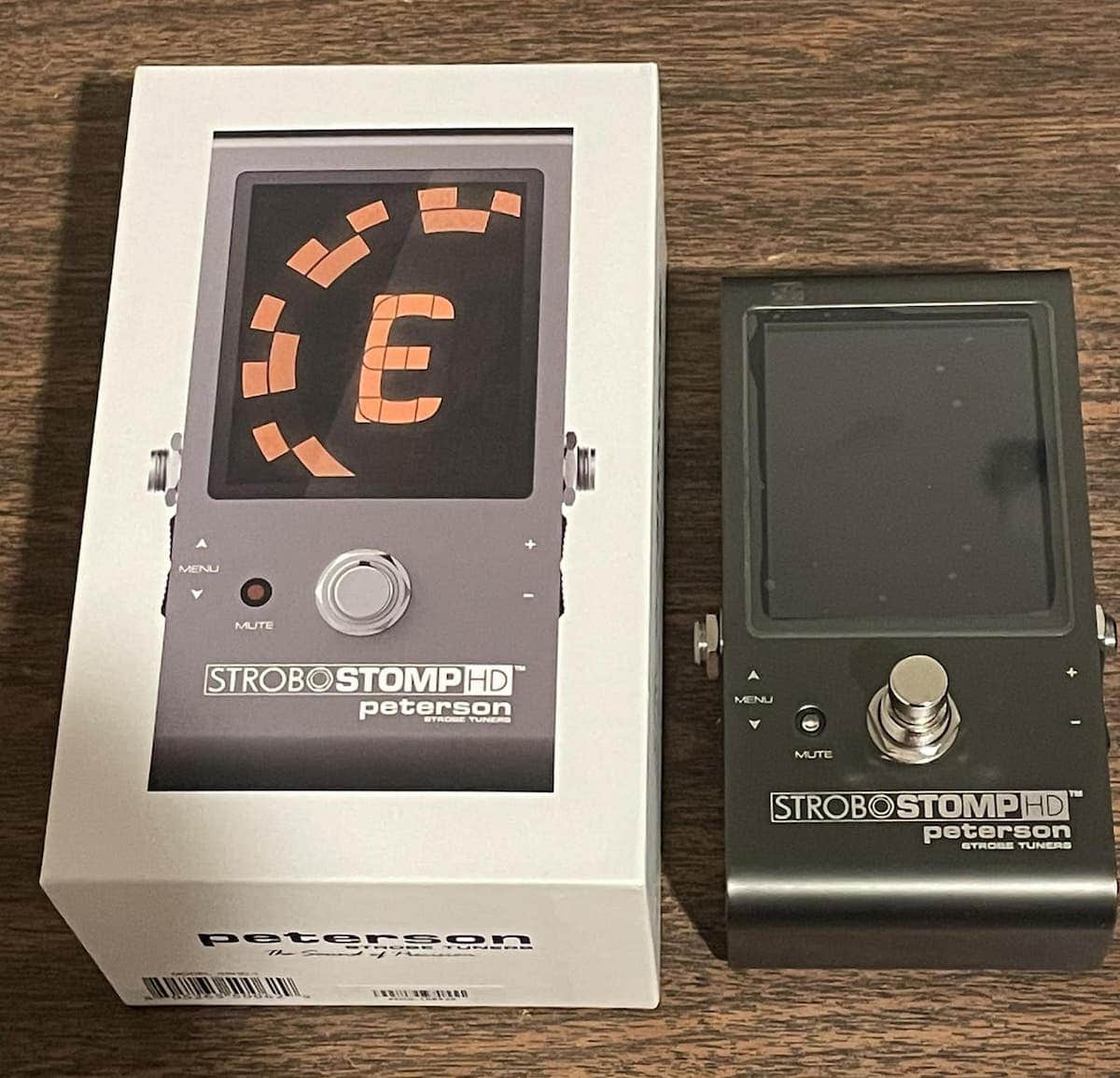
Peterson StroboStomp HD
Out of the box, the first thing I noticed was the absolutely massive LCD display of this tuner. This is certainly one of the biggest displays I have seen, especially on a tuner this size. When you’re playing on a dark stage, you want your tuner nice and visible. No point using a visual guide to tuning if you can’t see it. The display on this pedal is unmissable.
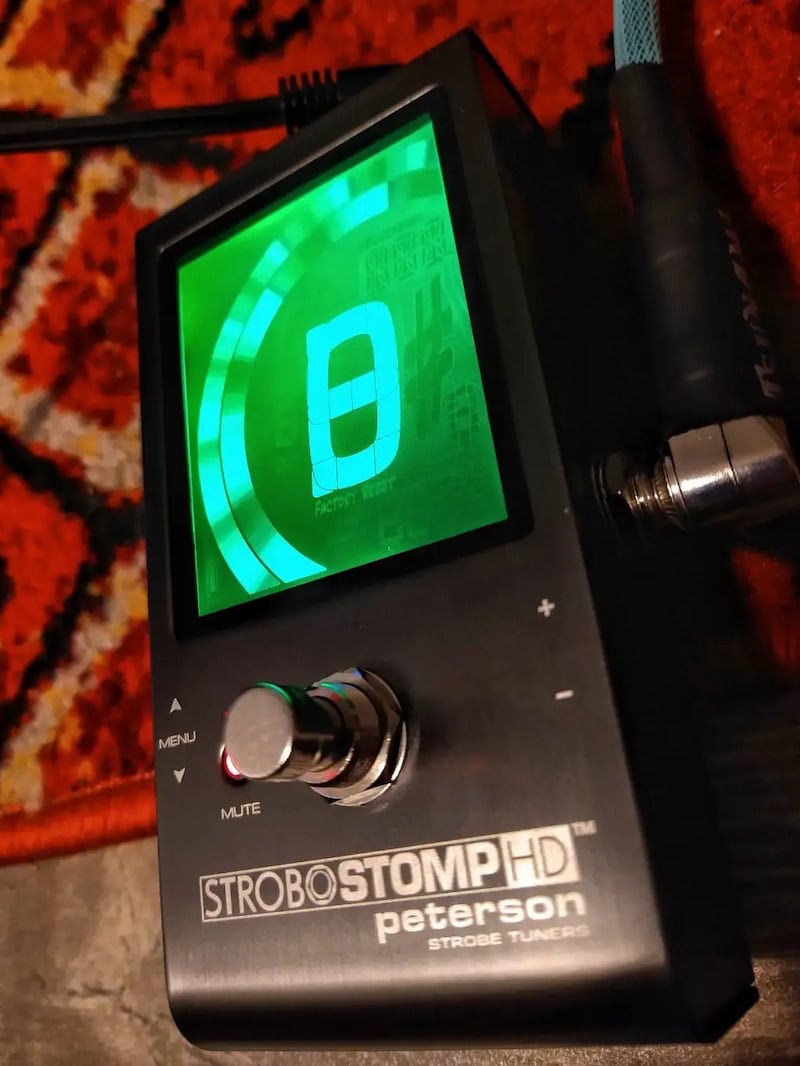
Love the display on this thing!
Even with such a big display, the tuner is still very compact and light. You won’t need to sacrifice much space on your pedalboard to make room for the StroboStomp. It’s about the same size as a Boss pedal.
Besides the big, highly readable display, the StroboStomp also has some nice features. It has 25 tuning modes and covers everything from standard tuning, alternate tunings, drop tunings, and many more.
It also has a very wide tuning range, going from C0 – A#8. Not only is this great for tuning bass guitars, but if you downtune your bass, you will just as easily and accurately be able to tune it.
This is especially useful for bass players who use extended-range instruments: the extremely low frequency of the low B can elude some tuners, but not this one. It recognizes the low B straight away. Excellent for on-the-fly tuning adjustments at a gig.
While not the most important part of a tuner, I also like the bypass of the StroboStomp. It doesn’t have that pop that a lot of other tuners have when you turn them off or on. It just makes for a more pleasant experience.
While this is a great tuner, it is quite expensive. This is a “buy nice or buy twice” investment for a working musician. If you have the budget for it, and you’re playing a lot, you’ll be grateful to spend the money once. If not, you might find another tuner better suited to your needs.
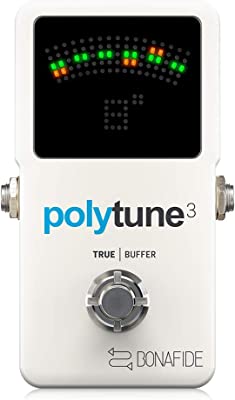
2. TC Electronic PolyTune 3
TC Electronics’ pedals typically toe the line between affordability and quality, and the PolyTune 3 is no exception. As I’ve come to expect from TC Electronics, there’s plenty going on under the hood with this pedal.
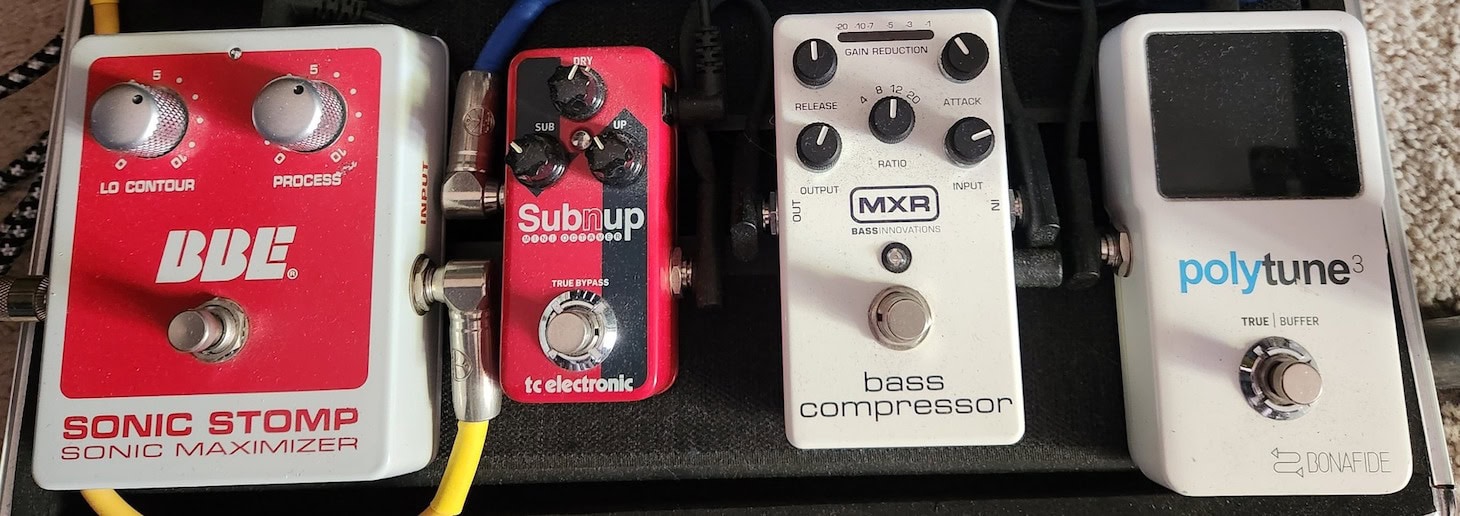
TC Electronic PolyTune 3 (right), as a part of my bass pedalboard
The PolyTune's main selling point is its polyphonic tuning mode. What this means is that if you strum all of your strings, the PolyTune will show which ones are out of tune, and which ones are okay.
I found the polyphonic tuning to be pretty accurate. It doesn’t seem to struggle to identify which strings are out and which aren’t.
This only saves you a few seconds at a time, and is probably better suited to less experienced players with untrained ears. If you’ve been playing for a while, you can probably tell which string is out of tune before checking.
It’s convenient for verification, however, and can save you valuable seconds if you knock your bass out of tune at a gig.
Tuning itself is also super accurate. Even a down-tuned bass is no problem for the PolyTune. It easily detects the exact note you are playing.
My only issue with the PolyTune is the LED display itself, specifically the note display. While most notes are perfectly easy to read, I did find B and D to be a bit hard to distinguish some times.
This is especially bad while you are standing, and can be even worse on a dimly lit stage. This was pretty frustrating at a gig where I borrowed a friend’s PolyTune. Apart from that issue, it’s a great pedal, perhaps best left to well-lit rooms.
But apart from that issue, the PolyTune 3 is a great tuner. While it is a bit on the pricier side, I think it is well worth it for the convenience it provides.
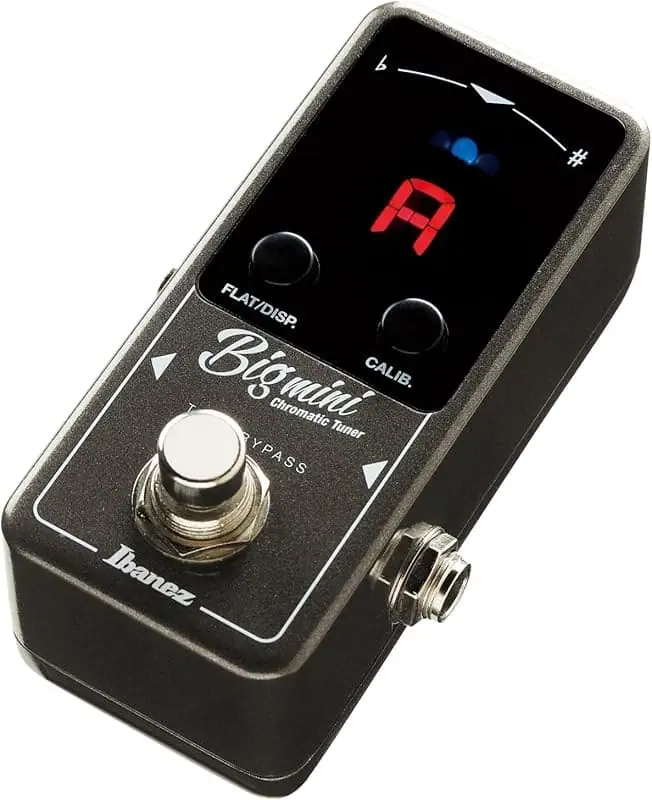
3. Ibanez Big Mini
If you’re sick of lugging a massive pedalboard from one show to the next, and want to save space without succumbing to the temptation of an AxeFX, you’ve probably considered mini pedals.
The Ibanez Big Mini is a tiny, reliable tuner with a footprint about half the size of a typical pedal. If you’re familiar with Ibanez’s mini tuner range, you’ll be familiar with the chassis dimensions. It’s about the same as the mini TubeScreamer.
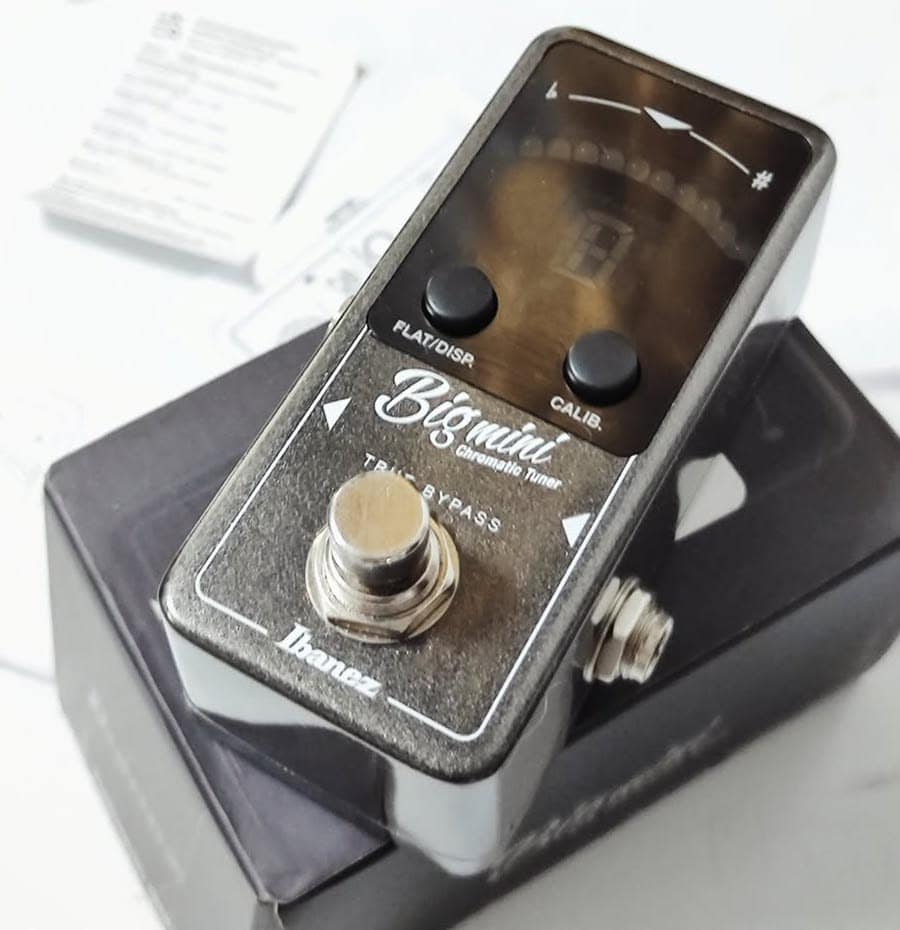
Ibanez Big Mini
It offers some serious tuning range, picking up that pesky low B on an extended-range bass in moments. I found the ability to switch between Strobe and Needle modes to be somewhat superfluous: I prefer the old-school needle, but if you like a strobe tuner it’s on offer for you.
The LED display on this pint-sized powerhouse is really bright. I could easily read it while tuning up between songs.
Being a mini pedal, you can’t use battery power. You have to plug it into a power source. I sometimes play gigs out in rural areas where on-site power is less than reliable, and I like to have fresh 9-volt batteries ready to go. Without a battery backup option, I’d be worried about this tuner being useless in such a situation.
This pedal really is just a smaller, cheaper version of other, more standard-issue tuners. It isn’t quite as rugged-feeling as, say, the tank-like Boss TU-3, and doesn’t offer as many features as the StroboStomp.
However, for the money, and for the size, it’s a perfectly usable bass tuner.
4. Boss TU-3
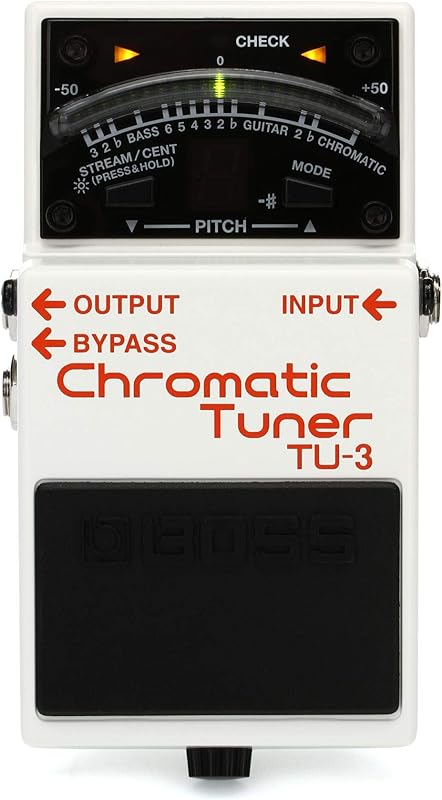
The Boss TU-3 is a staple of countless pedalboards, with good reason. The TU-3 was the first pedal tuner I ever bought. It’s also, to date, the last one I ever bought.

Boss TU-3
I’ve kept the same TU-3 on my pedalboard since 2011. It’s been covered in coffee, beer, and sweat. It’s survived hot cars and long road trips, countless gigs, and even more rehearsals. The TU-3 is a tank of a pedal: I wouldn’t be surprised if mine outlived me, enduring through my family throughout generations like a priceless heirloom.
The TU-3 is very accurate, even in extremely high or low frequencies. Its bright LED display is simple and easy to read: red line on either side means sharp or flat. Green in the middle means in tune. Simple.
I’ve actually used my TU-3 for outdoor gigs like weddings, and the LED is still legible in the middle of the day.
When going from guitar to bass, I switch instrument modes. It’s very handy for musicians like me who might play both guitar and bass in one night.
One of my favorite features on this pedal is also one of its most underutilized. It can function as a power source for your other pedals. Like most musicians, I put the tuner first in my signal chain. If you want, you can use mini pedals with no battery power, and daisy chain them from your battery-equipped TU-3 as backup.
You’ll need to buy a daisy chain cable to use this feature, but that’s not a major expense.
Like all good tuners, the TU-3 will mute your signal when engaged, so your audience doesn’t have to endure the twanging and moaning of your bass as it returns to correct tuning.
This is one of the world’s best-selling tuners with good reason.
5. Korg Pitchblack X
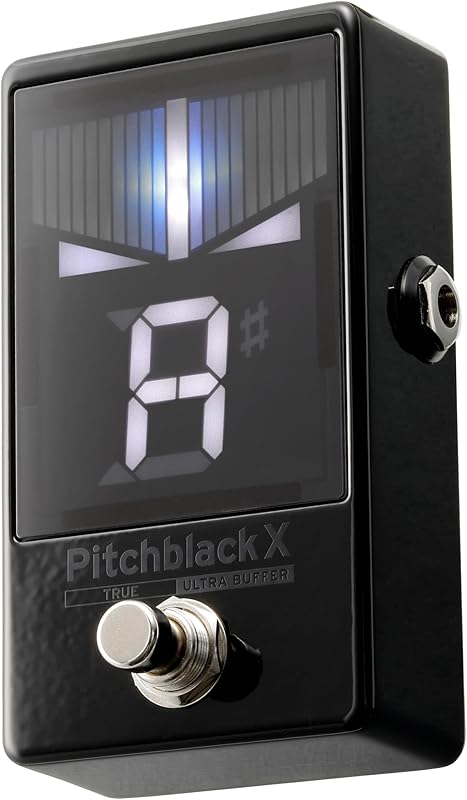
The Korg Pitchblack X is the revamped version of their already great Pitchblack pedal tuner. It sports a new look and some new features, keeping it a top choice.
The new, sleeker look is the first thing I noticed. The old Pitchblacks were angular and retrofuturistic. I always thought they looked like Captain Pike’s chair from Star Trek. This new version has a much more standard pedal design to keep it discreet on your pedalboard.
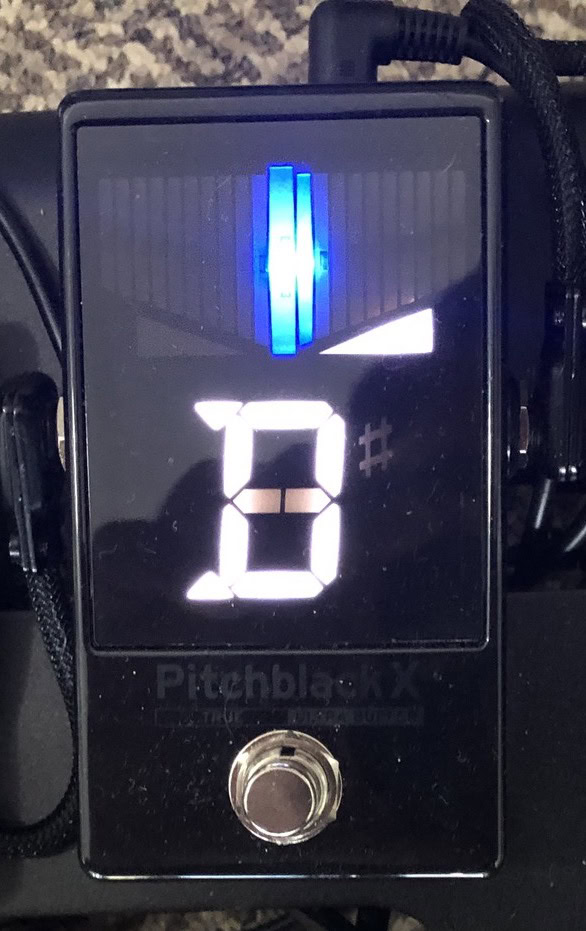
Korg Pitchblack X
The Pitchblack’s display, as with the previous model, is big, bold, and easily legible. Both the tuning display and the note display are big and clear to ensure you are as accurate as possible and you know exactly what note you are playing.
The brightness of the display is also adjustable. This is a great little quality-of-life feature. I can’t imagine a situation where you would want to turn down the brightness, but if you want to, you can. I played an afternoon gig with the Pitchblack and it was perfectly legible, even in direct sunlight.
The Pitchblack X also introduces a great new feature: Ultra Buffer. This ensures that there won’t be any dips in signal strength, no matter the length of your cables or the number of pedals on your board.
As far as tuning capabilities go, the X has a range of E0 – C8. This means you can downtune your bass pretty much as far as possible without a hitch. It even detects subtle changes to the elusive low B string, a welcome feature.
If accuracy and readability are what you are looking for, it is hard to beat the Korg Pitchblack X. It’s extremely sensitive and very accurate. You really don’t need much more from a tuner.
Clip-on Tuners (not my personal preference)
6. Peterson StroboClip HD
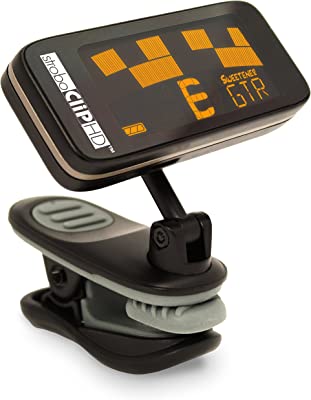
The StroboStomp’s little brother, the Peterson StroboClip HD packs everything great about the StroboStomp into a compact little package.
The StroboClip comes with a similarly large LCD display, as well as a bunch of tuning presets as the StroboStomp. That means it is super readable and you can easily tune regardless of the tuning you are playing in.
Having such a large display is especially great if you are playing a regular long scale bass. Because the headstock is a bit further away, I found the large display to be just as readable as if it were attached to a short scale bass.
While the frequency range isn’t as wide, the StroboClip only goes from C0 – B6, it is still more than enough. And on a bass you aren’t going to be tuning as high. It also has the same 0.1 cent accuracy to make sure you are perfectly in tune.
The clip is also one of the nicer ones I have seen on a clip-on tuner. It has soft rubber to prevent the clip from scratching your headstock, and has “teeth” for extra grip so that the tuner doesn’t slip.
The StroboClip is a bit pricey for a clip-on tuner, but similar to the StroboStomp, I think it is well worth the price. I also recommend getting the bundle that comes with a case to keep the tuner safe.
7. Fender FCT-2
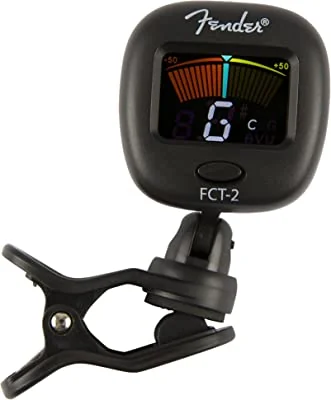
The Fender FCT-2 might be a fairly basic tuner compared to the rest of the tuners on this list, but it is one of the best basic tuners out there.
The FCT-2 is a very compact clip-on tuner. This is one that you will be able to throw in your bass case or bag without it taking up much space.
It is also light, and the dual hinge is pretty solid. I didn’t notice any drooping, and it stayed in place fairly well with a lot of movement.
The grips on the clip are also fairly nice and I didn’t see them slipping. They are a bit on the thin side, so I would keep an eye out for wear over time.
With the tuner being so small, the LCD display also isn’t very big. But it uses a nice combination of colors to indicate how in or out of tune a string is. The note indicator is also big and legible.
As a bonus, there are also a few tuning modes available for you to choose from. You can choose between bass, guitar, ukulele, and chromatic modes.
While I didn’t notice any issues personally, I have seen people mention that the FCT-2 can struggle a bit with bass tunings. But as long as you aren’t tuning much lower than standard, it should work just fine.
I wouldn’t take it to a gig, but it’s perfectly serviceable for a jam or at-home practice.
8. TC Electronic PolyTune Clip
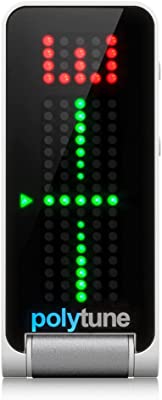
The TC Electronic PolyTune Clip is another tuner that is basically the clip-on version of the pedal one. It has most of the features of the PolyTune 3, with a similar look.
The Clip has a good level of accuracy like the pedal version, and even features polyphonic tuning as well. Of course, you can't directly compare it with the pedal when it comes to getting the job done just as accurately and fast. I do feel like the polyphonic tuning isn’t as accurate on the Clip, but it's not by that much. It still works great when you need to quickly see which strings are out of tune.
One big improvement on the Clip over the 3 is in the note display. I found it to be much easier to distinguish between D and B than I did with the PolyTune 3.
While the Clip is a great tuner, I do have some issues with its design. Firstly, I feel like it is a bit too big for a clip-on. It sticks out a bit too much off of the headstock.
Secondly, I don’t like the exposed metal clip. While the grips are nice, I was still worried about scratching my headstock when I put it on. It also doesn’t feel too great in your hand, and the metal can dig into your fingers a little.
The clip does fold into the tuner, though. This makes the Clip a bit more compact to fit into a case or bag.
Clip-on vs Pedal Tuners — Which is Better?
While everyone is going to have a different opinion on which tuner is better, with some having very strong opinions, the simple answer is that there is a place for both. Both types of tuners have their advantages and disadvantages.
While a good clip-on tuner is going to be very accurate, the simple fact is that a pedal tuner is just going to be even more accurate. A pedal tuner is getting a signal directly from your instrument, while ambient noise can always interfere with a clip-on tuner.
But of course, a clip-on tuner is much more portable than a pedal tuner. Clip-on tuners are also much quicker to use since you don’t need to plug them in or deal with cables. That said, once your pedal tuner is set up, it’s a simple matter of stepping on it to turn it on.
Some might argue that clip-on tuners are also more beginner friendly. They are more straightforward and can’t confuse a beginner with extra tuning modes or with what bypass means.
However, I’m of the opinion that beginners learn how to use their gear eventually. Musical equipment isn’t that hard to use, even advanced tuners with extra tuning options. Besides, learning about signal flow is an essential part of playing electric guitar or bass.
If you plan on playing live, you really need a pedal tuner. Have you ever seen a pro-level band with clip-on tuners? I certainly haven’t.
The best thing to do is to have one of each. A pedal tuner for performances to make sure you are as in tune as possible, and a clip-on tuner for practice and casual jamming sessions to just make sure you aren’t significantly out of tune.
Clip-on tuners are more convenient for acoustic jamming, so if you have a purely acoustic bass with no pickup, a clip-on tuner is an absolute must. Most bass players tend to plug in, however, so I’d recommend picking up a reliable, durable pedal tuner.
Tuning Apps
Tuning apps are a fairly new thing. While they have been around for a few years now, it is only in the last couple of years that actually decent and fairly accurate tuning apps have popped up.
They are a very convenient way of quickly checking that your instrument isn’t completely out of tune. You aren’t always carrying a tuner with you, but you pretty much always have your phone on you.
I would avoid any paid tuning apps, however. You can’t know for sure if it is just being sold by someone to make some quick cash off of people who think that paying for an app means that it is going to be good.
There are plenty of decent tuning apps that you can download for free. The Fender Guitar Tuner is free and an official Fender app. There’s also a Boss tuning app with a graphic that looks just like the TU-3.
The only tuning app I really use is the Soundcorset combined metronome and tuner. I usually practice with a metronome, so being able to easily switch to a tuner is convenient for me in that situation.
Tuning apps are OK for at-home practice, but you should never use one at rehearsal or a gig. Trust me. It looks highly unprofessional, and if you leave your tuner pedal at home, one of your bandmates should have one for you to borrow. Besides, an actual tuner picking up the signal from your bass is much more accurate than one that uses your phone mic.
True Bypass vs Buffered Bypass
One thing you will usually see on a pedal tuner is a bypass mode. When you add a pedal to your signal chain, it is important that you preserve your tone. This is where bypass comes in.
Your tuner pedal is going to be the first thing in your signal chain, after your bass. A bypass will allow the signal from your bass to go through the tuner unhindered while the pedal isn’t being used, or if it stops working.
True bypass disconnects the electronics in the pedal and connects the input and output. This then bypasses the pedal, and allows your bass signal to go through unchanged.
The downside of True bypass is that it can degrade your signal, causing you to lose some tone. Buffered bypass doesn’t have this degradation.
Buffered bypass is also the better option the longer your cables are, and the more pedals there are in your signal chain. This will prevent your tone from degrading if you have a large pedalboard.
Tuning Range
One very important thing to look for in a tuner for a bass is the tuning range. Since basses produce lower frequencies than guitars, it is important that your tuner can accurately pick up those low frequencies.
Some tuners have a hard time picking up the frequencies of the B string on 5-string basses. And some even struggle with the E on a 4-string bass.
The lowest note on the E string of a 4-string bass is E1. That means that your tuner should be able to tune lower than E1 to ensure that it is able to accurately tune a bass.
All of the tuners on this list can tune lower than that, and are perfect for tuning a bass. But if you are buying a bass tuner that’s not on this list, a good tuner should be able to go as low as C0. This will give you enough headroom, especially if you downtune your bass.
Durability
If, like me, live performance represents most of your playing, you need a tuner that’s going to be reliable despite less-than-optimal circumstances.
Guitars and amps can be fragile. They’re made of temperamental materials like wood and vacuum tubes. Metal strings expand and contract in different temperatures. Unsealed wood can warp in extreme humidity. Cables break, strings snap, and electronics wear themselves out.
Your tuner, however, should be the least fragile thing in your setup. It’s important to be careful with your gear, but your tuner needs to be reliable, night after night.
Think about it: if you’re putting your body weight onto something every night, multiple times per night, you want it to be able to handle that kind of pressure. Tuners made with a metal chassis and high-quality parts cost more, but they last much longer.
Cheaper tuners made from plastic and inferior electronics may fit more easily into your budget today, but if they break, you just have to spend the money again to replace them.
In my opinion, durability is a key factor in choosing a tuner. Ideally, you just want to get one tuner (perhaps two, to be safe) that you can put at the front of your signal chain and never worry about again.
Closing Thoughts
Picking a tuner for your bass isn’t as exciting as a new instrument, amp, or effects pedal, but it’s arguably more important than any of them. A good tuner keeps you sounding good, night after night, for as long as you need it.
When looking for a tuner for your bass, it’s important to pick one that suits your budget, is easy to use, and will be able to keep you in tune for years to come. I’m confident that you’ll find this tuner for yourself, likely from the list above.

Very helpful article. Thank you. My question is do the clip on tuners rely on the volume being up on my bass or may I turn the volume off to tune in a live situation because the clip on tuner relies on vibration to tune accurately? I look forward to your reply and guidance.
They work by sensing vibrations in the headstock, regardless of whether your bass is plugged in or not.