
Before steel-stringed guitars dominated popular music and the guitar-buying market, nylon-stringed classical acoustic guitars were the main guitar variant on the market.
With a distinctive tone that immediately brings to mind flamenco music or artfully arranged classical pieces, the nylon string guitar can be a great addition to any guitar player’s arsenal.
You can pick up a fantastic classical guitar for under $500 these days thanks to major advancements in guitar building technology. Some are purely acoustic, others acoustic-electric, while a few are designed as solely electric instruments.
In this article, I’ll look at some of the best value nylon-string guitars from the major players in axe manufacturing, exploring the tones and playability on offer as well as any unique, special features on some forward-thinking classical instruments.
Best Classical Guitars Under $500 - Affordable Nylon Strings
1. Cordoba C5
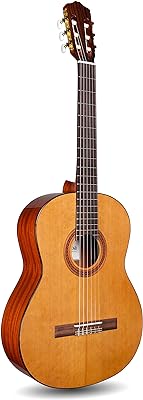
The Cordoba C5 is a classic Spanish style guitar with a hefty neck, chunky body, and the subtle, responsive sound you’d expect from a beginner level classical style instrument.
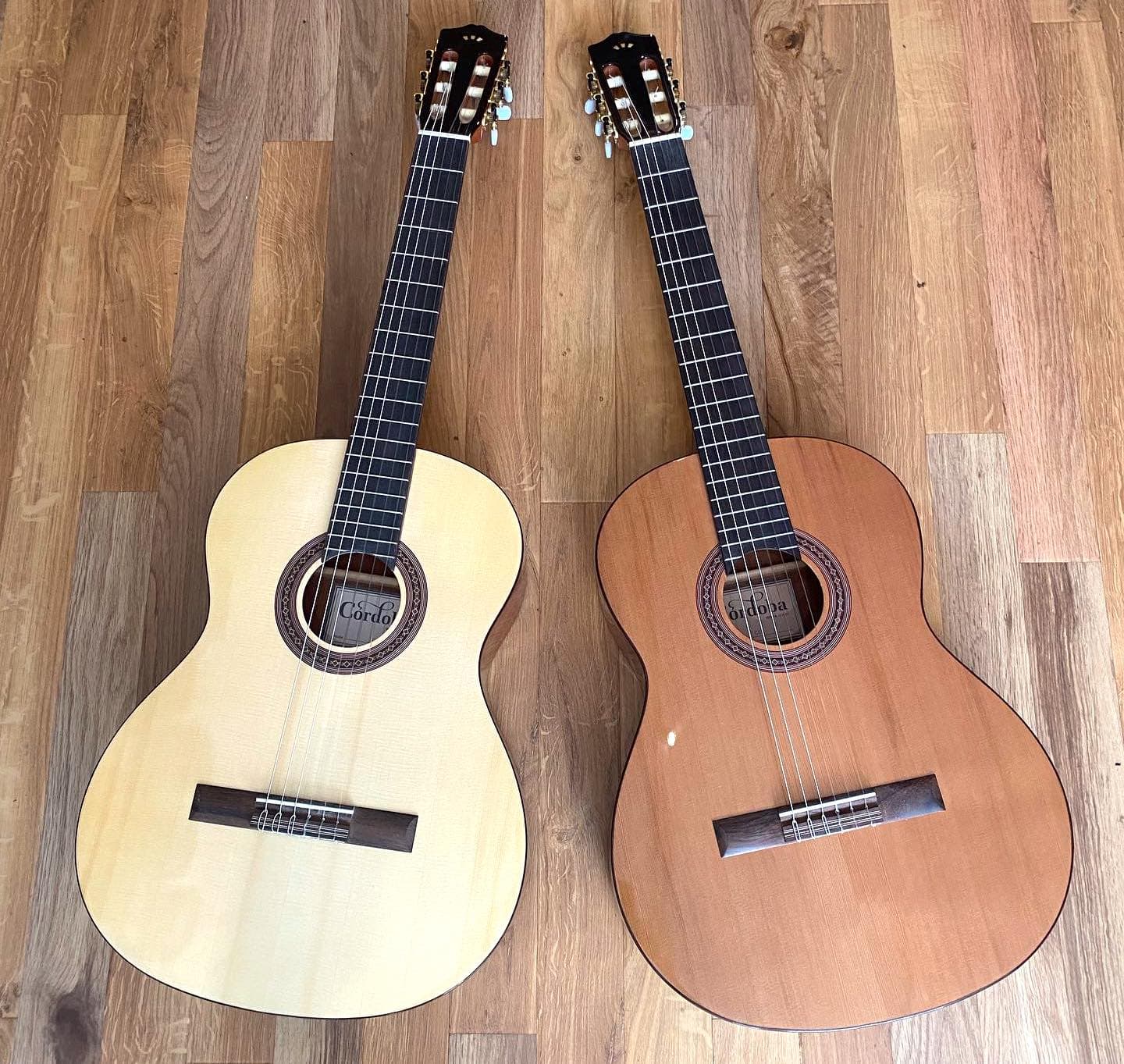
Cordoba C5 - Cedar (right) & Spruce
Aesthetically, the Cordoba C5 certainly looks the part. When I took it out of the box, I immediately noted how the poly finish on the Cordoba’s cedar top and mahogany sides combination feels pretty durable to the touch. The beautiful natural grain of the cedar top really comes through the finish when you see the guitar in person, which is a welcome addition in a guitar at this price range. It looks particularly good in natural light!
Although this guitar is clearly aimed at students, and I’d highly recommend it to a learner guitarist looking to play classical, you can feel the quality craftsmanship in your hands when you play it.
There’s plenty of sustain and balanced volume throughout the neck. While there’s no clear “sweet spots” on this guitar where it really shines, there are no obvious weak points either. I was comfortably able to wrap my hands around the neck.
Chords sound rich and full, with a nice midrange snap thanks to the instrument’s quality construction. I was particularly impressed with the projection from the body, so you could feasibly play this guitar around the campfire or in a small flamenco dance class.
I took this guitar with me to the beach, and it was loud enough to hear over the waves, but not so loud that it bothered any other beachgoers.
Overall, a great guitar.
2. Yamaha CG172SF
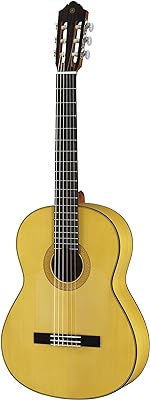
Yamaha’s CG172SF is another quality instrument from one of Japan’s biggest, and most diverse, guitar builders. Yamaha have built excellent copies of various instruments and a few models of their own, including the fantastic Revstar.
This guitar represents the Japanese giant’s foray into nylon classical guitars, and keeps up with Yamaha’s considerable reputation. When you buy a guitar from a major manufacturer, you’re getting a few guarantees that come with the brand’s reputation. This is no exception: the guitar certainly doesn’t feel as affordable as it is.
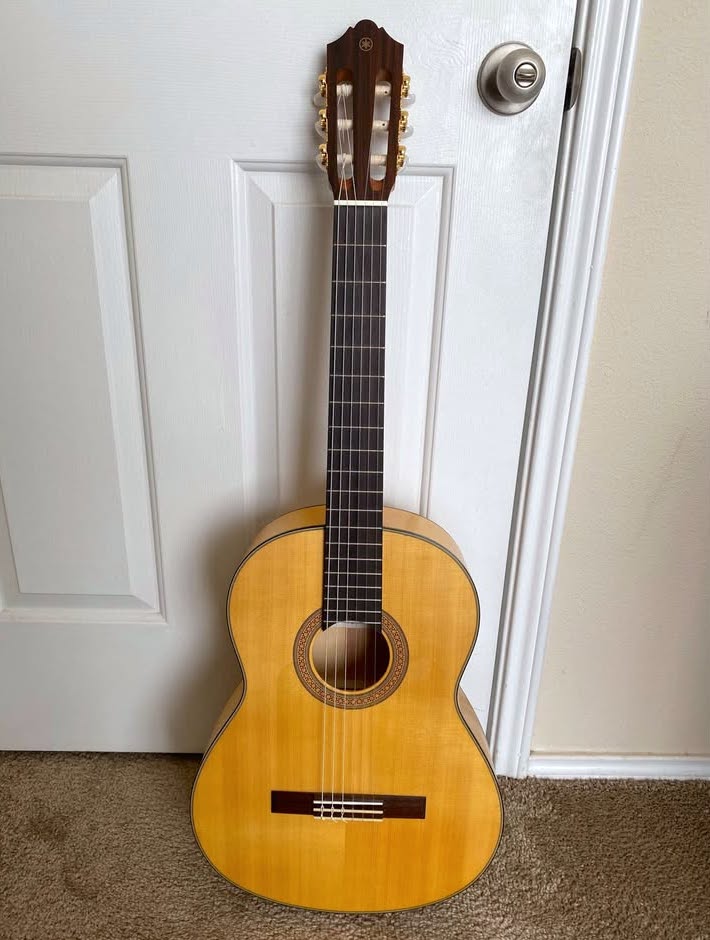
Yamaha CG172SF
Picking up and playing this guitar is a testament to Yamaha’s typical great quality. I immediately heard how the spruce top gives the guitar a crisper voice than many nylon-string classical guitars, which lean towards warm, welcoming sounds. I actually found that this guitar offered some pretty pleasant acoustic jazz tones, with every note in every chord ringing loud and clear.
The string spacing feels very comfortable in my hand. Although I’m used to the more cramped spacing of an electric guitar, this wasn’t too much of a stretch. Likewise, the neck is relatively slender, compared to other classical instruments. No classical guitar is going to feel like a Superstrat-thin shredder’s dream, but this felt like a comfortable transition from Les Paul-style necks.
Even the most finger-warping of extended chords sounded crisp and clear on this guitar.
The satin finish on this Yamaha guitar feels like an odd choice to me, however. I understand that it’s not as expensive as a gloss finish, and helps keep the price of the guitar down. However, the satin finish on the body feels so soft that I’m worried about damaging it with a stray fingernail.
I’d hesitate to take this guitar to a gig, or on vacation, for example. I’d hate to damage its beautiful finish.
Guitars at this price are clearly aimed at students, and having such a fragile and easily tarnished finish on a student guitar feels like an oversight from Yamaha. I can imagine it easily picking up dings and dents on the bus to and from school.
Otherwise, however, the (for a classical guitar, at least) slender neck, open string spacing and great tone make this another great Yamaha instrument.
3. Washburn C5CE
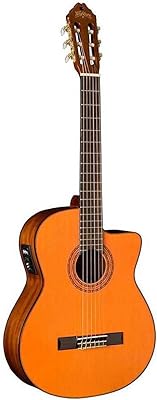
Washburn is an interesting brand. Its output can neatly be divided into reliable workhorse acoustic instruments and some bizarre marketing choices.
On one hand, they’re well-known for making quality acoustic instruments, but on the other, there was the time they built an arsenal of Les Paul-style copies for KISS frontman Paul Stanley.
Washburn’s C5CE feels like it belongs more to the former category.
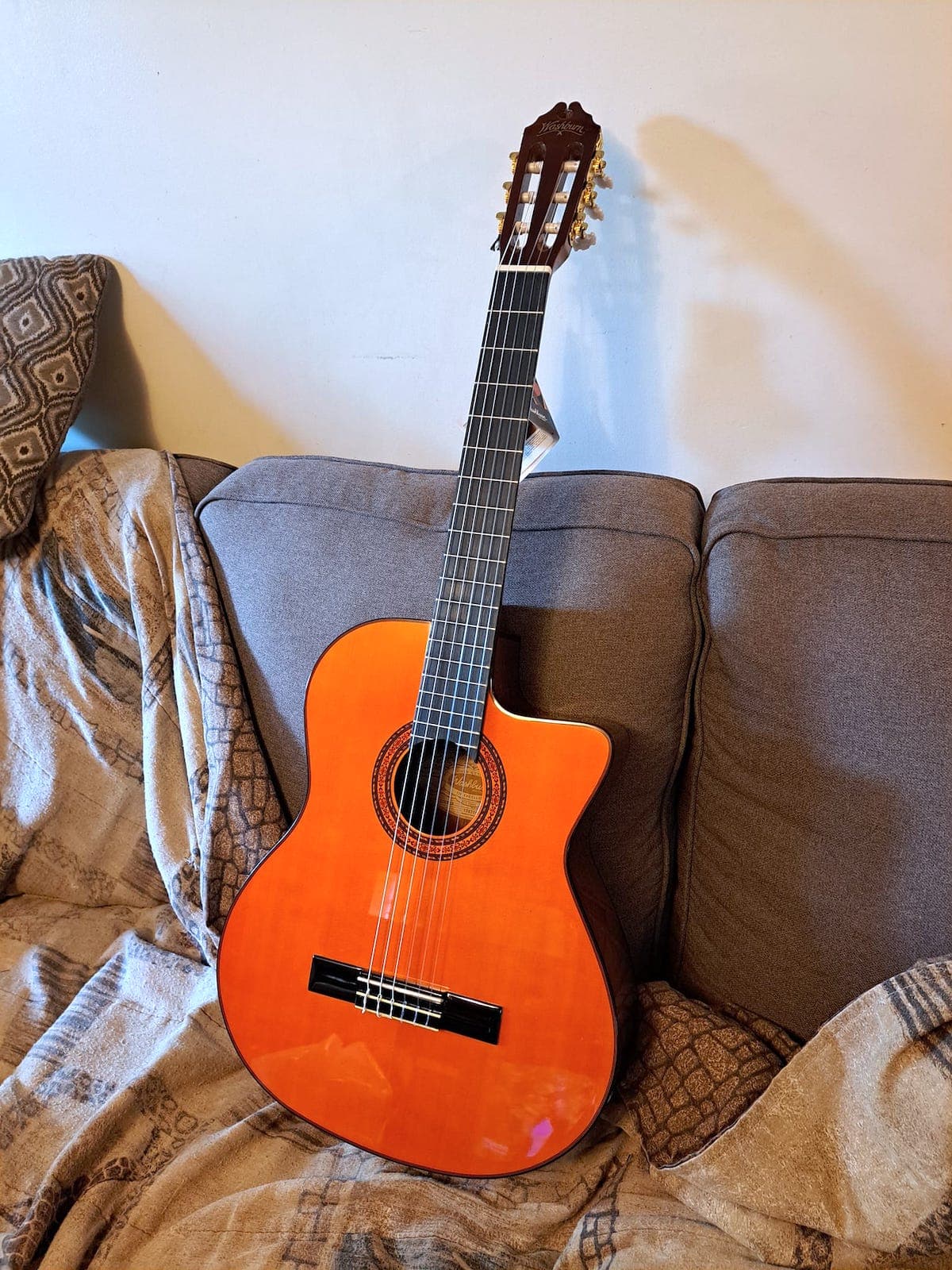
Washburn C5CE
The Washburn classical guitar sounds great unplugged. Chords ring out with precision and warmth, and it’s tantalizingly easy to play. Fingerpicked passages just leap off the fretboard, and every note sounds so good you can’t wait to hear the next one.
I wish I could say the same for its plugged-in tone.
The pickup in this guitar makes it sound remarkably brittle and fizzy. Classical guitars should be warm and mellow, not bright and shiny. The built-in pickup is unpleasantly treble-heavy, which feels like an odd choice for this instrument.
When I plugged it in to my PA, even through a tone-taming LR Baggs DI, it still sounded overly harsh and bright. It reminded me more of the unpleasantly zingy sound of old plugged-in acoustics than of a warm, welcoming classical tone.
Otherwise, the build quality is much better than you’d expect at this price point. The spruce top looks gorgeous, and the neck feels comfortable in the hand.
Unfortunately, brands have to make concessions to keep prices down when they are making affordable guitars. It’s clear that the concession Washburn made was on their choice of pickup for this guitar, which feels more like a late-80s piezo pickup than something voiced properly for this guitar.
I would much prefer to see a Takamine-style palathetic pickup or even a microphone/pickup blend like LR Baggs uses.
Although this guitar plays great and sounds even better when unplugged, the plugged-in sound is simply too unpleasant to use. I was happy enough using it unplugged in a small room, but for larger applications, I wound up placing a microphone in front of the sound hole.
4. Takamine GC5
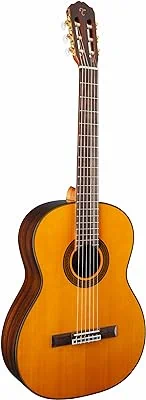
It’s no secret that I’m a huge fan of Japan’s Takamine guitars, and this stunning classical guitar does little to change my mind.
The Takamine GC5 represents something of a departure for Takamine, whose mission for decades has been to produce an American-style steel-string guitar that sounds as good through an amp or PA as it does unplugged. So how does the GC5 measure up?
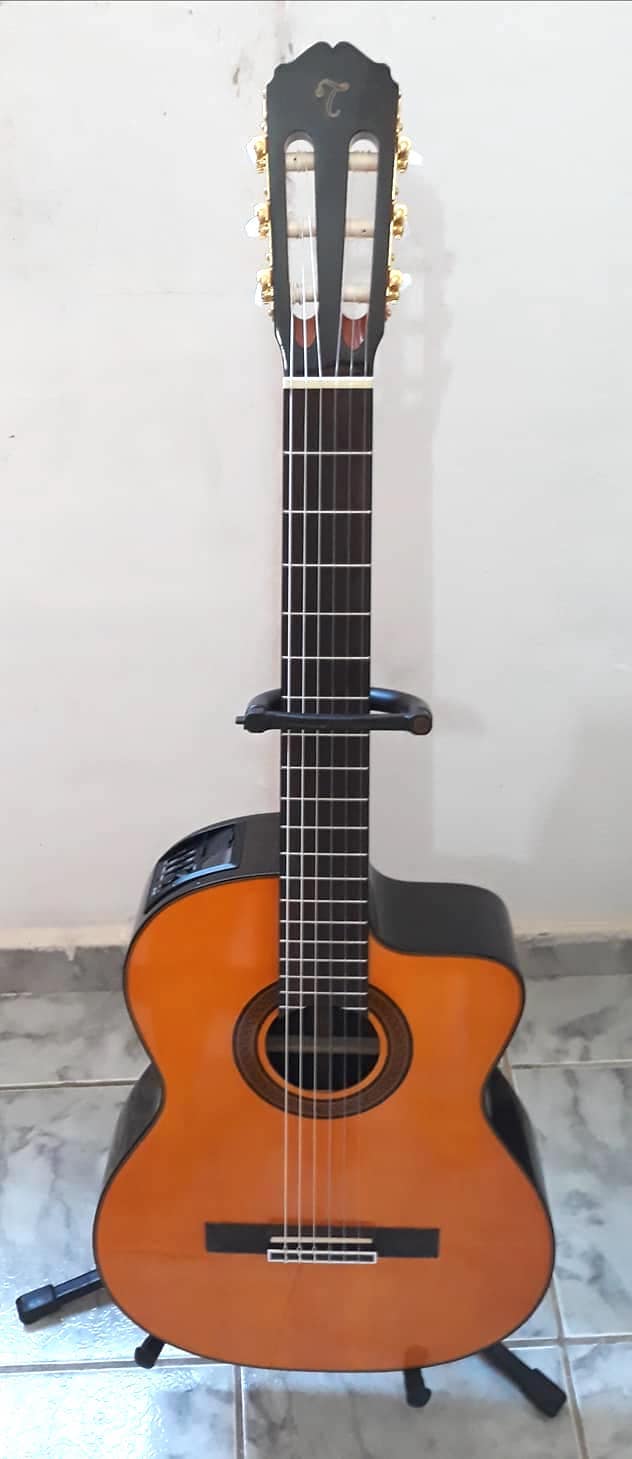
Takamine GC5
Upon picking this guitar up, the first thing I noticed was how comfortable the neck was, particularly compared to other classical guitars. The GC5 felt more natural to play for me. It felt much close to a ‘50s Les Paul neck than some of the cricket bat-esque slabs of wood on other classical guitars.
Perhaps it’s because Takamine typically build acoustic guitars for electric players. Whatever the reason, it’s one of the most comfortable playing experiences I’ve had with a classical style guitar in this price range.
The gloss finish, gold highlights, and beautiful wood make this guitar look as good as it sounds. I enjoy some understated elegance in an acoustic guitar, and this Takamine certainly delivers on that front.
I did find when playing around with Van Halen’s nylon-fueled classic “Spanish Fly” that the dovetail neck joint makes playing the upper frets somewhat difficult. I’m over six feet tall, and my hands are bigger than the average person’s. It wasn’t easy for me to access anything around the twelfth fret: I can’t imagine anyone having an easy time of it.
Having said that, I doubt many classical players will be utilizing anything past the ninth or tenth fret much anyway. This might be a non-issue.
This guitar is totally acoustic, with no amplified capacity whatsoever. I’m a fan of Takamine’s palathetic acoustic pickups, and would have liked to see one included with guitar to make it ready for a Spanish guitar gig, but that’s a minor gripe. It was loud enough to play in a quiet, sub-50-person small bar gig, but if the crowd were feeling chatty, I’d have struggled.
However, as a travel guitar, student guitar, or for practice at home, it’s a great option.
5. Epiphone Classical E1
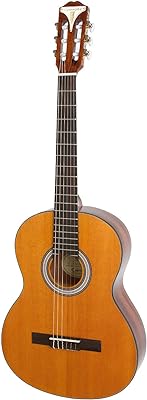
While Epiphone are better known these days for their quality licensed Gibson copies, they have their own rich history that actually predates that of their parent company.
The Epiphone Classical E1 is squarely aimed at beginner guitarists just learning to play, and places a premium on player comfort. This is most apparent in the guitar’s neck.
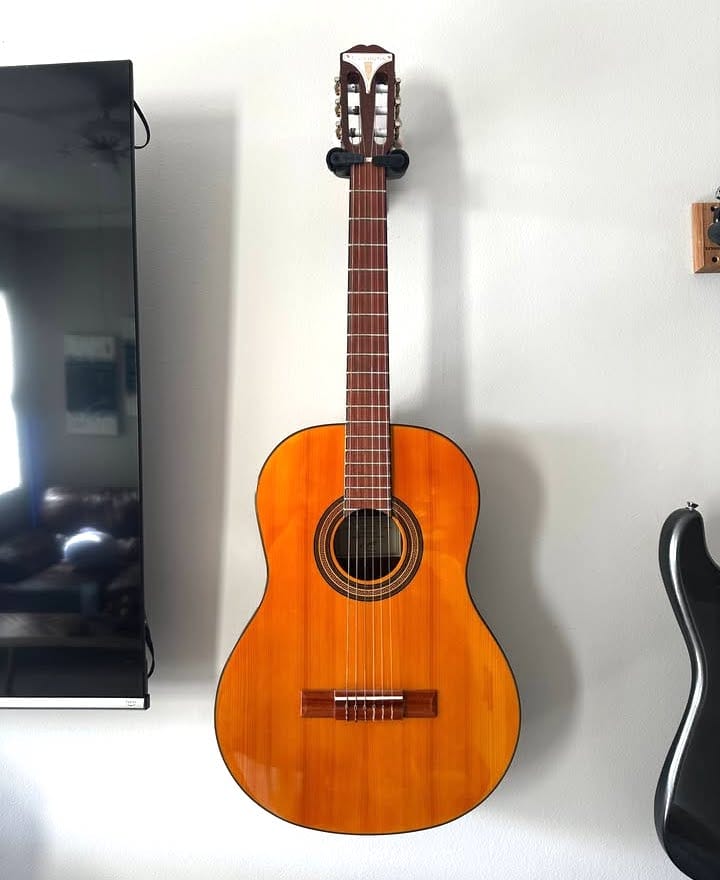
Epiphone Classical E1
While playing, I noticed first how little pressure I needed to sound a note. The jumbo frets enabled me to finger chords and notes with minimal pressure, like on a shredder’s guitar. That’s a great innovation for this style of instrument, and one I’d hope to see on more classical style guitars in future, particularly those aimed at beginners.
I remember, in the first few weeks of picking up the guitar, how hard it felt to maintain pressure on the strings. Easing this is a great way to keep kids interested in the instrument.
The neck profile is pretty comfortable, and I could see it being a welcome addition for smaller-framed players such as those learning to play the guitar in their early teens.
I also noticed that the mahogany-and-cedar body is much lighter than those woods typically are, once again placing player comfort as the paramount virtue of this Epiphone classical.
As if to counterbalance the comfortable weight, this guitar’s voice is not naturally very loud. It’s fine for practicing at home on the couch or at your weekly guitar lesson, but you couldn’t easily jam with other musicians or perform with it.
I actually found it to be a little too quiet for my taste. Even playing harder didn’t yield an appreciable increase in volume.
However, as a student guitar, it’s a great instrument. I wouldn’t recommend this guitar to anyone but a beginner just learning to play the instrument.
Its comfort features become somewhat redundant once you’ve built up the dexterity, resilience, and finger strength that comes naturally after a year or two playing the instrument.
However, it will help enormously in building those key skills.
6. Ovation Applause AB24CC
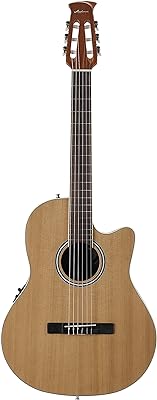
Ovation guitars are best known for their unique design choices, based, believe it or not, on helicopter engineering. One of these features is the distinctive synthetic “bowl” back, rather than the wooden back and sides of conventionally built guitars.
This, supposedly, makes it easier to amplify the guitar without the risk of feedback, and is a more stable, durable building method than the traditional joint. I always associate Ovation guitars with '80s rock players. They were everywhere: even Motley Crue bassist Nikki Sixx had an Ovation signature model!
This Ovation Applause AB24CC is an entry-level model with as many Ovation features as the builders could afford to include. The mid-depth back, made of a synthetic material Ovation have named “Lyrachord”, is there, and it feels very comfortable against my body while playing.
I’ve never felt like normal guitar shapes are particularly uncomfortable. Some guitars, especially big, boxy acoustics, dig into your forearm or your torso, so this might be a welcome innovation.
The guitar’s neck, too, feels much more like an electric guitar neck than an acoustic, let alone a full-width Spanish style neck. As I was playing it, I was instantly reminded of the comfortable C profile of modern Telecasters. I happily sat and played this guitar for hours, with no finger or forearm fatigue whatsoever.
Perhaps the best feature is this guitar’s plugged-in tone. It’s warm, welcoming, and snappy. I took it to a solo gig, and added a reverb pedal to my signal chain. Every note was clear as day, with none of the harsh electro-acoustic “fizz” of other plugged-in sounds.
This guitar is clearly aimed at electric players who want a nylon texture, rather than at classical guitar purists. As someone who normally plays electric guitar, I very much enjoyed this playing experience and would recommend it to anyone who regularly plays Spanish guitar in a live band.
7. Ibanez FRH10N Thinline
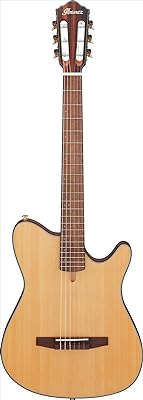
Ibanez guitars are a consistent favorite among shred guitarists, and with Polyphia axeman Tim Henson experimenting with nylon textures in his music, the Japanese giant clearly saw fit to offer a shred-ready nylon string guitar.
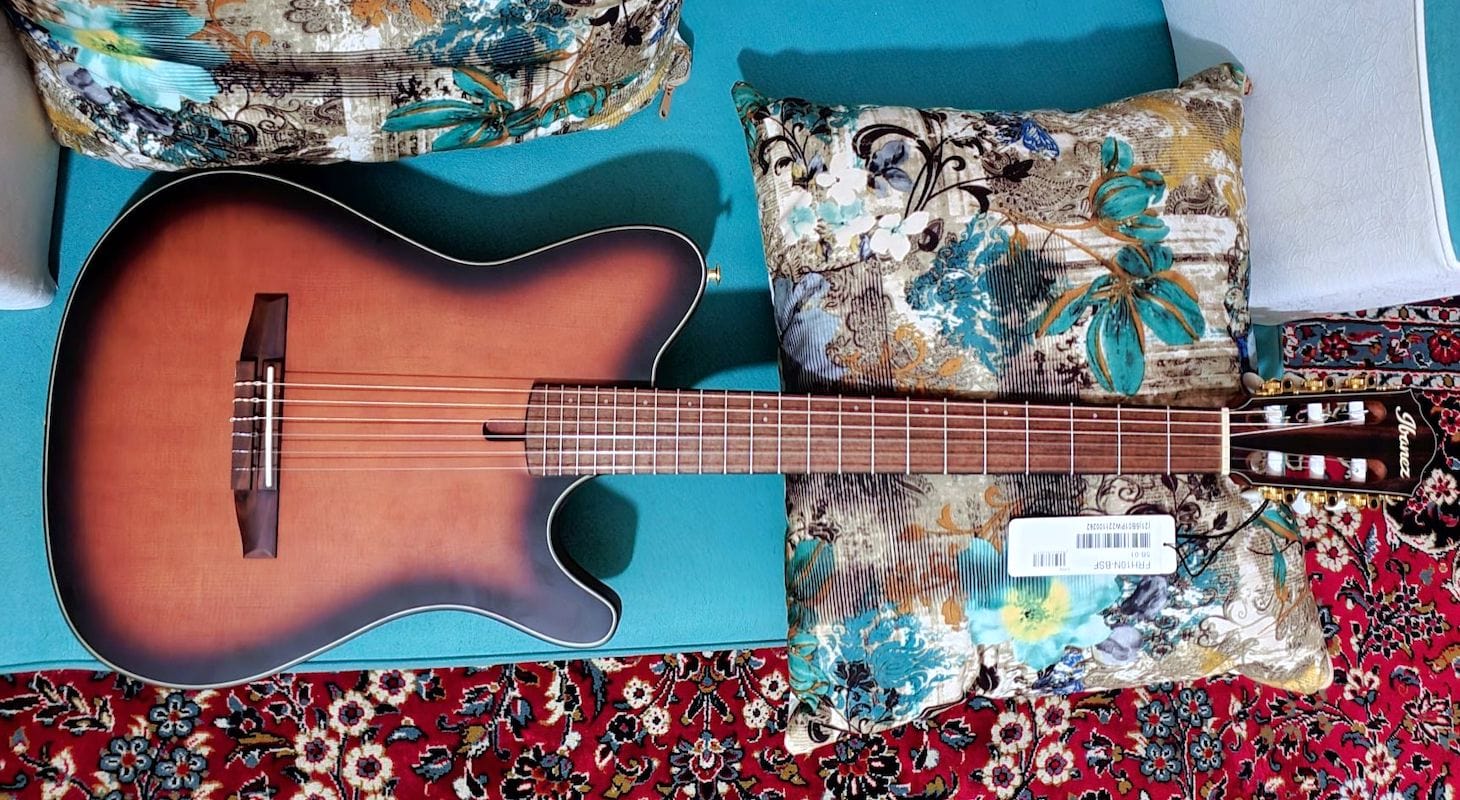
That’s exactly what the Ibanez FRH10NNTF Thinline offers. It could just be the shape and lack of a sound hole, but I find it to be a playing experience closer to a Telecaster than to a classical guitar.
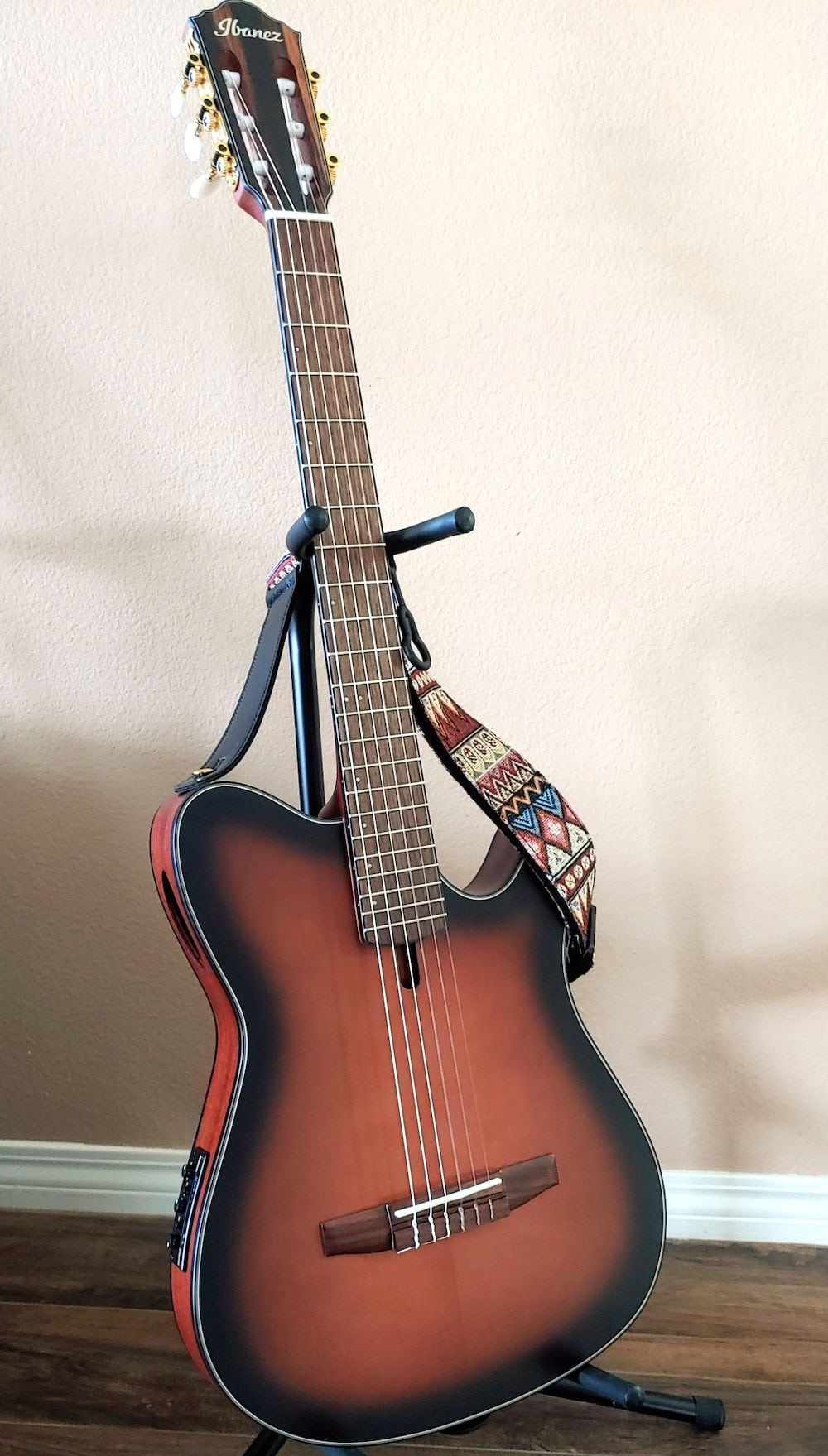
Ibanez FRH10N
The Ibanez Thinline must be played to be believed: my hands think I’m playing an electric guitar, but my ears hear a nylon-stringed acoustic.
The hollow body is surprisingly loud for a guitar of this shape and thinness. It’s a similar level of volume when unplugged to what I get out of my 335.
I’m a big fan of sapele as a tonewood, and the distinctive mahogany-like warmth it offers to acoustic instruments. The spruce top here gives this guitar the right amount of snap and pop for my taste in nylon tone.
The plugged-in tone, however, is where this guitar truly shines. It offers plenty of warmth and mellow, highly sensitive nylon character. Subtle chances in fretting pressure and right-hand strength are clearly audible when I plugged this guitar into an amp or a PA.
The lack of onboard controls might be daunting to some players used to EQ-ing their live guitars on stage, but in reality most of us use amplifiers or LR Baggs style DI boxes to shape our acoustic tones, so it’s not a feature I missed while playing live.
While this guitar is clearly meant for the live stage, it’s loud enough while unplugged that you could easily use it as a couch guitar or take it traveling, if you have a durable enough hard case.
I enjoyed it most simply sitting at my desk playing arpeggios and scales, revelling in the sound of a nylon guitar with the playability of a Telecaster.
Buying Guide on Affordable Classical Guitars
As always, when it comes to a guitar purchase, your own tastes and preferences are of paramount importance. So, too, is your planned use for the guitar.
Guitars under $500 vary widely in quality and application: at lower price points, manufacturers must make choices about which guitar features they are choosing to save money on.
A guitar that might be great for a student learning classical guitar from the very beginning would not suit a seasoned player looking to add a nylon string to their touring arsenal.
Likewise, even nylon-stringed guitars designed for amplification tend not to work well as a purely unplugged instrument.
It’s always best to look at what you need from the instrument and let that guide your choice.
Tonewoods
Acoustic guitars are built from a range of woods, and each wood has varying tonal characteristics. Some, like maple or ash, are snappy and bright, while others, like mahogany and sapele, tend to be darker in character or more mid-forward.
For classical style guitar, the most commonly used woods are those with a warmer tone that’s well suited to the mellow sound of nylon strings.
Often, you’ll see a darker-voiced wood like mahogany paired with a more balanced wood like cedar or spruce to get the best of both worlds.
You want an instrument made of quality tonewoods to ensure that you’re getting good value for money on your new guitar investment.
Construction
While guitar innovations are going on all the time, the basic construction of a classical guitar hasn’t changed much in the past few hundred years.
Quality craftsmanship costs more, but many affordable guitars are still well-made. As a general rule, an acoustic guitar with a solid top will sound better than one without.
If the guitar’s specs say anything other than “solid top” it’s a safe bet that the guitar’s top will be made from a laminate, or several smaller pieces of wood stuck together.
Laminate tops are not necessarily bad, but they don’t sound as good or offer as much sustain or resonance as solid tops. Even with "electric" classical guitars, a solid top will sound better.
Ovation guitars are made with a unique synthetic material for the back and sides, so the solid top is even more important. They have a distinctive tone and feel because of their unique round-back construction. They tend to be a love-it-or-hate-it instrument for most guitar players, and a matter of personal taste.
The other construction feature to consider is a guitar's bracing. Acoustic guitars, being hollow, need some support within the guitar to optimize tone and structural integrity.
Bracing is typically a more important factor with steel-string guitars than with nylon-string guitars.
Traditionally built classical guitars are usually built with fan bracing. Some guitars will use V or X bracing, although these construction methods are usually more associated with steel string guitars such as those built by Martin.
The bracing is less important for thinline nylon guitars built to be plugged in, as most of their tone comes from the pickup and tonewoods.
As a general rule, a classical guitar with a solid top and any of these bracing styles will sound great. At worst, a guitar without specified bracing may be built entirely without bracing and will warp, losing its shape, over time.
Can You Put Steel Strings on a Nylon Guitar?
No.
You can’t simply replace the nylon strings on your guitar with steel ones. This will ruin your guitar. Don’t do it.
Steel strings are much, much tougher and generate more tension in the guitar than nylon strings do.
Guitars built to have steel strings have their necks reinforced with a long metal rod, or truss rod, to keep the guitar in shape under the immense stress that six taut metal wires put on the wood.
Without this, the steel strings would pull at either end of the guitar, causing it to “bow” where the neck meets the body, and perhaps even ripping the bridge off the body of the guitar.
Many have experimented with this, and all have destroyed or irreparably damaged their instrument. You’d need to properly reinforce your guitar to make it capable of handling steel strings, at which point you may as well simply buy a steel-string guitar.
Final Word
When you’re looking for an affordable classical guitar, it’s important to find the right instrument for you. Just because your guitar choice won’t break the bank doesn’t mean it isn’t a big decision.
I hope this article offers practical guidance to those looking to make an informed purchase.
Whether you’re an experienced player looking to branch out into the unique textures offered by classical guitars or a total beginner who wants to start on a soft-stringed instrument, there’s a guitar out there if you know where to look.
