
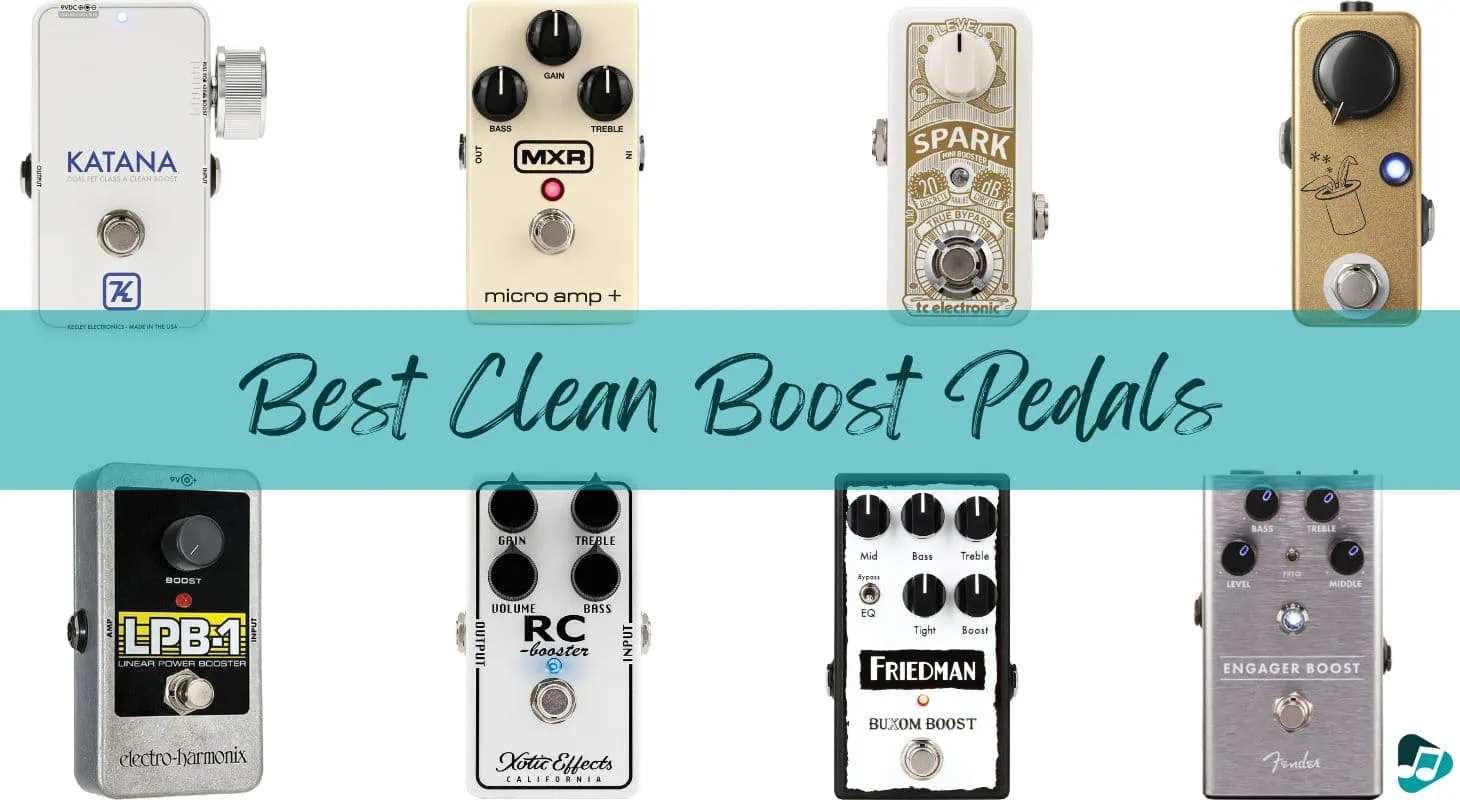
Sometimes you just need that little bit extra from your guitar tone. Whether that’s to juice up a guitar solo, get some extra sustain, or add some break up a stale clean tone, having a high-quality clean boost pedal ready to go is never a bad thing.
But the problem with most boost pedals is they color your tone and introduce unwanted harmonics, spoiling that perfect tone you’ve already meticulously crafted.
The solution? A clean boost. If you just want a set-and-forget boost to your signal, a clean boost is the answer. If you want to slightly beef up your sound without compromising on your overall tone, or kick in a little extra juice without going into full overdrive, a clean boost is the answer.
Some come with extensive EQ options, and others simply buffer your signal.
Top 3 - Clean Boost Pedals
Preview | Product | Price |
|---|---|---|
 | ||
 | ||
 |
Whatever your use case may be, I’ve gathered some of my all-time favorite clean boost pedals that will give you a hassle-free way of getting that bit of extra harmonic richness from your amp without introducing any unwanted coloration into your tone!
To finish with, I included a multifaceted clean boost and EQ from one of the world’s leading guitar & gear builders, as a bonus.
The Best Clean Boost Pedals in Existence
1. Keeley Katana
Keeley are one of the most well-respected companies when it comes to boutique utility pedals. Having made some of the most popular pedal-format compressors ever (which I also use in my personal rig). With Keeley you know you’re getting quality.
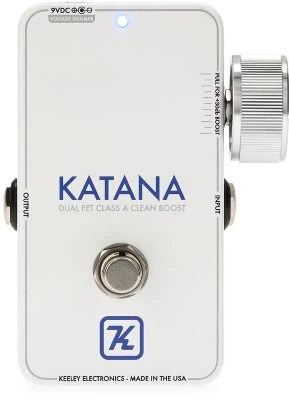
With the Keeley Katana, you’re getting a pedal that looks as clean and simple as it is to operate.
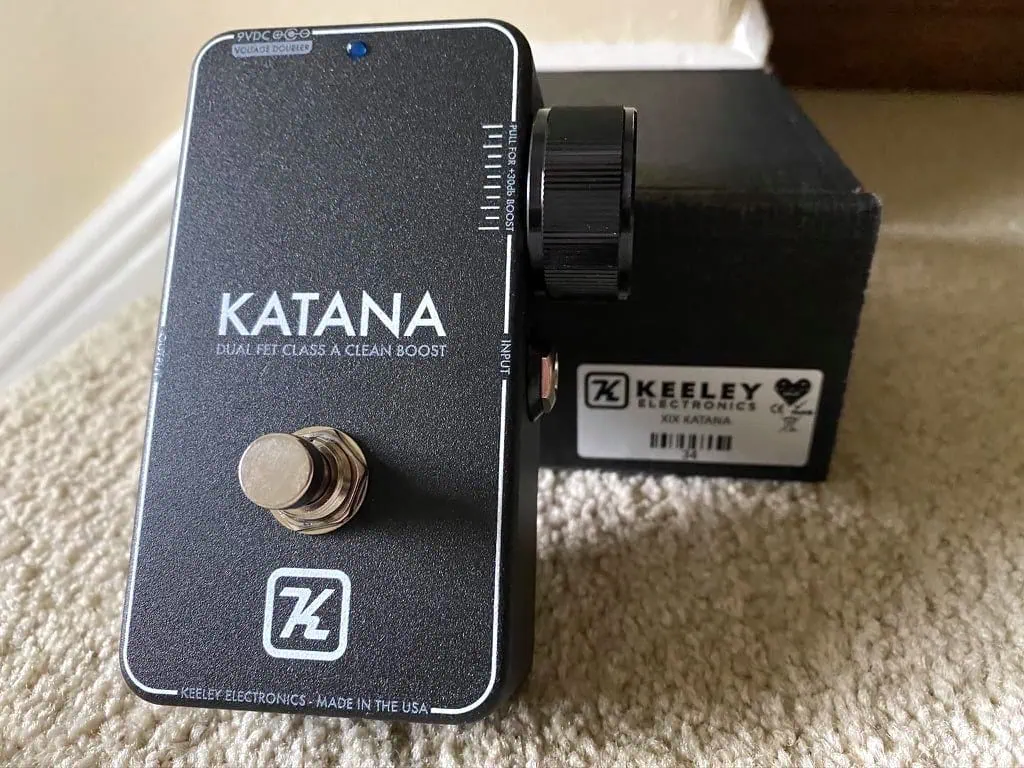
Keeley Katana - 19th Anniversary Limited Edition Black
It features a single on/off switch and a gain control knob that is mounted to the side where the large knurled knob allows you to adjust the gain amount using your foot. Being able to adjust this with your foot without needing to bend down isn’t just a cool novelty, it’s actually really practical!
I was nervous at first about having my foot hovering right above where my patch lead was connected, but the adjustment knob sticks out so much that it’s not really an issue. It’s a weird feeling, and I can’t help but wonder if a volume pedal-style attachment might be more practical.
In addition to that if you pull the knob out you get an instant +30db boost, although I found this very hard to do with my foot, an extra switch for this option would have been far more usable than a side-mounted pull switch.
The +30dB boost is clearly meant to be either on or not. You use the boost for extra saturation, or you run it relatively clean.
I usually control my overall output level by manipulating the volume knob on my guitar. The side-mounted knob here offers effectively the same experience. Although the Katana bills itself as a clean boost, it is capable of delivering quite a bit of extra punch and dirt.
Fans of amp-like response, myself included, will grin from ear to ear recognizing the JFET breakup on offer here. With the boost engaged, it’s very straightforward to capture those elusive edge-of-breakup blues tones.
At lower gain levels, I was able to coax some very sweet John Mayer-esque clean sounds from this pedal. As I cranked the gain, it borders on full-bore Gary Moore territory.
I’d be tempted to use the Katana as an overdrive rather than a clean boost, or buy two and have one set for clean boost and the other for drive. The higher-gain sounds are good enough to easily compete with any overdrive pedal I’ve ever tried.
The internal power supply doubles your 9v input into 18v which I found gives a little bit more headroom than a standard 9v supply.
The downside of mounting the gain knob on the side of the pedal means it takes up a bit more real estate than a traditional pedal. So if like me you have a very cramped pedalboard then this might be an issue, ensure you have enough room for it!
I found that the pedal did introduce some coloration into the sound the more gain I pulled from it, and it took some tweaking to dial things in a way where it felt like a true clean boost.
The nature of this pedal is that it offers more than just a simple volume increase. You can also get a thicker, juicier sound without any unwanted noise. It’s a clean boost, but more than that as well.
But the good news is, it’s true bypass so there’s no reason not to have it on your board at all times.
2. MXR M233 Micro Amp Plus
If you already own a few MXR pedals you’ll immediately feel at home with the MXR M233 Micro Amp as it uses the same design as other MXR pedals such as the very popular Carbon Copy or Phase 90.

MXR M233 Micro Amp Plus
In fact, making a small collection of these MXR pedals lined up on your pedalboard looks great, and like all the other pedals MXR makes, this too is built like a truck. You’ll have no problems when subjecting it to the rigors of gigging and touring.
I’m lucky enough to own a vintage script logo Phase 90 that still works. The paint’s a little chipped, but the knob makes no noise and it still sounds like the first Van Halen album. That’s the kind of durability MXR is best known for.
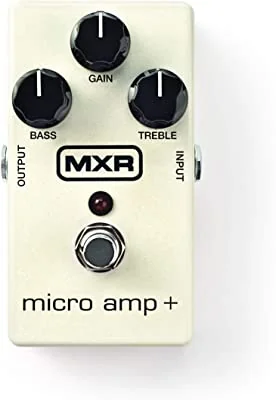
It has a really nice off-white, classic look. While pedals with complex artwork designs are cool, I actually found the black text on white background quite useful as I could easily see what was happening on a dark stage.
In addition to just providing a clean boost, the Micro Amp adds in a 2-band bass and treble EQ, so if you want to augment your tone while the pedal is on during a solo you can do so.
I know many guitar players who use the Micro Amp as an always-on “tone conditioner.” It works well as a preamp, offering a little extra tube-amp compression and grit without sacrificing articulation.
If, like me, you prefer not to spend too much time toe-tapping your pedals on stage, that’s a great option.
However, in this article, we’re looking at clean boost functionality.
The Micro Amp works very well as a transparent volume increase. The EQ knobs are sensitive enough that you’ll need to set them to neutral before engaging the boost.
But if you are adamant you want the boost to be as transparent as possible I found that leaving both EQ knobs at the 12 o’clock position did not introduce any noticeable coloration to the tone.
The boost itself sounds great, although the single gain knob doesn’t give any indication of how many DBs of gain I’m adding, meaning I’m relying purely on my ears to set the level.
While this is probably a good thing, for those who really like to know what’s going on with their guitar setup you might miss not having a dB value to key off.
I’m of the opinion that ongoing ear training is vital to being a guitar player. Part of training your ear is recognizing what sounds good and how much gain to add to your signal.
With the gain knob cranked, the Micro Amp doesn’t exactly get into full-drive territory. Even at full power it just offers a thicker, juicier variation of my clean tone.
With an already overdriven tone, it does tighten up some of the flabbier bottom end. Palm mutes sound much more rhythmic, and legato lead lines have a far more authoritative attack.
In fact, the MXR Micro Amp functions best when used for drive tones. I tried using it to coax a little extra saturation and articulation out of my op-amp Big Muff, and it passed with flying colors.
Similarly, I dialed in an AC/DC style poweramp-forward crunch tone, engaging the Micro Amp for solos. It added just enough high-voltage sizzle to make the solos stand out, especially when competing with a full band.
As a truly clean boost, there are better options on the market. If you tend to use a little dirt in your playing and need something to take you over the edge for solos, the Micro Amp has few peers.
3. TC Electronic Spark Mini
While most clean boost pedals like to try and sneak some kind of gimmick or feature in there to make it more marketable, the TC Electronic Spark hasn’t tried to do anymore more than what was advertised which is a simple clean boost, nothing else.
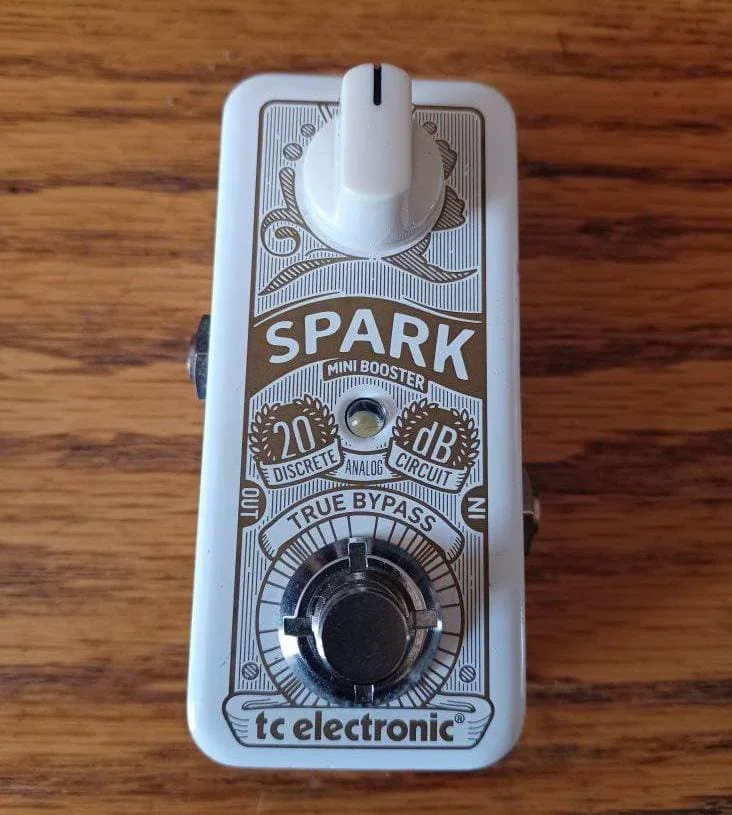
TC Electronic Spark Mini
It has a fully analog circuit for as much transparency as possible and is true bypass, so you can leave it on your board at all times.
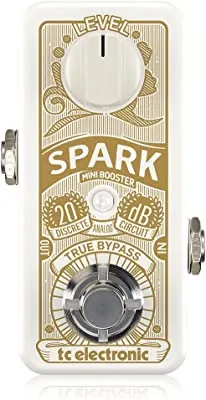
The level control provides up to 20db of boost making this a fairly subtle effect, you’ll really notice this when playing on lower gain or clean tones that need a bit of breakup.
But if you’re already on a saturated tone and need to drive it up to 11, this pedal won't push out enough juice for you.
Therein lies the true value of the Spark. It’s really just a clean boost. It won’t do much for gain addicts trying to get more decibels out of an already-saturated sound.
However, the boost on offer here is more than enough for clean players looking to juice up their tone come solo time.
In fact, I’ve been enjoying using the Spark in a solo acoustic setting. The boost here is clean enough that it doesn’t induce feedback or unwanted gain to my acoustic guitar signal.
I simply set a loop at normal volume, kick on the Spark for the solo, and stomp on it again when the solo is done.
That’s the level of cleanliness we’re talking about here, and it’s extremely useful.
While the intention behind using the mini pedal format was to have it not take up too much room on your pedalboard, I ran into several issues with its lightweight and small form factor.
Unless you tape or velcro it down to your board it tends to get yanked about a lot because of how light it is and the offset ¼’’ input jack placement.
The Spark Mini is very, very small. It’s not even wide enough to accommodate both an input and output jack in line with one another: the input and output are slightly offset.
Likewise, the power supply input is on the side, as with many MXR pedals. It makes for a slightly messier pedalboard if you’re mixing and matching the Spark Mini with top-input Keeley or Boss pedals.
I tend to Velcro my pedals in place regardless, and typically run my power cables as discreetly as possible from below the pedals on a Pedaltrain-style board.
The Spark is an affordable, small-scale clean boost that does exactly what it advertises, and nothing more. If you want a squeaky-clean volume boost, I can’t recommend it enough.
4. Electro-Harmonix LPB-1 Linear Power Booster
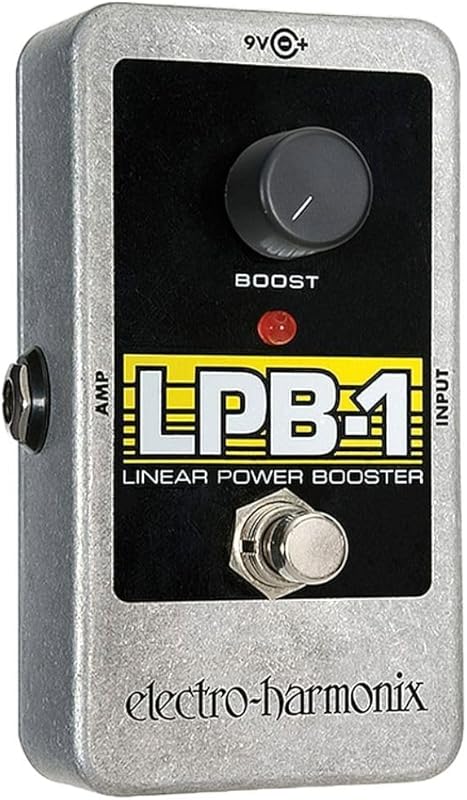
It’s no secret that I’m a big fan of Electro-Harmonix gear. It usually sounds great, is well made, and will endure the rigors of regular live playing.
The Nano LPB-1 Linear Power Booster is a much less complicated pedal than some of the brand’s offerings (like the bestselling Big Muff or their Holy Grail Reverb).
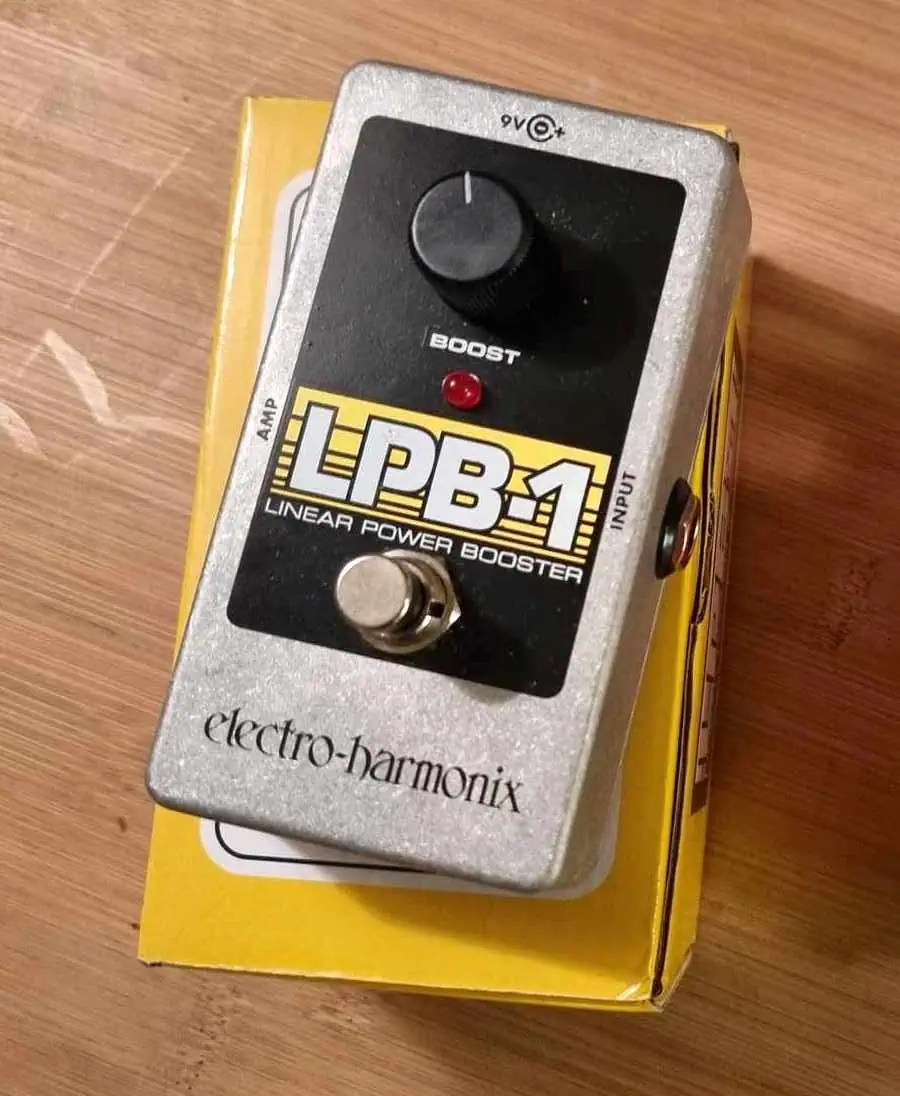
Electro-Harmonix LPB-1 Linear Power Booster
Its Phase 90-sized enclosure boasts a solitary knob labeled “boost”. Turning this clockwise increases the power of your signal. Turning it counterclockwise decreases it.
The LPB-1 first hit the market back in the late 60s, but it’s by no means exclusively for classic rock enthusiasts. You could plug the original model straight into your guitar, and it would boost your signal to help push your amp into overdrive.
The idea here is to push the preamp stage of your amp into more distortion than a guitar signal alone.
The modern pedal has true bypass, and I love the bare-bones functionality on offer here. It’s either on or it’s off. It either boosts or it doesn’t. No hidden buffering or extra functions here.
I found that it darkened my tone somewhat when cranked, and was capable of adding a huge amount of gain in doing so.
I had best results in two use cases for this pedal.
The first was run into a clean, bright amp (such as a Vox or a low-powered Marshall), where it seriously juiced up my clean sound.
The resulting tone isn’t quite spanky enough for country leads, but it’s great for arpeggios, jazzy clean chords, and edge-of-breakup tones.
The other use case is with a distorted tone. Engaging the LPB-1 after a distortion pedal in the chain sprinkles a little magic dust on a distorted sound. It increases the volume, of course, but it really adds some welcome compression and tightness.
You can even use this pedal as an overdrive, if you prefer low-powered preamp drives.
I like it best as a boost for soloing, where it breathes extra life into my guitar tone.
Although it’s not fully transparent, this is a classic boost that will find a home on many pedalboards.
5. JHS Prestige Buffer
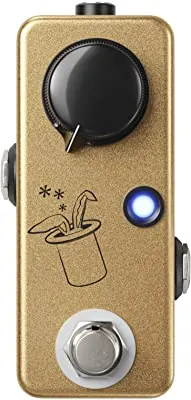
Unlike other boost pedals which are designed to be kicked in when needed, the philosophy behind the JHS is that it can be either left as always on tone buffer, permanently adding a bit of juice to make up for headroom that’s been lost elsewhere, or it can be an on/off gain boost to drive your amp harder.
As you can see from the magic bunny artwork, JHS Prestige is making a clear nod to the very popular (but unfortunately discontinued) Mr. Magic pedal.
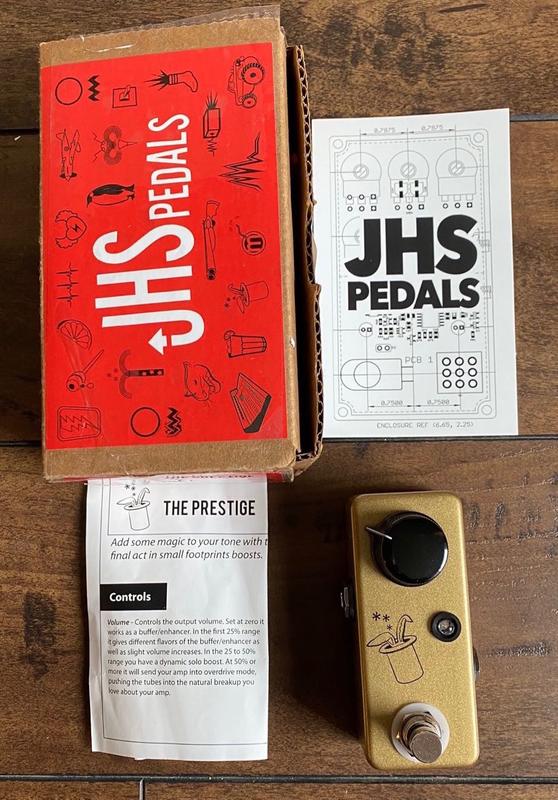
Unboxing the JHS Prestige Buffer.
It has a single level knob which you can set and forget, and then an on off switch that is unfortunately not true bypass.
There’s a single LED light to indicate when it’s switched on, this is very bright and I found it very helpful on stage as it made it easy to locate on my pedalboard. It was visible even in broad daylight.
Tonally there are three ranges, when the level is set between 0-25% it works as an always-on buffer, ideal if you use long cables and have noticed the top end of your sound being stripped off.
I wouldn’t call this tone setting a boost, per se. It’s more like a tone conditioner, adding some brightness and articulation to a dull sound. In my opinion, if you already have a great guitar and a great amp, you won’t need this setting, especially if you also own an EQ pedal.
From 25-50% it’s a fairly clean and transparent boost that works great for gritting up clean sounds or driving a lead tone a bit harder. This was my favorite setting on the pedal.
This is the main setting that felt like a true clean boost for me. It added extra juice and volume to low-drive sounds. It felt more like a beefed-up version of the base drive sound I was using than anything else.
I really enjoyed using this for almost-clean lead lines. It sounded particularly good for overdriven country leads a la Brad Paisley or Keith Urban.
Past the halfway mark, the Prestige Buffer functions like an overdrive pedal. It sounds like it adds extra front-end power to the amplifier’s preamp, pushing relatively wimpy low-wattage tube sounds into Stevie Ray territory.
As with other variable-gain boosts, having all these sounds in one pedal presents a conundrum. What if you need different tones throughout a gig? Say, to switch from a clear, clean sound to a beefy, bluesy lead tone?
I’m sure JHS would claim that it’s worth picking up more than one Prestige Buffer. For most of us, we’d have to mess with the gain settings mid-show. I wouldn’t be averse to an additional switch on this pedal to offer extra gain.
Even though it’s a small pedal which can be awkward to utilize, especially during a busy show, because I use this as an ‘always on’ buffer I was able to just tape it down and leave it be which circumvented many of the headaches that come with using a mini pedal.
6. Xotic RC Booster Classic
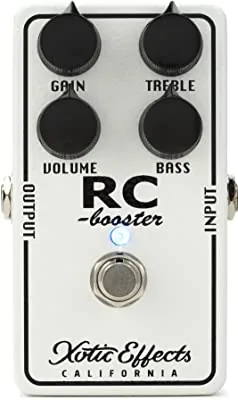
This is a reissue of the original Xotic clean boost pedal released to celebrate the company's 20th anniversary. Not the V2 of the same pedal.
While the Xotic RC Booster Classic can certainly function as a straight clean boost, this one has a few more bells and whistles on it for those who want to get a bit more granular with their sound.
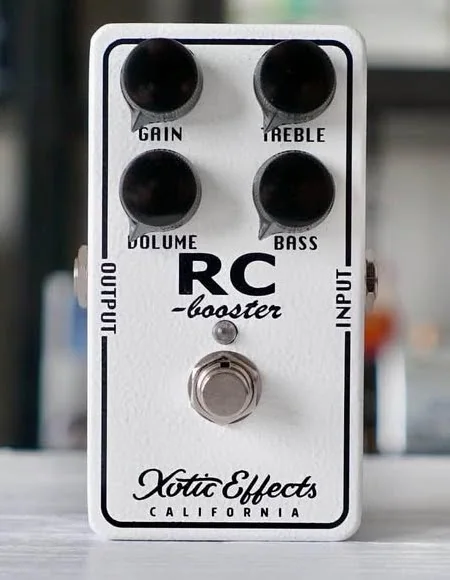
Xotic RC Booster Classic
Design wise it uses the typical pedal format with clear writing and a bright LED light so you can see it on stage.
Both the ¼’ jack and power placement is perfect for live performance pedal integration and the true bypass means it can live in your effect chain permanently. I will concede that the 18v power requirement is less than convenient, but a variable-voltage power supply should handle it just fine.
There are 4 main controls on the pedal, a 20db straight volume boost, a dedicated gain knob for those who intend to use this more as a lead boost which helps fatten and color the sound more than a straight clean boost would.
There’s also a 2-band EQ which I found immensely helpful when using the pedal through my PRS Archon.
As the input of the Archon was driven harder the amplifier began to behave and respond differently even though the pedal itself wasn’t introducing anything other than clean gain into the tone.
As you increase the gain level of your tone, you often find the low end going from warm and friendly to spongy and inarticulate.
So the 2-band EQ can easily function more as a corrective EQ to compensate for tonal changes that come as a byproduct of driving the amp harder, super convenient!
Because of the additional gain knob and EQ, this pedal takes some extra time to dial in than normal, great for tone tweakers, but those who just want a simple button they press for extra volume may feel impatient using this pedal.
As a clean boost, the RC Booster is excellent.
I set the EQ knobs to neutral and it offered a simple increase in volume. Turning up the gain in this position simply increased the volume of the signal.
Getting past about halfway on the gain knob did yield some tone coloration, but even all the way up, this is one of the cleanest signal boosters I’ve ever tried.
I used this mainly for country soloing. I already had a clean, clicky, compressed sound dialed in for mid-song licks and arpeggios. Where this pedal was most useful was for taking solos without needing any extra dirt.
It was particularly well-suited to Brent Mason-style soloing. I had a tremendous amount of fun playing along to the ultra-twangy clean solos on the new Zach Top record, for example.
As a truly clean boost, the sound of this pedal has been a benchmark for others for decades. It still is.
7. Friedman Buxom Boost
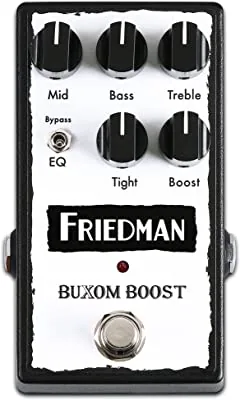
Anyone who’s even a little familiar with the great amp modders will know all about Dave Friedman, responsible for creating amps for the likes of Van Halen, Fredrik Thordendal, and Dino Cazares.
This guy truly knows his stuff and I trust his expertise implicitly.
Of course, the Friedman name is best known for the high-gain stylings of his most famous clients. Accordingly, this is one of the more in-depth boost pedals on the market and has a certain crossover between a volume boost, a tube screamer, and a straight up distortion pedal.
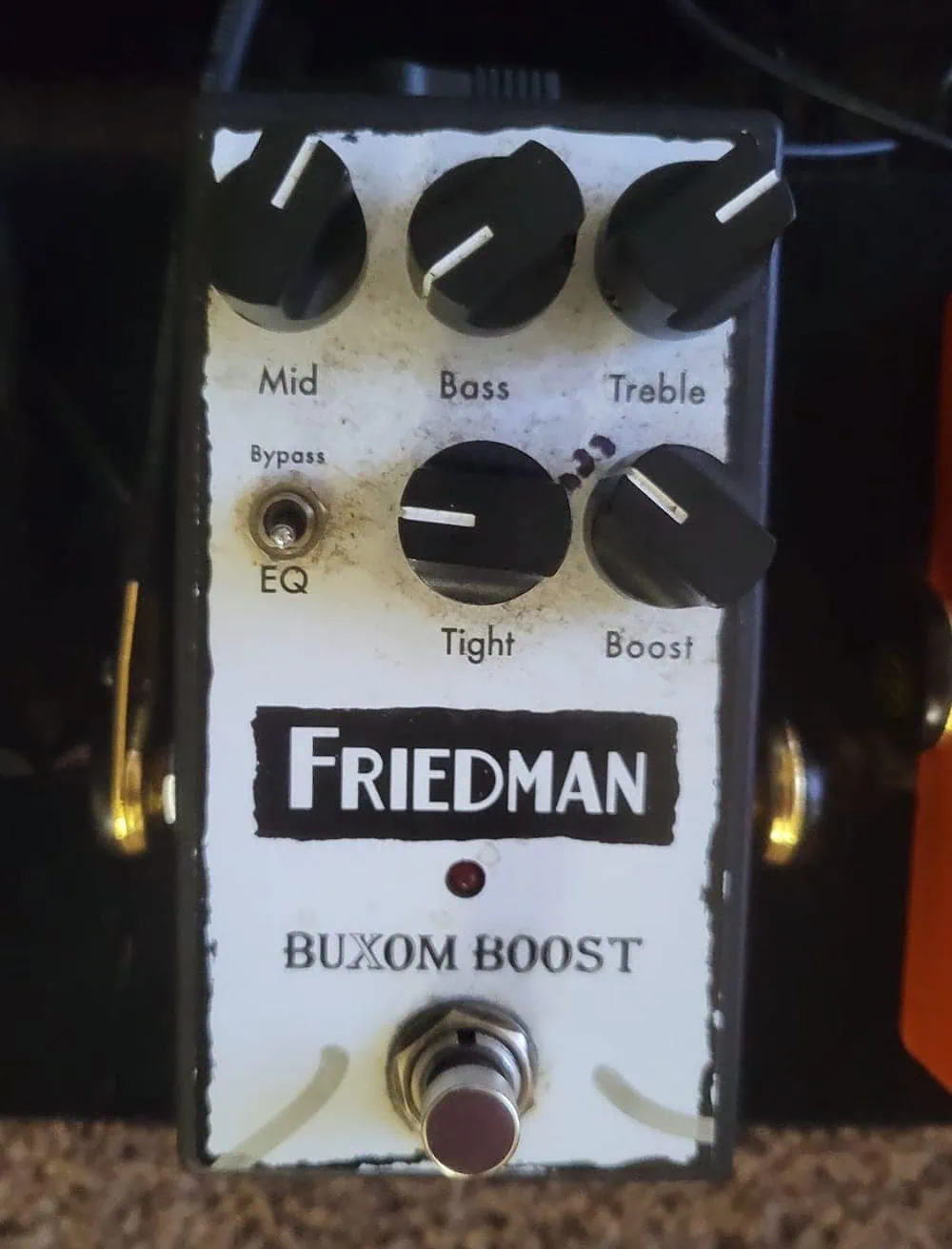
Friedman Buxom Boost
The Buxom Boost features a full 3-band EQ which felt very responsive, you can easily create a whole new sound using this to kick in during leads should you wish.
But if like me you’d prefer the pedal to be as transparent as possible there’s also a bypass toggle that completely removes the EQ from the circuit. A very welcome addition!
Another important feature on this pedal is the tight knob. Many amps tend to develop an unwieldy, flabby low end when driven hard from a boost pedal.
Most of us would typically twiddle with the EQ on our amp or the pedal in question to alleviate this. If you’re trying to get those machine-gun thrash metal palm mutes, the “tight knob” offers a chance to do so without endless EQ sculpting.
As the name suggests, it tightens up the low end of a saturated tone.
Of course, if you want to use this more as a traditional clean boost you can just bypass the EQ. There’s a little switch beneath the EQ knobs to allow you to use the pedal without engaging the EQ section.
I found best results for a transparent, ultra-clean boost with the tight on about 2 and the boost below 6, then this sounds very much like any other clean boost pedal.
With some tweaking, however, the Friedman does help add some sparkle and shine to a clean sound.
Unfortunately, it is a pretty ugly pedal, and for how feature complete it is they could have put in a bit more effort in the visual department so it looks cool on your pedalboard.
Hopefully, you’ll sound so good while shredding on stage that the audience will be watching your fingers in awe rather than inspecting your pedals.
All in all, the Friedman works best when taming a high-gain tone, but in application as a true clean boost, it’s an excellent, well-made pedal with a great sound.
8. Mesa/Boogie Tone-Burst
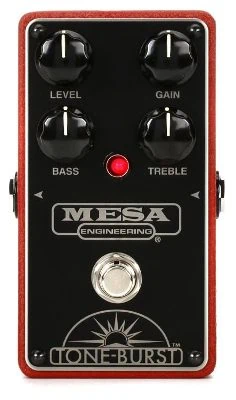
Everything Mesa Boogie makes oozes quality, and this pedal is no exception.
While the Tone-Burst is marketed as a straightforward boost pedal that provides up to +20db of volume, there are quite a few extra features going on here that allow it to be so much more.
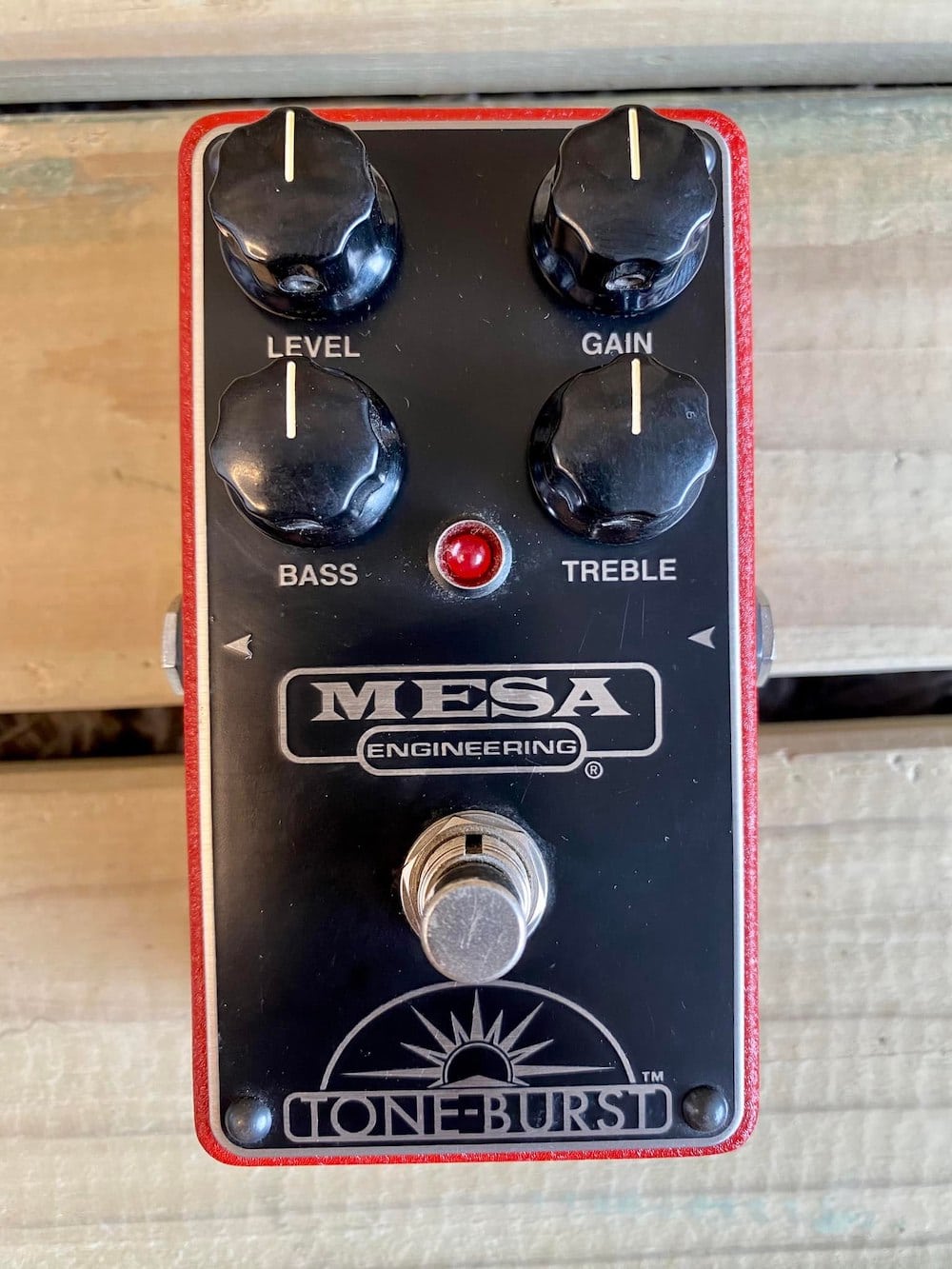
Mesa/Boogie Tone-Burst
In practice, it offers both classic boost effects: more volume for clean tones as well as deeper saturation and compression.
But first, let’s talk about the looks, this is a beautiful pedal that has a metal plate bolted onto the housing. This will make your pedalboard look impressive if nothing else!
It’s a little taller than an MXR Phase 90. Just like Mesa’s famed amplifiers, it’s also built like a tank and will have no problem withstanding the rigors of live performances. The black faceplate oozes rock n’ roll cool, and the red LED light begs for Metallica-style shredding.
The pedal features a 2-band EQ for corrective sculpting or you can craft a unique boosted tone.
In addition to the regular +20db volume boost there’s also a separate gain knob that allows you to saturate the distortion more.
I found this gain introduced quite a lot of harmonics into the sound, but they were pleasant and smooth, not harsh at all. I would definitely recommend using this as a lead boost!
The thing is that the extra gain control means this isn’t strictly a clean boost. Using the gain gives your sound more of the classic scooped and saturated Mesa tone. It’s a great lead tone.
With my Les Paul, in front of an already overdriven amp, it reminds me a lot of Justin Hawkins’ live tone.
No bypass for the 2-band eq means it’s always on and you’ll have to spend time dialing it in if you want a truly transparent sound. I found that setting the knobs about twelve o’clock offered best results for a transparent boost.
Because of the black faceplate, I did find it quite difficult to see the settings when playing in dark environments, so make sure your settings are dialed in before heading on stage!
Regardless of how you set the Tone Burst, it’s going to sound different depending on how you’ve set your amp. Setting my amp to a clean sound and cranking the gain settings on the Tone Burst didn’t magically yield high-gain Mesa tones.
I found best results here setting my tube amp to the edge of breakup, where softer playing yields a cleaner tone. Kicking on the Tone Burst at neutral simply pushes the amp a little harder.
Turning up the gain pushes the amp even more. The sweet spot for my setup didn’t require much extra gain at all, just slightly pushing the edges of my chords and lead lines into overdrive rather than clean decay.
This setting just added character and spice to my already dialed-in breakup tone, an excellent use case for this clean boost.
BONUS Entry: Fender Engager Boost
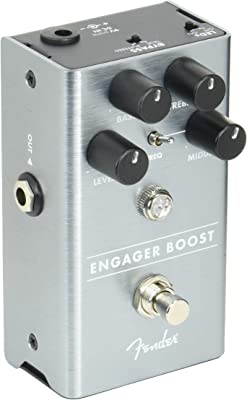
While the Fender Engager Boost is intended to be another more feature-rich boost pedal, it’s more subtle in its approach and strikes a great balance between implementing modern features while not alienating those who want a pure and honest clean boost.
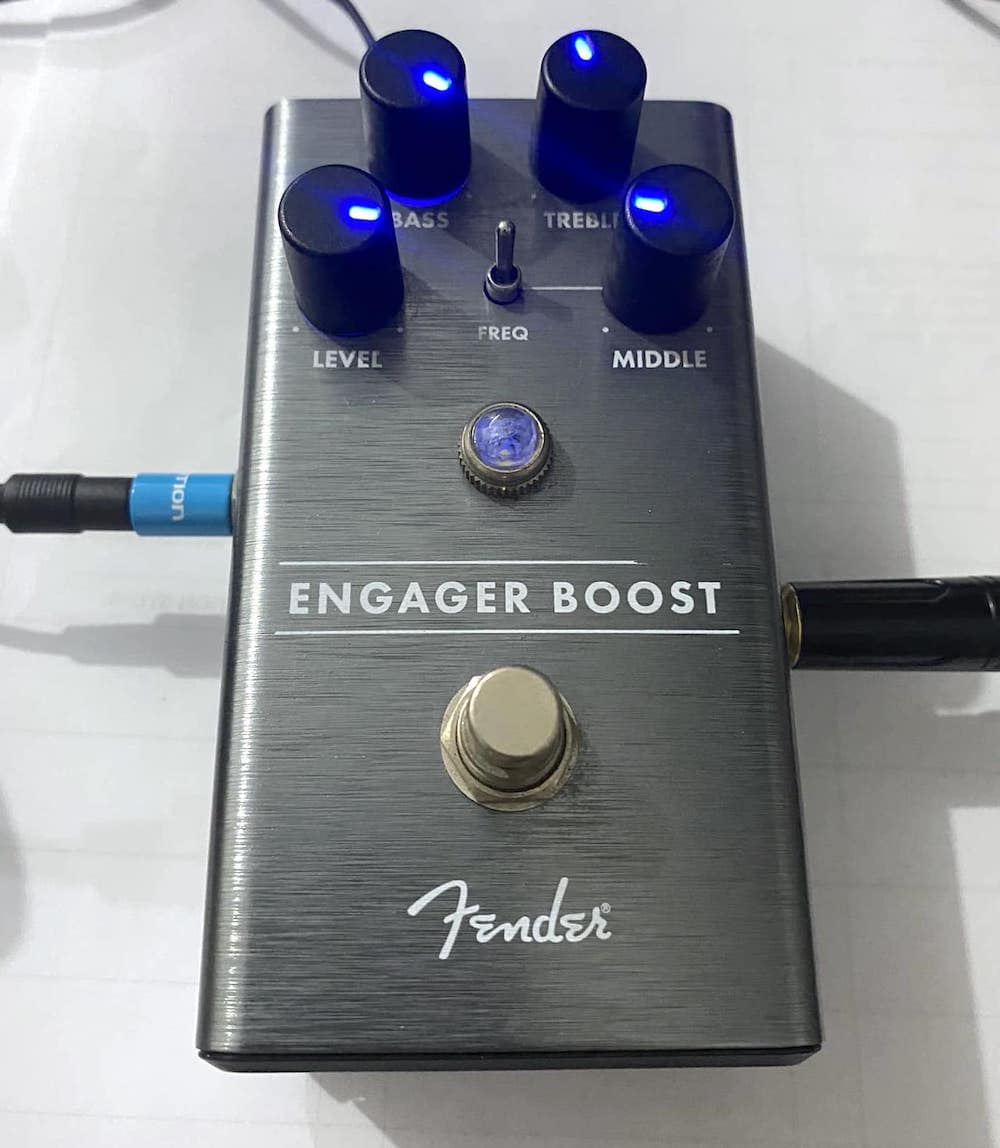
Fender Engager Boost
Strictly speaking, I don’t consider the Engager to be a clean boost in spirit. It’s best described as a parametric EQ that includes boost functionality. That is to say, you can, and should, use this pedal as a clean boost, but it shines when used to its full functionality.
The brushed aluminum pedal housing looks very sleek and modern, it clearly stood out as one of the most impressive-looking pedals on my board. Like Fender’s other pedals, it’s big and eye-catching, echoing Leo Fender’s eye for classic car-influenced design.
It also has an amazing feature where the knobs are LED backlit which is unbelievably helpful when playing on a dark stage. I wish more pedals utilized this!
There’s no gain knob this time, just singular level control and a 3-band EQ, but the middle knob of the EQ has a frequency switch to allow you to focus in on the hi-mids or lo-mids depending on your requirements.
Unfortunately, there’s no way to bypass this EQ, so purists may find this pedal frustrating as there is a degree of tonal coloration applied to your sound no matter where you set the knobs.
With that being said the overall impact of this EQ when set at 12 o'clock is very subtle, I’m confident even purists will be happy with it.
The offset ¼” jacks are not that pleasant to wire into a pedalboard, but the 9v battery door is a really nifty and welcome addition.
It could just be the Fender logo looking up at me from the pedal, but I think this clean boost really performs best at thickening up low-powered single-coil pickups.
I borrowed a friend’s Stratocaster for this experiment, playing it through an American-voiced clean amplifier. Without the Engager, it’s classic Strat sound. A little thin, in a good way. However, with the Engager switched on, the sound is subtly thicker, juicier, and more articulate.
The major difference I noticed was that every note within a chord or double stop was clearly audible, without a major spike in the first picked note.
It might be sacrilege to Fender purists, but it added a little humbucker-esque fat and muscle to the slinky sound of a single coil pickup.
The Engager truly excels at beefing up a clean tone.
Given this pedal’s always-on EQ stage, it actually functions more like an EQ pedal than as a bare-bones clean boost. Unlike a conventional EQ, the “level” knob only adds gain, and cannot take it away from your base signal.
Some folks like to use an EQ as an “anti-distortion” pedal that cleans up their tone when engaged, so if that’s what you want, look elsewhere.
However, for extra control of your tone, and the ability to add character to your guitar signal, it’s hard to argue against the utility of the EQ knobs here.
It’s easy to cut out unwanted flabby low end when you’re using a distorted tone. You can add some midrange to cut through the mix when it’s time for a guitar solo.
Although you can use it for a slightly more gain-forward preamp-style boost, it works just as well as a totally clean boost for those solos where you don’t want an overdriven tone.
I consider this pedal to be similar to seasoning a steak. It just adds a little extra flavor and power to an already great sound.
For what this pedal offers it’s also priced exceptionally well and is one of the best bang for your buck pedals on this list!
How 'Clean Boost' Differs from a Regular Distortion Pedal
Sometimes the terminology used in the pedal world can be a bit confusing, especially when functionalities overlap so greatly.
The main difference between any old regular distortion pedal (including those labeled fuzz or overdrive) and a purpose-built clean boost is in the coloration of the sound.
Regular distortion pedals are designed to have their own character and introduce new harmonics and tonal response into your guitar tone that is different from what your amplifier could achieve by itself.
A great example of this is something like the very popular Friedman BE-OD which takes your current amps sound and adjusts it to sound more like the Friedman Brown eye.
Whereas, a clean boost is designed to be transparent and not introduce new characteristics to your sound. This is preferable if you already love the sound of your guitar amplifier but just want to enhance the pre-existing characteristics.
A clean boost might be as simple as an increase in volume for your overall signal. Many modern boosts include an EQ stage to help sculpt your sound.
So, when you're deciding on the best transparent boost pedal for your rig, you'll have to bear this in mind to keep your overall tonal flavor unaltered.
The classic application of a clean boost is really as a guitar signal strengthener. It can breathe life into a dull-sounding clean tone, or tighten up a muffled drive tone.
Long signal chains with many pedals can suffer from signal loss due to the amount of pedals and circuitry between the guitar and amp. A clean boost can be used simply to buffer the signal before it gets to the amp, restoring it to its former unadulterated glory.
The Benefits of Having EQ Bands on a Clean Boost
At this point you may be asking yourself, well if a clean boost is supposed to be transparent, why do so many pedals have 2 or 3-band EQs on them?
There are 2 main reasons for this, the first is functional. Sometimes as you throw more signal into the preamp of your amp, the tone will naturally change by itself and introduce new harmonics.
The important distinction is that this coloration exists as a byproduct of driving your amp harder and not a new sound introduced by the pedal.
Sometimes these harmonics may be a little obnoxious or undesirable, so having the ability to keep them under control is always helpful.
The second reason is creative, some guitarists like to kick their clean boost pedal on during a particular section of a song to give it some extra energy.
High-powered clean sounds can become unpleasantly treble-heavy and brittle. Likewise, heavily saturated distorted tones often become bloated and inarticulate, with too much low end.
So the ability to cut some bass and add a bit of top end can help your guitar slice through the band and pop a little more can be extremely helpful.
To True Bypass or Not to True Bypass
One of the features you’ve probably noticed on a lot of clean boost pedals is that they are true bypass.
True bypass means that when the pedal is switched off, your signal completely bypasses the circuitry meaning there is absolutely zero coloration to your guitar tone, it’s as if your cable just passes straight through the pedal.
If you’re not looking to have your clean boost as an always-on pedal, then true bypass is an important thing to consider when making your purchase.
On the other hand, if you will always have your clean boost on, then true bypass is less necessary as your signal will always pass through the pedal anyway.
Enhanced Guitar Tone
A clean boost is a fantastic, yet subtle way to bring out the best in an already great guitar tone.
Instead of overwriting your meticulously crafted sound with a big obnoxious distortion pedal, a clean boost is the perfect way to drive your pre-amp harder and simply give you more.
There are plenty of ways to use a clean boost. You can increase the firepower of your clean tone, tighten up a dirty tone, or simply boost your volume for a solo.
How you use it is, as with all things guitar, totally up to you.
I hope you found the tips in this article helpful and have fun picking out your dream clean boost!
