
The best thing about playing guitar is you can pick it up at any time in life. You don’t need to be young and strong to learn to play guitar like with some sports. I’ve met beginner guitar players of all ages, from 12 years old to 50 years old.
The second-best thing is that you can improve as a player forever. Even the all-time greats sought out lessons and new knowledge well into their careers. Legendary Ozzy axeman Randy Rhoads famously found a guitar teacher in every new city he visited on tour.
Today, guitar players of all levels can benefit from a multitude of learning apps available online. Whether you’re a total beginner or an advanced pro looking to add some weapons to your arsenal, there’s a learning app out there for you.
Before I discuss my experiences with the guitar learning apps, I'll quickly address the online vs in-person debate first.
Short on time? Here's my top pick for online guitar lessons:

Out of all the guitar learning apps I've tested, Guitar Tricks is by far the most value-packed offering – tens of skilled instructors, lessons for thousands of popular songs, dozens of genres and styles of playing, reasonable price. It's just as helpful for intermediate and advanced players as it is for beginners. Click here to jump over to my detailed review below.
Learning Online vs In Person - My Take
I’ll be the first to admit that I’m a self-taught musician. I did pretty much all my early learning on guitar listening to my favorite records and working songs out by ear, or consulting dubious tablature online. It worked out well enough for me to start bands, record, and tour.
I never went to a guitar teacher face to face until much later in life, when I realized there were some major holes in my musicianship. Like most rock guitar players, my understanding of music theory was woefully lacking. Likewise, my technique (or lack thereof) was starting to really show itself compared to the more virtuosic of my guitar-playing peers.
In my experience, a great face-to-face teacher is the most valuable resource a learner guitarist can have.
However, not everyone has the budget, time, or capacity to see a face-to-face teacher. You might live somewhere without any fantastic local teachers, or no teachers for the style you want.
In that case, self-paced online learning can be extremely useful.
When it comes right down to it, the best learning resource for any player is one that will encourage them to practice and enjoy the process of improvement.
With that out of the way, let's move on to the apps that I find actually useful for learning guitar online.
5 Best Guitar Learning Apps Based on My Experience
1. Guitar Tricks
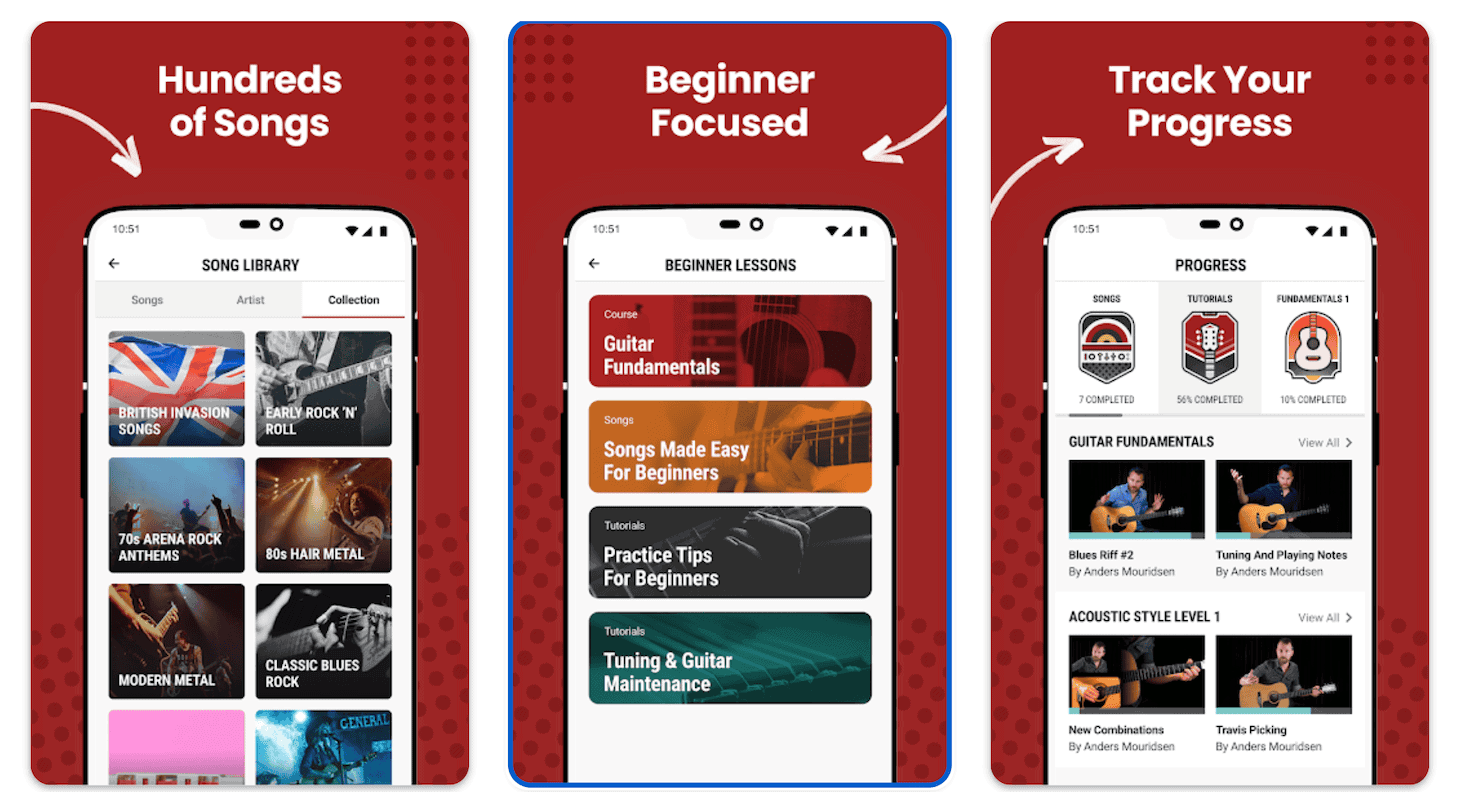
I don’t know how I went this long not knowing about Guitar Tricks. When I started learning guitar in the mid-2000s, Guitar Tricks was already almost a decade old!
As with a real guitar teacher, the decades of experience offered here make for a superior experience.
Guitar Tricks could simply be called “pro musicians teach useful stuff.” It lacks the fancy overlays and graphics that other apps offer. It doesn’t have the overly gamified “beat this level and get to the next one” approach of some modern online guitar lesson platforms. I actually prefer this approach: the roadmaps on offer here are truly excellent for learning to play guitar.
Although Guitar Tricks boasts mobile app versions, I mostly used it on my laptop computer.
To give you an idea of what Guitar Tricks is like, I’ll walk you through my user experience.
Three big, friendly panels greet you on the home page, marked Beginner Lessons, Advanced Lessons, and Song Library.
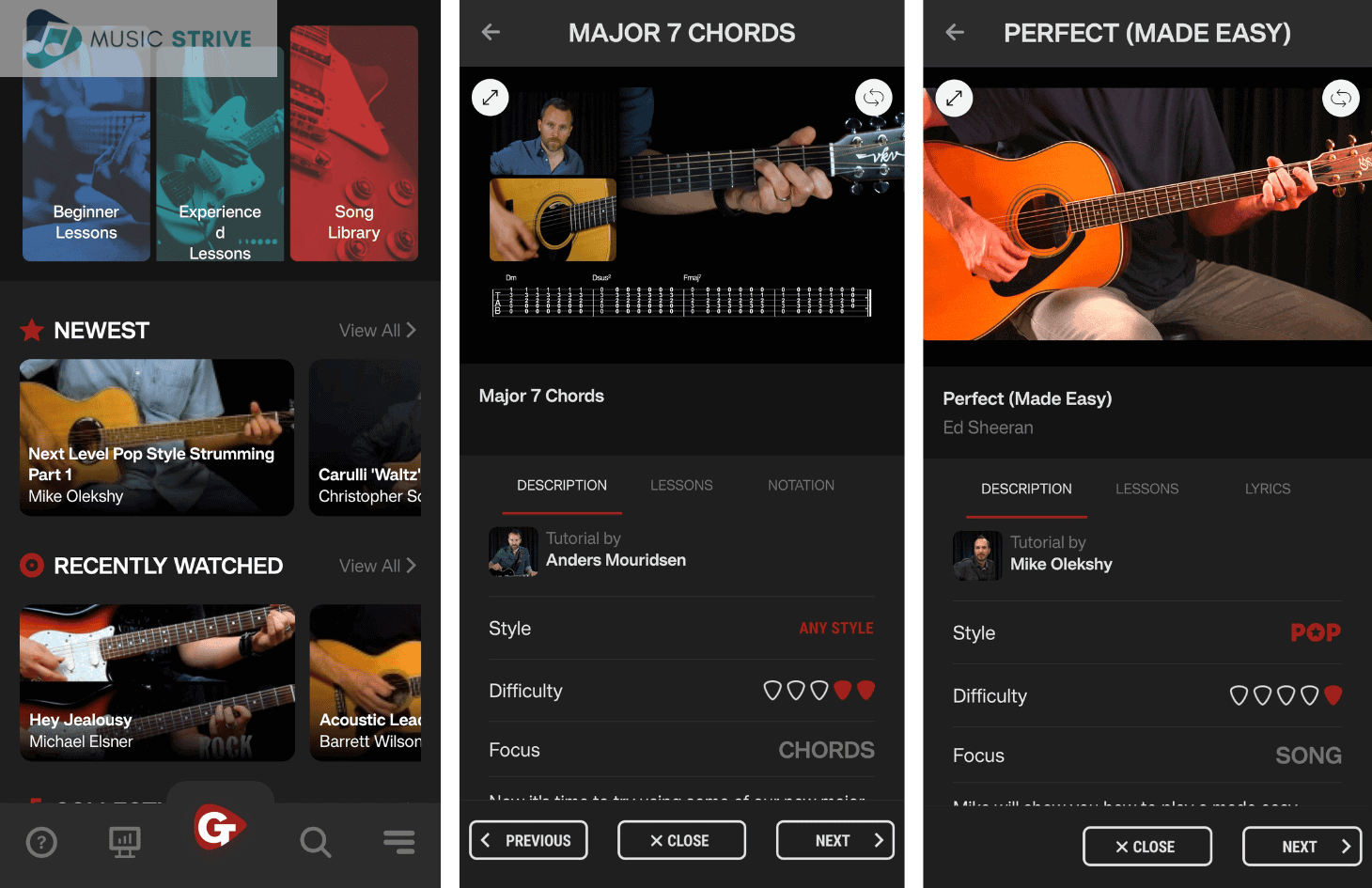
Screenshots of me browsing around the Guitar Tricks app.
Clicking on Beginner Lessons reveals the basic pathway of the platform: Guitar Fundamentals 1 and 2, followed by more style-specific lessons.
By “Fundamentals,” they really do mean Fundamentals. The first level is the most basic of basic guitar knowledge, covering terminology, tuning, basic chords, and strumming patterns.
These fundamental levels will probably feel redundant for any intermediate to advanced players, but it’s always worth rediscovering the basics. At each level, Guitar Tricks recommends suitable songs for practicing your freshly learned techniques, scales, or chords.
Some guitar players, like me, will remember having to learn teacher-prescribed songs. For some reason, they were always classic rock tunes from my dad’s era. How many early-21st-century beginners struggled through “Back in Black” or “Smoke on the Water,” I wonder?
Being able to choose from recommended practice songs is a real boon here.
Following the Beginner lessons, you can move on to the Experienced Lessons, and they allow you to choose a pathway. You can do Blues, Rock, Country, or Acoustic. You can revisit this section at any time, however, so don’t feel like you’re locked in as a blues player if you want to visit country or acoustic styles.
Each of these levels adopts a similar approach, offering the chance to learn techniques, songs, and an in-depth look at the application of basic music theory for the style.
The learning paths cover four genres, although they might better be described as styles. The final panel on the home page, the Song Library, features music from twelve genres, really covering everything from pop to metal.
Rock and blues styles are well covered here, but the song library feels very sparse for niche genres like surf. Pop, too, is poorly catered to here, with few representations of contemporary pop tunes.
That might be because there’s very little guitar in modern chart-toppers. Ed Sheeran, for example, gets an obligatory inclusion, but I worry that teenagers and total beginners wanting to play guitar might benefit from learning to play along to songs they recognize.
There’s the glaring omission, for example of Taylor Swift songs. I can’t think of a bigger artist on the planet right now who features guitar in their music and plays guitar themselves. The lack of Swiftie-friendly material might just be a case of the music industry’s litigious approach to copyright, but it feels like a major absence given the modern pop landscape.
Regardless, the videos offering tuition for the niche genres are excellent. Likewise, the Made Easy feature offers beginner-friendly playable versions of appropriate songs.
The video production value is sterling, and all the instructors are clear, concise, and engaging in their delivery of the material. While there are no luminescent fretboard animations here, I prefer the standard notation and tablature offered by Guitar Tricks. The inclusion of notation is particularly useful in my opinion, as it helps with nailing trickier timings and rhythms.
I feel like beginners and intermediate players will get the most out of Guitar Tricks. Most of its content is aimed at less experienced players. However, even advanced professionals will find value in the program here. Unless you’re Guthrie Govan, there’s always a style you haven’t mastered or a new song or technique to learn.
Guitar Tricks offers advanced players the chance to feel the giddy high of being a beginner again, rediscovering their instrument one fret at a time.
2. Simply Guitar
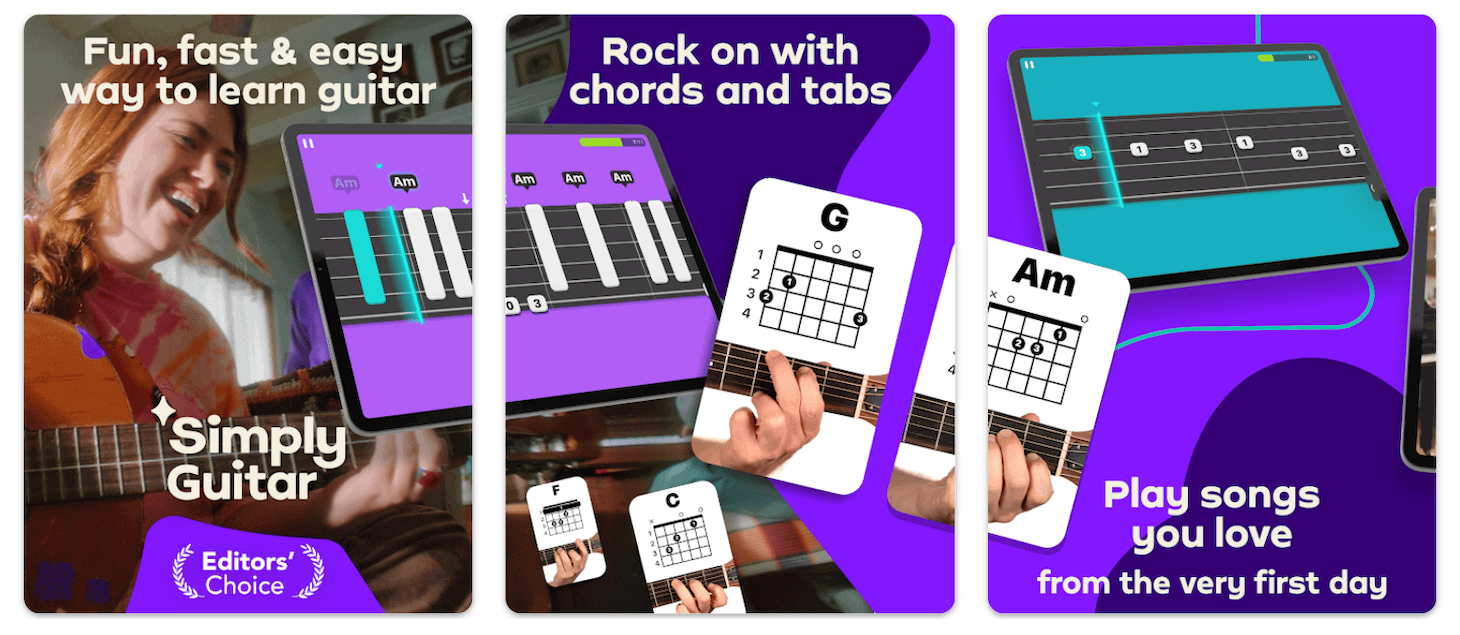
Simply Guitar does what it says on the tin. It’s a simple way to learn guitar.
It’s clearly aimed at beginners and entry-level players. The interface feels aimed at younger learners, with big, friendly lettering and simple icons.
The software asks basic questions like what you want to do with your guitar playing, and makes no assumptions about your knowledge. It even explains the difference between electric and acoustic guitar (“requires an amplifier” versus “all metal strings”).
It goes through the absolute basics of playing guitar, but the depth of knowledge ends at, in my opinion, intermediate level. There’s not much on soloing and lead playing, for example.
It’s heavily gamified, listening to your playing via your phone mic to track your notes and determine if they’re good or not. Honestly, it reminded me more than anything of playing video games back in high school. I think of Simply Guitar as Duolingo meets Guitar Hero.
This is far from a traditional approach to learning guitar, where you learn a concept, drill it until you feel confident, and move on. It feels more like a video game, where you advance through levels as you go forward through the game.
It’s a fun way to get to grips with your instrument, offering a more stimulating environment than an unaccompanied, unplugged guitar on its own. Beginners suffering with motivation and discipline will benefit enormously from real-time feedback as they’re playing.
Beginner and early-intermediate players will find plenty to enjoy here. More advanced guitar players or beginners who don’t want to have their learning experience to feel like a kid’s video game would be best to look elsewhere.
3. Fender Play
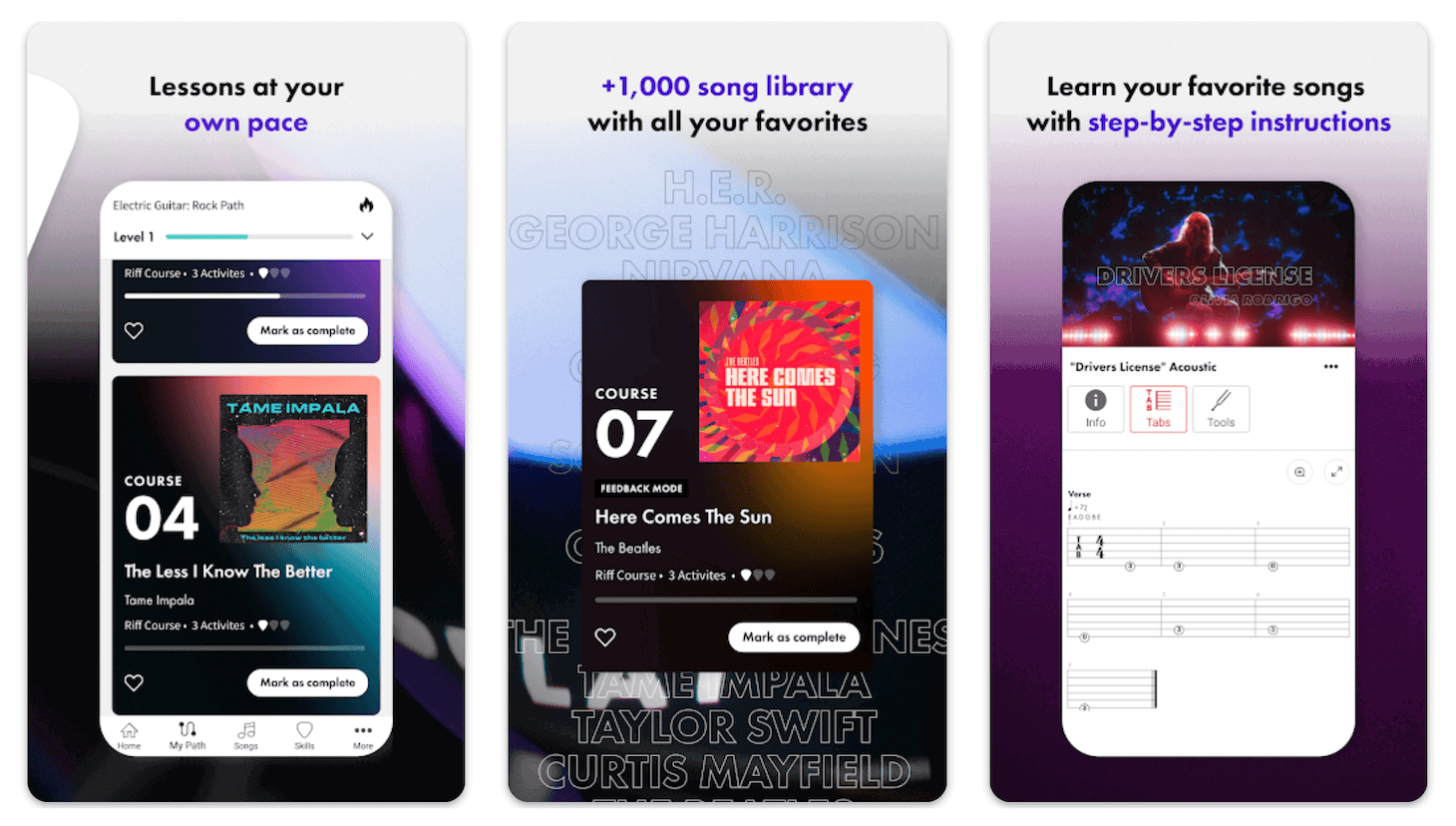
Getting guitar lessons from one of the biggest guitar manufacturers on the planet just makes sense. When I was a kid, Fender had the beginner market almost cornered with their Squier beginner kits, including amp, lead, and a Stratocaster copy. Why not double down with their own in-house learning app?
Fender Play, like the brand’s legendary guitars, feels very stylish and contemporary. The feel of the app is the same across devices: I tried it on a tablet, a phone, and my computer, and there wasn’t much difference.
As a learning experience, Fender Play feels very intuitive. You pick an instrument (in this case, guitar) and a genre, and Fender Play sets you down a learning path consisting of several levels. Each level is made up of several courses going in-depth on the relevant concept.
The lessons have tabs, which is a welcome addition, but Fender Play lacks standard musical notation, making identifying finicky timings and rhythms trickier.
There’s a Practice Mode for you to play along to a scrolling tab with a backing track. It’s not quite Guitar Hero-esque, but it does include the option to slow your backing track down as you get to grips with the exercise.
There’s also something called Feedback Mode, which evaluates your performance via your phone microphone. It scores your performance, evaluating where in the exercise or song you played well, and where you need to improve.
Perhaps the best feature of Fender Play is its exhaustive song library. It’s not limited to legendary tunes that featured a Strat or Tele, either. The song library covers far more than the classic rock and blues of other apps.
Modern beginners probably hear guitar in the music of Ed Sheeran, Taylor Swift, or Olivia Rodrigo more than AC/DC or Stevie Ray Vaughan. The inclusion of the modern pop songs that feature guitar is a welcome one.
One feature that more advanced guitar players will appreciate is the Skills section, which offers exercises tailored to particular techniques. These are lifted directly from the instrument-genre learning paths, but they offer a chance to work, for example, on your bends or hammer-ons without running through Fender Play’s entire rock course.
I wouldn’t recommend Fender Play to high-level players, however. There’s just not enough content to address the finer points of guitar playing, particularly for those who are years into a playing career. For beginner players and younger guitarists who prefer Ed Sheeran to Edward Van Halen, Fender Play is the place to be.
4. JustinGuitar
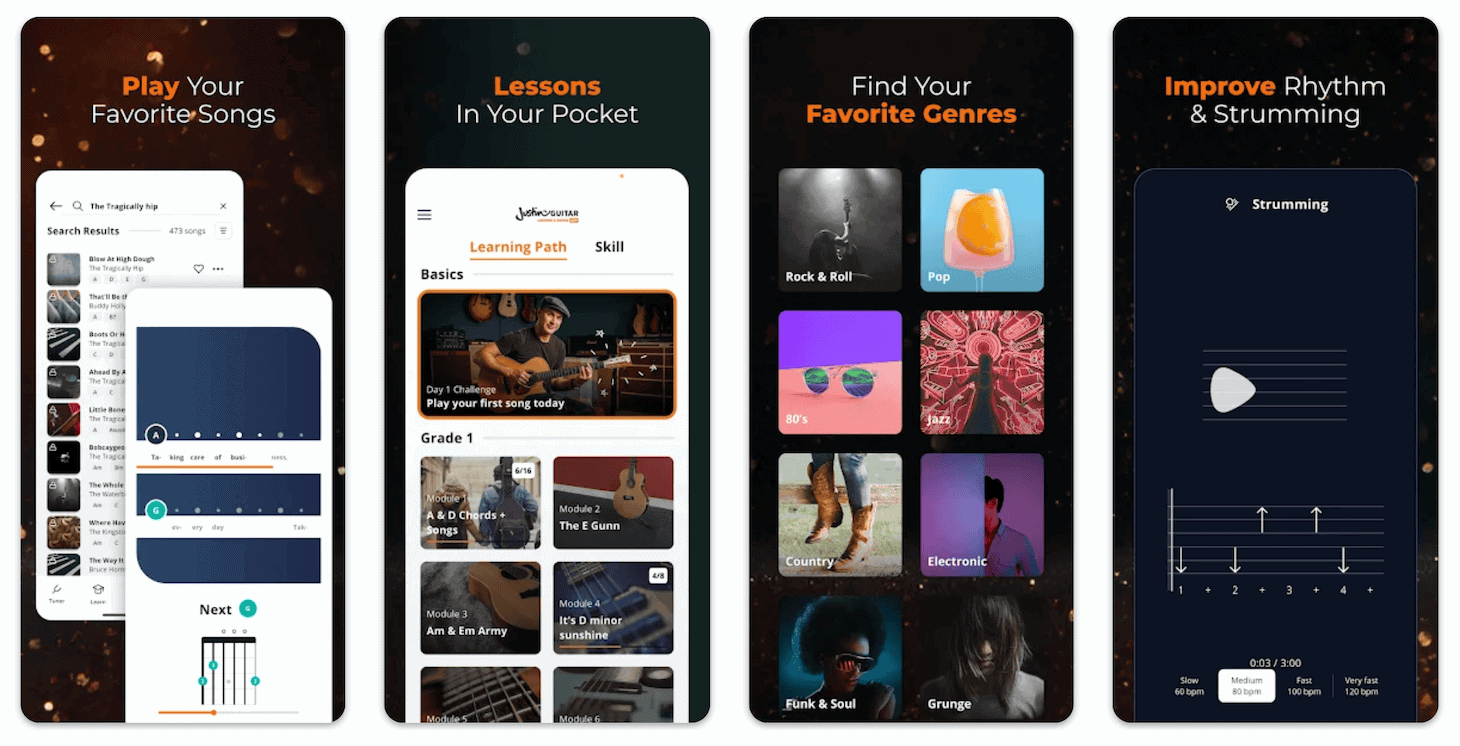
As the name suggests, the main appeal of JustinGuitar is Justin himself. It’s a simple enough proposition: free guitar lessons from an affable Australian man.
Justin delivers his video lessons with minimal sizzle and maximum steak. That is to say if you’re used to zany, wacky YouTuber-style engagement, this won’t be for you. If you want thoughtful, informative, occasionally drily humorous content, Justin is the man.
The most appealing thing about this course, apart from Justin himself, is the price point. Pretty much everything on JustinGuitar is free. The video lessons themselves come with fairly exhaustive notes and chord charts. You’re getting great value for money here, and there are some sections of the site, namely his premium courses, behind a paywall.
Although there’s plenty of content for beginners and intermediate players, JustinGuitar also offers deep dives into particular skills. If you’ve ever wanted to cover the ins and outs of arpeggios or ear training, Justin has a learning pathway for you.
Of course, the song library offers plenty of material. There’s about 700 songs in JustinGuitar’s lesson library. As you’d expect, it’s heavy on guitar-forward bar-band material. The top ten is dominated by the likes of Clapton, Knopfler and Led Zeppelin. There are much worse places to start than by learning your favorite songs, however, and as a learning resource, JustinGuitar offers plenty of value.
5. Yousician
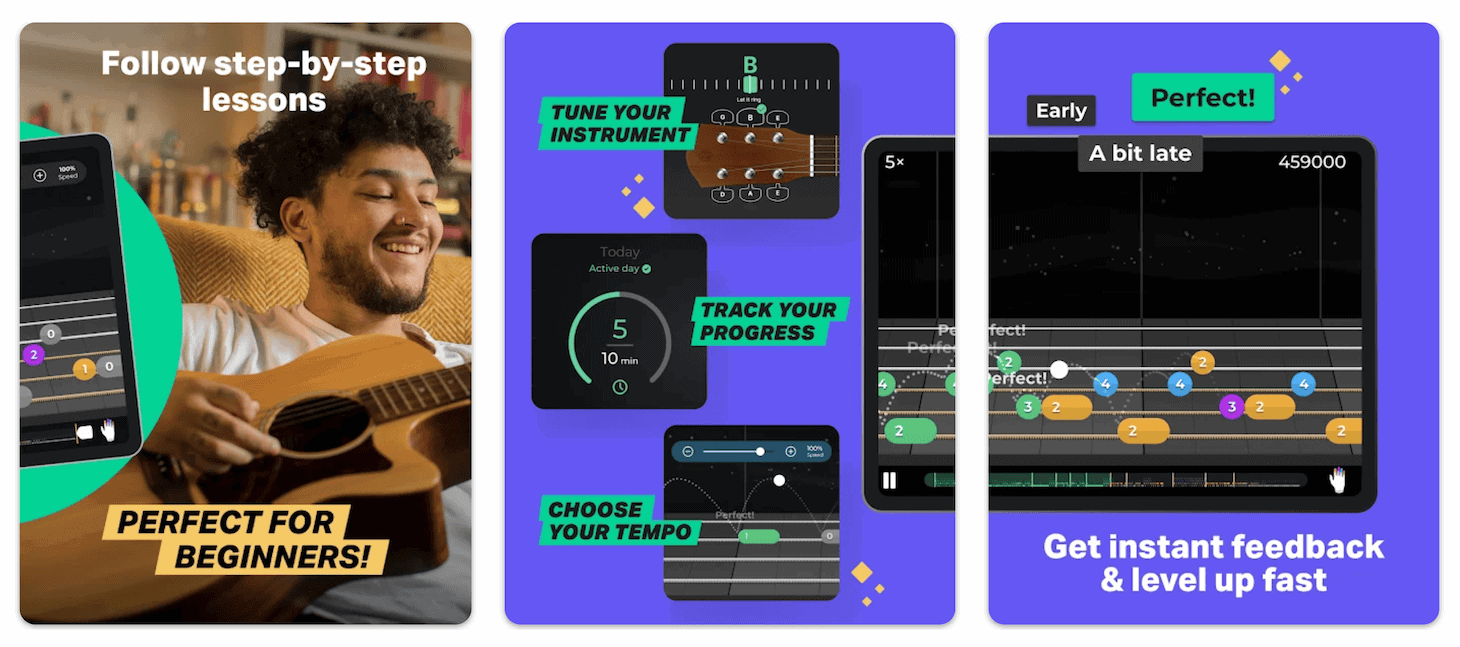
If you have an elementary school-aged kid looking to pick up the guitar, Yousician may well be the app for you.
I firmly believe that learning guitar, especially in the crucial first year, needs to be fun. With that in mind, the Yousician app (Android / iOS) successfully gamifies the learning process. For me, it errs too far on the side of gamification to be appealing, but my seven-year-old nephew loves it.
There’s no browser app here: you’ll have to install Yousician on your phone, tablet, or computer. It feels best on a tablet or phone. Yousician is not immune to the ultra-minimalist app design principles popular these days: the opening screen offers three options, Song, Learn, and Challenges.
Selecting “Learn” leads to another menu, offering Missions, Workouts, and Courses. I’m not going to lie: as a guitar teacher, I feel like beginners just want to get started. I can’t help but wonder if I’d find it more intuitive if I was a decade younger. The bright colors and minimalist aesthetic remind me more of the mobile games kids play than of Guitar Hero.
When I was a beginner, I never embarked on guitar “missions” or “workouts”. I just played! That’s my old-man-rant over.
As a beginner, you’ll want to select “Missions” as that’s where all the basic knowledge is. The missions feature levels with video demos of the technique or concept and exercises for you to play along with. The exercise presents an animated fretboard, scrolling away offering new notes and chords for you to play.
I can’t see this being useful to intermediate or advanced players beyond improving their timing, which is punished or rewarded according to your accuracy in playing notes when cued by a bouncing ball graphic.
Older, and more advanced musicians will struggle to enjoy the kid-friendly gamified learning on offer here. However, absolute beginners and kids who love music will find plenty to love with Yousician.
Is It Possible to Learn for Free Online?
As terrifying as it may seem to younger players, when I started playing guitar, there was no YouTube for me to turn to for a lesson. No Marty Schwartz and his jovial little hat, or JustinGuitar offering free instruction. My main source of online education was the various tab sites populating the internet, particularly UltimateGuitar.
I learned a lot doing this. My method was, and still is, to try to learn as much of a song by ear as possible, then check the tabs online to see how close I was. Sometimes, I realized, my by-ear learning was more accurate than the tabs someone else posted.
Therein lies the risk of learning for free online: most of what you can find, say on UltimateGuitar or YouTube, is just someone else’s interpretation of the song you heard. It may or may not be accurate. This is especially true for guitar tabs, although it can also be true of technique.
In teaching myself to play guitar, I learned mostly by trial and error, and from watching my guitar-playing friends. In doing so, I picked up some pretty atrocious habits. I routinely over- or under-bent notes, neglected my picking technique, and most unforgivable of all, forgot to mute unplayed strings on my electric guitar.
UltimateGuitar, these days, offers a broad range of services beyond its old bare-bones user-submitted tabs. Sometimes it feels like a gossip column for guitarists, with the news section dominated by updates on the opinions and habits of various guitar players.
The millions of tabs on UG offer hours of fun for guitarists learning to play their favorite songs. In my experience, their other offerings, including courses and videos, pale in comparison to the dedicated learning apps in this article.
Luckily for me, an older guitarist took me aside and corrected these tendencies. However, if I’d had access to online guitar lessons, I might not have made these mistakes.
Despite this, I learned plenty just by making mistakes and listening to music. To this day, I believe that once you’re out of the woods of beginner guitar, the best way to improve is simply to learn songs you love and play along with them.
In other words: once you know how to form chords and play in time, you should be learning songs as well as concepts and techniques. As I’ve stated many times, playing guitar is supposed to be fun. You’re meant to enjoy every minute of it. Sometimes, finding the right course can accelerate this and help get you over your learning “speed bumps.”
Closing Thoughts
Learning to play guitar might have been the most formative decision of my life. Picking it up at twelve years old has brought me more joy in the years since than just about anything else, including seeing Liverpool win the Premier League.
If you’re thinking about learning to play, my advice is as follows.
Don’t think about it. Do it. Pick up an instrument, learn a few chords, and play along to your favorite songs. I promise you won’t regret it. Hopefully you’ll find a great online course through this article.

Yeah. When I started there was no internet. We just played and figured it out. I first learned to tune. I would practice with a piano and use it to tune with. Finally I started learning songs by ear using a record player and slowing down the songs with my finger and playing the same few notes over and over until I figured it out then moved on. Even then I didn’t always get it right I later learned when watching the artists on TV or in concert, but at the tender age of 63 I have become quite advanced. I did a lot of playing in the 80s when guitar was an Olympic sport it seemed and even played in a couple bands at pool parties and small bars in the Indianapolis area.
Regards
Tim