
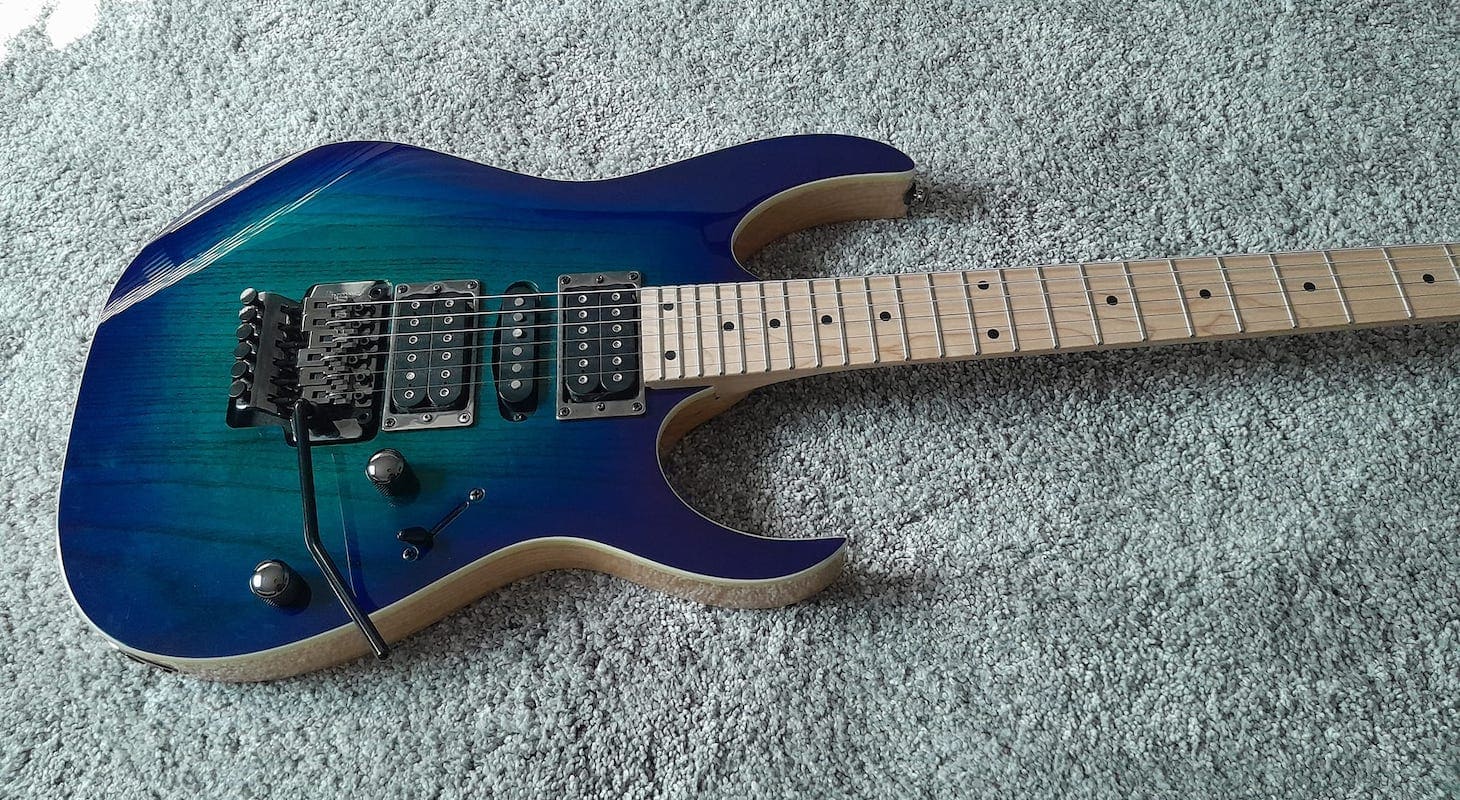
Can tremolo systems change your playing? Well, they can surely extend your sound palette while adding a few tricks and moves to your catalog. The thing is that you’ll never know just how fun it can be and how far it can take you until you try one.
I know, the options are endless, but worry not because yours truly went out to try out a bunch of guitars with different tremolo systems, vibrato systems, pickup configurations, and wood combinations to bring you the best guitars with a whammy bar out there. The whammy bar is about to become one more element in your arsenal of killer moves.
Top 3 - Guitars with a Whammy Bar
Ready? I’ll show you the way to your dream whammy-bar-equipped wailing axe!
9 Best Guitars with a Whammy Bar
1. Fender American Professional II Stratocaster
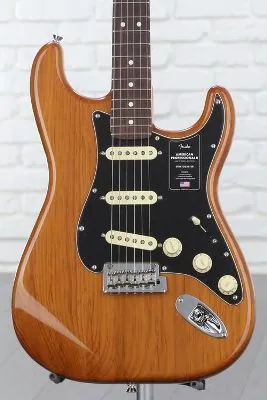
This guitar, the Fender American Professional II, and its more expensive sibling, the Fender American Ultra Luxe share the same tremolo system, a 2-pivot modern incarnation of the classic created by Leo Fender in 1954.

Fender American Professional II Stratocaster - Dark Night
The 2 pivots replace the traditional six bolts holding the tremolo system down and, during my playing time with this guitar, made the tremolo more stable and the guitar easier to intonate.
But that’s not all, because this Stratocaster could hold notes and sounded extra bright. I went online looking for the reason and it turns out that Fender made the tremolo’s steel block out of cold-rolled steel. This upgrade to the material, although a small nuance to the playing, felt like it enhances sustain and gives the guitar an extra dose of brightness. Well done, folks.
Speaking of which, this is a tremolo that’s good for vibrato effects, adding some motion to your playing here and there, but wasn’t built to play divebombs or take any natural harmonics to the moon (sorry Dimebag).
Using it like a traditional Stratocaster, I was in guitar heaven with how smooth it felt, how good it sounded, and how well it always retained the guitar’s tone.
2. Schecter Hellraiser C-1 FR-S
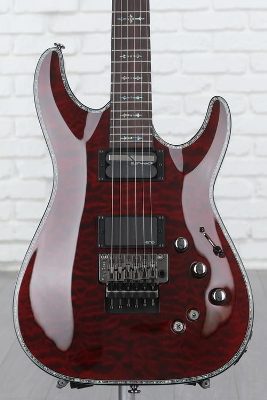
This version of the Schecter Hellraiser C-1 comes equipped with two great appointments not found in the rest of the Schecter line.

Schecter Hellraiser C-1 FR-S
First, let’s talk about the locking tremolo system. The company went the extra mile and installed a real Floyd Rose 1000 on this model. This means that you’ll be playing through the years of innovation and experience and enjoying the great accuracy of the original tremolo system that made Eddie Van Halen king of the guitar world.
Moreover, since it’s a floating tremolo system, you’ll get to combine it with the second awesome appointment which is the Sustainer pickup. Here’s how it works and sounds.
With these two together, there was virtually nothing I couldn’t do with this guitar. I’m talking about shredding but also about single-note melodic passages, and even ambient chords sustained forever.
Perhaps, the only downside to this locking tremolo system is that if you break a string live, your entire guitar will go completely out of tune in a nanosecond.
Other than that, I played the dark cherry version of this guitar attempting my best Kirk Hammett impression and I was quite accurate. This is one serious metal machine created to push your sonic boundaries (as long as you don’t break a string).
Read my full review of the Hellraiser C-1 FR-S.
3. Jackson Dinky JS22
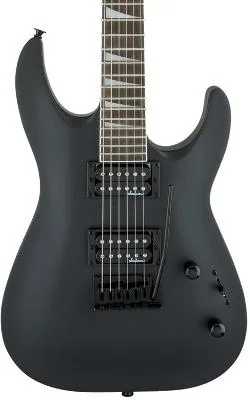
The Jackson JS22 is one of the few Jackson guitars featuring a 2-pivot Fender-like bridge nowadays. In my opinion, after having played one of these and having played the quintessential Jackson USA Dinky DK1, it feels more like a budget decision rather than a decision based on sound or comfort.

Jackson Dinky JS22 DKA
Yes, traditionally, Jackson has been a metal-oriented brand and was one of the pioneers in floating tremolos, fast necks, and high-gain pickups. Although this guitar carries the same spirit and offers some of those appointments (like a comfortable and super-fast neck), the locking tremolo (to go absolutely bananas on) was deeply missed during my trial of it.
This guitar can be a great access point to the brand for beginners, enthusiasts, and hobbyists because you can have a taste of the great Jackson tone without breaking the bank.
This is an entry-level instrument with a big budget cut in the accessories department. In other words, generic pickups were noisy, generic tuners couldn’t hold my tremolo abuse in tune, and the tremolo usage needs to become rather limited.
I suggest the next level, the Jackson Pro Series Dinky DK2 for those looking for a mean metal machine to abuse and shred on.
Further reading: my full review of the Jackson JS22 Dinky
4. PRS SE Custom 24
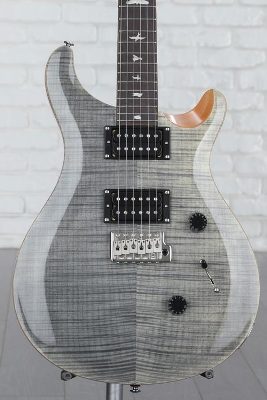
If I was to compare Fender to PRS, I would logically say that they are very different brands. Moreover, I would say that the latter is a more innovative and modern company than the first.
Well, when it comes to tremolo systems, that equation seems to reverse since PRS’s tremolo systems go back to the idea of the six springs. If you play both, you’ll notice that there’s a slight difference between them.
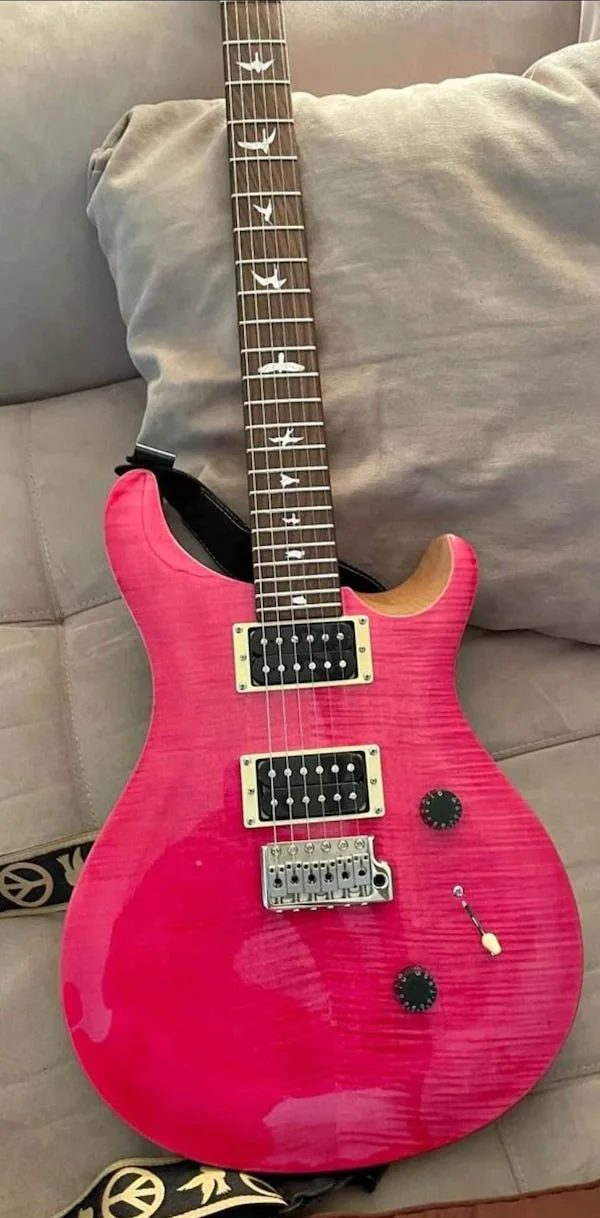
PRS SE Custom 24
When I first started playing the beautiful PRS SE Custom 24 (in awe-inspiring charcoal finish), it was obvious that the action is different from a regular Fender trem. But It’s not just the six springs, the way you insert the whammy bar is different, so it doesn’t move which makes it more accurate to operate. Also, it feels just a tad smoother than the Fender two-pivot model.
Perhaps, for someone who played a few PRS Custom 24 and PRS Private Stock guitars, this feels a little rough around the edges. But that’s something only a pro player would notice; this is a great dual-humbucker option for whammy bar abuse.
5. ESP LTD EC-1000FR
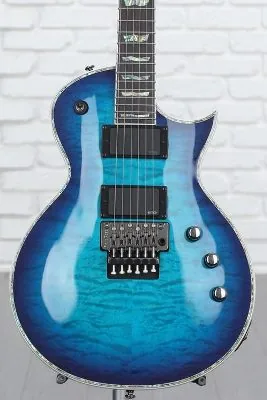
There’s just something about set-neck guitars with floating tremolos that is just not been explored enough. The level of sustain and the tone that a single-cutaway body and the construction type can provide can help a bent note being pushed to the sky with the tremolo.
I tried that as my first move after picking up this mean-but-pretty-looking guitar. It was a great experience because the active EMG pickup set and the original Floyd Rose tremolo are a match made in heaven.
Of course, like with any other floating tremolo system in history, if you break a string, you’re doomed. Other than that, the action on this ESP LTD EC-1000 FR was like playing butter with a cool vibrato system.
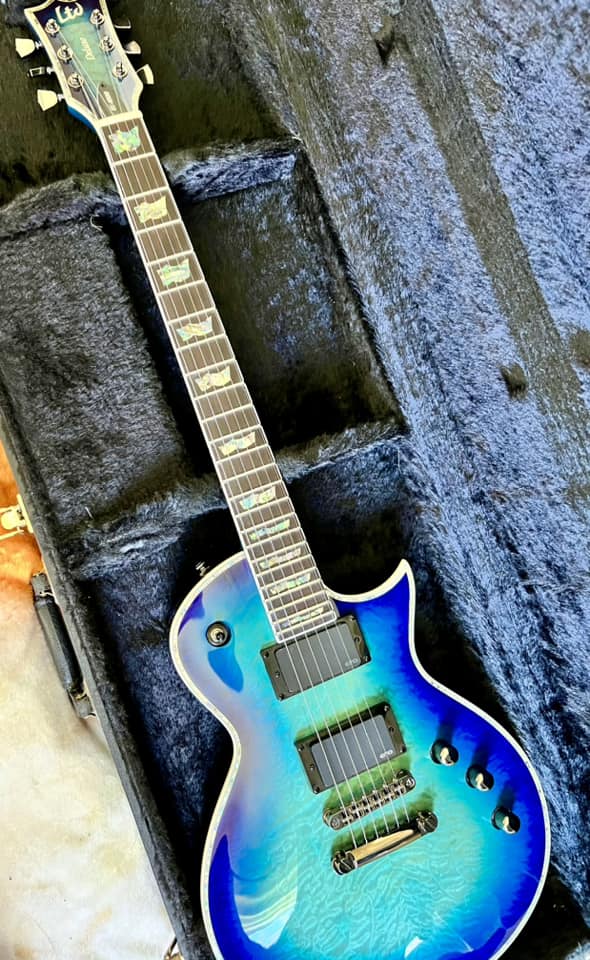
ESP LTD EC-1000FR
Before putting the guitar down, I went for a divebomb effect in the middle of a mean riff and the guitar came back to perfect tuning and stayed like that for a whole other minute.
Finally, I must warn all those fellow guitarists with a taste for hard rock and metal that EMG pickups require a learning curve, so don’t be freaked out by them, their transparency and accuracy will make you a better player.
6. Yamaha Pacifica PAC612VIIFM
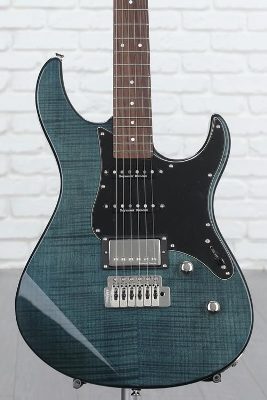
“WOW!” That was my first word when I saw this Yamaha Pacifica PAC612VIIFM in that beautiful flame maple finish. I mean, although it’s laminated in this price range, the soft blue dye puts it into 3-d territory.
I played it for two minutes and realized it’s the perfect guitar for those who want the comfort and speed of a super Strat with the traditional tones of a Strat. Yes, the Seymour Duncan TB-14 and SSL-1 combine to make a very usable HSS configuration (with a coil tap for the humbucker).
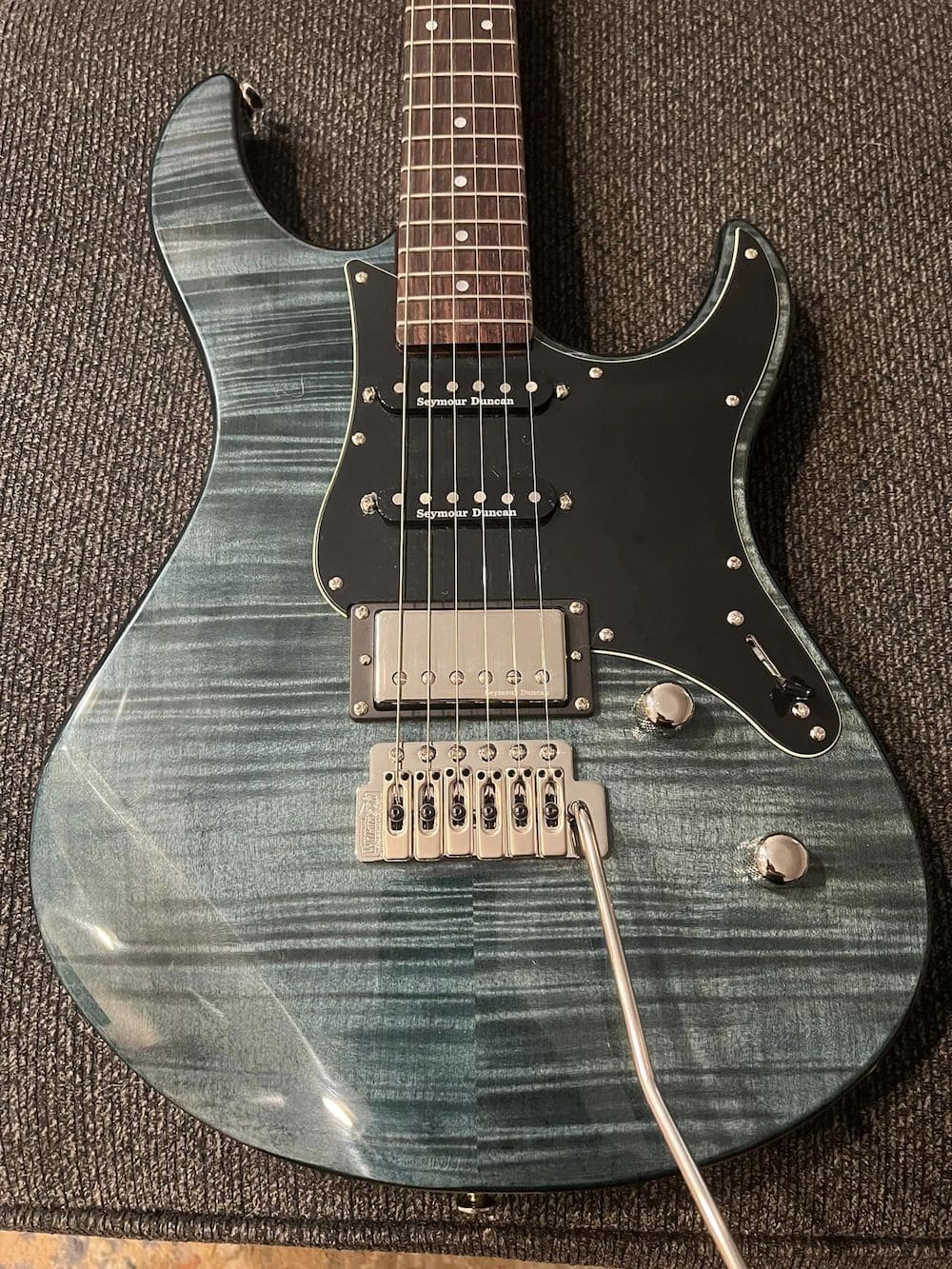
Yamaha Pacifica PAC612 VIIFM
This goes perfectly well with the Wilkinson VS50 bridge, a modern iteration of the single-action Strat bridge and a steady whammy bar that lets you add vibrato to any note in a wailing solo or do color touches with that neck pickup playing your favorite blues licks.
Finally, if you’re looking for a cool Strat that can offer you a very wide palette of tones, this guitar is a great contender, especially with that price tag. For tremolo abuse and shredding, you might be better off with another axe.
Read more: Our Full Yamaha Pacifica PAC612 Review
7. EVH 5150 Series Standard
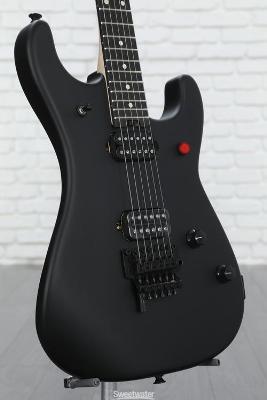
When you think of wild players who made locking tremolos famous worldwide, the name Edward Van Halen should come to mind. Well, it surely does come to my head. So, this list couldn’t go missing a guitar with his name on it.
After all I said before, let me tell you I was just as surprised as you are when I realized the original Floyd Rose R3 locking tremolo on this EVH 5150 Series Standard is a single-action bridge.

EVH 5150 Series Standard - Closer Look
It has a very logical explanation that’s just behind the bridge and it’s called D-Tuna. It was Edward’s invention, and if you pull it, you can have a drop-d guitar with a locking tremolo. Yes, and it works perfectly too.
I tried pulling off some of Eddie’s tricks and the ebony fretboard added good snap and definition for the basswood body. The pickups are mean and this guitar screams “Shred me!”. So I did and while at it, I abused the tremolo throwing all kinds of divebombs, soft touches, and hard touches and the guitar stayed perfectly in tune the whole time. It’s a rocking instrument that does only one thing, but it does it perfectly well.
8. Ibanez RG470AHM
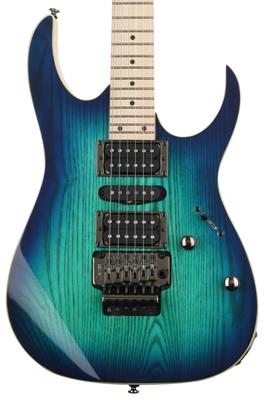
This Ibanez RG470AHM is the very definition of the super Strat that reigned supreme in the eighties. To begin with, the combination of an ash body with the maple neck gives you a razor-like tone that cuts the mids and can rip apart the densest mix during a wailing solo.
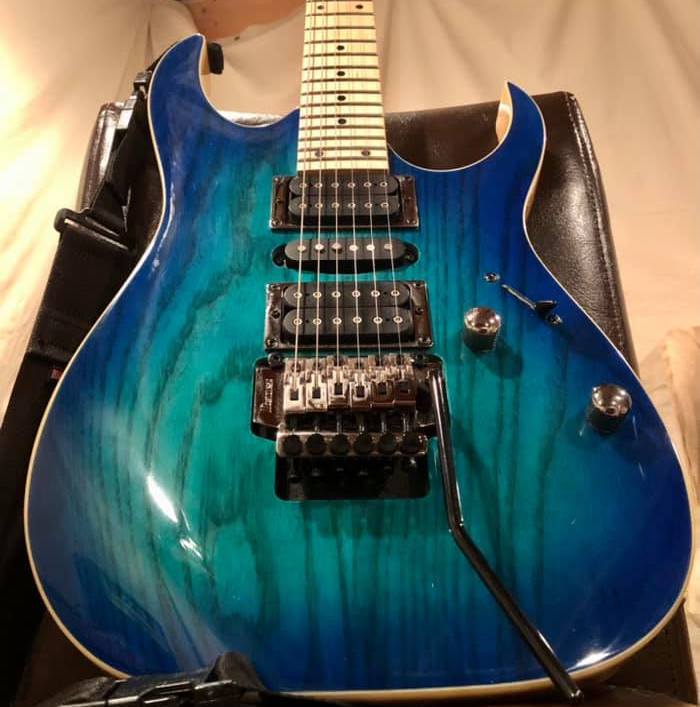
Ibanez RG470AHM
Speaking of which, the 24-jumbo-fret Wizard III neck is perfect for the double-locking Ibanez tremolo and the super low action you can get on this shredder. Shredding is what I did with it playing some bits of Vai and Satriani to test the speed and reliability of the tremolo system and the amazing profile of the neck.
In the same vein, I tried every sound the Ibanez Quantum pickups could give me, and I can tell you this is a metal-ready guitar that can take your playing straight to the hundred-notes-a-second highway where you can speed up easily. Plus, the super accurate tremolo action allowed me to play pitch-perfect solos for a while without even thinking about tuning.
I left the guitar behind after some divebombs and other tricks and I have to say that it was like getting down from a fast car. On the other hand, if you’re not into modern ergonomics, looks, and sounds, you’d be better off looking for a different guitar.
9. Epiphone Wildkat
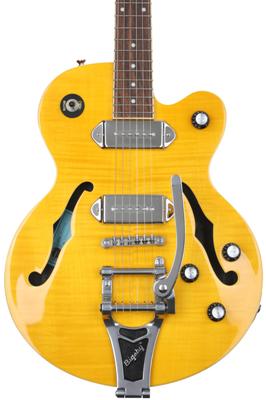
Update: The Wildkat is suffering from availability issues right now, with some retailers suggesting that it has been discontinued permanently.
Dual P-90 pickups and a true Bigsby vibrato bar make this guitar the perfect candidate for rockabilly, psychobilly, rock and roll, and punk rock players who want to recall that tone, feel, and sound.
Yes, the moment I picked up the Epiphone Wildkat and played it against my chest, it hit me immediately that this is a guitar designed to vibrate to old-school tunes.
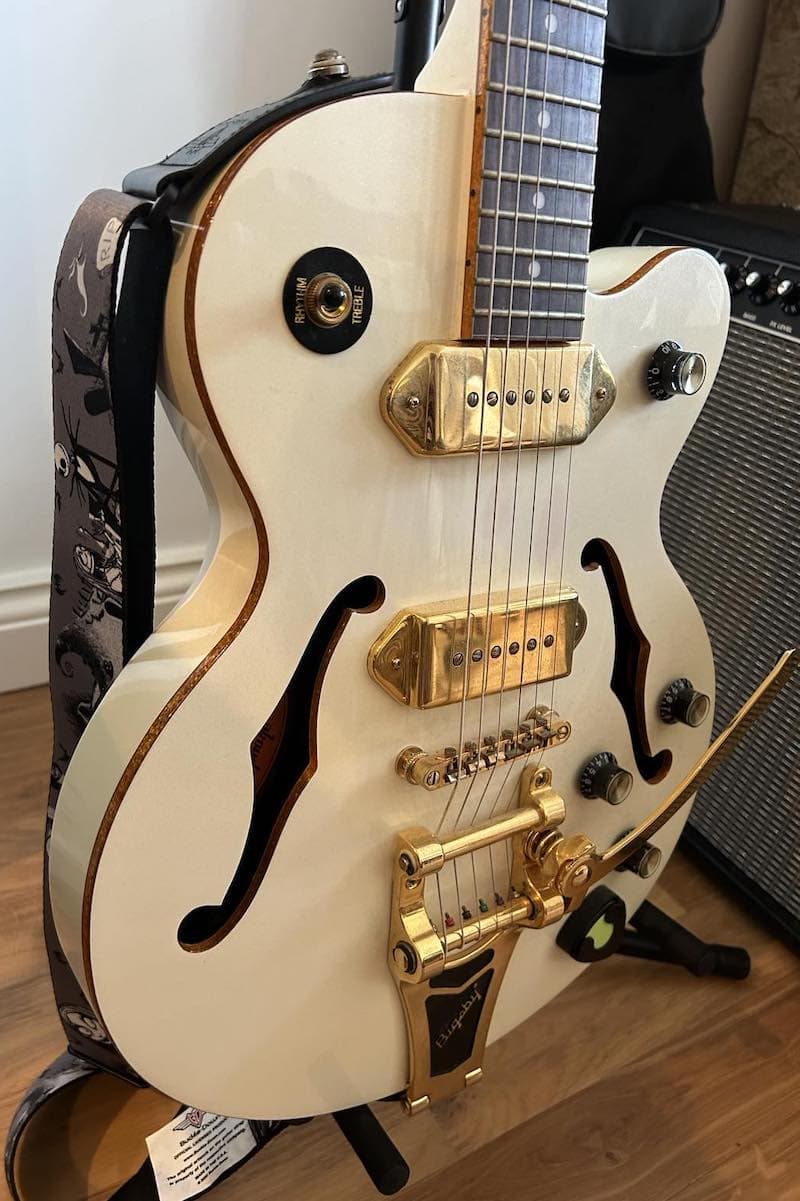
Epiphone Wildkat
First, I tried some Brian Setzer, and while the original Gretsch Filter’Tron snap wasn’t there, the biting, fierce (Alnico-V) P-90s sure did a good job taking the guitar to overdrive territory.
Secondly, I tried going toward some Chris Isaak terrain playing the intro riff to “Wicked Game” and the vibrato was pure butter moving the notes swiftly and accurately. Finally, I played some hard punk on it to see if I could get it out of tune and I was kind of successful, but not too much.
The Epiphone Wildkat is great if you don’t need modern, high-gain tones (it’s semi-hollow, so watch out for distortion and feedback). The Bigsby action is perfect for soft vibrato action and a little detail here and there. If you’re looking for a tremolo system to abuse, this might not be the best option.
Whammy Bars, from Natural Vibrato to Divebomb Action
To begin this piece, let me take you on a trip to the past. We’ll have to go more than half a century back to 1932, the year Doc Kauffman created the first vibrola that went on to become part of the Epiphone sound and into some Rickenbacker models.
Later on, by 1953, Paul Bigsby came up with his iconic design that can still be seen in many classic-looking guitars, reissues, and rockabilly, psychobilly, rock and roll, surf music, and country-oriented brands such as Gretsch, Epiphone, Gibson, and many more.
Just a year later, in 1954, the Stratocaster and its innovative tremolo design revolutionized the market entirely. That was the last big revolution until 1979 when Floyd D. Rose invented the double-locking tremolo we now know as Floyd Rose.
From soft vibrato effects in the ‘40s and ‘50s and the crazy wailing of the eighties, vibrato and tremolo systems have been shaping the soundtracks of our lives for a long time.
Isn’t it about time you joined the movement?
Bringing Down the Tuning Stability Myth
The first thing that comes along with tremolo systems for most people is the tuning stability myth. Why is this a myth? Well, it’s a myth because there’s some truth to it and because there are so many elements involved in tuning stability that blaming it all on the tremolo system is a big mistake.
Let me address this from three different guitar parts:
The Tale of The Oily Nut
Once upon a time, an oily nut let strings move through it with ease adding tuning stability to the brave rocking lead player abusing the whammy bar on the guitar.
Yes, fairy tales aside, since the invention of Fender’s Roller Nut, the concept that the nut is the one bringing the guitar out of tune when using the whammy bar has been growing.
So, you can either install one of those or make sure to oil the nut very often to create the same effect but through lubrication before blaming the tremolo system.
Calibration, A Must
Sometimes, I as a guitarist overlook the fact my guitars need calibration and a professional setup. There’s absolutely no other way (except possessing that skill yourself) to make sure all the aspects that make tuning stability are dealt with at the same time.
For example, string height and their pull affect a tremolo system and your playing experience drastically; most luthiers can solve that. Take your guitar to a professional before blaming the tremolo system.
It’s In The Tuners, Ma’ Boy
There’s one last inexpensive experiment you can perform with your instrument before blaming the tremolo system for the out-of-tune performances. Yes, most entry-level guitars and even mid-priced models come with generic, rather cheap tuners that tend to go out of tune even without touching the tremolo system. Try getting some Sperzel locking tuners and try wailing the whammy bar then.
Locking or Non-Locking Tremolos?
In the whammy bar world, there’s no right or wrong, but there are surely some pros and cons to each approach.
Let’s divide tremolos into those that include a double-locking system and those that don’t. For example, a Floyd Rose vs a two-pivot regular Fender-style tremolo.
Pros & Cons of a Locking Tremolo System
PROS:
- Tuning accuracy through microtuners
- Guitar won’t go out of tune regardless of the whammy bar use
- Allows dual-action, floating tremolos
CONS:
- Restringing the guitar is much more difficult and time-consuming
- Maintenance and calibration require more experience and knowledge
- String breakage takes the whole system out of tune
Pros & Cons of a Non-Locking Tremolo System
PROS:
- Guitar setup and restringing are rather easy
- Works for subtle effects and also for creating new sounds (Hey Jimi and Jeff!)
- Most techs in the world can work on it and fix it.
CONS:
- Doesn’t allow for double-action floating tremolos
- Whammy bar abuse can take most non-locking guitars out of tune
- If not properly calibrated, it can affect tuning stability and instrument sustain
The Bottom End
Whammy bars and tremolo-equipped guitars can transform into an opportunity to open your playing abilities to a different plateau. Keep growing as a guitarist and add more tricks to your catalog of crazy moves with a whammy bar; the sky is the only limit.
Happy playing!

Yeah. LOVE all tremelos. My fav of course is the German Floyd. It is just the best. The pro version is even better because it’s flatter and allows you to rest your hand on it. Or your palm. The Ibanez low pro edge trem is killer too! Almost as good as the German Floyd, but not quite to me… The standard edge is good too!
Gretsh 2622t, 6120t, 5120t, 5422t, 5420t, 5230t, and so forth in case you needed help finding a Gretsch for you list.
List is very incomplete without a Gretsch!