
You took your first steps into this long journey that guitar playing is. Perhaps, you got started with an inexpensive copy and outgrew its limitations. You feel it, you know it; you’re ready for the next step.
You saved dollar upon dollar and are ready to spend all your hard-earned pay on an axe that will carry your playing to the next level, the next plateau. You block out a chunk of time and decide to go online to purchase your new guitar. It’s definitely an adrenaline rush, a great moment to be alive.
Yet, two hours later, you’re even more lost than you were before. Yes, the options are mesmerizing!
Well, worry not, you’re in the right place. This article shall be a lighthouse, a compass that can help you buy your next acoustic guitar. Yes, I went the extra mile and tried out a bunch of intermediate acoustic guitars just to tell you which are the 7 best instruments on the market today, in my opinion.
Top 3 - Intermediate Acoustic Guitars
Preview | Product | Price |
|---|---|---|
 | ||
 | ||
 |
If you’re serious about your next step as a player, your next guitar is on this list.
Turn your dream into a six-string reality and keep on walking the guitar player path in style.
7 Best Intermediate Acoustic Guitars
1. Seagull S6
The Seagull S6 is one of the best-kept secrets acoustic guitar players have shared for the past decade, to say the least. This guitar is handmade in the small town of La Patrie in Quebec, Canada.
Let me tell you that you can notice the handcrafted quality of the instrument just by picking it up. Yes, the contours of the neck, the hand-rubbed stain, and the impeccable fret job are all part of the Seagull experience.
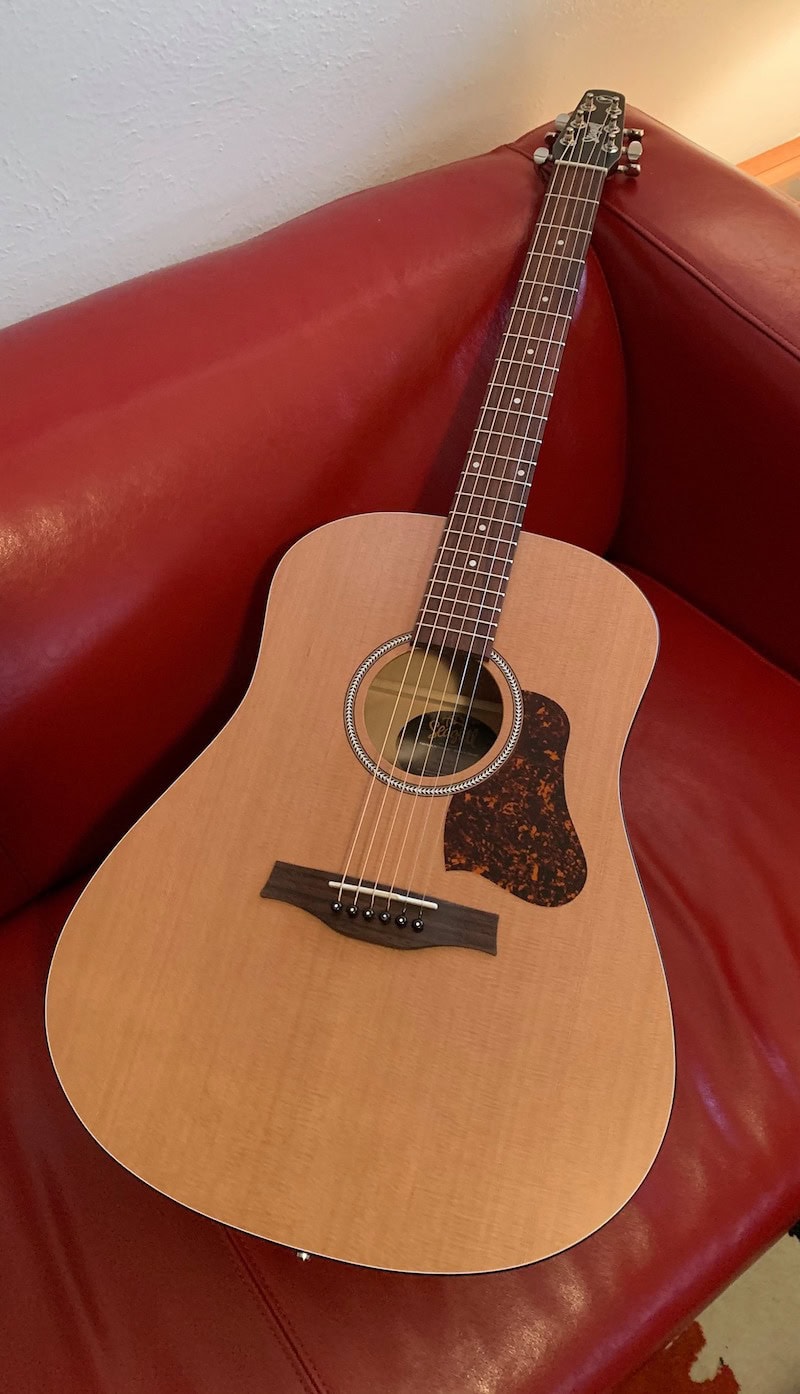
I played this guitar many times in different years and it’s always a pleasant surprise just how expressive and snappy cedar is. Moreover, the wild cherry the company uses for the back and sides adds warmth and low-end to the resulting sound.
In this vein, I noticed the shape of the guitar wasn’t exactly dreadnought, size-wise. So, I looked it up and Seagull changed the shape slightly to avoid the extra boominess some dreadnought guitars often have.
As I strummed the first chords, the solid cedar top responded perfectly, vibrating and resonating to give my strumming a myriad of natural harmonic overtones. Yet, the one thing I have to say is that the silver leaf maple neck adds a little too much midrange for my taste. You can’t get away with those bigger-than-Jesus open chords because the bottom end tends to be eaten up by the mids.
On the other hand, I tried some arpeggios and fingerpicking, and it was an absolute blast. The midrange was consistent, and the Fishman PreSys works great on a PA (and it has a built-in tuner!).
The Seagull S6 has been a steady classic for way over a decade, if you haven’t already, try one out. They will surprise you.
Further reading: my full review of the Seagull S6 (Cedar)
2. Epiphone Hummingbird Studio
Once you get over the outstanding looks of this guitar (the Hummingbird I tried was a faded cherry sunburst) and play it, you’ll find it’s a great-sounding, comfortable instrument as well.
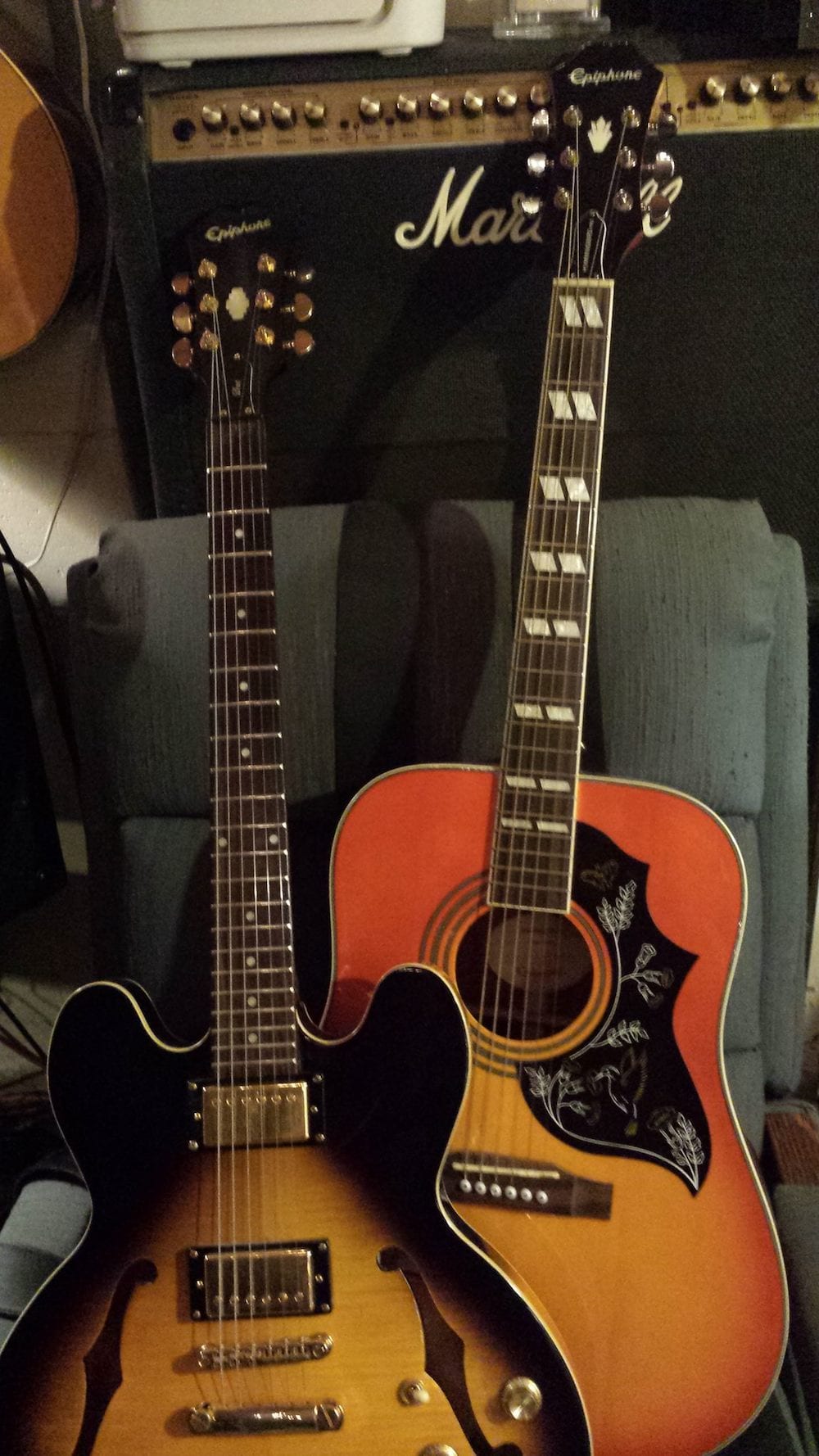
Epiphone Hummingbird Studio alongside my Epiphone Dot Deluxe.
So, to begin with, I sat down with this huge dreadnought body and played some chords to warm it up. The sounds coming out of the guitar’s body were lush, big, and musical. Yes, the solid spruce top on this guitar is a game-changer compared to cheaper, laminated-top Epiphone acoustics.
Also, since the back and sides are made of mahogany, as well as the neck, there’s a generous dose of low-end that complements the spruce’s snap. Perhaps, the only thing that I didn't like about this guitar was the glossy finish on the neck. I live in a humid area, and it only took a few minutes to feel my thumb getting sticky against that thick layer of paint.
I did what salesclerks hate, which is playing “Wonderwall” with it. The result was close to the real deal. Perhaps, the fact that the back and sides are not solid wood but laminated gives the low-end a lack of sustain and natural harmonics that makes the sound fade out faster than you would expect.
I know it’s an intermediate guitar and not a high-end instrument, but the effect was noticeable.
Finally, I plugged the guitar in and, while it sounded good, there was a serious lack of bass on the amplified sound.
So, if you want a guitar that looks amazing, plays great, and can withstand life on the road, this is a great choice you should check out before buying.
Further reading: my full review of the Hummingbird Studio
3. Taylor GS Mini-e Mahogany
If I wrote, to start, that Taylor makes great guitars, I wouldn’t be spoiling any scoops, would I? Well, this guitar isn’t at all an exception to that rule. Moreover, for small to mid-sized people, the GS Mini series is the perfect size.
But wait, doesn’t size compromise sound? Well, not in Taylor’s case. This guitar sounds rich and powerful, with great projection. Furthermore, I’m the lucky owner of a Baby Taylor, which is another great example of a guitar that sounds bigger than it looks.
So, I picked the guitar up and strummed a full E major chord. Boy, was I amazed at the low end and warmth of the solid mahogany top. Yes, although it could sound bigger if the back and sides weren’t made of layered sapele, it is surprisingly loud and big for its size.
The neck is smooth, and the playability is superb as you would expect from a Taylor. Speaking of neck and fretboard, the company used ebony which differs from rosewood in response, snap, and midrange. Yes, while rosewood is sweet and dark, ebony is fierce, snappy, and cuts through. This is the perfect pairing for a mellow mahogany top.
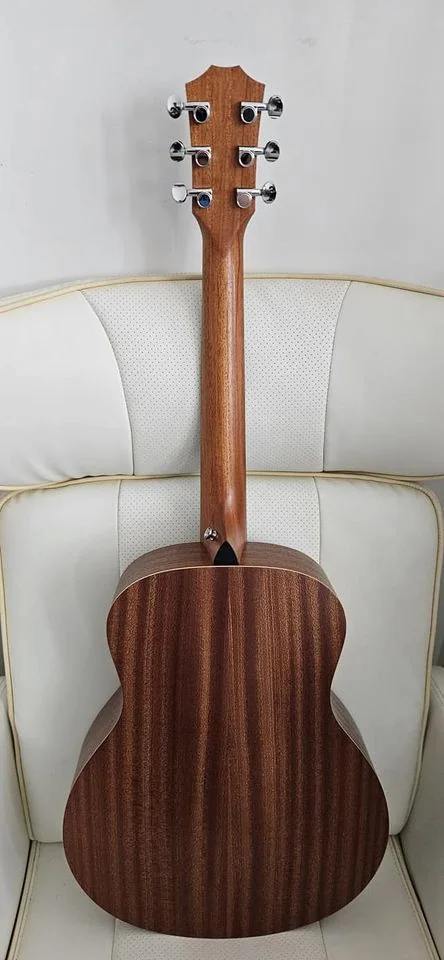
The Taylor GS Mini Mahogany looks stunning in real life, at least way more premium than you'd probably expect.
After I was done with the usual chord playing, I went through some chicken-picking and fingerstyle. Furthermore, I played quite a believable version of “Road Trippin’” by the Red Hot Chili Peppers. The articulation was perfect.
Also, Taylor’s preamp works great with a parametric EQ to get rid of any annoying frequencies and a handy built-in tuner. A feature I like a lot is the low-battery indicator that helps avoid epic fails.
Finally, the included gig bag is beyond sturdy. So, if you’re after a guitar that’s easy to carry around, sounds great, and is ready for the stage this is a must-try-before-you-buy case.
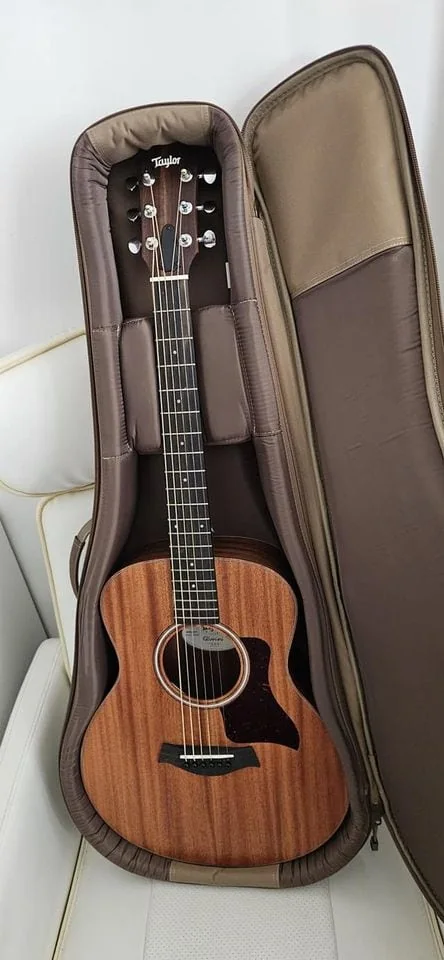
Loved the soft case that comes with it.
4. Martin D-X1E
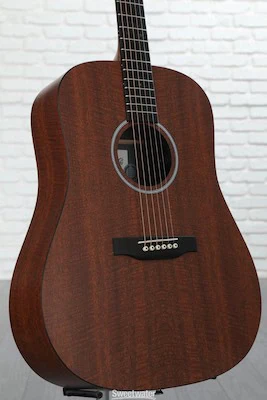
Martin is one of the oldest and biggest stringed instrument manufacturers in the world. This translates into a legacy of almost two centuries, the invention of the dreadnought shape, and the X-bracing among others.
Let me tell you that I cheated on this one. Yes, I never do it because it biases my appreciation of the instrument, but I looked up the specs on this guitar before trying it out. I was bummed to read it is a guitar entirely made of highly sustainable HPL wood. What does HPL stand for? I’m glad you asked, it means High-Pressure Laminated. Yes, this is a Martin that’s entirely laminated.
Moreover, it also sports a Richlite fingerboard. Richlite is a sustainable, synthetic material that tone-wise sits between rosewood and ebony.

So, I was expecting to hear a dull sound with no character, depth, or any 3-D qualities.
I was wrong. Very, very wrong.
This D-X1E not only sounds great, but it also conveys the Martin tone that we all love. Yes, that low-end that can sit in the middle of a mix and fill every corner of the song with tone is right there. Furthermore, because of how it’s constructed, this guitar can withstand harsh weather conditions without a problem.
I tried playing “Hotel California” on it and while it’s far from my Martin D15M, it sounded very good. I mean, after you’ve been playing it for half an hour, your ear starts noticing a slightly unnatural vibration that affects sustain and natural harmonic overtones.
On the other hand, this guitar carries great tone (plugged and unplugged) and has unmatched durability because of the materials used. So, if you’re a guitar player who loves bonfire classics, taking your guitar everywhere, and playing with friends, this guitar is a great choice.
Oh, and the gig bag is perfect for busking money to be thrown at it!
5. Ovation Celebrity Elite Plus CE44P-SM
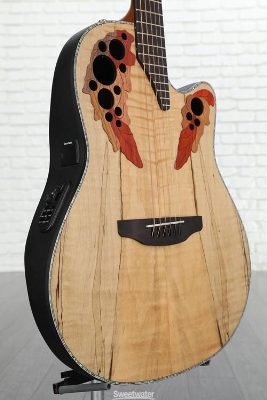
Back in the day when I was growing up in the roaring, wild, amazing eighties, Ovation guitars ruled Earth. Yes, we all wanted to be Richie Sambora and play “Wanted Dead or Alive” on it.
Well, I could never afford an Ovation back then, so it was a nice treat to try one out for this rundown.
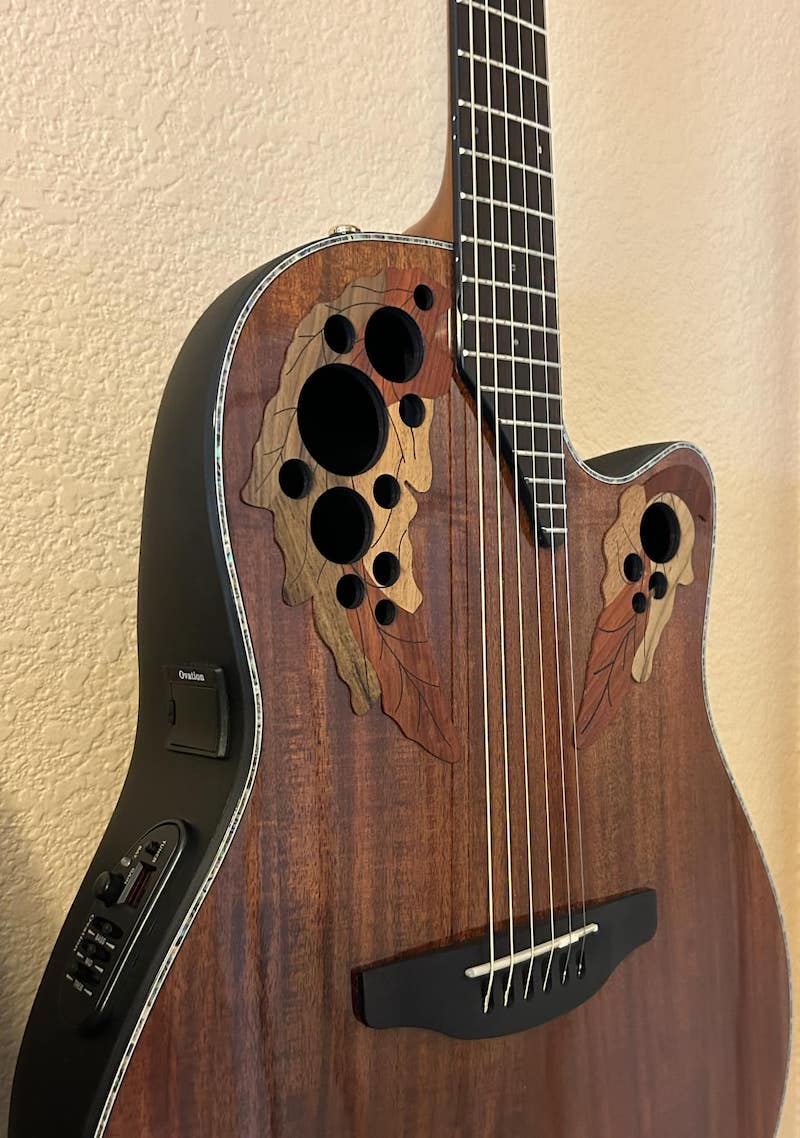
Ovations are by far the most unique looking guitars!
Let me tell you that it was a pleasant surprise to see the round back made of composite material project the sound the way it does. I obviously played that Bon Jovi song on it and the sound was ringing and loud.
Although it looks amazing, tone-wise spalted maple is a little too bright for my taste and the nato neck didn’t do too much to tame it down. The koa-version is marginally better in this regard. That being said, the rosewood fingerboard and bridge bring balance to the equation with some sweet and dark tones.
Perhaps, the drawback I found with this Ovation Celebrity Elite Plus is that it’s extremely uncomfortable to play sitting down. I had to ask for a strap to play on my feet. Yes, the “Lyrachord” body as Ovation calls it works great with resonance and projection but slips away from you all the time.
Finally, I plugged it in to play “More than Words”, another ‘80s classic. The preamp offers up to 12dB of boost or cut, which is more than enough to sculpt the sound to your liking.
If you can handle the whole playing-on-your-feet thing, this guitar is a great instrument, especially for its price tag.
Don’t be afraid to add some ‘80s vibe to your collection.

6. Ibanez AEWC400
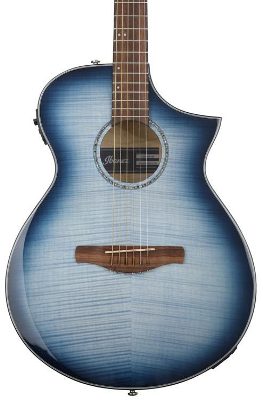
Whoever designed the AEWC400 must have been well-trained in ergonomics because I never played an acoustic guitar as comfortable as this one. I know what you’re thinking, and I agree, that’s what you can expect from Ibanez, a brand that made ergonomics a superpower.
Yet, this is way more than expected.

Ibanez AEWC400 in Amber Sunburst.
Although I loved the ergonomics of this guitar, it is the perfect instrument for the gigging musician who’s going to plug it in to play night after night. Why am I saying that? Well, because compared to a full-sized guitar (or a 3/4 by Martin or Taylor), this guitar lacks low-end as well as volume and projection.
It’s to be expected that an all-maple guitar with a walnut fingerboard and nyatoh neck doesn’t produce much in the lower end of the frequency spectrum. On the contrary, this is a great guitar for fingerpickers, arpeggio lovers, and lead players because its midrange is singing and full, and can cut through any mix.
So, I played “Everybody Hurts” and “Revelation Blues” and the guitar sounded clear and snappy. Then, I moved to “Blackbird”, the classic that’s quintessentially annoying for salesclerks. I missed some of the low-end there.
To finish the test, I plugged it in and manipulated the Fishman-powered preamp to get great, believable, balanced sounds. Moreover, the contour for the arm and the Florentine cut helped me play for half an hour without noticing it.
If you’ll be playing plugged in most of the time, love fingerpicking and arpeggios, and don’t need a huge-sounding guitar, try this beautiful instrument. For bigger sounds, you might be better off with another guitar.
7. Yamaha FGX800C
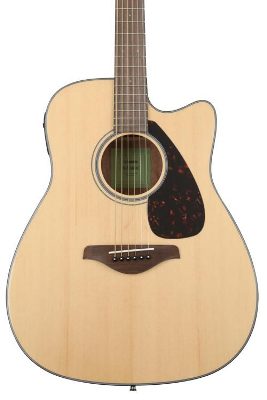
Yamaha has been doing outstanding instruments for way over a century. Not many people know this, but Yamaha’s first product was a piano. Furthermore, if you take a closer look at the logo, you’ll see three tuning forks intertwined.
The FGX800C is a great addition to that lineage of innovation and excellence.
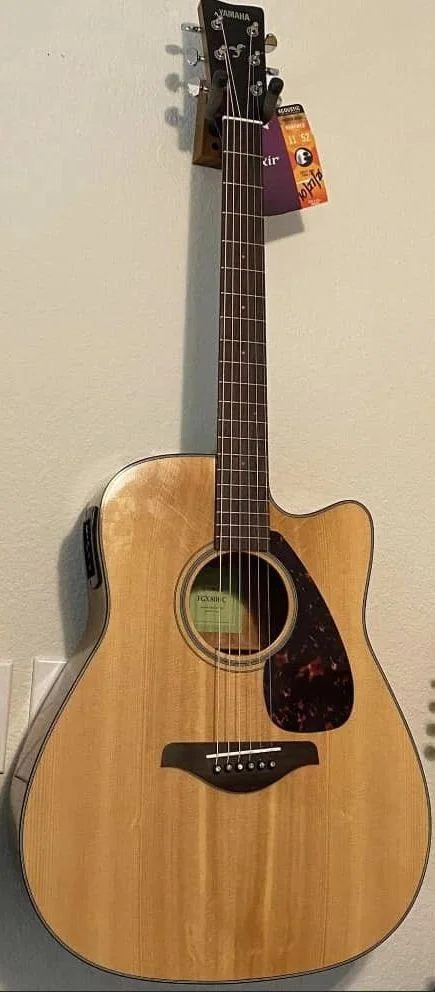
Yamaha FGX800C
Indeed, the solid Sitka spruce top offers projection, volume, and a great set of harmonic overtones. I found out about this immediately as I played the first open E major chord.
When you play such a huge chord on a solid-top acoustic, what you get is a ringing sound that lasts after the notes are gone. That’s exactly what happens with this Yamaha.
Although the action was a little too high on my testing model, it was a fun and easy-to-play instrument. Yes, the nato neck with walnut fingerboard was thin and fast with an elegant matte finish that helped speed.
Perhaps, this guitar’s main weakness is on the neck because the plastic, cheap nut it ships with does a lot to kill tone. I mean, if you install a simple and inexpensive bone (or a synthetic replacement) nut, this guitar will sound much better.
Finally, I plugged in to test Yamaha’s own System-66 electronics and found the 3-band EQ to be very helpful in shaping the sound coming out of the speakers. Oh, and the onboard tuner was welcome too.
This Yamaha is the quintessential mid-price acoustic-electric guitar. If you want a guitar that sounds great, plays great, and will age nicely (like solid Sitka spruce does), you have to try this one. Read our more in-depth review of this guitar.
The Role of the Soundboard on Acoustic Instruments
You must have heard and read everywhere about the need for a solid top on a good acoustic guitar. But do you know why you need a solid-top acoustic? Moreover, have you ever heard the term soundboard?
Well, I’m here to clear that information mist and tell you what we talk about when we talk about soundboards.
As you might know, an acoustic guitar has a back and sides. These woods are there to support the top of the guitar where the bridge and soundhole are (except for Ovations, of course). Well, the soundboard is the one vibrating with the strings and generating the harmonic overtones that we hear amplified by the box formed with the back and sides.
Therefore, a laminated top is a soundboard that doesn’t vibrate evenly. Furthermore, in some cases, if it’s laminated and painted with heavy polyurethane, the vibration and resonance get clogged. This is the equivalent of muting the guitar’s natural tone, harmonics, and resonance.
On the other hand, laminated and heavily painted soundboards can take the beating and the playing much better. Indeed, since those tops are made of several layers of wood and glue, you have to be very aggressive or careless to break such an instrument.
That’s one of the reasons why laminated-top guitars are perfect for beginners and children.
But as sturdy as those tops are, they don’t age well because all the pieces of the laminated top will age differently. Solid-top guitars, on the other hand, tend to age better because their soundboard sounds better and better with time.
Solid Top, A Must for Your Next Step
Durable, sturdy laminated tops are great for beginners and children. But you’ve outgrown that, you’re ready for your next step. Therefore, my suggestion is that you start looking for a solid-top acoustic.
I mean, there are exceptions. For example, the Martin D-X1E is one of them. It’s entirely laminated but sounds like a solid-top guitar. I don’t know how good or bad it will age, but after trying it I can say it sounds great.
But apart from that exception, solid-top guitars are your next step. Moreover, if you can aim at a fully solid guitar (including a solid back and sides), the sound difference is really worth it.
Know What You Want, Know What You Can
Now that you’re no longer a beginner, your purchase choices must be closer to the kind of music you want to play.
Yes, it’s time to make some decisions.
For example, if you want to be a master fingerpicker like The Tallest Man on Earth, you need a smaller guitar. Perhaps, a parlor would fit the bill perfectly.
On the other hand, strummers, singer-songwriters, and composers might be better off with a dreadnought, auditorium, or jumbo guitar.
Also, strummers might gravitate toward mahogany’s dark and sweet tone rather than maple. Oppositely, the midrange you get from woods such as maple is perfect for fingerpicking like a king.
Finally, once you know what you want, you have to know what you can, which means setting a budget. If you don’t set a price limit for your purchase, you’ll end up being frustrated. So, once you know what you want, set a limit for what you can.
Electric or Acoustic?
This is a question I get a lot from students but also from connoisseurs and seasoned players.
Let me divide this question into two different answers:
- You play live a lot – If you’re playing live on a stage frequently, there’s no question to be asked. I mean, unless you’re Eric Clapton and can afford a condenser on a huge stage, you have to plug your guitar in. If this is the case, get an acoustic-electric.
- You’re a studio musician/hobbyist/occasional strummer – If you can define your playing as any of those categories, then you have to know that there’s a big impact on the price at this range. Yes, it’s a very crowded niche with fierce competition in which every cent counts. Therefore, the money that goes into the preamp is lacking in tuners quality, a laminated top, or even a plastic nut or saddle. So, if you don’t plan on playing it plugged in, you’re better off without it.
Invasive and Non-Invasive Aftermarket Preamps
Let’s say you bought an acoustic guitar and that led to playing with friends and eventually forming a band. Now, you have to play live, and you need to amplify your guitar! Well, don’t freak out about it because most brands offer after-market solutions.
Now, the word of advice in this regard is that, if you have a solid-top guitar with a solid back and sides, you shouldn’t carve a hole to install a preamp. On the contrary, you can get non-invasive solutions like a magnetic soundhole pickup (like the LR Baggs M1) or a piezo-and-condenser Fishman Ellipse Matrix Blend.
The Bottom End
“Mid-priced acoustics for intermediate players” is a very competitive niche in which big brands compete with smaller ones and every cent counts. All the options above are great instruments for you to take the leap and enter the next era in your career as a guitar player.
Choose wisely, play your heart out, and enjoy the ride.
Happy (acoustic) playing!

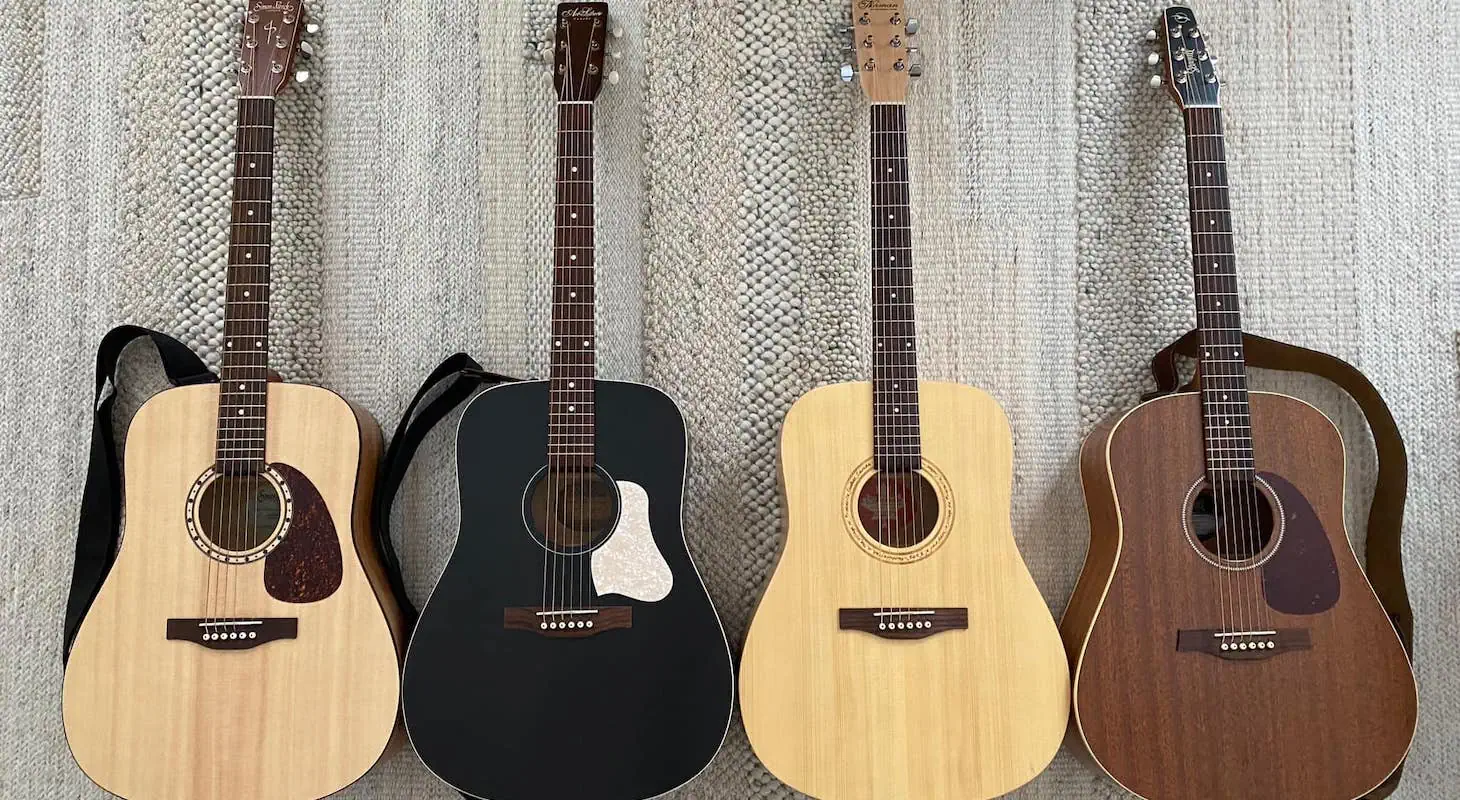
What are the two guitars in the main picture in between the s&p and seagull, it doesnt say at all, you should be promoting the less big name brands more not doing that with them.
Great article, very informative and your enthusiasm shines through. Just what I was looking for to help me choose, thanks!