
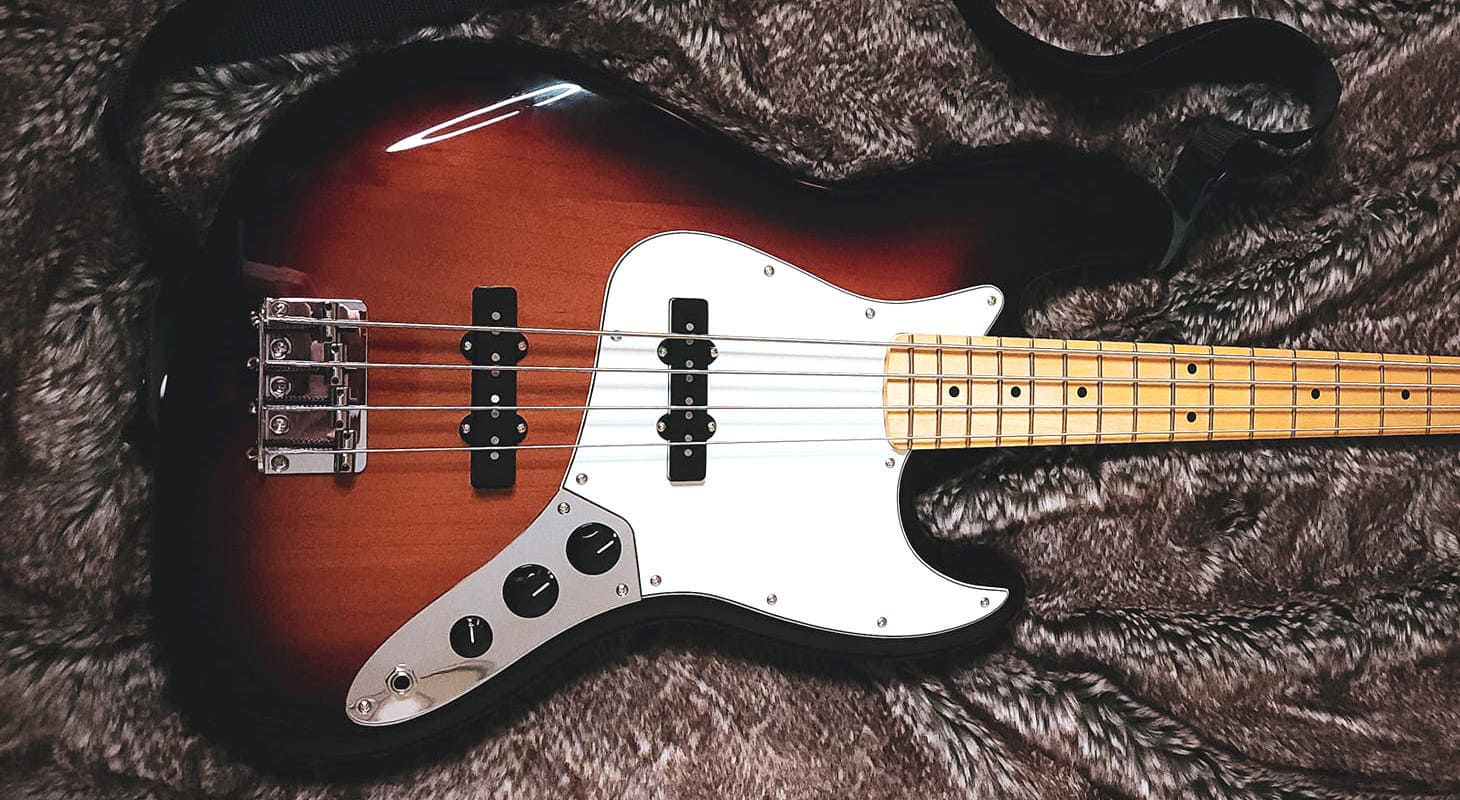
Since its debut in the early sixties, the Jazz Bass has been the go-to option for do-it-all studio bass players, funkmeisters, rockers, jazzers, and virtuosos.
To me, the Jazz Bass is the Stratocaster of bass guitars. Yes, one could think that the Precision bass is the Telecaster of basses and the Jazz Bass is the Stratocaster. It’s a more complex version of the same concept.
If you know your way around these two models, you’ll know they sound, play, and feel very different from each other. The Jazz Bass has such a signature sound it’s hard to replace it with any other model from any brand. That said, you can always push those boundaries further by experimenting with different pickups.
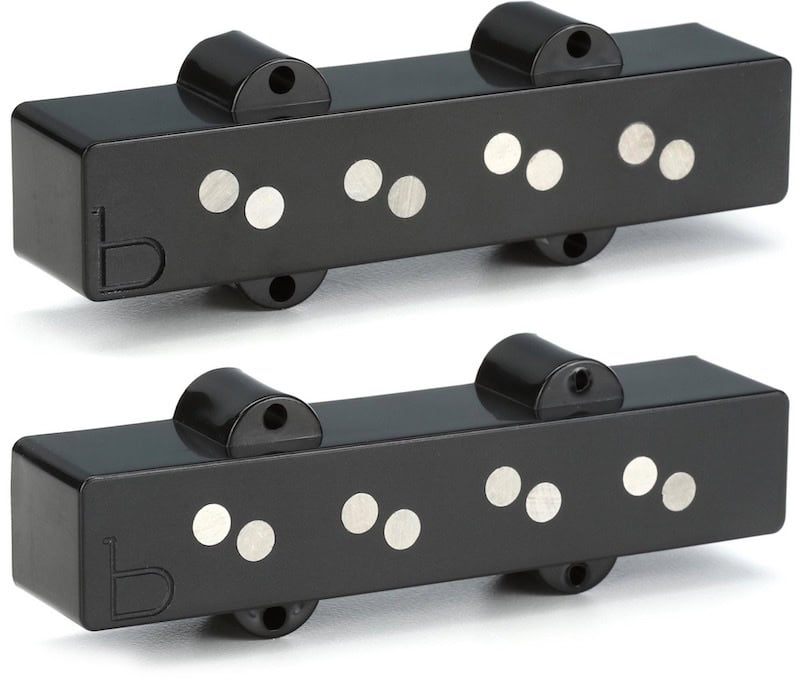
Top 3 - Jazz Bass Pickups
Preview | Product | Price |
|---|---|---|
 | ||
 | ||
 |
Moreover, a new set of pickups can be the perfect way to add mojo, improve the audio, or even change how your bass responds and sounds. Remember you can always go back to what you had before with a little soldering iron and a couple of hours.
I did the heavy lifting for you and boiled it all down to 7 of the best J-Bass pickups out there today.
Let’s do this!
Best J Bass Pickups – Definition, Depth & Dynamics!
1. Bartolini B-Axis J44J-L/S
Although not many people know about him, Bartolini was a sound innovator in the 1970s. He came up with a revolutionary idea to make electric basses sound more three-dimensional like acoustic instruments do.
He found out it was the asymmetry in string vibration that created that effect. Therefore, he came up with a design that could capture the natural harmonic asymmetry through an equally asymmetric magnetic field. He called this invention his “Hi-A” pickups. The name comes from “high asymmetry”.
You can consider that to be Bartolini’s USP. Moreover, if you’ve played a Bartolini-equipped bass, you’ll know they’re lively, punchy, and deep.
Well, the B-Axis series comes to you straight from that tradition and is capable of generating 3-D-like tones that will push your bass forward. Yes, there’s one thing that’s unmistakable about these pickups, they pack a serious punch.
You know how Jazz Bass pickups can sound thin and wimpy and have that quintessential 60-cycle hum of the single-coil pickups.
Well, these Bartolini have neither of those drawbacks. These are silent, very punchy pickups that round up that bottom end and give it extra oomph in the low mids. Don’t worry, you won’t lose any edge, because what these pickups lack in the upper-mids makes up for in the bottom-end and the highs.
The neck pickup is quite boomy, and, if you can kill the tone knob, you’ll get that silky, smooth, dark sound that’s perfect for some dead-sounding dub, reggae, and funky riffs. With the tone at full, you have that boomy low end that’s really cool for single-note kick-drum syncing.
The bridge pickup is nice, bright, and punchy. You can slap your way to heaven in this setting, and if you feel it’s got too much attack, you can just dial in some neck pickup or lower the tone knob.
I did try some finger-driven leads next to the bridge just like Mr. Pastorious would do but on my fretted MIM ‘90s Fender Jazz Bass. It kept that punchy attack I love so much about the high-end Jazz Basses I’ve played in my life.
The blender in the middle gave me sort of the best of both worlds and slapping like Flea became a thing I just couldn’t stop doing. These pickups are so responsive you just have to give them something to play with. For example, igniting the fuzz on my board and slapping on the fourth string gave me a tone close to “Around the World” the classic opening song from Red Hot Chili Pepper’s groundbreaking album Californication.
These pickups can breathe new life into an old instrument and give a thin-sounding bass some generous low-end while keeping the attack at its best.
If that sounds like something you want to achieve with your pickup change, then this is a serious contender for the prize.

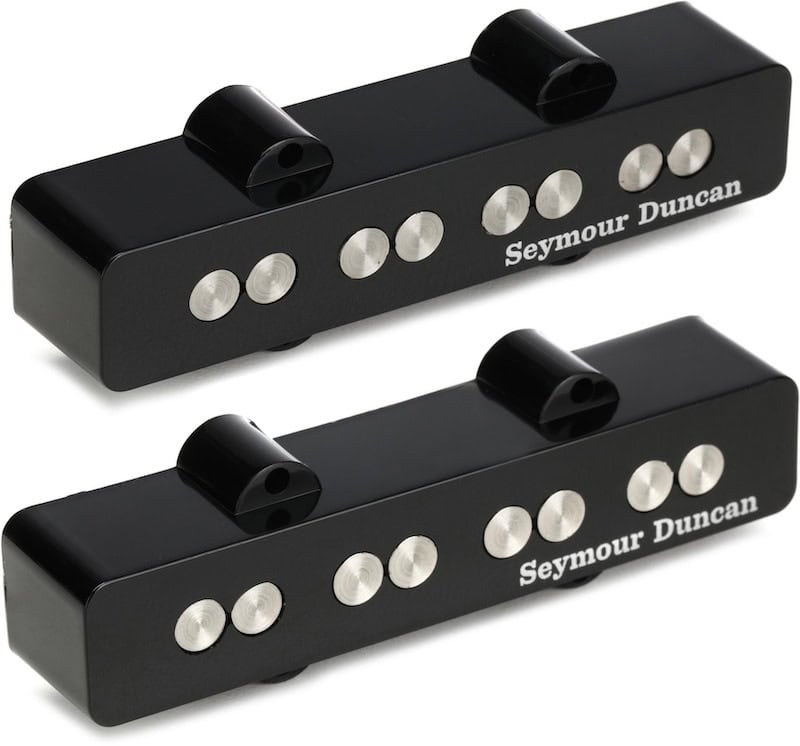
2. Seymour Duncan SJB3 Quarter Pound
What happens if you take a classic Jazz Bass and put it on steroids? What if you could just put an internal knob on your instrument up to eleven? Well, in that hypothetical situation, you would get the detailed, clear response of the Jazz Bass but with enough power and grit to drive your amp harder and add more bass to your signal.
I used my Seymour Duncan SJB3 Quarter Pound-loaded bass in the rehearsal of a three-piece ensemble with a fellow guitarist and a friend who’s a drummer. The result was an instant push in the low-mids and the low-lows that made me look twice to check I wasn’t playing an active axe.
The one thing that’s very noticeable about this pickup set is that they’re not hum-canceling by themselves. They are RWRP (Reverse-wound reverse-polarity) so when the blending knob is at noon, your bass is silent but as you roll it to either side, the 60-cycle hum sticks out its head and says “Hi” increasingly louder.
I’m one of those players who loves analog and vintage-sounding amps and instruments. To me, the grit and noise of single-coil pickups is like the hair you hear in the audio of a turntable or record player when you play vinyl. For some, it might be annoying noise and for me, it’s the sound of happiness.
Regardless of what side of the street you belong to, this is something you need to bear in mind when thinking about this pickup set. They’re not noiseless.
That said, they love making noise because they truly are very punchy. The Alnico V magnets make them rocking and the midrange is hard-hitting. Let me insist on talking about the bottom end of these pickups because it really is very generous and round. It sounds groovy and aggressive, and there’s enough dynamics and balance between the pickups to cover many scenarios.
The first thing I did is that Jaco thing of playing close to the bridge with the fingers and it was all very punchy but with enough low-end not to sound thin. Moving to the pick to play some Punk Rock results were edgy while still growling.
Slapping in the bridge position and with the blend knob in the middle were great experiences. You might know the feeling when you play really hot pickups and everything you play seems to jump at you. Well, these pickups are exactly like that, super responsive and loud.
The neck pickup adds some sweetness to the overall tone and it’s wonderful for lead playing or playing soulful lines. Also, the tone knob here opens a big palette of colors because you can go from that attack-less funky, groovy tone to some very soulful, round, and dark tones at the turn of a knob.
Finally, I engaged my Q-Tron to give these pickups something to chew and the results were clean, powerful, and defined. Not even the low side of the filter pushed the instrument into a boomy territory that could be anywhere close to annoying.
I had lots of fun playing with these pickups and I recommend them for everybody who loves the JB tone but wants more juice.
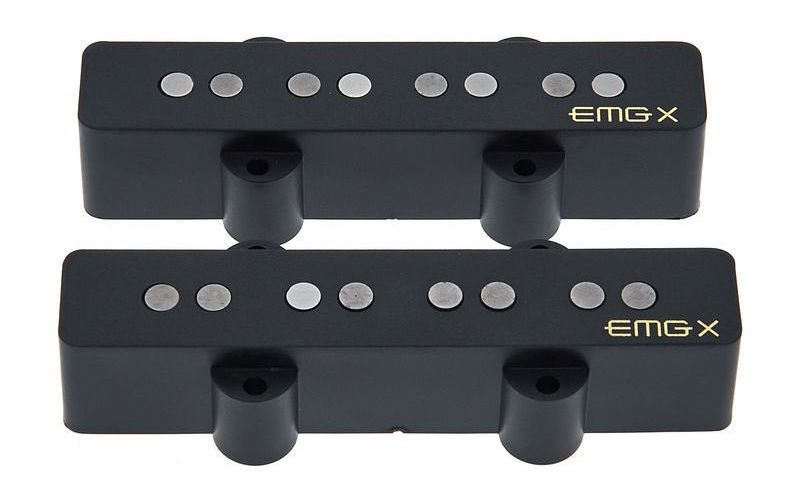
3. EMG JV-X
I know what you’re thinking, and you’re right, active pickups have a learning curve. It’s hard playing with active pickups with a Jazz Bass, they seem to lack that vintage feel we all love so much.
Well, may I present to you the missing link between active and passive bass pickups.
On one hand, the bare magnets give them a vintage look. You don’t expect them to be EMG active pickups because they don’t have a magnet bar under a blind plastic cover. Well, that’s the thing EMG did to bring two worlds together (I can almost see Dr. Strange bringing two worlds to collide in a cheesy Marvel blockbuster).
There’s an audio component to the design of these JV-X pickups that’s neither a pro nor a con, it’s just that they managed to keep that fading, dying tone that’s so particular in Jazz Basses (funk fed on it for decades!) without any noise.
These pickups have the clarity of active pickups and the warmth of a passive set.
Oh, behold the missing link between two worlds.
Jokes apart, I have to tell you I fell in love with these pickups instantly. I got an outstanding slapping sound out of them with the mix knob at noon. The dub lines sounded gorgeous, punchy, and powerful with the neck pickup.
Turning the knob to the bridge pickup I unleashed a funk monster and all my favorite Victor Wooten lines came to my fingers right away. Oh yes, you feel like you can fly with these pickups, they make you believe you’re playing better.
I guess the perfect symptom to describe just how blown away by these pickups I am is that I couldn’t remember how my bass sounded before installing these.
So, what’s the trick? How did EMG crack the code with these pickups? Well, it’s simply the combination of the exposed dual pole pieces (and the consequential lack of a magnet bar) and the active EMG preamp. This way, you get traditional string pull and decay but with active punch and clarity.
Oh, and the preamp works great with your tone knob. I didn’t just crank or kill it, it has enough nuance to let you find its sweet spot. You can round the tone, tame the beast, increase the punchiness, and it’s all just musical and usable.
I guess everyone could benefit from these pickups, well not anyone, if you’re a purist and know your way around your bass by heart, I’d say don’t do it. Yet, if you think your bass lacks headroom and has some room for improvement, then these pickups can be what you were looking for.
Finally, let me say that all installation is solderless, it took me less than two hours to do it and the biggest challenge was finding a comfy spot for the battery to sleep in.
Don’t discard that old Squier JB just yet, give it an extra life by installing these pickups.
4. Fender Custom Shop ’60s Jazz
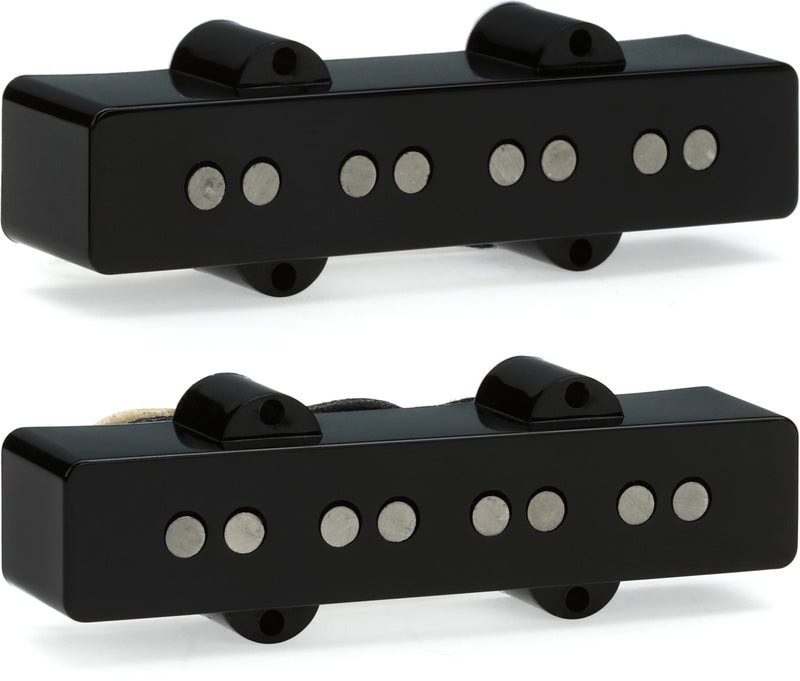
When talking about Jazz Bass pickups, Fender is the source, the mothership where it all began. Furthermore, if you’re thinking about what the holy grail tone of Jazz Basses would be, I guess we would all agree on the early ‘60s.
These pickups are a one-way ticket to the amazing, groovy sixties and all their psychedelic magic. Moreover, and this will be a spoiler, these are the right pickups for players who want to overhaul their instrument in a vintage or classic direction. If you’re looking for something that will give you more volume, power, or a different, bigger thump, this is not the place to look for that.
These are the quintessential Jazz Bass sounds you’ve heard for years in countless recordings. They have that quick decay with generous high-mid response, and enough edge to cut through anything.
I tried some lead lines (bending included) while playing on the bridge pickup and the result was instant spank, clarity, and the warm push and rumble of the traditional Jazz Bass. Furthermore, still on that pickup, I tried to find the tone knob’s sweet spot and what I found was that there was no mud to be found anywhere. The low-end remained tight and clear the whole way.
Victor Wooten, Jaco Pastorius, I was after those guys and it sounded close, with enough spank to rip through and enough oomph to push a band forward.
Let me tell you that the mid position (with both pickups on) was full of magic. I played with my fingers but also did some slapping and the tone was close to that of Red Hot Chili Peppers in the Blood Sugar Sex Magic era. Not as wild and round as in Californication and later where Flea plays the Music Man and its humbucker, but more of a traditional slapping sound. I played stuff like “Higher Ground” (RHCP version), “Run for Cover” (Marcus Miller), and “U Can’t Hold No Groove…” (Victor Wooten) it was all fun, games, and great tones.
The neck pickup was “fat enough”. I will say that, because of my playing style, I did miss some of the oomph of more modern Jazz pickups, but the roundness and warmth of the neck pickup had that vintage, analog flavor that’s just great. I tried playing some fast stuff, but these pickups shine with dub and funky lines.
I did feel I had to push my amp a little in terms of volume because these pickups have vintage output. That said, they took fuzz perfectly well, and playing with a pick unleashes a whole new level of edge and razor-like mids.
These are the perfect pickups for someone looking to add vintage definition, analog mojo, and ‘60s magic to their sound. If you’re looking for something modern or very powerful, you might have to look somewhere else.
5. DiMarzio DP123 Model J

This aftermarket Jazz Bass pickup set has been around since 1979. Yes, this is one of the things that you have to respect about DiMarzio. They have seen trends come and go, have been surfing the wave on top, at the bottom, and paddling many times in the past.
One thing is for sure with this brand, though: They make reliable, great-sounding pickups.
I know, and I agree with you, they tend to have modern, heavy-oriented, extreme pickups in wacky colors mostly. Yet, they’ve seen it all and have been pushing the magnetic fields in countless of your favorite recordings.
Why is this short history lesson necessary to explain these pickups? Well, very simply because the same thing they did for bass players then is what they can do for you today. They respect the tone of your instrument adding an extra dose of noiseless power and volume to it.
This allows you to, for example, play that MIM, Squier bass on stage au pair with your American Professional or American Ultra and not suffer any volume drop or 60-cycle hum but maintain that Jazz Bass tone with all its warmth, glory, and natural decay.
I’m not going to tell you these are the most defined pickups on this list, on the contrary, they’re noiseless but are closer to a Fender Custom Shop set than to a set of active Noiseless EMGs or something like it.
I tried everything on them just to make out what the sonic boundaries of these pickups are and I was pleasantly surprised in some settings and dimly disappointed in others.
For example, I think these pickups sound absolutely killer when playing with a pick. There’s a small bump in the midrange that adds a new dimension of edge to the tone. They also have enough warmth and decay to make playing with your fingers a nice, round sensation.
I found the bottom end to be not as tight as with other pickups on this list. This was especially true when slapping. I mean, don’t get me wrong, it’s not that it makes you shy away from slapping, but I had to cut most lows from the amp to avoid flappy lows rumbling non-musically.
Things got much better when slapping on the bridge pickup, which I think was my favorite of the two. It sounds ultra-punchy and edgy. It gave me enough mids to cut through anything but also enough tonal variance to play whatever style I wanted.
So, if you already like the tone of your instrument and feel you need a little more oomph and volume, and the idea of losing the 60-cycle hum is not annoying to you, these are amazing aftermarket pickups.
I would say that MIM, MIJ, Squier, and entry to mid-level instruments could benefit grandly from this set of DiMarzio DP123 pickups.
6. EMG RT “Rip Tide” Robert Trujillo Signature Set
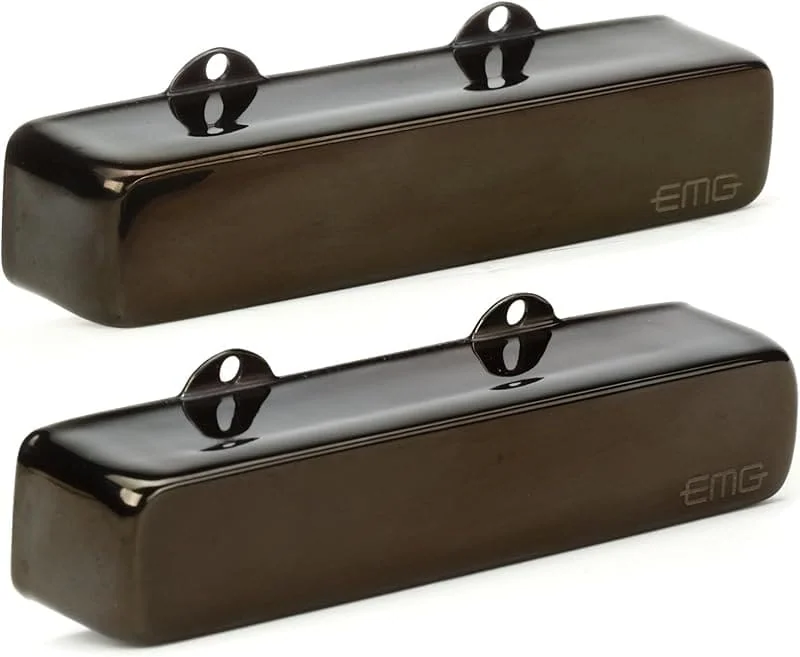
Say hi to the best-looking pickups of the bunch. Oh yes, Robert and EMG really took it to the next level with these pickups. As soon as you open the box you get the gleaming brightness of the brushed metal casings and it puts a smile on your face.
Although the looks might not be your cup of tea, you have to admit they’re cool.
These pickups went way beyond my expectations in many ways. I was expecting, as I’m sure you are too, that these pickups sound aggressive and stale so you can gallop with your fingers as Robert does so well.
Well, don’t get me wrong, they do a great metal bass tone, but they can do much more than that.
I played everything on them but started with a classic: “For Whom the Bell Tolls” (Everyone say hi Cliff!).
I could mimic that uncanny mix of high-end attack, clarity for the riff so I could hear every note, and a ballsy low-end filled the rest of the spectrum. Then, I moved to playing something different, and more modern, “King Nothing” (another amazing line by Jason Newsted), and the results were bright, aggressive, and huge.
So far so good, no big surprises. The surprises came when I tried playing other things, outside the realm of Metallica and metal and into grooves and funk. I was playing a Jazz Bass after all, wasn’t I?
Well, my first attempt was “Jungle Boogie” by Kool and the Gang. It has one of the coolest bass lines of all time with that descending riff. Well, it was a great experience playing with the bridge pickup and setting the tone knob at 7 and the volume at 6. All the aggressiveness came through silky and tamed because of the very useful tone knob.
Next, I tried “Detroit” , the seriously damaging track by legend Marcus Miller. Those fast-slapped notes shined through, loud and proud with definition, spank, and generous low end. I loved the middle position; it sounded powerful. The trick was setting the volume at 8 and keeping the tone all the way up.
Lastly, I gave a shot at my dub and reggae skills and I wasn’t so pleasantly surprised. Some musical styles that just need that dying tone a passive instrument has. In the case of dubstep and reggae, the lines have to almost die in your fingers while propelling the band forward without much brightness but with a rather full, boomy low-end.
My trick is killing the tone knob and dialing the volume control a bit back as well. Well, it’s not just my trick, many of us use it.
The thing was that the brightness and thump in the mids I got from the active pickups were very hard to tame or remove. It wasn’t going anywhere even with the tone all the way down.
Well, I guess that’s the only boundary that I found while playing with this pickup set that can add more life, thump, oomph, and aggressiveness to your current setup or just old-school tones to your arsenal.
Oh, and installation is a breeze.
7. Aguilar AG 4SD-D1 J-Pickup Set
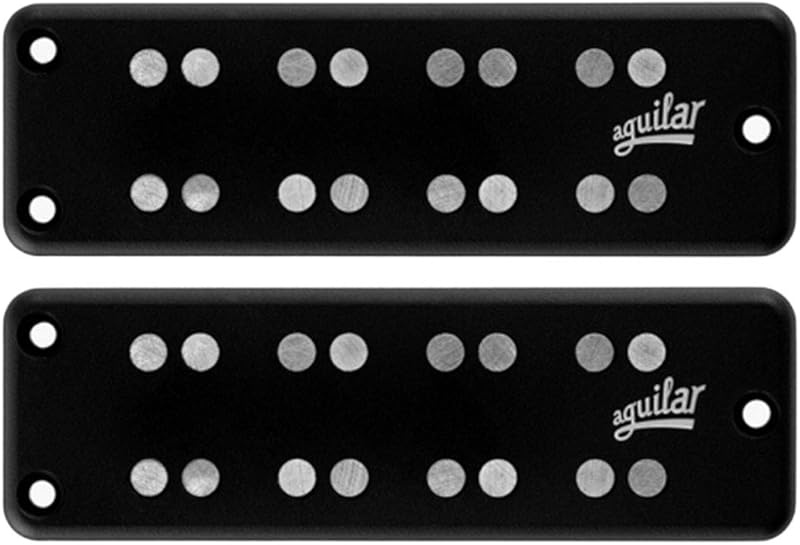
Aguilar has been making outstanding gear for bass players since 1995. We have all come across a bass head, cab, or combo on a stage before and we know it sounds great. Well, the same kind of accuracy found in their amplification gear is the kind of tone precision you get in this very capable set.
This vintage-flavored pickup set is a tad more powerful than a traditional set but has a unique tone that keeps them rocking hard throughout my test.
But you might be scratching your head with one of those huge triangular bass picks and wondering why you would pick this set over a Fender Custom Shop one. Well, the difference with this pickup set is that it’s made after the slightly hotter, more rock-oriented ‘70s pickups.
There are added harmonic overtones, an aggressiveness located in the midrange, and a powerful thump that’s not there on the ‘60s models.
I felt like John Paul Jones using my fingers and galloping to the unknown while I change the music world forever. But that’s not all, because the ‘70s isn’t just the era of Arena Rock, it’s also the decade when Disco flourished into the mainstream. Well, much of that was done on a Jazz Bass, and these pickups can reproduce those tones easily and with utter precision.
I started with the bridge pickup and had to play some Zeppelin to try just how ferocious these pickups are. I have to say they impressed me positively. They had that low-end hair that’s so seventies and can bring your amp to mild overdrive while keeping the lows tight and the low-mids rumbling.
With both pickups on, the slapping was precise, articulate, and still ferocious. The hair that was present with the bridge pickup only grew into a roar and I could hear the anchor in the lows for every slap. The whole slapping experience pushed me to play stuff I didn’t know I could. Yes, these pickups demand your best rocking version because they’re always ready to drive your amp in that direction.
Now, if you want to access a different state in these pickups, all you need to do is play around with the controls. I got this outstanding dub sound playing the neck pickup in 6 with the tone in 3. I was all over Bob Marley & The Wailers having fun for almost half an hour.
Yes, I could get all kinds of sounds from these pickups that tend to be rocking in every scenario but that can be tamed using the volume knob. Bear in mind these aren’t noiseless pickups and you need to add proper shielding and insulating to your bass body to prevent the hum from being too evident.
So, if you’re looking for a pickup set that can push your bass up in volume and into the overdrive zone while keeping the grit and hair of ‘70s vintage Jazz Bass sounds, these are just perfect. Same if you want some vintage flavor with some extra muscle.
These might not be for you if you want crystal-clear sounds with enough headroom to play loud and clean, that’s more ‘60s-like, and you already know where to look for that.
The Heart of Your Tone
There’s one thing to know about electric bass pickups, they are the heart of your tone. You can change the way an instrument sounds by only changing the pickups. Of course, the body, neck, fretboard, and other elements of your bass also put their part into what goes to the speakers.
Yet, if you want to make a drastic change to your sound, give a bass a different flavor, or make an upgrade to a bass you love how it plays but don’t love how it sounds, start by swapping the pickups.
Let me illustrate it with a little story about one of my favorite basses.
Just a Little Bit of History Repeating
This story could also be called “How to Fall in Love with Your Instrument (More or Again)”.
I learned how to play with one of those “Silver Series” Squier, one of those early models made in Japan in the ‘90s. As you might expect with such a bass, the body, the neck, and the overall craftsmanship were good but the electronics were a definite cut corner.
I outplayed that thing. That’s exactly the way to say it. I learned all my chops on it and played it to death.
I left it back in my parents’ house when I moved out with my brand-new Fender Jazz Bass American Standard I had worked a lot to buy.
Many years later, I had a romantic setback (is that how to politely say I had a broken heart?) and I went back to my childhood home. I found it hidden waiting for me. It played horribly and sounded even worse, but I loved the thing. My fingers found their way on that fretboard immediately, the muscle memory was intact.
I thought, “I love it but I can’t play it!”
I took it with me to my new home and got a gig playing with a jazz & swing guitarist. You know what that means: flatwounds. I needed a bass and I had to resurface the Squier. My technician suggested I did a pickup swap and put in a fresh pair of Fender Custom Shop pickups. I wasn’t so happy to invest that money on a bass I thought had nothing else to give me, but the situation was tight and I needed an extra bass.
To make a (already) long story short, the result blew my mind. My Squier is still part of my usable collection to this date. It came back to life with just a proper setup and a fresh set of high-end pickups.
That’s why I say, give that bass a second chance by changing its pickups.
Experimenting is Fun and Rewarding
Another reason why I urge you to try changing your bass pickups is because of one concept that was given to me by the producer of my first record: There is no right or wrong.
If you think about it, some of the most groundbreaking achievements in music come from experiments. For example, distortion isn’t something people sought after, and now it’s impossible to think about music without it.
A bass you can’t fit into your current repertoire needs a little more oomph to be there? Experiment with a different pickup.
One of your basses refuses to give up on that impossible-to-tame edge when played with the bridge pickup? Experiment with a different pickup.
Are you just tired of how your bass sounds and wish it could cover more sonic ground? Experiment with a different pickup.
At the end of the day, the only voice we have as musicians is the one coming out of the speakers, and you might encounter the next step of your sonic journey by chance, who knows?
The Bottom Line
Our musical instruments live in a gray zone. They’re things but they’re not just ordinary things, they hold a special meaning for us. They’re means of expression, an extension of our body, of our minds, of our talent.
Parting with one you’ve played a lot is always difficult, but the ear goes fast and you soon want to change things around, improve, try new things, and have more fun. Well, that’s just one of the beautiful perks of being a musician, staying in touch with that inner child.
So, have fun and give that little boy or girl the best toy you can. Perhaps, it’s just a couple of hundred bucks, and you’re missing the opportunity to fall in love with your instrument (more or again).
Happy (thumping and roaring) bass playing!
