

In the interests of full disclosure, I should start this article by saying that the Gibson Les Paul is my favorite guitar. It’s not even close: I’ve used Les Pauls for my entire career. I like how heavy they are. I like the versatility of the tone. I like the single cutaway and four control knobs.
Of course, a great guitar played through the wrong amp might as well be the wrong guitar.
To get the most out of my favorite instrument, it’s been vital over the years that I play the best amps for the job.
The key is to choose an amplifier that complements the natural qualities of a Les Paul. In this guide, I’ll provide you with a selection of my favorite amps that emphasize the warm, immersive tone of the legendary Gibson axe.
Best Amps for Les Paul - My Top Picks!
1. Marshall DSL40CR

The combination of Gibson and Marshall is something of a guitarists’ cliche at this point, and with good reason.
They pair perfectly with just about any guitar.
In particular, they sound great with a Les Paul. Marshall amps tend to be relatively bright, and Les Pauls tend to be relatively warm. The resulting sound, particularly when pushed into the amp’s sweet spot, has graced countless classic records, from Appetite for Destruction to ZZ Top.
The DSL40CR is a great example of the quality Marshall is known for. Both in terms of build and sound.

Marshall DSL40CR
This 40-watt tube amp has just about everything I think you would expect from a Marshall amp. Two great channels, full three-band EQ, and reverb.
The two channels are a Classic Gain and an Ultra Gain. Classic Gain can also switch between Clean and Crunch. The Ultra Gain has an OD1 and an OD2 setting.
This gives the DSL40CR a great amount of versatility that I haven’t seen too often on Marshall combo amps. On Classic Gain you have that vintage rock sound.
Upon plugging in, I kept the gain control relatively low, and used the master volume to get classic tube saturation. The resulting sound is pure classic rock goodness. “Whole Lotta Love” sounds just right. “Boys Are Back in Town” and “All Right Now” are spot on, too.
This sound is particularly good for rib-cracking power chords. It really rewards harder picking technique, and works great for 60s and 70s hard rock tones.
If you want a more modern, aggressive sound, you just have to switch over to the Ultra gain channel. Now you have everything from Iron Maiden to the most modern metal sound available.
I found the Ultra Gain channel a little much for my taste, and had to dial back the gain a little to get a usable sound. It was great for more modern rock sounds: it’s not quite scooped enough for Drop D Creed tones, but it’s close.
The great distortion doesn’t mean that it lacks in the clean department either. Quite simply, the cleans on this amp are fantastic. It might actually be one of the best clean sounds I have ever heard on a Marshall amp. I wouldn’t use it for country or jazz, but for clean sounds like Slash used on the Use Your Illusion albums, it’s definitely workable.
It is rich and deep. The cleans also play really well with pedals. If for some reason, you don’t like the amp’s distortion, you won’t have any trouble putting a pedalboard in front of this amp.
Something that I also appreciate is that Marshall has put the power attenuation on the front of the amp. While it doesn’t really make much of a difference, it is just a small convenience that shows the care Marshall has taken when designing this amp.

2. BOSS Katana 50

The BOSS Katana might be one of, if not the best modeling amp around today. It also happens to be one of my favorite combo amps.
My one concession for the Katana series is its smaller cabinet compared to other combo amps. I prefer the booming, authoritative sound of larger cabinets and speakers, but the Katana tone is entirely workable.
The Katana’s simple and sleek design hides an array of great features. This is one fully stacked amp.
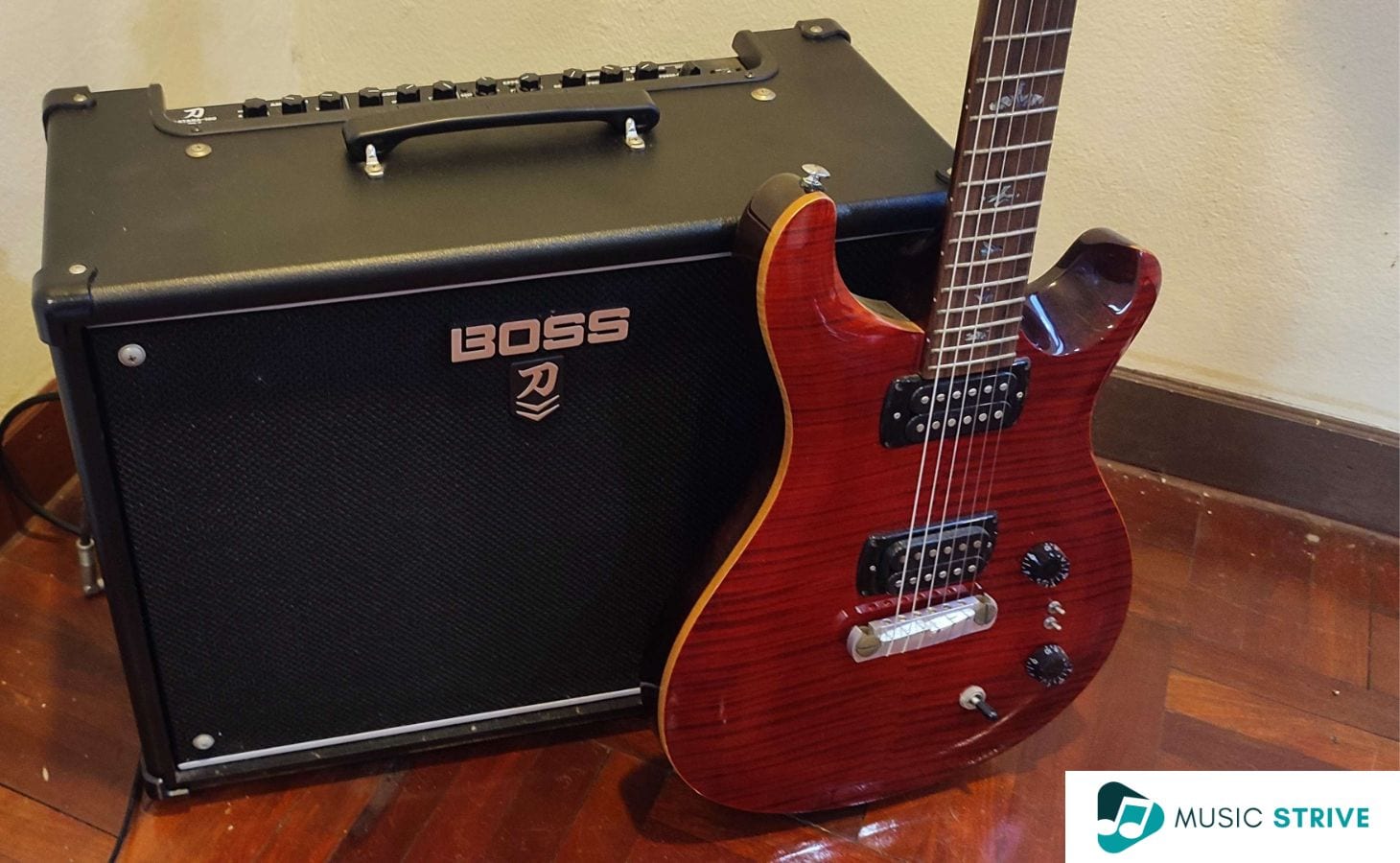
I don't have a photo of the newest gen. Katana 50, but here's my BOSS Katana 100 Mk2 next to my PRS SE Paul's. As you can see, I've been a fan of these amps since a long time, and use them alongside many other guitars of mine.
Since this is a modeling amp, you get a wider variety of settings than just the standard ‘clean’ and ‘gain’. There are now six different amp settings (the newly added edge-of-breakup Pushed tone, and five older classics - acoustic, clean, crunch, lead, and brown) with a variation button that effectively gives you twelve settings.
Les Paul guitars are fairly versatile themselves. So, having an amp as versatile as the Katana to complement a Les Paul is fantastic in my opinion.
Each one of the amp settings sounds great. None of them sound digital or flat. I even found the acoustic setting to have a very natural sound.
I wouldn’t use the acoustic setting for a full acoustic gig, but it’s usable for a short segment of a song.
You aren’t limited to what is on the amp either. You can connect the amp to a PC or Mac to edit and save your own presets onto the amp. I found the software is pretty easy to use and I found making my own presets to be a breeze and even fun. I’m of the opinion that time spent chasing tones is never wasted, and I was able to dial in some pretty fun facsimiles of classic Les Paul tones.
The smaller cab is a factor in affecting the tone coming out of the amp, but I got in the ballpark of Zakk Wylde’s Ozzy-era tone and Ace Frehley’s Rock and Roll Over tone pretty handily.
There’s even a very convincing fuzz sound ideal for Siamese Dream-era Smashing Pumpkins riffs.
I’m very partial to the Katana’s user friendliness. For example, The Katana uses a USB type C cable which almost everyone just has lying around. Along with the newest generation of this amp, you can also purchase the optional BOSS BT-Dual Bluetooth Audio MIDI Dual Adapter, which lets you tweak your tone on the fly using nothing but your smartphone, without even a cable.
I’m a little too curmudgeonly these days to try and play guitar through my phone, but it’s a cool feature that I’d love the time to dig into.
Apart from the amp presets, you also have an Effects section available to you. The effects section features a wide range of effects from overdrive, flanger, delay, compressor, and so on.
These digital effects are based on Boss’ own digital effects library. Accordingly, the effects based on Boss sounds are the most convincing: the chilly, metallic flanger is good for Stone Roses riffs, but not so much for Van Halen’s “Unchained.”
That said, I found it easy enough to switch between effects and adjust them. The effects sound just as great as the amp presets and they are all very responsive.
The BOSS Katana 50 is a truly versatile amp. From its great selection of amp presets to the high level of customization it allows. I always have a tough time finding anything wrong with this amp and you surely will as well.
It’s hard to argue against the convenience and broad-ranging versatility of this amp.
Further reading: BOSS Katana vs Positive Grid Spark (a much more in-depth take on the Katana, and comparison with the newer Spark amp from Positive Grid)
3. EVH 5150 Iconic Series

Any amplifier bearing Edward Van Halen’s initials was always going to be a shoo-in for hard rock and metal playing. Although Van Halen himself was a Superstrat man for the most part - he owned a few gorgeous late-50s models - this all-tube amplifier from EVH is a great match to the hard-rocking humbucker-equipped Gibson guitar.
A friend of mine, who loves Van Halen as much as I do, acquired one of these 5150 Iconic Series 1x12 combo recently, and invited me over to give it a crack. A few cups of tea later, I plugged my trusty Gibson Les Paul Classic in, and was grinning ear to ear with the high-gain tones on offer.
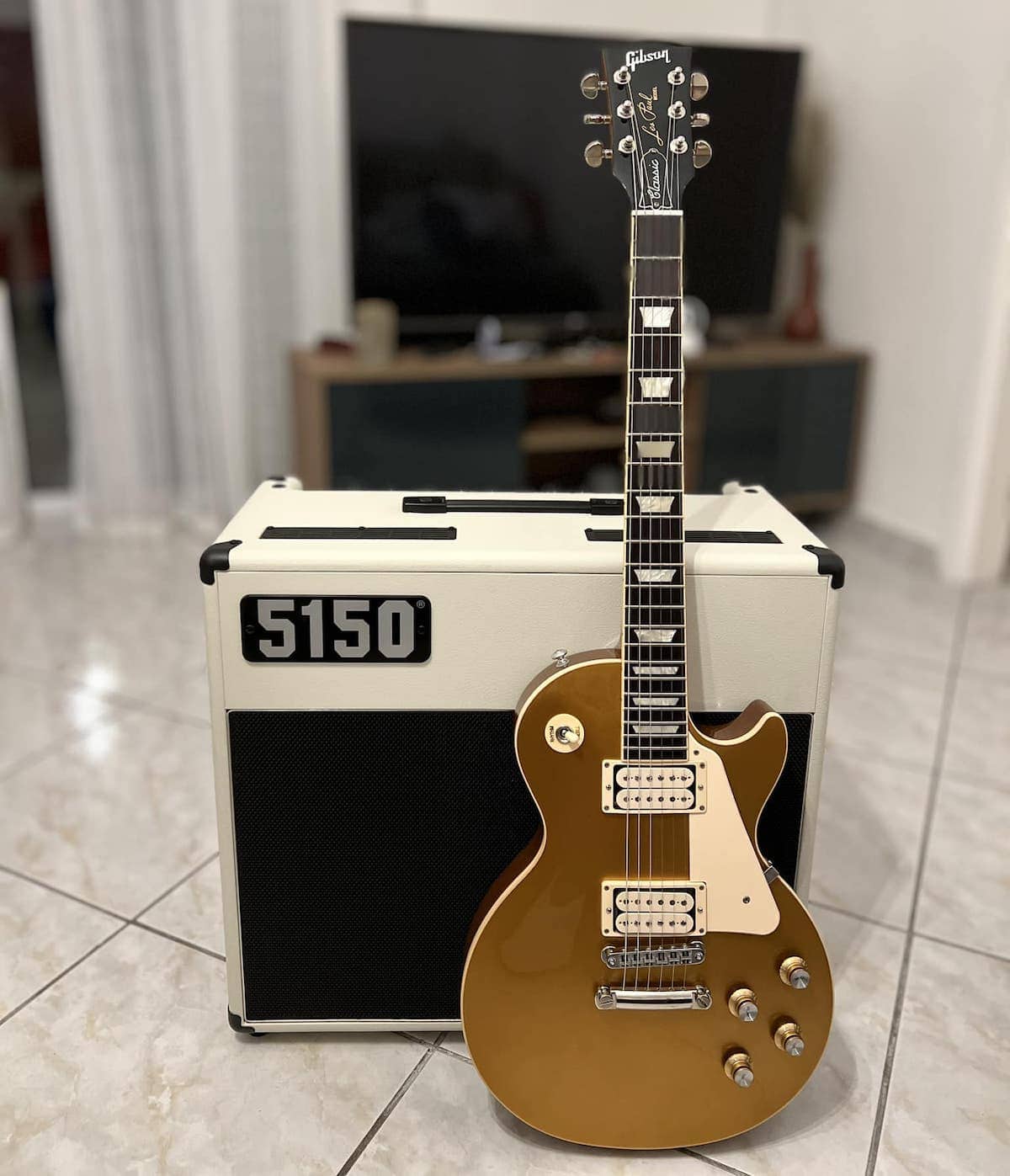
EVH 5150 Combo Amp Next to Gibson Les Paul Classic
The gain on tap is really something. There’s enough crackle and snarl to capture those big, sassy '80s metal tones, but cranking the gain knob and messing with the EQ saw me coaxing some high-gain modern metal sounds from the amp as well.
Palm mutes sound pleasantly chunky and aggressive. Pinch harmonics shriek and squeal like a stuck pig. Or, perhaps, a War Pig. You don’t lose any note clarity, even when deploying extremely high amounts of gain. I had a great time serenading my friend with my favorite Gary Moore licks.
Rolling back the volume knob on my guitar and setting the amp gain a little lower allowed me to get a cleaner “spank” from the tone. The cleans were not quite as glassy as my Hughes & Kettner Tubemeister. Regardless, I wished I had my chorus pedal handy to try out the tapped intro to “Women in Love”. Next time.
Unlike the Marshall amplifiers that Edward Van Halen used throughout the '80s, this EVH combo has a separate gain knob and a relatively even taper for saturation. The jump in saturation from one to four isn’t quite as aggressive on those beautiful old-school Marshalls, so the amp is much more user-friendly.
It’s been a long time since I’ve played music that demanded the sheer amount of distortion this amplifier offers, but I was very impressed by its tonal palette. There’s more headroom than you’d expect from an amp bearing Eddie Van Halen’s name, although it’s far from the neutral clean voicing of a Fender amplifier.
Similarly, the crunchy midrange sounds of this amp lend themselves far better to early AC/DC riffage than all-out metal. However, setting the gain knob past five is where this amplifier really shines.
It handles the chugging drop D riff from “Unchained” like a champ. It offers the right kind of poweramp compression for high-gain leads thanks to its all-tube construction.
You don’t lose any note clarity, even when deploying extremely high amounts of gain. The high-gain settings even react nicely to your picking intensity, and I had a great time serenading my friend with my favorite Gary Moore licks.
Sometimes, I find high-gain amps to be very muffled and inarticulate with the naturally darker voicing of my Les Paul. No such issues here, although I did have to ride the amp’s pleasantly sensitive EQ a little to hit the sweet spot with my guitar.
I’d strongly recommend this amp to those who, like me, prefer hard rock and outright. If you like the Van Halen brothers over Mumford and Sons, you’ll like this amp.
4. Hughes & Kettner Tubemeister
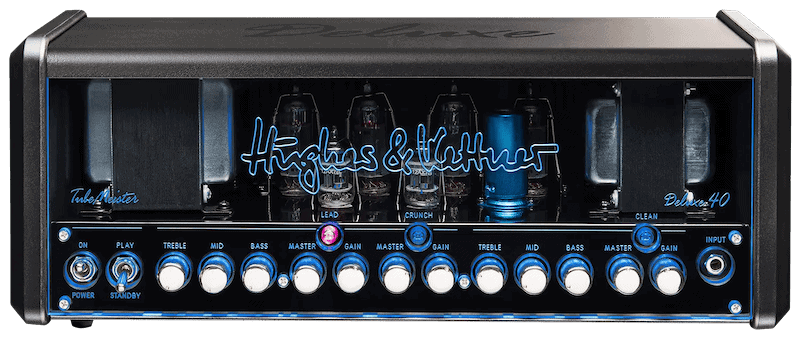
Hughes & Kettner are one of the lesser known names in amp building, compared to the British and American giants like Fender, Marshall and Vox.
However, they’ve secured a deserved foothold in hard rock and heavy metal niches in particular by offering seriously good tube tones right out of the box.
I’ve been playing my Les Paul through the Hughes & Kettner Tubemeister for about a decade now, and the compliments on my tone have been coming thick and fast that entire time. I’ve used mine on countless recordings and even more gigs!

Hughes & Kettner TubeMeister next to my Gibson Les Paul.
I love the Tubemeister for the specific tones from the modern iterations of classic rock bands. Rather than imitating classic Marshall sounds, for example, I like the Tubemeister’s ability to produce a tone that fits that genre without copying an existing tone.
My go-to riffs on this amp are classic KISS riffs, played loud and nasty with gain and volume about even. “She” and the harmonized solo from “Detroit Rock City” particularly benefit from this setup.
Likewise, I get a lot of joy from playing the arpeggiated lines from my favorite Rush tracks. The broken chords in the verse of “Limelight” benefit a lot from the clarity and articulation inherent to this amp’s character: no wonder Alex Lifeson played H&K amps for so long.
The built-in digital reverb isn’t enough for shoegaze, but it does provide a wet enough signal for me to do my best Gary Moore impression.
Of late, I’ve enjoyed the clean channel for country playing, even with my Les Paul. The clean sound is appropriately glassy and smooth for country and even pop riffing, and the power soak on the back allows me to retain my beloved tube saturation at bedroom volumes.
When I’m doing home demos or trying the Sisyphean task of keeping sound engineers happy, the built-in Red Box DI is a nifty feature, too, even if it does run extremely hot for when recording.
5. Blackstar HT20R

Another British amp company, Blackstar has been making excellent amps for many years now. From their first amps all the way back in 2007 to the HT20R MKIII, Blackstar has remained consistent with their quality-built and sounding amps.
I’m a big fan of Blackstar’s amps. For the most part, at least, they’re Marshalls with even EQ and volume tapers.
To this end, the HT20R is fairly standard in terms of features. It has two channels, a clean and overdrive, 3-band EQ, reverb, and master volume.
What isn’t as standard is the two voicings featured on both the clean and gain channels. The gain can switch between either a light crunch or a screaming high-gain overdrive.
Blackstar has spoiled guitarists here and allows you to switch between either an American or a British clean tone.
More accurately, the ISF tone control either adds or removes midrange spank. In full British voicing, it’s reminiscent of vintage Marshall tones. In full American voicing, it’s more like a Mesa-Boogie than a Fender.
I could be biased - Blackstar is a British company after all - but the British voicing, in both channels, is very impressive. It managed to cover my favorite tonal bases, from edge-of-breakup blues sounds to full-bore hard rock.
I even managed to EQ in a pretty convincing thrash metal tone, and I spent happy hours machine gunning away at classic Metallica riffs.
The main benefit here is the even tapering of the amp’s gain control. There isn’t the huge jump in distortion common on similar amps, nor the massive humps in volume.
The “sweet spot” for this amp is very wide, ranging from about 9 o’clock all the way up to about 5 o’clock on both channels.
A friend of mine plays in a hard rock cover band, and I immediately recommended this amp to him. If you need to play AC/DC and Creed on the same night, this amp can pull it off.
Dropped tunings sounded great here, too, not losing any definition. The satisfaction of playing a six-string D chord in drop D is enough to make any seasoned rock fan smile.
The power staging is pretty powerful, too. The full volume at 20 watts is remarkably loud: it’s more than enough for the kind of gigs I’m playing. The two-watt low-power does demand some volume in order to get to the lovely, fat tube saturation. I call it roommate volume: those who share your home will be able to hear it, but not the neighbors.
I’m a big fan of accommodations to make playing an amp easier. I’m thrilled that Blackstar has even included a simple two-button footswitch for easy switching between channels and voicings. I have played amps that don’t always work too well with every footswitch, and buying the right one is a bit of a hassle. An included footswitch, especially at this price, is a welcome inclusion.
6. Bugera V5 Infinium

Don’t be fooled by the Bugera V5 Infinium’s small size. This little tube amp packs quite the punch. It’s very light in my hand, but the tone can get spectacularly heavy.

Bugera V5 Infinium. It's the BOSS Katana 50 in the background, so you can use that as a reference to judge how small the Bugera V5 actually is.
The V5 is a very vintage-sounding tube amp. Specifically, I would call the tone ‘vintage British’. That does mean that the V5’s tone is quite limited compared to the other amps on this list. You won’t be getting a modern metal tone out of it without recruiting a distortion pedal.
I would say this amp is very much geared towards a blues, softer rock, and jazz sound. The clean tone is also fantastic. Very warm and very vintage.
I plugged my Les Paul in and had great fun jamming old Clapton riffs. Legato bends in particular benefit from the early compression of this amp’s tone, so it’s perfect for 60s-style British blues rock.
The clean tones also work quite well with pedals. I had no issues putting a distortion and some delay in front of this amp.
Even amp-style drives with lots of character like the Dirty Little Secret work great here. I’d consider using this amp as a pedal platform, to have the option of various Marshall-style amps on my board.
Playing a Les Paul through this amp is an especially great experience. The two work just so great together. Of course, the V5 is just a 5-watt amp. That means that you won’t be blowing the roof off of any gigs with this amp. However, for home practice or mic-ed up rehearsal with a drummer, it’s got enough tube-generated volume to work well.
It does mean that at its upper end, the tone gets a little too compressed and muddy, but it stays good up until about 8 or 9 on the amp.
I still think that it has more than enough volume to be a great practice amp. Combined with its great sound quality, I also think that the V5 is a great little amp to have in your studio.
It has such a rich and distinct tone. It will easily add a whole new dimension to your guitar tone. Its lightweight and compact design also make it a great travel companion. The V5 will be quite perfect for any buskers.
I think my only real issue with the V5 is its lack of EQ. It only has a single tone knob to adjust your sound with. The tone knob works well enough and the difference is quite noticeable. I would just have preferred even a simple 2-band EQ to be able to make finer adjustments.
Of course, I also own an EQ pedal, so the lack of EQ here isn’t as much of an issue for me.
All in all, the V5 Infinium is an excellent little amp, well worth the price (click here for our full review).
7. Vox AC15C1

The VOX AC15 has a long and prestigious history in music. Used by many iconic bands including The Beatles, it is no wonder this is such a sought-after amp.
American guitars and British amps are always such a great combination to me. The two distinct sounds blend together so well and create such a fantastic sound.

Vox AC15C1
I’ll the first to admit that a Vox is the last amp I’d think of when trying to match up with a Les Paul. It’s about as far from the classic Les Paul/Marshall pairing as you can get!
However, the natural brightness and British character of the Vox does offer some intriguing tonal options.
Here, the C1 version stays true to both the design and the sound of the original AC15. It retains that classic British look and tone.
The AC15C1 is a powerful 15-watt tube amp. It is one of the loudest 15-watt amps I have ever played and you would be forgiven for thinking it isn’t a 15-watt amp.
Vox amps tend to be very loud: even the 15 watts of this amp was enough to rattle the windows in my apartment.
As with the AC30, this amp is heftier than it looks. I’m just over six feet tall and spent years lugging 4x12 amps around in touring bands, so I’m used to dealing with heavy gear. More diminutive players might want to consider their comfort when loading this amp in and out of gigs, however.
Considering how good this amp sounds and how powerful it is, you probably will want to take it to every gig. I know I want to take it everywhere.
In terms of features, the AC15C1 has some unique offerings. It has both a normal and master volume and spring reverb which are fairly standard on an amp of this type. It also features a tremolo reverb with depth and speed adjustments and a top boost with 2-band EQ and volume.
The spring reverb is nice and drippy, and the tremolo is, to my ear, more Fender-voiced than Vox. I was able to summon tones very workable for surf rock. Likewise, I got into the ballpark of Humbug-era Arctic Monkeys tremolo sounds.
In terms of sound, though, the amp isn’t very versatile. You won’t be venturing into high gain, distorted territory with this amp. Clean and light gains are what it does, but does really well in my opinion.
Of course, being a Vox, this amp excels at cleaner British sounds. With my Les Paul adding some much-needed warmth, the clean tone is very usable for the less jangly end of Britpop tones. I wasn’t much impressed by its capacity for drive and distortion.
I managed to find a usable blues sound, and the chiming, sustaining tones of the amp are nice enough to justify taking it to softer-voiced musical outings.
While I personally prefer the Gibson/Marshall pairing, there’s a lot to be said for this distinct flavor by comparison. It’s got enough grit and warmth for lower-gain rock playing: think Led Zeppelin’s early material, or full-throated Camden indie.
8. Fender Blues Junior IV

Similar to Vox, Fender amps don’t need much of an intro. You know that you will be getting high-quality design and sound, regardless of the Fender amp you choose. The Blues Junior IV is no different.

Fender Blues Junior IV
As the name suggests, this little 15-watt amp was made to play the blues. And from my experience, it does blues wonderfully.
The Blues Junior has that classic sparkling Fender clean sound. Switching over to the ‘fat’ channel, you get a smooth midrange and, well, fat crunch sound that is just perfect for blues and rock.
The reverb has also seen a substantial improvement from the Blues Junior III. The IV’s reverb sounds quite a bit smoother and warmer to me than on the previous version.
I was also pleasantly surprised by how well this little amp handles pedals. Drive pedals sound especially great with loads of volume. This allows you to push the amp a little further into a distorted sound. This is far from Marshall-style rock and roll saturation. It sounds best as edge-of-breakup bluesy drive.
Speaking of, I found this amp, paired with my Les Paul, to be great for country playing. More specifically, modern rock-tinged country, like Jason Aldean, Luke Combs, or Chris Stapleton.
My Les Paul just doesn’t twang quite the right way for classic Chet Atkins playing, but for “No Love in Oklahoma” or “White Horse” this pairing of guitar and amp works great. The cleaner sounds are fantastic for blues or country rhythm playing in a pinch, too.
Reverting to a clean tone did present a very neutral palette for pedal platforming. The addition of overdrive and compression helped to push this great amplifier further into the nether region between clean and dirty tones.
Speaking of pedals, Fender has also included a simple footswitch for easy switching between the clean and gain channels. It isn’t that big of a deal, but I do feel it was nice of them to include this small convenience. I tend to switch between clean and dirty sounds by manipulating my guitar’s volume knob, especially on a Les Paul. Regardless, it’s a useful inclusion when you need some extra push.
Build wise, the Blues Junior is a compact and lightweight amp. It’s a tube amp, so it has some weight, but I was easily able to throw it on the backseat of my car to take to gigs and rehearsals.
Even at just 15 watts, this is still a fairly loud amp. Although, I will say that it isn’t anywhere near as loud as the AC15. While you can certainly gig with this amp, you are going to be limited. I probably wouldn’t do any large gigs with it, but it was plenty for rehearsal and bar gigging. Likewise, I could see myself using it for rather smaller café gigs or some busking.
Further reading: Blues Jr vs Princeton Reverb (a much more in-depth take on the Blues Jr)
Les Paul Amps: Tube vs. Solid State
One of the reasons the Les Paul is such a beloved instrument to so many musicians is the sheer range of styles it can be used for. Although predominantly used for rock guitar throughout the 60s and 70s, the classic Gibson guitar has gone on to be utilized for many different purposes.
When it comes to identifying the best amplifier for Gibson or Epiphone Les Paul, you need to identify the results you're aiming for.
Do you simply want to amplify and enhance the natural, warm tone of the Les Paul, or would you rather have access to a plethora of effects to bathe the guitar in?
If the former is your preference, then an all-tube amplifier is likely to be your best bet. If the latter piques your interest, then perhaps a solid-state amplifier with many onboard processing options would be better suited.
Amplifiers with all-tube constructions are generally preferred by music purists. They popularly produce a natural layer of grit, which is sometimes called "breakups", adding character and color to an electric guitar.
Solid-state amps, on the other hand, are preferred for the additional headroom they offer a guitarist. The signal is much cleaner and less likely to be subjected to distortion or saturation.
In terms of effects, tube amplifiers often house the classic combination of tremolo and reverb. These channels have a distinctive sound, with spring reverb the predominant variety used on valve amps.
Solid-state amps have the potential to house hundreds of inbuilt presets and effects. They can often be accessed simply by using a rotary control or buttons, and for that reason, these amps are well-suited to experimental guitarists.
Tube amplifiers are generally more expensive than their solid-state counterparts, due largely to the inner components that form them. However, they are more fragile, and the tubes are prone to wear out eventually.
Why Do Guitarists Like Les Pauls?
The Les Paul’s humbucker-powered tone is as well-suited to the treble-heavy easy saturation of British-voiced amps as it is the warm, clean sound of old-school American amplifiers.
The Gibson Les Paul can be heard on countless classic rock, jazz, and blues records. It was a mainstay of popular music from Les Paul himself launching the guitar in the 50s, powered the British blues boom of the 60s, heralded the apex of hair metal on Appetite for Destruction, and rang in the new millennium in the hands of My Chemical Romance’s dual axemen.
A good Les Paul is the sort of guitar that sounds better the better you play it.
There’s some sort of unique magic about them that highlights a player’s own personality. Jimmy Page never sounded like Joe Walsh on Joe Walsh’s guitar, and Gary Moore never sounded like Peter Green on the “Greeny” Les Paul, as much as he might have wanted to.
While they can be a little unwieldy, not least due to their tremendous weight, that’s part of the charm. Les Pauls have a distinct personality, and the great guitars have a tone all their own.
Consider The Speaker Configuration and Size
This might not have been something you have ever considered, but the speakers in your amp do make a difference.
The obvious difference is in terms of power output. A larger diaphragm speaker is going to output much more power than a smaller speaker.
But that doesn’t mean that bigger is automatically better. There are reasons to want to go with smaller speakers.
For example, smaller speakers are more responsive and have a tighter attack. Larger speakers on the other hand will have a lot more low-end, but will also be more evenly spread across the frequency spectrum.
Consider the type of music you are going to play. If you are mainly playing things like jazz and blues, you will probably be better off with a smaller speaker as you won’t need as much power.
If you are playing rock and metal, then bigger is better. And in that case, you will also likely want to go with an amp that has two speakers. Something like a Fender Champion.
Bigger, more powerful speakers will also allow you to play in larger venues.
Choosing the Right Wattage
This sort of ties into the size of your speakers, but you should also consider the wattage of your amp.
More wattage will of course mean you will be able to play larger venues. You can play gigs with a 15-watt amp, but what this is really about is headroom.
Specifically, headroom with the clean sound. A higher wattage amp will have a lot more headroom for those bright, sparkly cleans.
Headroom is also important if you are going to use pedals with your amp. This brings me to the next point.
Are You Using Pedals or Just the Amp?
This is another important thing to consider. Different amps tend to react differently to pedals.
Some amps work flawlessly with pedals while others don’t like having a pedal plugged into them. Other amps work well with certain pedals but not others. And then there are amps that work well with pedals up to a certain point.
If you don’t plan on or need to use pedals, then you won’t have to worry as much. Just make sure you get an amp that can still do everything you want it to.
But if you are going to use pedals, especially to add to the sound with effects like flangers and delays, you will have to make sure the amp still sounds good with a pedal plugged in. Tube amps can be especially picky when it comes to pedals, even more so with digital pedals.
I would just always look up videos of the amp I want to by being played with pedals. Even better would be going to a shop and testing it out for yourself. Even if you aren’t planning on using pedals, you might change your mind down the road.
How Versatile is the Amp?
And of course, the genres and styles of music you play are going to affect the one you choose.
Do you want an amp that can do it all? Or do you want an amp that can just do one thing, but really well?
If you only play jazz and blues, an amp like the Marshall DSL40CR is probably going to be overkill and unnecessary. If you play blues, but also sometimes delve into rock and metal, the Blues Junior IV isn’t going to cut it.
I personally think that going with a more versatile amp is better than going with an amp that is more focused on a specific sound. This is just to leave the door open in case you want to experiment with other genres or you suddenly need an amp that can play a certain genre.
Closing Thoughts
Whether it's Gibson or Epiphone-made, a Les Paul deserved to be paired with an amplifier of sufficient quality. Hopefully, this list has pointed you in the direction of the ideal companion for your beautiful guitar.
While there’s a lot to be said about the classic pairing of a Les Paul and a Marshall, there’s no shortage of awesome tones out there for those willing to look.
It takes time to figure out the operation of a new amplifier, so be patient, and you’ll be producing some wonderful tones in no time!

The list of amps that wouldn’t sound good with a Les Paul would be more instructive. It would be a list of amps that simply don’t sound good.
I have the boss katana 50, awesome amp,can drop it to half watt, hook to laptop for endless possibilities!
I really looking for an amp that gives me a mellow sound, the Gibson will add the other thins I need