
Metal guitars are a breed of their own. They serve a higher purpose and have appointments needed to reach the extreme. Yes, metal and extremes have been intertwined since the genre’s birth back in the late ‘60s and early '70s.
But what makes a good metal guitar today? Furthermore, which are the brands that you can trust with your hard-earned money to get the best possible six-stringer for your heavy adventures?
Well, we’ve got your back and did the heavy lifting for you, so you’re about to read a highly curated list of the best metal guitar brands and models for every budget. We’ll also discuss what these guitars need to have to fit the bill.
Finally, read until the end and you’ll find a mini, 3-step procedure for a mindful purchase.
Are you ready to shred your way into Paradise? Let’s do this!
Table of Contents
- What Makes a Good Metal Guitar (The #1 Priority)?
- A Little Brand History & Profile
- Entry-Level Guitars
- Medium-Tier Guitar
- Professional Guitars
- What about 7 and 8-String Guitars?
- What are the Big Three Offering Metal Players?
- What To Look for in a Metal Guitar?
- Three Steps to a Mindful Purchase
- The Bottom End
What Makes a Good Metal Guitar (The #1 Priority)?
Before you start thinking about guitars with headstocks that won’t pass airport security regulations, let’s talk about the main feature to look for in a metal guitar: Comfort.
Yes, despite what everyone else says and what image you see when you close your eyes, metal is a very physical kind of music. Therefore, you need to have a good relationship with your instrument comfort-wise. By this I mean a body shape, neck, and weight you can handle.
Furthermore, if you’re going to be practicing with that guitar as well as playing it live, you need to bear this in mind and buy a guitar that’s comfortable in both scenarios.
So, the best metal guitar for you (and for any of us shredders) is the one that lets you express your best playing. We all know that a good-sounding, comfortable, badass-looking instrument with obnoxious levels of distortion is enough to awaken our inner metal demon.
So, comfort should be your #1 request for your new ax.
A Little Brand History & Profile
We’ll start this head-to-head battle for the imaginary pole position in the race for the best metal guitar brand in the world with a pinch of history. But don’t start yawning just yet. We added a profile for each brand, so you know what to expect from each of them, too.
ESP/LTD
Hisatake Shibuya opened his shop, called Electric Sound Products (ESP), in Tokyo in 1975. His brand started selling replacement spare parts and accessories for big brands. The first of these made it into the US in 1983. By 1985, the brand was making custom instruments for players the size of Vernon Reid, Bruce Kulick, and Ronnie Wood.
Around the same time, the brand also made OEM parts such as necks and bodies for Schecter and Kramer. In the late ‘80s, with Metallica’s fame, James Hetfield and Kirk Hammett’s ESP guitars drew attention to the brand that has grown exponentially since.
Top 3 - Popular ESP/LTD Guitars
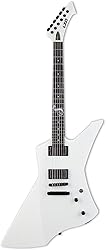
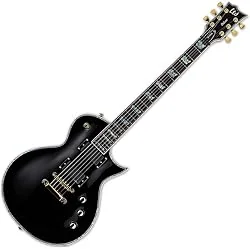
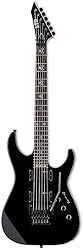
Although they were issued a cease and desist from Gibson to stop using their shapes, the brand is today, Ibanez’s biggest competition in Japan and the USA.
What you can expect from ESP/LTD is high performance throughout the line, audacious accessories, and some of the most comfortable necks in the business.
Ibanez
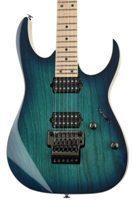
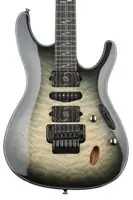
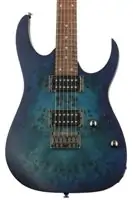
Ibanez, for many, is the number-one shredder brand in the world. They won this badge for being the string force behind players like Steve Vai, Joe Satriani, and Paul Gilbert among many others. Ibanez is a brand that, because of its size and the number of products it offers, is thought by many as the third-biggest guitar brand in the world after Fender and Gibson.
Top 3 - Popular Ibanez Guitars
Preview | Product | Price |
|---|---|---|
 | ||
 | ||
 |
It all started with Hoshino Gakki, a guitar company founded in 1908 in Nagoya, Japan. They began making nylon-string guitars in 1935, and with the explosion of rock and roll joined the electric guitar revolution.
After losing a lawsuit against Gibson, the company started designing and building their own models. Guitars like the Iceman, the Roadster, and the Artisan were the spearheads of the Japanese guitars flooding the market.
Nowadays, Ibanez represents the finest, most technologically advanced guitar maker in the Japanese market. They make fast, outstanding guitars that can take the abuse of some of the most demanding players on the planet.
Jackson
Grover Jackson founded Jackson Guitars at the request of one of the scene’s most relevant players for a custom instrument. The man I’m talking about is no other than Randy Rhoads, and the guitar is the Concorde, a legendary instrument.
Jackson started its life the opposite way many brands did, making only premium-class guitars made in the USA. You might remember endorsers such as Dave Mustaine, Scott Ian, and Phil Collen from that era.
Top 3 - Popular Jackson Guitars
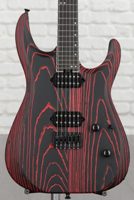
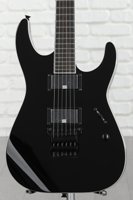
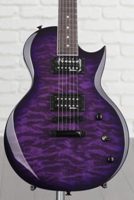
In the ‘90s, the band expanded its production to Asian countries and began offering affordable versions of their best-selling instruments. By 2002, Jackson was purchased by the Fender Musical Instruments Corporation.
Nowadays, Jackson offers elite-level guitars made in Corona California up to Fender Custom Shop standards, and mid and budget price-guitars made in Asia. Jackson is a synonym for playability, boldness, and more than anything, metal-friendly shapes like Vs, Explorers, and such.
Schecter
Just like Grover Jackson, David Schecter started making spare parts for other companies in 1976. In 1979 his company offered over 400 parts but not finished instruments. In the early ‘80s, Schecter began offering top-notch guitars, sold at premium prices by only 20 retailers in the US. These were Custom Shop quality, handmade in Van Nuys, California.
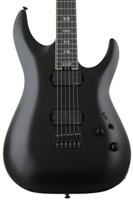
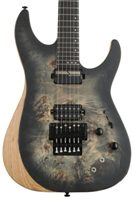
Top 3 - Popular Schecter Guitars
Preview | Product | Price |
|---|---|---|
 | ||
 | ||
 |
The company made it to the 1984 NAMM show with Fender copies (using the same headstock shape). This was allowed by Fender when they were a spare parts brand but filed a lawsuit for the guitars. This resulted in the sale of the company in 1987 to Shibuya Hisatake, the owner of ESP Guitars.
The Company’s Diamond series rose to prominence because of Jerry Horton’s C-1 displayed in the “Last Resort” video. Nowadays, the brand is a synonym with heavy metal guitars that aren’t necessarily aimed at shredders, but at players who play heavy riffs and need a bigger-than-life tone.
Entry-Level Guitars
What to Expect from Entry-Level Guitars?
Entry-level guitars are aimed at those starting out, those who want a guitar to kick back and relax, those who play like a hobby, and those who need an extra flavor in their arsenal and don’t want to break the bank.
In this market segment, below $500, big companies take their most iconic designs and cut some corners to make them affordable. So, what you have generally is a guitar that looks like the real thing (sometimes no binding, or a different bridge or tremolo system, or a veneer instead of flame maple) and plays like it, but with budget construction.
So, if a guitar comes originally with Seymour Duncans and a Floyd Rose, you might get generic pickups and tremolo, or the body might be made of poplar instead of mahogany.
Still, the aggressiveness, ease of play, and looks will all be there for you.
ESP/LTD
ESP is the Japan and US-made guitar name while LTD is the brand they use for their lower tiers. So, this is an ESP LTD EC-200DX and it’s made to bring their acclaimed Eclipse model to the masses at an affordable price.
Although it’s dressed to kill, that amazing flame maple top is just a veneer, this guitar sports a Les-Paul-style single-cutaway body made of poplar. The neck is bolt-on and is made of roasted maple with a rosewood fingerboard.
So far, this guitar doesn’t scream metal, but the moment you put your hands on it, you’ll notice that the contours, the neck, the mighty power of the humbuckers, and the frets are all metal material.
To begin with, the thin-U neck is fast and the 13.77” radius helps lightning-fast shredders get the most out of this 24.75” Gibson-style scale. Speaking of playability and comfort, the 24 extra-jumbo frets are very tall, enough to make playing fast very easy.
Perhaps, the ceramic pickups could be a little more defined, since I tuned the guitar down a whole step and did the drop-C trick to find myself in a little gain swamp. That said, playing the open C with this guitar’s full power made a few things rattle and fall.
You might lack the sustain, clarity, and depth of the real deal, but this guitar packs enough punch to make riffs like “Minerva” and “Shove It (My Own Summer)” by Deftones feel and sound heavy.
That said, the neck is comfortable and fast so you can make your way into Mount Olympus of shredders and riffers.
If you dig the traditional-meets-modern shape of this guitar, you should try it before buying.
Ibanez
The man who started it all for Ibanez as a worldwide virtuoso brand and the one who has consistently pushed his own limits as well as the instrument’s is Steve Vai. Well, the JEM caused a revolution upon release. I remember being like Wayne from Wayne’s World, admiring it behind the glass drooling at all its gold-and-white gorgeousness.
Although I never did fulfill my dream, like Wayne did (I own guitars that expensive now, but not a Jem), the Ibanez Steve Vai Signature JEM Jr can make the dream come true for a lot of people at a fraction of the price.
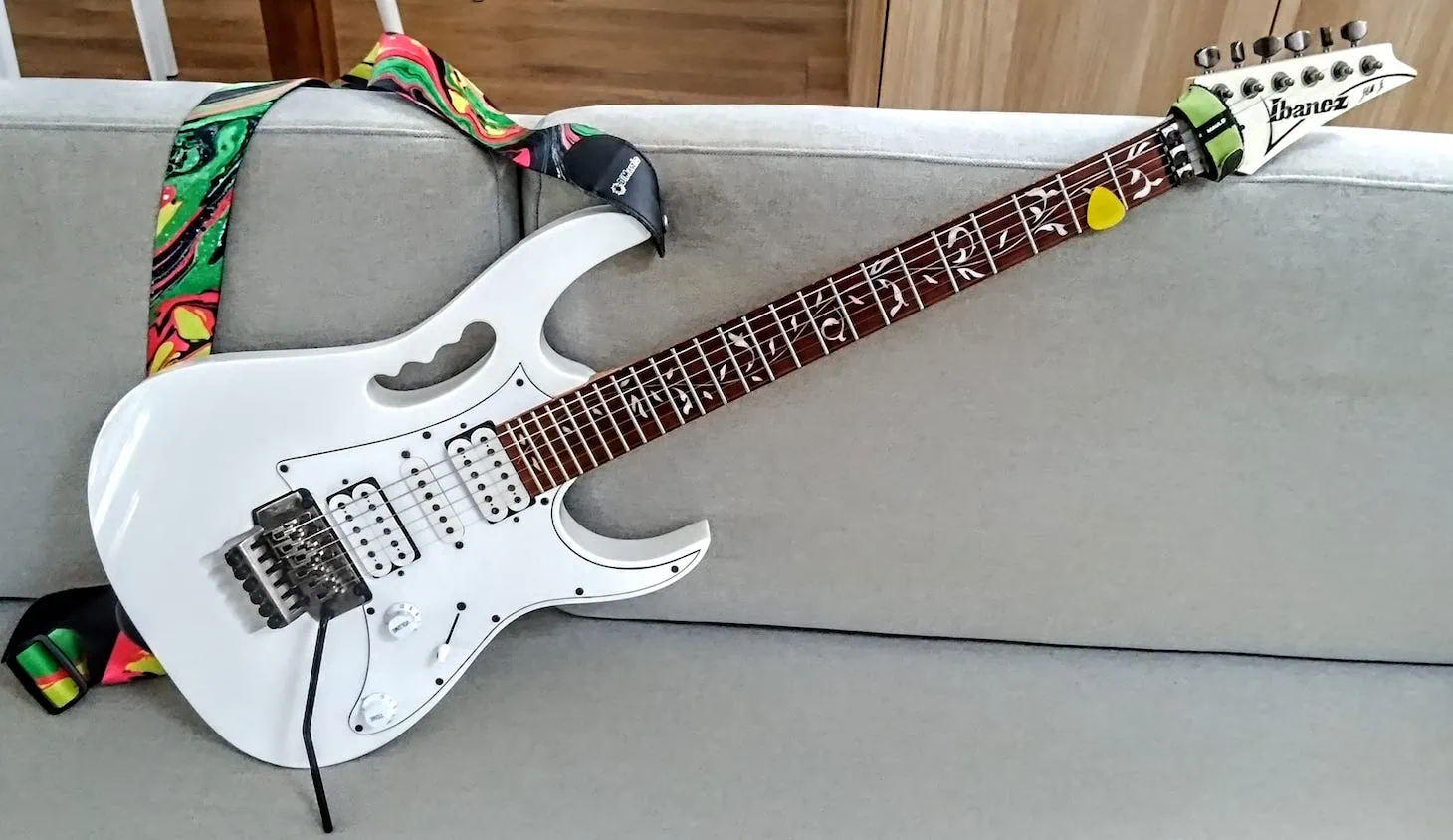
Ibanez JEM Jr
Although this guitar is a black-and-white version of Steve’s ax, it really does the trick playing-wise. Yes, it sports one of Ibanez’s most audacious necks, the thin and fast Wizard III. There’s no speed limit in it and you can really feel Steve’s mojo pushing you forward.
Furthermore, the jatoba fretboard with (an acrylic version of) the Tree of Life features a lightning-fast 15.7” radius. Although it doesn’t feature the scalloped last four frets as the real Jem does, it allowed me to play the first part of “For the Love of God” quite accurately.
The one thing that the company went too far with, in my opinion, is the pickups. These are medium-powered, not-so-defined pickups that don’t give the guitar the kind of violin-like sustain or body you expect from a Jem. I tried those fast runs, and the result was more like splashing into a swamp than galloping through the prairie.
Moreover, I tried some heavy crushing riffs, like “Cowboys from Hell” and “Five Minutes Alone” and, although I had an amazing time because it’s such an easy guitar to play, I felt it lacked the definition because of the Quantum pickups.
This guitar, with its meranti body and jatoba fretboard, can turn into a really vicious metal machine if you upgrade the pickups to DiMarzio Evolutions. Even without them, it represents a serious bang for the buck.
Jackson
A metal guitar with a shape that would engage the alarm in any airport? I’m in! Well, the Jackson Rhoads JS32 embodies the very spirit of Jackson guitars and Randy Rhoads in a guitar that sounds as menacing as it looks.
First, please, let’s take a moment to appreciate the audacity of this guitar’s shape. It’s bold, it’s aggressive, and it screams metal to the four winds. Well, after that first moment of stupor that came upon me, I managed to ask for a strap and hang it on. It was a beautiful surprise to know it doesn’t nose-dive like many others.
The guitar doesn’t feature the set-neck construction the original does, but the bolt-on maple neck is medium ground between Ibanez-like thinness and some Strat-like amount of wood to grab on. Also, the 24 jumbo frets and the 25.5” scale make this a stable, easy-to-play guitar.
Speaking of playing, I plugged into a new EVH combo, and, man this thing screams. I did the whole harmonic-overtone-with-whammy-bar trick, and it sounded utterly epic. What’s more, I put it to the test and played “Crazy Train” and “Mr. Crowley” and the result was tight in the bottom end but with enough sparkle to cut through.
Yes, the Jackson-designed ceramic pickups pack quite a punch and, although the guitar doesn’t have the mahogany-ebony combination of the original, it does have the spank from the maple and the scale.
Finally, the double-locking Floyd Rose licensed tremolo unit is stable and functional as you’d expect. It might be a little fragile if you palm mute a lot, but it does the job well.
A pickup swap could put it into the next league, that said, I would definitely gig with it; this guitar is ready for the stage.
Schecter
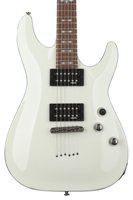
Schecter took everything that made their C-1 model an iconic, pivotal guitar for a generation of heavy players and presented it in a package that’s affordable for most musicians. Yes, the company did this without cutting as many corners as the competition.
To begin with, the Schecter C-1 Standard is made of mahogany, with a bolt-on roasted maple neck, and a rosewood fingerboard. Seeing this combination of woods in a guitar in this price range is, at least, a surprise. But that’s not the end of the surprises with this guitar.
We’re used to seeing flame tops, but have you ever seen a burled top? Moreover, have you ever seen a burled mahogany top? Well, that’s exactly what the brand went with, and it looks really cool.
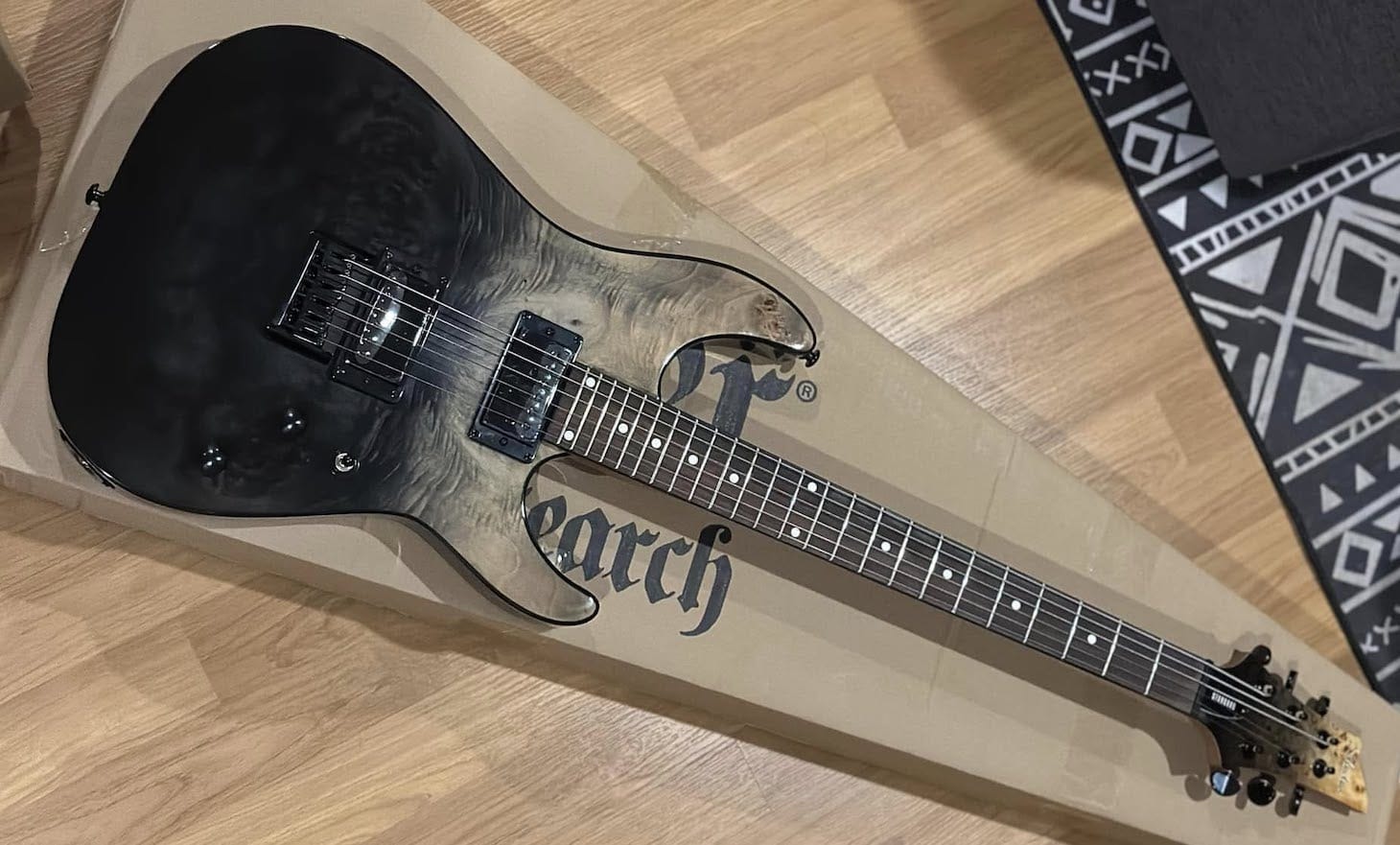
Schecter C-1 Standard
Another cool aspect of this guitar is the graphite nut, something you usually find in much more expensive guitars, and that affects the instrument’s tone and tuning stability.
Speaking of which, although it has a fixed bridge, the inclusion of locking tuners would have been a great plus since it can go out of tune when you play dropped tunings with a heavy right hand. I tried “Bored” and “Digital Bath” by Deftones, and this guitar sounded mean and heavy but went out of tune fast.
The 25.5” scale, the 14” radius, the 24 jumbo frets, and the (very) thin-C neck are an invitation to shred. Since you don’t have a floating tremolo, you can drop the 6th string and play heavier-than-life crushing riffs in the first frets as well as lightning-fast shredding and lead playing high up in the fretboard.
Although this guitar doesn’t have the sustain and punch of the original, it makes an outstanding heavy guitar at a price that most players can afford.
Medium-Tier Guitar
What to Expect from Medium-Tier Guitars?
Medium-tier guitars are a very difficult niche for builders and for buyers. How so? I’m glad you asked. Well, this segment of the market that goes from $500-700 to $1300-1500 is where companies need to deliver the goods on a tight budget.
I mean, they can no longer use generic tremolo systems, pickups, or alternative woods. Nevertheless, they can’t go over the top with materials and accessories as you would expect on $3000 guitars and up.
So, here you can expect original construction methods (no more bolt-on to replace set-neck or neck-through), some wood types like mahogany and ebony, and some nyatoh and laurel as well. Also, some big-brand pickups like EMGs and Seymour Duncans along with company-designed replacements, and original tremolo systems like Evertune and Floyd Rose.
You won’t find any exotic woods or elite-level appointments, but these are road-ready, stage-friendly guitars that can take you around the globe and back.
ESP/LTD
Blending a traditional build and modern features, this guitar is a mean metal machine ready to sing, chug, and destroy upon your commands. Yes, the matte finish and the silver hardware make it flashy but dark, cute but evil.
Speaking of evil, let me tell you that combining a neck-through construction with active EMG pickups is to unleash a sustain demon that will keep your note ringing for ages. In the same vein, the 81 in the bridge position of the ESP LTD EC-1000 Evertune has enough crisp power and mammoth punch to put Ozzy to sleep.
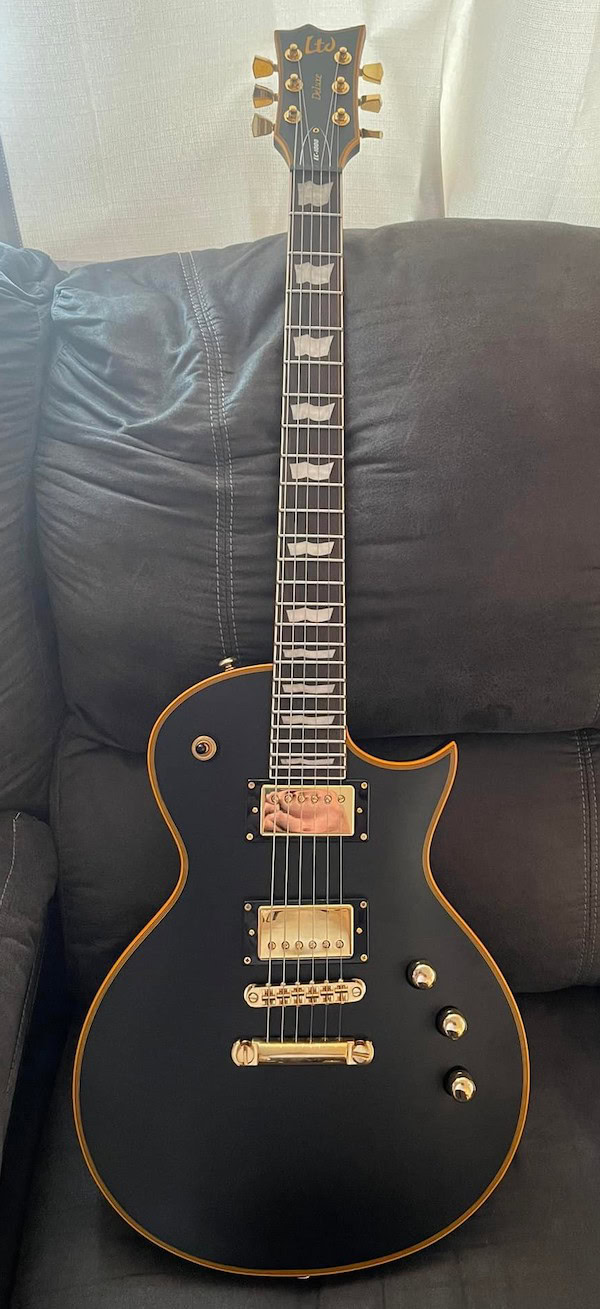
ESP LTD EC-1000
I tried some Metallica stuff on it because when you play an EMG-loaded ESP, the first thing in your mind is that band. Classics like “Sad but True”, “Enter Sandman” and “The Memory Remains” sounded just as punchy and fierce as the originals.
The Evertune bridge always keeps everything in tune, regardless of what you do to the guitar. It’s one of those guitars you can take out of the case months later and it’ll still be in tune. The three-piece, thin-U, mahogany neck with Macassar ebony fingerboard and 13.7” radius feels fast and comfortable to play. Moreover, the 24 extra jumbo stainless-steel frets make playing fast a breeze.
Perhaps, the only thing that didn’t appeal to my playing was that the company chose a Gibson scale of 24.75” for a 24-fret guitar, which makes the room for the fingers up there a little cramped.
Finally, I tried coil-tapping. Although it wasn’t pristine clean, the idea of going from single-coil verses to full-humbucker choruses or from single-coil chords to humbucker-driven leads proved to be a great resource.
This is a guitar that can give you years of flawless metal tones without investing a penny above its retail price.
Ibanez
The first thing you ask yourself as soon as you pick up this menacing instrument is “How much black can you put on a guitar?” Well, except for the silver shine of the guitar strings, the rest is all matte black. And, let me tell you, it suits this Ibanez RGRTB621 Iron Label perfectly well.
This guitar has, in my opinion, three main appointments that separate it from the rest of the metal guitars, at least, on this list.
Firstly, it’s a neck-through construction, which means that the amazing 5-piece maple/walnut Nitro Wizard goes all the way to the back strap button for increased sustain and reliability.
Secondly, it’s a string-through-body design (yes, like you would find on a Telecaster) enhancing that sustain even further.
Thirdly, the monorail tailpiece (kind of like a Strat hardtail bridge) offers utterly precise intonation and allows you to drop the 6th string or experiment with tunings easily.
But that’s just the tip of the iceberg here because, besides the superb playability of the ebony fretboard and the 24 jumbo frets, the reversed headstock increases the tension on the sixth string. Taking into consideration the Fender-like 25.5” scale, riffs sound and feel heavier and tighter because the top string stretches all the way to the last Gotoh locking tuner.
Finally, the company worked on these pickups with DiMarzio exclusively for this model. They’re humbuckers called Fusion Edge and coupled with the dyna-MIX 10 switching system, give you 10 sounds to express your soul.
Let me tell you that I tried it all, from Slipknot to Quiet Riot, and from Black Sabbath to Mastodon and it all sounded huge, precise, and heavy. Plus, you can experiment with the pickups and get some decent clean sounds with them as well.
I can’t imagine this guitar on any stage that’s not a metal stage, but you could accompany Gloria Stefan on a world tour with it too and it would deliver salsa-ready tones night after night.
Jackson
Yes, I know what you’re thinking, and you’re probably right. But let me ask you a question, did you ever strap on a Rhoads guitar? Well, I chose another Rhoads for this tier because it’s one of the highest bangs for the buck you can get in the entire Jackson catalog.
Oh, and because it looks badass too.
The Jackson Pro Series Rhoads RR3 is the next-best thing after the almighty RR1 and packs enough punch to set an entire arena on fire (not literally, of course). It has the same looks and terrific gold hardware as the Concorde guitar.
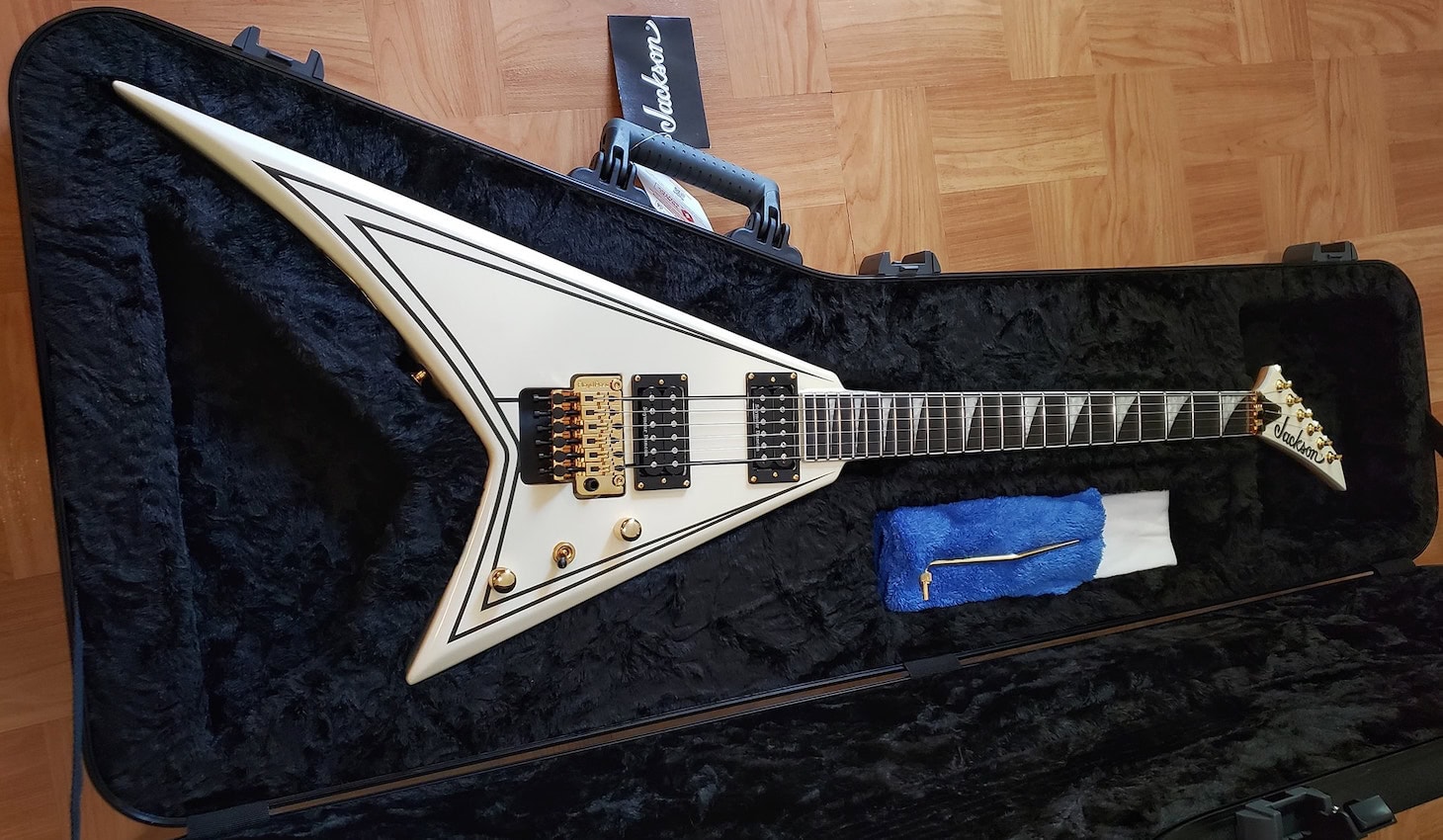
Jackson Pro Series Rhoads RR3
To begin with, this guitar sports a mahogany body with a neck-through construction. The neck is made of graphite-reinforced maple and sports an oil finish that makes it velvet to the touch. In the same vein, the ebony fingerboard has virtually no grain (it looks like black marble) and the tall jumbo frets make this guitar a joy to play anywhere on the fretboard.
Speaking of the playing, the Seymour Duncan passive pickups give this guitar a well-deserved retro sound with a nice, scooped EQ, not-so-tight lows, and spanking highs. Moreover, the 25.5” scale and the compound radius (12” to 16”) make this the perfect riff machine but also a speed demon on the higher frets.
I tried Randy classics like “Diary of a Madman” and it sounded just perfect, maybe with a little more presence due to the maple-ebony neck combo. My fingers just wanted to speed up as I played past the 12th fret and the results shocked me. This guitar wants to unleash your inner metal speed demon all the time.
Furthermore, and this might be polemic, but the 22 frets allow the neck pickup to be further from the bridge, giving it a warmer tone.
Finally, I tested the original Floyd Rose tremolo system by doing some dive bombs and pushing some harmonics up to the sky and the results were flawless. The guitar stayed perfectly in tune and went from the fires of hell to the mushy clouds and back effortlessly.
If you dig the looks, this guitar is a must-try-before-you-buy specimen.
Schecter
The moment you see the Apocalypse red finish on the Schecter Avenger FR S Apocalypse you’re mesmerized, but the first time you see it under the lights of the stage, the whole thing just comes alive.
That said, aesthetics is only a small part of this unique guitar full of usable, powerful, outrageous metal tones.
Let’s begin with the neck. The thin-C shape is fast and comfortable while the maple/padauk mixed with a 25.5” scale and an ebony fretboard gives you enough spank and tension to play your favorite riffs and unleash the speed demon equally.
Speaking of which, the 12 to 16” compound radius, Roman numerals, and see-in-the-dark side dots give it the ultimate look and utility of a stage guitar.
But what truly takes this guitar away from the bunch is that they made it with a swamp ash body. Yes, I know, and I agree, it is an odd choice for a metal guitar, it’s a wood type normally used in Telecasters and such. What does it do to this Schecter? Well, it adds some mids to the equation, so this isn’t just a guitar to play those scooped metal tones with, it becomes a versatile machine capable of playing most musical genres.
To test this, I tried playing some tunes by The Cult and mixed them with some Iron Maiden, Papa Roach (I was born in the ‘80s, don’t judge me), and Pantera and I was able to get quite close to the old-school nastiness of Maiden and Pantera, a modern scooped tone for Papa Roach, and a more rocking, mid-infused sound for The Cult.
The Sustainiac system is great if you play without amps live because it can get some quite believable feedback in any scenario and give you virtually infinite sustain. If you mix that with the Floyd Rose 1500, a unique tremolo system designed by Schecter and Floyd Rose, you have a broad palette of sounds to pull off your best pyrotechnics with.
If you want a mesmerizing metal guitar that feels great and plays fast but can also do other things, you must check this version of the Avenger.
Professional Guitars
What to Expect from Professional Guitars?
These brands put their names on the line with these guitars. There are no more budget constraints that could explain corners cut. On the contrary, this is the perfect guitar tier to show what you can do and why your guitars should be the go-to for metal maniacs worldwide.
Here, you’ll find premium and often exotic woods, original tremolo systems, top-notch accessories, and more than anything else, a big investment in R&D and QA. First, to match the parts to perfection, then, to make sure you receive nothing but the best and the flawless.
These guitars are built with purpose and every choice along the way has an explanation in the resulting sound of the instrument or its performance.
This is the chance ESP, Ibanez, Jackson, and Schecter have to show you why they are the kings of metal.
ESP/LTD
When ESP makes guitars in their Tokyo factory, results are usually beyond flawless. This ESP E-II M-II NT is no exception at all. Furthermore, it comes equipped with top-notch appointments to shred and riff your way to stardom.
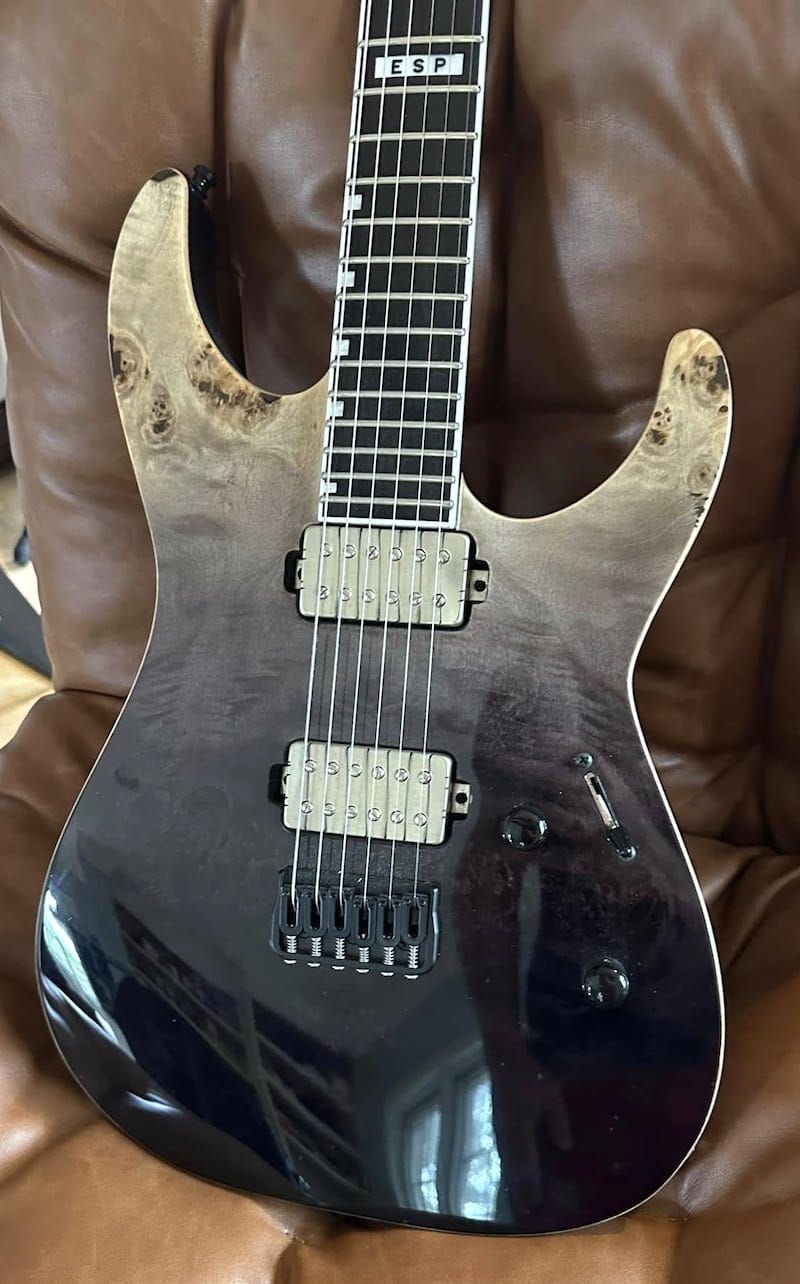
ESP E-II M-II NT
To begin with, the company decided to equip this guitar with boutique-level Bare Knuckle Aftermath pickups. They sound so good enhancing the natural qualities of the guitar’s construction that shows just how many hours swapping pickups the R&D spent to land on this company.
But speaking of wood and tone, the guitar is made of mahogany with a beautiful and exotic buckeye burl maple top that’s painted with a natural fade that looks just stunning. The construction isn’t set neck but neck-through, which means that the 3-piece maple neck goes all the way to the back of the guitar increasing sustain and resonance.
The neck offers an ebony fretboard with 24 extra-jumbo frets, a 12” radius, and a 25.5” scale length. This scale and the reversed headstock change the feel of the 6th string and riffs never felt so powerful before. Moreover, the bone nut and locking tuners keep everything sounding great and in tune regardless of the circumstance.
I tried playing “Until it Sleeps”, “Fuel”, and “King Nothing” with this guitar and nailed every bit of the tones in those songs. Furthermore, I even attempted the solos, and playing them felt effortless with this guitar’s uncanny neck.
This is not ESP’s highest tier; you have the Custom Shop for that. Nevertheless, there’s no heavy sonic adventure you can’t embark on with this guitar in your hands.
Ibanez
The combination of African Mahogany and AAA flame maple can come from a Gibson Les Paul or a PRS Custom 24. Nevertheless, when you shape them into a sleek, contoured, sexy body like the one in this Ibanez J Custom RG8570, what you have is a killer-sounding, astonishing-looking metal machine.
Furthermore, the recipe gets even better with the Super Wizard 5-piece maple neck. I know you know Ibanez’s necks are thin and fast, but this one is just ridiculous. You can speed up your fretting hand to a velocity you never thought you had. Moreover, the 24 jumbo frets over the Macassar ebony (with a beautiful Tree of Life engraving) make this a responsive, spanking, brutal guitar ready to take your playing to the next level.
Speaking of the next level, the choice of DiMarzio Air Norton in the neck, True Velvet in the middle, and Tone Zone in the bridge gives you just about every tone you need and then some. Yes, going from the neck to the bridge you feel like you’re setting free a wild animal, every note piercing through effortlessly. Even the in-between positions are great for some tamed playing while the bridge pickup proposes a take-no-prisoner approach.
The Edge-Zero tremolo by Ibanez is the next-best thing after an original Floyd Rose. You don’t feel it under the palm of your hand when you pick or chug, and it can divebomb as well as go sky-high. I even did the Vai trick holding it by the whammy bar and making it speak in tongues with some feedback from the amp. Afterward, it continued to be perfectly in tune.
Everything the J Custom team makes is outstanding and this guitar is, by no means, an exception. It might even surpass the limits of choosing a metal guitar because this ax can be used in a plethora of scenarios. I did it, I played Frusciante, Malmsteen, Vai, Hendrix, and even a little Gilmour with it, and it never felt short.
If you’re looking for a great metal guitar that can cover more sonic ground and be as reliable as electric guitars get, then this is a guitar for you.
If it fits your budget, you should, at least, try it.
Jackson
If I had to sum it up in one line, I would say that this Jackson American Series Soloist sounds as outrageous as it looks.
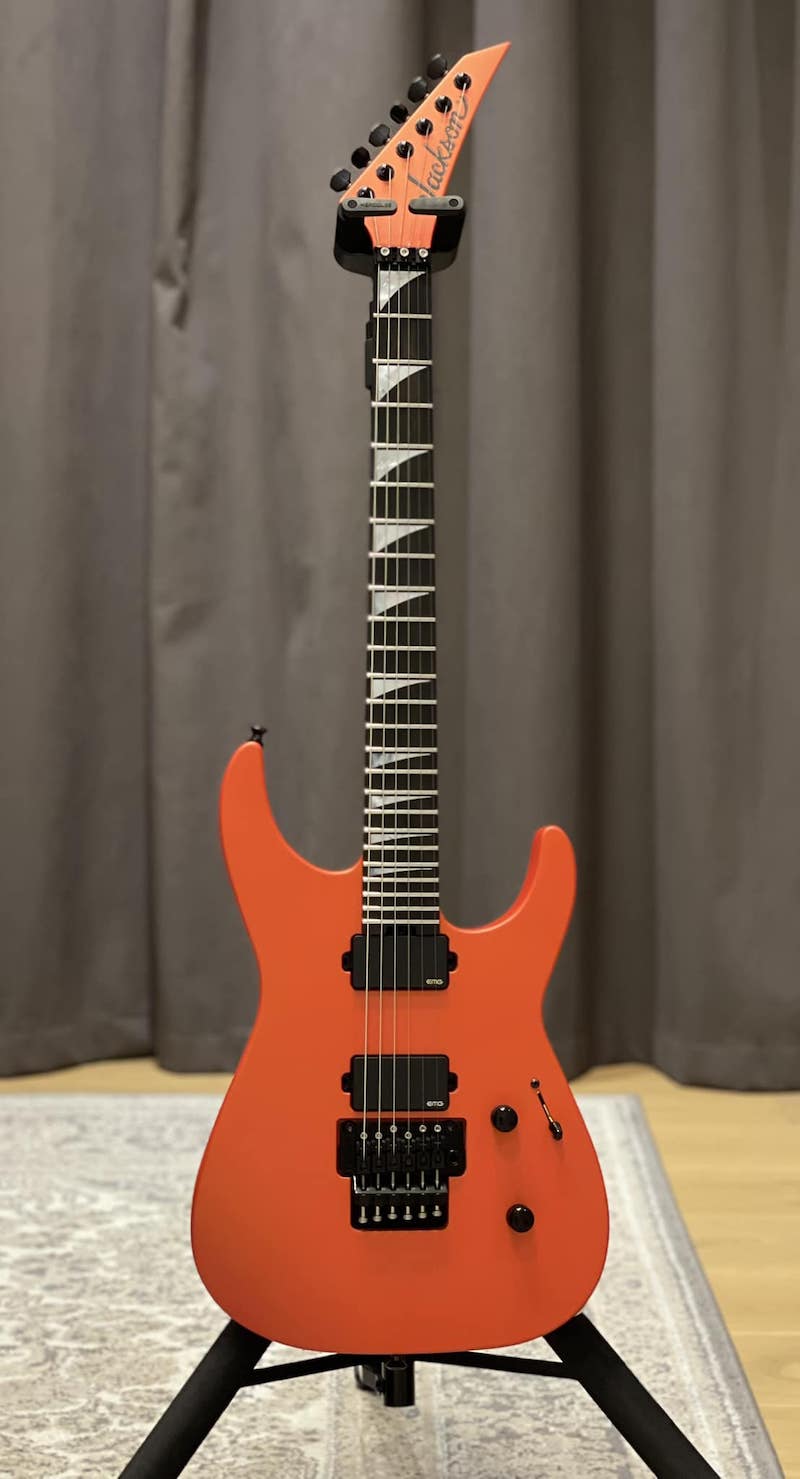
Jackson American Series Soloist SL2MG
In my opinion, the lack of mahogany in its build makes you miss some of that growl and low-end other guitars on this list ooze. That said, it’s hard to think of a guitar with more presence and edge while sounding big and heavy.
Perhaps, the main thing contributing to that sound is the fact that this guitar features a couple of alder wings to a neck-through maple neck. This combination of maple and alder is famous because it’s the one that companies like Fender use extensively in their production line.
Well, it gives this Jackson somewhat of an edge that can cut through double kick drum, bass, guitar, and vocals even with heavy distortion. This goes in line with players like Dave Murray (Iron Maiden) whose signature Strat is made of alder too.
The story of this American Soloist continues with another classical combination that’s an EMG 81 in the bridge and 85 in the neck. This is the same combination Kerry King and Zakk Wylde used for years. Furthermore, Kirk Hammett used dual 81s for years as well.
Now that we established how this thing sounds, it’s time to talk about how it plays because “Speed” is the name of the neck carve on this guitar. And it really is a fast, thin neck with a compound radius (12 to 16”), an ebony fretboard for extra spank, and 24 jumbo stainless-steel frets. I’m telling you, I dared to play things on this guitar that I never played on any other instrument for fear of not being good or fast enough. This guitar does that to you, it feels and plays so effortlessly that you’re convinced you can.
The Floyd Rose 1500 is also a great addition to the combo because it gives you that extra weapon in the arsenal and it is also a reliable tremolo that stays in tune no matter what.
If you’re into Super Strats, you must try this guitar. It can be your one and only metal axe and it will cover all your heavy needs and then some.
Schecter
Coming to you straight from the Schecter USA Custom Shop, the Schecter USA Sunset Custom II is a guitar that spares no expense in its making and in its sound. It has some of the specs Edward Van Halen brought into metal but with a cool twist.
Yes, just like the Frankenstein guitar, it’s an ash body but with a beautiful quilted maple top. I know what you’re thinking, what’s a maple top doing on an ash body, right? Well, the result is a guitar that can kick the front row right in the face with spank, punch, and a level of aggressiveness other axes can only dream of.
Again, I surely miss some of that low-end growl mahogany can bring to the mix, but this guitar makes it up with bite and midrange punch. I’m not going to tell you I tried playing “Eruption” with it, but I did do some drop-D metal like “Gets Me Through” by Ozzy and some standard tuning old-school stuff like “Breaking the Law” by Judas Priest.
The results were powerful, defined, and punchy with a little more edge than the originals.
The neck is very thin and comfortable, it’s made of maple and features a Pau Ferro fingerboard. I know what you’re thinking, but I think it’s a tone decision rather than a budget decision. I mean, if you can afford to put a curled maple top on the guitar, you can afford some rosewood. But Pau Ferro is a tad brighter, spankier than rosewood, and not as edgy as ebony.
A player well-known for using Pau Ferro was the great late Stevie Ray Vaughan.
So, the thin neck with a flat 14” radius, 22 frets, and 25.5” scale gives you some serious ground to play. Since it’s a single-action tremolo and the guitar comes with Hipshot staggered locking tuners, I played with several tunings and the result was stable, usable, and great in all of them.
Moreover, I tried playing some blues with the neck pickup and got this creamy tone that would have had me playing for hours. You can just step on a pedal, flick the selector, and you’re back in chugging heaven.
This is a superb build at a great price, ready to handle anything you throw at it.
What about 7 and 8-String Guitars?
These brands all make 7 and 8 guitars to accommodate the Stephen Carpenters and the Meshugghas of the world. If you haven’t already, I would recommend you try one of those before buying. Especially the 8-string guitars because necks get bigger and flatter and you might lose more than you gain.
Here are some examples of each brand in every budget so you can choose the one that suits you the best.
7-string Guitars
- Schecter C-7 SLS Evil Twin
- Ibanez Iron Label RGIXL7
- ESP LTD M-7 HT
- Jackson Pro Plus Series DK Modern MDK7 HT
8-string Guitars
- Schecter Hellraiser Hybrid C-8
- Jackson Dinky Arch Top JS32-8 DKA HT
- Ibanez Meshuggah Signature M80M
- ESP LTD Javier Reyes JR-208
What are the Big Three Offering Metal Players?
We talked about legendary metal-oriented brands, but what are the big three (Gibson, Fender, and PRS) offering metal players?
Gibson/Epiphone
Gibson owns Kramer and uses it to attract metal players.
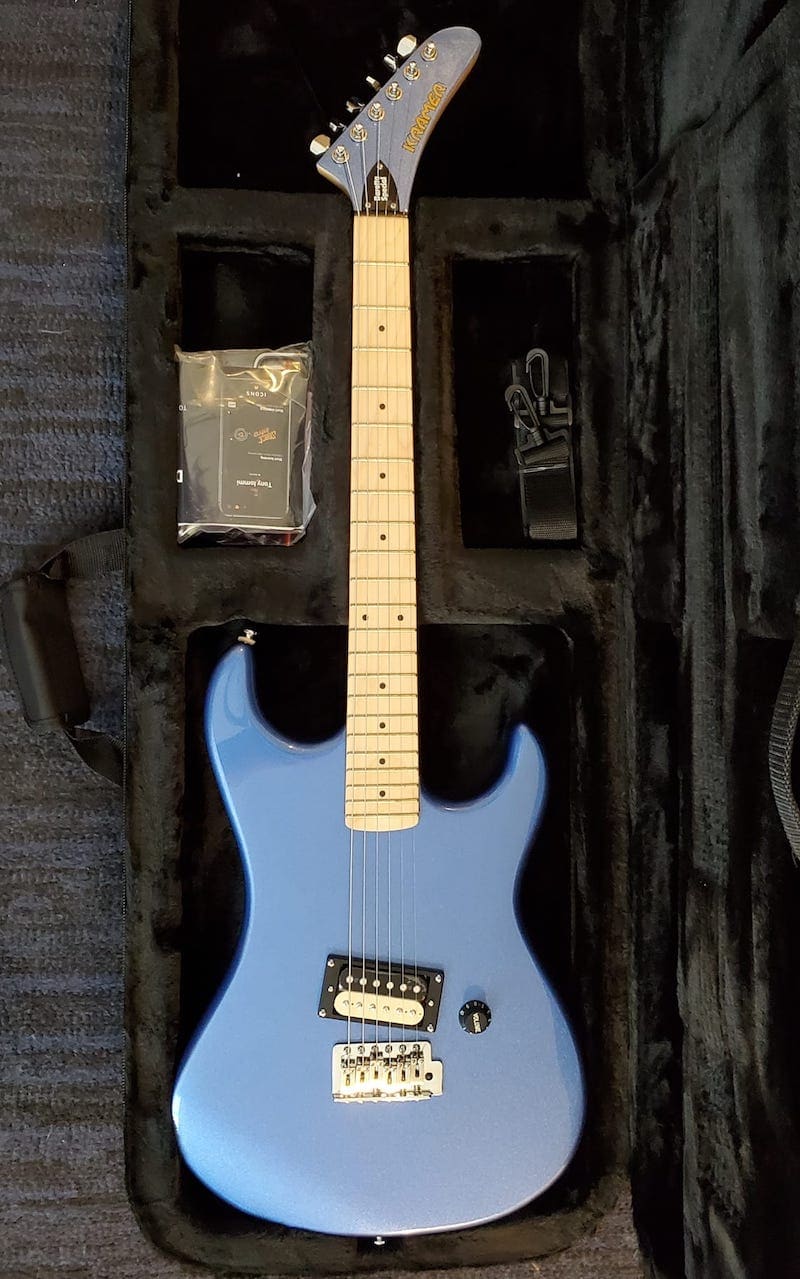
Kramer Baretta Special
That said, the new Dave Mustaine guitars are amazing and the Prophecy line by Epiphone is also worth checking.
Fender/Squier
Fender owns Jackson and channels all the metal needs through that brand. That said, the Jim Root models are amazing and the Squier Contemporary Series packs a good punch too.
PRS
PRS is a brand that can appeal to any player. Let’s not forget that they spearheaded the heavy alternative wave of the late ‘90s and early ‘2000s. Nowadays, I would say the PRS Mark Holcomb (6 and 7-string models) and the PRS Mark Tremonti (SE and Core Collection models) are terrific metal instruments.
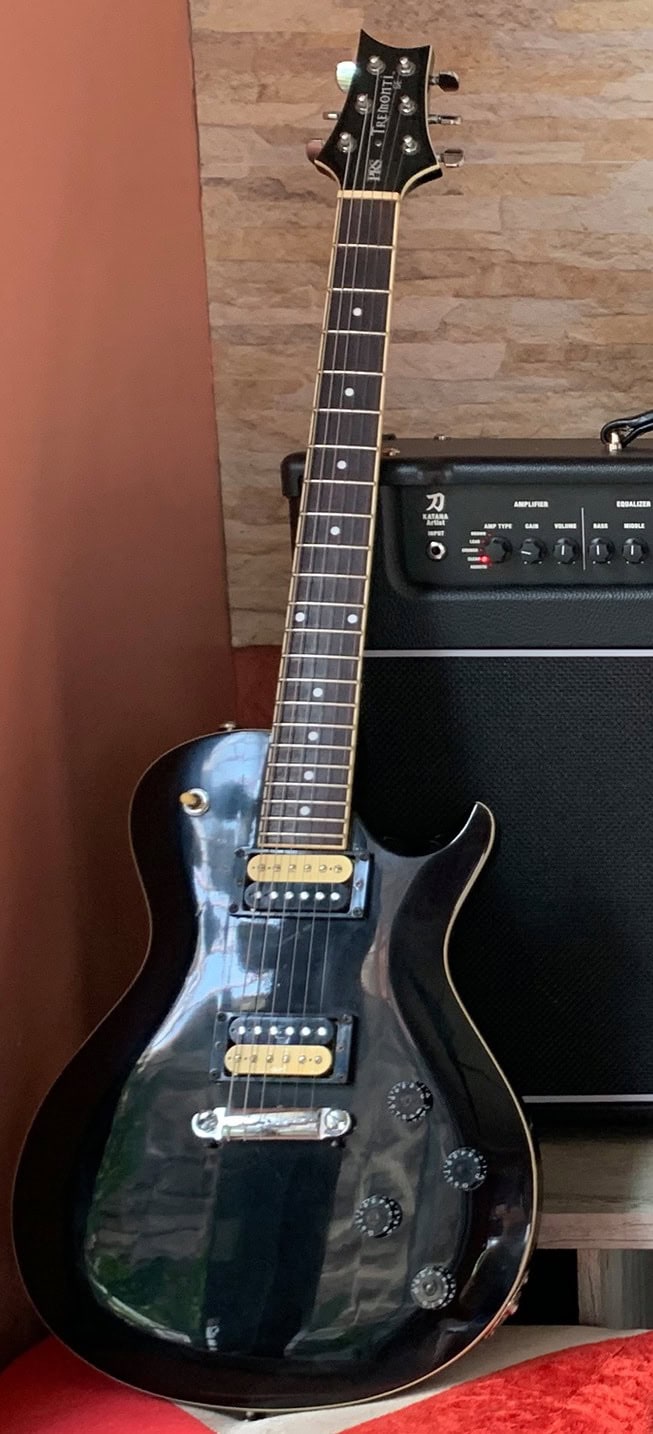
PRS Mark Tremonti SE
What To Look for in a Metal Guitar?
Let’s dive into this mini guide so you know what to look for in a metal guitar.
Let’s Talk Playability
Playability, in metal, is king. Yes, heavy metal is played often at the peak of a player’s capacity. We talked already about this thing between metal and the extremes, right? Well, playability needs to be superb so you can feel comfortable enough to give pyrotechnics your all.
In a metal guitar, in my opinion, this combines three aspects:
A thin neck is a must. You need to play fast, accurately, and effortlessly. Look for a neck that’s thin enough to be very fast and with enough wood to be comfortable.
Jumbo or tall frets. The more you need to press on the string to fret it and make a sound, the more it slows you down. Look for guitars with tall, jumbo, or extra-jumbo frets.
Low action is a necessity. If you’re playing fast and heavy, you need the action to stay low. Look for a guitar that will grant you that possibility with no dead notes or fret buzz.
Let’s Talk Power
A metal guitar needs to have enough power to drive an amp or pedal very hard, but it can’t go into muddy territory, or you’ll have the opposite effect. Yes, the pickups on the guitar need to be menacing, nasty, and loud but well-defined and punchy.
There are many companies that reunite these characteristics like Seymour Duncan, DiMarzio, EMG, and Fishman among others.
Active or Passive?
If you’re going for active pickups, you must bear in mind two things.
- First, they do have a learning curve you’re going to have to go through.
- Second, you need to make room in your guitar to put a battery.
That said, they do add clarity, definition, and punch to any guitar.
Let’s Talk Pyrotechnics
Finally, before we go into the last bit of this piece, let me tell you that metal players love to show off. This isn’t something bad per se. Of course not. On the contrary, we love the Eddie Van Halens, Zakk Wyldes, Randy Rhoads, and Joe Satrianis of the world. They push the boundaries of metal even further.
So, if you want to be one of the shredders, you must learn to play like a shredder. For that, you need some special appointments like:
- Floating tremolo bridge to do some cool dive bombs and make the most out of every harmonic.
- Low action and tall frets or a scalloped fingerboard so you can play faster than ever and do some effortless tapping.
- Sleek and thin neck with no reversed headstock. You need the maximum tension on the first string so that after you bend it behind your skull it remains stable. The thin neck helps you gain speed and accuracy.
Three Steps to a Mindful Purchase
Before you go on a mad guitar safari, let me give you three pieces of advice I wish I was given when I got my first guitar (or all of them).
1. Set Your Budget
Sure, trying expensive guitars is a blast. But be very rigorous with yourself when you set the ceiling of your budget and don’t try anything above it.
It always gets cooler, better-sounding, and more comfortable as you go up in price. Be responsible and set your budget clearly. Otherwise, you might end up in debt (been there many times, believe me) or frustrated because you can’t afford that amazing guitar you just tried.
2. Set Your Expectations
What can that budget get you? Well, I divide this into three parts. The necessary, which is the absolute must. Then, what I would like the guitar to have but not as a necessity (the finish falls here, for example). Finally, my dream appointments within my budget (the brand of the floating tremolo on a tight budget, for example).
Always bear in mind things like tuners and pickups can be affordable after-market accessories.
3. Find the Best Bang for Your Buck
The final step of this mini mindful buying guide is to write down all the above and find the axe that gives you more of what you want, need, and desire. Otherwise, you’ll engage that part of our brain that’s non-rational and that wants to act on the impulse a good sonic machine generates in you.
Don’t fall for it, think it over, and buy following these three steps.
The Bottom End
Heavy metal is a guitar-driven musical style. This has been the case since the beginning, in the early ‘70s. Although nowadays guitars, technology, and the number of options available have changed drastically, the guitar is still the royal queen of all things metal.
On the list above, you have 12 of the best metal guitars in the market today from the four top brands in the world. They’re divided by budget, and I tried to pick the ones that gave you the best bang for the buck in the pack.
Regardless of the tone you’re after, the budget you have, and the brand you like the most, I’m sure one or more of the guitars above resonated with you.
So, go out there, try them out for yourself, and bring home the kind of guitar that will keep you playing and enjoying for hours. Yes, buried underneath tons of marketing strategies and media bombardment is your passion, and these guitars can help you unearth it and take it to the next level.
Happy (heavy metal) playing!

Schecters are my absolute favorite but I also have different guitars for different songs. Each of those brands have their own distinct sound. They do exactly what they’re each meant to do as well. Can sit and argue about which one sounds the best when in fact they all do depending on what you’re playing
Ibanez is king of shred. Period.
Satriani
Vai
Paul Gilbert
Eddie Van Halen
John Petrucci
Reb Beach
No guitar neck beats an original wizard neck.
Eddie Van Halen did not play Ibanez guitars.
Jackson made in japan 2000 to 2011 I think especially all the bolt on models best guitars out there that i have experienced and charvel same era I have a bunch of them ….can get them cheap sometimes used as well. i had some new pro series and x series and they were really nice and I do not think the mj series is built any better than the 2000s mij.
I have a few Jackson’s 1 ibanez and epiphones Harley bentons Micheal kelly. I love the feel of Jackson not so much the Ibanez. The epihones and Harley bentons feel the best with gibson scale and feel, even with 24 frets. The Michael Kelly with 24 frets FR feels like a Gibson neck is a pure joy to play. Even the chibson les paul with 24 frets feels better than ibanez in my small hands, i love my soloist hate the RR V tolerate the king v. The dinkys are good, easy to play. I wanna trash the Ibanez and one of the Michael kelley hex while the hex deluxe is feels like part of me. Newest harly benton single xut custom with Teslas is becoming the favorite.
Jackson all day
Esp makes the best guitars for metal
No way bro! 40 yr pro here. Jackson Rhoads V & King V made in China 1990s & early 2000s, USA Custom Shop & Indonesian Pro Series Soloist.
You mean made in Japan right?
I have not played many ESP, I can however say I have played a lot of LTD and I think they are not as good as Ibanez or even Jackson =(
Especially If you are on a budget. But If money is not a problem ESP might have very good guitars. However for the 200-1000€ price bracket they are the last brand I go for. I rather buy an Ibanez or you can even get a PRS SE for that money and those are pretty awesome 🙂
Not even close. Schekter
LTD/ESP bringing out amazing stuff for metal