
While fuzz boxes and distortion pedals steal the spotlight, noise gates are what make the metal world go around. I’m telling you, these are the unsung heroes of the high-gain revolution. We would have never had many grinding, nasty, chugging, bone-crushing metal tones if it weren’t for them.
Some of us might be skeptical about it, and I get it. I was there too. That was until I played through a 5150 head with a built-in gate, and I didn’t notice. Can you believe it? Well, that showed me it can be done right, so I went out in the hunt for the best gate to put on my board.
Top 3 - Best Noise Gate Pedals
Preview | Product | Price |
|---|---|---|
 | ||
 | ||
 |
What you’re about to read is the result of my experience with different gates trying to find one that won’t kill my guitar’s dynamic and attitude but will keep it silent between bursts of distorted madness.
Shh, let’s go, but quietly!
Best Noise Gate Pedals for Metal
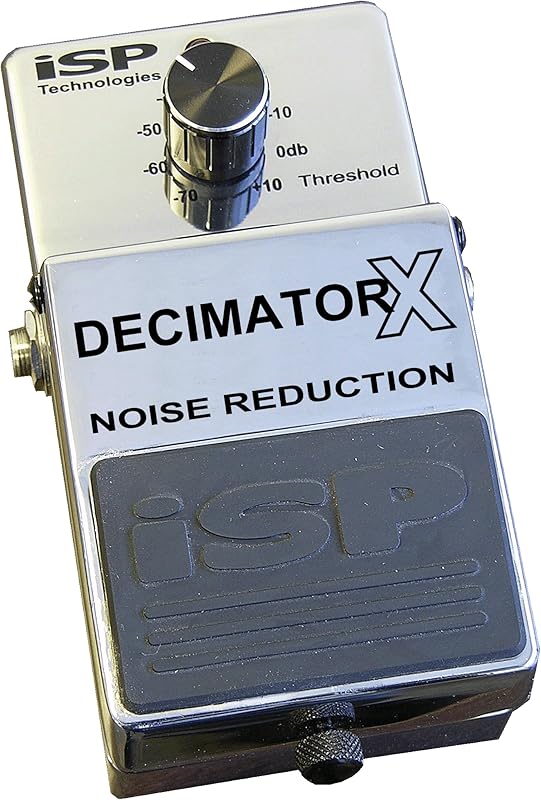
1. ISP Decimator X
The ISP Decimator X was the first one that I tried. Yes, I know, I’ve seen it in a million metal stages before. It’s hard not to since it’s heavy, shiny, and completely made of metal. It reminded me of Boss pedals, so you can imagine it’s ready for the hardships of the road and then some.
The good news for old-school people like me is that it’s just as hard to use this pedal as it is to operate a blender. There’s a single knob that indicates where the gate opens. Let me tell you, it’s hard to find a bad setting.
I started playing some Pantera because it’s just such an amazing mood shifter. I plugged the Decimator in front of a 5150 and played with a humbucker-equipped super Strat to make some squealing noises and pinch a few harmonics here and there.
I have to say I loved the way this gate handled note decay and noises. It’s not easy for a gate to get rid of the frequency that’s annoying without wiping out some of the cool stuff about near-feedback playing.
I asked for a single-coil guitar and played some Iron Maiden to check how it reacted with a fuzz-infused Stratocaster with 60-cycle hum. I know what you’re thinking, but playing Malmsteen is way out of my reach. I played some Deep Purple, too, but the hum was still there, right behind each of my notes.
For something more complex that can get rid of that frequency too, you can get the ISP Technologies Hum Extractor + Decimator G.
I could picture this pedal traveling with me, tour after tour, in a set-it-and-forget-it mode on top of the amp or under the board right next to the drive pedals, and always on.
Believe me, this pedal is dangerously heavy and durable; it can take the worst part of the road and then some.
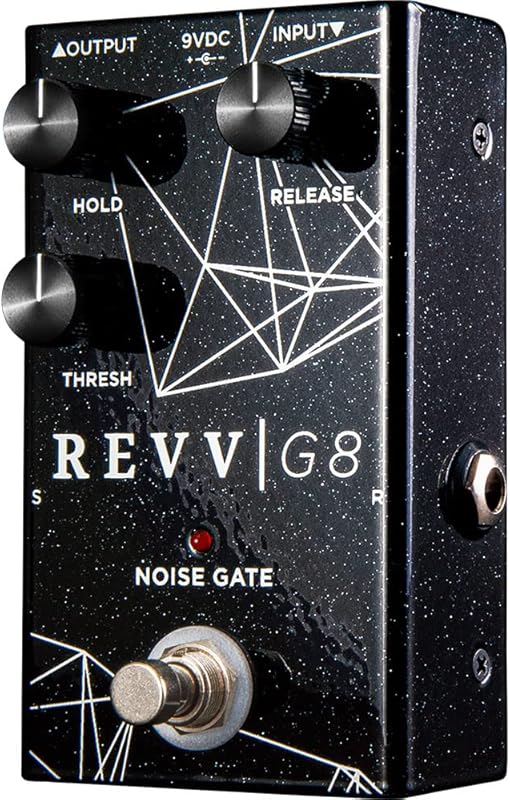
2. Revv G8 Noise Gate
If you’ve ever had the joy and the pride of playing through a Revv Generator 120, a monster head capable of causing mayhem with a single note, you’ll know it’s dead-quiet. Well, the secret is that it has this Revv Amplification G8 Noise Gate built in as a factory standard.
Yes, the circuit inside this small pedal comes straight from a multi-thousand-dollar amp and fits in this small pedal. Oh, and in case you were wondering, it does deliver chugging-ready sounds very easily.
To begin with, having three controls at your disposal can be a good thing or not, depending on your taste. I just loved the way you can dial in exactly what you want and how you want it instead of a set-it-and-forget-it scenario like with other gates. Moreover, that feature makes this a studio-ready pedal, too.
While I absolutely loved it for a high-gain amplifier, this pedal does something that’s just very clever, and I’ve seen in other units as well. You can use the pedal as an effects loop that will affect only the pedals in it. I had to dust off my old Metal Zone and try it that way. Believe me, the difference is like walking in the desert wind or standing inside an elevator.
That said, in my opinion, the hold and the release knobs are great and super useful for lots of applications, but for metal, I found them to be at their best when they’re at zero. With that setting, the pedal gave me that choppy chugging tone we all love. I played some Megadeth, some Slayer, and some Sepultura with it, and unless you crank it, it’s perfectly musical.
If this one fits your budget and you want to silence a pedal and an amp, this can be the perfect gate for your needs.
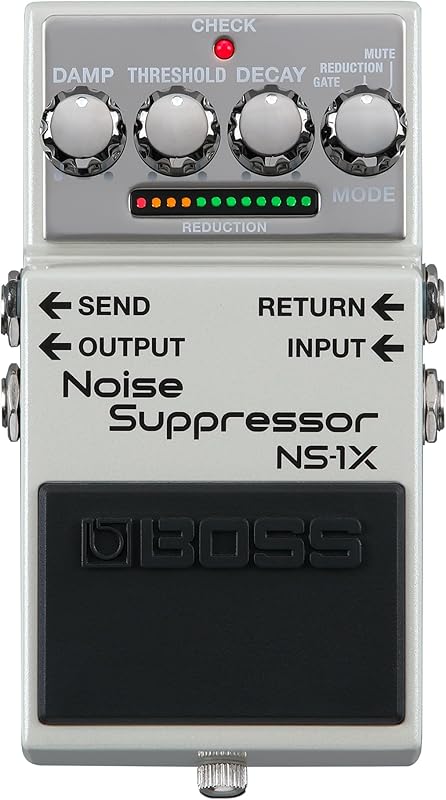
3. Boss NS-1X Noise Suppressor
The mother of all noise suppressor pedals in the metal world is no other than the NS-2. That’s where it all started in 1987, and that’s still the benchmark for noise gates.
Well, since many companies came up with pedals that wouldn’t color your signal so much, and that could handle extra-fast gate action in high-gain settings, Boss felt they had to catch up and came up with a new iteration called the Boss NS-1X Noise Suppressor, and let me tell you that it’s one big and bold step ahead from its predecessor.
To begin with, the Damp knob won’t let the door close completely, so it opens faster. There’s even a big meter that shows adjustments in real time. This makes a huge difference. I just loved to be able to see what the pedal was doing all the time.
I preferred to place the damp knob at noon and use the gate mode to get that riff-oriented sound that works great during silences but won’t kill my guitar’s sustain and decay.
To test this, I played “Five Minutes Alone,” and those string strums in the middle of the heavy riff were dead silent while the picked notes sounded full and round and not dead and fading.

The reduction mode as well as the decay knob, are great but just not for metal. They can help a ripping, heavy-blues player like Gary Moore work his way through a screaming solo without a tsunami of noise chasing his heels, but for metal it just makes everything noisier and way, way less cool.
Speaking of cool, this pedal has input and output 9V power supply sockets. Yes, with a daisy chain, you can supply other pedals of power using this NS-1X as a power source.
Finally, just like the original, this pedal comes with a third mode in which it acts like a mute pedal. If you use that setting, it will just kill all sound immediately.
I can see a new classic on the rise here, capable of stealing the benchmark from the original NS-2. If it fits your budget, you can never go wrong playing a Boss pedal on stage.
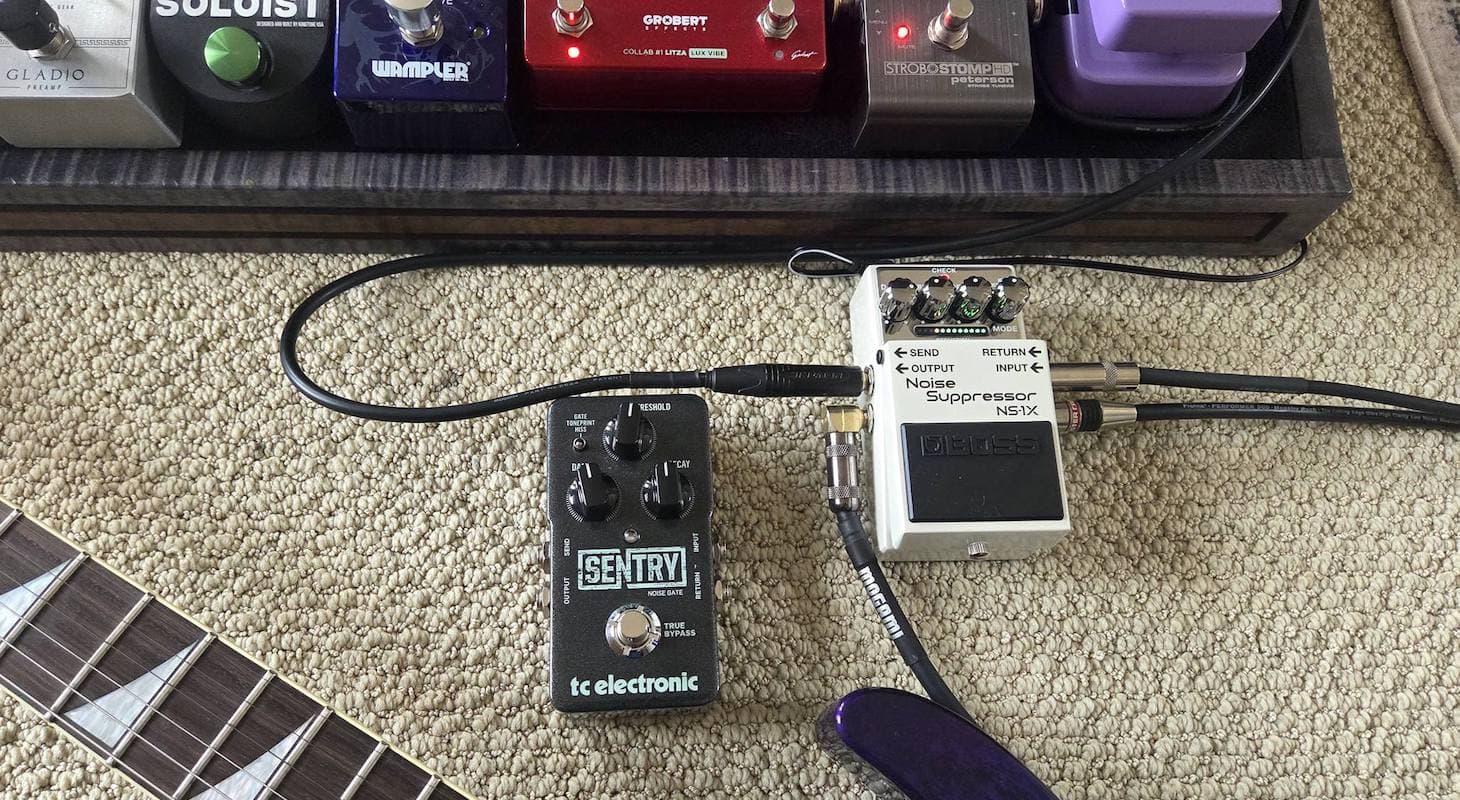
4. TC Electronic Sentry
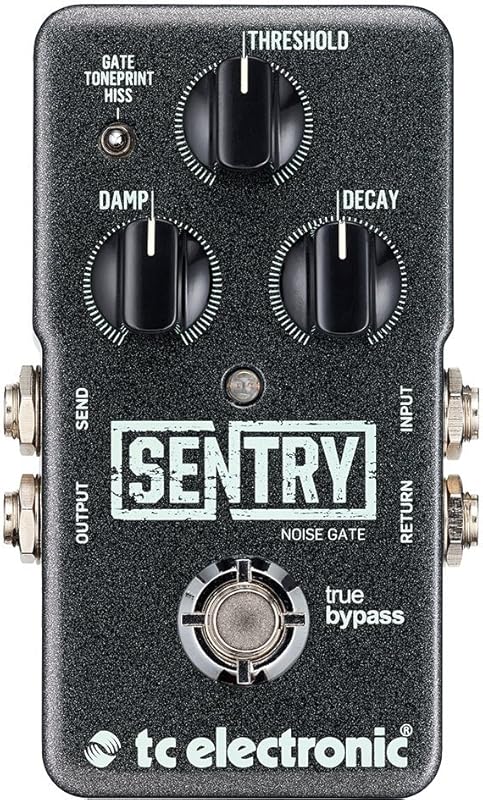
There’s one feature that separates the TC Electronic Sentry from most of the noise gates in the market: it can do a multi-band job perfectly well. This means you can have the gate affect only some frequencies of the spectrum when it shuts.
I had to do my homework to find out about that, but it was just amazing to hear it happening while I was playing.
So, let me explain. The pedal comes with three modes: gate, Tone Print, and hiss. The first is a regular single-band gate. The second is to recall presets made by big names in music using the tone editor. The third is the three-band gate that’s designed specifically to attack hiss while letting the low-end of your guitar intact.
Believe me, I was playing “Crazy Train,” and the amp’s static and hiss were completely gone while I was chugging and playing leads, believing I had polka dots on my guitar.
I did a lot of fiddling with the knobs until I found the sweet spot, but there’s way more to do with this pedal than just moving the knobs. The editor is great for modifying all parameters. It’s like jumping into a very deep well of guitar nerdiness and swimming there until you find the bright diamond we all know as perfect tone.
Speaking of tone, the only thing I didn’t like so much about this pedal is that it does change the instrument’s tone a bit too much for my taste. There’s an internal switch to go from buffered to true bypass, but both settings do the same thing to my guitar’s tone. That said, used as an effects loop for noisy pedals (you noisy fuzzy, you! Lol), it behaves as a much quieter unit.
I’d say this is the most versatile noise gate pedal on this list and my personal favorite right now. I keep finding new and awesome presets and beaming them through my phone to the pedal. There’s gold in the Tone Print library.
The Bottom End
You can be shredding like Eddie Van Halen himself or crushing bones as Dimebag Darrell did for years, but if every time you’re not playing, a loud buzzing noise hits the audience in the face, your days on big metal stages are counted.
Yes, metal is passion, precision, chug, sweat, and silence.
So, you’ll very likely be playing through a noise gate your entire metal career, and, therefore, need to be very serious about choosing your next. Even if it’s your first; especially if it’s your first.
Heavy riffing is all about being surgically precise, so engage the silence-master and practice those lightning-fast moves; the sky’s the limit.
Happy (heavy and silent) playing!
