

For most of my life, I’ve been afraid of octave pedals. I had the feeling that they were this alien force that took over the tone and made all kinds of unwanted noises. I mean, let’s be honest, octave pedals ARE intimidating for the average player.
But they’re just as fun and amazing as they’re intimidating. Once you pierce through that wall made of prejudice and fear, what you have is an entirely new sonic universe to explore.
Needless to say, I have one in my pedalboard.
Do you want to know how I use it and which one I prefer? Well, we’ll talk about that at the end of the article, but first, let me give you a broader idea about the five best octave pedals in the market right now (in my opinion).
Let’s do this, it’s time to get heavy.
5 Best Octave Pedals in the Market Right Now
1. The Boss OC Series

Since their introduction in the late ‘70s, the iconic, brick-like Boss pedals have seen more stages, rehearsal rooms, bedrooms, and backpacks than most brands could dream of. They’ve literally sold millions of units around the world.
Well, every guitarist out there knows that Boss pedals are just as sturdy and reliable as they’re great-sounding. You can take them to war, buy them very much anywhere in the world, and play to a packed arena with them.
In 1982, Boss released the first pedal of the OC series, the OC-2. It was a monophonic pedal made in Japan allowing two octaves below and a mix control.
It has been used by bass players, synth players, and guitarists. It does a terrific job at tracking the low and ultra-low notes perfectly.
But that’s not the pedal we’re here to discuss, we’re here to talk about the OC-5, the latest incarnation of the concept. That said, using the OC-5 in its Vintage mode turns the pedal into an OC-2 with the addition of an upper octave.
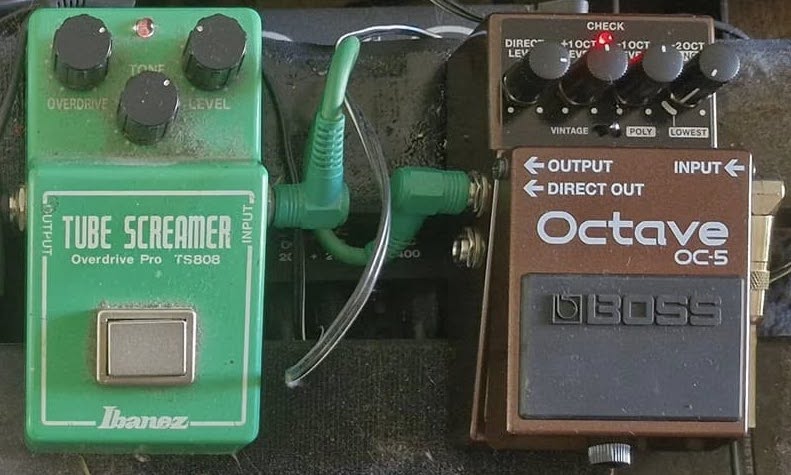
Boss OC-5 next to (one of my) Tube Screamers.
I was able to get some cool organ-like sounds mixing it with a fast phaser. Also, the tracking is perfect and the notes have a level of depth that makes everything sound huge. Furthermore, mixed with fuzz or distortion, things get well into Jack White’s territory and it’s hard to stop playing.
The Polyphonic mode is also very interesting. The second octave below knob transforms into a “Range” knob, something inherited from the discontinued OC-3. This knob allows you to select which notes in a chord are affected by the octave while the rest sound perfectly natural.
Moreover, using the dual outputs, you can select that range for only the top 3 strings, and split the signal to go with the effect to a bass amp and clean to your guitar amp. That way, you can play the melody and the bass line and sound like a full band.
The polyphonic with some delay and a shimmer reverb is exhilarating. You can think of the best Tame Impala moments cut on record, maybe some ambient music, or soundscaping.
Mixed with distortion and fuzz, it does a great job at tracking too, but in that scenario, I prefer the Vintage side to get that inaccuracy that’s so common in monophonic octave pedals.
For its many possibilities, its price tag, and its reliability, if the OC-5 is within your budget, it’s a must-try-before-you-buy option.

2. The POG
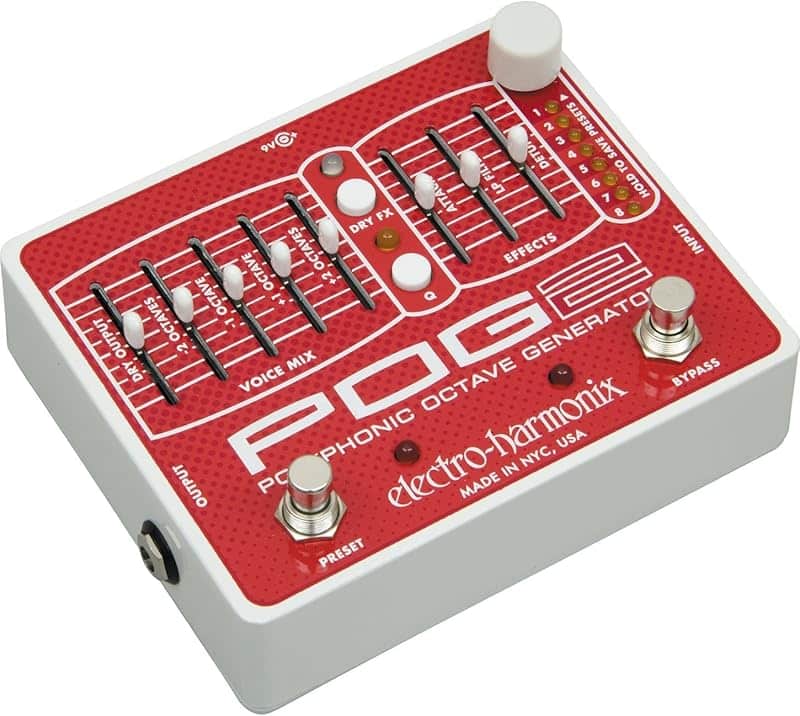
The POG is a legendary octave pedal by Electro Harmonix that currently has 6 versions. The otherworldly POG3, the POG2, the Micro, Nano, and Pico POG, and the Soul POG.
The one I want to stop at is the amazing POG2, a great octave pedal that does it all, and then some.
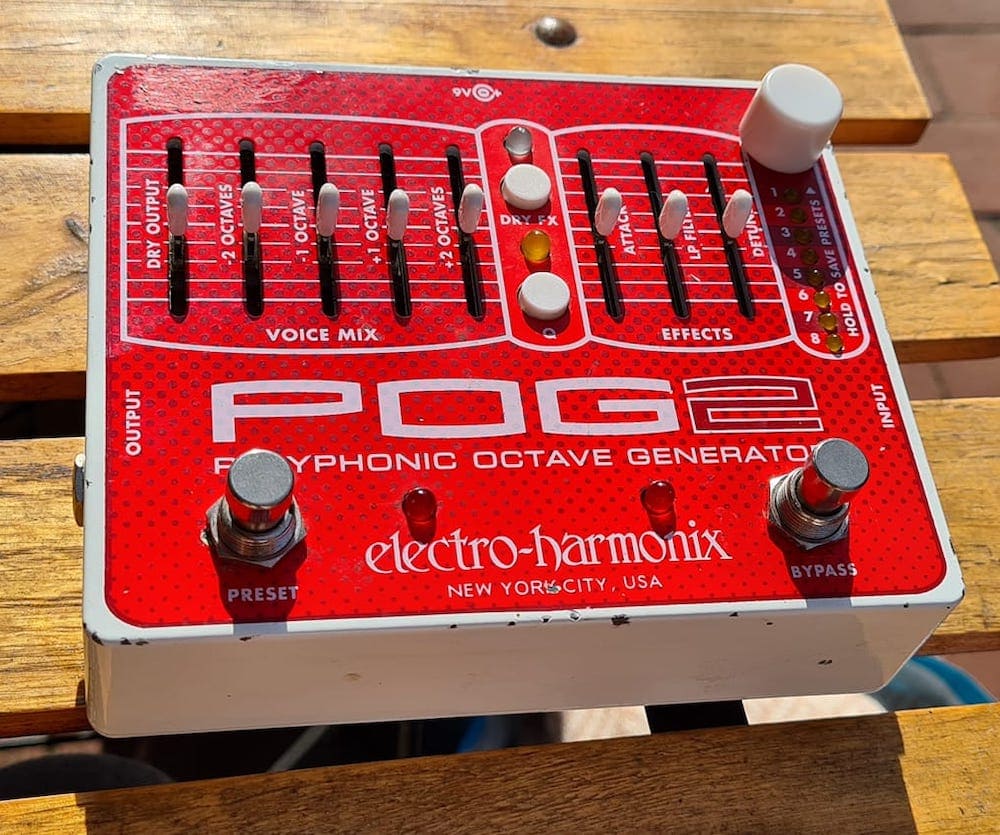
Electro-Harmonix POG 2
To begin with, you can create and save up to 8 presets. This allows you to expand your sonic palette drastically carrying one guitar with you.
For example, the first thing I tried when I plugged it up was the 12-string effect by killing the octaves below and adding the two octaves above. The dry signal at halfway and so the attack. It was so believable people would have to look twice to check I was playing with a six-stringer.
The opposite, only the bottom two octaves engaged, gave my playing a different spectrum. One word of notice here, this pedal goes really low and if you push the amp’s volume in that scenario or hit it hard with a heavy distortion pedal, then what you’ll likely get is a broken speaker cone.
That said, the ultra-low sound not only tracks great, but it’s also very clear and punchy.
Still in this setting, I tried the cello sound lowering the attack and letting the pedal do nice swells and fade-ins. I played some chords above and used that sound for some overdubs in my looper pedal and it was a lot of fun; the ultimate Bon Jovi ballad effect.
Next, I tried the Detune function and things got warbly, 3D, and with some delay and reverb, the tone was perfect for some arpeggiating.
Just for fun, I tried the violin sound over that detuned arpeggio changing the lower octaves for the higher ones and lowering the attack slider. The result was just mesmerizing.
Finally, I went for the all-in setting with all 4 octaves up and the dry sound of the guitar up and, if my neighbors didn’t call 911 to tell them it was the end of the world when I stepped on the fuzz, then I guess nothing will scare them ever in life.
I know, it has a bulky price tag, but it’s one of the most versatile, do-it-all octave pedals in the market. Furthermore, if you have a home studio, you can think of it as a multi-instrument tool.
3. The DigiTech Whammy
I was fourteen years old the first time I heard Tom Morello play with a Whammy pedal. Later came Jack White, Joe Satriani, Steve Vai, and Tom again, but in Audioslave playing that mesmerizing solo in “Like a Stone”.
I knew it, I needed one of those red bad boys for my pedalboard. It was a call I had to follow. I didn’t get one right away, I already told you octave pedals intimidate me. But when I finally got it, the result was years of investigating, tinkering, having endless fun, and getting great sounds from one of the most versatile octave pedals ever made.
But let me start from the beginning. The Whammy 5 (the current version) isn’t an octave pedal, it’s a pitch shifter. I added it to this list because it can do it all, including the octave thing.
So, that’s what I’m going to be focusing on in this piece, but there’s a lot more you can do with it.
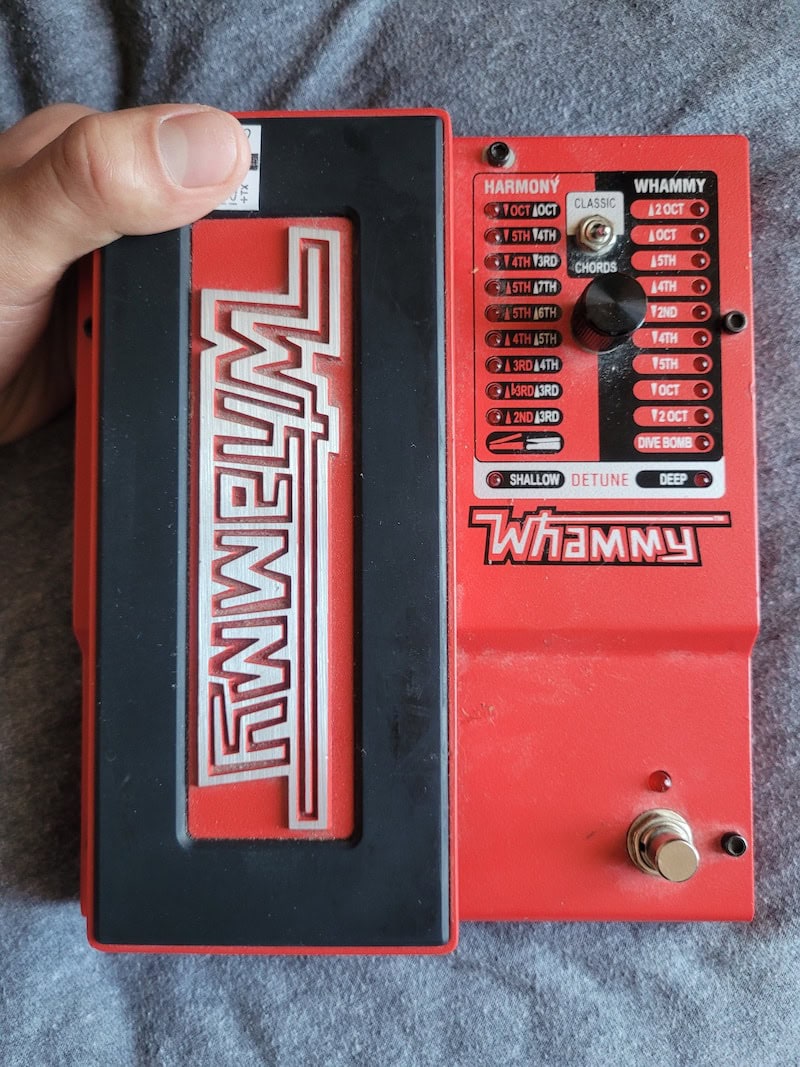
DigiTech Whammy 5
The main aspect of the Whammy is and has always been, the expression pedal. The fact that you can move from 2 octaves below to 2 octaves above is just mind-blowing. You’ve heard many of your heroes playing guitar parts doing just that.
But beyond that classic setting, you can also do a dive-bomb effect. You activate the pedal forward and your guitar sound mimics going with your whammy bar all the way to touching the pickguard.
Also, when in the Detune setting, you can access a 3D-like chorus effect.
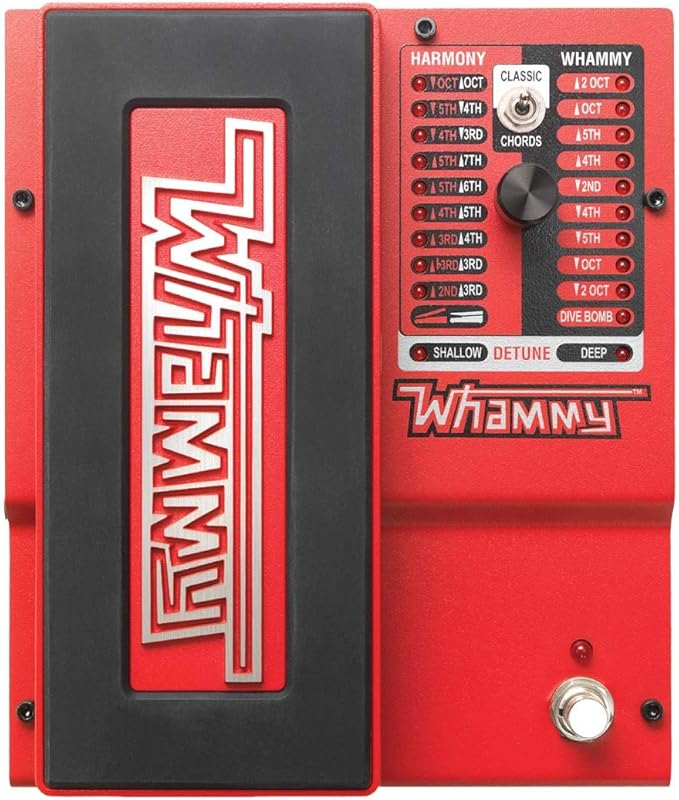
The pedal is basically divided into two parts: Harmony and Whammy. The harmony part tracks notes and chords and allows you to choose the intervals you want the harmony. Rocking the pedal forward you might go from a 5th up to a 7th up, or from a 5th below to a 4th below.
On the Whammy side, you can set the pedal to do whatever you want going from your original sound to 2 octaves above or 2 octaves below (or go Divebomb).
I use it mainly to add some things here and there coupled with a delay and a soft distortion, I use the typical 2 octaves above setting to do some Tom Morello-inspired licks, but I also use it with the octaves below to thicken the sound and do some “Seven Nation Army”-inspired stuff.
Finally, pressing it and leaving it on with the 2 above or the 2 below you can get some quite amazing lead tones out of this pedal with a fuzz too.
I know it’s big and it’s expensive, but nothing sounds quite like it. If you want those tones I just described (and a bunch more you’ll come up with once you start playing), the Whammy 5 is a great pedal.
4. The New MXR M306 Poly Blue Octave
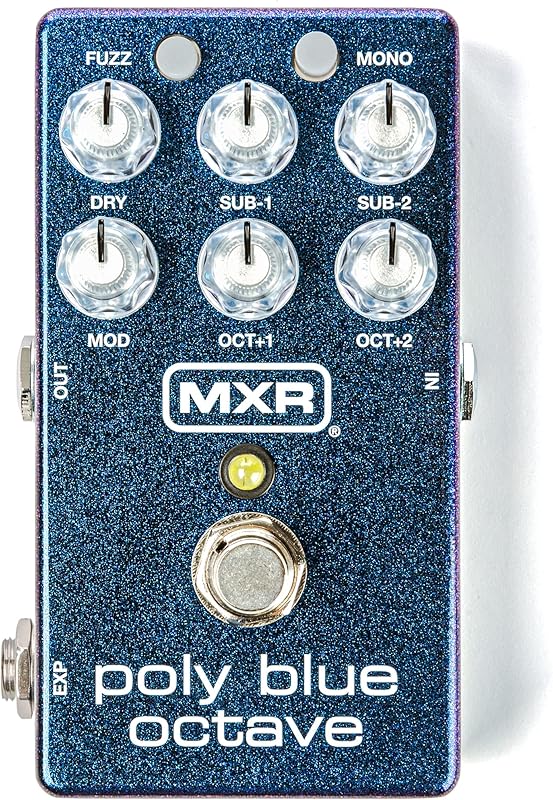
In 2022, MXR released one of the most complete octave pedals I have ever owned. It comes in such a small enclosure that size and capabilities are on the opposite sides of the spectrum.
Yes, the MXR M306 Poly Blue Octave is a powerhouse including modulation and fuzz. The “blue” from the title comes from the legendary MXR Blue Box, one of the classic octave fuzz pedals rocking hard since 1974.
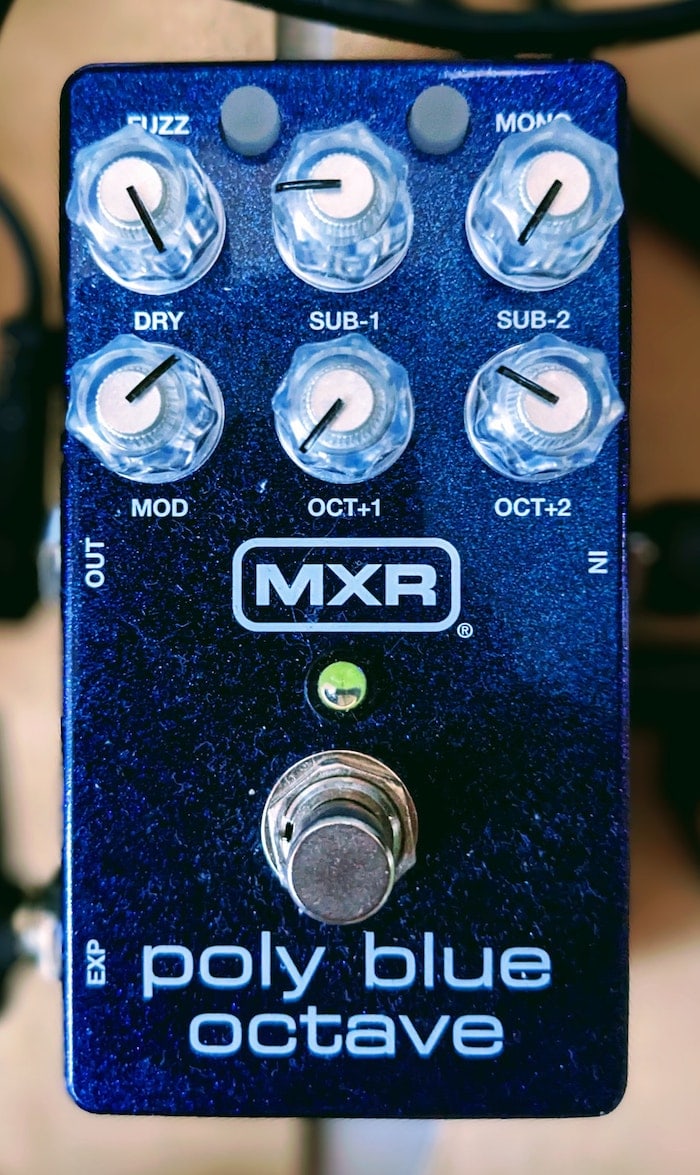
MXR M306 Poly Blue Octave Pedal
But let’s break it down piece by piece because there’s a lot to this pedal that makes it a usable and unique noisemaker.
First, the ability to play along with five octaves for a pedal this size is just great. Adding to that, you can adjust any of them, on the fly, with the turning of a knob just like a regular pedal.
But that’s not all, you can choose between mono and poly modes to have the pedal track vintage-style or to add to your chords. Speaking of which, that was my first experiment. I put the pedal on poly mode and added only octaves +1 and +2 and my guitar went into 12-string mode (or church organ mode if you like too) immediately.
I added the modulation to that setting and things just got so ’60s and psychedelic. I felt my hair was turning into an afro!
In that scenario, the pedal tracks very well, there’s no latency, and you can feel it reacting to the nuances in your playing. So, I did what we would all do, went all in.
I added the two sub octaves and the thing just became monstrously big. It was a humongous tone that allowed me to play the lows and the highs organ style, and also let me play chords and melodies at the same time as if I was playing piano with both hands.
Finally, I took the high octaves out, went into mono mode, and activated the fuzz. The result was evil, menacing, and powerful. Those who are faint of heart, should not try it at home. It’s seriously colossal.
Now, the only caveat I have for this pedal is that I think it’s a great studio tool, but you can’t use all it packs in a live situation. Although the external footswitch out is great for that, you don’t have something like presets to store your favorite sounds.
I think that should be MXR’s next step, to make this a bigger, programmable pedal.
If you want a pedal that can be a great studio tool and that can do the octave, the fuzz octave, and the organ sounds perfectly, then this is a must-check.
5. The TC Electronic Sub n’ Up
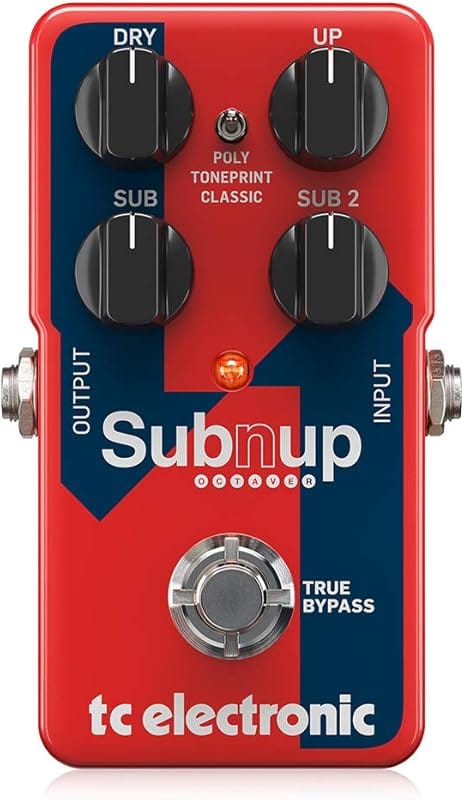
Don’t let the modest price tag this pedal has fool you, this is a very powerful octave pedal by TC Electronic. It offers you 3 octaves to play with and it comes in two sizes, regular, and mini. These two are very similar but we’ll talk about the regular-sized one.
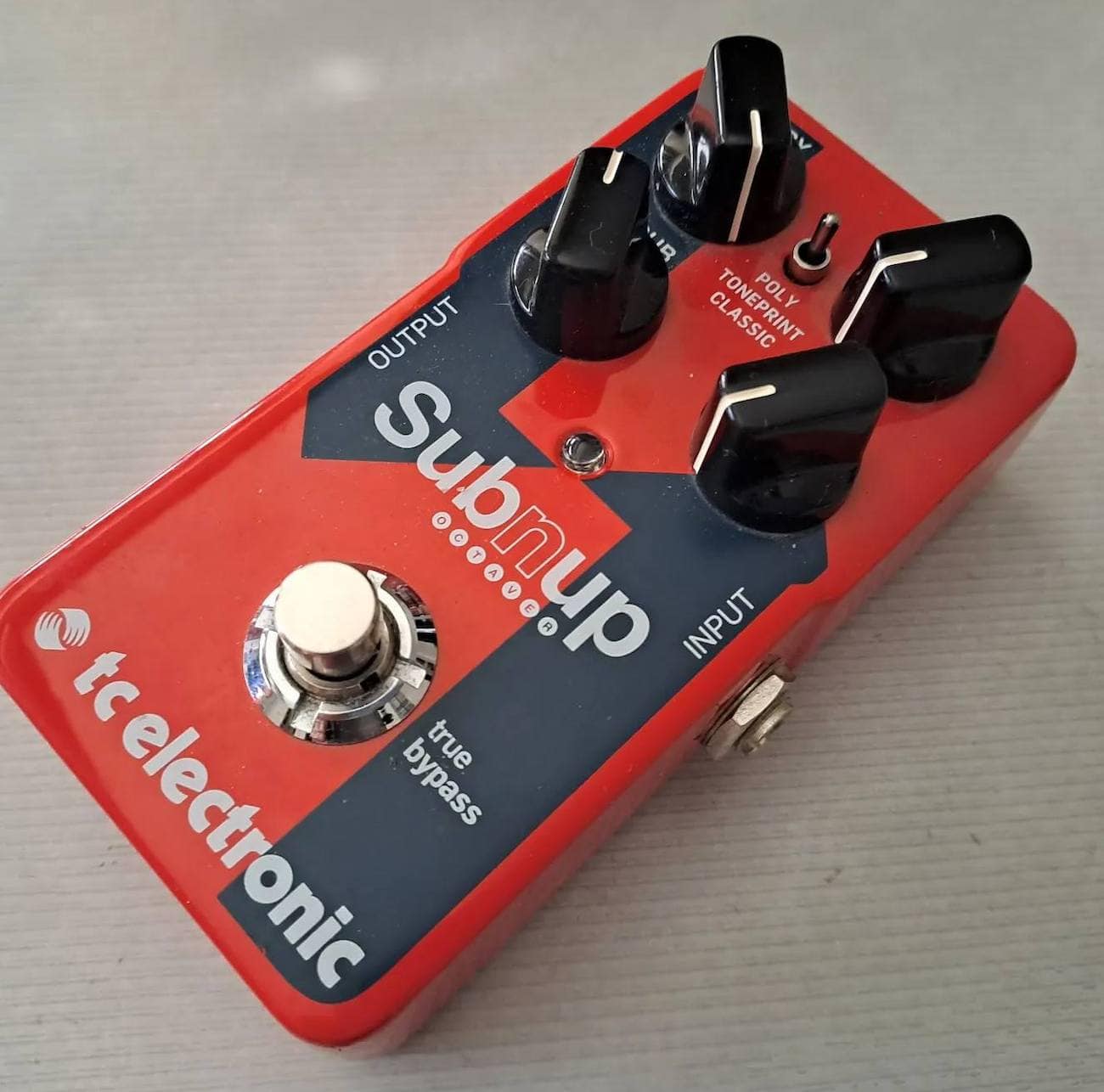
TC Electronic Sub n’ Up
The control layout is as simple as it gets, the dry/wet mix knob, an up octave and two sub octaves. Each knob changes the octave level and the dry/wet the overall mix.
In between the knobs, you find a toggle switch to go from classic to Tone Print to polyphonic.
The classic mode, as you’d expect, is a mono effect that tracks perfectly and gives you that nice lo-fi warbly stuff when you push it to its boundaries. Adding the upper octave and the two lows I managed to create some organ sounds from this setup, great to play some melodies and small licks.
That same idea, when you go into polyphonic turns the whole guitar into an instant synth or church organ. This is marvelous for someone who knows his or her way with chords. 4-note chords like seventh, ninth, and twelfth sounded amazing.
Taking the higher octave out, still in polyphonic mode, I was able to play some convincing walking bass lines, and with a looper had a lot of fun going from bass to organ to guitar with just a couple of knob changes.
The Tone Print section gets even more interesting because you can use the provided app to add more effects to the effected signal and access a little modulation and other stuff that’s great for that ‘60s thing.
Yes, this pedal is a groovy baby. It looks serious, but it drips hard.
Also, in the Tone Print library, you can access and download presets made by hugely acclaimed artists in collaboration with TC and random users who came up with amazing tones and shared them with you.
This is a powerhouse of a pedal that can do everything well. My only caveat is that it ends up being more of a studio tool than a live pedal because you can’t access all the features without kneeling between songs like a complete amateur.
Why Play with an Octave Pedal?
Octave pedals have been around forever. Yes, since the late ‘60s, we could hear Jimi Hendrix and the bunch playing through the Octavia and Roger Meyer’s alien spaceship pedal.
So, on one hand, you have all the cool fuzz-infused tones coming straight from the very guts of rock and roll, garage rock, psychedelia, and heavy music.
On the other hand, the ability to play with multiple octaves and add modulation to it transforms your guitar into a full-fledged church organ, synth, or any other thing you like. This can be used to add all kinds of textures to your playing.
But that’s not all, you can also mimic a 12-string guitar using the octaves above. If the pedal tracks well and you know how to dial it in properly, you can carry one acoustic guitar to the set and play as if you had several, and a bass too!
That said, what I just mentioned is half the story because the other half is in your hands and mind. Octave pedals are the kind of pedal that opens up a gate in your brain. It can happen with others too, like a wah pedal, or even a delay pedal.
Yes, the moment you get one for the first time, you start by playing every riff, solo, and lick through it. Then, you gradually begin taking it out of everything until finally, you find some balance.
Well, every lick, riff, solo, arpeggio, or intro could be enhanced with an octave pedal. Therefore, you’ll surely find your own voice in these noise-makers and come up with sounds no artist thought these pedals could do.
I highly recommend opening that mind gate and enjoying what octave pedals can do for your creativity.
Some Inspo
Jack White soloing with the Whammy on and a slide.
Tom Morello’s iconic “Like a Stone” solo.
Guitar virtuoso Joe Satriani killing it with a Whammy pedal live.
Muse’s Matt Bellamy killing it with a Whammy pedal in front of a packed Wembley Stadium.
Where to Put Your Octave Pedal in the Chain?
This is a question that I wish someone had answered for me back in the day. I took the usual trial-and-error approach to this issue but made many mistakes until I found the right answer.
So, let me help you with this so you won’t go through that as well.
My answer to this question is simply before any distortions or fuzzes. In my signal chain, I have it after the overdrive and before the distortion. The reason why I did that is because, if you hit the octave with a signal that’s already too hot and broken, you’ll very likely get an awful-sounding octave tone. The device will very likely track deficiently and, unless you want that kind of audio because of a personal choice, it’ll suck much of your tone.
Once, I went to a gig, a proper one with a stage and all, and tried doing this through a solo. I know, but I was a young player back then and wanted to surprise my mates, so I never told them I was going into it with the octave pedal on.
What a bummer of a surprise it was! My playing was all over the place, the tracking became imprecise because of the amount of gain, and a piercing squeal came out of the amp every time my notes overlapped for being a monophonic pedal and I stopped playing.
We all had a good laugh after the show because playing music with your friends and trying out new stuff are the moments you can get away with this kind of thing.
If I did it in my current gig, I’d be kicked out the same night.
So, by placing it after the overdrives and before the distortions, I get into the pedal with a little dirt and then hit the distortion and fuzz with a sound that’s thick, rumbly, and low.
As a result, my tone is clear and punchy, but it tracks perfectly well.
Which is My Favorite Octave Pedal for Live Use?
My favorite octave pedal for live use is the Electro Harmonix Octave Multiplexer (discontinued in 2021). It is an old-school pedal that’s monophonic.
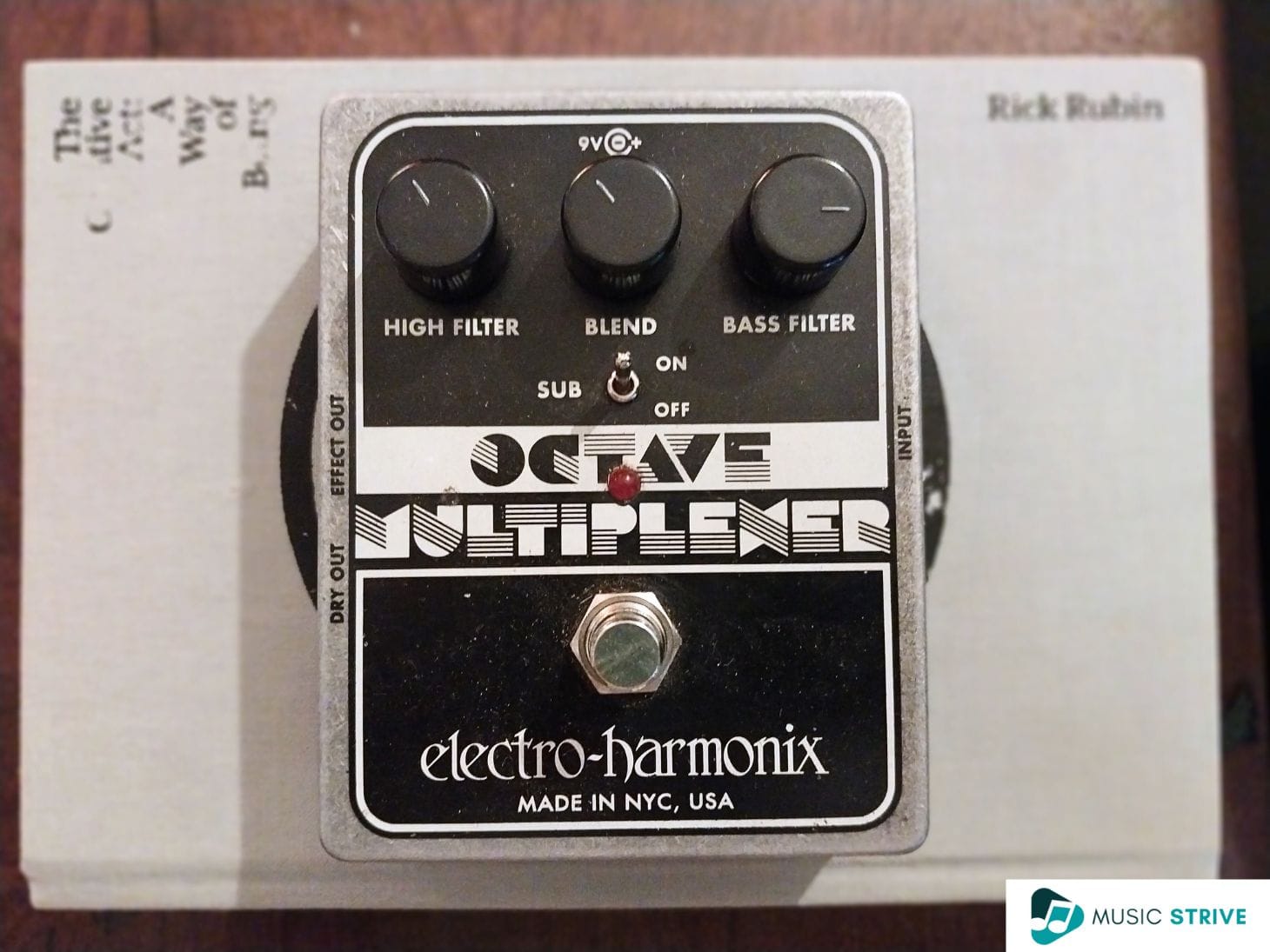
My Electro-Harmonix Octave Multiplexer pedal.
I feel I can see your face from here, lifting the eyebrows and thinking “It’s the 21st century, man, how come you’re still in monophonic land?!” And, you know what? You might even be right.
But here’s the deal, I just love that little randomness that goes into play when you accidentally (or not so much) push a monophonic octave pedal into a territory it can’t handle. There are all kinds of warbly sounds that I just love and learned to tame and play with.
Furthermore, when I kick it on, and then turn on the fuzz pedal, you can literally feel I’ve opened the gates of hell and mayhem is galloping toward us.
Because of how thick, warbly, evil, and big it sounds, I’m nowhere close to changing this pedal anytime soon.
This is How I Use it Live and in the Studio
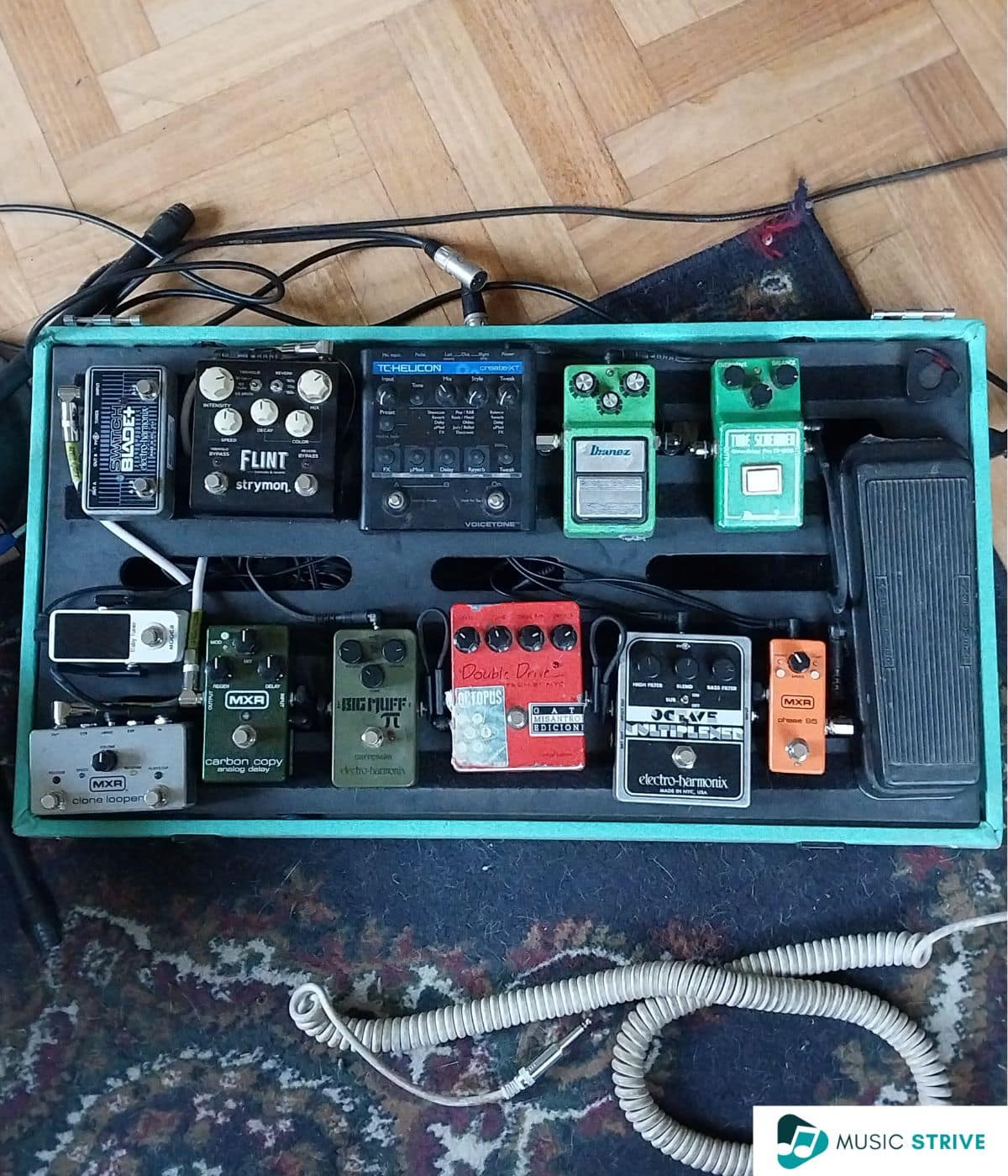
My Pedalboard featuring the EHX Octave Multiplexer.
The best live use I have for this pedal is at the very core of my board. I go into the wah pedal, a couple of Tube Screamers, and into the Octave Multiplexer. The dry-out goes straight into either an IR loader or my Deluxe Reverb.
The wet output goes through the rest of the signal chain and then is split with a Switchblade to a bass amp and a guitar amp. That way, I have a clean sound on all the time to gain definition and two distorted/effected amps doing all the heavy lifting.
In the studio, I play with it and small amps a lot. I have this Danelectro Honey Tone that I usually mic up with an SM57 and put the octave and a fuzz through it. The result is huge-sounding on record.
Also, I’ve played it with my Korg MK1 synth to add an extra-low layer to a melodic run and it works wonders.
The Bottom End
Buying your first octave pedal as a guitar player is opening a new path, a new sonic highway in your playing universe. Octave pedals aren’t like the rest, they’re not subtle and won’t just embellish your tone. They’re almost like another instrument for your instrument.
I hope my choices and explanations made it clear what is it that you can get from an octave pedal and how it can blend with your playing style. I know my favorite pedal is a tad old-fashioned and a one-trick pony, but I found restrictions enhance creativity more than they cripple it.
So, with all this new information, go out there, play a few on the list, and make a bold decision to expand your playing into new territory.
I promise you, it’ll be a lot of fun.
Happy (2 octaves below) playing!
