
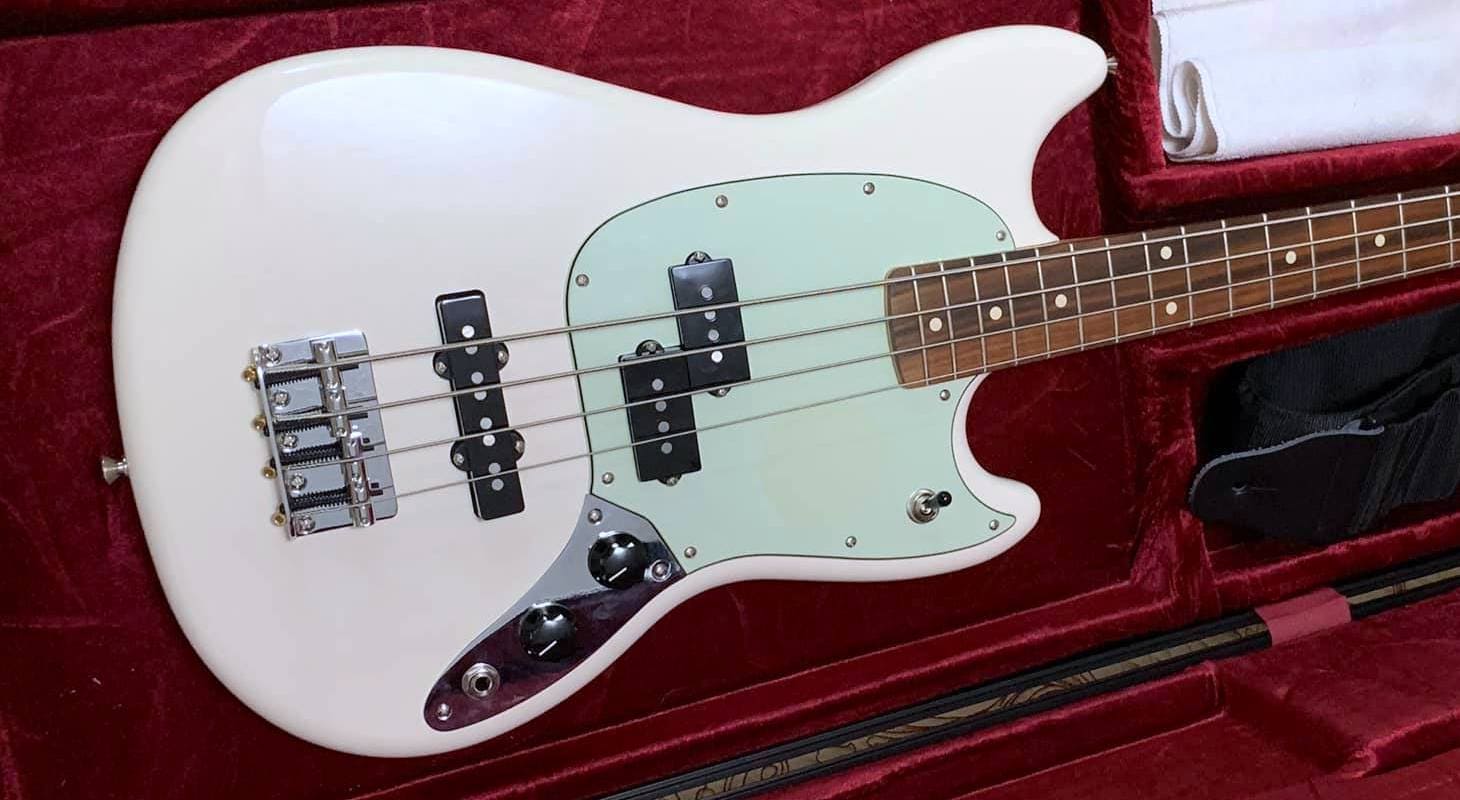
Being a P-Bass player and lover, I have to say I can never get enough of that tight low-end and boomy presence. Yet, the first time I played a Jazz Bass, countless different sonic pathways opened in front of me.
Top 3 - PJ Bass Pickups
Preview | Product | Price |
|---|---|---|
 | ||
 | ||
 |
Yes, there’s a certain snap and edge in the bridge pickup of a Jazz Bass you just can’t replicate with a P-Bass. So, I did what any other serious musician would do: I bought a cheap Jazz Bass to add some flavors here and there.
Come on, I wasn’t going to spend thousands on an instrument I didn’t know if it was a keeper.
Well, it seemed my love story with P-Basses had room for more than just two. So, I went through the slapping phase most of us go through, and I fell in love with the Jazz Bass, too.
Nowadays, I just miss that snappy midrange when I play the P-Bass and the huge low-end when I play the Jazz. So, I did what any other serious musician would do: I bought a cheap PJ Bass.
Then, I spent months changing pickups until I found a sound that was close to what I heard in my head. There were ups and downs, that’s for sure, but I did learn a lot.
So, here are those months of trying back and forth poured into a piece that can help you choose the best PJ replacement pickup for your bass.
Trust me, if you’re serious about playing, your new set is on this list.
Best PJ Bass Pickups - My Favorites!
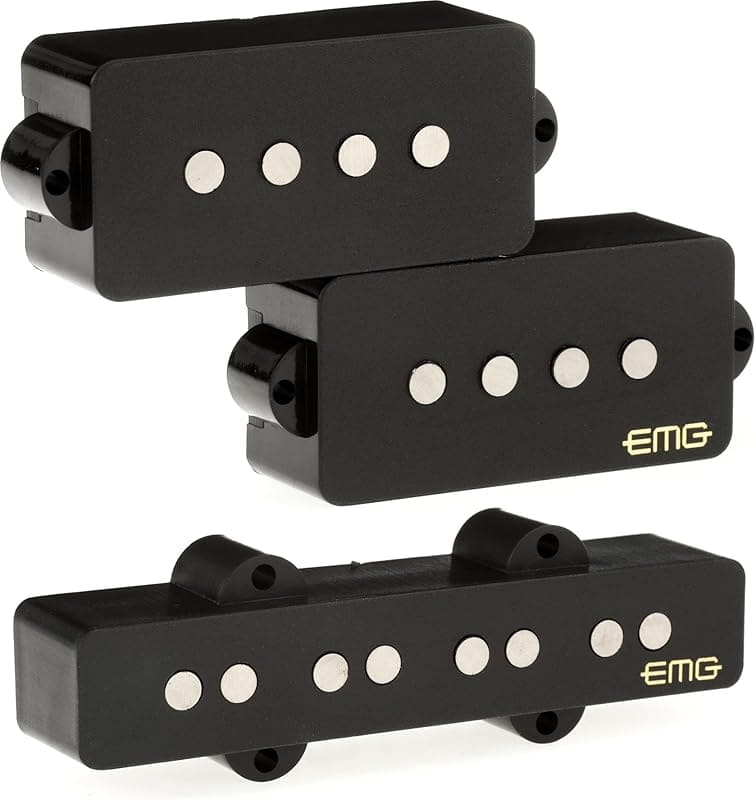
1. EMG Geezer Butler Signature
In my opinion, the unsung hero behind the larger-than-life tones of Black Sabbath was Geezer Butler. There would be no such thing as that low, growling, scary tone to push you straight into the Twilight Zone in the early ‘70s without him.
This set of EMG Geezer Butler Signature pickups does one of the best P-Bass sounds I’ve heard in a long time. I mean, think of the intro to “Children of the Grave”. That’s the kind of tone you can expect from this P-Bass pickup.
Although the tone and the mojo are definitely there, what’s not there (fortunately) is the hum. Yes, I put obnoxious levels of thick Big Muff fuzz to the signal, and it was crystal-clear and dead-silent. Believe me, when trying to lock your playing to a complex kick drum pattern, it makes a world of difference.
Speaking of which, the J-Bass pickup sounded bright, with a big midrange bump that translated into a razor-sharp overdrive coming out of my clean amp. It made perfect sense, I mean, with that guy’s name outside the box, what did you expect?
Well, there’s more than meets the eye about these pickups, because when you dial a mix of them, you get this silent, slightly edgy, funk-ready tone that will have you slapping for hours. Oh, and I also loved that thin, bridge-pickup sound when playing with my fingers.
Another thing to love about these pickups is how easy they are to install. It took me one hour and a screwdriver. That was it, I was playing in no time.
Perhaps, the only drawback is that the P and the J pickups have very different output levels. You have to carefully calibrate them so the volume jump won’t be so drastic.
That said, it was bliss playing my favorite Sabbath, Chili Peppers, The Weather Report, and Metallica songs without changing instruments. Believe me, with these pickups, it’s all there.

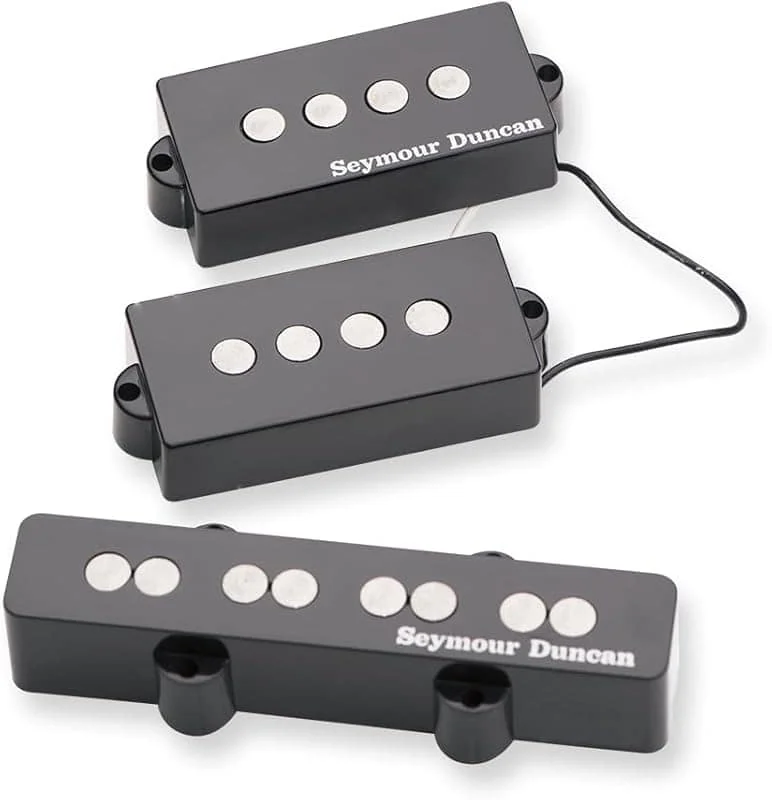
2. Seymour Duncan Quarter Pound
The most famous Quarter Pound in the world comes with fries and a smiley face, but the second is definitely this pickup line by Seymour Duncan. If you ask around, most players played and loved them. Furthermore, they were the first set I installed on my cheap PJ Bass.
The one spoiler I need to make here is that these pickups are FAT. Yeah, in upper cases. The oversized magnet pole pieces and the Alnico V magnets give this set a traditional tone with added spice.
To begin with, the P-Bass pickup has that tight punchiness you expect from a Precision pickup, but with so much added power, it feels closer to an active pickup. That said, the tone isn’t at all stale or cold. It has that added warmth only Alnico can provide.
Trying those pickups out was a ride and a lot of fun.
The bridge pickup is bright and punchy with lots of edge, and that attack that made Jazz Basses so famous in the late sixties and seventies. Believe me, with the oversized poles, these pickups are like an invitation to go on the highway and speed up.
I had a great time playing with a pick, slapping, and doing those fast runs using my fingers and only that pickup.
Perhaps, the only thing I have to say about them is that they’re very powerful. So powerful they might not suit the bill for those who want something more vintage-sounding. Other than that, and the fact that these Quarter Pound don’t come with fries (a shame, really) these are perfect for those about to rock.
Those in the search of a balanced, tamed, not-so-huge sound will be better off with other options on this list. If you want your bass to sound big and mean, these are a must-try-before-you-buy specimen.
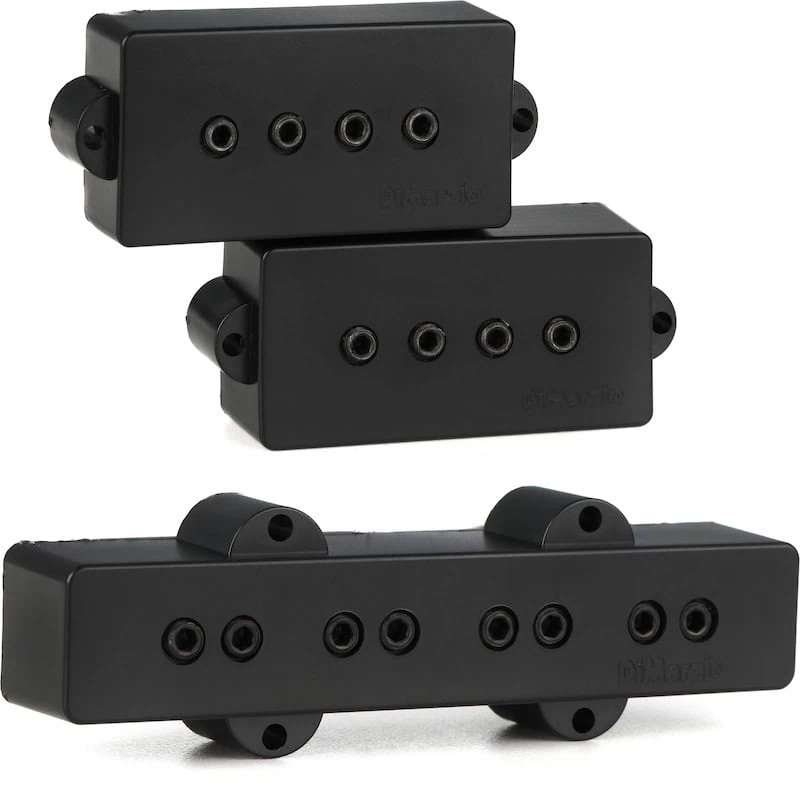
3. DiMarzio DP126
I’m an eighties kid, so I’ve been playing DiMarzio for decades. This was the coolest, most daring, futuristic, and outrageous pickup maker on the market back in the day. Moreover, they survived the change of decade and fueled Cobain’s guitar during Nirvana’s meteoric ascent to the top of the charts in the nineties, too.
Well, as a connoisseur of these pickups, I was, frankly, quite impressed when I installed this DP126 set on my bass.
The P-Bass pickup sounds huge and very compressed. Yes, this is not by any means a pickup aimed at the faint of heart. It sounds modern, compressed, pushed, and gigantic. The low-end can indeed be too much. It happened during the testing that it got muddy at times.
Yet, if you work on the volume knob a bit and the amp’s EQ, your bass turns into a mastodon from a prehistoric age ready to stomp on any track and crush it. It sounds big, round, full, and thick.
The bridge pickup compensates for this mammoth tone with some fierce attack and crystal-like high midrange. I mean, it’s got bite and sounds beefier and thicker than most J-Bass bridge pickups, but retains the attack and the sharp edge.
Blending the pickups was a lot of fun too because they sound scooped and modern and you can tame some of that low end by adding the counterpart of the frequency spectrum.
Also in that position, the slapping was otherworldly. I did my best Fieldy impersonation playing Korn tunes and slapping my way back to the early ‘00s.
It brought back some nostalgia, but no tears were shed.
Jokes apart, the P-Bass pickup can shake walls, the J-Bass can cut through them, and together can make the world tremble. Yes, these are gainy, fat, boomy pickups ready to bring mayhem to any scenario.
That said, I did try some Cocteau Twins, some New Order, and some Chic, and was able to get a decent muffled sound. The trick is working your bass’s controls. Lower the volume and look for the right spot on the tone knob and you’ll have an ace up your sleeve at all times.
A stallion ready to be unleashed as soon as you crank the volume knob.
I would recommend these pickups for the rockers and the metal players out there. For those in search of a more traditional tone, other pickups might be better.
4. Aguilar AG 4P/J-HC
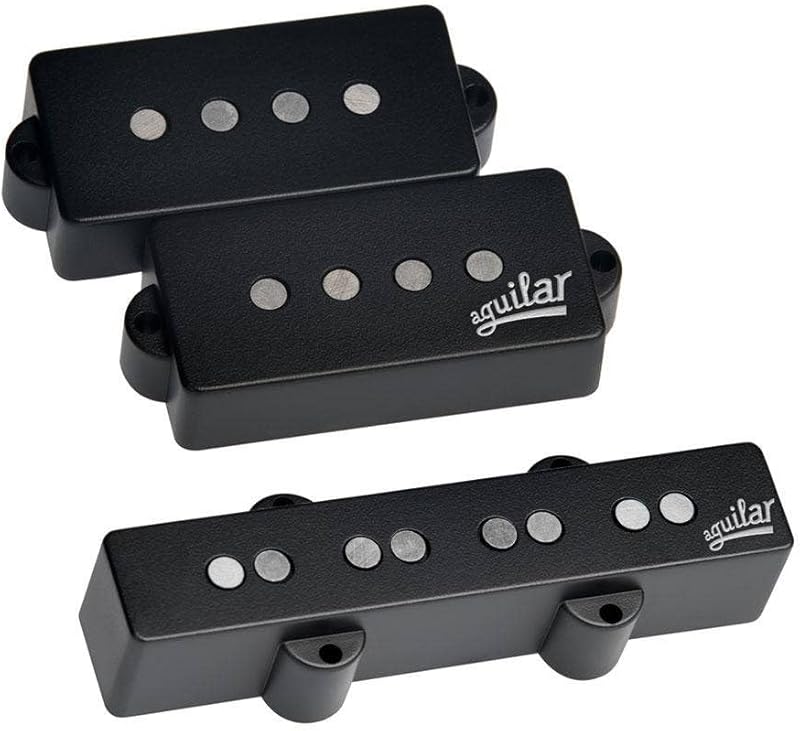
Aguilar is a brand you might have heard about because they make terrific bass amps and cabinets. Well, they also make outstanding pickups.
After playing with the Quarter Pounds for a while, I got tired of their super-hot gain and searched for a different set with a mellower, more tamed vibe. These Aguilar seemed to fit the bill just right, so I went for them.
Installation was, perhaps, the most difficult part because these don’t come with any mounting hardware. Luckily for me, I had the leftovers of previous conversions. Please, bear this in mind if you choose to go for this Aguilar pickup set.
The P-Bass pickup does that beautiful thing that’s adding warmth and mellow, tamed, but round and big bottom-end to the sound. Moreover, since they’re Alnico V, these pickups are warm, responsive, and have a vintage flavor.
I loved to play some Pino Palladino lines, some Pink Floyd, and some The Police, and it all sounded beautiful. I turned on the distortion and went for some Steve Harris licks like “The Number of the Beast” and “Hallowed Be Thy Name”.
The pickup remained consistent throughout and responded great to every scenario, they push when they have to push and behave when they have to behave.
The bridge Jazz pickup is perfect for those who look for that traditional, slightly edgy, bitey-but-friendly bass sound. Yes, this pickup doesn’t sound hollow and cold like many do. On the contrary, it’s warm and punchy with generous midrange and even more generous high-end.
Playing with a pick and the fingers I went from Adam Clayton to Gail Ann Dorsey with some John Paul Jones, Tim Commerford, and Geddy Lee in the middle.
Moreover, blending both, I was able to get this balanced, full, round tone that can cut through the mix. For example, the Flea mix of notes played with the fingers and slapping back and forth became effortless (tone-wise, of course).
If you want to put a pickup set on your PJ bass that will give you punch but will still sound warm and classic, these are awesome. If you’re looking for something with lots of power to play metal or heavy rock, you’d be better off with other models on this list.
5. Fender Yosemite
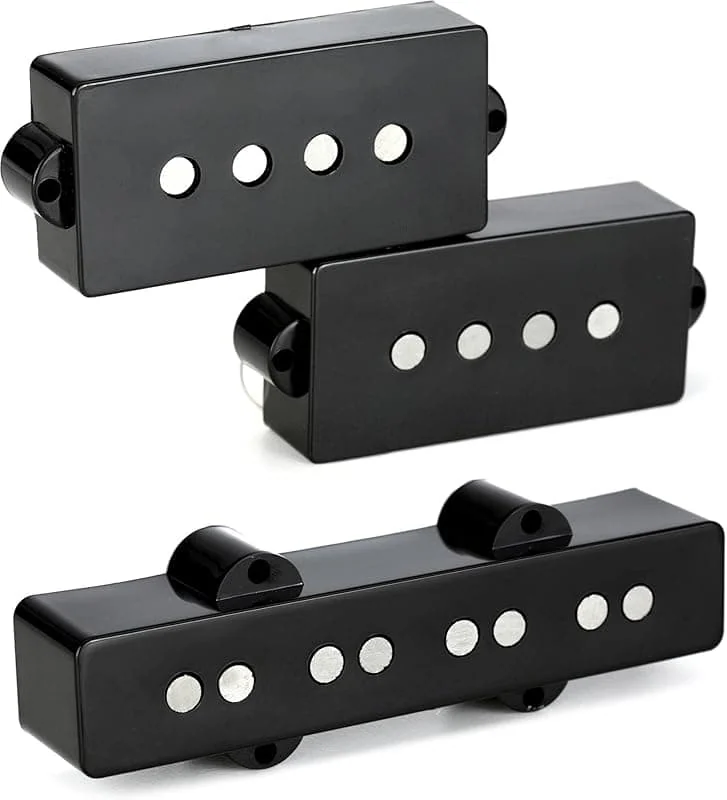
The moment I bought these pickups, I had zero info on them. It was just a hunch. I went for them, and what I received wasn’t what I expected but a pleasant surprise nonetheless.
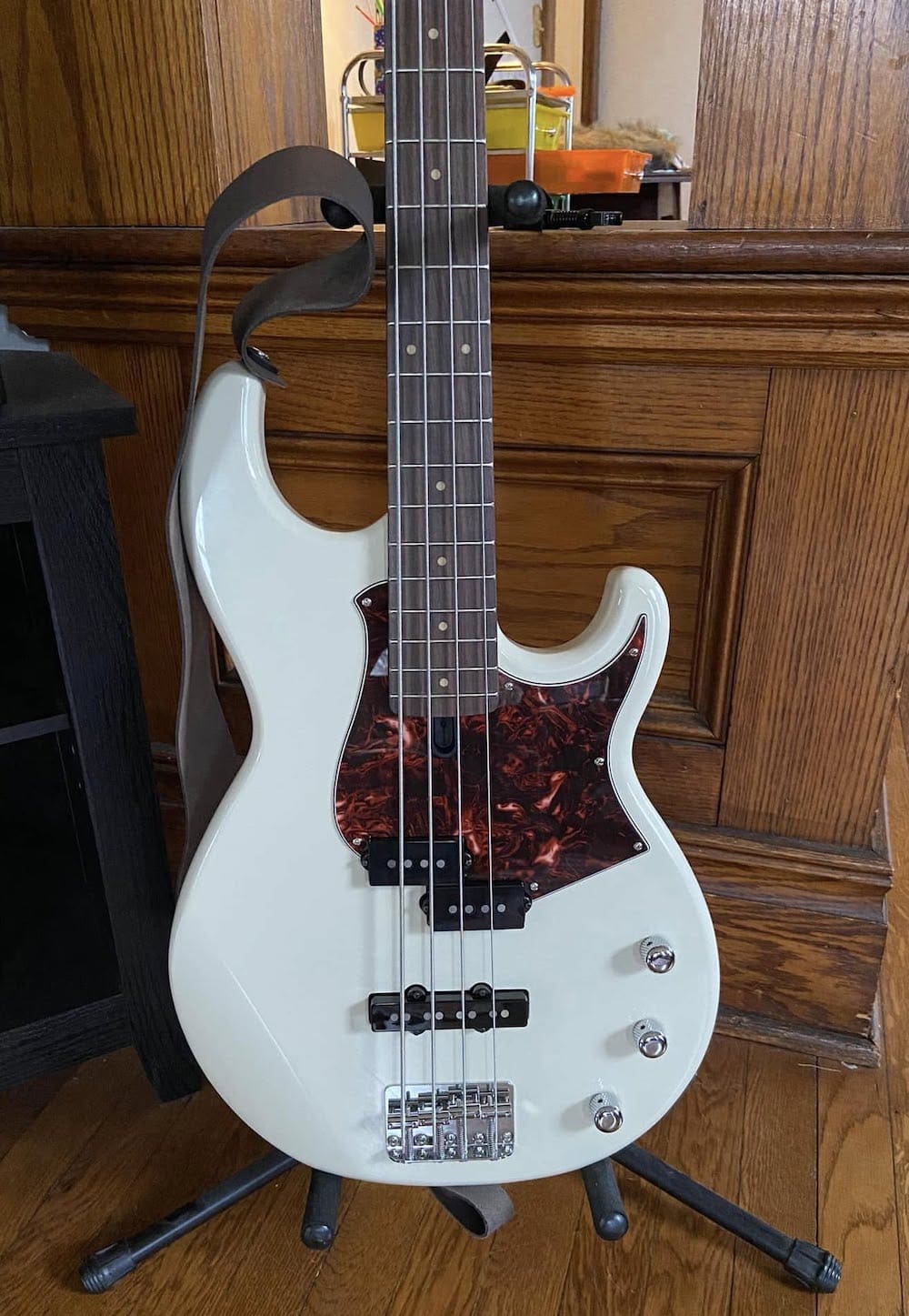
Yamaha BB234 with Fender Yosemite PJ Bass Pickups.
To begin with, these Yosemite pickups don’t have the vintage, quintessential, “holy grail” Fender tone. On the contrary, they’re geared toward a much more modern audience. If we were to put this into Fender terms, it would be closer to the American Ultra than the American Vintage.
This turned my bass into a funky machine. I’m telling you, I was slapping and throwing groovy moves for hours. That ultra-clean, punchy tone with generous presence and a tight bottom-end is at its best in this set.
But that’s far from all, I had a lot of fun playing these.
The P-Bass pickup is loud and sounds fat and punchy. You feel at home when playing clean lines. The right round and tight bottom is matched with musical high-end. You can play anything with that setting. I used a pick, and the spirit of Dee Dee Ramone came back from the grave to congratulate me for my tone.
The bridge pickup is a different story. The growl of the Jazz tone isn’t what you expect. The company chose to put all the low-end power in the P-Bass pickup and leave this pickup with a little less volume and notably less body.
I mean, don’t get me wrong, the midrange is musical and it sounds articulate and super clean. Perhaps, that’s it, it’s just too clean and bright.
In my opinion, the combination of both sounds perfect. It’s got body and edge, and the midrange is full and punchy. That said, the bridge pickup on its own might sound a little lacking for most players. I found the balance isn’t optimal, but you get two outstanding sounds out of three. That’s quite a bit.
Also, I have to say these pickups are ideal for clean sounds but if you want the slight grit and dirt of the original Fender mojo, you’ll have to look for it elsewhere.
I loved it with a Q-Tron engaged and a clean, loud head with a 15” speaker. I’m telling you, it was the ultimate funky tone.
Why Go for a PJ Configuration?
As I said at the beginning, I’m a Precision lover who has room in his heart for some other models. This means I can’t part ways with the sound of that round, tight, punchy, and huge P-Bass pickup.
With time, experience, and many studio sessions, I discovered the Jazz Bass and that clarity, growl, and definition blew my mind.
After even more time, yes, I’m THAT old, I found myself going back to my PJ basses all the time. I still have my holy grails, but I love going to sessions with everything I might need and no extra luggage.
I can play that chorus with a pick and a larger-than-life tone and slap my way through the verse without changing the instrument.
More Than the Best of Both Worlds
The PJ combination is an effort to bring together two different eras in Fender. The P-Bass is all about low-end punch, power, and size. The Jazz is all about edge, midrange, definition, and growl.
But what if you could have a third sound? Well, that’s what many people often overlook about this combination; you get a third sound. Both pickups combined, in my opinion, make a rounder, bigger, better slapping sound for certain scenarios than a Jazz Bass.
A P-Bass with More Options
Most manufacturers apply this pickup configuration using the body shape of the Precision. So, if you’re like me and don’t like that extra chunk of wood in the Jazz Bass’s offset body, this is great news.
Attention Session Players!
Walking into a studio holding more than one instrument might give you a mysterious halo telling those around you that you’re a pro.
In reality, though, real pros walk in with the least gear possible and do a great job. Moreover, for a session player with lots of work, having an instrument that can cover more sonic ground is always great news.
Finally, if you know your way around your bass controls, you can dial almost anything you need with a PJ bass.
Dialing Some Tones
Let’s talk about typical tones you can get with this instrument and how to get them. Hey, did you think I was out of secrets to share with you? I’m all about freebies, and I know you are too.
Let’s do this!
Do This for Added Fatness
Depending on the PJ set that you decide to buy, sometimes, you might want to add some of the edge of the Jazz pickup and not lose the fat and boomy bottom-end of the P-Bass pickup. Well, my recipe for this is working the tone pot on my bass.
Again, depending on the pickups, but rolling off the tone knob from 10 to 8 might help regain some of that fatness without losing the high-end.
Do This for More Snap
Some parts just require that snap and spank only a Jazz Bass can deliver. Perhaps you want to dial that snap with some added lows from the Precision pickup.
In this scenario, depending on the set you bought, I would dial in the bridge pickup 80% and again work on the tone of the instrument. I don’t recommend you play with the volume on anything but 10 to get that hard-hitting, midrangey tone.
A Balanced Tone
Every time I have the pleasure of playing a new instrument with PJ pickups, what I do is start with everything at noon. That includes volume and tone knobs as well as the blender.
Working your way from there is using your ear as a guide to move the tone and the blender until you find the perfect setting. Bear in mind that a volume pot is a gain pot, so if it sounds small, increase the volume and check again.
Take-no-prisoner Attack
This is one of my favorite things to do with a PJ Bass; going all-in. This setting works great when you need to take the center of the stage and steal the spotlight from the singer who knows nothing but bad jokes.
For this setting you need your volume in ten, 30% Precision, 70% Jazz and the tone cranked. Depending on the set, you might want to tame the high end with the tone knob. The trick is done with the picking hand, if you want more treble go closer to the bridge, and if you want more bass, play over the Precision pickup.
Do this, and the stage is yours to rip.
Conclusion
This pickup combination is the closest it gets in music to a clash of titans, a duel of legends.
In the blue corner, with seven decades of taking over the airwaves, going through mutations, pushing through trends, we have the P-Bass pickup in all its divided-coil magic.
In the red corner, with six decades of bringing the grooves to the world, being the instrument of choice of one of the (if not the) best players in history, Jaco Pastorius, and defining the sound of a generation, we have the Jazz Bass.
What if we could take the best of each world?
Well, the moment I go from my Precision to my Jazz pickup, I just take different decisions, it sparks new ideas, stirs inspiration, and opens new sonic highways.
Yes, the good news is that the only winners in this clash of titans are the legion of bass players who get three amazing sounds to play with in a single instrument.
You not only get the best of both worlds, but also a new world you had no idea existed.
So, go ahead, get the set that resonated the most with you, and take over those airwaves (the old version of the hottest Spotify Playlist?), the stage is yours to rip!
Happy (Precision AND Jazz Bass) playing!
