
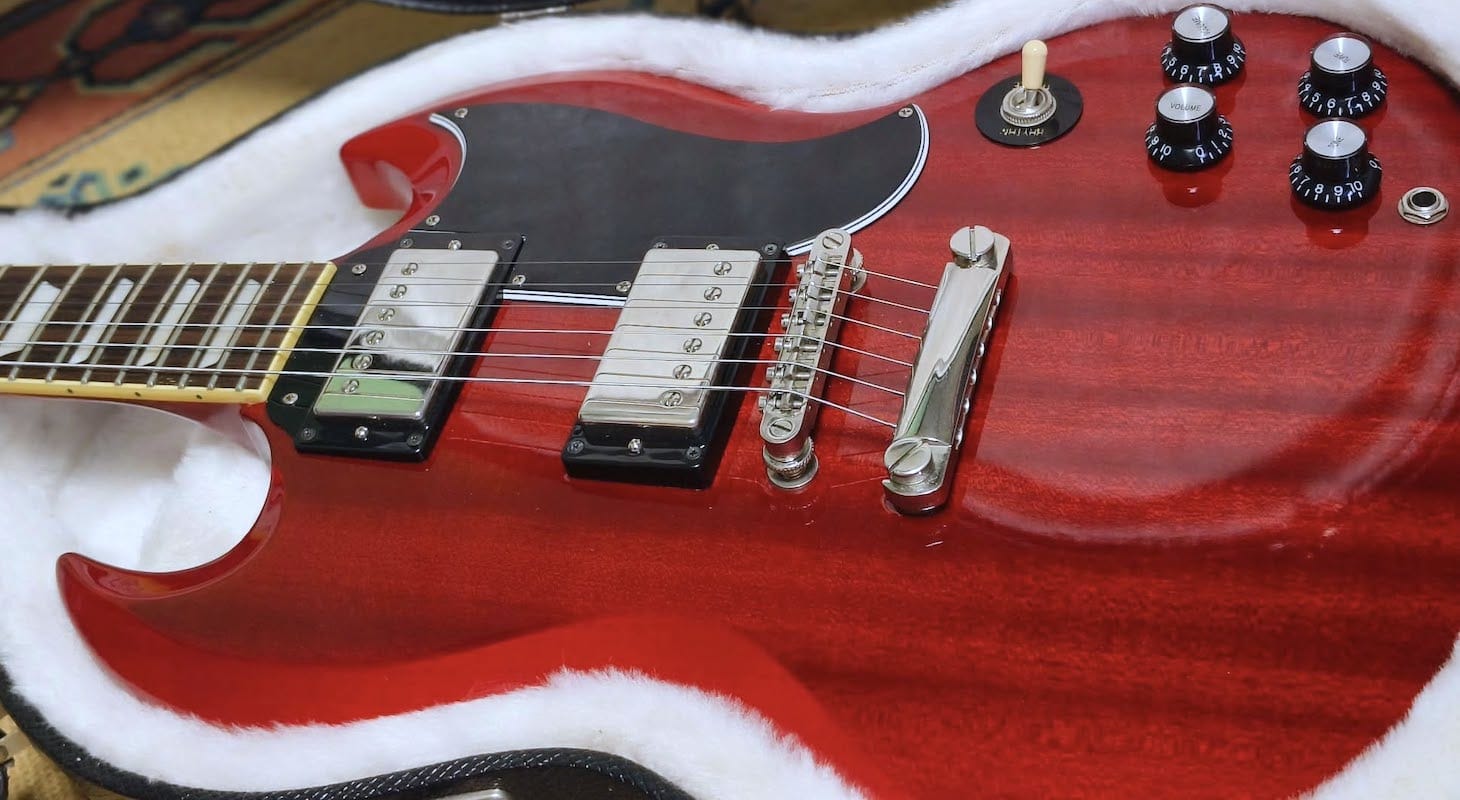
Few guitars have enjoyed the popularity and longevity that the Gibson SG has. The SG is renowned for being a fast-playing instrument that is a favorite amongst technical players.
Pickups have a significant impact on the overall tone of a guitar. To get the maximum quality out of this classic axe, it’s important to equip it with pickups that are capable enough to handle your needs. More so in case of cheaper SG-style guitars including Epiphone ones.
Although many of us best associate the SG with AC/DC’s Angus Young or Black Sabbath’s Tony Iommi, this humble double-cutaway solid guitar is capable of far more than simple classic rock tones.
While to many, the classic SG sound is a clear, bell-like Gibson-and-Marshall combo, there’s plenty of other sounds on offer.
In this article, I’ve included a few pickups voiced for both high- and low-intensity rock stylings, as well as some other inclusions that can diversify the SG’s tonal palette.
There’s more to the SG than PAF-style pickups, as we’ll discover today.
Best SG Pickups - A Few of My Favorites!
1. Seymour Duncan SH-4 JB
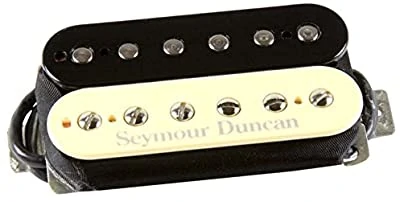
The Seymour Duncan JB pickups have had a very long and impressive history. With some of the best players in the industry using a set at one point or another. Guitarists like Kurt Cobain, Dave Mustain, and Beck who actually commissioned the original pickup that would eventually become the JB. In fact, it was Jeff Beck who lent his initials - JB - to give the pickup its name.
With such an impressive list of names, the JB is surely a powerful and versatile pickup. I almost don’t need to say much more about the pickup if you are familiar with any of these guitarists.
Their endorsement speaks for itself. Let’s get into why this pickup is as great as it seems.
The JB’s are actually a bit brighter than normal for humbuckers. There is quite a bit of emphasis on the highs, and the mids especially are pronounced.
The voicing here boasts enough low-end so that the pickup isn’t too biting or tinny. It is fairly balanced, but I would say it definitely leans more to the bright side.
I like the bite and articulation these give to a guitar. They’re particularly good at highlighting the distinctive clarity of my SG. With my SG plugged into my Marshall Plexi combo, the sound is pure hard-rock humbucking goodness. It’s hard not to break out into spontaneous bits of “Thunderstruck.”
With the tone knob rolled down a little, I was able to get endearingly close to the thick, wailing “woman tone” of Cream-era Eric Clapton. “Crossroads” and “Sunshine of Your Love” poured out of these pickups beautifully.
As you might expect from humbuckers, especially Seymour Duncans, the JB’s handle distortion very well. Power chords sound fantastic. They growl beautifully without becoming fuzzy.
Even with all this bite and attack, the JBs still manage to be crisp and clear. This means that solos will still sound clean even with a lot of distortion.
The pickup is also well-balanced in terms of volume and tone. Every string and note is picked up equally. I didn’t notice any dips or dead spots.
The Seymour Duncan JBs pair really well with Gibson and Epiphone guitars, especially SGs. If you want that cutting AC/DC sound with your SG, these pickups are perfect for that.
I do think the JBs might be a bit too bright for some. Luckily, pairing them with a guitar that is made with a warmer wood, like mahogany, helps a lot to pull the brightness back.
I’d make the case that the voicing of these pickups is specifically designed for use with a warmer, darker-voiced guitar like an SG or a Les Paul. Certainly, it’s what worked for Jeff Beck in the first place.
PROS
CONS

2. Seymour Duncan SH-1
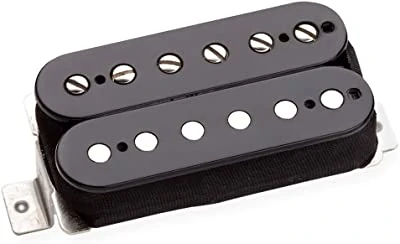
If a warm, vintage-sounding pickup is more your style, then look no further than the Seymour Duncan SH-1. The SH-1 is a fantastic recreation of old-school PAF pickups from the ‘50s.
Of course, keen-eyed readers will no doubt rush to the comments section to let me know that the SG was invented in 1961. Technically, the warm, low-powered tones of the '50s aren’t era-correct for a Gibson SG. Regardless, there’s plenty to love about a vintage-voiced SG pickup.
This pickup has a pleasantly warm and mellow tone. There isn’t really any emphasis on any of the frequency ranges, although I do get a slightly rounded mids feeling from the pickup. With such a balanced response, I found that I could get a broader range of tones by adjusting my technique.
This was particularly tangible with my Marshall set just around the edge of breakup. Harder playing yielded a sharper, more aggressive, biting sound. Softer playing offered bluesy, clearer tones.
It is a bit thinner than other humbuckers, but I don’t see that as a bad thing. For a more vintage tone-focused pickup, you don’t really want something too bright or too thick. Depending on how you play, you want to avoid unpleasant, harsh treble or muffled low end.
If you have a vintage SG, the SH-1 is a fantastic match. It just brings out the vintage tone so well, adding some nice color with both gain and clean.
It is also a very clear pickup. Vintage pickups tend to have a bit of fuzz and noise, but Seymour Duncan has done an excellent job to make the SH-1 as noiseless as possible.
The only real issue is that the pickup isn’t very loud. You will definitely need to turn up the volume on your amp to make your guitar loud enough.
Because the SH-1 is styled as more of a vintage pickup, it is a bit limited in terms of music styles and genres. Heavy metal doesn’t sound very great through the pickup.
At least not modern metal. I think they actually do work well enough if you are going for the fuzzier Black Sabbath sound. This pickup is far from hot enough to drive the amp into full Iommi territory, however. You’ll need a fuzz pedal or high-powered overdrive to really push this tone into a convincing facsimile of “Paranoid” or “Iron Man.”
But they really shine the most with lower amounts of gain. Blues, jazz, and softer rock are where you will get the most out of the SH-1. The welcoming clean and edge-of-dirt tones here are perfect for softer '70s rock. It responds best to a deft, subtle touch, so I’d recommend brushing up on your Lindsay Buckingham chops to get the most out of it.
While it is marketed as a neck pickup, I think the SH-1 works just as well as a bridge pickup. I didn’t notice a dip in tone quality or any issues really with it in the bridge position.
PROS
CONS
3. EVH Frankenstein
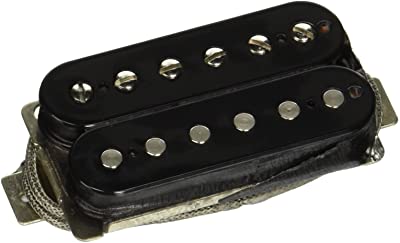
The EVH Frankenstein is based on the pickups in Eddie Van Halen’s famous Frankenstart. It is the perfect pickup for anyone after that old-school hard rock sound.
The Frankenstein guitar was, at least originally, built with a PAF pickup from Van Halen’s own Gibson 335. When Van Halen’s tremendous stage volume proved too much for his hollow-bodied guitar, he sought to place the pickup in a solid-bodied guitar, cobbling together his now-legendary “Frankenstein” Stratocaster.
Of course, we’re here to discuss SG pickups, so how does this sound when fitted to an SG?
While the EVH Frankenstein isn’t an exact replica of the original, it is designed to come close to the same sound. It comes quite close indeed.
The Frankenstein might be the best PAF-style pickup I have ever heard. Notes and chords aren’t just massive-sounding, but they are also crystal clear.
Even when the pickup is stacked with distortion, it doesn’t become noisy or muddy. Every note and chord still ring out clearly while still having a ton of bite.
I was especially amazed by how fantastic the harmonics sound. Natural and artificial harmonics pop while pinch harmonics squeal and scream. I wouldn’t expect anything less from a pickup bearing Eddie’s name.
Cleans with this pickup are a bit of a different story, however. With the guitar’s volume turned up, I started noticing some grit in the clean tone. There is almost a slight natural distortion in the Frankenstein. Given the enormous output on offer here, that checks out.
Dialing back on the volume does get rid of that grittiness. But let’s be honest, if you are playing with Frankenstein pickups, you probably aren’t playing clean a whole bunch.
The trick here is to play the guitar like Edward Van Halen did, or at least to appropriate his techniques. Rather than switching channels for a clean tone, I simply rolled back the volume knob on my SG. Although it didn’t yield a truly clean sound - I couldn’t take it to a country gig - it cleaned up enough to get into a tone appropriate for the “Women in Love” intro.
Speaking of, this pickup sounds best for Van Halen-style playing. It works great into my cranked Plexi. The sharper clarity and edgier bite works so well with the Plexi’s natural cranked-tube compression that I sat down and just enjoyed running through my arsenal of Van Halen licks.
It handles the tapped intro from “Women in Love” just as well as the frantic power chords of “Somebody Get Me A Doctor.” The jump in saturation as I rolled my volume knob back up to 10 for high-octane riffing was very satisfying.
I can, however, see why EVH himself used high-friction pots for his volume controls. Taming this beast with a standard volume pot isn’t easy: it’s very sensitive to minor changes.
This pickup is best suited for that ‘80s style of hard rock and metal. Punk and doom also sound really good with the Frankenstein. Anything that requires a more dirty, chewier tone will sound incredible through this pickup.
I found the voicing darker than the classic Van Halen tone, but still very usable for heavier stylings.
I was a little concerned about how it would sound with an SG. This pickup was designed specifically for a Super Strat with a Floyd Rose tremolo after all.
But honestly, it sounds just as amazing in an SG as it does in a Frankenstrat. Of course, a Frankenstrat still sounds better, but you certainly won’t be disappointed putting one in your Gibson or even Epiphone SG.
In fact, it’s probably more worthwhile throwing the Frankenstein pickup into an Epiphone SG just to turn it into hard rock firebreather.
PROS
CONS
4. Seymour Duncan Phat Cat Silencer

Most players think of the SG as a classic Gibson humbucker axe. However, Gibson’s other great pickup, the P90, deserves an honorable spot in this list.
The P90 was Gibson’s original single-coil pickup. It’s hotter and thicker sounding than, say, a Fender single-coil pickup. Like a Strat pickup, however, it’s fairly noisy, especially at higher volume or gain levels.
That’s where the Seymour Duncan Phat Cat Silencer steps in.
It’s a noise-cancelling single-coil capable of both modern and vintage-voiced tones. Even better, the Phat Cat is sized and wired to slot easily into any standard humbucker-equipped guitar, like a Gibson SG.
Although you can find it in a set, my favorite use for a P90 is in the bridge position. Plugged into my Marshall Plexi, I was easily able to conjure high-powered bluesy rock and roll tones reminiscent of “Mississippi Queen.”
Likewise, power chords thundered out of the amp. Although the pickup runs nice and hot, it never gets mushy or overly saturated. The sweet spot is with crunchy poweramp saturation, which lets these pickups absolutely roar.
I even dusted off my teenage affection for punk rock downpicking, which these pickups handled with great aplomb. It’s hard to resist running through the big, chunky chord progressions of “American Idiot” when you have a P90 tone this good.
I liken it to the classic, slightly spiky sound of Southern rock or classic punk rock.
The clean tone, too, especially on the neck pickup, is much brighter than a standard SG humbucker tone. There’s plenty of spank and sparkle here. I was thrilled to find it bright enough to play 2000s indie-rock. It was almost spot-on for the sound of The Strokes’ “Reptilia.”
In fact, with a little technique adjustment, it’s bright enough for modern country playing, too. I have no idea when I’ll play a gig that includes Green Day and Luke Combs in the same set, but if I do, this is the pickup for it.
It’s a thinner, brighter tone than one might expect from a Gibson SG, but it’s much more versatile than I initially thought.
PROS
CONS
5. DiMarzio Super Distortion

If you find a live photo of any hard rock or heavy metal player from the '70s or '80s, you might spot a distinctive cream-colored humbucker in their guitar. It could be in a Stratocaster, a Les Paul, or, as is relevant here, an SG.
This was the DiMarzio Super Distortion, the pickup that powered the halcyon days of '70s and '80s hard rock.
This pickup really only does one thing, which is the biting, slightly icepicky tone of that era’s hard rock bands. If you think of the sounds of KISS Alive or early Iron Maiden, that’s the tone. It’s aggressive, and sounds great through a cranked Marshall, but does very little else.
In an SG, the guitar’s naturally darker tone offers a little balance to the brightness of the Super Distortion. Through my Marshall Plexi, I had great fun with riffs from “The Trooper” and “Detroit Rock City.”
The clean sound here is brittle and a little harsh, so I’d avoid using this pickup for blues or jazz playing. Of course, I doubt that anyone buying a pickup labeled “Super Distortion” wants to sound like George Benson.
Likewise, it’s a little too bright for more modern metal stylings. Anything heavier than Randy Rhoads-era Ozzy Osbourne is going to demand a differently voiced pickup. The Super Distortion is simply too bright for chugs and machine-gun palm mutes.
However, for legato lead lines and proto-metal riffage on a Gibson SG, it delivers that sound in spades.
PROS
CONS
6. Gibson Accessories ’57 Classic Plus
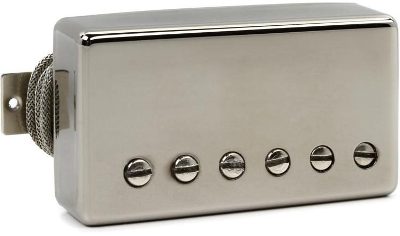
Who better to make a pickup for a Gibson or Epiphone SG than Gibson themselves? The ’57 Classic Plus was designed to replicate Gibson’s original PAF humbuckers. If that vintage Gibson sound is what you are looking for, then the ’57 Classic Plus is the pickup for you.
If you bought a Gibson SG new, this might be the pickup already included in your guitar!
The ’57 Classic Plus has a fairly bright tone with the mids scooped just a little bit. It isn’t too noticeable, but you can hear that scooped sound if you listen closely, particularly on lower notes. It’s balanced somewhat by the SG’s naturally mid-forward character, but it’s noticeable.
With gain, the pickup has a very nice punch to it and higher notes have a certain sharpness. They aren’t harsh, but just have this nice cut to them. It reminds me, perhaps too obviously, of the slight edge in Jimmy Page’s classic Led Zeppelin tone.
Notes and chords also stay crisp and clear when distorted. Every note is distinct during solos and chords have just enough attitude to stand out.
When playing clean, the ’57 Classic Plus has this great blend between warmth and shine. It will lean more to one way or the other depending on its position, with neck being warm and bridge being bright and chimey.
Likewise, it responds very easily to how I’m playing. Harder playing close to the bridge yields classic-rock crunch. Softer playing by the neck offers sweeter-bluesier tone.
For a low-output pickup, the ’57 Classic Plus is also quite loud. I didn’t have to push the volume on my amp a whole lot to get my guitar to a loud enough volume. As did the classic '50s PAFs, it drives an amplifier into a sweet breakup tone with relative ease.
This pickup is really better suited for a low-gain and clean sound. Blues and jazz are where it especially stands out.
I would avoid pushing the gain too far with the ’57 Classic Plus. More than about 7 or 8 and I started to notice some serious noise. As long as you keep the gain under control, the ’57 Classic Plus is a real joy to play.
The ’57 Classic Plus is a great pickup if you want to give your Gibson SG a more vintage sound and just an overall great upgrade for an Epiphone SG.
PROS
CONS
Desirable SG Pickup Qualities
Choosing the best pickups for your SG shouldn’t be too difficult. Due to the unique tone and design of the guitar, there are some standout qualities that you should look for to get the best out of the instrument.
The only pickups you’ll find to fit into an SG are humbuckers or humbucker-sized single coils, like the Seymour Duncan P90s.
Then, the next quality to look out for is how compatible they are with the SG design. Some pickups are easier to install than others. Four-conductor hookup cables are a great tool for simplifying the installation process.
The style of guitar that you play will also be a factor in your search for SG pickups. Due to the versatile nature of this guitar, you could opt for high-output pickups to add more bite to your tone, or more subtle and subdued pickups for lighter styles of playing.
The type of magnet that is used for the pickups will also impact the results it produces. Two of the most popular magnet types are the Alnico 2 and Alnico 5 varieties. These are the most commonly used with an SG.
Alnico 2 magnets produce a warm tone, with full-sounding mid-tones and a slightly reduced output. Alnico 5 magnets, on the other hand, produce a higher output, with more bass and clear-sounding treble.
Things to Consider When Buying Pickups for an SG
While the pickups you choose will be entirely subjective and depend on what you like, there are a few things you can consider when making your choice.
Active and Passive
One of the biggest arguments when it comes to pickups: active or passive?
But what are they?
Passive pickups are your standard, everyday pickup. A few magnets and a wire connected to an output jack. Active pickups come with a battery-powered preamp.
Most active pickups, like EMGs, are powered by an additional 9-volt battery. You can usually squeeze a 9-volt into the potentiometer cavity on an SG, depending on the size of your potentiometers.
The main difference is that active pickups have a higher output, better sustain, and reduced noise. Passive pickups on the other hand sound a bit more natural.
There isn’t really a right or wrong anymore when it comes to choosing active or passive pickups. It is really more a matter of whether your guitar can take active pickups or if you are willing to cut holes in your guitar to install active pickups.
Output
The output level of a pickup basically refers to how loud the pickup is. High-output pickups will be much louder than low-output.
You might be thinking “Oh, I should just choose high-output pickups then?” Well, both types have their own pros and cons.
High-output, for example, can handle high amounts of distortion better, but have less dynamic range. While low-output pickups are cleaner and more dynamic, but can’t handle very high levels of gain.
So, the type of music you play will likely determine the output level of the pickups you choose.
Two-Conductor and Four-Conductor
Humbuckers can be split into two types: two-conductor and four-conductor pickups.
What this refers to is how the pickup’s wiring is set up. Two-conductor humbuckers have separate wires for only the hot output and the ground.
While four-conductor humbuckers have two separate wires for each of the pickup’s coils. But what does this actually mean?
The number of conductors a pickup has determines how many different circuit configurations it can have. This means that two-conductor humbuckers can only be used in the humbucker configuration.
Four-conductor humbuckers on the other hand can be used in series, parallel, out-of-phase, or single coil. This doesn’t mean two-conductor humbuckers are pointless, just that four-conductors opens up a lot of options in the event that you want to explore them down the line.
Should I Replace My Gibson SG’s Pickups?
Considering Gibson guitars ship with Gibson pickups, it is probably not necessary to replace the pickups. Gibson pickups are made to the same high standard as their guitars and to work with those guitars. Most Gibson SGs from the past decade or so are shipped with the excellent ‘57 Classic pickup, for example.
Most players won’t have any issues with the pickups in a Gibson SG and won’t see any point in replacing them. However, there are a few reasons to consider replacing the stock pickups.
The most obvious reason would be that you want to change the sound of your guitar. Gibson pickups are a bit more focused to play blues, rock, and hard rock. But what if you want pickups that are better suited to jazz or funk or metal?
Or maybe you want pickups that work great with a wide variety of music styles and genres. Changing your guitar’s sound or improving its versatility are great reasons to want to replace its pickups.
Another great reason would be to simply beef up your SG’s sound. They tend to be a bit thinner and weaker sounding than Les Pauls. So, putting in pickups with a bit more bottom end and a bit higher output can be a great way to make your SG sound fuller and more aggressive.
While replacing a Gibson SG’s pickups isn’t really necessary in most cases, it also isn’t a bad idea. Just make sure that you are getting high-quality pickups that aren’t going to hold your guitar back.
Should I Upgrade My Epiphone SG’s Pickups?
Just like Gibson SGs, I would say it probably isn’t necessary for most people to replace the pickups in their Epiphone SG.
In many cases, an Epiphone SG is a beginner guitar and there isn’t really any point in replacing its pickups. A beginner probably won’t hear the difference, so there won’t be much of a benefit.
But maybe you aren’t a beginner and you want a better-sounding guitar, but you can’t afford a Gibson. In that case, I would say that swapping out your Epiphone’s pickups for a higher quality set is a great idea.
It’s the easiest way to improve your guitar’s tone. When I was a teenager, I had an Epiphone Les Paul Custom that I wanted to sound better. I bought a set of Seymour Duncan pickups (a JB neck and a ‘59 bridge), borrowed my dad’s soldering iron, and an hour and a few soldering burns later, I had a better sounding guitar.
You can improve a guitar’s tone quite a bit by just putting in better pickups. This can make the guitar’s sound fuller, richer, and just overall better.
I would be careful with the pickup that I choose, though. Don’t immediately go for the most expensive option. Not only would you likely be able to get just as good a pickup for cheaper, but there also comes a point when a guitar stops benefitting from a piece of gear.
Even the most expensive pickups can only do so much for a guitar made with cheaper materials. I would say that pickups in the $100 - $150 range are perfect upgrades for an Epiphone SG.
Final Word
No matter how good a guitar is, without the best pickups for that particular model, it won’t play to its maximum potential. That’s why it’s so important to consider the tone you’re aiming for before you decide on the right pickups for your guitar.
Thankfully, the SG, whether it be a Gibson or Epiphone model, is blessed with a beautiful natural tone. Installing the best pickups for the SG will simply enhance it and allow you to enjoy the full scope of its capabilities.

I’ve played high end Gibson SGs for many years. TY. (classic rock, pop & originals)
I just got an Epiphone SG Muse. I really like it, except the tone, in my opinion, sucks big time, if you will excuse that expression. There is almost no bottom end at all. That ruins it. It is a beautiful guitar and plays very well. I woud return it, but I bought it from a family member who works for a large music gear company and I promised another family member that I would not return it.
I am considering upgrading the pickups. Any suggestions or advice. Thank you, in advance, Mike