
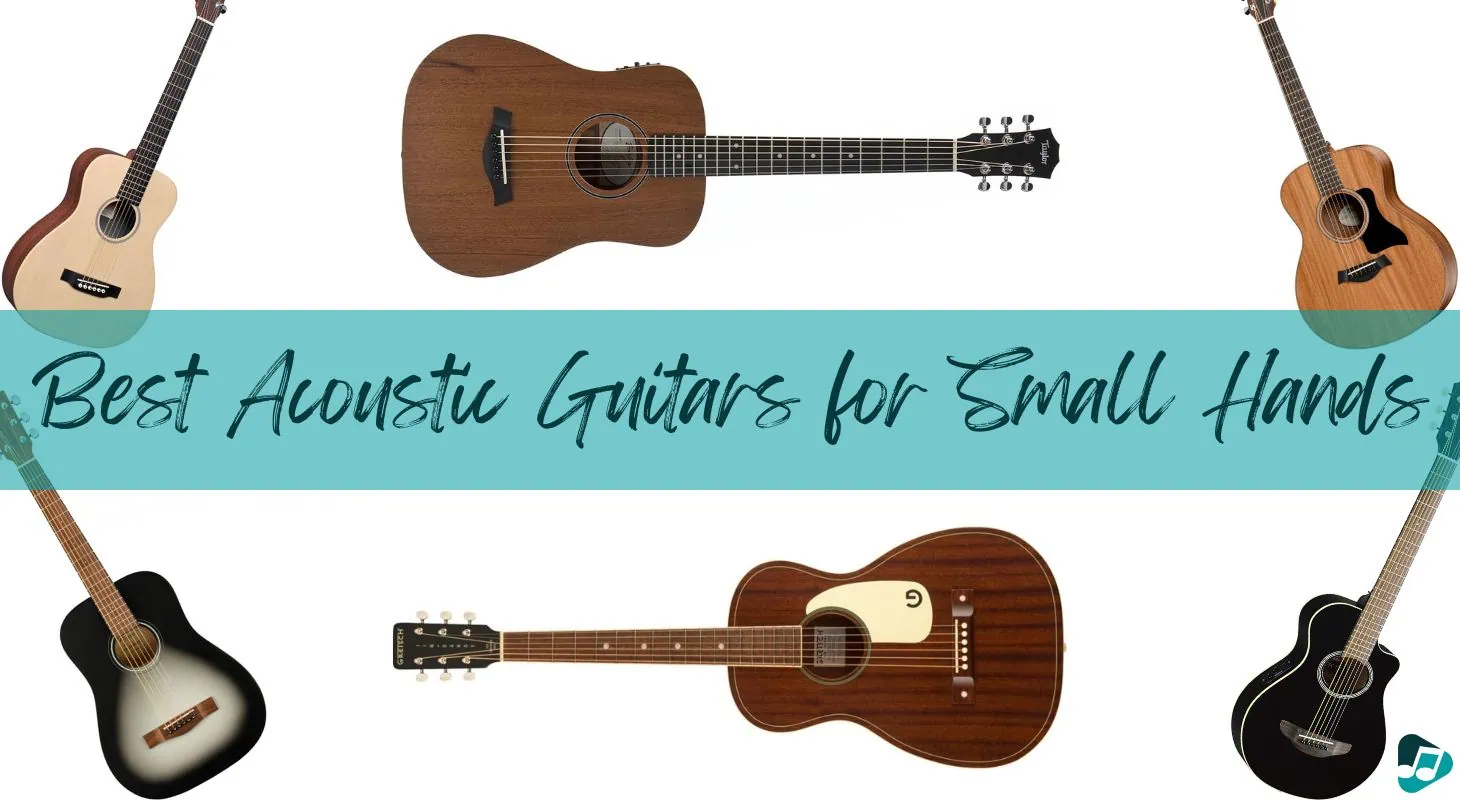
One of the best things about the guitar is that there are models out there to suit absolutely everyone, regardless of age or gender, and even size. Yet some people still have the belief that if their hands are too small, playing the guitar might be more difficult for them.
While it’s absolutely true that size will affect how comfortable a guitar is to play, the good news is there are guitars out there designed specifically to accommodate those with smaller hands, from small children all the way to full-grown adults who just happen to have little hands.
One of the most important ways a guitar will fundamentally accommodate players with small hands is by utilizing a shorter scale length. This means the distance from the nut to the bridge is reduced, essentially squishing the frets together.
This has a multitude of benefits from making large chords easier to hold to reducing string tension which makes fretting a note easier.
Top 3 - Acoustic Guitars for Small Hands
Preview | Product | Price |
|---|---|---|
 | ||
 | ||
 |
Over the last two decades as a guitar player, I've had more than enough opportunities to try out travel-friendly, smaller acoustics. A few of those are my favorites and I still own and use them today.
Based on that experience, I’ll discuss 6 short-scale acoustic guitars that will accommodate most players (with shorter hands; including kids) and most styles of playing. Now all your issues caused by playing a guitar that’s too large for you will be a thing of the past!
So, if you’re a player with smaller hands, you’re in the right place!
6 Best Acoustic Guitars for Small Hands
Table of Contents
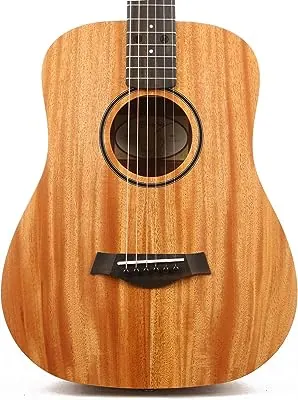
1. Taylor Baby Mahogany BT2
Taylors are the cream of the crop when it comes to world-class acoustic guitars. They’re used by some of the best players on the planet, and as such are one of the most respected brands around.
But unfortunately, they’re also one of the most expensive brands too, with some of their production models costing several thousands of dollars.
So when Taylor introduced a downsized and more affordably priced instrument known as the Baby Taylor, players were overjoyed at the prospect of being able to obtain a Taylor guitar for such a reasonable price.

Our Music Strive author Santiago playing his Baby Taylor during a trip to India. He's written a thorough editorial piece on traveling with travel-friendly acoustics based on his extensive experience, which you can check out here if you're interested: https://guitarstrive.com/travel-guitars/
But the name Baby wasn’t just referring to the price, it’s actually a miniature ¾ sized Taylor that mimics the proportions of their iconic Dreadnought instruments exactly, just in a scaled-down format.
There are some obvious benefits to this, it’s ultra-portable for players who wish to travel with it, and it comes with a handy gig bag which is a nice travel bonus. I was very impressed with the quality of the bag too!
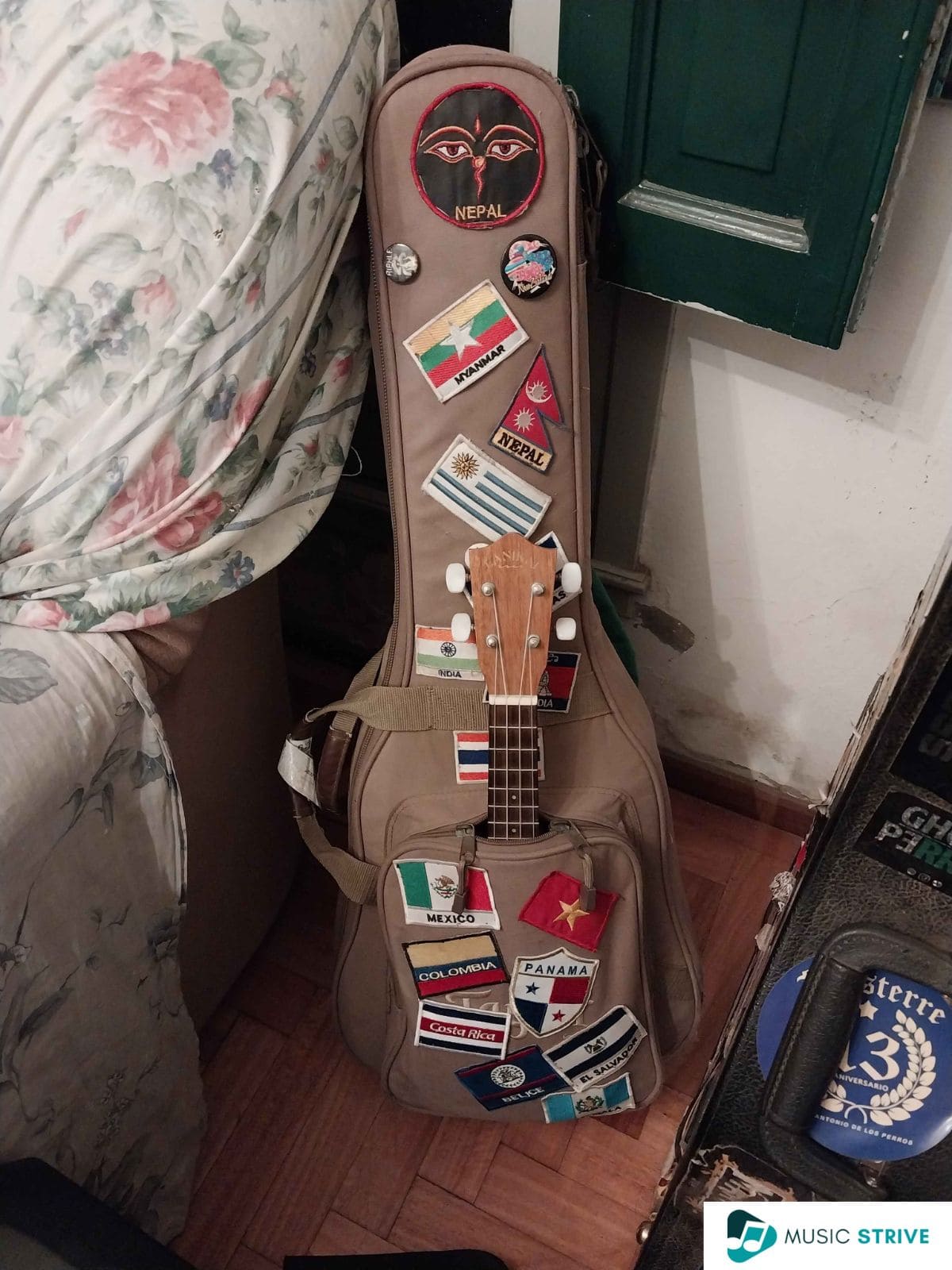
Santiago's road-worn Baby Taylor gig bag often houses more than just the guitar!
Although for players with bigger hands, do keep in mind that it’s not just a short-scale instrument, the body is also smaller too! So it might feel a bit like a toy.
However, this makes it particularly good for young players as they can reach over the smaller body easier with their strumming arm.
Tonally it’s hitting all the marks we love from Taylor. The mahogany top gives it that rich projection as you’d expect, but of course, there is a volume reduction due to the smaller body. But this just makes it even more appropriate for home playing as it’s not as loud.
Now it’s worth noting that this is a very short-scale guitar with a neck length of just 22.75”, this means your string tension is going to be very loose, and if you’re a fan of down tuning you’re going to need to compensate for this by using much thicker strings.

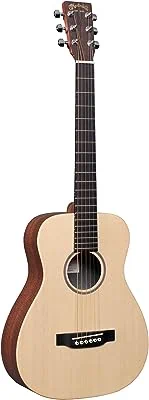
2. Martin LX1 Little Martin
When thinking about top-tier guitar brands, Martin finds itself in the same discussion with Taylor. Martin guitars have an incredible heritage and are considered one of the best acoustic guitar brands around.
The Little Martin can be seen as the Martin counterpart to the Baby Taylor. It aims to hit all the main beats that make the big boy Martins so good, but it’s just been shrunk down in body size, scale length, and price!
Designed primarily as a travel guitar, it also works great as a practice and performance instrument for smaller players, teens, and young learners too.
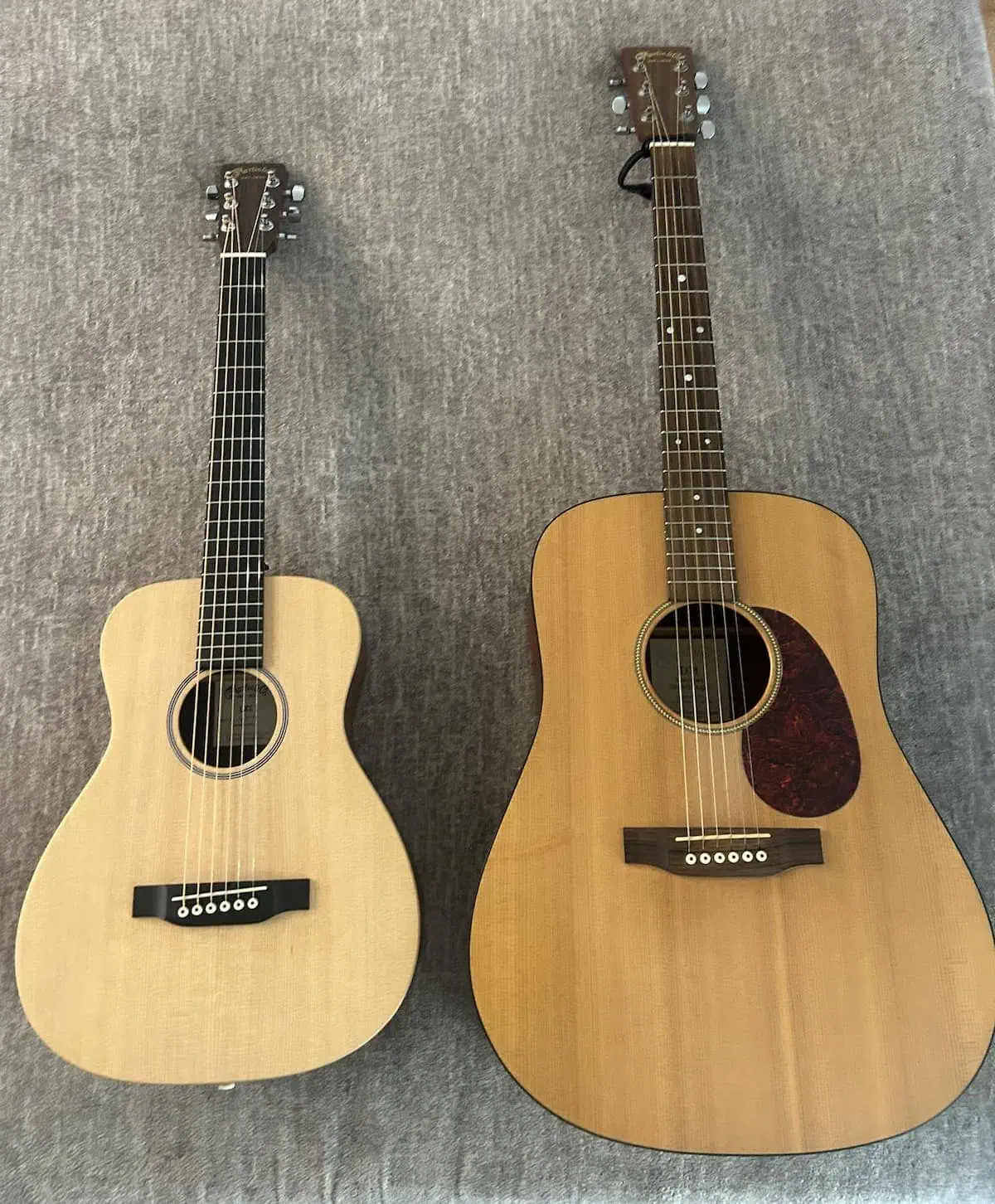
Martin LX1 next to a full-size dreadnought guitar (Martin DM), for reference.
It lends itself particularly well to more inexperienced players thanks to its use of composite materials, such as the Richlite fingerboard and bridge which is extra-resilient to things like temperature changes and high humidity levels. This means there’s less maintenance and stress when it comes to keeping the guitar in good shape, allowing you to just focus on playing and having fun.
One thing I noticed about Martin LX1 Little Martin is that it’s extremely stable, after traveling with it for many hours and through some pretty extreme temperature changes, once I pulled it out of the included gig bag, it was still perfectly in tune and ready to go.
The scale length of this is a little larger than the Taylor at 23”, but it’s still very small and I’d have no concerns about younger players' comfort levels using this guitar.
The tone of the guitar is overall quite bright and vibrant thanks to the solid spruce top. This is then balanced out with a more warm mahogany back and sides which helps to inject a little bass into the sound.
Overall this is one of the best purchases for beginners as it’s so low maintenance and the laminate finish makes it tough to scratch too!
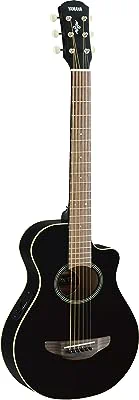
3. Yamaha APXT2
I firmly believe Yamaha is one of the most underrated guitar brands around, they’ve never quite been able to gain the reputation of brands like Martin or Taylor, but they’ve consistently delivered quality instruments with innovative designs and at incredible prices. The Yamaha APXT2 is no exception.
You’ll immediately notice that this guitar doesn’t look like just another short-scale guitar, it’s ultra streamlined with a huge cutaway on the underside to accommodate reaching those higher frets, and deep body and leg cutaways so it fits very snugly against your body.
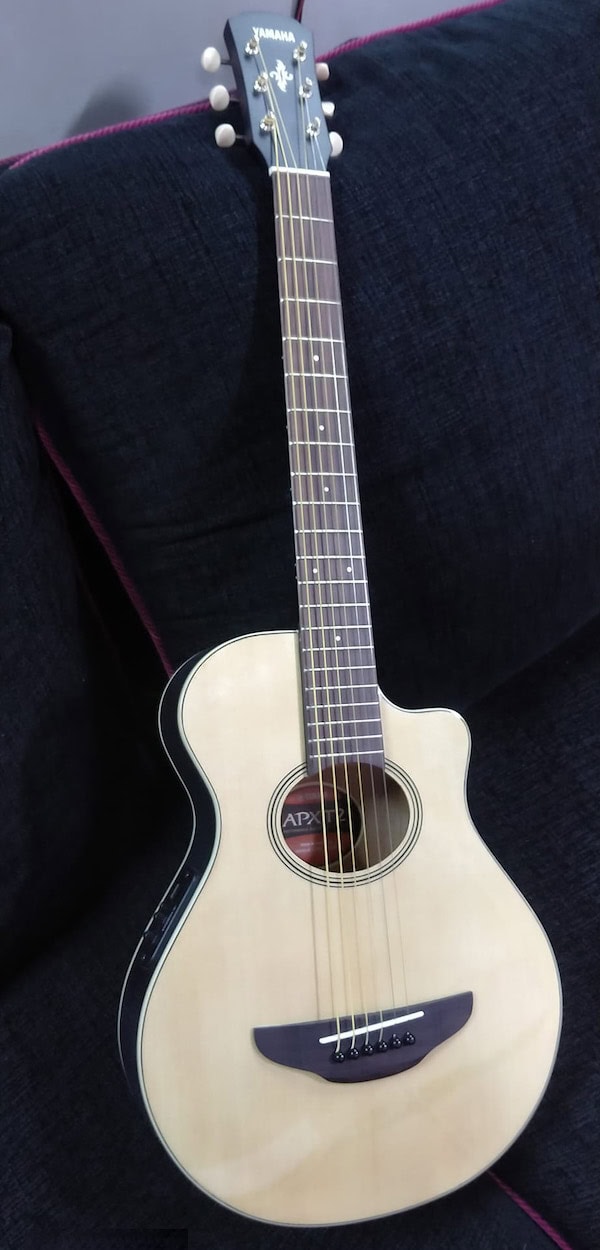
Yamaha APXT2
It’s fundamentally based on Yamaha’s APX500 series and has a bright spruce top which helps with projection due to its smaller body. As to what the back and sides are, it’s an uncommon wood called Meranti. I wasn’t that familiar with it prior to playing this guitar, but it sounded great regardless!
Now one of the main reasons why you’d purchase this over something like the Baby Taylor is due to the onboard System38 electronics system and pickup. This allows you to run this guitar directly into a PA giving it special utility as a performing guitar at larger venues.
Usually, the smaller stature of short-scale guitars makes them too quiet to be realistically used unplugged for performances, but this guitar is perfect to throw in the car and take to a local gig.
The scale length for this instrument is 22.81”, once again making it perfectly adequate for both adults with smaller hands and small child learners.
A couple of things to note is that the glossy black finish tends to show fingerprints particularly easily. While this doesn’t really affect playability, it sure looks unsightly. You’ll need to keep a lint-free cloth nearby and wipe it down regularly!
Additionally, although I didn’t have any real tuning problems the tuners did feel particularly cheap. You may wish to consider upgrading them at some point.
4. Gretsch Jim Dandy Parlor
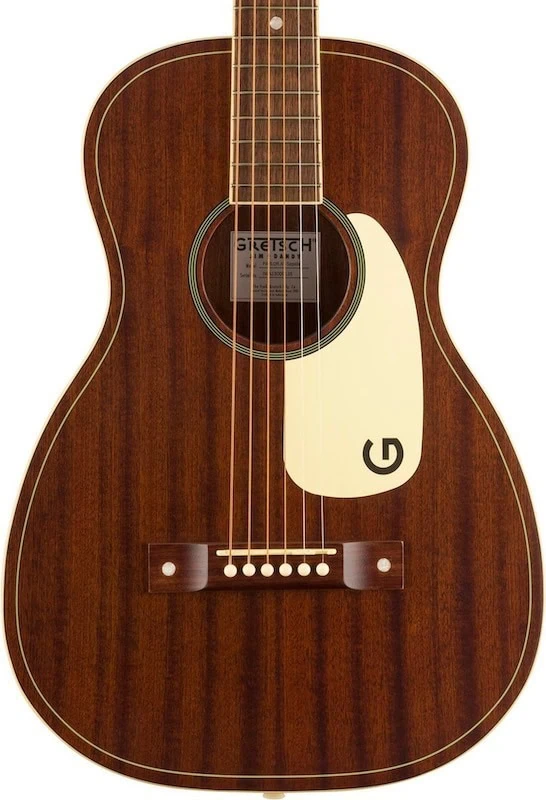
For old-school players who love that classic parlor look of the old Gretsch guitars, this is a dream come true as it unapologetically embraces that 1930s/40s parlor guitar aesthetic.
Everything about the design of the Gretsch Jim Dandy Parlor harkens back to that era. During a time before the widespread use of amplification, where players would perform just using the natural volume of the guitar.
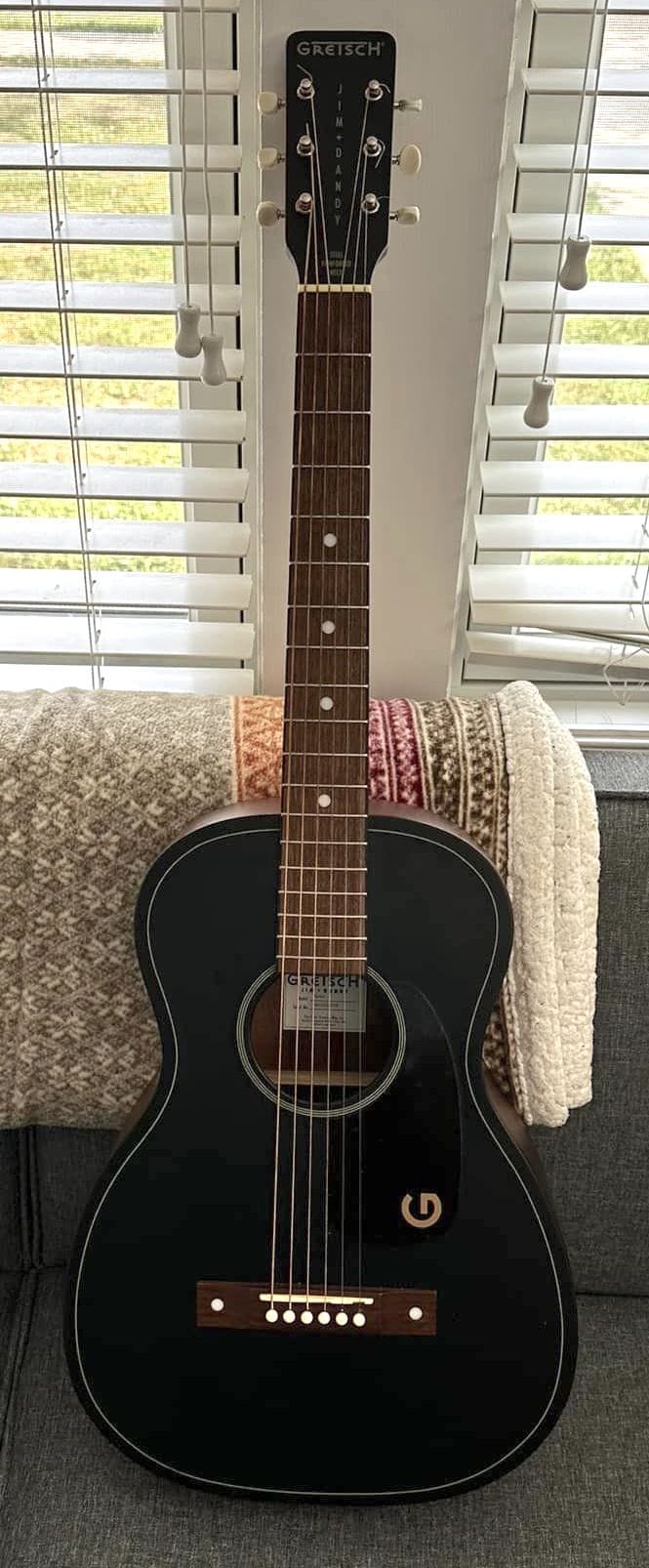
Gretsch Jim Dandy Parlor
So there’s been some interesting design adjustments made to accommodate that philosophy, particularly where the body joins the neck which is all the way down at the 12th fret. This allows for stronger vibration and resonance which increases the overall volume output of the guitar, allowing this rather diminutive instrument to have a very respectable amount of projection.
The downside to this, however, is that there is reduced access to the upper frets. But generally, for the styles of music you commonly play on an instrument like this you’ll just be strumming chords anyway.
You’ll need to assess whether this will be a problem for your needs. They actually market the guitar as a 12-fret instrument so it was never actually intended for you to use those upper frets and they are purely aesthetic.
It has a full basswood top, back, and sides which overall sounds very balanced, and thankfully there’s enough low end to where the increased projection doesn’t make it sound thin or harsh.
As this is technically a parlor guitar and not a 3/4 size acoustic the scale length is a little bit longer at 24”. This is still a noticeable difference over a standard 25.5” scale length, but is perhaps better suited to adults with smaller hands over young learners.
While this is a great instrument that is available for an extremely competitive price, unless you are specifically interested in the styles associated with a guitar like this you may find the lack of upper fret access restrictive.
5. Fender FA-15
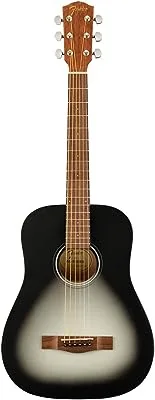
Usually we associate Fender guitars with more expensive, premium instruments. But their 3/4 size acoustic, the FA-15 is surprisingly one of the more budget-friendly instruments on this list.
The first thing you’ll notice is the silver burst finish which gives it a more contemporary look when compared to more traditional-looking instruments such as the Baby Taylor.
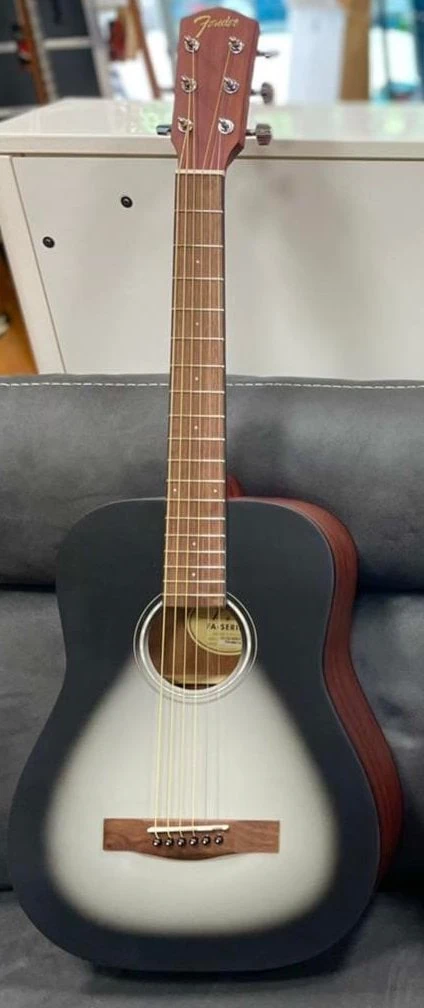
Fender FA-15
And while it is available in 4 different finishes including black, blue, and red, they’re all solid colors, so if you’re into the more natural look you’re unfortunately out of luck here.
The wood choice here is also a little unusual, it has an agathis top with a sapele back and sides. Visually it looks fantastic as the natural look of the sides contrasts wonderfully against the painted top. However, in terms of tonal qualities, it did sound a bit flat and lacking in top-end shimmer.
Because of this, I could consider the Fender FA-15 better suited for practicing at home and less as a performing and recording instrument.
It has a 23.3” scale length which is a nice middle ground to where it could be equally as appropriate for smaller adults as it would be for young children.
As an added bonus it comes with a handy gig bag making it a fantastic travel guitar too.
So if you need a cheap and cheerful small guitar that still carries the real Fender name, this thing is an absolute steal, and you don’t have to worry about being too careful with it as if you accidentally damage it you can simply buy another one as they’re so cheap!
6. Taylor GS Mini Mahogany
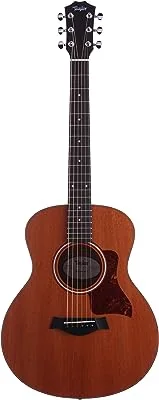
Not to be confused with Taylor’s 3/4 sized counterpart. The GS Mini Mahogany is a regular acoustic guitar, just slightly scaled down.
Fundamentally it’s based on their Grand Symphony acoustic, which has a large body with full projection. Because of the wood choices and construction, it still has all that same richness and fullness to its tone, just as a quieter volume and in a smaller package.
The guitar has a beautiful natural finish that fully embodies the look of the more expensive Taylor models. Particularly the ebony fretboard having the blond streaks running through it looks exceptional.
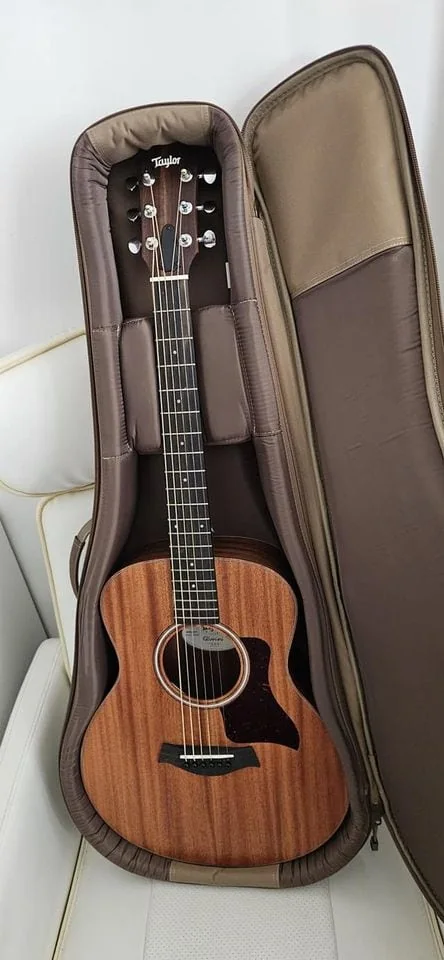
Taylor GS Mini, inside the bundled soft case.
The wood choice here is a typical mahogany top with a laminated Sapele back and sides. While the Sapele does help to even the tone out, that mahogany is where most of the richness and projection is coming from.
Whereas other guitars on this list could be considered just home use guitars or practice instruments, I cannot state strongly enough just how much of a legitimate professional instrument this is, whether you are a frequent performing musician or just need something to sound great at a birthday party, this instrument's always going to deliver.
But what’s beautiful about it is the price and size don’t necessarily make it inappropriate for a learner either.
As this is not a full 3/4 size guitar the scale length is a little bit longer at 23.5”, but this is still significantly shorter than standard scale length and you’ll feel a very noticeable difference in how much easier large chord voicings are to hold.
Props have to be given to the case that comes with this guitar, Taylor really spared no expense when it came to the quality and robustness of the supplied bag! Absolutely fantastic both in terms of quality and how it looks, the embroidered Taylor logo looks exquisite!
Who are Short-Scale Acoustic Guitars Designed for?
Short-scale guitars are widely accessible these days, most guitar brands will have at least a few short-scale models on their roster because there is a notable demographic of guitar players who really prefer short-scale necks.
But who are these people? Why do they like short-scale guitars? And do you think you might fall into this demographic?
To answer this we have to fundamentally understand what happens when a guitar neck is reduced in length and in what ways it affects how the instrument plays.
The first and most obvious thing that happens when a neck’s scale is reduced is that the frets become squished together slightly. This makes big chords easier to hold or large stretches less taxing on the hands. So for players who have smaller hands, they’ll experience less stress and fatigue on their hands, fingers and ligaments.
This makes playing not only more comfortable in the short term but can also protect your wrists and tendons against issues such as repetitive strain injury or even arthritis in the long term too.
The second thing that happens as a byproduct of shortening the neck is that the strings will have less tension on them. This is because when a string is shortened (due to the shorter scale) it will naturally produce a lower pitch at any given tension.
This means a short-scale guitar tuned to E will have less string tension than a regular scale length or baritone guitar. Some people don’t like this and opt to instead compensate by using a thicker string gauge, obviously a thicker string produces a lower pitch at a given tension effectively counteracting the shorter scale length.
But for many players with smaller hands, or more importantly smaller forearms meaning slightly less playing strength and dexterity, that reduction in string tension can make fretting notes that much easier, which increases their playing comfort dramatically.
Ultimately there’s no hard and fast rule with this, but if you’ve ever found yourself struggling to hold chords or noticed your hands tiring too quickly, I highly recommend spending some time with a short-scale guitar, you’ll be surprised how much of a difference it makes!
Which Scale Length is Right for Me?
Ok, so you like the idea of a short-scale neck and what it can offer. The next question to answer is which scale length is going to be right for you.
The first thing to do is establish what exactly short scale means. In the world of guitars, we generally consider standard scale length to mean a neck that is 25.5” in length. Anything longer than that we refer to as a baritone, or extended range instrument, anything shorter than that is considered a short scale instrument.
This rule is generally pretty simple and easy to grasp, however, there is one thing to note and that is that there is a difference between a regular guitar that just happens to have a shorter neck, and a 3/4 sized guitar, which also has the body size reduced.
All 3/4 size guitars are short-scale guitars, but not all short-scale guitars have a 3/4 size body. So this is an important thing to consider when making your buying decision.
There are technically dozens of scale lengths out there, with many luthiers making theirs just a little bit different to be unique. But let’s distill them down to 3 common scale lengths so you can get a ballpark idea of what each offers.
24.9”
While at first glance you might be thinking well this is only 0.6” different from a regular scale guitar, does it really make that much of a difference?
The answer is absolutely yes, there will be a noticeable difference in both string tension and fret distance. So this makes a great choice for those with just below normal-sized hands who are still kind of ok playing a regular guitar but just want something that’s going to give them a bit of an edge.
24”
This is a more extreme shortening of the neck that will be very noticeable. It tends to be a good balance between playability while not affecting the string tension so much that you’d be required to use strings of a different thickness.
This is ideal for those who want to get as close to a regular-sized guitar as possible, still using a full-size body, but are really struggling with fatigue when playing a regular scale-length neck.
23.5”
This scale length is what’s commonly used on 3/4 sized guitars. This means that everything on the guitar has been reduced in size, not just the neck.
These guitars are designed for 2 main demographics, the first being for people who want a small travel guitar they can take with them on flights or throw in the back of the car. The second is younger players including kids and teenagers who have very small hands that have no hope of grasping a full-sized guitar.
You're essentially looking for these when deciding on the best mini acoustic guitar for you.
Don’t Fret the Details
While this all might seem like a lot of factors that you need to take into account when deciding which scale length might be right for you. The reality of making that decision is actually very easy, just head to your local music store and give all these scale lengths a try for yourself and one is sure to jump out as feeling just right for your hand size.
Then you can come back to this article and refer to our suggested instruments to get the best instrument of that scale-length for you.
Short-scale guitars are a real blessing for those of us with smaller hands who deeply desire to play those huge and exotic chord voicings or the big stretches that come with large intervallic arpeggios. I hope you find the information shared in this article helpful and best of luck finding your ideal instrument!

I would stack the Yamaha CSF against any of these in your article. I’ve played most of them and the yama just feels better. Solid spruce top and passive pickup make for a great combo. As far as sound goes, the yama sounded better than the Taylor and the Martin. Too quality gig bag to boot! Just my 2 cents