
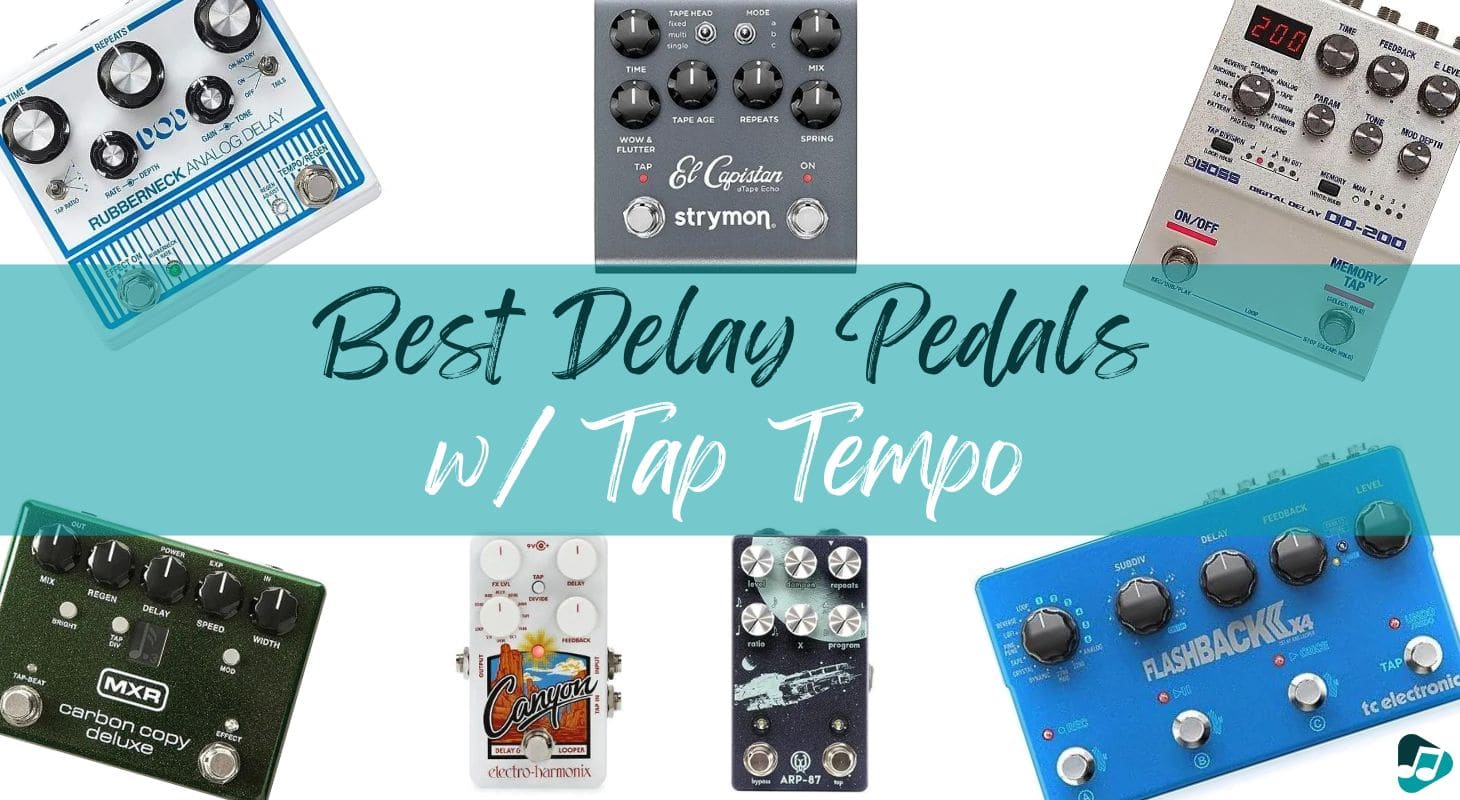
Delay pedals are an entire universe. I don’t mean that figuratively; it’s not just an empty metaphor. I really mean it; delay pedals are a sonic universe that obeys its own rules. The same thing happens with other sonic universes like overdrive pedals or even wah-wah pedals.
Luckily for you, here’s a guitarist that went out on the hunt for the best delay pedal with a tap tempo and came back with a detailed list of seven winners you can choose from.
Don’t go out buying your tap-tempo delay pedal blindly in the vast darkness of the universe, use this article as a guide to make an informed decision and make the most out of every dollar spent.
Top 3 - Tap Tempo Delay Pedals
Preview | Product | Price |
|---|---|---|
 | ||
 | ||
 |
Fasten your seatbelt, put on your helmet, and sit tight because this intergalactic vessel straight to the delay universe departs right now.
Are you in?
7 Best Tap Tempo Delay Pedals that You Can Rely on
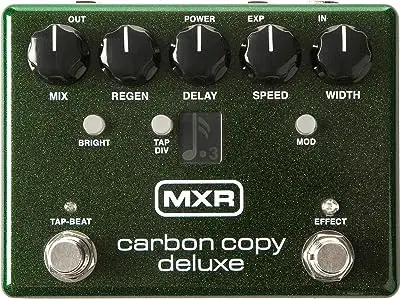
1. MXR M292 Carbon Copy Deluxe
I don’t want to say that I’m a little biased when talking about this pedal, but honestly, in my opinion, the MXR Carbon Copy is the definitive, dark-sounding, self-oscillating, analog delay pedal in the market. Therefore, this Carbon Copy Deluxe ranks even higher in my cool-o-meter.
Perhaps, the only complaint I have about this pedal is that it takes up too much space on my board. Other brands were able to pull off something similar taking up way less real estate than this Carbon Copy Deluxe.
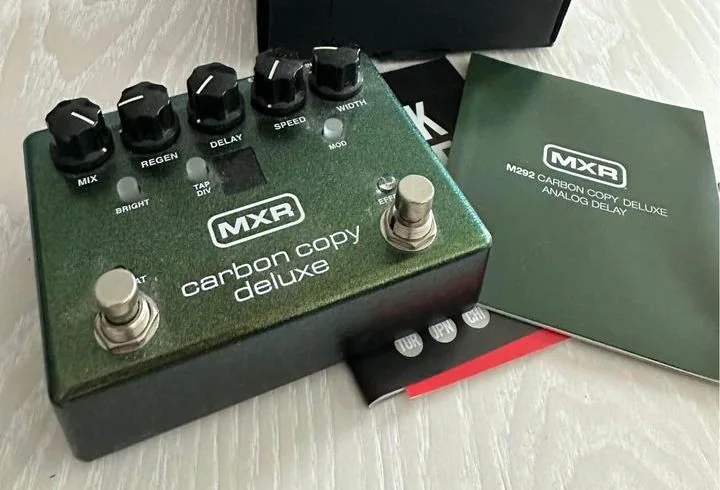
The MXR M292 Carbon Copy Deluxe will occupy quite a bit of space in your pedalboard.
But caveats aside, this pedal isn’t just an overhauling of the classic, it adds much more to the mix. I guess the best example is the external controls for the MOD switch. Finally, that amazing modulation option can be adjusted without taking the whole thing apart.
Also, the TAP divisions are very handy when you know what kind of musical figure you want your feedback to have. In the same vein, the “bright” switch comes handy to brighten up dark guitars.
Believe me, for a player like me who loves his telecaster but has a weakness for bass-oriented ‘70s neck pickups on Gibson Les Pauls, this is a great way to have a consistent tone across the board.
Sound-wise, though, there are absolutely no complaints, it’s just the perfect Carbon Copy sound that can be set to whatever you’re playing easily and on the fly.
Finally, when I tried the expression pedal outlet, I was able to go between presets dialing a slapback delay and a long one with the MOD on and play a cool mashup between Brian Setzer and The Edge.
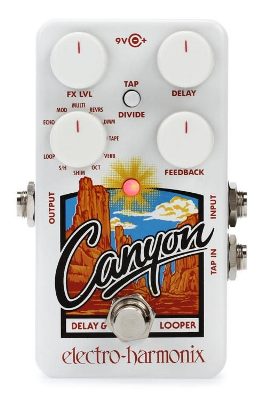
2. Electro-Harmonix Canyon
The Electro Harmonix Canyon is one of those pedals that you think: How did they fit all of that in such a tiny space!? Indeed, this tap-tempo delay pedal takes very little space and offers many options.
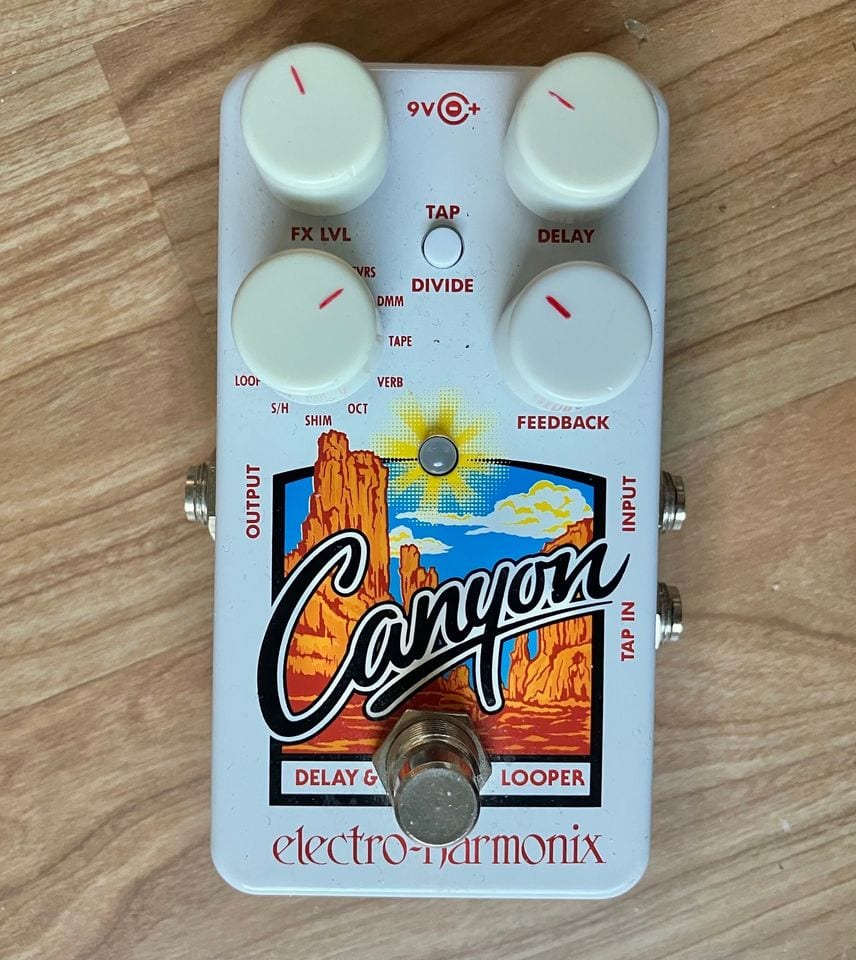
It certainly looks the part, too!
My test started with the “Echo” mode and then I moved clockwise through every setting.
The “Echo”, “Multi” “Mod”, and “Reverse” settings were perfectly accurate. Moreover, I was able to plug in my Strat and do some reverse delay, Hendrix-approved moves.
The “DMM” and “Tape” settings work great emulating analog delay’s flavor and sound. The pedal gets darker, and the delayed sound becomes more organic. I pulled off some bends David Gilmour would be proud of pairing this pedal with a good old Big Muff.
Finally, the “Octave” and “Shimmer” positions were nice ways of adding 3-d qualities to the sound.
The pedal can go onto TAP mode upon the pressing of a little white switch. When you press it, the “Delay” and “Regen” controls turn into other controls since the delay time is controlled with the TAP tempo. The count was super accurate, and I tried moving from one style to the next with flawless results in both fast and slow bpm settings.
On the not-so-good things, and this is a big one on this list, the TAP tempo is a mode and not a separate switch, which makes it more difficult to use when playing live.
For those in search of a tap-tempo controlled, small but packed delay powerhouse, this Canyon Delay is a goldmine.

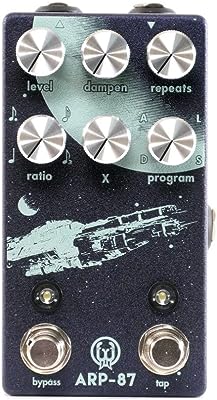
3. Walrus Audio ARP-87
This Walrus Audio ARP-87 is, perhaps, the best example of size not being an obstacle to creating one of the most powerful and versatile delay pedals on this list. Yes, the six knobs and two switches are enough to create a myriad of sounds.
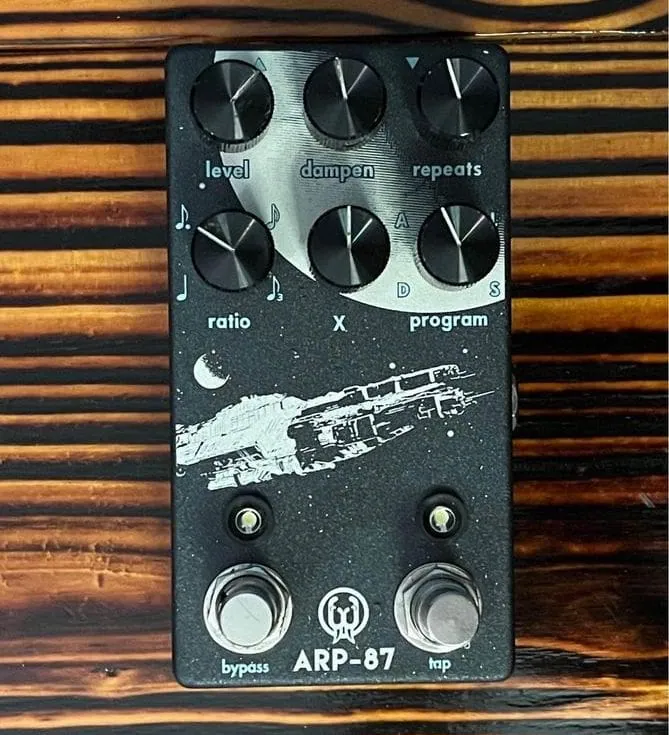
Packs quite a punch!
But let’s get started with the important part: the TAP tempo. Let me tell you that it works flawlessly and can set the delay time to even the craziest times.
Moreover, you can do all sorts of things with the same switch. To begin with, you have a separate switch for the tap tempo function, which is very handy and unexpected on a pedal this size. Speaking of which, let me describe the “momentary functions” that are, in my opinion, a great addition to a good pedal.
- If You Press and hold the “Bypass” Switch:
- With the pedal OFF – It activates the pedal momentarily and fades out as you release the pedal.
- With the pedal ON – It ramps up the “X” control that changes parameters depending on the mode. When you release the switch, it goes back to its original value.
- If you press and hold the “TAP” switch – It ramps up the “Feedback” control to the maximum and returns to its original value.
The bottom row of controls offers the “Program” control that turns the pedal into a digital, analog, lo-fi, or slapback delay. Likewise, on the same row, you can find the “ratio” knob to select the musical figure of the repeats (quarter notes, eighth notes, dotted quarter notes, etc.).
Finally, the top row of controls holds the classic Level, Mix, and Repeats you’ll find on most delay pedals to control the basic functions.
Perhaps the only complaint about this powerhouse is that it’s too crammed to make on-the-fly changes in a live situation. Other than that, there’s very little you can’t do with this pedal.
4. Strymon El Capistan
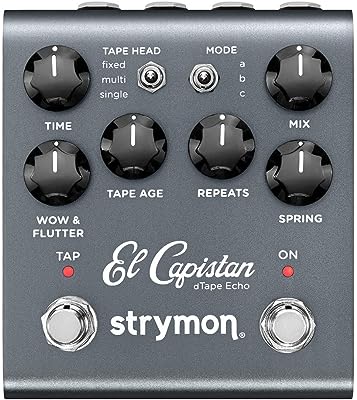
Strymon is one of those brands that has become a synonym for quality, performance, and outstanding tone. Indeed, I haven’t ever played a bad, non-musical, or poorly crafted Strymon product in my life.
But let’s get down to El Capistan, an echo pedal with tap-tempo capabilities. Yes, you read that right, this is a pedal that acts like an ethereal bridge joining two very different times in music history.
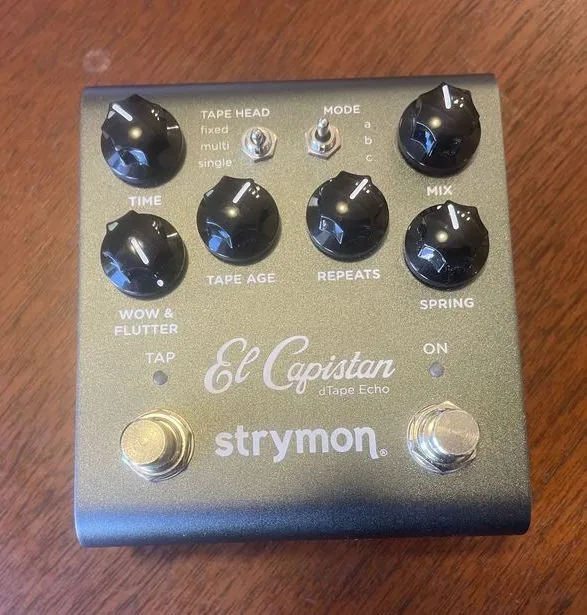
The updated Strymon El Capistan V2.
On one hand, you can dial in a great-sounding tape echo sound with all the grit, dirt, and flutter of those wonderful hippie psychedelic sonic adventures. On the other hand, you’re able to control that with a modern tap-tempo switch and make changes on the fly.
I tried some of my favorite post-punk riffs like the great “Love will tear us apart” and “How soon is now” and the result was impeccable. I even tried slowing and speeding up the sound to see how accurate it remained, and the result was, again, flawless.
My next step was to hook it up to my MIDI-powered rig (hey, I’m an eighties kid!) and it responded perfectly to the clock. Yes, I played my favorite U2 songs through it and it synced perfectly with the rest of the things in my rack. Also, the spring reverb control added some more epic feel to an already huge sound.
To finish my test, I went to the B-side controls of this pedal by engaging both footswitches. This way, I was able to change tape crinkle, tape bias, low-end contour, and a 3dB boost/cut.
I tried my best to get a bad sound out of this pedal, but I couldn’t. Perhaps the only thing that can stop you from choosing it is the price tag.
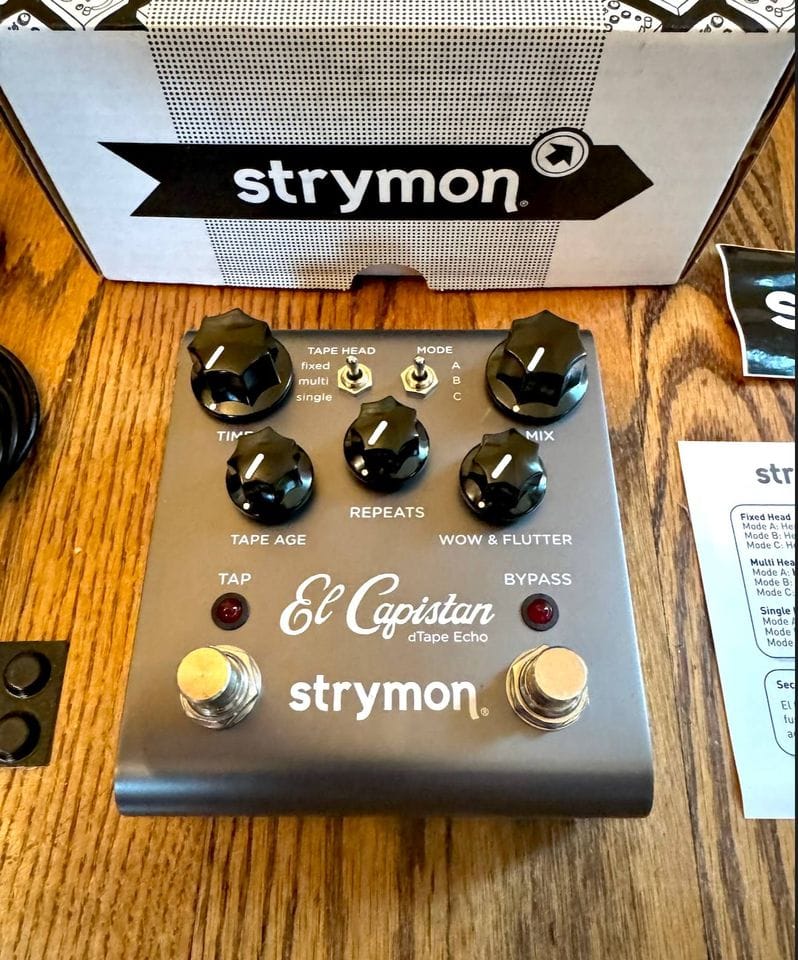
This was the V1 of the same pedal - you can notice the minor differences in the positions of the controls.
5. Boss DD-200
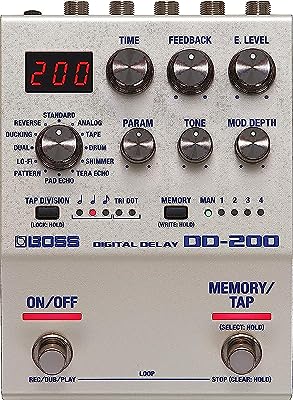
Faithful to its long tradition as a bold innovator, Boss came up with the most powerful pedal on this list.
Moreover, the number of functions the company managed to put into the DD-200 and still keep it slightly bigger than its traditional line, is simply heroic.
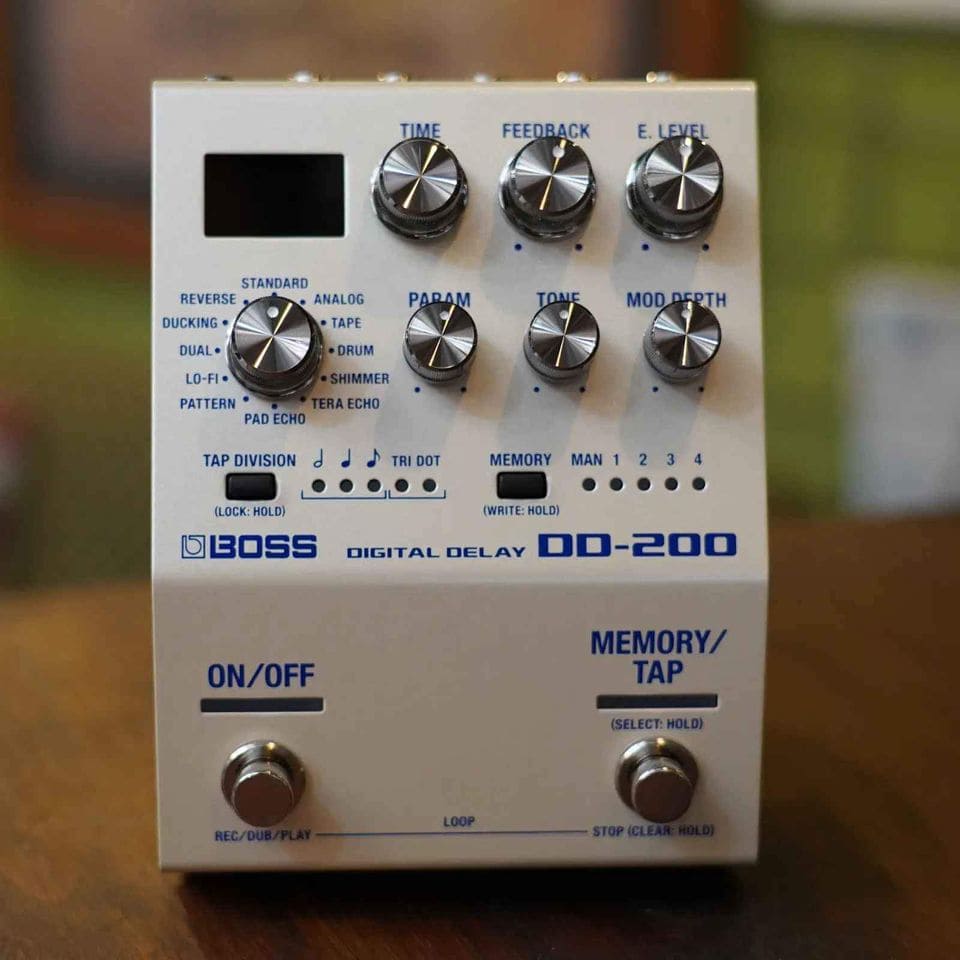
No dearth of power!
Let me start with the only flaw I found, though. If you hit both switches at the same time, you go into “looper” mode and there’s no delay. I was declared “completely guilty” of stomping on both when playing in a live situation, which led to sort of an epic fail on stage. Believe me, it wasn’t fun.
That slight inconvenience is the B-side of this pedal being as compact and portable as a pedal this complex can get (for now).
By complex I mean this powerhouse offers 12 different delay types that can be controlled via six knobs. That alone is a lot of information, but you also have to add the screen and the sliding switches. Believe me, with that combination of controls and 5 programmable user presets, there’s no highway this delay can’t take you on.
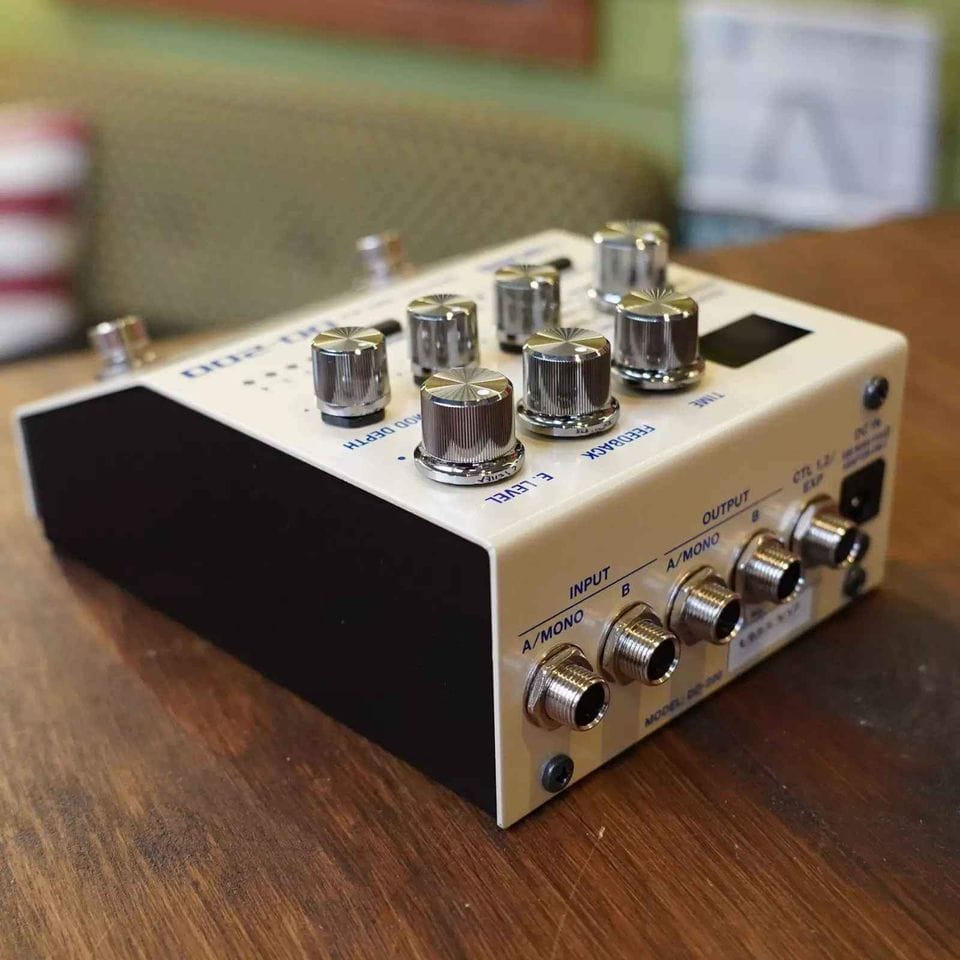
The build quality speaks for itself.
I tried the digital as well as the analog emulations playing some Depeche Mode riffs (Martin Gore is such an underrated guitar player) and the pedal sounds flawless just out of the box. Furthermore, if you play with it long enough you can make it do all kinds of crazy sounds; it’s got a wide palette of sounds to offer.
If you’re looking for simplicity and you’re a set-it-and-forget-it person, this is not a good candidate. If you love tweaking knobs to the infinite, this is a must-try-before-you-buy.
6. DOD Rubberneck

This was one of those “you had me at hello” moments in my musical career. Indeed, it’s very hard to not love the retro vibe this pedal oozes without even plugging it. But, the DOD Rubberneck is much more than just a pretty carcass.
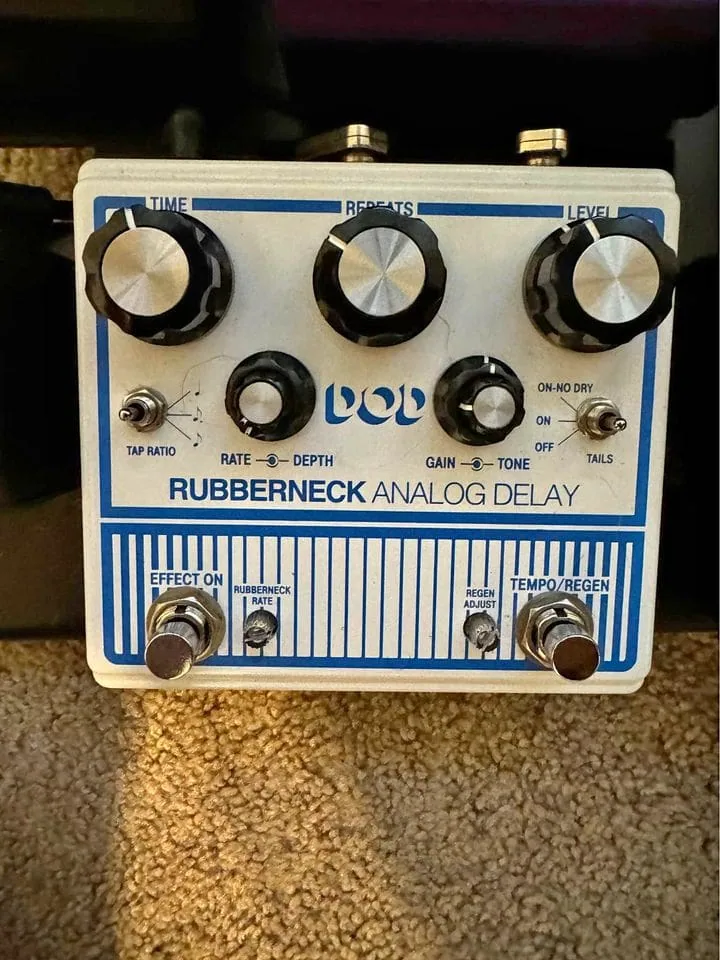
It impressed me during the brief time I had it to play around with.
To begin with, you have so many options at hand, it can take you a full week to go through all the features. I wasn’t so lucky since I only had a few hours alone with my unit. Nevertheless, I was able to get great tones out of it. The only caveat I have to address is that it is a high-consumption pedal, and if you don’t plug it into a supply that can handle it, you will think that the pedal is broken or malfunctioning.
After saying that, I have to say I was blown away by the audio quality of this dark-sounding, warm analog delay unit. Moreover, it offers 1.5 seconds of delay, which is a lot for an analog delay pedal (regular Carbon Copy offers 600 milliseconds, and the Deluxe version, 1.2 seconds).
You can use the tap function to change the delay’s time but you can also choose the tap ratio between dotted and regular eight notes, and quarter notes.
Also, next to each of the switches there’s a small LED/knob that allows you to adjust the famous rubberneck effect (stretching the delay to make swooshes or ramp-ups). The tap switch can also be used as a momentary feedback generator as you leave it pressed.
Finally, I was really impressed by the way the “Gain” and “Tone” knobs worked by adding more life to the dark tones of my Les Paul and taming the twang of my Telecaster. Oh, and I even plugged my modulating effect boxes through the pedal’s effects loop which enhances the apparatus’ options drastically by applying those effects to the delayed signal only.
If you’re in search of a complex, great-sounding pedal, this DOD might be it. If you want something simpler and more compact, then you should look somewhere else.
7. TC Electronic Flashback 2 X4
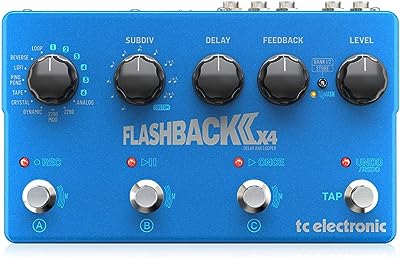
TC Electronic is a brand that’s always pushing the frontiers of what’s possible in the pedal world with its innovative creations. This Flashback 2 X4 is no exception to that rule.
To begin with, the tap tempo feature with a dedicated switch is perfect for on-the-fly tempo changes and the subdivision knob offers 10 set parameters and the ability to create one of your own. In other words, the tap tempo for this pedal can offer you a myriad of usable, musical results with a single rotary knob.
Also, there are 16 different options to choose from on the delay type and function knob, making this one of the most versatile delay pedals on the market today.
Furthermore, adding to that, the onboard features, the Tone Print capabilities, and the ability to download presets from the app make this, virtually, a pedal with endless possibilities.
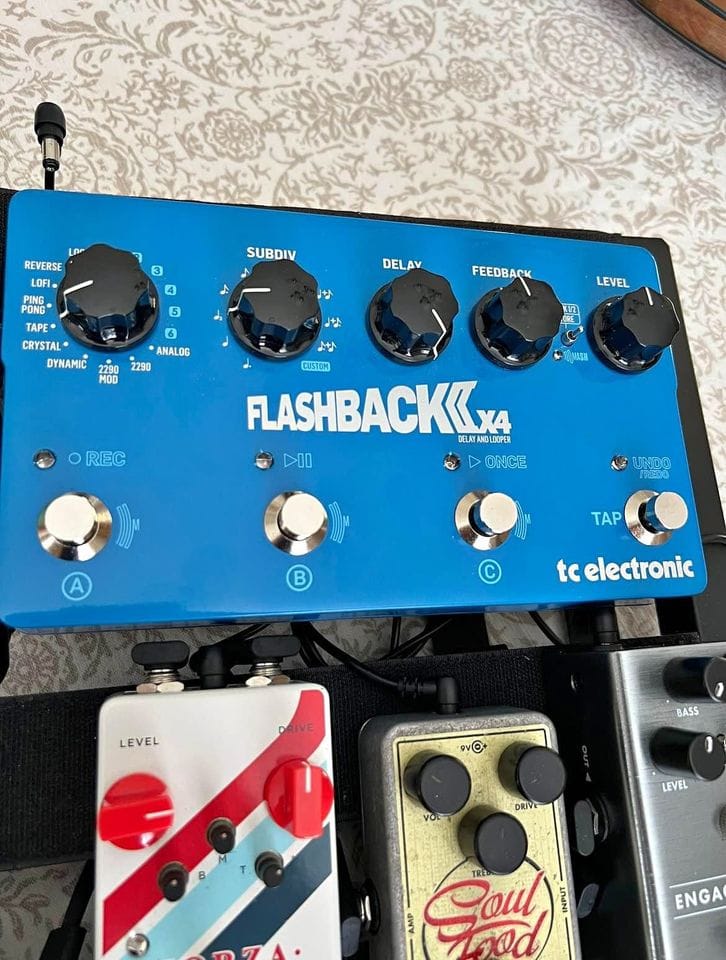
TC Electronic Flashback 2 X4 - a part of my pedalboard
There, I think is the pedal’s only flaw: it’s a big, complicated unit ideal for those who want to go above and beyond with their delay (ab)use. Otherwise, the number of options is overwhelming, to say the least. I say this because it was one of the few and rare occasions, I had to go to the user’s guide to learn how to maneuver this starship.
If you want a simple tap-tempo delay to set and forget, you might be better off with another unit. On the contrary, if you’re after more flexibility, functionalities, and options, this is the pedal for you.
This is a question I get a lot because I swear by my tap tempo delays and am willing to pay the extra price for it, but I know some skeptical players too. Let me give you my three reasons why you should get a tap tempo delay.
- On-the-fly adjustments – If you’re a player who enjoys playing live and jamming with friends, you’ll know that making on-the-fly adjustments on your delay pedal usually requires bending down or entering a complicated menu and reading a screen. Well, tap tempo delays can solve that. Hey, it even looks cool when you measure the beat live!
- More accurate measurements – Setting delay time by turning a knob while you’re not playing is Mission: Impossible. Trying to magically set the tempo right but playing while doing it with your foot is usually better, more accurate, and more reliable.
- One delay to play them all – Instead of bringing multiple delays to the gig on your bigger-than-Jesus pedalboard, you can just have a tap tempo delay and dial in the required bpm per song. Just like in Lord of the Rings: one delay pedal to play them all!
Digital or Analog?
This is another common question that arises not only when talking about tap tempo delays but delays in general. Let’s see the pros and cons of both approaches so you can make an informed decision about what suits your playing and needs the most.
Analog Delay
PROS:
- Warmer and darker tone with a natural, organic feel.
- Sound changes with the repeats, degrading naturally.
- Retains the signal quality of your analog instrument.
CONS:
- Reduced delay times.
- Not crystal-clear or perfect.
- Different units might sound different between them.
Digital Delay
PROS:
- The reproduction of the original signal is always perfect (no degradation or coloration).
- Longer delay times can be achieved.
- Precise delays with surgically correct delay times.
CONS:
- Digital delay pedals can sound sterile and lifeless.
- No natural degradation, coloration, or organic elements in your guitar sound.
Is Tap Tempo More Common on Digital Units?
The answer to the question above is “Yes, definitely”. This is, in my opinion, because of two main reasons:
- The tap tempo function is usually something sought after by players who like the complexity, multiple functionalities, and sound palette of digital delay pedals. Therefore, manufacturers of such pedals tend to add tap tempo to those units.
- Most analog delay pedals are either reissues of classics or spins on classic circuits that are aimed mostly at purists and tone lovers who think dark, slightly off-tempo, organic, degrading repeats are the thing. There are some exceptions to this rule, but most analog delay pedals focus on tone rather than features.
Combo Effects Pedals
Besides buying a great pedal with a tap-tempo function, what other effects can be included as a combo with the tap-tempo delay? Well, let’s look at the most common three:
- Reverb – Reverb engages the epic factor, and when mixed with a lush, beautifully dark, analog delay the epic factor of your playing can hit Beyoncé proportions. A good example of this feature is the Strymon El Capistan.
- Modulation – Modulation is commonly found in delay pedals nowadays. Yes, either with controls inside the box or in the shape of knobs, adding a little movement to the delayed signal is always a plus. A great example is the Carbon Copy Deluxe.
- Pitch Shifting – Finally, it’s not so common to find delay pedals with pitch-shifting capabilities, but some of them include pitch effects in their scheme. A great example is the DOD Rubberneck that allows you to slightly change pitch as you engage the momentary effects holding down either switch.
The Bottomline
Tap tempo delays have been making my life easier for many years. Although I still swear by my ‘70s Memory Man and my Carbon Copy, when I’m out with a live band, I’ll always carry my tap tempo delay pedal; you’ll never know when you might need to re-set your delay time to match the drummer’s mood!
Happy playing-ing-ing-ing-ing-ing!
