
When you think of a Telecaster, the first genres that come to mind are probably, country, blues, and rock.
Metal would probably be the last genre anyone associates with a Tele.
Top 3 - Telecasters with Humbuckers
Perhaps, the twang, midrange, and uncanny brightness of a Tele’s bridge pickup are hard to tame when you put on some distortion to the signal.
Well, one thing is an unavoidable truth, a long time has gone by since this guitar started making history.
Indeed, during the past seven decades many things happened to this iconic guitar that made it more versatile and helped it cover more sonic ground. Part of that was the ‘70s and its grandiloquence; a decade marked by the “bigger is better” motto.
That’s how we arrived to the 21st century, with more Telecaster models to choose from than ever before in history. In this piece, we chose the best humbucker-equipped Telecasters in the market right now.
Yes, in an overwhelming ocean of products, I dove deep and found the pearls you need to consider. I had the tough task of trying out a bunch of Telecasters and picking the best. Well, don’t look at me like that, it’s tough work but someone has to do it, right?
Jokes aside, there are no rules that say you can’t play hard rock and metal on a Telecaster. In fact, here are a few of the best Teles and Tele-style guitars specifically for playing heavy rock and metal.
Swearing by the spirit of John 5 and Ritchie Kotzen, here are the best Telecasters with humbuckers you can buy today.
Best Telecasters with Humbuckers for Metal & Rock
1. Fender Jim Root Signature Tele
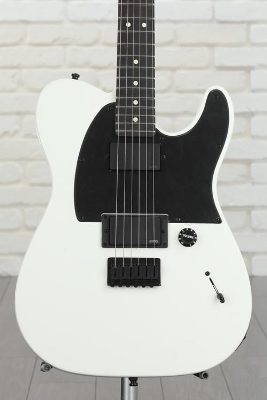
Fender Telecasters aren’t normally associated with metal. Jim Root of Slipknot thinks differently and this guitar with his name on it has proven that Fenders are more than capable of playing heavy music.
To say it in one line, this guitar is absolute fire to play metal. Yes, Root’s signature Telecaster is not just a great Fender, but a fantastic guitar for metal. It is a do-it-all kind of axe but shines with distortion. With lots of it.
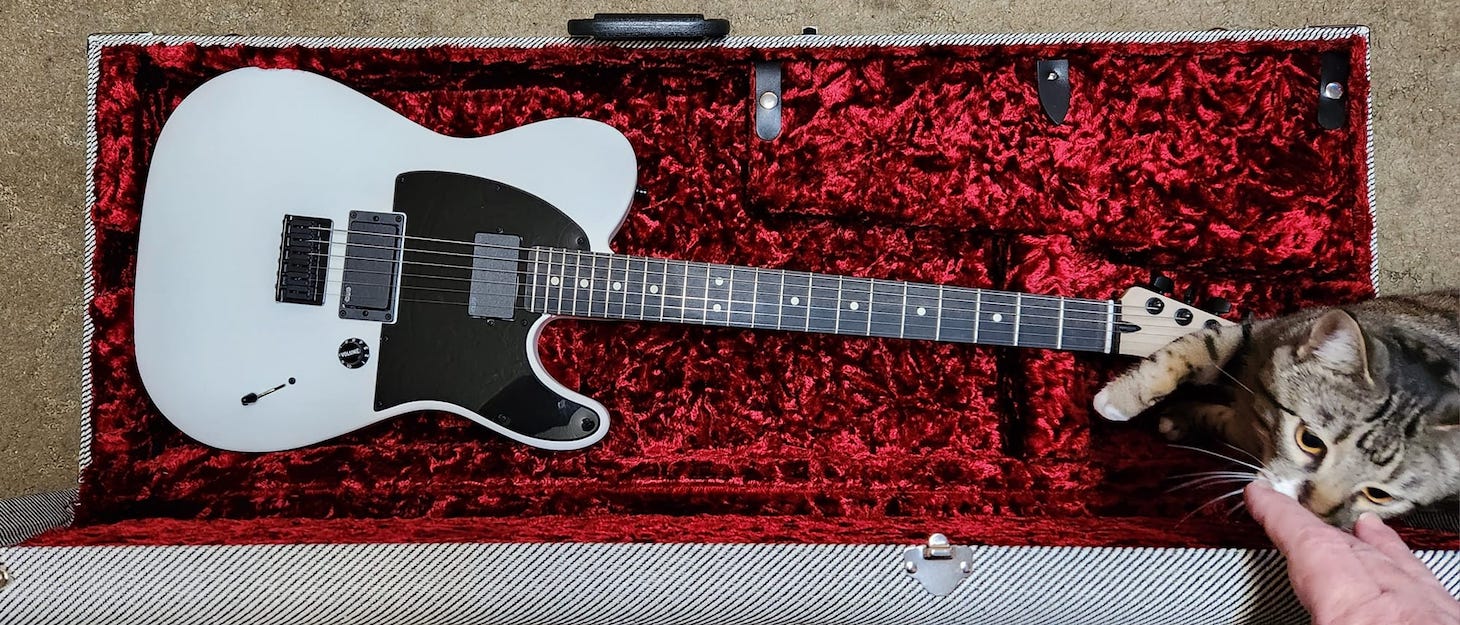
Fender Jim Root Signature Tele (cat approved!)
Let me also tell you that this guitar is one of those strange cases you have to look down again to verify you’re playing a Telecaster because from the amp you hear something coming from a Les Paul or a super strat.
This guitar can unleash hell while being familiar for anyone who has played a Tele.
One of the tricks Fender used to make this a metal-friendly guitar is to replace the alder body with mahogany. This bottom-heavy tonewood is what gives this Telecaster the beefy sound; it can really chug. Speaking of which, what better song to soothe my Nü Metal soul than playing Deftones’ “Bored” with it.
But that’s not all, because I did go for some classic metal and played Black Sabbath’s “Paranoid”.
Mark my words, this Tele packs some serious chugging capabilities. It sounds loud, proud, heavy, and mean.
At its heart of this guitar is its active circuit. You can just feel the pickups pushing you forward like a freight train. I’m talking about the EMG 60 and 81 pickups. They turn this Telecaster into a completely different guitar.
These pickups give the guitar a very thick, heavily distorted sound. As it happens with EMG pickups they are also quite tight to keep that dirt behind your guitar’s character. They sound distortedly clean if that makes any sense at all.
Notes don’t bleed into each other, and chords sound full and clear. You can riff your way to paradise on board this Telecaster. Plus, that combination of the maple neck and the ebony fretboard is just razor-sharp. You can cut the mix and, if you’re not careful, you can cut the clothing of the people on the first row!
Furthermore, I went into shredding mode and the clarity of the pickups mixed with the 12” radius and the aforementioned edge pushed me into a territory not even I knew I could go. The frets are high and the neck is fast; I even tried some tapping on it.
I even liked the clean tone of these pickups, something I can’t always say about EMGs. The cleans are crisp, clear, and vibrant. Perfect for the quiet Slipknot acoustic song “Snuff”. I also tried to play some The Cure with a bit of delay and chorus and the result was beautiful.
In this setting, I tried the rest of the pickup combinations and the one thing I wished this guitar had was a tone control to have that beautiful no-tone neck pickup sound to play complex chords. That would have added more versatility to this killer Tele.
I appreciate that Fender has put locking tuners on this guitar. This helps to keep your strings in tune during aggressive playing. Locking tuners aren’t usually standard on Fenders, but are needed on a metal-focused guitar.
I had lots of fun trying out this one as you can see above. It’s a fun, great-playing, great-sounding metal axe. I would dust off my white sneakers and tight black jeans to play it on stage. With a guitar like this, you just HAVE to, you know?

2. Fender Special Edition Custom Tele
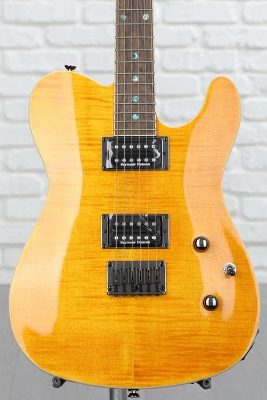
The Fender Special Edition Custom is quite a unique instrument. I would easily call it the least Telecaster-like Tele on this list.
Right off the bat, this guitar looks less like a Fender Tele and more like a Tele-shaped guitar made by PRS. I do mean this, this Telecaster is almost identical to the PRS recipe, except for the scale, which is still 25 ½”.
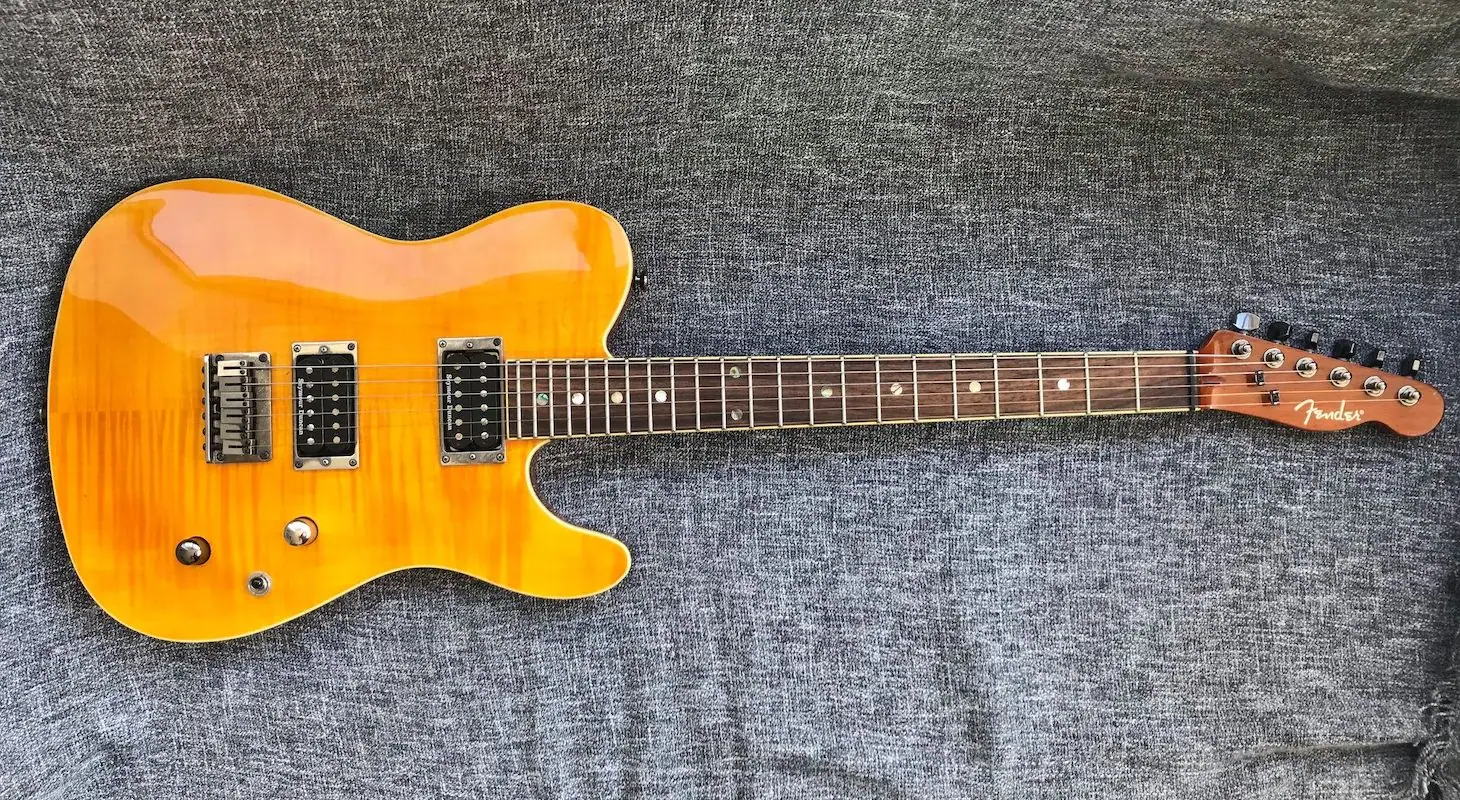
Fender Special Edition Custom Telecaster FMT HH in Amber.
To begin with, it comes with a mahogany body. It’s way thinner than you would find on a Custom 24 but it’s a mahogany body with a “flame” carved maple top (more on this later). Again, just what Paul did with his guitars. Yet, instead of going after the shape of the almighty Tele, he shaped his guitars like Strats and added a tremolo system.
This guitar also features binding on the body, a hardtail, six-saddle string-through-body bridge, and a pair of almighty Seymour Duncan humbuckers. These are a Pearly Gates at the bridge and a ‘59 at the neck.
Speaking of neck, this guitar is a set-neck design with a very comfortable pocket that’s as ergonomic as it gets. Moreover, here I would say this is better than what Paul did with his guitars. But back to the neck, it’s a mahogany neck with an Indian laurel fretboard featuring binding and beautiful abalone dot inlays.
The headstock is fully Telecaster and the guitar comes with master volume, master tone, a 3-way switch, and a handy coil tap to nail those purely Fender Telecaster tones. I have to say I love the 3-way switch next to the knobs because, when it’s on top as the Les Paul and the ‘72 Tele Deluxe, I just keep hitting it all the time with the pick.
Also, it doesn’t come in any of the standard Tele finishes and its control layout is completely different. Gone is the plate for the knobs, they are mounted right on top of the wood.
The pickguard is also gone.
If it weren’t for the shape of the body and the Fender logo on the headstock, I wouldn’t even have thought this was a Fender Tele.
The Special Edition also doesn’t feel quite the same as a Tele. The body-and-neck joint feels very differently from what a Telecaster is. Don’t get me wrong, it’s more comfortable, but very different. Another very welcome feature is the body contour. This means that the back of the body is slightly curved, like a PRS, the American Professional, and the Ultra lines by Fender.
The guitar sits nice and firm against your body.
The neck is also quite smooth and fast, and I had a great time playing on it. Being an all-life Telecaster player, I have to say with some grief that the spank, the twang, and the upper mids that make the Telecaster an uncanny instrument are gone. Moreover, this guitar is, by no means, close to the percussiveness of a traditional Tele.
Yes, even with the single-coil activated (more on this later) and the body being so thin and weightless, it bites more than it cuts.
But wait because this isn’t bad news. What it lacks in traditional tele tone this guitar makes up for in versatility and rocking sounds. There’s a natural growl coming from the neck and the body being made of mahogany that adds to the equation.
Where a Telecaster having a maple neck and an alder body snaps and twangs, this guitar growls and bites.
That said, the coil tap adds three more sounds to an already versatile guitar. I tried some The Cult on it, “She Sells Sanctuary” to be more precise and it performed great. The note by note and the chugging were cool and usable. I also tried some blues on the neck pickup and Santana would be proud of his little apprentice here. Sustain was remarkable.
The tone with the pickup selector in the middle was powerful enough for grunge but clear enough for open chords (ready for the upcoming tour, Noel). The three remaining positions were amazing in their own right. I played Hendrix, Rolling Stones, and Lenny Kravitz on it and it was all very good.
Killing the tone knob and going for the neck pickup gave me some Alan Holdsworth to play with. The mild overdrive was great and the midrange tight. Those Seymour Duncan pickups add a lot to this guitar’s sound.
I also loved the neck, it feels smooth and helps you take some chances because it’s fast, too.
Look and feel aren’t the only places this guitar differs from your standard Tele.
The Special Edition also doesn’t really sound anything like a Tele. It’s much warmer and fuller than what you would normally find on a Tele. It has more of a rounded, modern sound than the twangy, vintage sound of other Teles.
The one thing that I found that was kind of a bummer was that the 3D-like flamed maple top is really a veneer. Other than that, this is a great guitar showing how good Fender Asia is working lately and that can help you cover a lot of sonic ground using one guitar.
3. Charvel Pro-Mod So-Cal Style 2
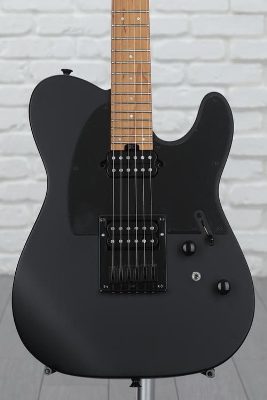
Charvel makes some really outstanding Tele style guitars. The Pro-Mod So-Cal Style 2 might just be their best.
It features everything that I love about the Telecaster sound but it adds some metal-oriented and modern specs; it’s just amazing.
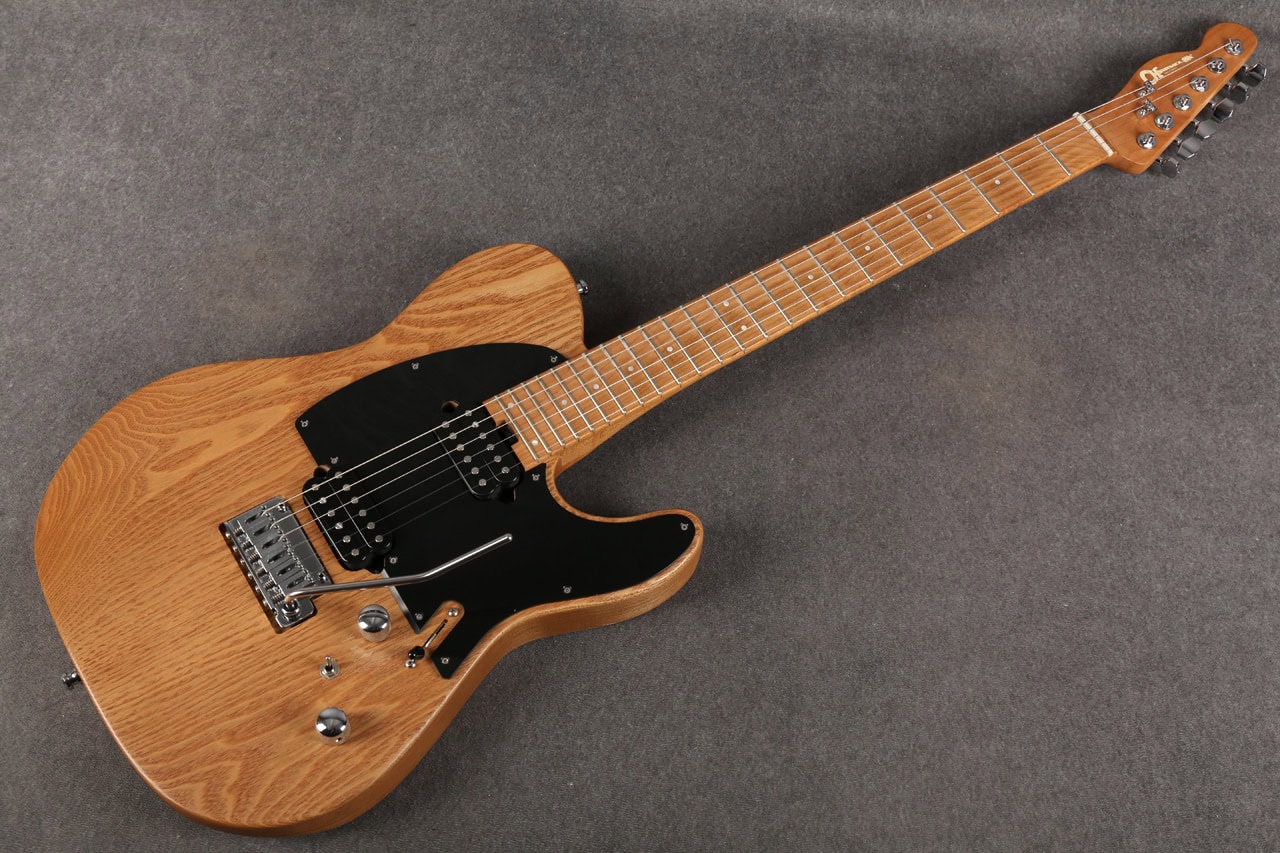
To begin with, the company went with alder for the body and caramelized maple for the neck which gives it that uncanny tele snap. Adding to that, the metal bridge over which the humbucker is mounted is also string-through-body with ferrules and all.
Charvel Pro-Mod So-Cal Style 2
Speaking of the guitar’s body, the contours are vertiginous and the access to the upper frets is Ibanez-like easy. Yes, this is a guitar that’s so ergonomic that makes you feel you’re playing something brought from the future. In the same vein, the matte finish and black pickguard and hardware add to the futuristic vibe.
The knobs, a master volume and a master tone, are placed more like you’d find on a Super Strat, one above the other. This guitar also comes with a 3-way switch, the tone knob doubles as a coil tap and there’s a second 3-way switch for the voicings of the Fishman Fluence pickups.
If it wouldn’t nose dive (a bummer, I know) I would say that the design is flawless.
Moving on to the neck, I have to say there’s a good reason why Charvel calls it Speed Neck. The hand-rubbed satin urethane on the back of the caramel maple and the smoothly rolled edges push you forward.
For me, it was inviting enough to play tunes by Muse. I tried all those crushing distorted riffs and the result was powerful and tight. It had that midrange I love so much about teles but the voicings of these powerful pickups turned this Tele into a chugging machine ready to end the world as we know it.
Furthermore, this guitar plays as well as it sounds. I tried all the pickup configurations and everything from Muse to John Scoffield, Bruce Springsteen, Rolling Stones, and even some Khruangbin with some generous reverb for more fun, and it was a great playing session.
The three voices of the pickups are very distinct and usable. I loved the modern mode the best. The single-coil mode that the coil tap takes you to makes quite a believable traditional tele sound. The snap is there and the twang too.
I can’t think of a sound I couldn’t get with this guitar Telecaster.
This guitar really lives up to the ‘Pro-Mod’ in its name. You can shape the tone almost any way you want through the 3-way pickup selector and three different voicings.
This gives you a wide variety of different tones to choose from. You can set up the perfect tone for fat, chunky metal riffs, then switch to a blistering lead tone with the flick of a switch. Likewise, you can go to a jazzy tone with the tone knob all the way off or a traditional Tele tone with the single-coil mode in the bridge position.
In other words, fat, warm, and aggressive distortion is accompanied by crisp, sweet cleans.
The Pro-Mod is a very comfortable guitar to play. The body has all the right contours to make the guitar sit snug against your body, your arm rest while picking, and make reaching the high notes a breeze.
Charvel has also added a few conveniences to the guitar that I liked quite a bit. You know how it is, the devil’s in the details. Therefore, little things like that the batteries for the active pickups are easily swapped out at the back without the need to unscrew anything.
Or details like the cable jack at the back of the guitar really make a difference.
This is a great version of the Telecaster and a great jack of all trades to be your main or your only guitar.
4. Sire Larry Carlton T7 FM
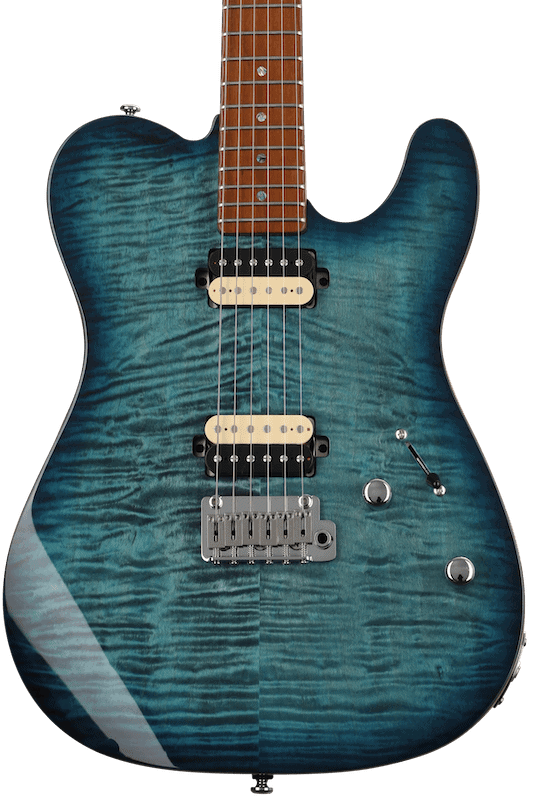
Sire guitars have been causing Tsunami-high waves in the musical instruments world. Yes, with a combination of great specs and impeccable craftsmanship they made a reputation for being affordable and playing great.
Well, spoiler alert, everything you heard about Sire guitars is totally true.
Sire Larry Carlton T7 FM
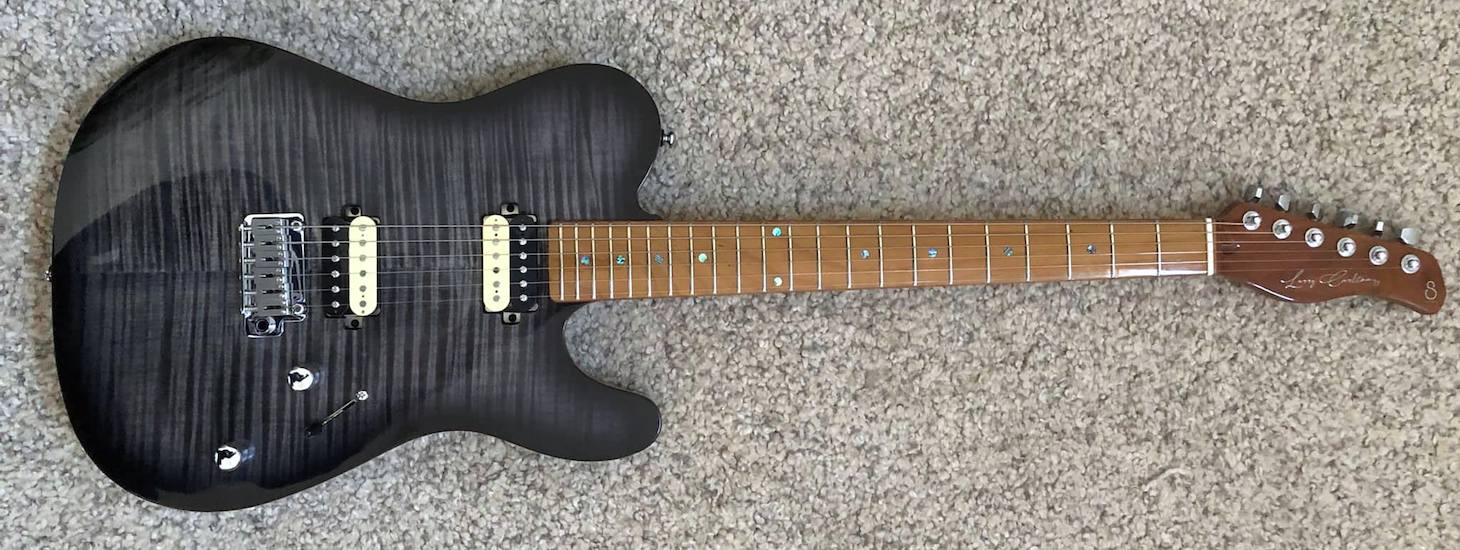
To begin with, the body of this Sire Larry Carlton T7 FM is made of alder which gives it the quintessential mid-infused tele tone to the guitar. Although it also sports a flame maple top veneer, the midrange is right there where you need it.
Attached with four bolts you’ll find a great-sounding roasted maple neck with rolled edges and 22 medium-jumbo frets that’s a joy to play. Seriously, it feels buttery because of the smoothness of the rolled edges and the finish on its back. It’s a neck you could definitely play for hours (I know I did).
The addition of the tremolo bridge is polemic (more on this in a second) but it’s very well complemented by the locking tuners. You can play it ‘80s-style and still play in tune.
Finally, the chrome plated knobs and the 5-way switch add to the whole Super Strat vibe.
Sound-wise, the zebra pickups, the company’s own Sire LC Super-M, are moderate but fierce. I would say that partly because of the wood combination and partly because of the gain from the pickups, if you step on enough gain steps, you can drive this guitar to hell and back.
Moreover, the 5-way switch helps the coil-tapping without any push/pull knob or overthinking your moves. Plus, in my opinion, the tones coming from position 2 and 4 were very usable for stuff like rock and roll or bluesy, dirty, broken tones.
One thing I have to mention is that there’s a noticeable volume drop in those positions when compared to the full humbucker sound. Sometimes, that helps the parts and the song, sometimes it doesn’t.
I particularly liked the aggressiveness when riffing on that bridge pickup. Things got really nasty and menacing. What I missed was the string-through-body feeling. It’s not something easy to explain to those who don’t play Telecasters, but the tremolo bridge, in my opinion, takes something away from the guitar’s feel and tone.
That spanky, rhythmic, percussive thing that helps the overall twang and razor-sharp midrange is just not there. It’s replaced by the sweetness of vibrato-equipped guitars. I love doing those swells and coming up to the note like in “Wicked Game” by Chris Isaak.
Although it doesn’t fall so close from your usual Telecaster and is heavily mixed with a Super Strat, this is a terrific quality I hadn’t seen in this price range in quite a while. Beware, world, Sire Guitars are coming strong!
5. ESP LTD TE-1000
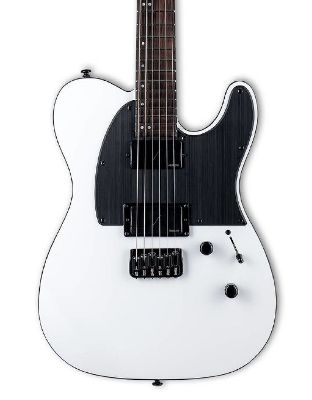
If you are looking for a guitar that can do metal, then ESP is one of the best brands around. And if you are looking for a Tele style metal guitar, look no further than the LTD TE-1000.
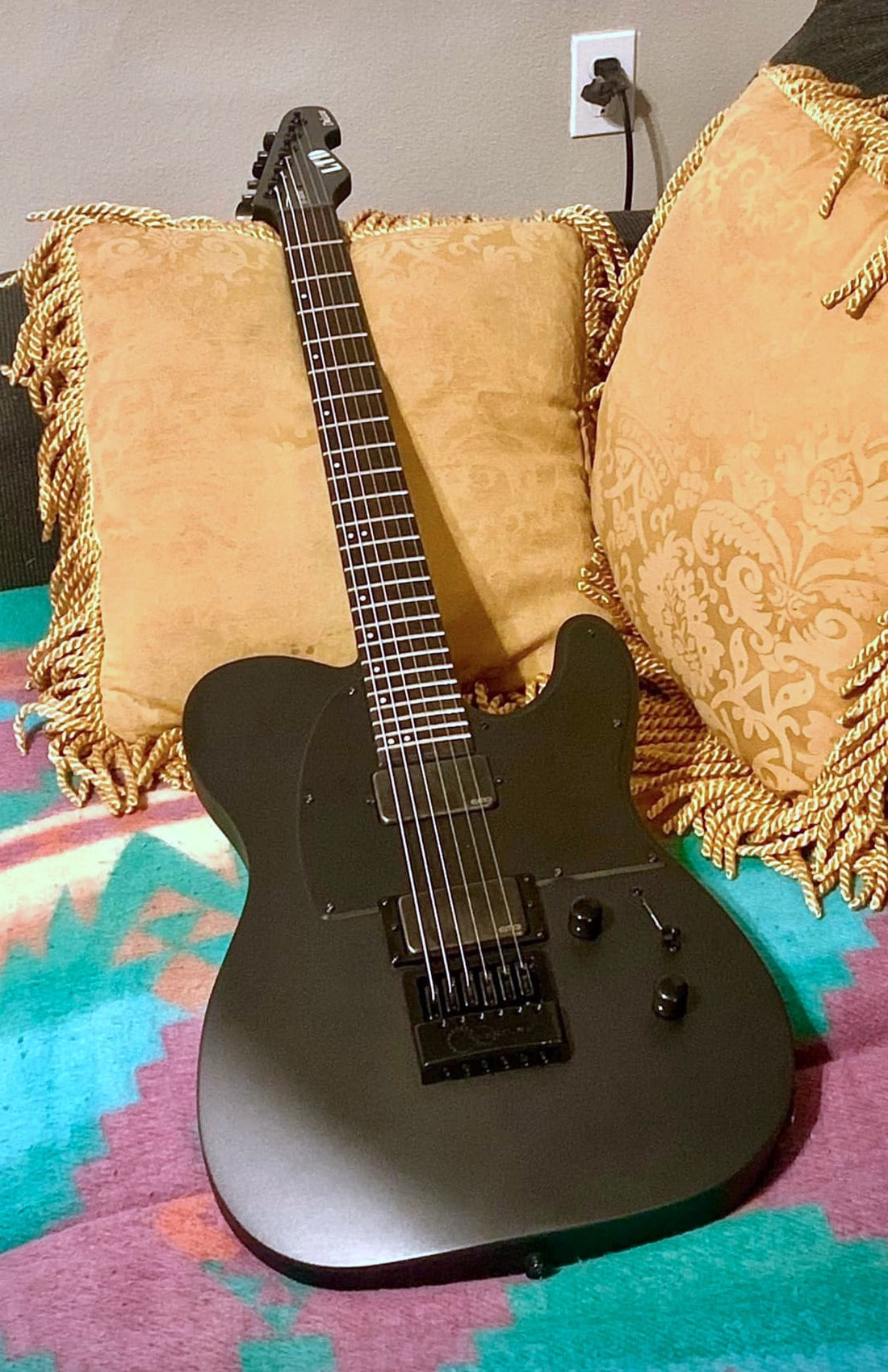
ESP LTD TE-1000
I know what you’re thinking, and I thought so too: Isn’t it suspiciously similar to the Jim Root Telecaster by Fender? Well, it is so in more ways than you can imagine. That said, they sound completely different, let me tell you why.
To begin with, and just like with the Fender, this is an incredibly well made and comfortable guitar to play. The body sits comfortably and the neck is smooth and fast.
Here’s when you notice the first difference, this guitar isn’t a bolt-on instrument. It’s what the company calls a set-through construction. This is an innovation that has become increasingly popular among modern guitar builders. It’s a deeper neck pocket and a glued neck that goes the entire scale inside the guitar body.
This adds sustain while leaving some of that spank and percussiveness Teles have.
The Extra Jumbo frets and near-flat radius make the neck very easy to play.
Plus, the Macassar Ebony is always very bright and combines perfectly with the mahogany body and 3-piece maple neck. Speaking of which, the neck is as fast and shred-friendly as necks get. Although I prefer the no-paint version like in the Fender Jim Root, you can spend many hours playing on this neck and not realizing time went by. That said, humid areas might make it sticky and uncomfortable.
The locking tuners worked great, the guitar didn’t go out of tune no matter how much abuse it took from yours truly. The string-through Hipshot bridge sounds and looks great.
Another big difference between these guitars is that you have a tone control here, which allows you to have more tweakability over the resulting sound.
The TE-1000 has a fairly dark tone in the low end. It’s not too boomy or muddy, but it’s fat and chunky. This guitar can seriously chug. That said, thanks to the maple neck and the ebony fretboard, it is also quite tight and snappy. This makes it perfect for modern metalcore that has a fairly tight sound. Also, leads can be a lot of fun, you can just shred away and those extra-high bends can take it all to the sky and back.
I have to say my model came with 0.009s and bending became an addiction.
The pickups, Fishman Fluence, sport different magnets for the neck and the bridge. The bridge ones are ceramic and the neck ones are alnico. This way, you get the most of every scenario.
The bluesy tones on the neck pickup with the tone knob cut to 5 and volume in 7 sounded sweet, round, and fat.
Moving the pickup selector to the bridge pickup you have all the nastiness of the maple and the ceramic pickup combined to make this a serious, very serious metal guitar.
Hidden under the controls are the second voicing of the pickups that help you tame down the beast and play some funky tunes, Texas blues, or even some Jimi. The pickups seem to emulate every scenario perfectly and you just feel you can go for it.
I played stuff like “Scuttle Buttin’”, “Voodoo Chile”, and “Lose Yourself to Dance”, and it was all fun and sounded great. After that, I engaged those loud humbuckers and the whole thing became a face-melting ball of energy. Yes, there is more than enough crunch on offer here to give you nice and heavy riffs. The tone is just controlled and makes notes sound cleaner.
I tried “Knights of Cydonia”, “Sleep Now in the Fire”, and “My Own Summer” (It’s an ESP Telecaster after all, right?) and it all sounded heavy, fat, menacing, and powerful.
I found that the clean tone is also quite dark. There isn’t any of that Tele sparkle really present on this guitar. The coil tap does add some brightness. I also found that switching to the single coil mode made riffs and chords a bit crunchier as well.
If you’re going to be playing mostly metal but want a versatile guitar that can do many things well, this is a great option. If you look for a traditional Tele with added spicy sauce, this is not the best option.
6. Squier Affinity Telecaster Deluxe
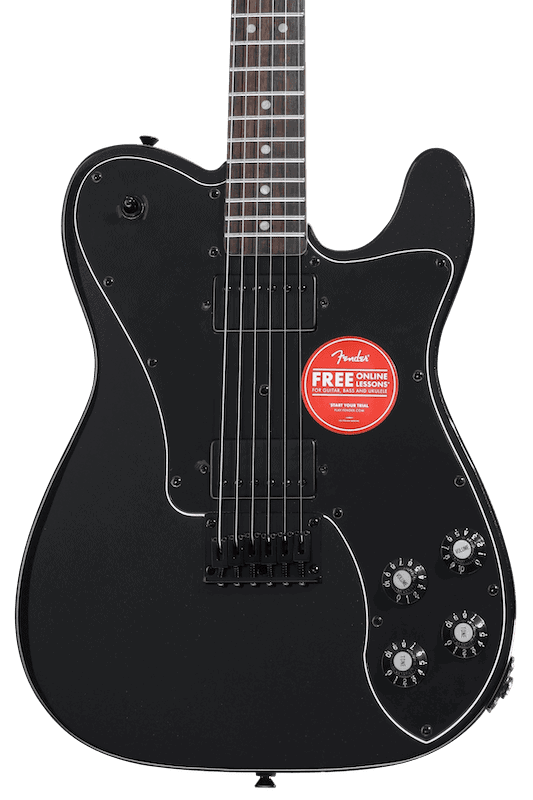
Squier has come a long way since the early days in which their guitars were more or less unplayable straight from the box and had all sorts of quality control issues. Nowadays, the company makes quality guitars in Asia and ships them to the entire planet with a fast-growing reputation for being a great bang for the buck.
Well, this Telecaster Deluxe just broadens that reputation one step further and gives you a great rocking guitar at a great price. I mean, I’m not comparing it to a guitar that costs three, four, or five times more; that’s unfair. I’m saying that, for the price tag, you get a lot of guitar.
So, to begin with, the body is made of poplar, something you expect to find at this price range. It’s not as detailed and clear-sounding as alder is but not muddy either. In this case, it makes a great combo with the humbuckers that beef up the sound of the guitar a lot.
I loved the contours on the body making this guitar closer to an American Ultra than a traditional ‘72 Tele Deluxe. Also, as a Tele lover, I love that they kept the traditional Telecaster headstock instead of going for the big Strato-like headstock of the original one.
The maple neck is capped with Indian Laurel and the 9.5” radius makes this guitar a joy to play. It’s true that it’s not a shredder’s best friend but you can play anything on it and it all feels good. The C-shape for the neck is so familiar that I felt I was playing an old, loved axe of mine and not trying out a guitar.
It’s fitted with 21 medium-jumbo frets that do their job perfectly well.
Beyond all the technical aspects, what I think I loved the most about this guitar was the sound. Yes, this Squier Affinity Series Telecaster Deluxe oozes tone from those ceramic pickups. I love the fact that you have two controls for each pickup and, although this is personal preference, I didn't like the positioning of the three-way switch on the top of the guitar.
I just kept on hitting it with the pick!
That said, you can do all kinds of tricks with that configuration, like for example using it as a kill switch with one volume knob in zero.
But beyond gimmicks and pyrotechnics, I began my test with the bridge pickup and some heavy distortion and this guitar just kept it all tight and bright. I’m not going to tell you it was as defined and spanky as other models on this list, but it wasn’t at all muddy and very punchy. I tried leads, riffs, and power chords and it was all fun. The guitar felt powerful when playing.
The in-between position with the pickups turned down was another great setting for this guitar. It became a mellower instrument that could play sweet, percussive, clean, and mildly overdriven sounds with ease. Some heavy overdrive in front of the amp and you can play any rock and roll song you want to.
The neck pickup is a bit spicier than you’d expect, the ceramic pickups tend to overload it all a bit and it might be somewhat of a loss rather than a gain with the volume in 10. That said, if you lower the volume, you get some other stuff coming up that’s more usable. Yes, you lose some gain and some treble, but you gain in transparency and can understand every note.
I don’t think you can find a guitar out there that can beat this humbucker-equipped tele in its price range, Squier did it again, folks. This is a great platform to overhaul but if you want something midrange and up, you’ll have to look elsewhere.
7. ESP LTD TE-200
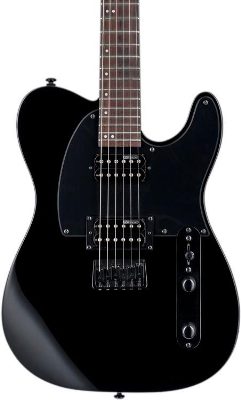
The ESP LTD TE-200 is the little brother of the TE-1000. But it is a little brother that packs quite the punch. Yes, don’t let that price tag fool you, you get a lot of guitar for the price you pay. But I don’t want to get ahead of myself here.
To begin with, this guitar offers a Tele-shaped mahogany body with contours and reliefs right where you need them. That means where your forearm goes and where the beer belly gets its space.
In this sense, The TE-200 is actually quite similar to the TE-1000. Both guitars offer a contoured mahogany body and a 3-piece maple neck. The big difference is the way the body meets the neck. While on the TE-1000 it was a set-through design, here’s a regular bolt-on with a bit of a relief to make access to the highest frets an easier endeavor.
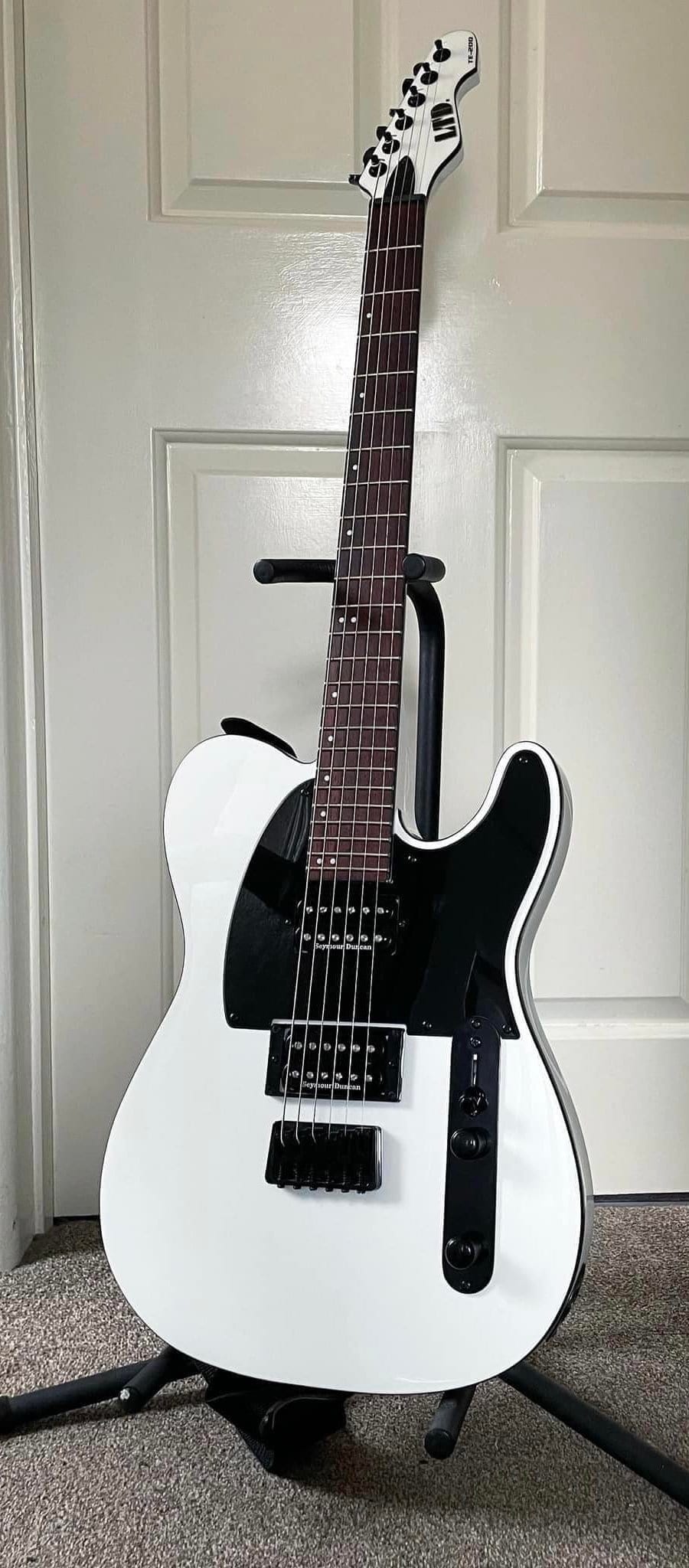
ESP LTD TE-200
Another big difference in the guitar’s construction is that while the TE-1000 features a Macassar ebony fingerboard, here you get roasted jatoba. Jatoba is a wood type used to make floors because of how hard it is. With some tint, it can be made to look like a replacement for rosewood. That said, it’s much brighter than rosewood and not as spanky as ebony or maple.
The TE-200 features coil tap on the tone knob. This means that the neck and bridge pickup are splittable. This is an especially friendly spec because the 150-series pickups installed on this guitar are quite hot. I would say they can drive anything into overdrive pummeling the front end of the amp with lots of gain.
I tried playing with my Tube Screamers and the guitar sounded like I was going through a Triple Rectifier. Well, maybe no that heavy, but surely just as gainy. As soon as I pulled the tone knob, the beast was instantly tamed and I could get away with some Chili Peppers and some Tom Petty.
Can you imagine going from full-on Metallica to Tom Petty by simply turning off the distortion and pulling the tone knob? Well, it’s THAT easy with this guitar because it gives you some added versatility.
In comparison with the TE-1000, the Fishman Fluence pickups make a big difference in terms of clarity. Yes, these pickups can be neat-sounding with a glass-like quality while the TE-200 pickups tend to turn a little muddy when paired with too much gain and playing heavy riffs or power chords. At the same time, it finds its most comfortable spot next to the mid-high frequencies.
The TE-200 doesn’t have the dark tone of the TE-1000. It is much brighter, making it sound more like a Tele. Its distorted sound is also a bit dirtier. There is more chunkiness on the TE-200, and it isn’t as tight and controlled as the TE-1000.
The low end of the Fishmans is perfect with enough chug and bottom end to be heavy but not enough to get muddy. It’s not a swamp of frequencies but rather a perfectly-orchestrated choir of rumble. The TE-200 isn’t as clear, defined or tight, which could be a bummer for some. On the other hand, it has an analog warmth that active pickups just don’t have.
I have to say I had a lot of fun playing this guitar and that its price tag might not make it justice because it’s a lot of Telecaster for the money.
In my opinion, the TE-200 is an excellent guitar for anyone who wants to start playing metal. More advanced metal guitarists will get just as much of a kick out of it after maybe a professional set up and a pickup swap.
Read my full review.
8. Schecter PT Pro
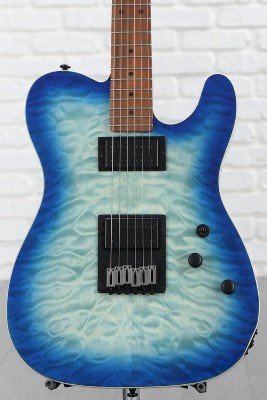
Schecter has been making some exceptional guitars the last few years. So, a Tele style guitar from them should be great, right?
Well, the PT Pro is nothing short of fantastic. This is one of Schecter’s best, and one of the best humbucker-equipped Tele style guitars in existence
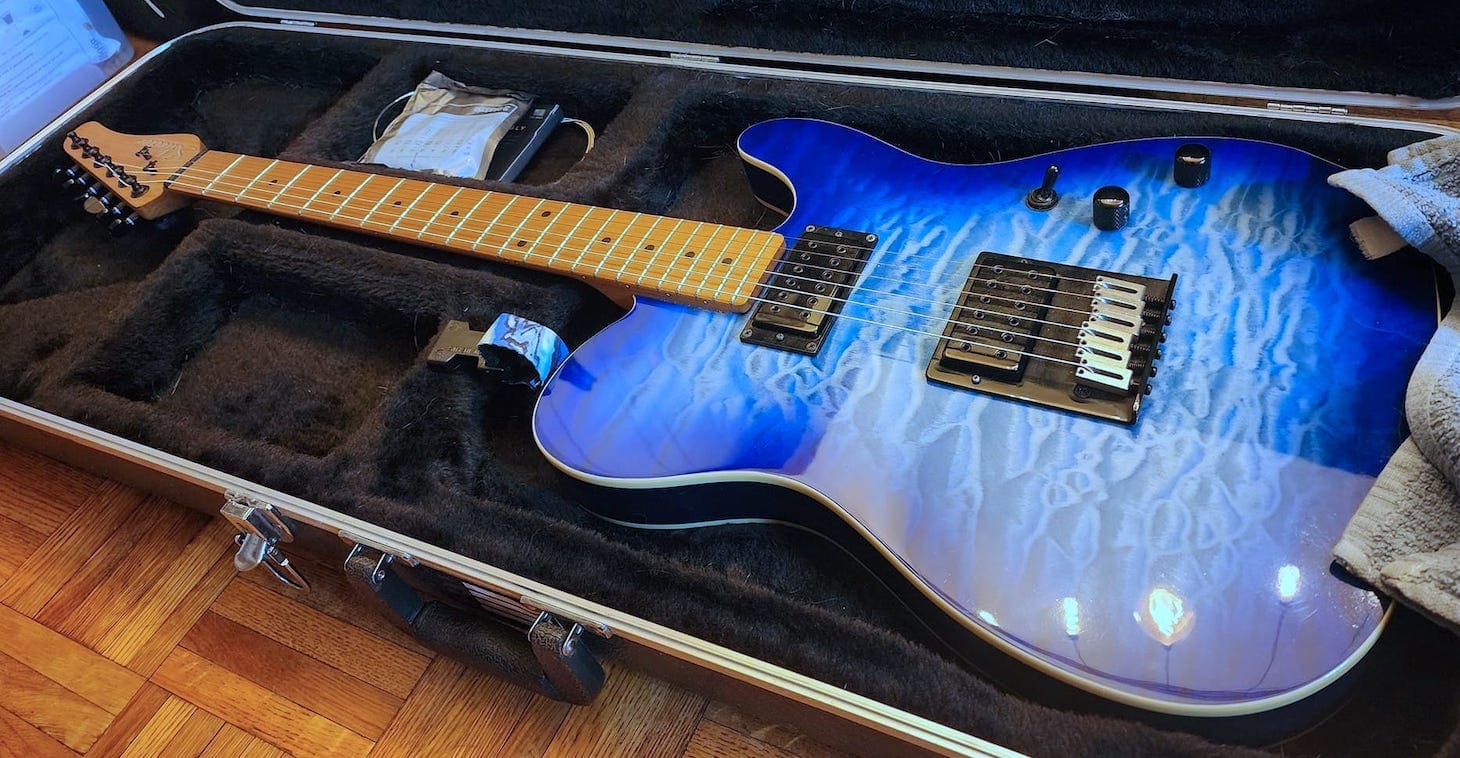
Schecter PT Pro
I had a lot of fun playing with this guitar and it allowed me to mix some wildly different stuff from The Clash and The Police to Nirvana to Metallica. I never felt the guitar was falling short, on the contrary, I was always pushing it and it always responded.
Buy let’s rewind and start from the beginning, shall we?
The build quality of the guitar is incredible. It actually feels like a guitar twice the price. Everything from the wood, to the finish, to the hardware is just top notch. It doesn’t feel like Schecter has cut any corners here.
Well, that’s if we rule out the plastic pickup rings. Those aren’t au pair with the rest of the guitar. We all know what happens to plastic pickup rings with time and live usage. Yes, I’m a sweaty guy when I play live and I think most of us are, so it’s kind of a bummer.
That said, it’s also an easy and inexpensive fix.
The pickups are mounted over a quilted maple veneer that sits flat on top of an alder body. This combination gives you that Tele spank and percussive quality you always look for in a guitar like this. I have to say that the string-through-body design and the metal bridge contribute a lot to the Tele twang and edge.
Those stainless-steel saddles on a black bridge might not be everybody’s cup of tea in terms of the looks, but do the job perfectly. The guitar stays in tune perfectly and is easy to set up.
The controls are ergonomically placed like those of a super Strat (close to your fingertips) rather than a Telecaster. The three-way switch is right next, conveniently placed.
The one thing I think this guitar lacks is the body contour of a modern tele. I mean, I get it. I own a CS Custom Telecaster with a double-bound body. It looks totally amazing. Yet, that’s a classic guitar, this is a dual-humbucker, black-hardware, take-no-prisoner approach to the Telecaster, shouldn’t they bring it to the present with a comfy place to lay our beer bellies on?
Everything the body lacks in comfort, the neck makes up for in ease of playing. This guitar plays like absolute butter! I was playing for more than an hour and a half and I hadn’t even noticed. Plus, the 14” radius and the 22 tall frets help your playing a lot. Maybe 24 frets would have been better? Not a deal breaker, but something to consider if you’re a shredder.
The sound is just as incredible as the build quality. This is a guitar with quite a lot of attitude. The tone is mean and dirty. The company went with their proprietary USA-Z Plus pickups which aren’t incendiary hot but moderate. They’re punchy and pack a generous blow, especially in the low end, but can do rock and roll and blues as much as they can do metal and thrash.
I loved the coil-splitted sound too, I played some riffs by The Police, some by Prince (he was a Schecter endorsee), and some by The Clash, and it all sounded spanky, with lots of attack and a beautiful midrange. It was a great way to tame the low-end too in high-gain settings.
So, while I do think the tone of the PT Pro leans a bit more to the rock side of things, you can definitely get some fat, metal tones out of it. It isn’t quite as heavy as some of the other guitars on this list. This is partly because of the not-so-gainy pickups that I think add a lot to the equation making this a more versatile guitar. If it had something like EMGs, it would be closer to being a fancy-looking one-trick pony.
One cool feature, that I actually discovered by accident, is that the fret markers on the side of the neck glow in the dark. This is obviously to help you keep track of where you are on the fretboard on a dark stage.
I think that if this guitar and its amazing roasted maple neck suit your budget, it might be the most versatile option on this list. It’s a must-try-before-you-buy situation.
9. G&L Tribute ASAT Deluxe
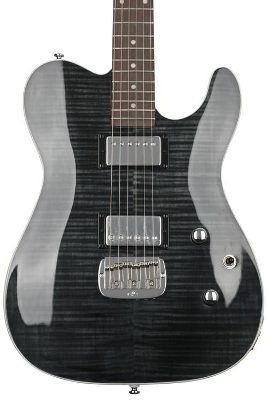
G&L guitars are probably the best Fender-like guitars around. That isn’t too surprising considering Leo Fender himself is one of the company’s founders. That makes the G&L Tribute ASAT Deluxe one of the best Tele-like guitars out there today.
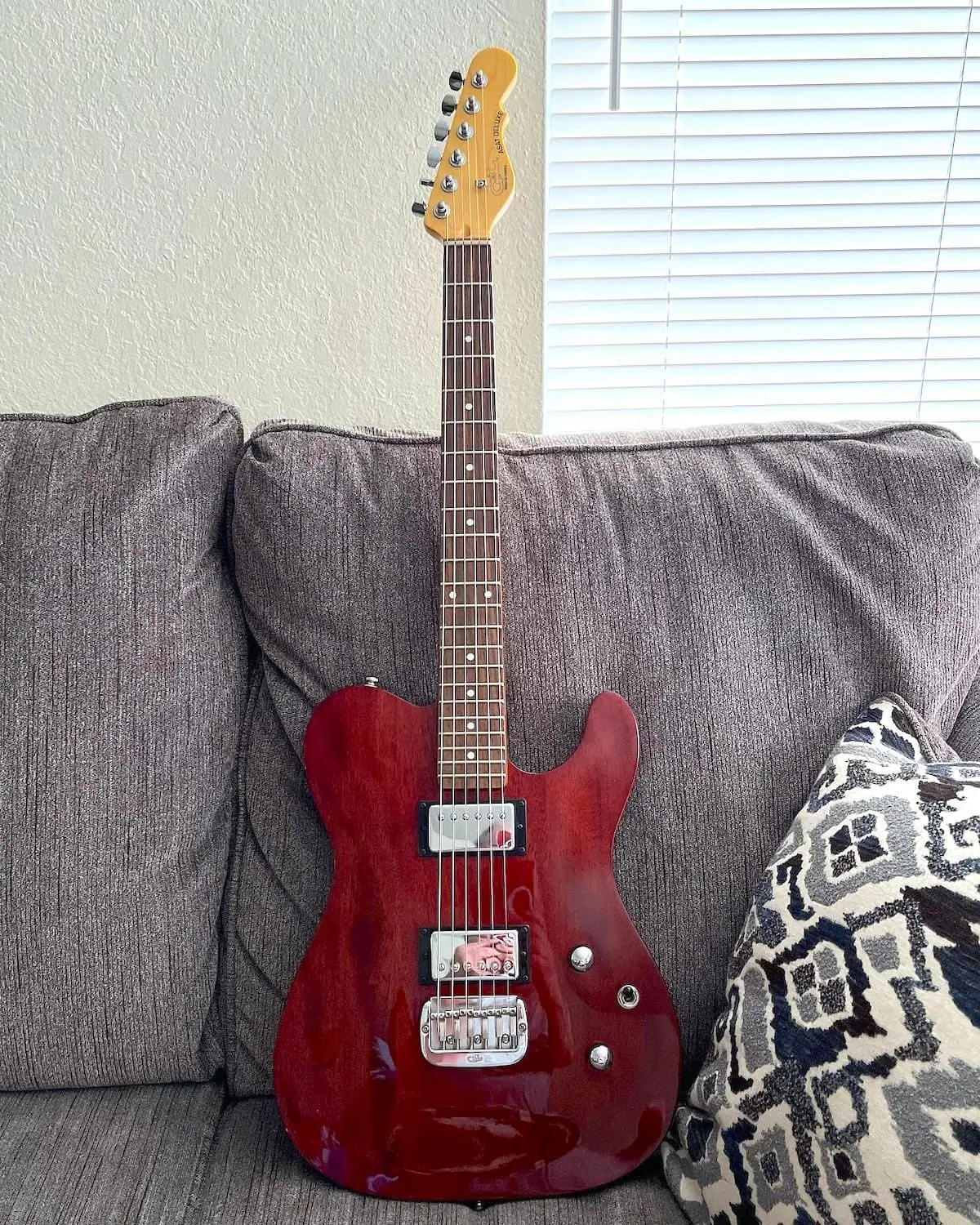
G&L Tribute ASAT Deluxe
That said, this guitar takes only a few elements from the Fender legacy and owes most of its existence to another builder. I mean, don’t get me wrong, the Tribute is a gorgeous guitar. The thing is that it reminds me quite a bit of a PRS in both looks and sound (perhaps even a bit too much?). That is actually the best way I can describe it. It is a mix of a Fender Tele and a PRS SE Standard.
On the PRS side, this is a Tele-shaped body but with a carved (flame) maple top and a nato body. If you’re used to playing plain-top traditional Teles, the difference will be notorious. If, on the other hand, you’re used to playing carved-top guitars, you’ll notice the bridge as the main difference.
Speaking of the bridge, it’s what G&L calls the G&L Saddle Lock bridge and it’s an original Leo Fender design that adds tuning stability and sustain to the guitar. The pickups are also the company’s own AS4250C in the neck position and AW4370C in the neck. These were designed specifically for these guitars by G&L’s own Paul Gagon and manufactured by Cort.
They’re not bone-crushing heavy but aim mostly at rocking and hard-rocking tones. The rock maple neck and the Indian rosewood fretboard make a very comfy combo with a 12” radius and a C-shaped, quite fast neck. The union between body and neck is bolt-on.
The neck feels similar to a Tele, fast and smooth. While the body feels like that of a PRS, just in the shape of a Tele. Tone is the same. It has that Tele spank, but has a more aggressive, crunchy tone courtesy of the nato body with maple top. It has the quintessential edge Teles are known for but with a little more lower-mids oomph.
The tone is quite warm, but with a nice touch of brightness to it. It is also quite boomy, without sounding too bass heavy. Activating the coil tap gives it more of a midrange, but turns up the attitude to 11. This guitar really screams in single coil mode.
I did my homework right by playing “Hotel California” going from single-coil to humbucker and it held it together in every scenario.
I played it with some clean, delay-infused tones and clarity was perfect, also tried some jazz with the front pickup and the tone knob in zero and while it was a little too bright, it did the job. Also, both pickups together at half the volume with the tone knob maxed out and some reverb gave me a cool neo-soul thing.
Finally, the bridge pickup with enough distortion was instant punk, rock, hard rock, and metal.
Don’t get me wrong, this isn’t your metal-oriented guitar with active pickups and a menacing look. On the contrary, you’d be better off touring to support Mariah Carey than Slipknot with it.
Just like the Schecter PT Pro, I think the Tribute falls more in the hard rock category. It doesn’t have quite the modern metal sound, but if you are looking for a great 80s metal tone, this is the guitar for you.
Also, if you want a guitar that can give you a wide variety of sounds, is very comfortable to play, and looks classy, this is the guitar for you. Furthermore, for Telecaster lovers out there who want something that’s not too bold but more like a Tele on steroids, this is a great guitar.
If you’re playing Pantera covers, on the other hand, this might not be the one for you.
What Makes a Tele Great for Metal?
The way Telecasters are designed actually makes them quite ideal for playing metal. I know, I’m used to thinking that metal guitars need to have all these bells and whistles to do the thing too.
Well, although features have been incorporated into many other metal guitar designs like flying tremolos, extra strings, flat radii or scalloped frets, most metal players use one setting. Yes, cranking the amp and going for the bridge pickup of a Tele is something that brings country and trash players together. They all prefer the simplicity of a tele to do it.
In my opinion, simplicity is a big reason why many metal guitarists have turned to Teles and Tele-style guitars.
These are some extra reasons:
Comfortable Body
Most of the guitars on the list above feature a contoured body with space for your forearm and the lower belly. Also, most feature contoured neck joints or even the lack of four bolts and a neck socket. This makes the art of reaching the higher frets as easy to pull off as the art of playing a heavy riff.
Also, because of the wood type used and fairly slim body, Teles are very comfortable guitars weight-wise. They fit snugly against your body, and their weight makes them comfortable to play for long periods while standing. Furthermore, according to Jim Root and the bunch, they make amazing guitars to run around and play a high-octane show.
Ideal Neck for Technical Playing
Since metal is usually a very technical genre to play, you need a neck that allows you to play complex and fast parts. Let’s not forget most of the guitar Gods and master shredders of the world did their parts mostly on Super Strats. And I mean everyone from Steve Vai and Joe Satriani to Yngwie, Eddie, and Eric Johnson.
Strat and Tele necks have their tapered C shape in common. This makes them ideal for fast and smooth playing.
But that’s not all, because most of them also have a 12” radius, making them almost flat and super fast. Yes, a flat fretboard allows for more accurate playing, which is crucial when you’re going fast.
Furthermore, I think having a flat surface is a condition to go fast in many scenarios in life.
The radius (from 9.5” onwards) also works by making bends easier. Their scale length is also 25.5” which maintains that percussiveness even though the metal bridge where the pickup is mounted in original Teles is mostly gone on the above models.
Also, longer scale length necks have wider fret spaces. These wider fret spaces offer more accurate and efficient playing. In summary, these tele necks are fast, comfortable, and have tall frets for you to shred your way to mastery.
Deep Cutaway
Although this is not what they are famous for, Teles also have quite a deep cutaway where the neck and body meet. In some cases above that has been enhanced giving you an even more comfortable access to the higher frets.
Nevertheless, this deep cutaway makes it easier to reach the high notes at the bottom of the neck on all of the models above.
I know what you might be thinking, “Hey! Metal isn’t just about solos!” And you’d be absolutely right. That said, if you want to move in that direction with your newly-acquired guitar, then having an instrument prepared for the time you want to take that bold step into the unknown is great.
Finally, since metal solos often rely on playing these high notes, being able to reach them easily is very important. This is especially important if you want to pursue a career in fast-playing, shredding, and continue the legacy of virtuosos already making history on a Tele like John 5 and Ritchie Kotzen.
Important Things to Look for in a Tele for Playing Metal
If you are going to buy a Tele for metal, you should consider the following things:
Humbuckers
If you’re going to use your guitar to play metal, the most important thing is to get a Tele that has humbucker pickups. I’m not going to tell you what you have to do, you might encounter an amazing new sound playing with high gain and single-coil pickups, but it’s not my definition of fun.
The 60-cycle hum is enough to hear a loud bee-like sound coming from the amp.
In that scenario, what you’ll most likely encounter is a loud squeal coming from your guitar whenever you’re not hitting it hard. Furthermore, if you have an ash body and a maple neck, chances are you’ll be in a feedback nightmare.
Humbuckers are ideal for metal since they not only have a much higher output than single coils, but also don’t have any hum (hence the name, right? Hum-buckers). But that’s not all, the dual coils also generate a more powerful magnetic pull and you get a sound that’s full, round, and simply fat. Also, you need high output pickups to be able to handle all the distortion you are going to be using.
Of course, that doesn’t mean you can’t use single coils. But don’t get a Tele that only has single coils.
The best option is to get a Tele with humbuckers, but also a coil tap. A coil tap basically ‘splits’ the humbucker, turning it into a single coil, but without the 60-cycle hum.
All of the guitars in this article have a coil tap. So, any of them will do. As for other Teles, make sure they have a coil tap if you want the option of using the pickups like single coils.
Locking Tuners
Locking tuners are a must on metal guitars. In fact, I would say, it’s a good idea on all of them unless they have a floating bridge and a double-locking tremolo system. Since you are likely going to be playing very aggressively, you want your strings to stay in tune. For that, you need more than your average tuner resistance.
Locking tuners are pretty much a must have on any metal guitar that’s likely to take some abuse from the live situation or heavy studio playing. Because they usually have an extra layer of strength, these help to keep your strings in tune after heavy strumming, picking, or bending.
Teles with locking tuners can also benefit from staying in tune even after using the whammy bar.
If you are by any chance thinking that this is going to affect your tone or playing, you’re just plain wrong; it is just going to make life a bit easier. You don’t want to have to re-tune your strings after every song and look like a complete amateur now, do you?
Closing Thoughts
The Telecaster is no longer confined to genres like country and jazz. Many guitarists have shown that they are more than capable for metal. This has also led to Telecasters and Tele-style guitars to become more and more popular among metal guitarists.
Moreover, you shouldn’t at all be surprised if metal players embrace the Telecaster as their instrument of choice for world domination soon.
But beyond metal players particularly, the Telecaster is the working man or the working musician instrument. These guitars we just saw above expand the reign of the almighty Tele so more players can enjoy the beauty of simplicity.
Perhaps, Telecasters will become more common than Strats in metal and we create a new category: Super Teles. That could be fun, to see this old recipe giving new players extra colors to paint with.
Well, only time will tell if they catch fire with new metal players. One thing is certain, though, the Tele will continue to make rocking history for decades to come.
Plus, I love Teles and metal, so having two of my favorite things join in such a great way is absolutely fantastic.
Happy (Heavy) playing (on a Telecaster)!
