
There used to be a time when loop pedals were reserved for guitarists and bassists. But more and more vocalists have started to embrace the power and potential of loop pedals.
Nowadays, we can speak of a category called vocal artists. For them, looping plays a key role. This has led many companies to focus on creating high-quality loop pedals aimed at vocalists. The options available today are almost as varied as those for other musicians.
I'm here to do the heavy lifting and bring you a curated list of the top 5 options in the market today. As a regular performing vocalist (singer-songwriter), I have extensive hands-on experience with each of these pedals.
If you’re serious about vocal loopers, your next purchase is (likely) on this list.
Best Vocal Looper Pedals (Ideal for Singers!)
Table of Contents
1. Boss VE-22

BOSS has been making great pedals for guitar and bass for many years. But now they also cater to vocalists who have been left out of the pedal game for so long.
BOSS’ VE-22 combines a multi-effects pedal with a loop station and aims it directly at vocalists. All while maintaining the quality that BOSS is known for.
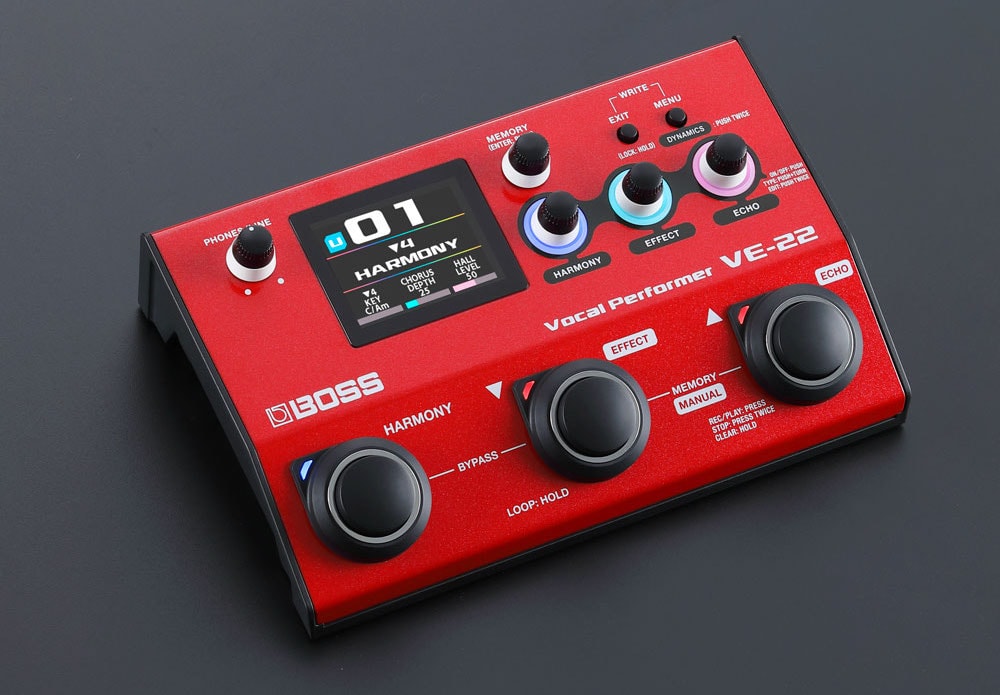
BOSS VE-22
The VE-22 is a packed unit. It comes with 50 presets, with room for 99 user patches, a looper, a harmonizer 39 types of effects, and can also act as an interface to go straight into the computer via USB. Combining this with its phantom power capabilities makes the VE-22 a great studio tool as well.
But let’s rewind a bit, shall we? Because with the 50 factory presets, the VE-22 is pretty much plug and play. The presets come in a variety of music genres and effects and are easily visible because of the impressive color LCD screen taking up most of the unit’s front panel.
Speaking of which, the color-coded knobs for harmony, echo, and effect make changes on the fly very easy. Those are also the names of the three footswitches that help you maneuver the unit while looking at the audience in the eye.
The looper works and sounds great as well. Recording, stopping, and playing are all controlled with the right footswitch. It can record loops for up to 38 seconds and can layer infinite loops.
This is, perhaps, the biggest drawback this unit had for me. It has three footswitches and all the looping is controlled with one? This means you have to double-tap on it to make it stop. We all know that’s one of the hardest things to do while playing with loops. A separate footswitch to stop and clear would have been just great.
On the good side, the ability to use the unit as an audio interface makes it helpful to store ideas you’ve been working on in a safe place. Plus, the unit works with a 24-bit AD converter and a 32-bit DA converter; your voice will sound better than ever.
The sound quality of the multi-effects processor is exactly what you’d expect from a Boss product. This is especially true for the echo section as well as the modulation. In the same line, the harmonizer sounds top-notch and accurately tracks your original regardless of your register.
You also aren’t restricted to C Major. Different keys can be cycled through with the simple press of a button.
Finally, it works on batteries, which make it an awesome all-in-one powerhouse for singers who love looping and using their voice as an instrument.

2. Zoom V6-SP
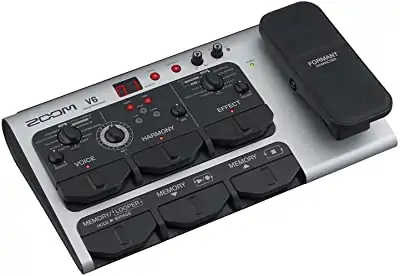
Even with the increasing popularity of vocal effects pedals, most of them are still pretty much just set-and-forget. The Zoom V6-SP changes that by encouraging a more active approach during performances.
Zoom V6-SP
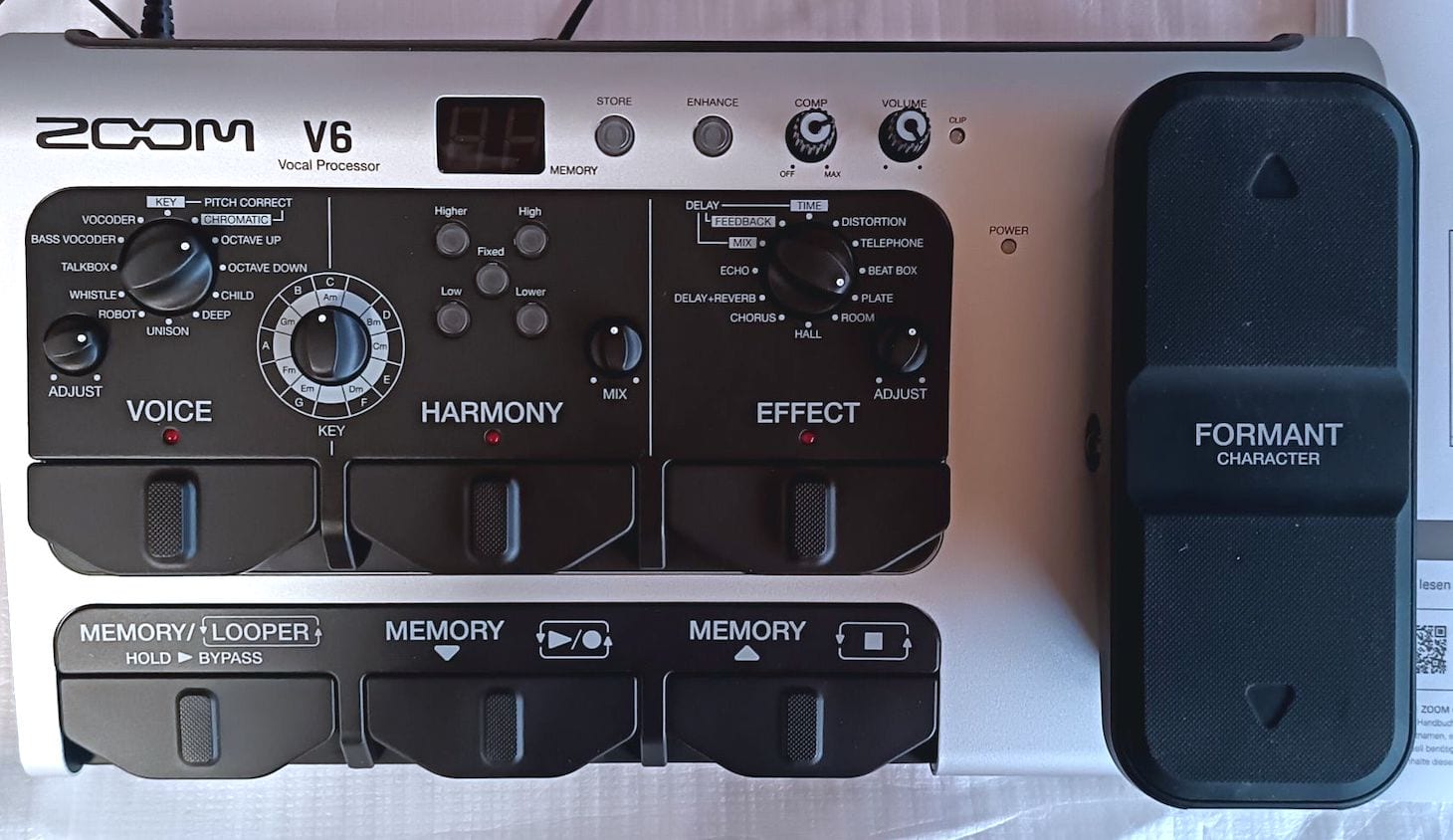
Firstly, instead of having a small screen to scroll through the different effects, everything is right in front of you.
You simply have to turn a dial to switch between the voice and sound effects. Selecting different keys for the harmonizer is also done with a dial.
Not only is selecting an effect easy, but you can also easily and quickly see what effect you have selected. There are also a large variety of different effects.
Two different Pitch Correctors, Vocoders, Octaves, Talkbox, three different Delays, etc. The Voice and Effects both have twelve options to choose from, so you have practically any sound you could want right there, at the twist of a knob.
Secondly, turning the effects on and off is done with the simple press of a comfortably large footswitch. The looper section has three separate footswitches as well to control recording, play/pause, and switching between memory banks.
The looper function is great because you can loop effected sounds. This means you can create soundscapes with your vocals recording harmonized vocals, or making layers with weird, otherworldly sounds that transform a simple vocal into something much more interesting and bigger.
The best thing is that you can control it all with the lower row of switches while you turn the effects on and off with the upper row. This means you have complete effortless control of your vocals even when looping.
My favorite feature on the V6-SP is the expression pedal. It lets you make small or sweeping changes to effects while you are performing. This means that your sounds aren’t static the whole time which can make your performances so much more dynamic.
You can also get the optional SGV-6 shotgun mic with the V6-SP. The mic is designed to pair seamlessly with the pedal. And since it is a shotgun mic, it isolates your vocals quite well.
The mic is quite nice with fairly decent sound quality. I wouldn’t say that it is a must, though. The V6-SP can work with any mic and the SGV-6 isn’t necessary, especially if you already have a decent mic.
3. TC-Helicon Ditto Mic Looper

The TC Electronics Ditto looper has been a well-loved looper pedal among guitarists for quite some time now. For singers and acoustic players, however, the Ditto was off the table.
Until now, that is.
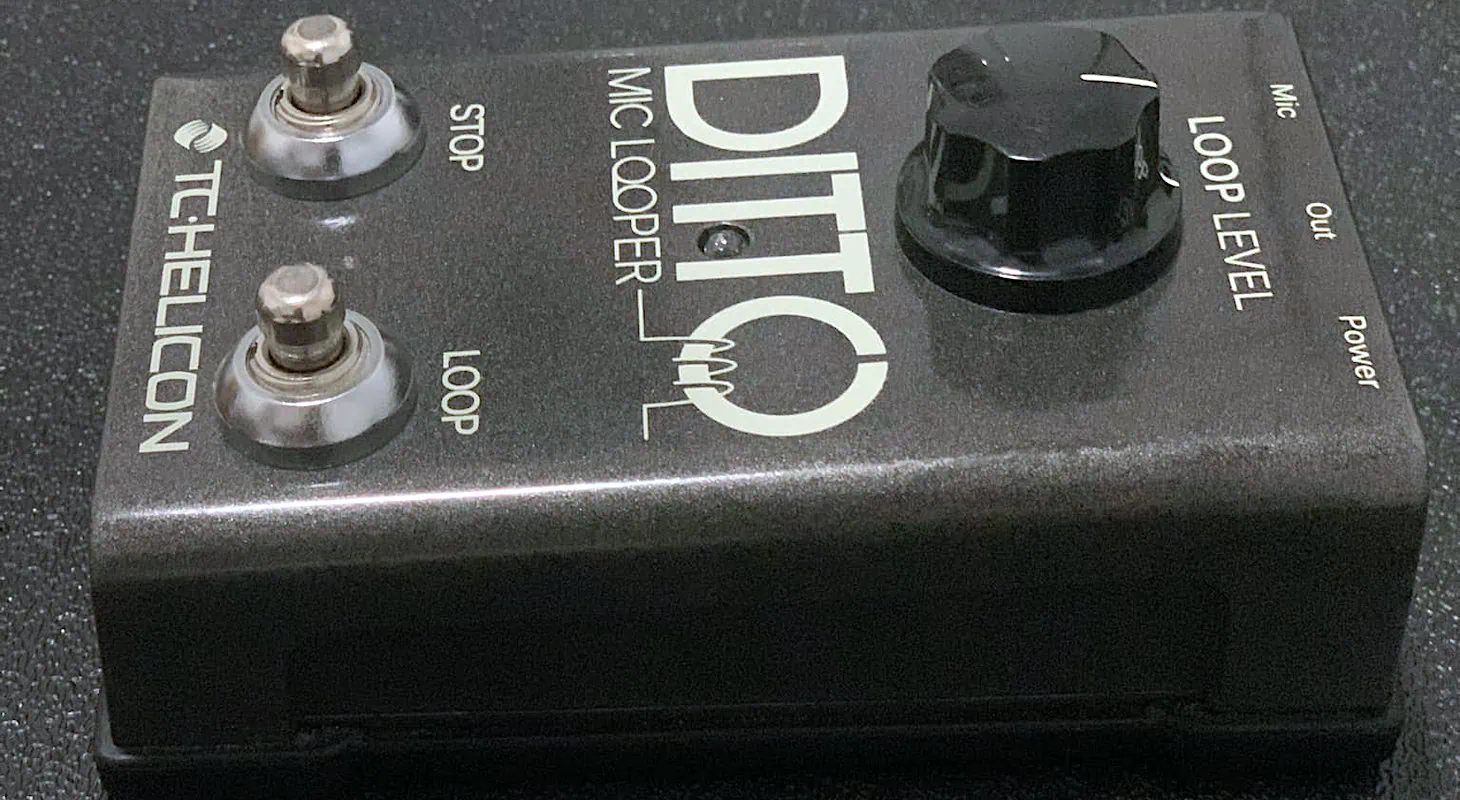
The TC-Helicon Ditto Mic Looper is a minimalist loop pedal. It has just two footswitches; a Stop and Loop, and a volume knob. And that is it, no fancy color screens or a hundred different buttons.
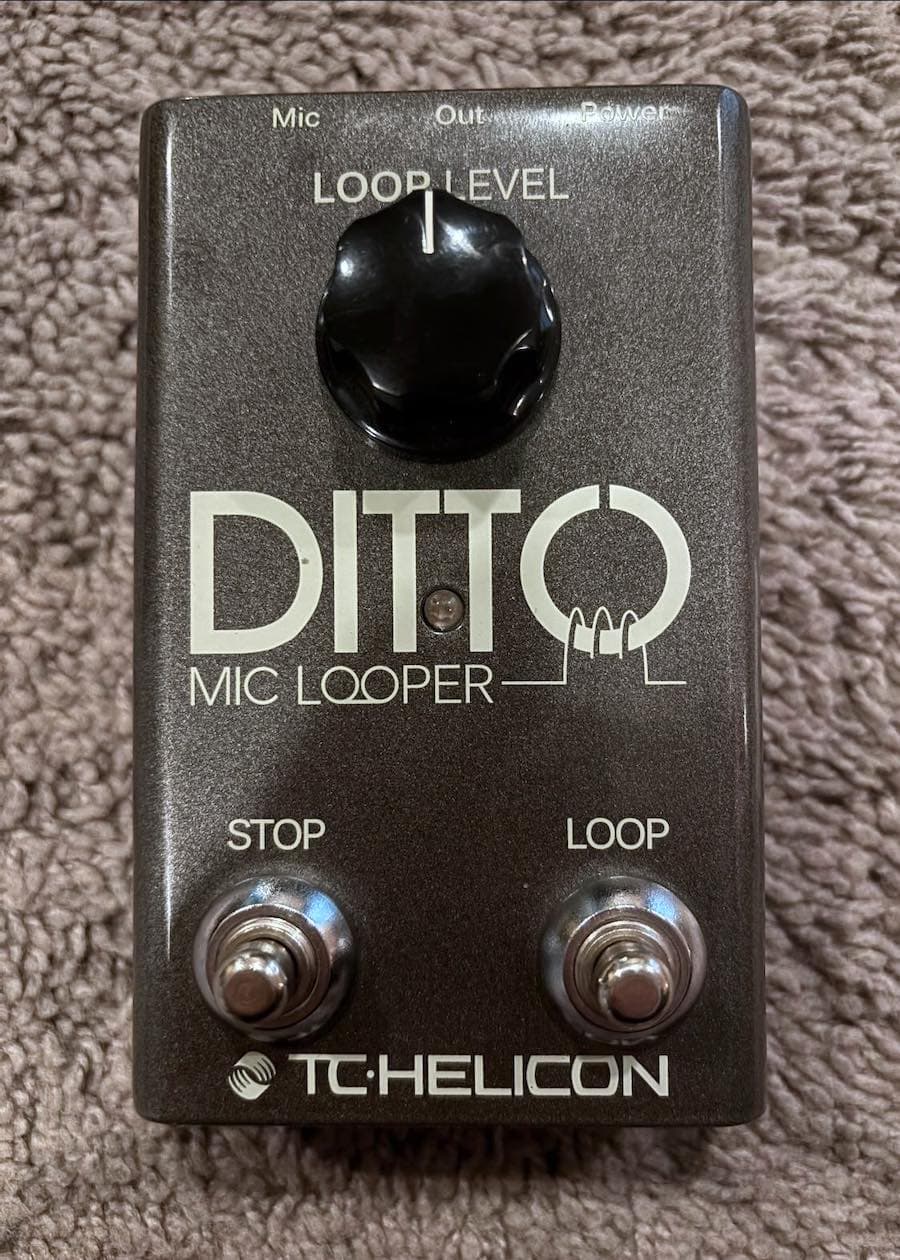
TC-Helicon Ditto Mic Looper
The Ditto Mic is as basic as it gets for a loop pedal. That, in my book, is an advantage. There’s no need to set anything up, not even your volume with the PA. It’s as simple as plugging in and you’re ready to go.
The sound quality is great, just like every other member of the illustrious Ditto family (doesn’t it sound like a Godfather-friendly last name?), this pedal features 24-bit uncompressed audio quality. But that’s not all, because TC-Helicon also hid a top-notch mic preamp and phantom power under the hood.
In other words, it’s a mic signal processor as well as a looper. Speaking of which, the pedal is also very responsive and loops just continue seamlessly.
The Ditto’s simplicity makes it extremely easy to use. You simply press the Loop switch to start recording and again to stop. Furthermore, adding the not-included TC Helicon MP-75 or Sennheiser e835 FX, you can control the looper from the microphone. With either of those, you’re free to move around the stage while still controlling your loops.
You can do the whole Ed Sheeran thing running around and setting the crowd on fire.
Speaking of stage, the metal enclosure of this Ditto Mic Looper is as rugged as it gets. This little thing feels so sturdy it looks like it’s ready to go drop the ring in Mordor and back.
I guess the best way to say it is that it’s built like a tank.
Also, like the entire Ditto family, this pedal offers you infinite overdubbing. This feature allows you to create a sonic landscape the size you want using only your voice. If you feel it gets too busy you can stop, but your only limit is your taste.
I tried it with my trusty, old SM58 and the results were stellar. It’s a dead-quiet pedal that won’t modify the sound of my microphone. Then, I tried my Super 55, another great dynamic mic by Shure, and the timbre changed. It respected the difference in tone between these microphones.
Finally, I tried my studio condenser and the pedal fed it some much needed 48v phantom power. The natural warmth of the condenser was preserved throughout the test, I must say. This is, of course, something to do in the studio, an omni condenser on a stage is a recipe for disaster.
Speaking of disaster, I would easily take this pedal to a gig with no backup and be worry-free night after night.
If you’re looking for a no-frills approach to looping and love a great-sounding piece of gear, this pedal is, at least, worth trying. Believe me, it will surprise you.
4. TC-Helicon VoiceLive 3 Extreme
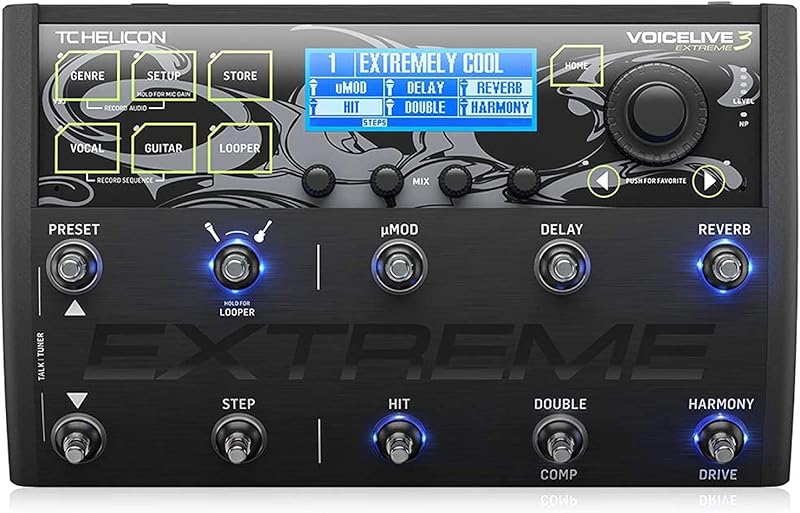
The TC Helicon Voicelive 3 Extreme might be TC’s most ambitious project yet. It’s a true powerhouse packed with enough processing power to play a stadium show but with such an easy user interface it can be the ultimate tool for the singer songwriter at the local pub.
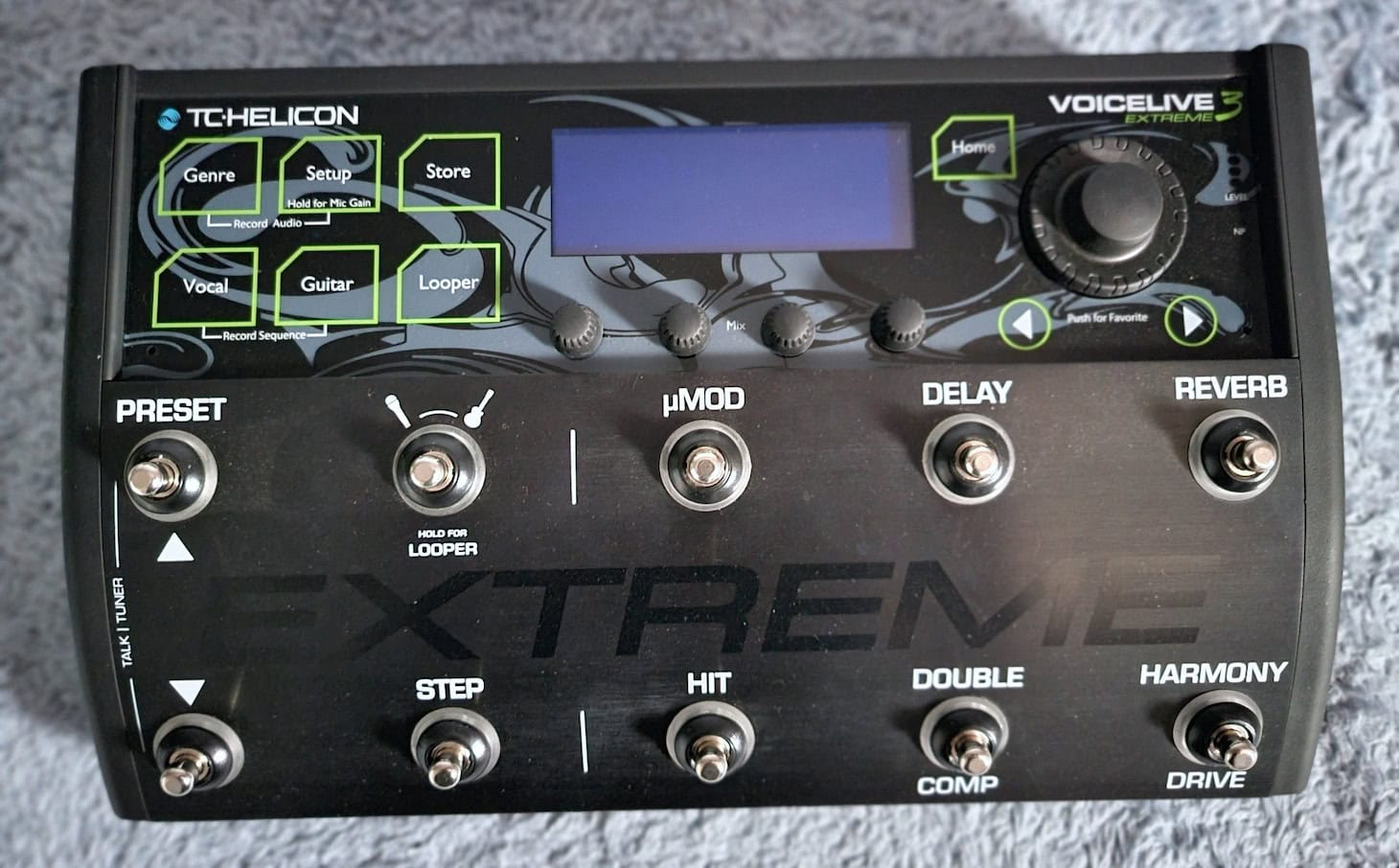
TC-Helicon VoiceLive 3 Extreme
To begin with, the Adaptative Tone feature helps you with perfect EQ, de-essing, slight compression and gating. Just turning it on makes a huge difference on your live vocals, even in those gigs they don’t bother to hire a live sound engineer at the pub.
Speaking of the PA, this unit packs enough output (and “thru”) options to accommodate even the most complex setups. You can even send a dry mix to the front of house in case they want to add a clean layer to your sound and make it all more crystal-clear.
Secondly, all the glorious performing tricks you did last night and wanted to put down to recording so you can upload that cool Spotify live performance album can now be stored effortlessly. Just plug in a USB device and everything will go into it.
This was also very helpful for me when working to improve my live shows. You can go in-detail into those difficult sections and break the code with real data.
Thirdly, the unit comes with a mesmerizing number of 180 pre-programmed styles and offers you over 250 factory presets to play with. That’s seriously everything you might ever need and some Alien-like space-ready effects when you want to go extra WOW.
Although what’s above already makes this a great resource, what’s amazing about this unit is that you fully automate it as a non-MIDI thing. Yes, you can just upload a backing track and program the unit to make all the changes during the song. That way, you can simply focus on singing your heart out and entertaining the crowd. I know, it's not an easy task but, without the tap dancing, it might get easier.
Perhaps, when addressing live performances, the most unbelievably overlooked function is that of a songlist. You can upload backing tracks and automate effects but can’t upload a set list and have the unit make all the changes as you proceed with your show?
That’s something TC should reconsider.
Moving over to the looping function, the fact that you can easily store your productions in the USB device is already a win. But that’s not all, the company increased the unit’s internal memory, making it 4 times bigger than the VoiceLive 3. Moreover, the smart LoopAssist function and the metronome help making every looped part tighter and more cohesive.
I had a lot of fun overdubbing vocals while playing the guitar and overdubbing guitars as I was doing vocals. Furthermore, the wide arrange of effects choices for vocals and guitar make this one of the most complete platforms to base your show on I’ve ever tried.
Believe me, it’s seriously good and can take your live performances to the next level.
If it’s out of your budget, the VoiceLive 3 is another great choice.
5. Boss RC-202
Boss has a long history with looping pedals. Perhaps, without the RC-20, we wouldn’t be speaking about Ed Sheeran’s looping proficiency.
Even going beyond that, the little red pedal, the RC-5 is just an amazing looping workstation. The thing is, with that as a foundation, Boss just kept going and fine-tuned the concept until they got to the new lines, one for the floor and one as a desktop looper.
I chose the RC-202 because I think it’s got the best balance of size, price, and features in the entire line.
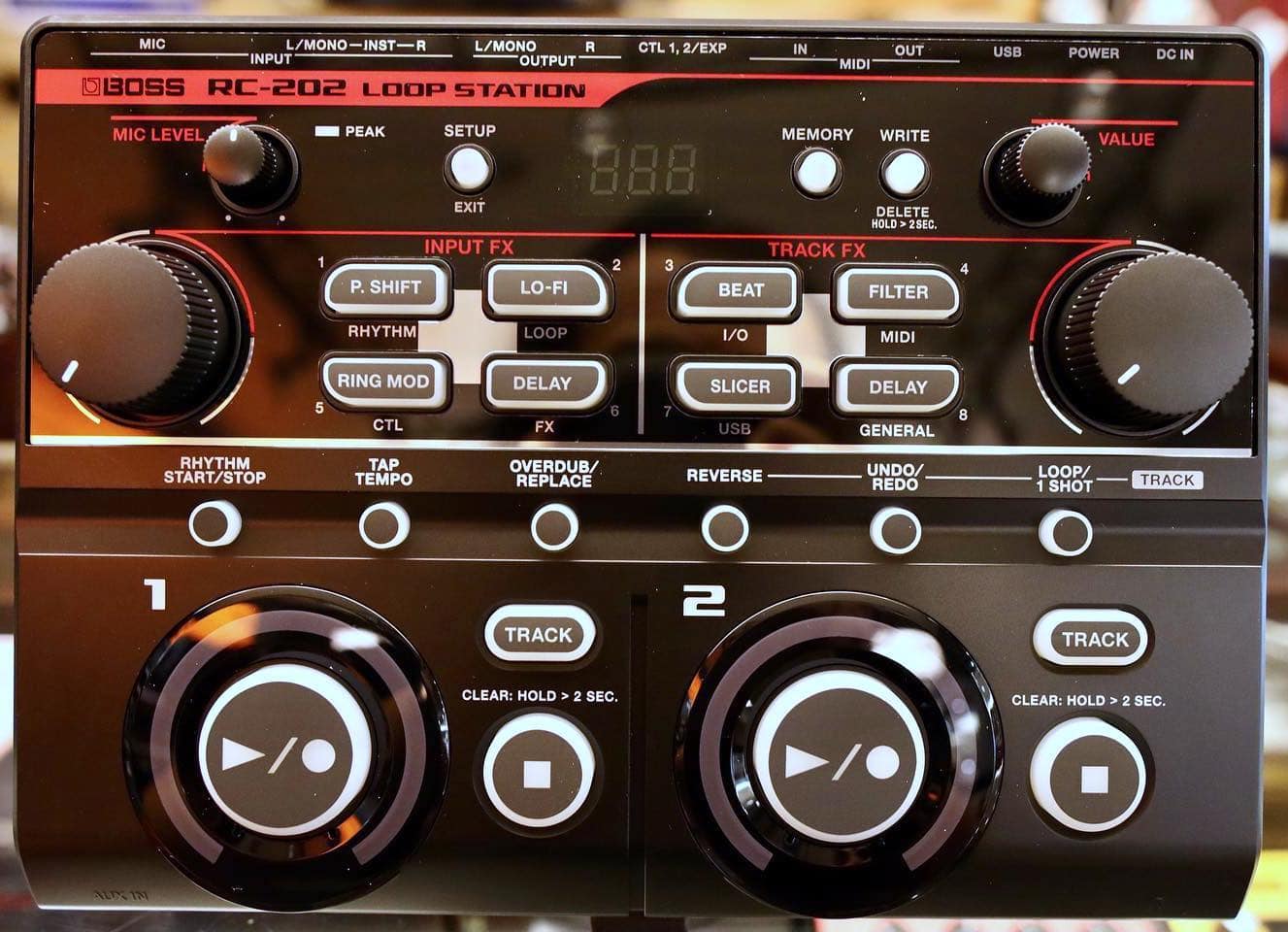
Boss RC-202
You get all the amazing perks of the RC-505 in a smaller, more affordable package that’s ready for vocalists and multi-instrumentalists.
The line goes all the way to the brand-new RC-600, a masterpiece that can accommodate a whole band, but that’s another budget, and another size.
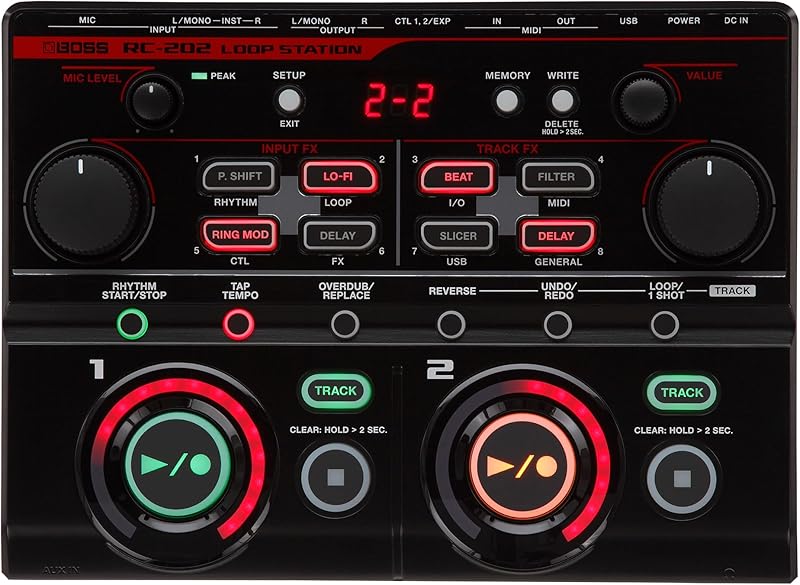
The Boss RC-202 is a two-button looper that allows you to work with two different separate stereo tracks. These tracks are accessed by the big, round switches at the front of the unit. Each track can have a distinct length, and you have a stop/clear button next to it.
Speaking of length, the red circle surrounding the switch shows you the loop progress, so you also have a visual indicator of when it starts and ends; great for overdubbing.
So, for example, I tried the common scenario, having my beatboxing/percussion/rhythm on channel one and some chords on channel two. This way, I could play and pause the chords while leaving the beat on to go into the bridge or the chorus.
Do you want to make it even cooler? Well, just engage the effects for the overdubs real time and take those powerful notes you’re singing to the stratosphere.
You can add up to 4 input FX and 4 track FX simultaneously in real time and control parameters as you go. You can also choose from 17 pre-programmed rhythm patterns which even include some odd time measures. Finally, with 8 memories containing 8 banks and the ability to import/export and connect to your favorite DAW through USB, the sky’s the only limit to what you can create.
The one thing that I didn’t like about this pedal is that there’s no XLR output option. This means you have to use a TRS cable to go to the mixing board or need to have a DI box to turn the output into an XLR connection.
I used this pedal to do some solo performances at home plugging my guitar, a synth, and my vocals, and it’s like stepping into a parallel universe. There’s so much you can do to the signal pressing a single button, you’ll be able to create and combine amazing sounds.
I especially liked the “Lo Fi” button which transforms everything into low-quality audio that sounds great when playing indie and the other weird stuff I like. Also, the delay per channel sounds amazing and adds a beauty layer to everything you do.
Finally, engaging the pitch shifter effect, I could go back and forth between bass and guitar without changing the instrument.
What Makes a Great Vocal Looper Pedal?
You’ve probably noticed from the featured pedals in this post, that there is a lot of variation between vocal loopers. Some aim for simplicity, offering only start/stop and level functions, while others are bursting with additional processing options.
The main advantage of choosing one which also has onboard effects is that it saves you from purchasing external pedals and overcrowding your pedalboard. Effects such as reverb, delay, distortion, and harmonizers are commonly included with loopers.
A second thing to bear in mind is if you need it for live performances or just for songwriting and having fun at home. For this, you need to take into consideration input/output connections, size, and weight. For home fun, you only need the most basic features and connections.
Thirdly, are you going to use it for DAW work? Some loopers, like the TC Helicon VoiceLive can apply a de-esser, a compressor, and some EQ to your voice. Going into the DAW with a processed voice tone and being able to record your performances might be the key to sounding better and uploading bootlegs of your shows.
Number four, I would say that the ease of use has a lot to do with the switches too. Having a dedicated stop switch is important for live use, because the double-tapping to make it stop is very hard to do when you’re also singing and playing. So, in that scenario, a dedicated stop switch is the best (regardless if it’s a desktop looper or a floor looper).
Finally, the audio and effects quality are also concerns for some, especially when recording live. In that regard, always try to go for 24-bit and above, which is the industry’s benchmark.
Audio Quality
This should always be your number-one priority with any pedal. The sound quality of a pedal is going to have a massive impact not just on how you feel about the pedal, but on how audiences feel about your sound.
You should especially keep in mind how the quality of sound changes as you add layers to loops. A good looper pedal won’t degrade as you add layers.
But if you notice a dip in volume, or the sound starts to become muddled and distorted as you add layers, then you should consider getting a better pedal.
Also, as stated above, the audio quality with which the pedal captures sound is important; always go for the 24-bit version when possible.
Features
Some of the features you might need are:
- A dedicated stop footswitch - This is crucial to avoid double-tapping when stopping the loop is something to look for. I know, dual-footswitch loopers take up more space but, believe me, while singing and playing, you don’t want to be tap dancing too.
- Vocal effects - Being able to apply some effects to the looping can be the key to make your performances stand out from the rest. We’re past the first quarter of the 21st century, the loopers with no effects are something from the past (unless you want to maximize space or need it just for details).
- Loop storage - The ability to store the loops you create (or the entire performance like in the VL3 Extreme) can help you as a songwriter and performer because you can improve on what you felt didn’t do right or can also use the bits you created to make songs in your DAW. Whichever the case, looper storage capabilities are welcome in vocal loopers.
Controls
You want a pedal that is easy to control during a performance. This is important for both vocalists and instrumentalists.
This is a bifurcation on the road. More controls usually mean that the pedal is bigger and takes up more space. On the other hand, fewer controls allow you to do less on the fly.
Here are some recommendations of things to look for:
- A display - This might seem as a no-brainer, but it does make a big difference when playing live. For example, the Boss wheel showing you what point of the loop you’re in at all times is a definite winner. Also, the VL3 Extreme and its larger-than-life screen make navigation much easier in a live situation.
- Handy real-time input and output levels - Live performances are like unleashing a wild animal and letting it do its thing. You just never know what’s going to happen. Therefore, to protect your ears, and your audience’s ears, being able to modify your gain and volume easily is a must.
- Effects real-time controls - I just love pedals with big knobs to play with in real time. But beyond my taste, you can do things like adding that long delay trail when finishing your chorus, or even add a little more intimacy to the slow part cleaning up the vocals. A big shout out to Zoom for including an expression pedal, the ultimate tool for playing with effects live.
Portability
If you are a vocalist, you probably don’t want to carry around a huge pedal to every gig. Moreover, you won’t want a big piece of equipment between you and the front row; it might even be an anchor undermining your live performance. In that case, getting a smaller, more compact pedal will probably work better for you.
If you are an instrumentalist and a vocalist, a larger pedal probably won’t make much of a difference and might even be necessary to accommodate both the instrument and the vocal.
Just like with the pedal’s controls, its portability will likely be determined by your overall setup. Do you want or need your pedal to be small and compact, or is something bigger not an issue?
Connectivity
This is another aspect that will be determined by your setup. If you just need to plug a mic into the pedal, then a mic input and output are all you should need. This is what pedals like the Ditto Mic offer, for example.
If you want to connect the looper to MIDI controllers, other instruments, a laptop, then of course you are going to need a pedal with the right connections. This will affect the size of your pedal as well since smaller pedals usually have fairly limited connections.
The one thing you shouldn’t overlook is an XLR output. This is crucial to avoid the signal loss of long-running TRS cables from the pedal to the PA’s mixing board.
Of course, you can add a DI Box to the equation and solve the TRS/XLR issue easily too.
Should You Only Use a Vocal Looper?
No, of course not. Just because a looper pedal isn’t designed as a vocal looper, doesn’t mean you can’t use it.
A guitar looper pedal will work just as well with vocals as with a guitar. The only trouble you could run into is with the inputs.
Because guitar pedals aren’t designed with mics in mind, they aren’t necessarily going to have XLR inputs. That just means that you will have to connect a mic to the pedal through a mixer or DI. There are TRS to XLR cables and adapters available as well for fairly cheap that allow you to connect a mic directly to a pedal.
Another thing to bear in mind when thinking about this is the mic preamp. Most of the models above are built to work with vocals and microphones, therefore, they offer a preamp that’s perfectly tailored to help the human voice sound better and richer.
A great example is the TC Helicon preamp, de-esser, compressor, and EQ you can activate with a single button.
Final Thoughts
Vocal looper pedals are a fantastic way for vocalists to add extra dynamics to their performances. They are also a great way for vocalists to express themselves in entirely new and different ways. You know how you start a loop, but you never know where creativity will take you, and, believe me, looper pedals foster creativity like few other pieces of gear.
Looper pedals are no longer something that is reserved for guitarists and bassists, vocalists are now invited to join the looping party. And if you’re an instrumentalist and vocalist, then chances for you have been multiplied by the million.
I hope this article has helped you find the looper pedal to bring out the most creativity at your next performance. I hope your audience values the time and effort you’ve put in mastering this difficult craft and the tool of your choice takes your act to the next level.
Happy (looped) singing!
