
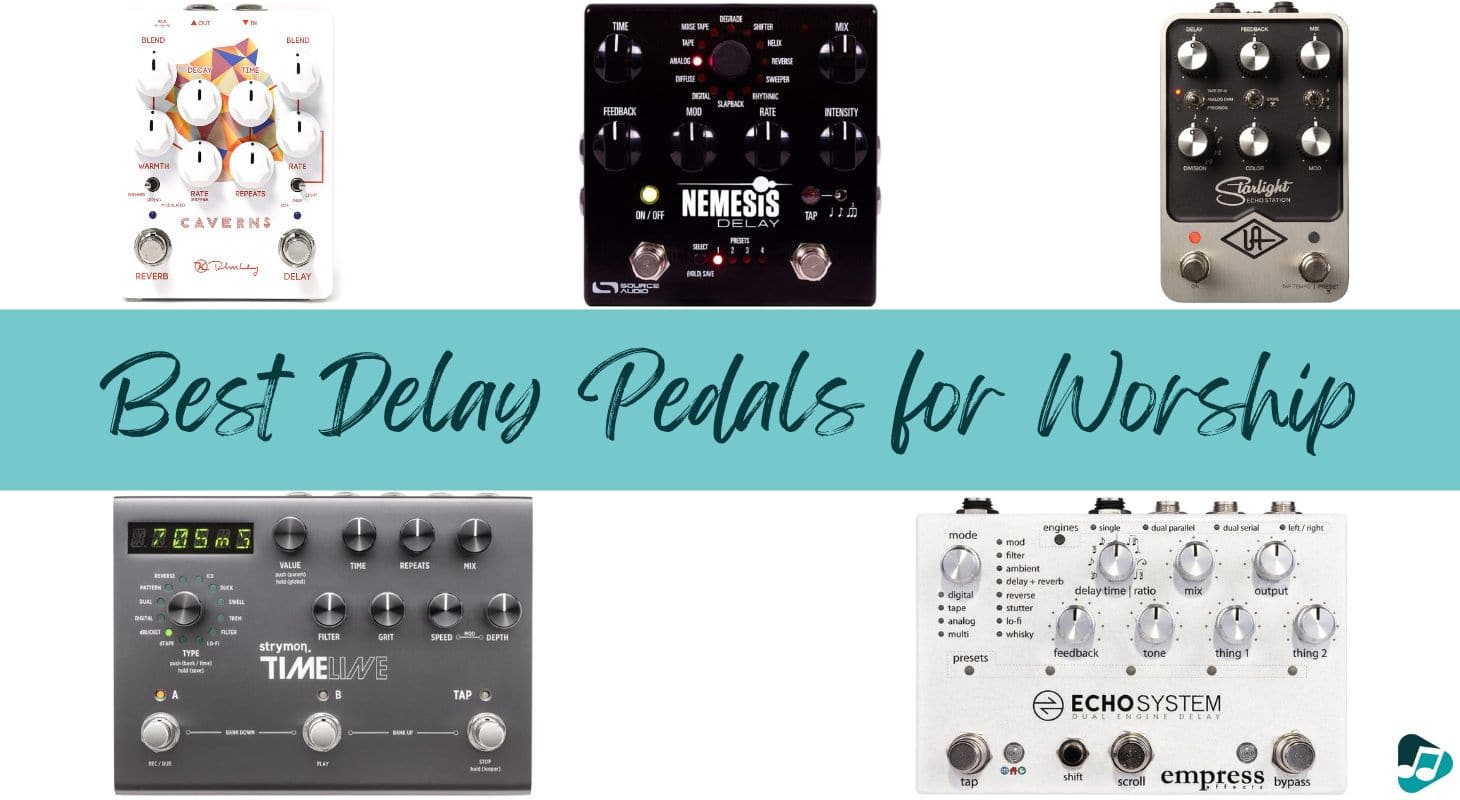
A lot of music genres benefit greatly from the humble delay pedal, and worship music is no different.
Top 3 - Delay Pedals for Worship
Preview | Product | Price |
|---|---|---|
 | ||
 | ||
 |
Many guitar players won’t leave home without their delay pedals. It can turn a dry signal into an arena-worthy lead tone, or add some push and power to a rhythm sound.
You can dial in U2-style dotted rhythms, or cathedral-level echoes, or even an old-school warbling tape echo. Delay is the secret sauce that often takes a guitar tone from good to great.
For worship players looking to enhance their sound and playing, a delay pedal could be the missing link in your signal chain. There’s no shortage of delay pedals on the market, so I’ve discussed my favorite delay pedals for worship music below.
5 Best Delay Pedals for Worship Music
1. Strymon TimeLine
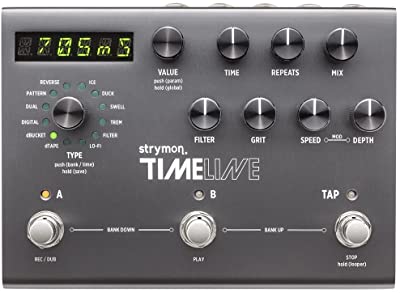
The Strymon TimeLine is one of those pedals that I think actually does more than it needs to, and I don’t mean that in a bad way.
With 12 delays, 200 presets that can also be customized, and a 30-second looper, the TimeLine goes beyond just being a delay pedal. I feel that this helps the pedal to really open up the possibilities for any worship guitarist.
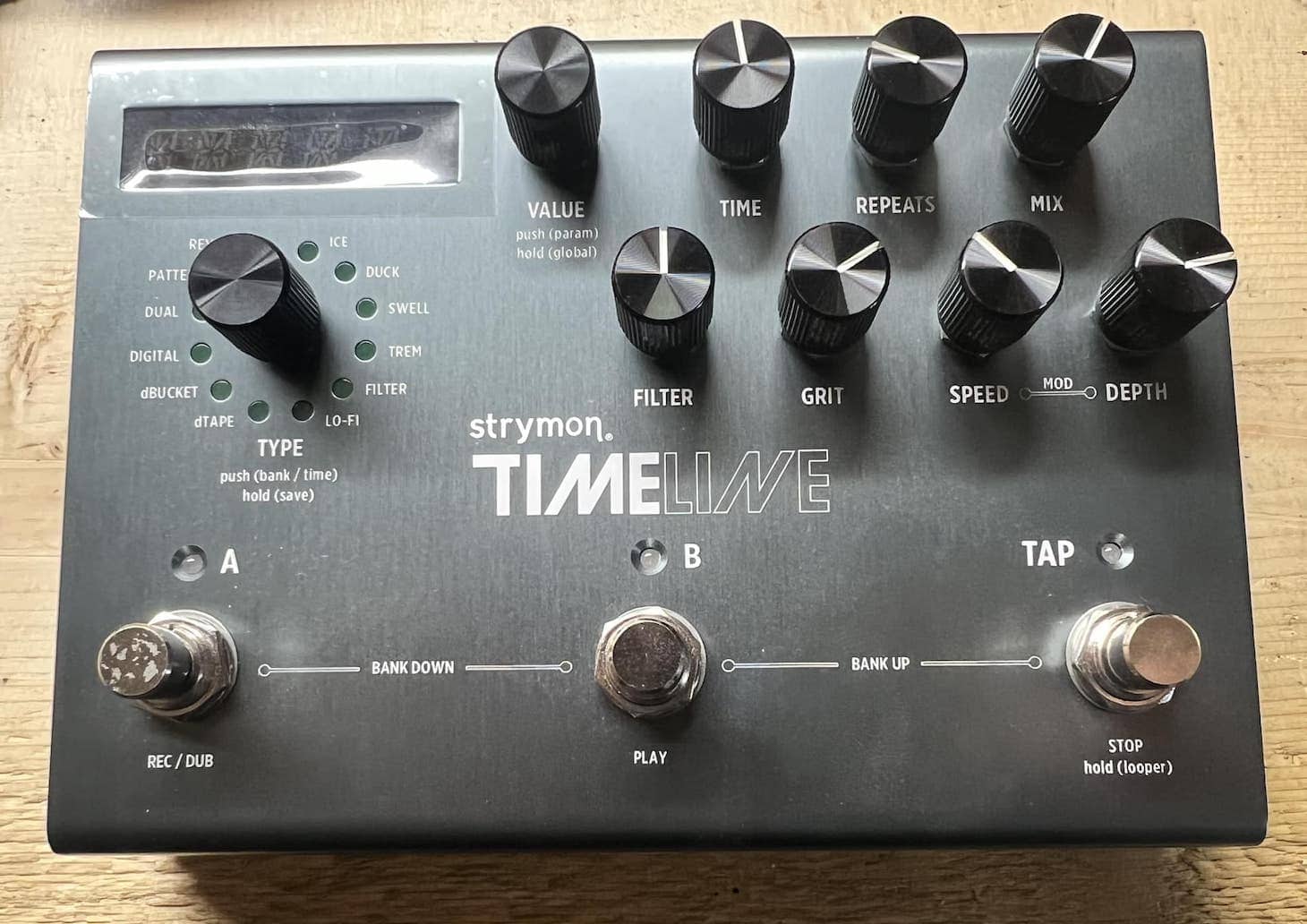
Strymon TimeLine
Allowing you to mix and match delays will really let you explore those crazy sounds you have in your head, but can’t achieve with just one or two pedals. For me, this is a great way to create those psychedelic delays that I love while cutting down on pedalboard size.
Sure, a massive pedalboard looks cool, but sometimes you just need something small that is quick and doesn’t take too long to set up. Something that I have had to contend with on occasion, but a pedal like the TimeLine helps to keep my board down to just a few necessary pedals.
The only real downside I can see the TimeLine having is just how complex it is. For new guitarists and guitarists that aren’t too familiar with pedals that have this many functions, I can see it being quite the learning curve.
I remember the first time I used a pedal with customizable patches and so many settings. It took me some time to figure out how everything worked, and I can see that happening to so many other guitarists.
This time investment can easily put some people off if all they’re looking for is a delay pedal to simply add some color and dynamics to their playing. Even so, I would still highly recommend the Strymon TimeLine.
If you’re willing to spend the time to learn how this pedal works, it can be an invaluable tool in your rig.
PROS
CONS
2. Keeley Caverns V2
The Keeley Caverns V2 is one of those dual-purpose pedals, serving as both a delay and a reverb.
I always appreciate these types of pedals more in a worship setting, since they let you cut down on setup time which often needs to be fairly quick and easy when playing in a worship band.
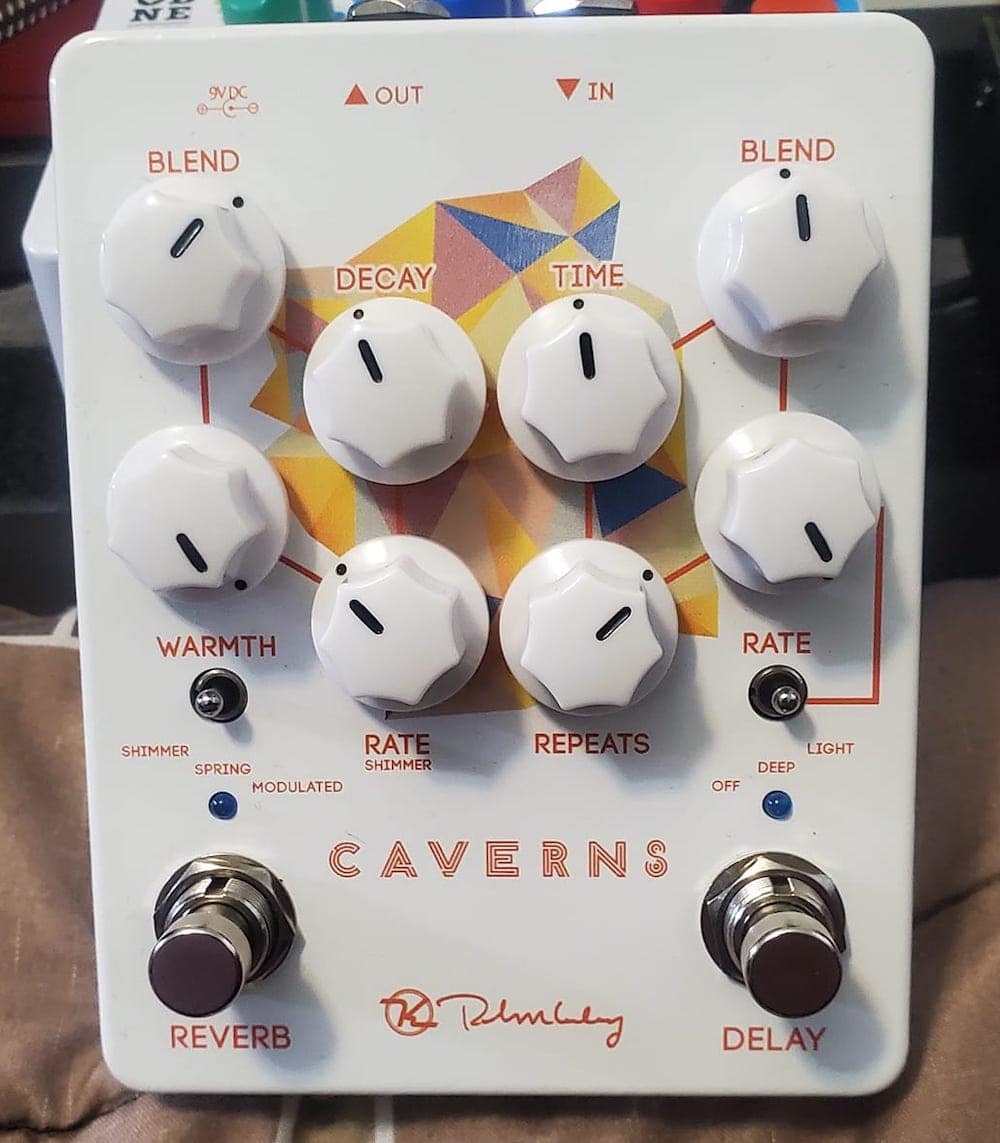
The real appeal of the Caverns V2 for me, though, is how the two sides of the pedal, the delay, and the reverb, are clearly marked and distinguishable from each other.
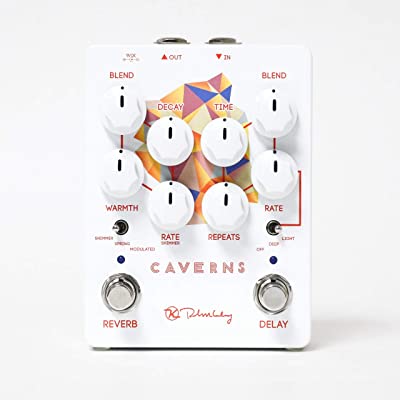
Keeley Caverns V2
The reverb side has its own footswitch with dedicated blend, warmth, decay, and rate knobs, and the delay is the same with blend, rate, time, and repeats knobs.
I like to think of it more like Keeley just stuck a reverb and delay pedal together. Having two dedicated footswitches means that you can either use the effects separately or combine them to create some really unique sounds.
On the reverb side, you also have a mode switch to select between shimmer, spring, and modulated. Shimmer gives that sort of spacey, shiny reverb. Spring is a vintage tremolo type of reverb, and modulated is a wavey, almost surf rock sound.
The delay also has a mode switch between light, deep, and off. These adjust the intensity of the modulation, with off of course being zero, light warping the delay slightly as it decays, and deep warping the decay quite a bit.
Overall, I really like the Caverns V2, from its sound to its sleek design, it doesn’t have any downsides for me. The only issue I can possibly see is that you’re only really getting one type of delay.
PROS
CONS

3. Source Audio Nemesis
Another pedal with a wide range of delay types, the Source Audio Nemesis is a great choice for worship guitarists that want to really explore the sonic limits of their instrument.
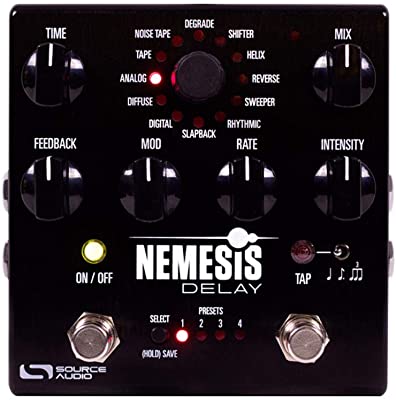
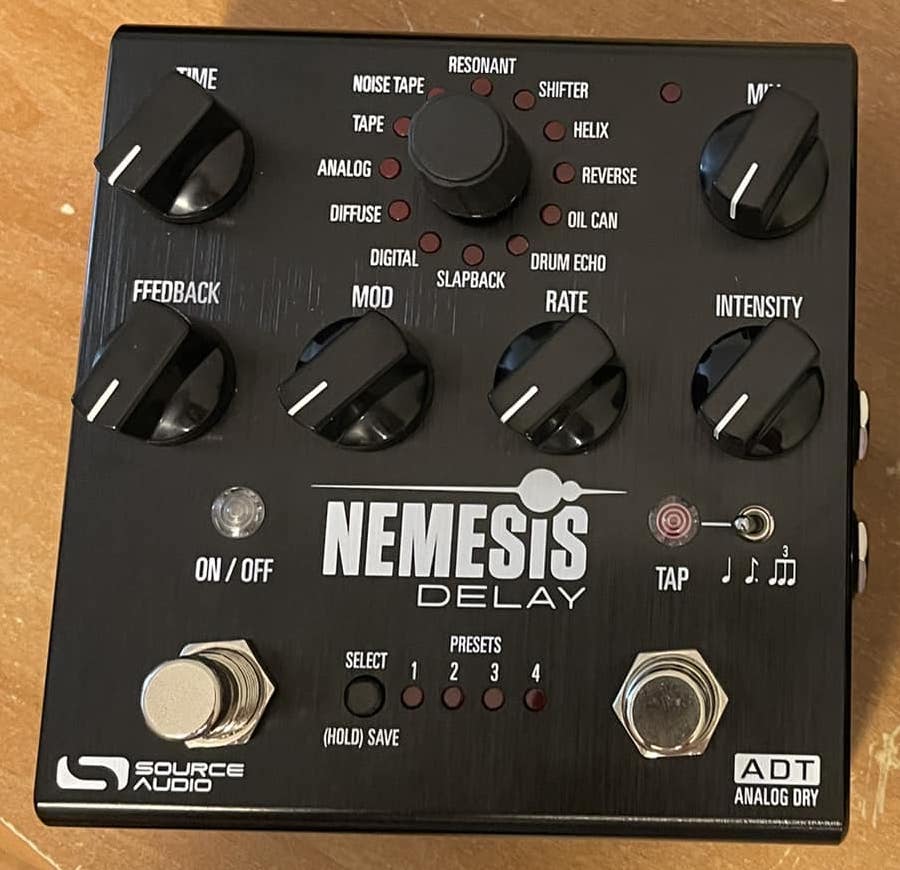
Like the Strymon TimeLine, the Nemesis has 12 types of delay that can also be combined and saved as patches that you can easily recall later. But that is about where the similarities stop.
Source Audio Nemesis
The Nemesis is fairly compact for a delay pedal with this much versatility, and that is where a big issue for me pops up. Because of its size, there isn’t enough room for even one extra footswitch to allow you to switch between saved patches.
This meant that while I was testing the Nemesis, I had to get down and press a button on the pedal to switch between my saved patches. Another problem I encountered was the fact that you can only save four presets at a time.
I find this a bit limiting, but I also see this as a potential strength for the Nemesis. Since it’s not as complex as something like the TimeLine, I think guitarists with less experience with these types of pedals will have a much easier time learning how to use the Nemesis.
I also don’t see the lack of a patch switch as too big of an issue because most worship guitarists probably aren’t constantly switching between delays during songs. Sure, these are downsides that will turn some guitarists off, but I would still easily recommend the Nemesis to anyone looking for a versatile and effective delay pedal.
PROS
CONS
4. Universal Audio UAFX Starlight Echo Station

With retro-cool looks and a clear homage to the classic space echo effect of yesteryear, the UAFX Starlight Echo is one of the most versatile and useful delay pedals on the market today.
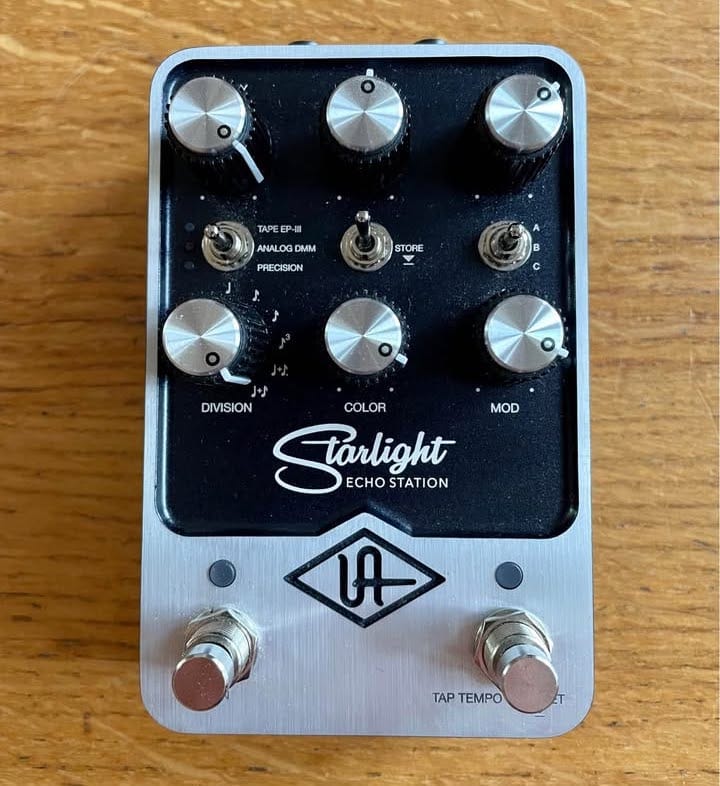
Universal Audio UAFX Starlight Echo Station
Plugged in, and not switched on, there’s no additional noise, and none of the dreaded “tone suck” of cheaper delays. That’s a2 huge bonus in my book, as I spent years playing cheaper delay pedals that darkened and dampened my dry tone simply by being in the signal chain.
I don’t love overly complicated pedals, but I very much appreciated the shallow learning curve and user-friendliness of this pedal.
The idea here is that the Starlight emulates the iconic delay sounds of the great records of the past. I hear bits of Echoplex and Space Echo, and of course the clean, crisp Digital Delay.
The presets are relatively easy to load, and, blissfully, the pedal has a tap tempo already installed. You can simply time your trails with a couple taps of your foot.
I found it very easy to switch between different delays on the fly, which I can see being very useful in a worship setting.
Let’s say you have a nice Memphis slapback for your rhythm sound, and you want something more spacious for a solo.
A simple press and hold of your tap tempo/preset button, and you’ve got your other delay setting ready to rock, already in time with the tap tempo you just set.
Pretty much every setting on this unit sounds good, but by far my favorite was the Tape EP-III, an Echoplex-style delay.
Of course, I immediately had to run through the “Ain’t Talkin’ Bout Love” riff a couple of times with that setting. You probably won’t be playing Van Halen at worship, but you can channel some of Eddie’s legendary tone through the Starlight.
5. Empress Effects Echosystem
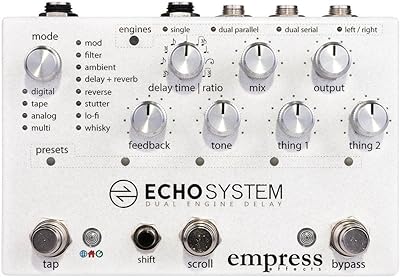
The Echosystem from Empress Effects is one of the most complex-looking pedals I have ever seen.
It looks more like something from Star Trek than something I’d have on my pedalboard, and the vaguely labeled “thing” dials do little to inspire confidence.
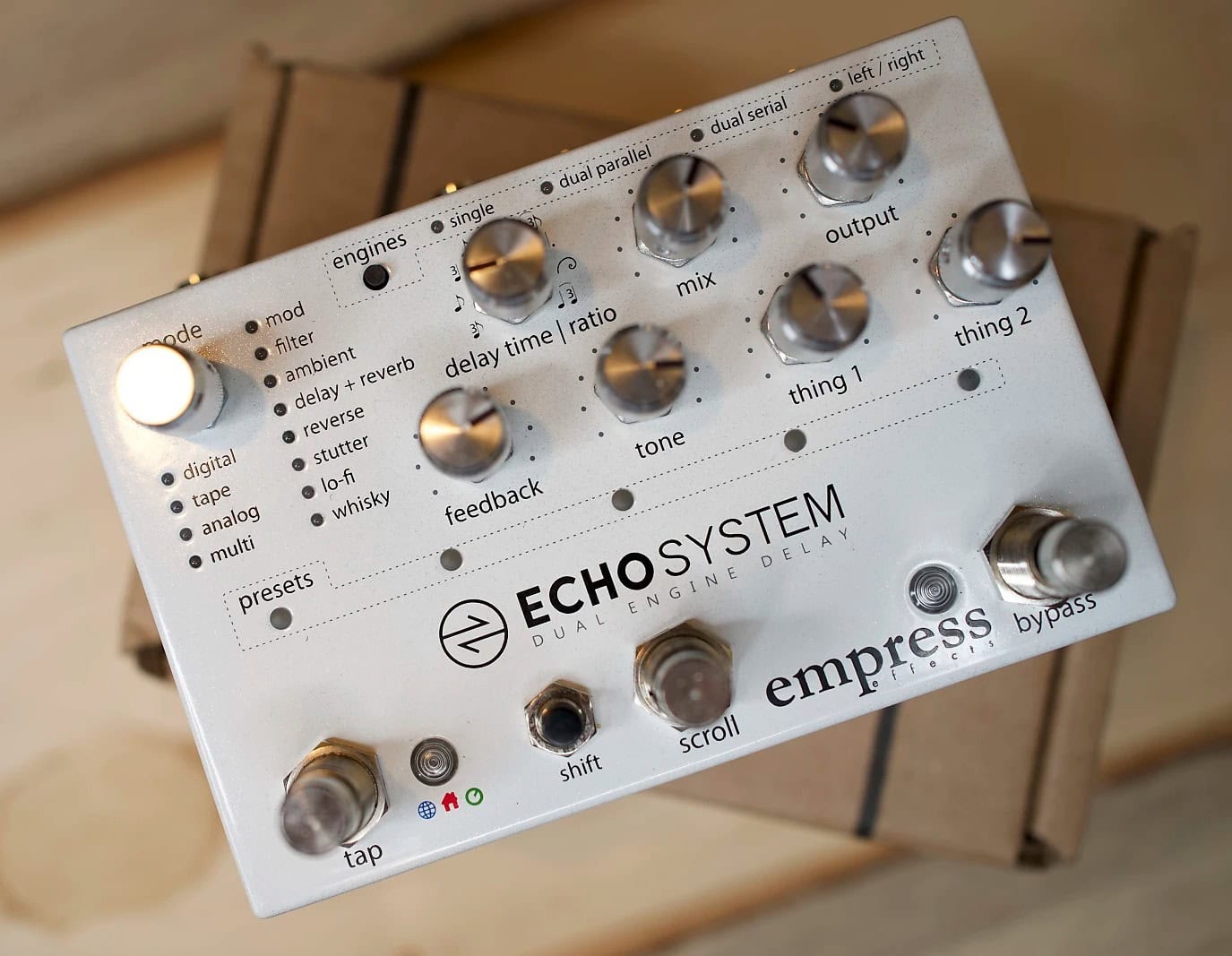
Empress Echosystem
However, the Echosystem is designed to cover more echo bases than the planet Hoth.
It’s an ultra-modern take on the echo box that I liken to the modeling amps that are popular these days, offering limitless sounds in one convenient package.
With plenty of room for presets and a wide range of delay sounds (from country slapback to wild, glitching canyons), I found myself playing with various settings for far longer than intended.
I had to keep the manual handy to really get to grips with this pedal. Once you know what the buttons do and how to make them work, the options feel limitless.
However, I’d want to spend a few hours alone with the Echosystem before taking it to worship, just to be sure.
The learning curve on this delay unit is nowhere near as steep as I feared, thanks to the easy-to-use manual and intuitive layout. The range of echo effects on offer, however, far exceed that of a standard worship set.
I can’t see many worship players using 32 different echo presets, for example. Nor can I see some of the more out-there delay options available here being useful at worship, where the guitar is primarily an accompanying instrument.
I’d recommend this pedal to a player who plays many different kinds of gigs. If you’re doing worship one day and a shoegaze project the next, the Echosystem could save you valuable money and pedalboard space.
However, if your primary gigging environment is worship, using the Echosystem will feel like keeping a Lamborghini in the garage to do the grocery shopping.
Choosing the Right Delay Pedal for Worship
I always that the gear that works the best for you really comes down to personal taste. But I also believe that some things are better suited to certain situations. Choosing a delay pedal for your worship setup is no different.
Analog vs Digital Delay
I generally prefer analog delays because I feel their sound is a bit more natural and vibrant. However, from personal experience, I have found that they aren’t the best for worship music.
That’s why I would highly recommend going with a digital delay instead. They allow you to get that nice dotted eight delay that works so well in a worship music setting.
Brighter is Better
When you play enough delay pedals, you’ll notice that some have brighter or darker tones than others. Some, like the famous Echoplex, include a preamp that affects your guitar tone.
Modern digital delays tend to offer as clean a sound as possible, but this is not always the case.
For worship playing, you want to make sure your tone isn’t too dark or muddy. You want a nice bright, uplifting sound to match the feel of the music.
You also want your echoed notes to closely match the original tone. You likely do not need trails washed in echo or with a vastly different glitchy or distorted sound compared to your base tone.
Deep and Narrow
Most of the time, you’re better off being deep and narrow than wide and shallow.
In essence, you’re usually better off doing one thing extremely well than many things poorly. I apply this axiom to many areas of my life, but nowhere does it feel more apparent than when picking out guitar gear.
A great delay pedal should just be a great delay pedal. Unless you’re already using an AXE-FX or similar unit, you should avoid all-in-one pedals.
They don’t sound as good as dedicated pedals, and they’re harder to use in a live setting, which is where you’ll be doing most of your worship playing.
You should also always go with a dedicated pedal instead of something like a Zoom 505 that’s just a sort of jack of all trades pedal. Dedicated pedals will always sound better, so get a pedal that is just a delay.
Even something like the Caverns V2 mentioned in this article that does two things really great, rather than a pedal that does a bunch of things just okay, is better.
The Right Tool for the Job
Guitar pedals are tools, and it’s all about getting the right tool for the job. How wild you’re willing to get with your worship delay settings is really up to you. However, as a general rule, with worship, the guitar is primarily an accompanying instrument.
This means that your choice of delay pedal shouldn’t be too out-there. You won’t be constructing wild, swirling delay soundscapes, unless you want to get some very confused looks from the vocalists.
Have More than You Need
Having a pedal capable of more than you need is never a bad idea. There are few things more frustrating than coming up against the limit of a tool’s ability when you just need a little more out of it.
That’s where having a powerful, versatile delay unit can be truly valuable even in a limited worship setting.
Ease of Use
The other thing I want to emphasize is how important it is that your delay be able to deliver live. That means it needs to be easy to use, and easy to manipulate live when you have to change settings on the fly.
Durability
That means it also needs to be sufficiently durable to handle multiple gigs. Worship isn’t typically a high-stress environment for guitar gear, especially when compared to other live performance spaces.
Having said that, a well-built pedal with a good chassis and quality parts - particularly switches - is a great tool that you can rely on for years to come, in the rehearsal room or at a gig.
Final Word
Whether you want to create elaborate soundscapes, or you’re just looking for a straightforward delay to add some interesting color and dynamics to your sound, I hope I have given you enough guidance to choose the best delay pedal for worship music.
Remember that the best delay pedal is one that offers a sound you love and that makes you want to play. Worship music is meant to be uplifting: let your tone hunt reflect this, and find a tone that makes you feel like the player you want to be.

Great. Throwing my Keeley Caverns in the trash now