
Tube amps are the top of the crop, la crème de la crème for guitar players. They have the tone we’ve heard in countless records all our lives. Yet, not every tube amp is created equal, they differ drastically and can give you a very different playing experience.
There are many differences in terms of their price tags in some cases as well. But does this difference translate into more reliability, better-sounding amps, or is it simply market hype granting overpriced equipment?
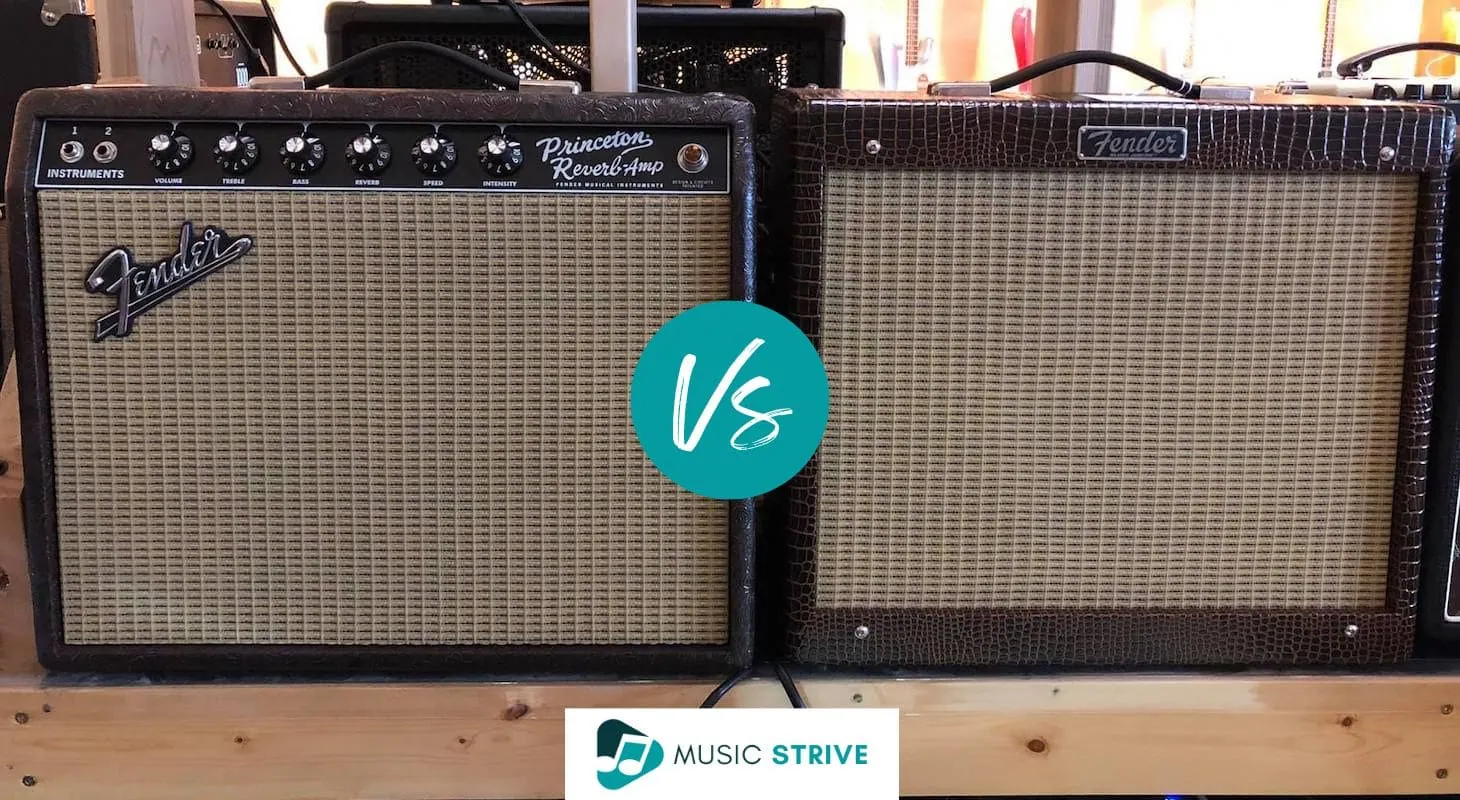
Well, this is it, the battle of the century between two of Fender’s mightiest contenders when it comes to small tube amps.
The Affordable One
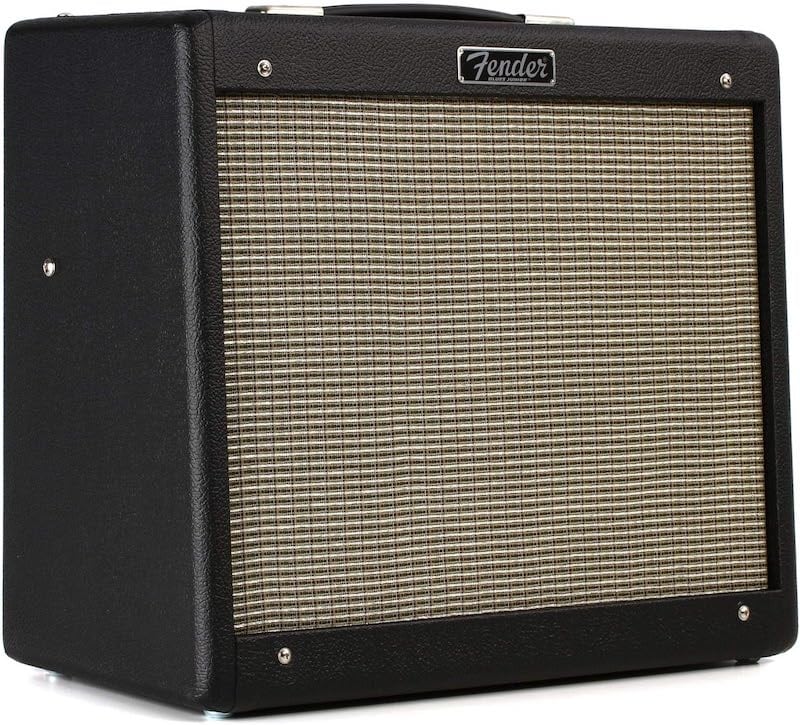
On the red corner, the Blues Jr. IV, the low budget workhorse for the working musician, the gigging guitarist, the hobbyist, and the enthusiast.
The Premium One
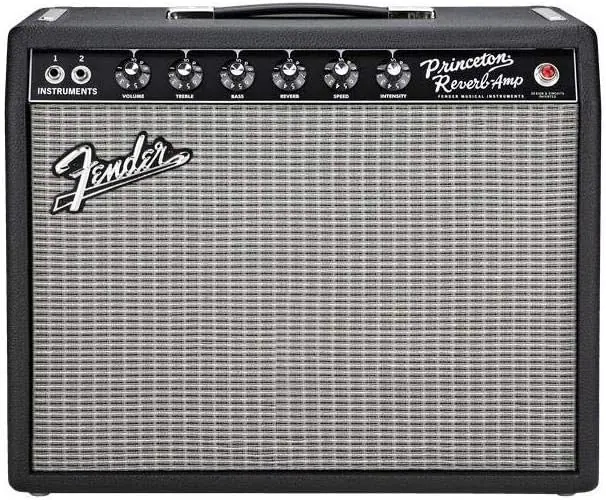
On the blue corner, the Princeton Reverb, a historic amp that’s the hidden gem connoisseurs love, play live, and that has made it to many more records any human can count.
So, how do these different Fender amps compare? How are they similar and how are they different? And most importantly, how do we choose the right one for our needs?
Let’s get ready to rumble!
NOTE: For this comparison, I've pitted the '65 standard Princeton Reverb model against the black Blues Jr IV amp. But, as you may already know, both of these amps are available in other (hugely popular) variants. Such as:
- Princeton Reverb: '65 Tweed, '68 Custom, '64 Standard
- Blues Junior: Tweed w/ Jensen speaker, Tweed w/ Eminence speaker, Western Tolex
While the basics are more or less the same, there are nuances to consider (beyond the differences in appearance, which is obvious), like the speaker brand and configuration, while picking a variant for your specific needs.
Table of Contents
Build
Both the Blues Junior and the Princeton Reverb are very well-built amps. That isn’t too surprising considering they are Fender amps.
The first difference to note is that, while the Princeton Reverb is made of birch plywood like all legendary amps from the ‘60s, the Blues Jr. IV is made of 3/4" particle board, a cheaper material used on Fender’s more accessible Hot Rod line.
Fender Blues Junior IV - Closer Look
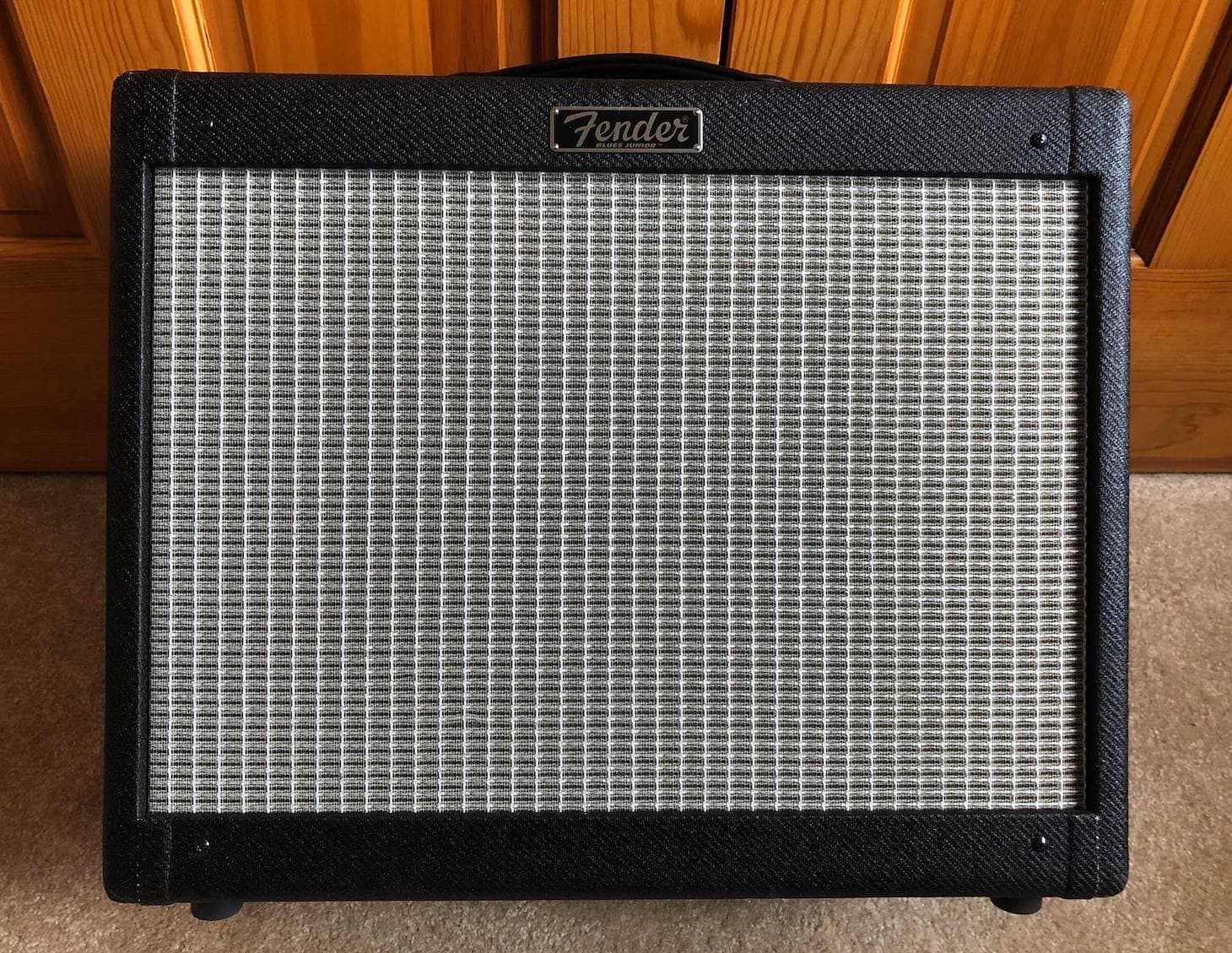
Fender amps are both sturdy and lightweight. Amps like the Princeton Reverb and the Blues Jr. IV are light enough to carry with one hand. These amps are built with traveling musicians in mind. Furthermore, one of the things Fender updated (and upgraded) for the version IV of the Blues Jr. is the handle that now looks more like that of a traditional Fender amp instead of being the unreliable rubber handle it used to be.
Both the Blues Junior and the Princeton Reverb come in many colors, including tweed and black. If you want that vintage look, then tweed is perfect.
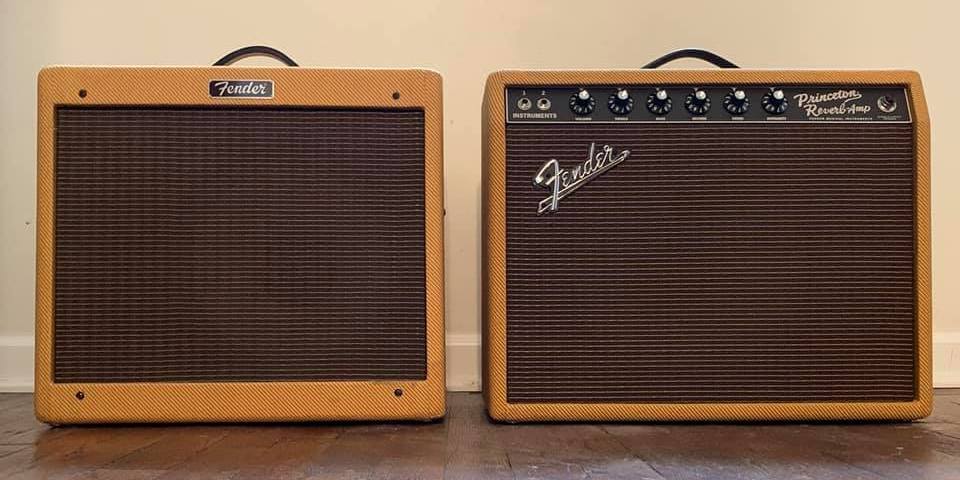
Fender Blues Junior and Princeton Reverb - Tweed
I prefer the black look as it is more modern. Black amps are also a bit more discreet on stage.
Fender often releases limited-edition amp colors so it’s not hard to find either a Blues Jr or a Princeton in your preferred color as long as you’re willing to wait a while and pay a little extra.
Design-wise, each of these amps responds to the aesthetic of the line it belongs to. While the Blues Jr. IV is typically a Hot Rod amp, the Princeton Reverb is made to look exactly like its ‘65 predecessor.
If you zoom into the details, the top-mounted chicken knobs and controls is something the Hot Rod series inherited from the ‘50s brownface amps so acclaimed by Fender lovers.

The Fender Blues Junior features top-mounted controls like fellow 'Hot Rod' fender amps. This allows easier access to the tone knobs when you're busy performing.
The Princeton Reverb is a typical Black Face amp featuring the same knobs and letterings as the Twin and Deluxe Reverb reissues. Also, the power switch is in the back along with the speaker output and the footswitch input.
I personally prefer top-mounted controls on smaller combo amps like these. It’s easier to tweak your knobs from above at a gig or rehearsal if need be.
Front-facing knobs require you to kneel or crouch to access the control panel, which isn’t always comfortable, especially on smaller stages when you already have your guitar strapped on.
Features
The Blues Junior and the Princeton Reverb are quite different in terms of features. Let’s talk about a few key differences.
The Blues Junior has a full 3-band EQ (treble, mids, bass), while the Princeton has a 2-band EQ (treble, bass).

Tone Controls on the Fender Blues Junior IV
Although this might create the illusion that the midrange is more controllable in the Blues Jr. than the Princeton, the truth is that these amps sound very different because of their speakers. While the Princeton features a classic 10” Jensen ceramic speaker, the Blues Jr. comes equipped with a modern 12” Celestion alnico speaker.
This difference in speakers affects the amp’s tone directly, and especially in the midrange. The Princeton is a faithful reproduction of the ‘65 original which didn’t have a “middle” control (neither does the Deluxe Reverb, for example). That famous “scooped” sound has personality and is the faithful representation of a golden era in Fender amplification.
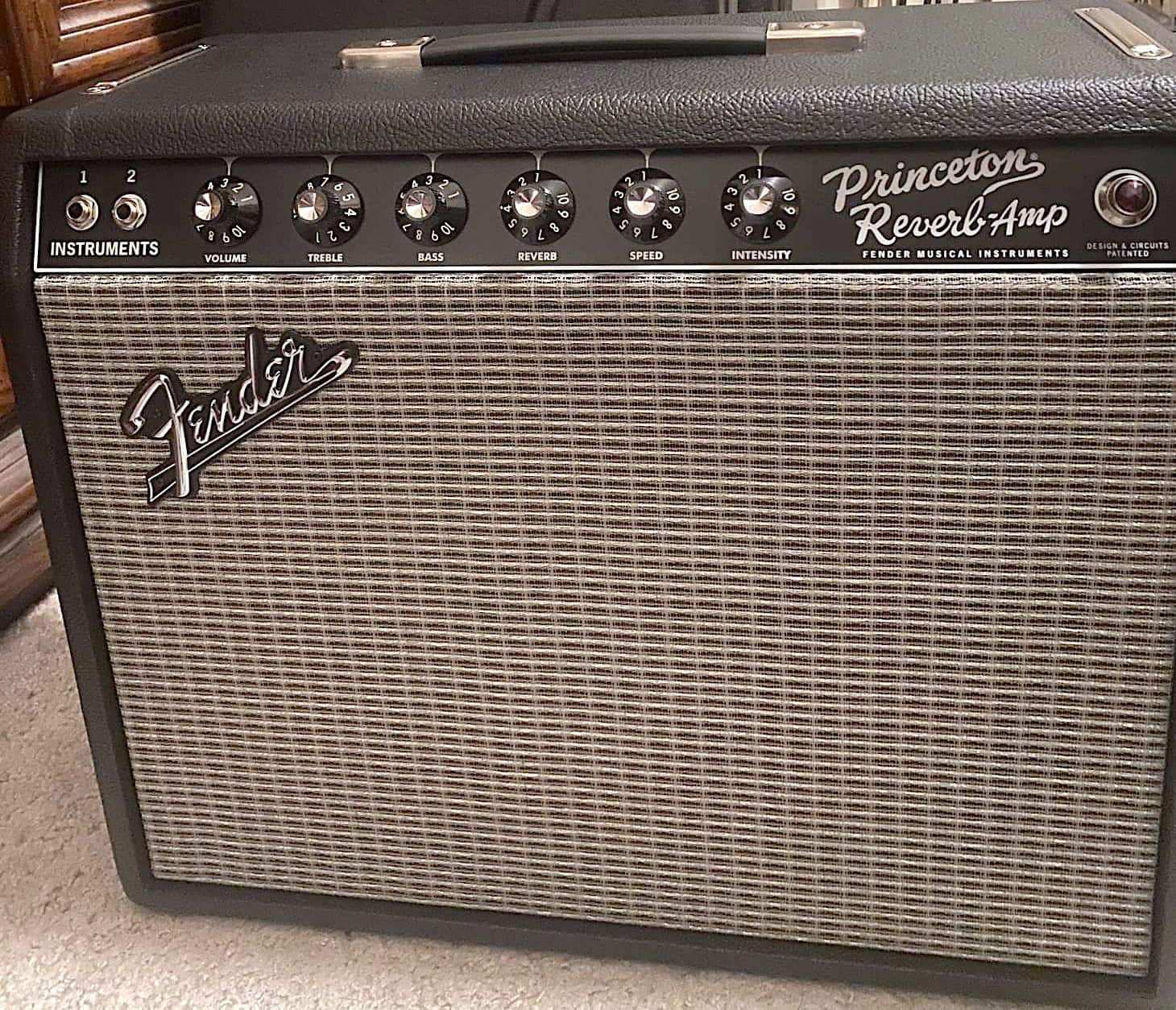
A closer look at the '65 Fender Princeton Reverb (reissue). The tonal controls lack a 'middle' knob, just like the original '65 model.
The Blues Jr., on the other hand, attempts to capture a more modern demographic not so interested in a replica of a traditional amp but in what an affordable and portable tube amp can give them. Therefore, the mids and the mid control in the Blues Jr. can help you tame a frequency that’s more present in the amp because of the speaker choice.
This difference is also found when comparing the Fender Princeton Deluxe and the Fender Deluxe Reverb.
But let me explain this midrange thing a little further.
Generally speaking, midrange is the most important frequency when tailoring a guitar sound. It’s what will help your guitar signal stand out from the drums and bass.
Consider that the bass guitar, kick drum, and toms occupy most of the low-end frequencies. Then consider that hi-hats and cymbals will occupy the treble frequencies.
Midrange helps your tone cut through in a band setting.
With the Princeton, you’ll have a compressed beast with a beautiful bright presence and a tight low end. When trying to compete with a loud drummer, that tone will make up for the loss in the midrange, don’t worry about it.
Since it doesn’t have a master volume and a preamp control, the only way to get that compressed sound is by cranking the volume. Also, at 12-watts, to play with a loud drummer you’ll need to go above 8 or 9 for sure.
The Blues Jr., on the opposite corner of the ring, is a master volume amplifier so you can push the gain through at any volume level and have similar natural compression even playing at home at mild volume.
This might be the biggest difference in terms of features between these amps. The master volume and gain knob structure in the Blues Jr. moves away from the traditional ‘60s audio and makes the amp a tad more versatile in any modern situation.
The Princeton, without a master volume and a separate gain knob, requires volume to get to the edge-of-breakup or natural overdrive status. If you’re a gigging musician, you know that there’s an increasing volume limitation in most venues that would prevent you from pushing your amp’s volume up.
Well, that’s covered with the Blues Jr. Furthermore, it even comes with the “FAT” switch that allows you to add an extra gain stage to the sound. This is close to what you’d call a two-channel configuration like you’d find in modern amps. This is a feature you can also activate with an included footswitch.
The difference between the power amp overdrive and natural compression of a pushed Princeton Reverb and the preamp gain and compression of a Blues Jr. is something we’ll discuss in the “tone” section. So bear with me.
Speaking of tone, also, it’s worth noting that the Princeton Reverb is a classic Fender 6v6 powered amp and features a 5ar4 rectifier valve in its circuit. The rectifier valve is only there to transform AC into DC but it affects tone and makes the amp much more reactive to your playing style.
Without going too far into nerd territory, let’s just say that the valve rectification gives the PR that traditional “sag” we love so much. What’s sag? It’s the rectifier valve not being able to cope with the gain coming and being inefficient. This causes the smoothing of the high end and that beautiful broken tone.
Also, the 6v6 power valves in the PR are the US version of 7.5-watt power valves. They have a characteristic sound that’s the clean and punchy sound of an era. You can think of The Beach Boys, the late Beatles, or even current legends like Ryan Adams or Mike Campbell.
The Blues Jr. doesn’t have valve rectification, it uses a silicone rectifier (known as solid-state rectification) that’s infinitely more efficient in delivering power but that sounds nowhere as magical as the PR does. It will give you a more consistent tone that’ll be the same every night but won’t sag.
Also, and this was a bold move by Fender, the Blues Jr. utilizes a pair of el84 power valves. These are commonly known as the British version of the 7.5-watt power valve. How so? You might ask while scratching your head with the pick, well, they’re the ones at the heart of the iconic Vox combo sound. The AC-15 uses two and the AC-30 packs four.
This gives the Blues Jr. a somewhat raspy, not-so-bright, more rocking tone, especially when pushed.
Also, a big difference is in the reverb. While both amps have great reverb units, the Princeton Reverb offers a valve-driven reverb circuit with a single 12at7 dedicated to reverb and tremolo.
This gives the amp the lush, wet, expansive reverb sound that’s so characteristic of the ‘60s Fender amps. The Blues Jr., on the other hand, has a nice spring reverb that’ll add some nice room to your playing but won’t sound “wet” as the PR.
Finally, the PR packs that swampy blues tremolo that can be warbly enough to inject psychedelia and 3D tones to your playing by just dialing the right amount. The Blues Jr. doesn’t have a tremolo circuit.
The Princeton Reverb also has two instrument inputs. This doesn’t change much in terms of controls. It is really more of a convenience to make swapping guitars and jam sessions easier.
Back in the ‘60s, it wasn’t uncommon for multiple guitarists (and sometimes even the singer) to plug into the same amplifier at rehearsal or a gig. That’s less common now, but multiple inputs remain on some vintage-style amps of that era.
Tone
The names of these amps describe quite well what they do and the type of tone you can expect from them. The Blues Junior is, of course, a blues focused amp. While the Princeton Reverb is the reissue of a Fender ‘60s classic.
That is a bit of a simplification and from my experience, these amps are capable of more than what their names would suggest.
In terms of clean tone, both amps are fantastic. Both have very bright, shimmering cleans that are almost a staple of Fender amps.
The Blues Junior doesn’t sound quite as bright to me as the Princeton Reverb. There is certainly a bit more warmth to the Blues Junior’s tone.
As said above, this is a combination of the speaker and valve choices made by Fender in both these amps. The el84s and the 12” alnico speaker in the Blues Jr. will give you something closer to a “brown tone” that’s instant rock and roll and not so country and surf-oriented as the PR is.
You would think that, with this sort of ultra-clean sound, both amps operate as excellent pedal platforms. Well, you’d be right about that with the Blues Jr. but the Princeton is a different animal. With the 10” speaker and the scooped, super-bright, and resonant sound, the PR has a little too much personality to be a good pedal platform.
No matter what you throw on top of it, it will retain its character and tone. That said, when played clean at a low volume, you can get some believable sounds with pedals like distortion and fuzz. As soon as you put it past 5, though, you start feeling the amp’s tone prevails over the pedal.
The Blues Junior, on the other hand, embraces pedals and works great as a base to sculpt your tone over.
Guitar players who prefer to get most of their tone from their pedalboard rather than their amp will appreciate the spanking bright, midrangey, and hyper clean tones that they can get from the Blues Jr.
Pushing the amps into their distortion ranges things become even more interesting. Both amps have a nice, natural crunch, but the Blues Junior is much muddier and, well, bluesy.
The difference between preamp overdrive and natural compressed power amp overdrive is a big one. These two amps could be used to demonstrate that difference.
With the gain knob below 3 and the volume knob below noon, you can drive it to get a beautiful broken sound that’s as glassy as it is raspy too.
Beyond that, the Blues Jr. has that typical grainy, thick, midrangey tone that’s usually closer to the rocking tones of British brands. Plus, the master volume and gain knob combo allow you to play with gain before cranking it.
For example, I was able to play some believable rocking tones like Ritchie Blackmoore and Jimmy Page with a Strat and a Les Paul respectively at moderate volume.
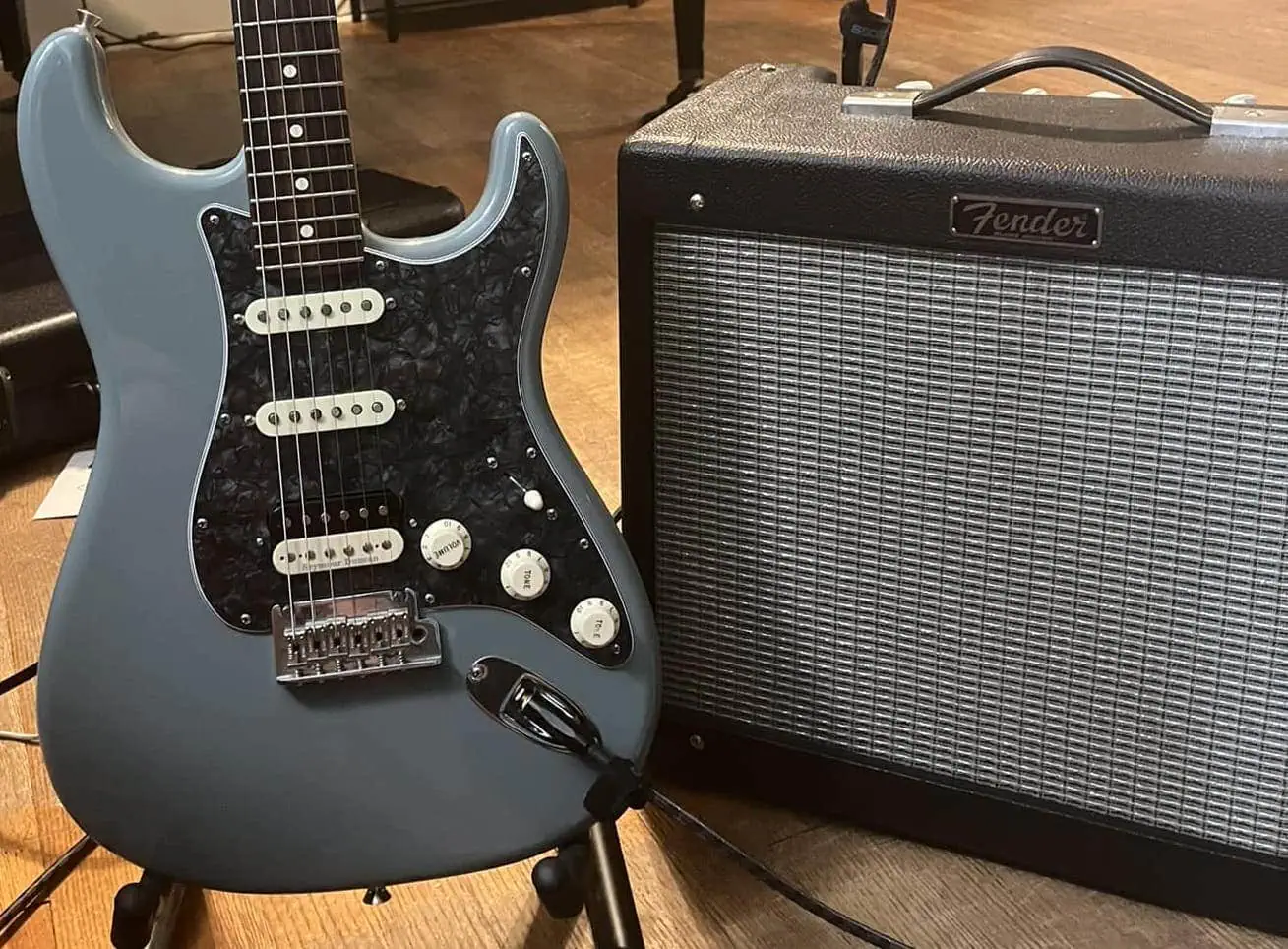
My Fender HSS Stratocaster next to the Blues Junior.
Yes, cranking the gain knob and engaging the FAT switch takes you a little further than just overdrive territory.
Furthermore, cranking both knobs you can play some thick tones that resemble that ‘70s heavy rock and roll explosion of big bands breaking charts, records, and rocking arenas.
The Princeton has a much twangier drive. The Princeton also sounds a bit more aggressive to me than the Blues Junior once it is at full drive.
By full drive I mean the volume knob above 8. Opposite to what happens with the Blues Jr., the PR sounds more organic, compressed, and punchy. Moreover, the level of clarity the PR maintains from pristine-clean to full-on roaring is something the Blues Jr. can only dream of.
Whichever guitar you plug into a dimed PR, what you’ll get is the character and sound of that instrument amplified and taken into a raunchy, cristaline yet utterly distorted tone, that can bring down a wall with chords that are heard to their last nuance.
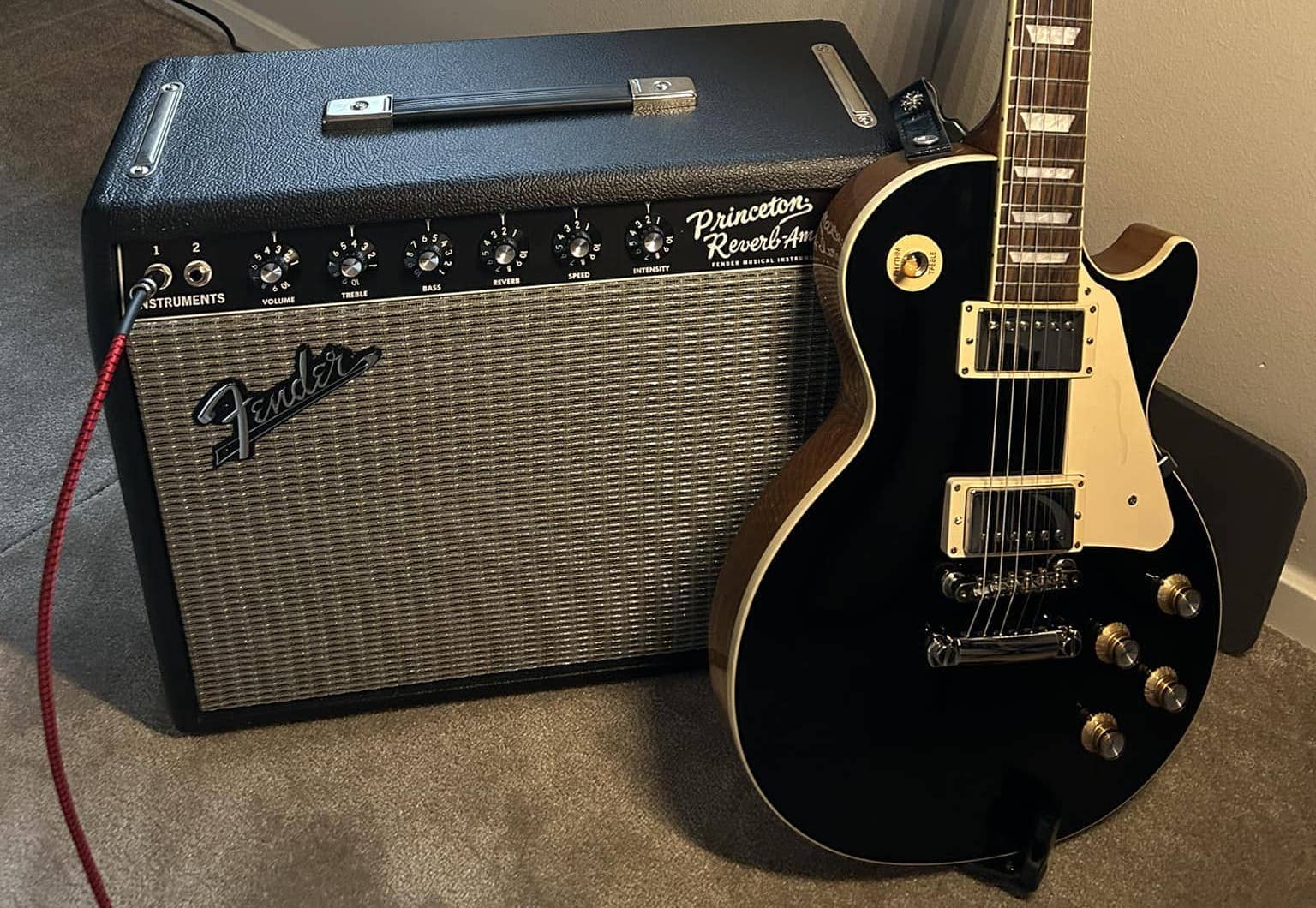
My Gibson Les Paul plugged into the Fender Princeton Reverb '65 reissue.
You can think of the sounds of Johnny Marr, some broken tones like Keith Richards, Eric Clapton, or John Mayer in its sweet spot. Beyond 7 or 8 you can think of Pete Townshend, Billy Gibbons, and Mike Ness to name just a few. That classic, thick and bright quintessential pushed Fender audio and it’s effortless for the PR.
The catch here is that you can’t get those tones unless you can really push the volume and when you do that, you’re limited in your gain options unless you’re very well-versed in the arts of the volume knob for clean and dirty sounds.
That might not be possible in many venues and you’ll end up putting gain stages between the amp and the guitar that’ll bring you closer to the Blues Jr. sound and its preamp dirt.
The Blues Junior does start to distort at lower volumes than the Princeton because of the gain and master volume tandem. But the Blues Junior also offers an almost immediate switch from clean to overdrive called FAT, while the Princeton has a transitional twangy area before going full crunch.
In my opinion, that’s where the Princeton Reverb sounds best is in the edge-of-breakup, its sweet spot. Just at the edge of overdrive, harder-picked notes sound driven and softer-picked notes sound sweet and clean.
Don’t get me wrong, the Princeton also offers crisp, precise country-style drive as well as the swampy blues drive. But when you push it to the sweet spot, the nuances and complexities of the tone are so amazing you just can’t stop playing.
You also aren’t limited to the tones on the amp. The Blues Jr. works great as a pedal platform, much better than the Princeton. That said, both of these amps work really well with practically any pedal at a low volume. I have tested a variety of pedals with these amps from fuzz, overdrive, phasers, delays, and didn’t find any that didn’t sound great.
Especially with the fuzz, I could play some early Black Sabbath, like the riff to “Paranoid” and “Iron Man” on both amps with great results. Although the PR’s personality will always shine through, before breakup is a good amp to play pedals through.
Finally, you’ll read and hear a lot about the Blues Jr. sounding nasal and boxy and it’s all true. But that depends on the guitar you plug into it and what you’re looking for. If you compare it, like we’re doing here, with an amp twice its price and with such an open, vibrant, brilliant sound with so much presence, you’ll feel it a lot.
That said, it makes a terrific first approach to tube amps, a great bedroom practice amp, and especially an amazing touring amp.
So, to summarize it, the Blues Jr. is a little more versatile in terms of available tones, especially at a low volume. It’s useful for bedroom practice and home recording. The PR, on the other hand, shines way beyond the Blues Jr. capabilities but it requires more volume to do so.
Volume
While the Blues Junior is a 15-watt amp and the Princeton Reverb is a 12-watt, you might assume that the Blues Junior is the louder of the two. But interestingly, that doesn’t appear to be the case, at least not to me.
Remember that guitar wattage doesn’t always translate to volume. A 100-watt amp isn’t 10 times louder than a 10-watt amp.
The difference between 15 watts and 12, in terms of volume, is really so minimal that the two numbers may as well be identical.
In this case, the amplifier’s speaker array and construction have a far more pronounced effect on the amp’s volume than its wattage.
The Blues Junior isn’t louder than the Princeton, and in fact, I think it might even be a little bit softer. This is likely due to the Princeton’s size as well as its open back design.
The Blues Junior is also an open back, but much less than the Princeton. The Princeton’s opening is also right over the back of the speaker, while the Blues Junior’s opening is at the bottom of the cabinet.
This allows more volume to escape out of the back of the amp, making it louder overall.
The Blues Jr. feels and sounds a little smaller because of that boxy effect while the Princeton is surprisingly loud for its size and wattage. Plus, because of the valve rectification, what you get is a roaring effect when you push the amp beyond its limits giving you the feeling of playing through a bigger amp.
Finally, the master volume and gain knob with a FAT switch available in the Blues Jr. makes this amp much more versatile than the PR, especially at lower volumes.
Final Word
In my opinion, if you’re a gigging guitarist who will spend its time going from bar to bar risking your amp to beverages spilling over, faulty stage construction, and the hardships of the road at an underground level, I would say go for a Blues Jr.
If you want a good first valve amp, a warm-up amplifier, or an amp that sounds great at bedroom volume, I would say go for the Blues Jr.
Finally, if your budget is tight and you’re looking for a reliable, good-sounding valve amp to play clean and dirty under a grand, I’d say Blues Jr.
On the other hand, if you’re looking for a great tube amplifier that can take your sound to the next level, and want stellar reverb and tremolo to go with it, I’d say Princeton Reverb.
If you’re looking for an amp that you can carry on one hand but can be a do-it-all studio weapon that can provide stellar, pristine-clean yet three-dimensional clean tones with drippy reverb and that can be a mean machine cranked giving you that power amp compression and sag we know and love, I’d say Princeton Reverb.
Finally, if you’re in the market for a good, classic tube amp that’s below two grand but that offers elite-level components and tones, then the Princeton Reverb is a great choice.
There isn’t really a right or wrong between the Blues Junior and the Princeton Reverb. It is really more a question of do you want a versatile amp that can do a wide range of sounds, or do you want something a bit more focused on doing one thing really great.
Either way, both these amps are excellent choices that won’t let you down, no matter what.
So, after a very tight fight I declare this a technical tie with one winner, you.
Yes, Fender offers you two amazing amps that can help you in different moments of your career and to do different things. So, try them and decide which one best adjusts to your needs, and let me know in the comments what you think of them!
Happy (Fender tube amp) playing!

Excellent write up!
My buddies and I know all this already (I’ve been building tube amps for 60 years), but Santiago has put it all into words perfectly.
The Blues Jr has a Master volume control that the Princeton does not have. So theoretically you can crank the volume up to 10 for max overdrive and set the Master to a low number to not blow out your ear drums. But I found the distortion at any setting not to be very pleasing with the Master choking the speaker output. But make no mistake. These amps are damn loud. Anything over a 2 or 3 and your ears will bleed.
The wattage of the amp has no bearing on its volume, only how quickly it breaks up. However the smaller speaker in the Princeton is more likely to affect perceived volume, although of course it depends on the speaker (plus there are Princetons with 12″ speakers as well as 10″). But as you suggest the more open back does counter this somewhat.
I just bought a Blues Junior tweed used from my favorite music store in NH on black Friday. I get a great tone out of it. I’ve brought it to a jam three times and so far it blows the room(s) away. Anything past 2 on either volume and I’m being told to turn it down. Then again, I’m playing a Gibson Les Paul thru it. Anyway, I love the amp. If I were a working musician I would gig this one and retire my Hot Rod Deluxe.