
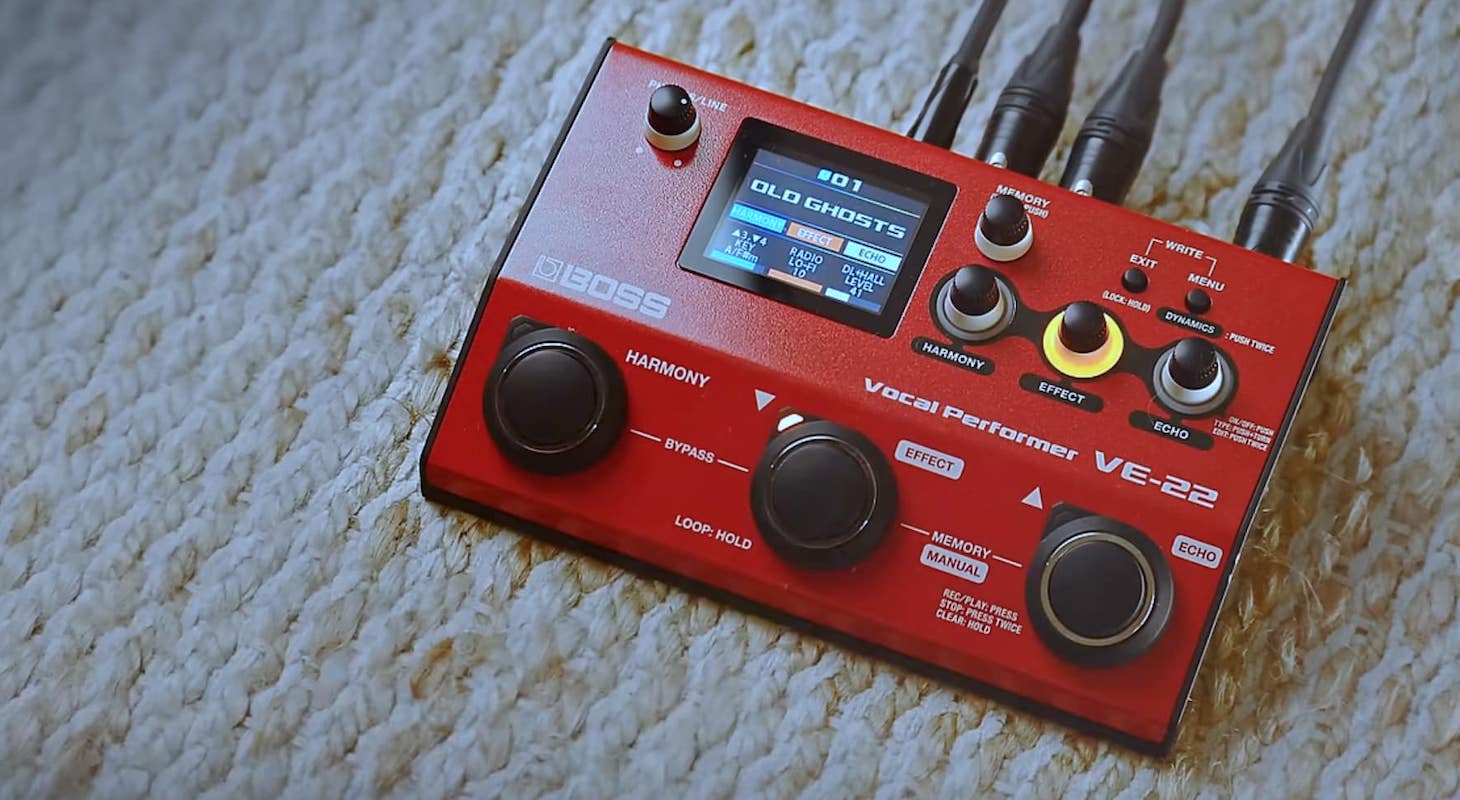
It’s not common to find a single piece of gear that can address all your needs. Most of us have to drag pedalboards around with different gizmos that do a part of the job. Well, after fine-tuning it for years, the VE line by BOSS is finally a one-stop solution for singers.
But that’s not all, because although this is a performance-oriented device, there’s much more than meets the eye here. This is an outstanding studio companion, gig pal, and practice buddy that will keep you singing and improving for a long time.
I used and abused this pedal in every situation I came across and, although not all is good news, most of it surprised me for the best.
Come with me into the deepest review you’ve read so far about this unique vocal processing unit that will turn into your best friend in no time.
Quick Take

The VE-22 is surprisingly handy for gigs, practice, and even recording — it does more than you'd expect, even if it’s not flawless. Overall, a solid all-rounder for vocalists who like keeping things simple but effective.
Let’s Get the Technical Stuff Out First
I know, you’ve read this mumbo jumbo everywhere but understanding the technical side will help us address why this unit is a game-changer for singers, beatboxers, rappers, and public speakers.
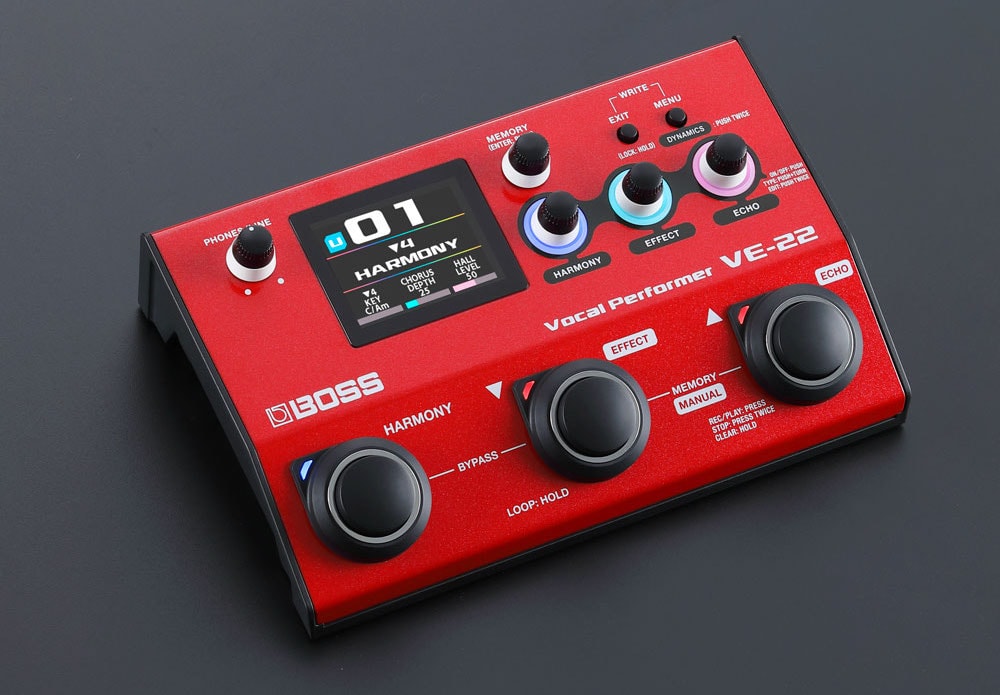
BOSS VE-22
To begin with, it weighs under a kilo and features a rugged, steel construction that’s ready for the hardships of the road. Even if you would sing your way through D-Day in WWII, the VE-22 would land in Normandie safe and sound.
Also, the AD/DA conversion is top notch at 32 bits. The sample rate, at 48 kHz, puts the VE-22 right up there with the best in the market.
The unit comes with 50 factory and 99 user presets, a 37-second looper, microphone preamp, and sensitivity adjustment as well as phantom power. This means you can plug in a multiplicity of microphones and always get the best results.
Finally, with 39 effects to choose from and a streamlined, easy-to-navigate user interface, you’ll find your imagination to be your only limit.
OK, now that we got all of this out of the way, let’ go into the juicy stuff. These are the chronicles of a singer trying his best and being helped by cutting-edge technology to reach his best version.
It Shone In Live Shows
When I say that this pedal shone, I don’t mean it in a metaphorical way, although it did shine in a metaphorical way too. But the one thing that separates this pedal in a live situation from all of the competition is the huge, full-color LCD display.
It’s priceless to look down and know that your settings, bank, and parameters are exactly what you need them to be. It’s a confidence booster, and you know that confidence for a live singer is half the match. When you think you won’t hit a note, you probably won’t; the opposite is also true.
But that’s not all, because I did many things with this pedal while playing live.
For starters, something nobody talks about is how useful it is to attach an expression pedal to this thing. I know, it’s one more thing to do while singing, but bringing up the echo as you’re going into that epic note at the end of the chorus and letting it fill the room is a great thing to do.
Also, modifying the intensity (or rate) when using modulation effects in real time or the mix when using reverb can give your signing way more dynamics.
Generating momentum has never been easier.
I just loved the compressor and the de-esser in this unit. They allowed my voice to cut through the mix even when playing in a band with four harmonic instruments (guitar, guitar, keyboards, and bass). The compression feels natural, gives your vocals a punchy edge, and also propels you forward like a turbo engine.
We’ll get to this in a few paragraphs, but using the looper live for the drummer’s endless preparation time between songs or the guitarist’s tuning moments, proved super useful. Yes, I did this melodic bits that worked great to keep people engaged.
Finally, I did put together my song list with one bank per song, and the ability to turn on and off every effect within a bank was great to be in manual and bank modes at the same time. You can spend time dialing everything perfectly during band practice and then do some crazy on-the-fly adjustments live.
Yep, that’s the perfect way to shine in a live situation: Giving it your all.
The Magic Number Three
Everything in this pedal revolves around the number three. The good news is that the user interface is so streamlined you need nothing but what you see to control each parameter.
The three footswitches turn on or off the harmony, effect, and echo sides of this unit. This is something you can do in manual mode while using this pedal as a chain of effects. But if you are in bank mode (which means you can set everything up per song), you can use the knobs above to turn on and off the same items.
So, while on bank mode, you’re also in manual mode.
This is very useful from a harmony perspective. Although it doesn’t automatically chooses the key to harmonize (you have to set it yourself), you can set a bank per song with its specific key. I had three songs in Am, two in D, and one in G. So, I set up the banks for those tonalities and then pushed effects on and off using only the knobs.
This thing really shines as a performance companion, you can do a plethora of things with your vocals. Also, results are always musical, sound good, and cut through the mix.
A Great Studio Pal
Besides using this pedal in a few live performances, I used it to replace my audio interface going straight into the computer using the USB Type-C connection.
The results were outstanding. Plus, with the knobs and the screen I also recorded a performance. AKA, me tweaking the knobs while recording to make dramatic shifts within songs, experimenting, and… well… having fun!
Let me break it down in more detail.
The DAW Needs Some Help
Pitch-correction, de-essing, and compression are tricky things in a home studio. If vocals are far off, you get all sorts of artifacts along with the correction that sound bad. Well, you can really help your DAW if your vocals hit the program with a de-esser, a pitch shifter, and studio-grade compression. That way, the work you have to do with your favorite plugins is minimal, avoiding unwanted noises.
Hey, the better the source material, the better the results, right? Yeah, mixing the best of both worlds is usually the recipe for success.
Shortcuts to Save Time
I have my vocal chain set up in my home studio. That said, every song I tackle is different and moving tiny wheels with my mouse every time I attempt a new tune steals precious time (besides being annoying, very annoying).
Well, the VE-22 is a shortcut that allows you to track great vocals that can then be perfected in the DAW.
Also, the mic sensitivity dial, phantom power, and compression allow the use of any microphone in any situation. Boy didn’t those vocals shine after plugging my condenser in.
So, the VE-22 is way too much for just shortcuts in your home studio, but it’s a great way to take your favorite sounds (the ones you used on the record!) to sing those tunes live.
Consistency is always the name of the game, and this unit helps consistency a lot.
Working My Chops with the VE-22
I loved two features from the VE-22 especially to work on my chops as a singer.
The Old & Trusty Aux-In
The first is a no-brainer, the aux-in to sing over backing tracks. I do this with the songs I’m working on the DAW. I export them fully produced but without vocals and work my parts singing them over and over again.
I mean, convincing band members to play a chorus five times so you can get every note right isn’t feasible in most bands (not in mine, at least). I spent hours singing and listening back fine-tuning to the last detail.
Looping My Way to Stardom
The second is looping. Looping is fun. That’s the first thing to say. I mean, building musical pieces using just the voice for drums, instruments, and melody is a trip. Well, the 37-second loop built in this unit is great for that.
There’s one big flaw that doesn’t make it very live-performance friendly: The impossibility to undo or redo your last recording. That’s a big miss by BOSS. BIG MISS.
Other than that, if you build stuff using just vocals, you’ll be able to perfect your register by nailing the notes exactly and listening back for discrepancies.
Believe me, it’s a fun way to work on your chops. Practicing had never been this fun for me before.
My Verdict
In my opinion and experience, the VE-22 is BOSS’s best vocal performer so far. This isn’t something I write lightly and is a quality that makes the VE-22 a contender for the pole position as the best vocal processor in the market right now.
It works great for singers as a live tool, studio help, and a practicing hub. You can get creative and create patches from scratch or use one of the 50 provided to modify it a little and make it more vibey for your voice. I loved the lo-fi, robot, oldies, and I loved messing with the mic’s gain settings in the menu to record some ASMR sounds effortlessly.
That’s not something I recommend doing live, btw.
My Honest Take
I would say that, as long as you can afford it, there aren’t many other units out there that can match this unit’s performance, features, and specs. In other words, you can’t go wrong with this pedal.
That said, I have to add a couple of things before ending.
First, the looper undo/redo function is a must and is missing here.
Second, the unit does come with batteries but it doesn’t include an adapter. For the price on this thing, I’ll just say: Shame on you, BOSS, shame on you.
Finally, MIDI implementation would have been great. This would allow us all to share the same tempo for everything in the band.
I recommend the VE-22 for the serious gigging musician or public speaker. Also, if you have a small home studio, processing vocals with the VE-22 can change the way your tracks sound drastically.
Try one today, you might end up taking one home.
Oh, and buy a power supply, you’ll need it.
Happy singing!
