
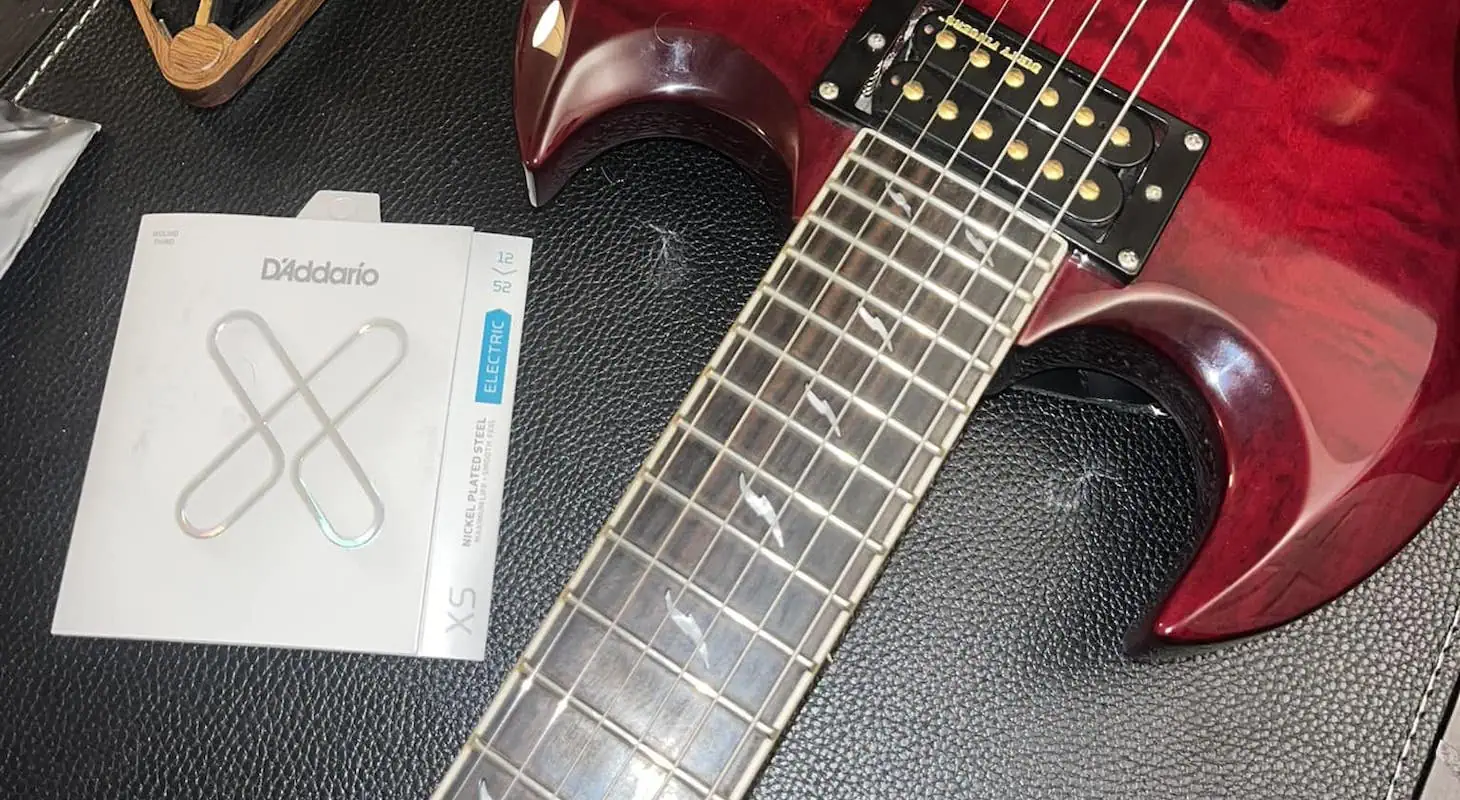
With so many different string brands on the market today, it can be a bit confusing to decide which strings to go for. And even when you have decided on a brand, which series of strings do you pick?
Often times the names given to each series of strings aren’t all that helpful. Such is the case with D’Addario.
With names like XT, NYXL, and XL, how do you tell the difference? What is the difference?
Fortunately for you, I’ve been playing D’Addario strings for years, and use them on my guitars to this day. In this article, I’ll go over the major families of D’Addario strings and their various features.
Table of Contents
Which D’Addario String is Which?
D’Addario’s electric guitar string lines come in a few major families:
- XL
- NYXL
- XS
- XT
The XL line will be most familiar to experienced guitar players. It’s graced the shelves of guitar stores for as long as I can remember.
These were D’Addario’s original flagship product. The original D’Addario string featured nickel-plated steel, rather than the pure nickel or pure steel construction of earlier guitar strings.
The XL series is also the most varied of D’Addario’s electric guitar string products, with various iterations of the line including pure nickel, “pro steel” and “chrome” strings.
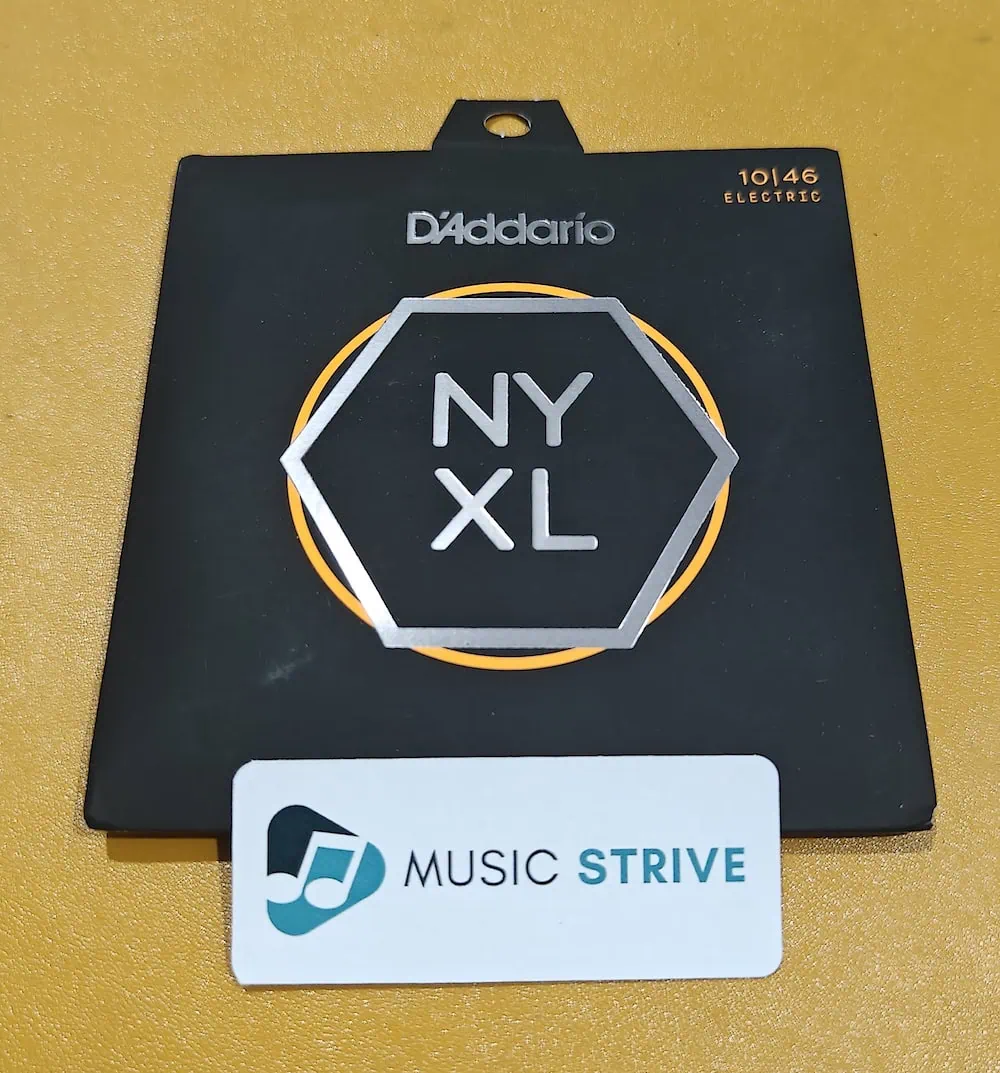
The NYXL line, introduced in the mid-2010s, was D’Addario’s redesigned string, with a reformulated nickel-steel alloy. These strings were louder, brighter, and more durable than the previous XL line.
The XS and XT lines are D’Addario’s coated strings. These strings feature a corrosion-resistant coating to improve string life and minimize breakage.
I mostly use the XS strings on all my guitars these days.
Construction
XL
The XL series features a carbon steel hexagonal core with a nickel-plated steel winding. The string was launched in 1974, and the standard line of XL strings persists to this day.
D’Addario uses a special steel they call “NY Steel” for their hexagonal string cores, and a patented winding named “Fusion Twist” for the winding around the core.
There are many variations on the XL string’s construction.
- XL Nickel Wound: the standard-issue XL string, as introduced in 1974. Steel-and-nickel construction.
- XL Half Round: the halfway point between flatwound and roundwound strings, using D’Addario’s usual steel-and-nickel construction. This line of strings is mostly for jazz players who don’t like the slick feeling of flatwound strings. D’Addario polishes these roundwound strings for a smoother finish. When I play them, I notice much less friction and string noise from my left hand. However, they lack the darker, warmer tone of true flatwound strings.
- XL Pro Steels: all-steel construction, with no nickel. The wound strings are wrapped in stainless steel, rather than nickel or an alloy.
- XL Chromes: D’Addario’s flatwound string. Stainless steel flattened ribbon wrap wire is wrapped around D’Addario’s hex core, then polished.
- XL Pure Nickel: the old-school guitar string. D’Addario’s hex core is wrapped in a nickel wire, emulating the kind of string that was commonplace before nickel-and-steel construction took over the market.
NYXL
The NYXL uncoated strings feature a different steel alloy than the flagship XL series. The hex core is made from a high-carbon steel wire, while the nickel plating uses a different formula than the typical XL string. Supposedly, this endows the strings with more durability and elasticity.
XT
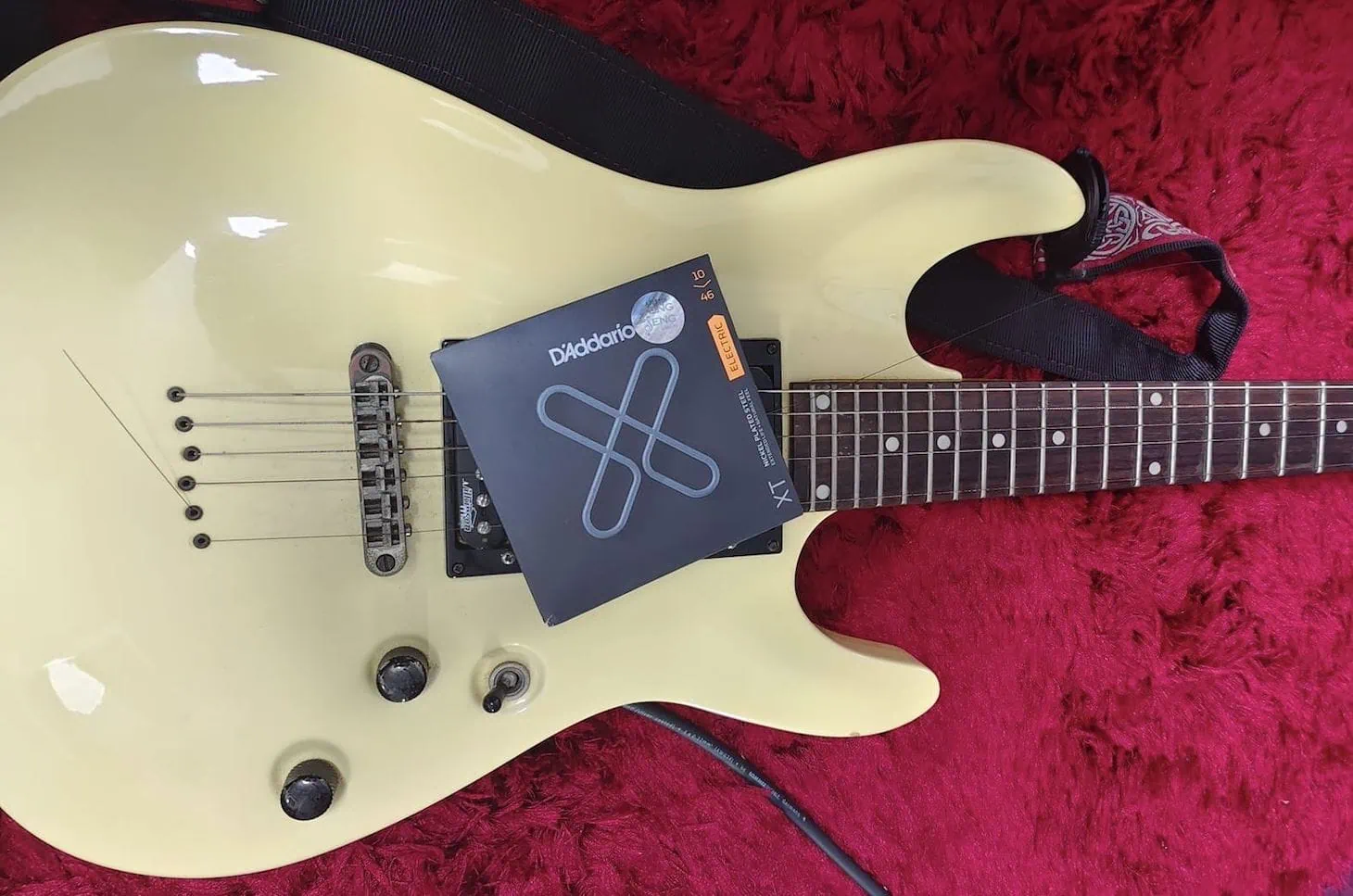
D’Addario XT strings.
The XT series has the same core and winding as the XL series. The only difference is that it also has a thin corrosion-resistant coating covering the strings. The coating is so thin that I barely notice it!
XS
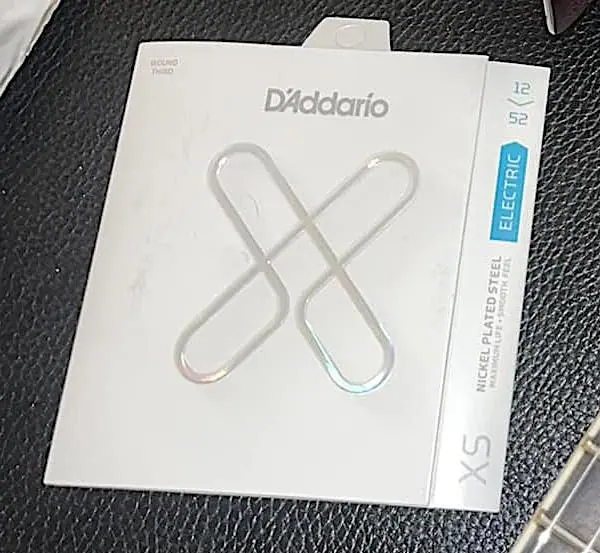
My string of choice, the D’Addario XS is the other coated string in the family. The coating, while still extremely thin (that is, ten times thinner than a human hair), is more noticeable than on the XT. Otherwise, it’s D’Addario’s usual construction: “NY Steel” core with nickel winding.
Strength and Lifespan
Because all three series use the same hexagonal core, their strength and tension are very similar. All of these strings are more than capable of taking a real beating.
Of course, not all strings are created equal. D’Addario’s XS strings, for example, maintain their brightness and character for much longer than their uncoated XL strings. I can usually get through three or four gigs on one set of XS strings with only minimal loss of tone by the end of the final gig.
The XL series is, broadly, about the same in terms of strength. The pure nickel strings degrade more quickly than the others. The flatwounds and half rounds aren’t quite as strong for bends as roundwound strings. The pro steels don’t offer much difference in terms of strength and lifespan compared with the other strings from the XL line.
I remember trying out NYXLs a few years ago, and marveling at the extreme bends they were capable of delivering without going out of tune. Just to try it, I managed to bend the string up two whole tones without the string feeling like it was about to break. That’s some serious durability.
Although I don’t play a whammy bar-equipped guitar, a friend of mine does. He only uses NYXLs on his Floyd Rose-equipped shred machine because of how well they stay in tune despite his most extreme whammy bar abuse.
Fresh out of the packet, even with heavy strumming, picking, or bending, none of these strings ever feeling like they are about to break. They also stay in tune no matter what. Even heavy whammy bar movements aren’t enough to make any of these strings go out of tune.
I should note that enough use will eventually dull and break even the most durable string. Hot, sweaty gigs, temperature fluctuations, and harsh playing technique will shorten your strings’ lifespan.
Lifespan is where the biggest difference comes in between these series. While all three can last for long stretches of time, they aren’t all made equal.
If you’re a regularly gigging player like me, you won’t get much more than a week out of most guitar strings. Bedroom players doing an hour or less per day will get more time from each set of strings than I do.
In my experience, D’Addario’s XL series has the shortest lifespan of their entire lineup. They’re still fairly durable, but they’re not as strong as the NYXLs, XS, or XT strings.
The NYXL series has a much longer lifespan than the XL series. This is thanks to the better nickel winding on the strings. You can read my full review of the NYXL strings to know more about the kind of situations they went through without letting me down.
This winding gives it extra strength that makes it more resistant to wear and tear. A set of NYXL strings will easily last twice as long as XLs. Depending on how often you play, they can even last three times as long. These strings will dull more quickly than the XS or XT series, but in my experience they withstand some pretty serious abuse without breaking.
The XT and XS strings tend to maintain their tone and character for a similar length of time. Neither is particularly prone to breakage. I thought, for a couple weeks, that the XTs might be more breakable, but it turned out there was a small burr on the bridge of my 335. Once I fixed that, I tended to get about the same amount of playing time out of the XS and XT strings.
Even though they have the same winding as the XL series, their coating gives them a major advantage over both the XLs and NYXLs.
This coating makes them much more resistant to corrosion. The oil and sweat produced by your hands are the biggest factor when it comes to your strings’ lifespan. But having a coating on your strings, even a very thin one, can significantly improve how long they last.
The XS and XTs can last up to four times as long as the XLs, and twice as long as the NYXLs.
However, it’s worth noting that the XS and XT series cannot handle nearly as much abuse as NYXL strings. They don’t maintain pitch with extreme bends or dive bombs as reliably. Likewise, they don’t stretch quite as far, and I find it harder to unleash extreme bends with them.
Feel
This is another aspect where the XL and NYXL strings are fairly similar, but the XS and XTs are very different. The main reason for this is the fact that the XLs and NYXLs are uncoated, while the XT and XS are coated.
Uncoated strings will have a rougher, more natural feel. Coated, on the other hand, are much smoother and therefore, more unnatural feeling.
Within the XL series are a few different strings, all with corresponding adjustments to feeling.
Their Chrome series, for example, is a flatwound string, with a slicker feel. You get virtually no friction under your fingertips with these.
The Half Round series offers a similar experience, albeit with a little more “grip” under my fingers.
The Pure Nickel XL strings feel softer than the normal XLs, and the Pro Steels feel a little tougher. It’s not enough to significantly affect your playing experience, but as a matter of personal preference, I prefer the Pure Nickels.
NYXL strings feel pretty similar to the standard XL strings. I feel a little less pull and tension when bending the NYXLs compared to the XLs, but that might be a placebo effect.
The XT strings feel a little smoother than the NYXLs. There’s still an appreciable amount of friction and grip under my fingertips, but I can still tell that these are coated strings.
I often describe the XT series as the least coated-feeling coated strings.
D’Addario has kept the coating as thin as possible. This makes them feel not too smooth, while also keeping them feeling as natural as possible.
The XS strings do have a noticeable feeling of the coating, but it’s not nearly as much as with other brands. It’s the classic slightly-slick feeling of coated strings, but the coating is so thin that it doesn’t make the strings feel overly slippery. I’ve also noticed that this feeling helps reduce fatigue in my fretting hand over the course of long gigs.
Sound
Sound is where these strings differ the most. Each has its own unique tone, determined by the way they are made and whether they are coated or uncoated.
XL
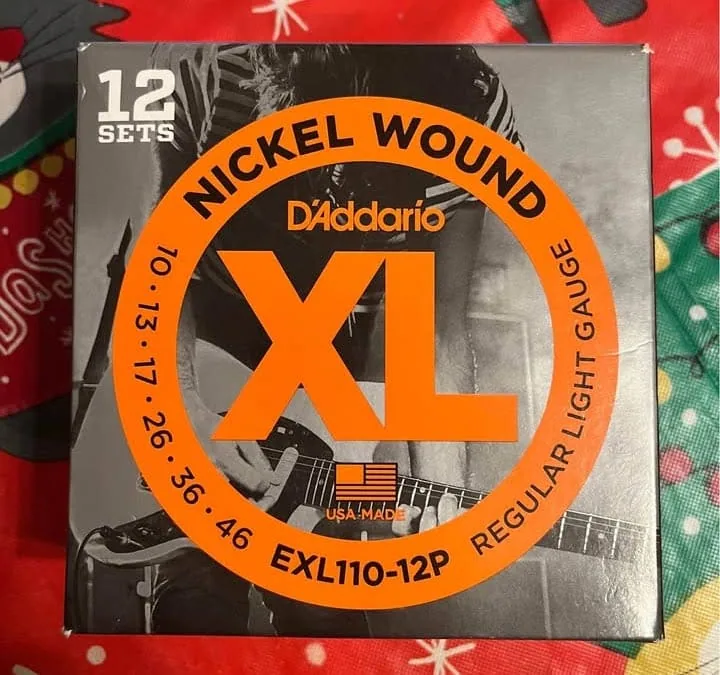
D’Addario strings are generally quite bright. The standard-issue nickel-wound XLs are no exception. The nickel-wound XLs and Half Rounds sound very similar, offering a bright, mid-forward tone.
They have a very nice top-end, with a punchy, tight attack. They are also able to mellow out quite a bit on a clean tone, providing a beautiful, warm sound when played more delicately.
You can play just about any genre with XL strings. You’ll find leading guitarists in every genre using them, from funk maestro Nile Rodgers to Anthrax axeman Scott Ian. Many of these players also dabble in the NYXL strings.
The various XL strings do boast different characters, however.
The Chrome flatwounds and pure nickel strings have a much mellower tone than the standard nickel-wound strings. These sound great for jazz and blues playing, or for rock guitarists who prefer a warmer tone.
The brightest, most aggressive tone on the standard XL line tone belongs to the Pro Steels. I’d happily use these in a country band or a rock band.
NYXL
The NYXL sound is similar to that of the standard nickel-wound XL, turned up to 11. The first time I put NYXLs on my 335, it was noticeably louder, even without plugging the guitar in. It’s upon plugging into an amplifier, however, that these strings truly shine.
The NYXLs are clearly designed to work great on electric guitar.
They are brighter, with a much more aggressive midrange. They aren’t as warm as the XLs but have a lot more volume and weight.
NYXL strings also have more sustain than the XLs. And while they do have a great clean tone, they are much better suited for high amounts of gain and distortion.
The NYXLs handle saturation much more comfortably than the XLs, sounding great through my cranked Marshall Plexi.
I’d highly recommend these to hard rock and heavy metal players.
XT
The overall tone of XT strings is a bit more rounded than the NYXLs. They aren’t as punchy, but that is likely due to the coating that does still dull the sound a little bit.
While these aren’t as loud or powerful-sounding as the NYXLs, they offer plenty of character and respond very well to adjustments in my playing. Harder playing yields brighter tones. Softer playing, and fingerstyle, offers jazzy warmth.
Jazz players will find plenty to love about these guitar strings.
XS
I use D’Addario’s XS strings on all my instruments. I find the tone to be most similar to the XL strings, although they maintain their fresh-out-of-the-packet brightness for far longer.
I’d recommend the XS strings to players in pretty much any genre. I personally use them mostly for rock and country playing.
Price
As you might expect, the construction and materials of strings have an effect on the price. D’Addario strings are no different and each of these string series does differ in price with the exception of the NYXL and XT strings.
The XL strings are the cheapest, at around $6 per pack. The biggest factor in the price is likely the less advanced winding compared to the NYXLs.
Surprisingly, the NYXL, XS and XT strings are actually priced similarly. Both cost around $13 per pack. My best guess is that, even though the XTs are wound the same as the XLs, their coating is what pushes the price up to the same range as the NYXLs.
If you’re interested in purchasing a single set and still get free shipping, you can order from Sweetwater. What’s more is that they add free candies to every order. Here are the Sweetwater product links for (Amazon links in brackets):
Final Word
Even though strings are made by the same company, they can differ quite a lot from series to series. D’Addario’s various offerings feature similar construction methods, but the materials used can differ widely, resulting in vastly different products.
If you have ever wondered what the difference is, I hope this article has cleared up some of that confusion and helps you decide the next time you are picking out strings.

Thanks
I emailed a Sweetwater tech regarding the construction of these strings but did not get an answer. I know Daddario makes strings for PRS and they promote the hex design. This article answered my question.