
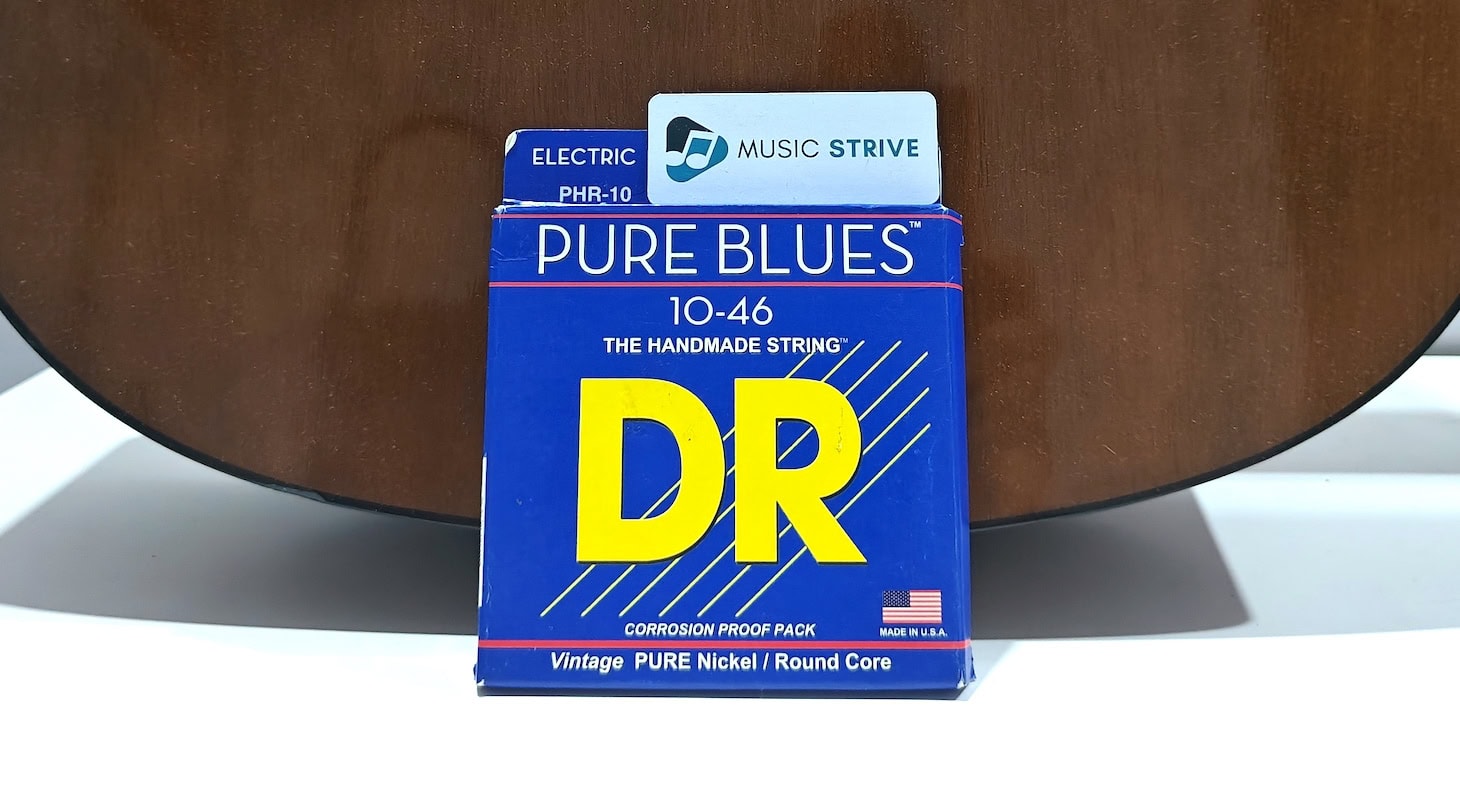
I’ve long had a soft spot for pure nickel strings. More than anything, it’s that I love the sound and the playing from the era when they were more commonplace. Hendrix and BB King used them, so that’s enough for me!
I’ll be the first to concede that, for most of my professional guitar work, I’m better off using hex cores and alloys. However, every now and then, I want to play some old-school guitar, and what better than old-school strings?
DR Strings boast that their Pure Blues line is built the way strings used to be made: round core, pure nickel. That’s enough for me to try out, so I placed a Sweetwater order and eagerly strung up my 335 with these blues-ready beauties.
Quick Overview
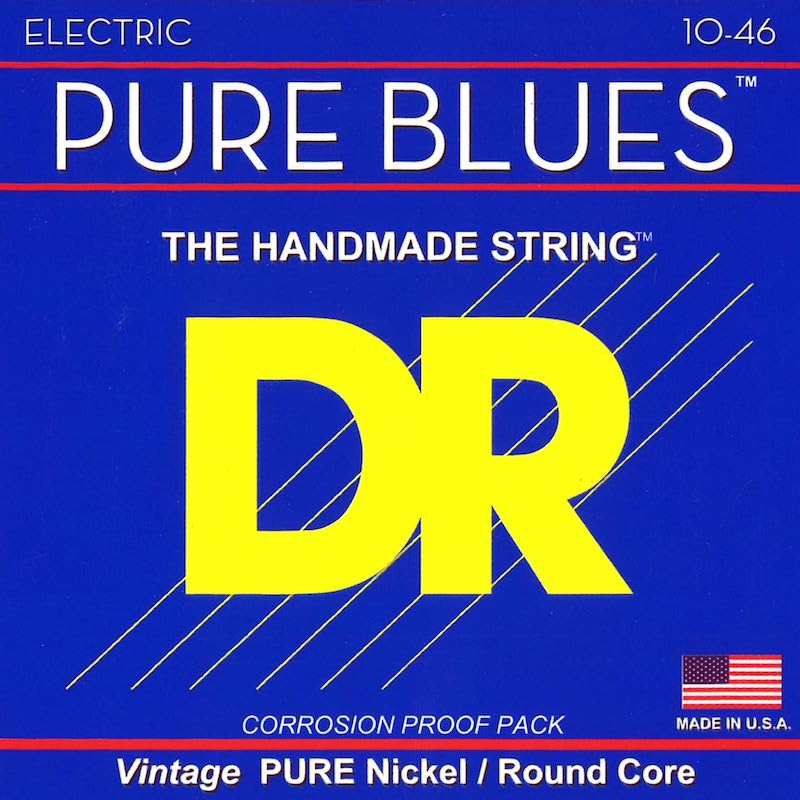
Round-core, pure nickel strings that feel softer under the fingers and bring a warmer, boomier tone.
The Best Strings for Those Who Still Got the Blues
Forward-thinking guitarists who only want ultra-high gain, .60 extended-range instruments and modeling software over tube amps need to look elsewhere. I’ve got nothing against that style, but for vintage sounds, it’s important to use vintage gear!
I picked these out precisely because, once upon a time, round core strings were all that was available.
On most modern guitar strings, an alloyed wire is wrapped around a hex-shaped core. These strings are both more durable and cheaper to make than round core strings, and they’ve dominated the market for decades now.
However, round core strings do have a distinct sound. Because they were very much the norm for years of recorded music, it’s almost impossible to attain the tones of some classic recordings without them.
I can’t quite get in the zone of very old-school blues sounds, even the rockier, more aggressive ones, without pure nickel strings. It’s what Jimi Hendrix used. It’s what Rory Gallagher used. Although I’ve found that the right gear helps me get close to those sounds, I find that I need to play pure nickel strings, ideally with a round core, to really nail down vintage-correct blues tones.
In my experience, the brighter, more aggressive sound of a hex core is awesome for modern gain levels and drop tuning. They just aren’t as well suited to vintage tone.
From my playing experience, too, the Pure Blues feel much softer under my fingers than the typical nickel-steel alloyed strings I’m used to from, say, Ernie Ball or D’Addario. They bend easily and it’s a small matter to deploy a broad Kossof-style vibrato.
My unwound G, B, and E strings feel nice and nimble beneath my fingers. It’s on the wound strings, however, where I noticed the major difference between these strings and my usual fare.
The first thing I noticed upon strumming these strings was the deeper booming sound they delivered, even on my unplugged 335. No wonder GHS calls their round core strings “boomers!” (my full review)
This translates to greater output through the pickups, too. That plus the pure nickel gave me a much warmer, smoother tone than that of a typical bright, edgy set of strings. I found that this made my guitar sound particularly good on the neck pickup, or on the bridge pickup when playing up near the neck.
This really is a vintage-ready tone: I’d hesitate to use these strings for anything heavier than Cream or The Who.
Sticking Around
I tend to break guitar strings easily, but I actually found that these strings didn’t lose their shine at all quickly.
It could just be that their mellower sound doesn’t drop off as noticeably as other strings: without much brightness to begin with, they can’t become as dull by comparison.
They did become noticeably stiffer after about a week of regular paying, but I expect that from uncoated pure nickel strings.
Certainly, these retained their fresh-out-of-the-packet tone for longer than most other uncoated strings I’ve tried.
I actually wonder if this might also be because the round core of the wound strings encourages tighter winding than a hex core: the nickel wrap wire is in firm contact with the core along the entire length of the string, unlike a hex core. Perhaps, on the Pure Blues, this creates less space for oil and grime from my fingers to accumulate in between the layers of the string itself.
Round, Gentle, Mellow
Blues guitar demands a lot of nuance. All the great blues players seem to have superhuman control of their touch on the instrument. They can play with near-imperceptible softness.
Because the Pure Blues set simultaneously has a more booming tone, but a softer hand feel, this really encouraged me to vary my picking attack, vibrato, and fret pressure. The nickel is noticeably softer on my frets, for a start!
Likewise, I play with much more nuance, especially on lead lines. I’m not digging in and attacking the strings like Zakk Wylde. Instead, I find myself opting for lighter, more fluid playing, trying to channel BB King or John Mayer.
This might also account for the improved longevity of these strings as opposed to typical hex-core strings: I’m probably just playing in a way that isn’t as hard on the strings themselves!
DR Pure Blues: Believe the Hype?
When it comes to guitar strings, there’s no such thing as “the best.” There’s only the best for what each individual player wants to get out of their strings.
To accurately capture the sounds of yesteryear, it’s important to use the right equipment. I derive a lot of joy from chasing tones and making my guitars sound like those of my heroes. I like to play vintage instruments through tube amps. Likewise, when I’m playing for my own personal joy, and looking to evoke some of the fire and fury of my blues-playing heroes, I love pure nickel strings made in the old-school way: with a round core.
I wouldn’t recommend these for anything else than raw, powerful, old-school blues guitar. For my taste, even more modern blues players like Joe Bonamassa lean more into rock stylings, and are better suited to the brighter tone of alloyed or hex core strings.
However, when I want to get into the tonal zone of the great guitar music from before the 1970s, I can’t look past vintage construction methods.
My Final Take
Great for capturing pre-1970s blues tones with a smooth, mellow feel and strong output. Not as bright or aggressive as modern strings, and less suited to heavier styles.
