
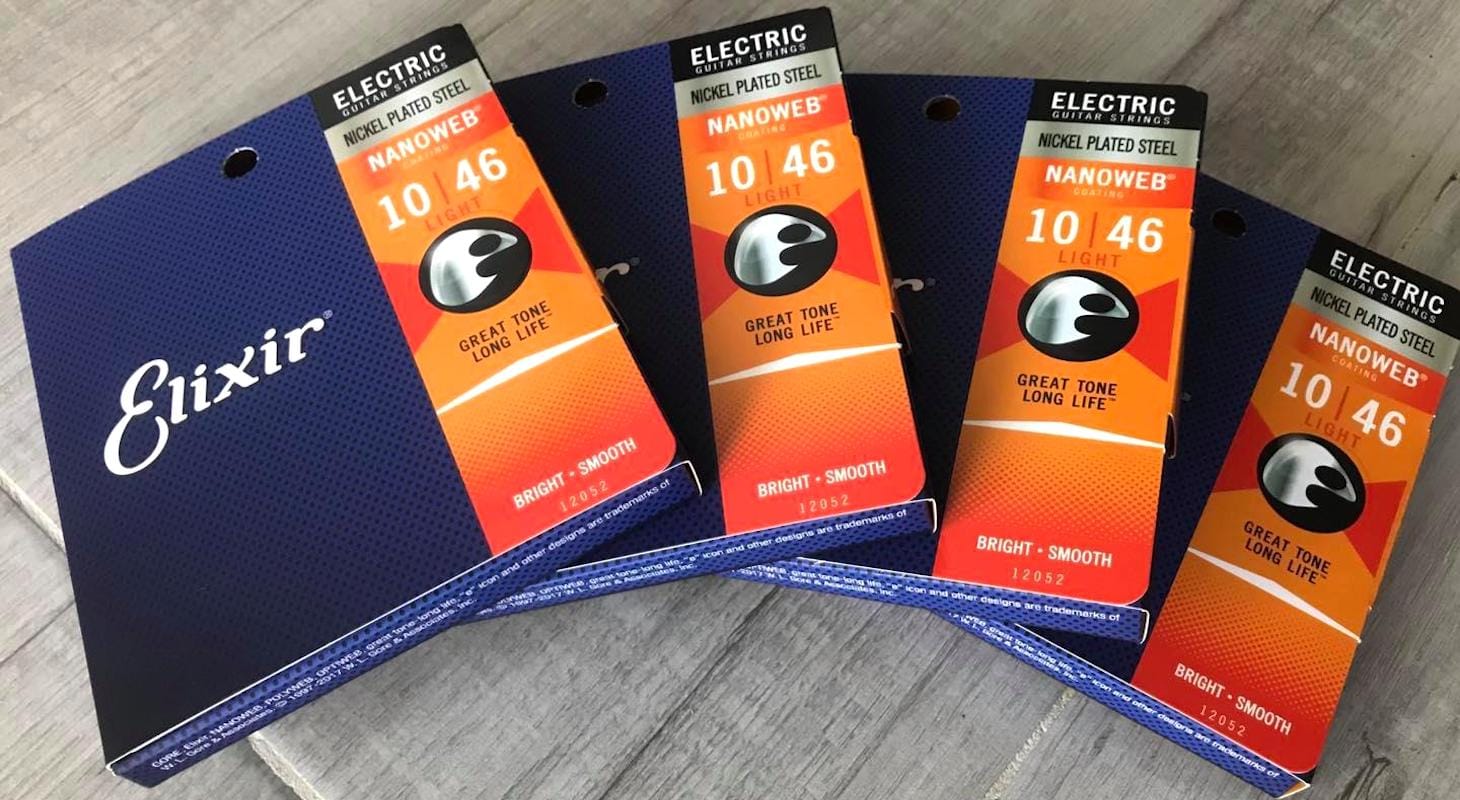
I’m writing this because today, I broke a string on my ’66 Mustang. They were a year old. They were Elixir Nanowebs. We all heard hype around them. I gave them a shot, and bam! I’m a fan.
So, to pass it forward, I decided to write this.
I’ve been playing guitar for almost three decades, and I’ve had my fair share of string-driven tonal experiments in the past. Elixir Nanowebs check all the boxes on my list.
I know it looks more like rock and roll to buy a pack of Slinkies or D’Addario EXLs. But let me tell you that these strings are a hidden gem, especially for rock players.
I used (and abused) them, and I’m about to tell you why you should try them too.
Let’s go.
Durability
I’m an old-school guy when it comes to buying strings. I like walking into a music store, looking around, talking to the clerk, and getting my goodies. I like that old face-to-face interaction.
So, a year ago, I went back home with three packs of Elixir Nanowebs. This was Monday.
I put them on my Telecaster, my ’68 SG Jr., and my ’66 Mustang. This last one got 11s, and both the others got 10s. I had a busy week coming up, making guitar parts for an online client, rehearsing with three bands, and playing two gigs on the weekend.
Usually, when my guitars get that kind of schedule, a set of strings can last until the first gig, but rarely makes it to Saturday night. I have to say it; I have a heavy right hand, and I’m not afraid to use it. Don’t look at me like that. I grew up playing punk rock in smelly joints on the outskirts of the city.
Sometimes, my right hand was my only distortion pedal, you know?
String durability is something I always put to the test. A week of abuse is always too much for regular strings. Punk rock is a lifestyle.
My SG Jr. not only made it through the initial week. These strings remained on that guitar for the following three weeks. I jumped, spilled beer, bled, and hit the hell out of those strings, and they remained stoic in the battle against my pick.
I was declared the loser, and Elixirs remained on their feet as the crowd offered a standing ovation. I just couldn’t break them. No matter how hard I hit, bent, or pulled them.
What happened in week three was that they lost some of their tone and sounded dull. I mean, if I’m playing that kind of music, I want ferocious strings, not gloomy and dark.
So, off they went, three weeks, a lot of sweat, some beer, and a lot of fun later.
The case with my Telecaster was quite different. I don’t play that guitar as fiercely and viciously as the SG. I need it to be more versatile. It needs to do the jangly, Tele thing but also clean chords, big spaces, and soundscapes.
I play it mostly in a looping project, one of those do-it-all, one-man bands.
We’ll discuss tone in a bit, but for light live, studio, or bedroom use, I would say Elixir found the elixir of everlasting life and poured it all over these strings. I mean, I had them on for close to six months! That never happened to me before. Ever.
The case is even more extreme with my Mustang. If you’ve ever played one, you know that the shorter scale screams for heavier strings. Well, the good news is that the .11s were on my Mustang for almost a year. It doesn’t get as much use as the other two, of course. It’s my favorite and stays mostly with me in the studio, although it went out to some shows and made stellar appearances here and there.
But a full year? Never happened before.
I would say that durability-wise, nothing beats Elixirs.
The Coating
Although most of us agree on durability, well, the coating is a different story. I know, the texture and the feeling are somewhat different when you put your fingers on them for the first time. They feel soft; it’s as if you were playing a set of flatwounds.
This is both a good and a bad thing.
The good thing is that slides are not only effortless but also feel softer to the hand. The strings feel silky and are delicious to bend.
The bad thing is that they feel nothing like home. You get this instant feeling of weirdness and the classic “these strings aren’t for me” reaction.
Well, in my opinion, that’s something that fades away in less than ten minutes. You get used to the silky feeling right away. It is like asking your body to feel comfortable while sitting on a fluffy couch. It’s not that difficult, right?
So, although I now love the feeling of fresh Elixirs on my guitars, it took a while to get used to it.
The Optiwebs
Elixir is one of those companies that listen. They picked up on the feeling thing and released the Optiwebs. These are engineered to have the same coating treatment (having the elixir of everlasting life poured all over them) but to feel like regular guitar strings.
This humble fellow guitarist right here tried them out for a spin, but, although they succeeded at the feeling thing, these strings feel a little too stiff when bending.
In my opinion, between the silky, delicious experience of bending a Nanoweb and the Optiwebs feeling like traditional slinkies, I go for the Nanowebs ten times out of ten.
That said, if feel is an obstacle between you and Elixir strings, there’s a way around it, it’s called Optiwebs.
The Tone
The moment we’ve all been waiting for: “What about the tone, man!”
Well, the Nanowebs are a little bit brighter than a regular guitar string. You’ll find all kinds of online discussions saying that it’s due to one element or the other. For whatever reason, the added brightness can be heard right away.
Don’t get me wrong, these strings aren’t brittle or harsh. On the contrary, it gives them this lively element. For example, I had to dial down the presence on my MIG-50 to accommodate these strings while playing the SG.
The midrange is still punchy, but they don’t sound as full in the bottom end. Dialing it with pedals, I was able to reclaim those lows and tame the highs with the tone knob of my always-on Tube Screamer.
The tone felt razor-sharp during the first few hours of playing. I would hit them with all I had, and they would just respond by shining through the mix and staying in tune.
By the third week, the coating had worn off, but the strings still felt good. The tone, though, that beautiful, bright thing was completely gone. That’s when I replaced them. Just because they lost their thing, and life’s too short to play with dead strings.
The Telecaster, being a bright, alder body with a rosewood fingerboard, got enhanced in the upper midrange. I had to reach again to lower the treble, especially when playing the bridge pickup.
I played with it on all kinds of things in the six months they lasted on. In my opinion, the middle position of the Tele through a clean Fender amp works great with the brightness of these strings. I also loved them distorted with the bridge pickup.
I mean, I played everything from The Clash to John 5 to Tame Impala, and the high-end shone through more than it normally does with a Telecaster.
By the sixth month, the mojo was gone. The Telecaster somehow lost the sparkling high end, and it was time for a change. Also, the coating had completely worn off.
The experience with my Mustang was the best of the three, by far. I love that guitar for its fat, huge neck pickup and its interaction with overdrive and fuzz pedals. But I also think it’s an amazing piano-like, chord guitar. Plus, you can use your hand to move the tremolo bar behind the bridge and get some natural vibrato.
Well, the whole thing became livelier. A dark guitar is the perfect match for Nanowebs. It’s like that bright switch on your amp you always want to leave on.
I know, tone is subjective. These strings made three guitars brighter, though. I see a pattern there. So, bear in mind they tend to that side when buying.
Are These for You?
These strings are a match made in heaven for a heavy-hitting Les Paul player. They will withstand the battle but will also brighten the growl of the guitar. Coupling that with some distortion gives you enough midrange to tear down the Empire State Building.
For those who play Telecasters, Stratocasters, SGs, or any other guitar that’s heavy on the higher mids, just beware of the added brightness. You shouldn’t change to Nanowebs and jump on stage without equalizing first.
These strings are also great for those of us who play a lot and carry that rock and roll thing in our picking hand. Strings must endure life on the road but also perform and shine through the mix night after night. That’s where it all starts.
So, having a set that won’t break live gives you more confidence. I was bending them as if there was no tomorrow. I knew they just wouldn’t break in the middle of my wailing solo.
Price
Elixir strings are pricier than most regular guitar strings (especially if you buy a one-pack like the single 9-42 pack I bought last year which you can see below).
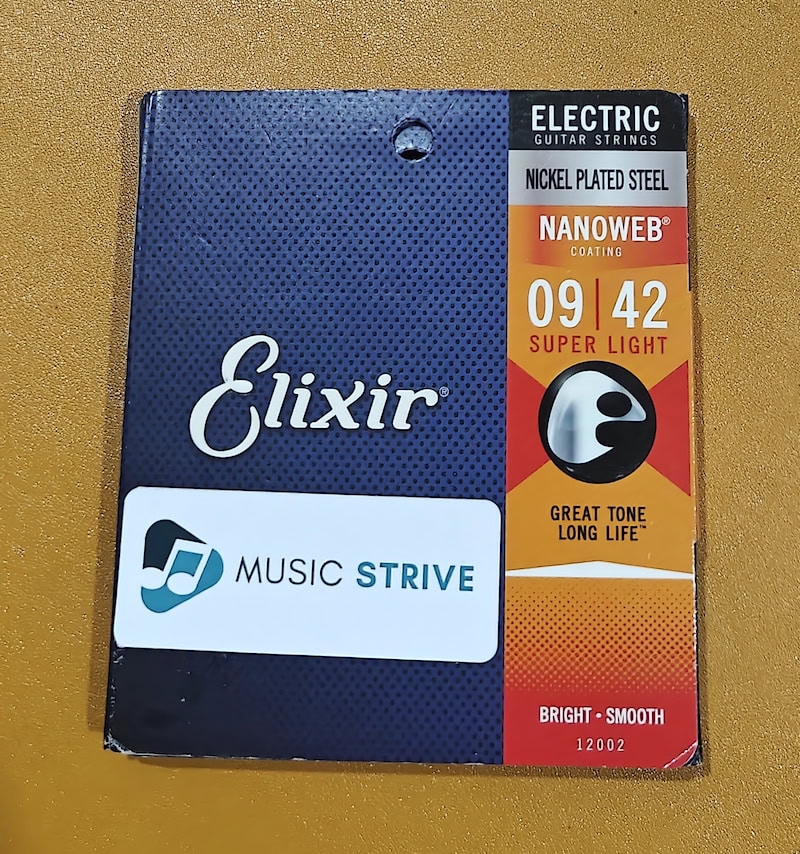
Elixir Nanoweb Strings
So, if you’re a casual strummer or someone who leaves slinkies on their guitars for years, I wouldn’t even bother.
If you play them a lot, Elixirs are more reliable and maybe even cheaper in the long run.
My Verdict
Let’s get one thing out of the way right now, shall we? I know Elixir strings aren’t cool. I went into that shop knowing that those strings might not be for me. The box is so clean-looking and sober, it’s just unappealing.
However, they might just be the perfect companion for the abuse strings take in rock, punk, and metal gigs. They can stand the beating and give you a great tone, not to mention tuning stability and durability. I couldn’t break them no matter how hard I played.
They do feel a bit weird from the get-go, are pricier, and don’t look as badass as Ernie Ball Slinkies. Yet, today, as one of them broke while playing my Mustang, I had to make an effort to remember the last time I put strings on it.
My Verdict
Elixirs might not be for everyone, but they’re sure worth the try, especially if longevity is a big deal for you. Also, if you're like me, it would be hard to go back to regular, cheaper, uncoated strings if you experience the Nanoweb smoothness once!
Happy (coated strings) playing!
