
Guitar players tend to be choosy when it comes to certain aspects of their craft. Brian May only ever played with a sixpence, instead of a pick. Zakk Wylde used to buy two sets of guitar strings, one heavy and one light, and use half of each set on his guitars.
When it comes to string, everyone has their own preferences, and the best thing to do is to try various brands and gauges out to see what works for you.
The second best thing is to check out information like this article and use it to inform your buying decisions.
These days, with so many string brands available, it can be hard to choose the best string for your playing style.
D’Addario and Elixir are two of the biggest names in string manufacturing. Which is best for you? Read on to find out. I've written this piece based entirely on my extensive personal experience playing both Elixir and D'Addario sets.
Elixir Strings
Most Popular Elixir Strings
Preview | Product | Price |
|---|---|---|
 | ||
 | ||
 |
Elixir are best known for their string innovations, particularly their fluoropolymer coated strings with superior durability and lifespan.
Unlike many other string companies, Elixir’s parent company is not in the business of musical instruments. Instead, the parent company, W.L. Gore and Associates, is about the coating, not the string: their business is fluoropolymers and derived products.
Elixir are popular among guitar players for their flagship Polyweb strings, which were the first coated strings on the market when they debuted in the late '90s.
Elixir strings are used by some of the world’s leading musicians, including Gus G and Led Zeppelin bassist John Paul Jones.
D’Addario Strings
Recommended D’Addario Strings
Preview | Product | Price |
|---|---|---|
 | ||
 | ||
 |
The D’Addario family business began in Abruzzo, Italy, back in the 17th century. Abruzzo is fertile sheep farming country, and the family made sheep gut strings for use on acoustic instruments like violins, harps, and, of course, guitars.
In the early 20th century the family, like so many other Italians, emigrated to New York, and took full advantage of the business opportunities afforded in the New World.
Today, D’Addario is the world’s largest musical instrument accessories manufacturer, covering a variety of niches like drums, orchestral instruments, and, most famously, guitar strings.
Today, I personally use D’Addario strings almost exclusively across my guitars. After years of devoted loyalty to Ernie Ball Beefy Slinkys on my Les Pauls, a friend advised that I try D’Addario’s Extra Lights on my acoustic guitar, and I’ve been a loyal D’Addario player ever since.
D’Addario strings are best known for their balanced tone well-suited to overdriven or compressed playing. However, D’Addario also makes excellent acoustic strings, and they are popular across rock, country, and even disco genres.
Direct Comparison: Elixir vs D’Addario
When I’m trying out guitar strings, especially on acoustic guitar, the most important thing to me is tone. However, the biggest difference from a playing perspective typically comes from the feel of the strings.
As a player who typically gigs anywhere from two to six times a week, I heavily prioritize durability in my strings. I don’t want strings to break mid-set, and I don’t want to have to re-string my guitar before every show.
Tone
Beyond a certain level of playing ability, tone is in your fingers. Slash and John Mayer both play Ernie Ball strings, and sound completely different. Sure, they’re using different gear, but you could put either guitarist on the other’s instrument and Slash would still sound like Slash, and Mayer would still sound like Mayer.
Upon my local guitar store’s recommendation, I recently tried out D’Addario’s new coated strings, the XS Extra Lights, on my acoustic guitar, a parlor-sized Takamine New Yorker.
The sound is mid-forward, nicely throaty, and has all the bright, frosty zing of fresh strings. They’re not overly warm or bottom heavy, which I appreciate as I have a baritone voice and use these strings for solo acoustic gigs.
Elixir’s Extra Light Nanoweb strings are the direct competitor here (my full review). They were much brighter and crisper in tone than the XS, with a very prominent attack. I also lamented the lack of sustain when strumming as compared to the D’Addarios.
Both strings retained their new-string brightness after hours of practice and gigging, as you’d expect for coated strings.
For electric guitar strings, I used the XS nickel-plated steel-coated Mediums, putting them on my most versatile guitar, an Orville by Gibson 335, and also tried the Elixir Medium gauge strings.
As expected, both were bright and aggressive, the Elixir strings more so. However, I felt that, particularly for rock tones, the D’Addarios (even the NYXL, which I reviewed in-depth) offered a more balanced sound. I really enjoyed the thick, chewy tone of the D’Addario strings for meat-and-potatoes rock, especially through my Marshall amp.
Overall, tone wise, I preferred the D’Addario strings.
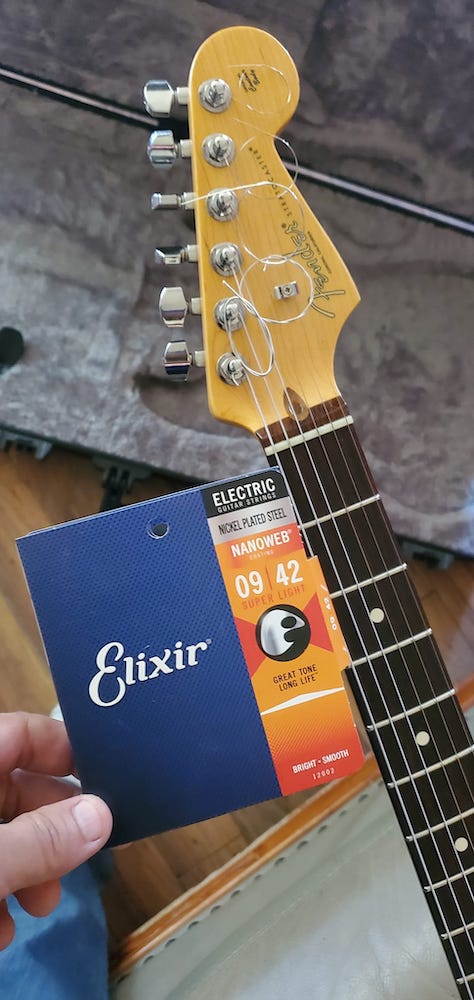
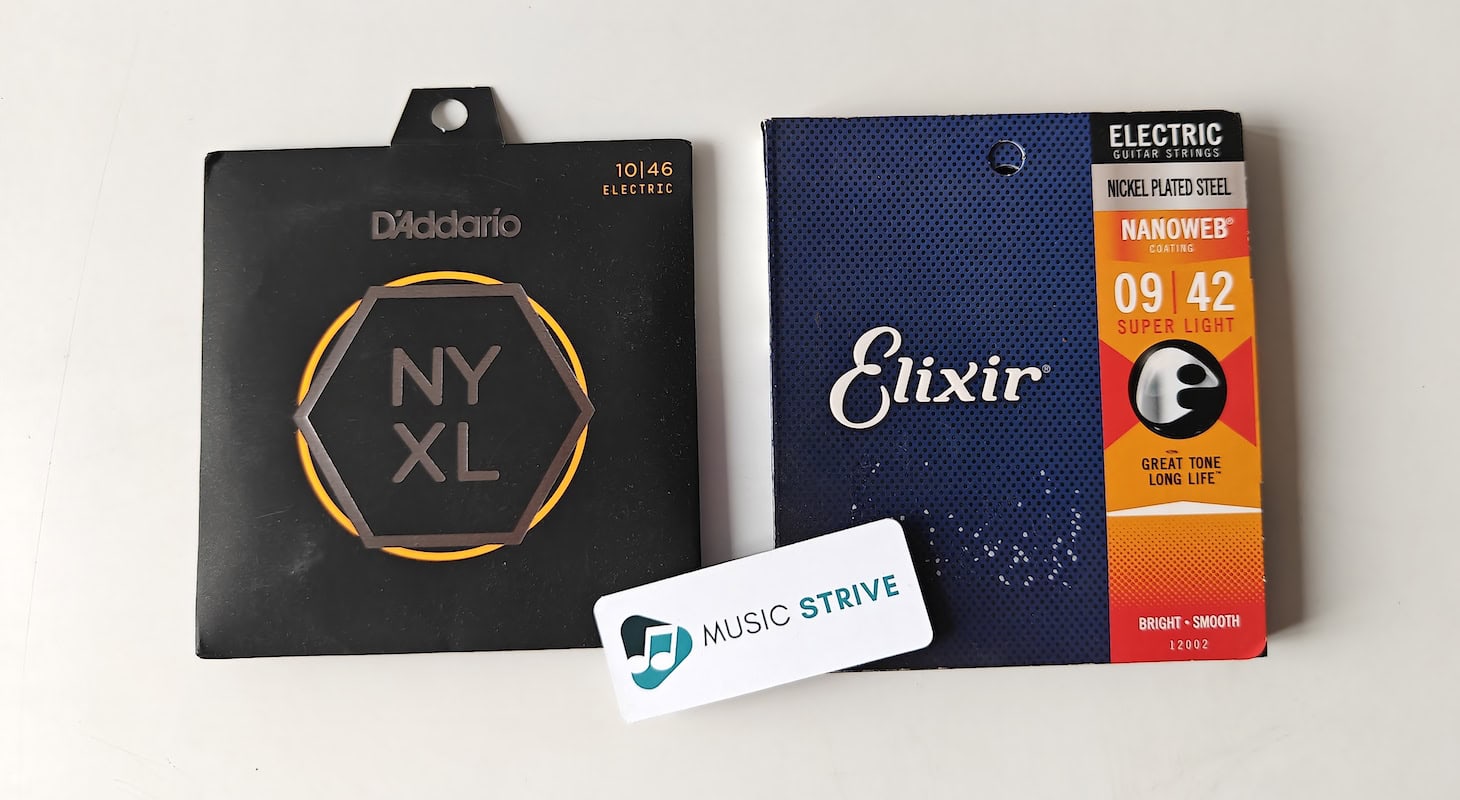
Elixir Nanoweb 9-42 gauge strings...
Feel
Because both strings are coated, they have a slick, smooth feel not unlike that of flatwound strings.
Personally, my preference is for uncoated strings. I don’t love the slick feeling of coated strings, and like the extra grip of roundwound strings for bends and pull-offs.
Elixir’s coating feels much thicker and more noticeable than D’Addario’s. This comes with a few bonuses: slides are easier, and rapid legato or alternate picked runs flow effortlessly from the fretboard.
The playability is great, but I personally do not like the slick, lubricated feeling of the Elixir coating.
On the other hand, the D’Addario XS coating is much, much thinner than Elixir’s. The string feel is still smooth, without the squeaky grip feeling of uncoated roundwound strings.
Slides and rapidfire licks come similarly easy as compared to the Elixir strings, but the string feel is closer to that of a typical roundwound string.
Both strings play very easily, but my personal preference is for the thinner coating of the XS strings.
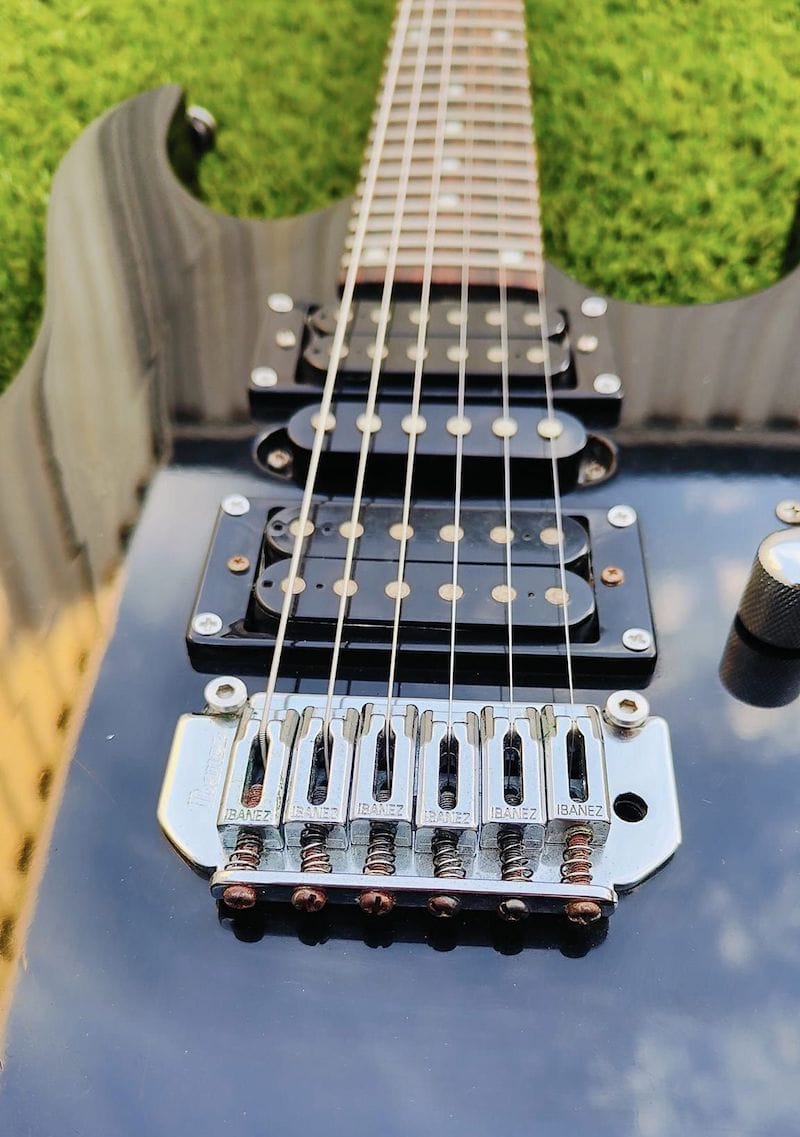
D'Addario XS Strings loaded up on my old Ibanez.
Durability
For durability, the pair are about tied, but zero D’Addario breakages gives the Italian brand the edge for me.
When my mate at the local guitar store recommended coated strings to me, he pointed out that my busy gigging schedule made a good litmus test for the brands’ claims of superior durability.
He had a point: at the time, I was on the way to the first of four gigs that week.
The D’Addario strings retained their freshness from the moment I put them on to the end of my fourth gig that week. To really put the strings through their paces, I used the same guitar for every gig.
It was a combined twelve hours of performance in sweaty, heaving pubs, and the XS passed with flying colors.
The following week, I tried the same trick with the Elixir strings. They also maintained their brightness, but disaster struck at the first gig: I managed to break the G string in final set of the night.
String breakages happen, and I won’t just Elixir’s build quality based entirely on one breakage. However, when you’re paying a premium for extra-durable strings, I expect to get more than one gig out of them.
It could just be that I tend to play hard, my bridge too sharp, I wound the string poorly, or that my two-hundred-pound frame bashing away at the strings was just too much for the Elixir. The replacement string, from a spare set of Elixirs, lasted me throughout the remaining shows that week, so it might just have been a one-off dodgy string.
Final Word
If, like me, you prioritize a deep, balanced tone with plenty of sustain, I would highly recommend D’Addario strings.
Elixir’s strings have a brighter sound and slick feel well suited to virtuosic guitar playing, while the thinner coating of the D’Addarios offers a playing experience closer to a typical uncoated string.
Both are excellent strings, and any working guitar player would do well to try both sets.

I find that a bottle of string cleaner goes a long way to rejuvenate strings. Coated strings or not coated eventually get dirty and the metal of both types gets fatigued with time. A simple cleaning assures you have your best situation at the moment.
Interesting posts… I absolutely prefer uncoated phosphor bronze on my acoustics… But I accept that I will replace string sets after 8 or 10 hours of play. I feel the coated strings are just not as bright or balanced. As for gauge: depends on the instrument and tuning – I use D’Addario extra light phosphor bronze on OM guitars 9-43 (I think) with an unwound G. I pay a price in presence and time but can mic up and fix it electronically. For full size guitars, I am partial to 11s and if I’m drop tuning a full step or more, I use 12s or medium guage 13s.
On electrics, I’m an Ernie Ball man. I’m back to plain old super slinky after getting big on cobalts about 8 or 10 years ago in my search for stronger mid range response. If I’m working, those strings never stay more than 3 days.
I think it boils down to the fact that I LOVE new string sound and I’m willing to pay for it (luckily I can afford it these days). I swear, when I was younger I played on strings that would give someone lockjaw
Did you call D’Addario an “Italian brand”?
How many generations has it been since their ancestors immigrated to America and you call them an Italian brand? WTF?
You start a business in New York during the depression but if you have a funny name you’re still not American ninety years later, huh? Just wow.
Why nitpick on a point that has no bearing on the focus of the post?
Like elixirs. Just bought 3 sets of d’addario’s just to try them. I will find out which is better for me.
I bought 3 sets of Elixir Nanoweb XL Phosphor/Bronze (80/20) for $6 from a well advertised Chinese online company. Packaging looks like the old version of D’Addario strings. Elixir strings show: W. L. GORE& Associates, Inc. Elkton MD USA 800-3675533.
Hi. The coating material used on Elixir strings is Goretex- originally used as a fabric treatment in shoe linings and other textiles, to make them more resistant to moisture. Someone had the bright idea of seeing whether guitar strings would benefit and, if I remember correctly their Elixir strings were the first coated strings on the market. The coating was a little bit too thick initially and trebles were slightly muted although the strings lasted much longer than uncoated and they now do a much finer coating. I don’t know who makes the strings for them unless the have actually taken to string manufacturing as well as coating. D’Addario caught up very quickly as you might expect.
It’s pretty unfair to compare coated Elixir strings (about $13 a set) with uncoated D’Addario XL strings (about $6 a set). D’Addario also makes coated strings (the XS series). Why didn’t you compare those against the Elixirs?
Myself, I don’t like the feel of coated strings at all.
One more thing ,if you are a heavy strummer the coating of the elixir string near the sound hole will peel off easily and coating threads are exposed thats the disadvantages.. although the cripiness last longer than bare strings
Several years ago, i did a product test of two unmarked set of strings. One on one guitar the other set on my second favorite. I had a strat and a tele for this test. I compared the strings at different intervals and found one set to be like new after 4 solid weeks of playing. The other was dead at the 4 week mark. I ended up sending the form in and I think I was voting on the latest extended strings the NanoWebs. I now only use them. They last forever and feel like a non-coated string. Cheers!
Elixirs are great. I use the Nano 80/20 bronze 11-52s on my guitar. Polys are too mellow and don’t vibrate properly in my opinion. But for the nanos I don’t switch my strings for like 3 years because they stay good for a long time. However I usually use D’addario phosphor bronze once here and there depending on if I want a different tone. But mainly Elixir is my main string.
Hi,
Elixir buys its strings from D’addario.
Elixir only puts their special coating on the strings.
Finally, it’s still D’addario