
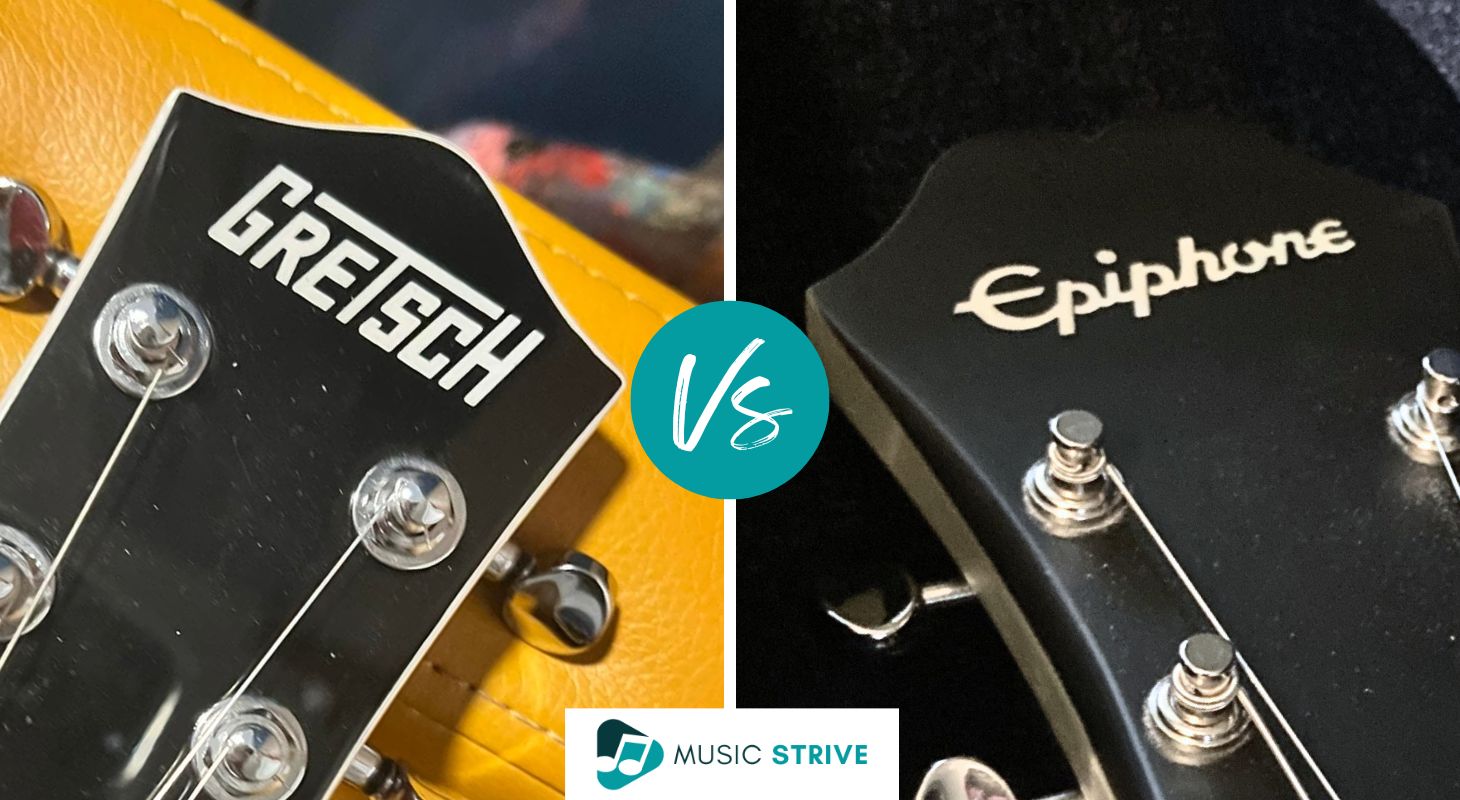
Gretsch guitars have been making history for decades. They have survived all trends and market changes and continue to be a family-owned company (with a little help from Fender) making top-notch musical instruments sold worldwide.
Epiphone started being Gibson’s number-one rival. Still, the latter bought it and made Epiphone the brand of its cheapest instruments. That said, Epiphone is a name with iconic guitars of its own that’s slowly coming back to its righteous historic spot.
But what do Epiphone and Gretsch share as musical instrument manufacturers?
Well, they make some of the most iconic hollow and semi-hollow instruments today.
In this post, we’re going into the similarities, differences, and models that make these brands your go-to for your next gleaming ax.
Are you ready? Because this head-to-head race for the pole position in the hollow-body guitar market starts right now.
A Little Brand History
Before discussing models, players, and specs, let’s dive into the history of these iconic brands.
Gretsch
You know how most of these stories go, a German immigrant set up a shop in Brooklyn. Well, that’s exactly what happened with Gretsch. Although it was founded by Friedrich Gretsch in 1883, it only began making guitars in 1916.
After two generations of Friedrich’s children and grandchildren successfully managed the company’s growth and direction, by the 1950s, Gretsch was outselling Fender.
Not only that, but it was also the brand guitar legends like the one and only Chet Atkins, Duane Eddy, and Eddie Cochran who chose to be endorsed by and play live.
Top 3 - Popular Gretsch Guitars
During the sixties, George Harrison played a Jet and a Country Gentleman in the eyes of millions of idolizing fans. This gave Gretsch another big push. Plus, guitars were about to become the most popular and important instrument in the world because of rock n’ roll’s triumphant conquest of the airwaves around the globe.
The problems for Gretsch, just like with Fender, Gibson, and many other brands began when it left the Gretsch family. Yes, it was sold to Baldwin on July 13th, 1967.
But Baldwin didn’t understand Gretsch’s legacy, market positioning, or tradition.
As a result, what was a stellar career until the late ‘60s became a disastrous slalom into oblivion during the psychedelic ‘70s and the wild ‘80s.
Matters were so bad for Gretsch that the company stopped production in the early ‘80s. Baldwin never grasped the product and couldn’t come up with models that carved their own spots in a crowded market full of super strats with pointy, fluo bodies, floating bridges, and scorching-hot colorful humbuckers.
But that wasn’t the end of Gretsch. It was Fred W. Gretsch and his wife Dinah who purchased the company again from Baldwin in 1984 and managed to rebuild its high profile.
As a result, they landed a production, distribution, and marketing deal for Gretsch guitars with the Fender Musical Instruments Corporation in 2002.
Although Fender handles most aspects of Gretsch, the company remains a family-owned endeavor.
Finally, the quality craftsmanship and the decades of an uncanny legacy found their best version yet in the US Custom Shop opened in 2004.
What’s the Classic Gretsch Sound?
The Gretsch sound can be defined as the perfect crossover between a Telecaster and a 335. One of the main things that hit you right away whenever you plug a Gretsch is just how bright they are. There is a certain twangy quality to the sound that, in my opinion, is one of the things that made Gretsch a great option for country and bluegrass players early on.
Moreover, that’s also arguably the reason why rockabilly players like Brian Setzer embraced this tone and built an entire career over it with a pinch of reverb, a spoonful of gain, and a bucket of slapback delay.
Gretsch hollow and semi-hollow guitars have enough bite and attack to be in the Fender realm. They add to that same universe the warmth and depth of the hollow body.
Finally, a set of very particular pickups made by DeArmond, known as Dyna Sonic and Filter’Tron gave these guitars an even more uncanny sound that’s become the brand’s trademark.
Epiphone
Epiphone is another of those stories that begins with an immigrant arriving in the USA in the early 20th Century. In this case, it was Anastasios Stathopoulos, Epiphone’s Greek founder who created the company in 1873 and arrived in Queens, New York in 1903.
The company’s name comes from Anastasios’s son, Epaminondas. He was nicknamed Epi and took complete control of the factory in 1923 renaming it the Epiphone Banjo Company in 1928.
It was under his management that the company began making flat-top and archtop guitars that could compete against Gibson. The Epiphone shop was the usual spot for impromptu jams by some of the most notorious stars of the music scene.
One of those prominent musicians was Les Paul who created the famous “Log” guitar in Epiphone’s factory using a Gibson neck. He was good friends with Epi, an avid visitor of the shop and factory who became a close advisor for the company.
Top 3 - Popular Epiphone Guitars
Preview | Product | Price |
|---|---|---|
 | ||
 | ||
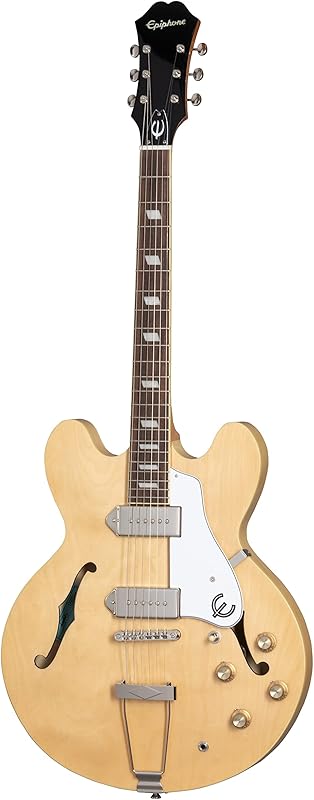 |
After Epi’s passing in 1945, the company went to his children, Orphie and Frixo who struggled to understand the changing market. The Telecaster was only 7 years away, and with it, the solid-body guitar revolution would commence.
In fact, if Epi was still alive, perhaps Les Paul’s signature model wouldn’t have been a Gibson guitar but an original Epiphone design.
After failing to keep the boat afloat, the company was sold to Gibson in 1957 for the outrageous sum of $20,000 (something close to $200,000 now).
Ted McCarty, who was Gibson’s president during that era used Epiphone guitars to tempt dealers with more affordable models before they could sell Gibson guitars. Some of those models like the Casino, Coronet, and Texan became very famous.
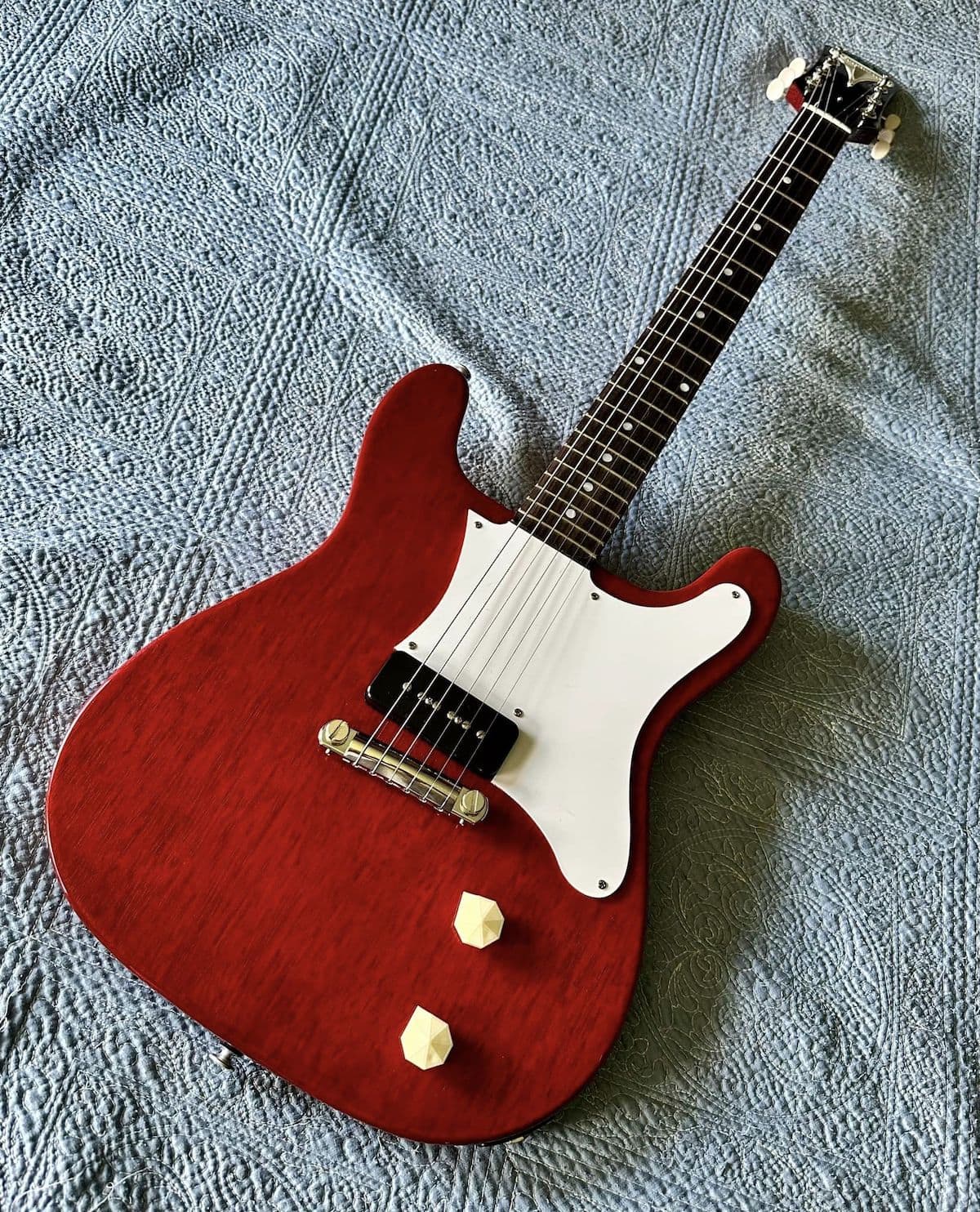
Epiphone Coronet
In the ‘80s, Epiphone became the brand for Asian-made affordable Gibson products that could compete against the other copies in the market.
Nowadays, with the return of the US-made Casino and the Inspired by the Gibson Custom Shop series, the Epiphone brand is back to being the great guitar company it once was.
What’s the Classic Epiphone Sound?
Epiphone is Gibson’s second brand (similar to Squier), and, as you’ll see later on in this article, its sound is very close to that of its parent company. That said, a few outstanding models from Epiphone’s early days carry the spirit and tone of the original days.
For example, the dark brilliance that meets the huge hollow body of the Casino is found nowhere else in the market.
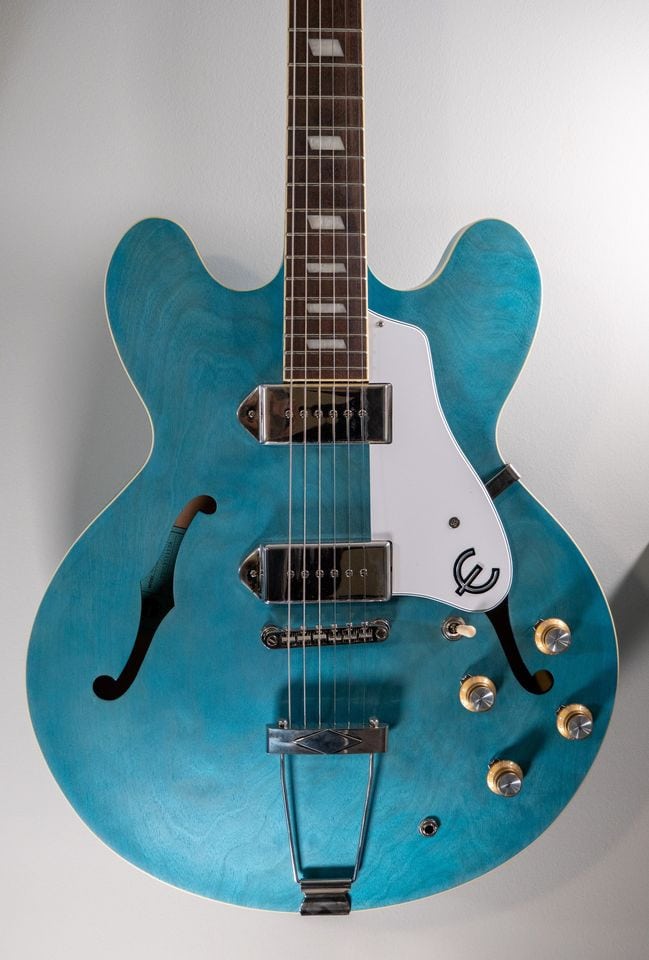
Epiphone Casino
Furthermore, adding to that combination of the raw power and midrange bite of the dogear P-90s, what you get is a rocking machine with enough definition and bottom end to carry a band forward (ask The Beatles if you don’t believe me).
So, what you can expect from Epiphone hollow and semi-hollow guitars is dark, sweet, and powerful tones mixed with the midrange bite and snap of layered maple bodies.
Understanding Brand Tiers and Specs
Each of these brands divides the products offered in different lines or tiers. Each of them is aimed at a particular niche with a set type of features and within a price range.
These lines are self-explanatory in some cases and in others, they are like signs inside a maze leading nowhere.
So, think about these lines, series, or tiers as indicators of what to expect from the guitar spec-wise.
Gretsch
Except for the Gretsch Custom Shop that works in the Corona Fender factory, the rest of Gretsch guitars are made in Asia. Furthermore, when the company was repurchased from Baldwin by Dinah and Fred W. Gretsch, they resumed production in Japan in 1989.
Gretsch was a pioneer in making high-end Professional-line guitars overseas. If you open one of those cases, you instantly realize that they are at the same level as any other US-made professional guitar, if not higher.
Nowadays, the company manufactures them in Indonesia, China, Korea, Japan, and the USA (Custom Shop only).
Streamliner
This is Gretsch’s most affordable line. Don’t be fooled by the price tags because these guitars offer serious bang for the buck.
One of the main differences between these guitars and the Electromatics (twice the price) is the nato neck. This is a replacement wood for maple. Also, the original Bigsby tremolos are replaced by generic copies, and the original Filter’Tron pickups, stock in most Electromatics, are replaced by generic copies labeled Broad’Tron. These should not be confused with the real Broad’Tron humbuckers from the Electromatic Series. These are the more affordable Broad’Tron BT-3S.
This last one isn’t a minor difference because these generic humbuckers push the guitar far from the Gretsch realm.
That said, these are amazing entry-level guitars that are au par with Squier Classic Vibe guitars. You can have the looks (they come in all sorts of colors like Arctic Blue and Steel Olive which are great), the mojo, and some of the tone of the real deal at a fraction of the price.
This is the perfect first Gretsch guitar for those who are curious about the brand, the amateurs, the enthusiasts, the hobbyists, and the beginners. Furthermore, although they might need some quality tuners, a change of mics, and a professional setup, they’re definitely stage-worthy instruments too.
Electromatic
The Electromatic line by Gretsch is where you would put Fender Mexico series guitars or PRS SE guitars. These are fully formed, stage-ready, great guitars with quality appointments and materials.
Unlike the Streamliners, the hollow and semi-hollow (Gretsch calls them center-block) guitars Electromatics are made in Korea. The solid-body ones are made in China.
The Electromatics are built using a highly resonant, yet perfectly lightweight spruce center block. They sport a real maple neck with a laurel fretboard, original Bigsby licensed tremolo units, Graph Tech NuBone nuts, original Gretsch tuners, and a very useful treble bleed circuit in the volume knob. This helps tame the beast a lot.
Finally, some of these guitars come with Black Top Broad’Tron humbuckers. These are powerful and very articulate pickups that can catch and carry the snappy properties of the guitar’s build all the way to the amp’s speaker.
Although they cost one-third of the price the Professional series costs, these are great guitars with tons of Gretsch mojo to give. Furthermore, if you do a pickup swap, you have a great stage-ready guitar with the tone, looks, and mojo of a much more expensive ax.
Yes, it’s a common thing to happen, I’ve been there too, asking naively “How can this get better?” Believe me, the first time I played a Professional Series Gretsch, I was beyond blown away by the difference. It does get better, much, much better.
Professional
The Professional Line by Gretsch is entirely made in Japan and is a spare-no-expense kind of series. These are either faithful reproductions, to the utter detail, of timeless classics, modified icons, or new creations.
The series is divided into different kinds of guitars.
Vintage Select – Comparable to Fender’s American Vintage II series, these guitars replicate timeless classics to the last detail (mishaps and problems included).
Player’s Edition – These are modern twists on timeless classics to make them more player-friendly, stage-ready, and reliable touring instruments. Comparable to Fender’s American Ultra and Gibson Modern Collection.
Artist Signature – Every big guitar brand has endorsers making it bigger by the day. Well, Gretsch is no exception, and these co-creations are perfect for fans and players alike. For example, the rock-ready Black Falcon guitar by Billy Duffy can withstand more gain than a regular Falcon.
Limited Edition – Gretsch knows how to keep it fun. Do you want a paisley Jet, a Champagne Sparkle Penguin, or a sparkle Falcon? Well, limited runs of guitars like those are what you can expect from this line.
Custom Shop
I’m not going to go into the Gretsch Custom Shop because it can’t be compared to Epiphone. This means there’s nothing in the Epiphone line that comes close to these guitars, you’d have to go to the Fender or Gibson Custom Shop to find suitable contenders.
Therefore, we’re going to leave those models for a different moment.
Epiphone
Most Epiphone guitars are made in the company’s facilities in Qingdao, China.
The journey for Epiphone started in Japan in the early ‘70s with original models like the awkward, legendary, and great-sounding Epiphone Genesis. Then moved to South Korea in the ‘80s and stayed there until the big factory in Qingdao opened its doors in 2004.
In the year 2020, Epiphone made its triumphal return to the United States with a new series of USA-made guitars, the first US-made steady production-line instruments since the seventies.
Inspired by Gibson (and The Gibson Custom Shop)
As its name says very clearly, the Inspired by Gibson series offers you a wide array of Gibson models with the Epiphone logo. You can buy everything from Power Player guitars (3/4 size) to the Dave Grohl signature ES-335 in Pelham Blue.
In this series, you can expect faithful reproductions of iconic guitars. They don’t do the stripped-down versions of the semi-hollow and hollow guitars; they just do the bolt-on build with the Les Pauls and SGs. Therefore, although this line starts a little higher than those, it also features guitars that are closer to the originals.
In fact, the Grohl model comes equipped with USA-made Burstbuckers. Perhaps, the laurel fingerboard and the workforce wage are where Epiphone cut some corners.
You can expect in this range some serious bang for the buck. You’ll also find plastic nuts, generic pickups, and cheap wiring. Well, for a guitar with that price tag and that looks so cool, that might be expected.
When you move to the Inspired by Gibson Custom Shop series, Epiphone cut fewer corners and they have a heftier price tag, but there’s a quality jump. These guitars sport the open-book Gibson headstock, for example.
That said, with minimal overhauling, both these lines make amazing stage instruments.
Don’t take it from me, mate. Ask me mate Noel Gallagher, he’s got a thing or two to say about making a career playing Epiphone semi-hollow guitars!
Originals
This is where things start getting truly interesting in this supposed rivalry between brands. This is the collection that seriously steps into Gretsch territory.
Although we all think about the Casino (if three Beatles agreed on something, that something must have been really good, right?), when we think of Epiphone, there’s much to discover.
Guitars like the Broadway, a large jazz-oriented boat with all sorts of ornaments that’s got a spruce top, resonate much like a Gretsch when taken into overdrive. Speaking of which, it lacks some of the snap because it comes equipped with Alnico Classic PRO humbuckers.
But that’s not it because guitars like the Emperor Swingster, Wildkat, and UpTown Kat are decidedly competition for the rockabilly, psychobilly, and rock and roll players. They feature vintage tremolo units and even come in striking colors.
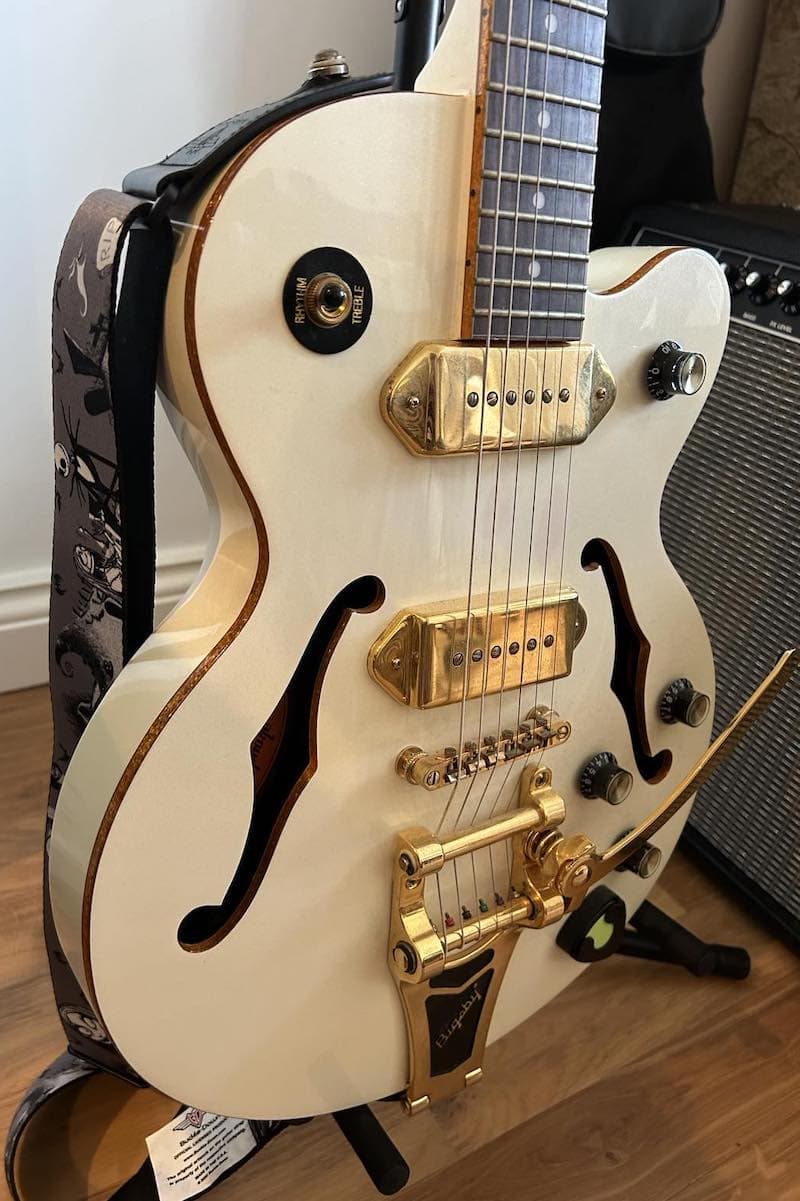
Epiphone Wildkat
Finally, guitars like the Sheraton, Riviera, and the Casino too are Epiphone’s own creations turned into classics by a vast audience of fans and collectors.
Well, Noel Gallagher might have had a thing to do with it.
Made in USA Originals
The Made in USA version of the Casino is huge news not only for the company but for all the music lovers in the world. As you might also recall, during the peak of their careers, the Beatles were all really into their Casinos. You can’t forget another chap named Keith Richards who really liked playing his as well.
Well, this guitar is the return of that original model in all its glory.
The first thing you notice is that the headstock is different, it’s the same as Sir Paul McCartney has on his. That retro detail is paired with the Royal Tan color, which is sprayed with nitrocellulose lacquer. Also, it’s a completely hand-wired guitar with original Orange Drop capacitors and comes with Gibson P-90 Dog Ear pickups.
The fingerboard is Indian rosewood while the guitar’s neck is made of solid mahogany. This combination along with the maple-poplar-maple body gives the guitar the unique combination of timbres it’s famous for.
Finally, it comes in the same case you’d expect a Gibson guitar to come in.
Hollow-Body Guitars
I said I was going to do the heavy lifting for my people, and that’s you. So, I tried a bunch of hollow-body guitars and came up with my list of favorites.
These are the best three hollow-body guitars for each brand in my opinion.
Gretsch
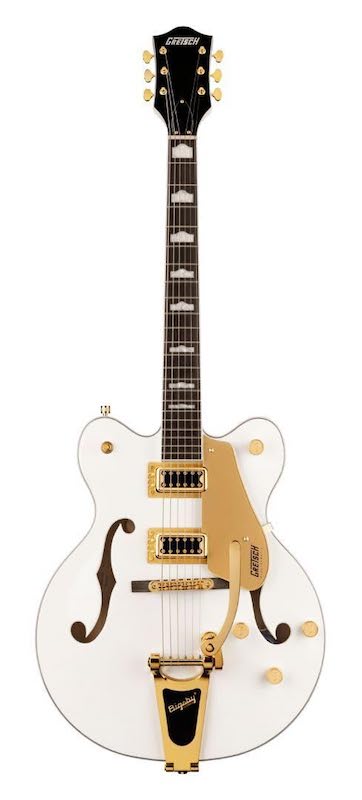
Gretsch G6136-55 Vintage Select 1955 White Falcon
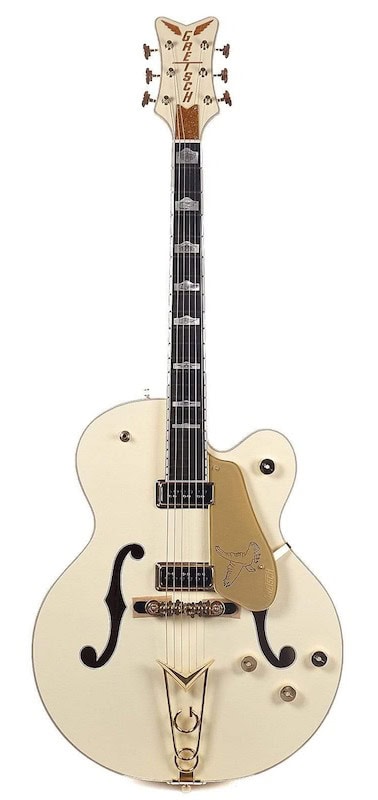
Few guitars on this planet can give you the sort of feeling opening the case of a White Falcon does. One that comes close is the Lucille, but that’s for another occasion. The Falcon is, to many of us, the pinnacle of Gretsch’s mojo. Furthermore, after “Californication”, its status grew even more gigantic.
The Falcon is a giant guitar in many senses but this model with the TV Jones T'Armond single-coil pickups has the perfect mix between snap and oomph. Yes, the maple body with a spruce top, the maple neck, and the ebony fingerboard all contribute to the guitar’s high end. If you plug it into a pushed tube amp, the result is simply a razor-sharp mammoth tone.
This guitar isn’t the most comfortable to play due to its size and the U-type neck, but it’s not a guitar you choose because of its ergonomics but because of its looks and tone.
Dust off those suede shoes and try on the Falcon, you won’t look back.
Gretsch G5422G-12 Electromatic
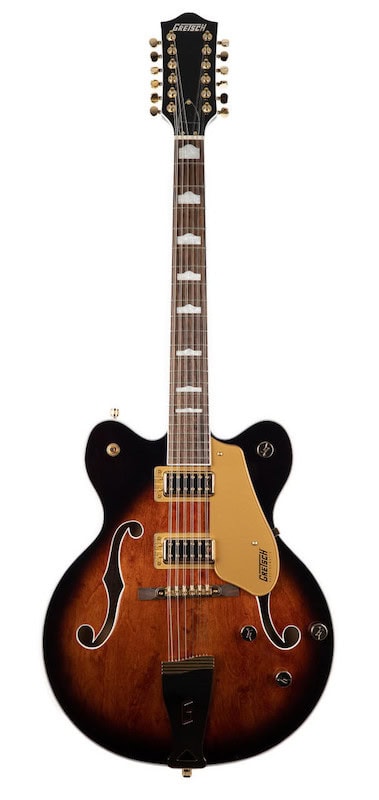
Is there anything cooler than a hollow-body Gretsch guitar? Well, of course, there is, a 12-string hollow-body Gretsch guitar!
This affordable version of one of the coolest-looking Gretsch combinations, the Walnut stain color and the gold hardware packs some serious punch besides the outstanding looks.
Yes, in the heart of this guitar are a pair of FT-5E Filter'Tron pickups that facilitate the punch, take away the hum, and make their part for a noiseless operation.
Speaking of noise and sound, the guitar sounds huge, but the sparkly top of the octave-high strings and the maple body and neck make it a specially jangly guitar, perfect for arena anthems and timeless singalongs.
Although it’s not the most comfortable guitar (it’s a hollow-body 12-string guitar, all right?), it could be worse. It passed the nosedive test easily with the strap, too.
Gretsch G2420T Streamliner
Let me tell you that if I needed a different color for the studio, a backup live guitar, or just some new tones to play with, I would buy this guitar without thinking twice. The price tag is very low for what this guitar has to offer.
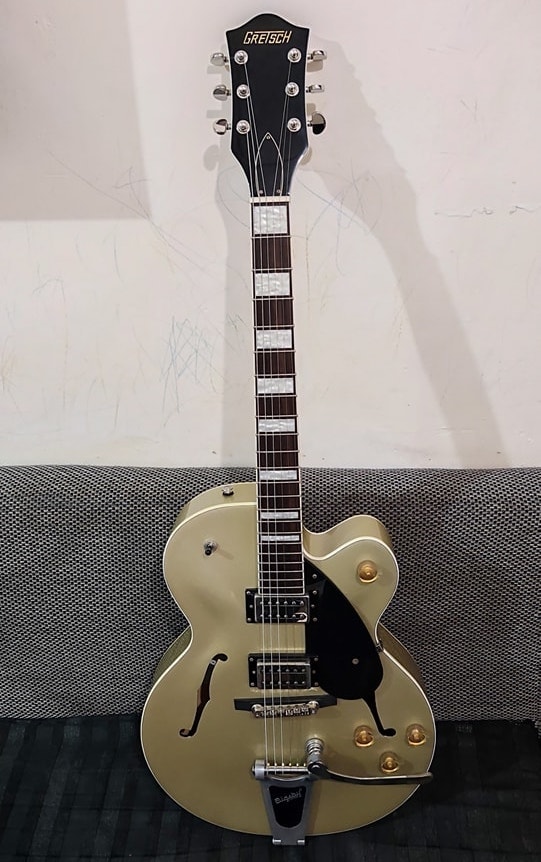
Gretsch G2420T Streamliner
Despite the nato neck, plastic nut, laurel fingerboard, and Broad’Tron B3TS pickups, this guitar is a perfect rocking machine to play bits in songs, tour amateur, and can even give you a lifelong of fun and music.
The sound is a bit muffled; it doesn’t react perfectly to volume changes on the guitar, but the snap, twang, and attack that are Gretsch’s trademarks are all there. Plus, if you want to open up the tone, just throw in some high-end pickups, set it up properly (maybe also change the nut) and you have the Gretsch sound for a fraction of the price.
Epiphone
Casino USA
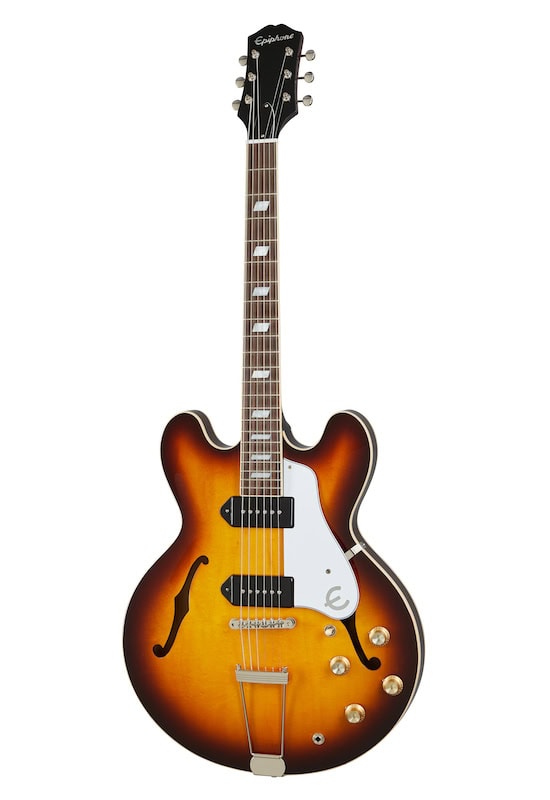
What a difficult guitar to put down! There, I said it. This guitar is a songwriter’s dream; everything that sounds great unplugged only sounds better plugged in. Yes, the jangle top and boomy bottom end are a beautiful combination, especially for those about to rock.
Speaking of which, a lot has been written and said about P-90s fierce midrange and bite. Well, it’s never enough because these USA-made pair of pickups is enough to cut through the densest mix and deposit you right in the forefront of it. Yes, you can play first-position open chords with a full band and you’ll be heard perfectly.
Also, this is a very balanced instrument. The maple/poplar/maple combination in the sides, top, and back along with the mahogany neck and premium rosewood fingerboard tame the high end making it beautifully round and sweet.
As I said, a very difficult guitar to put down.
Broadway
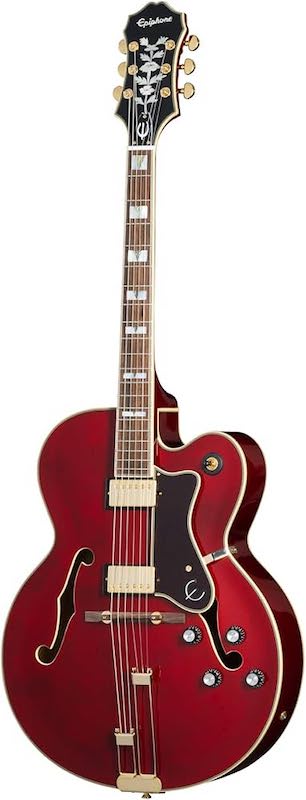
The size, appointments, and materials make the Broadway a guitar that steps boldly into Gretsch territory. The first thing that gets you is the spruce top with maple neck combination. This massive high-end is met with the huge hollow body of this guitar that’s just as big as the ’55 Falcon.
The 12” radius and the 22-fret neck with a slim-taper ‘60s profile are also a winning combination. They mean that this guitar feels huge to play but it also has the neck of an SG. Also, the floating pau ferro bridge adds not only to the overall mojo of the guitar but also to its vintage-inspired tones.
Speaking of which, Epiphone packed this guitar with Alnico Classic Pro humbuckers. These are vintage-voiced pickups that kill the hum and give you a slight punch while keeping it all crystal clear.
The Broadway is a serious runner for the price, so, if it’s within your budget, give it a try before buying.
Emperor Swingster
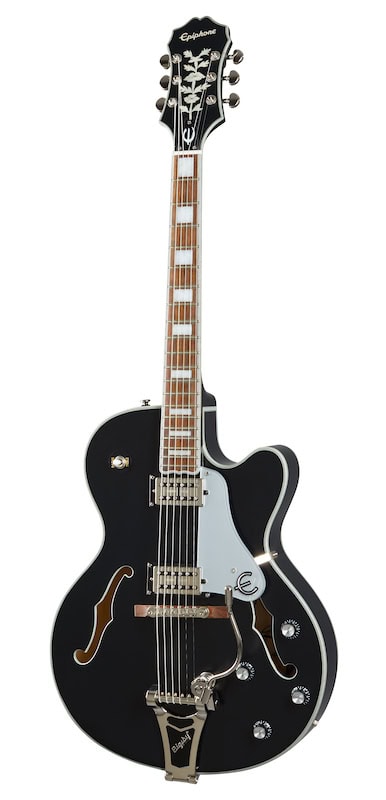
I know, I know, I thought the same when I saw it. Epiphone took it too far into Gretsch territory with this model. I mean, if instead of an e on the pickguard, it was a G on the body, it would be a Gretsch guitar. Although the shape of the body and the vibrato add to that vibe, it’s the pickups that make the biggest push in that direction.
Nevertheless, besides the obvious aesthetic appointments, this guitar and its mahogany slim-taper neck, 24 ¾ scale, Indian laurel fingerboard, and SwingBucker humbuckers are closer to the Gibson legacy than Gretsch’s.
But, let me tell you that once you play it, you uncover a whole new concept of rockabilly guitar. Yes, the ability to use coil taps to get different sounds makes this a usable instrument when you need a beefy low-end, or when you need a guitar that can sit right above the bass but below the keyboard. Also, when you need those small two-string or one-string licks soaked in reverb surfing a tidal wave of slapback delay, this guitar can pull it off.
In all its glory, this ax is a true working musician workhorse that with a new set of non-muddy pickups can be a stellar stage instrument stealing more than one look every night.
Center-Block or Semi-Hollow Guitars
Semi-hollow guitars are a whole different universe when compared with hollow-body guitars. I not only mean this tone-wise, but I also mean it in the sense that they are usually smaller guitars that vibrate and react differently to your playing.
These are my favorite three from each brand.
Gretsch
Gretsch G6620TFM Players Edition Nashville
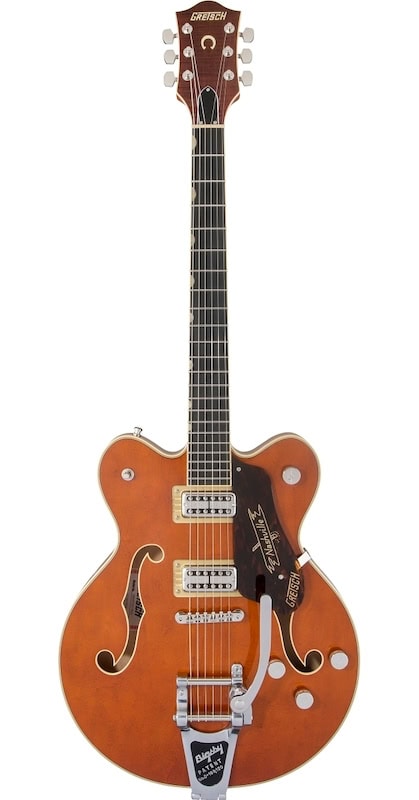
When seen in all their beauty, Gretsch guitars are truly glorious. Opening this case was quite an experience. The flame maple with the orange stain forms a mesmerizing finish that you can just admire for a while before picking up the instrument.
Once I was over that initial shock, the guitar felt and played like what it was; a big guitar. Now, once you plug it in (and even perhaps playing it unplugged too), you instantly note the ringing quality that sets Gretsch apart from all other guitar manufacturers.
This guitar has a hollow spruce center block going across the entire body. Adding to that already brightness-inducing feature, the high-frequency snap of the maple neck and body, and the ebony fingerboard give you this razor-sharp instrument capable of some huge lows too.
Just playing chords feels different, you get the feeling you occupy more space, musically speaking. Also, regardless if you’re an avid Bigsby user or not, you’ll find it hard to stop adding a bit after every chord or note.
This guitar is capable of the quintessential Gretsch tone we all know and love. If that’s what you’re after, and this guitar fits the budget, it’s a no-brainer at least trying it.
Gretsch G5655T-QM Electromatic
The G5655T is a perfect example of a rocking Gretsch made to be played loud and proud with gain and without it. It sports the same combination of a hollow spruce center block with a maple body and neck.

Gretsch G5655T
The first difference here is that the fingerboard isn’t made of snappy, responsive, and clear ebony. On the contrary, it’s made of laurel, an affordable replacement for rosewood many companies use nowadays.
Let me tell you that the moment I sat down to play this guitar for the first time, the 22 medium jumbo frets and the 12” radius made my fingers go for some Setzer vibes, and the Broad’Tron pickups gave quite a punch to nail those two-note rants.
Although, in my opinion, humbuckers and the laurel fretboard put me right into Gibson’s shoes, there’s still some snap to the sound coming from that maple combination. I tried some Gary Moore and BB moves (with all due respect, of course), and there was some sweetness and nice roundness to the sound as well.
The smooth thin-U neck feels comfortable to the hand and, if you strap it on, the guitar doesn’t nose drop at all. If you’re in this budget range looking for a guitar that can give you the Gretsch tone and then some, this is exactly it.
Gretsch G2622T Streamliner
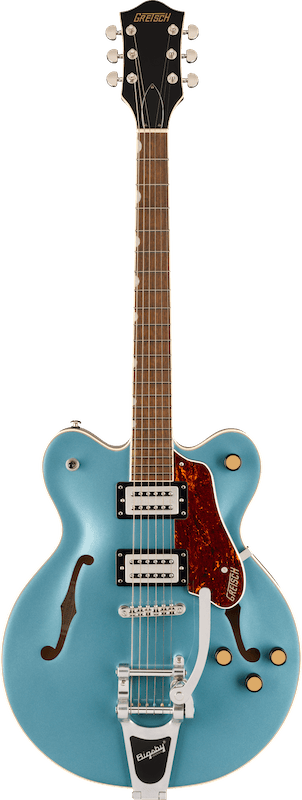
This guitar feels exactly the way a guitar this size should feel. It’s a big boat with a Bigsby and a pair of hollow wings to the sides. The company doesn’t disclose what the material of the center block is, but the neck is made of nato and the fingerboard is made of laurel.
The snap, the twang, the attack, and the feel are all there. Perhaps, the characteristic razor-sharp edge of the original Gretsch pickups is the only thing I could say this guitar lacks. The Broad’Tron BT-35 aren’t the most articulate or clean. On the contrary, they’re quite gainy and a tad muddy too. This doesn’t improve with the overall volume control, which doesn’t have a treble bleed circuit, and thus, takes away all the high-end from the guitar.
That said, this Streamliner does the Gretsch sound very well and with a pickup swap can be a gig-friendly instrument. Even without it, the moment you engage the guitar’s coil tap hidden under the volume control for each pickup, you get a little more definition and midrange to get that twangy, bright, Gretsch tone.
If you’re looking for an affordable center-block guitar with serious overhauling possibilities, terrific looks, and the snappy Gretsch tone, try this Streamliner.
Epiphone
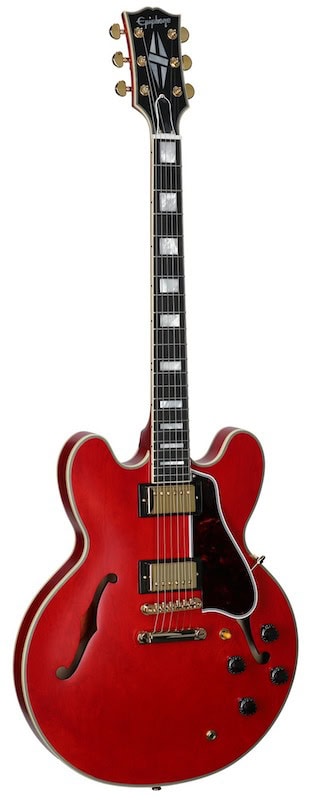
Epiphone 1959 ES-355
“WOW!” That was the first word that left my mouth when this case opened. Yes, I tried the cherry red version and, between the appointments on the headstock, the binding, and the gold hardware, this guitar haunts you from moment zero.
You know how it goes with the 355, it’s like the 335’s fancier bigger sister. It’s got that Les Paul Custom inlay on the headstock, and this one even comes with the open-book shape.
Plugging it in is another great experience because the Gibson Custom Shop and Epiphone worked painstakingly on a new set of pickups to emulate the gentle punch of original PAF humbuckers. They’re called Custombuckers, and they’re even potted for a closer emulation of the original sound.
Well, this guitar with its Gibson USA pickups, CTS pots, Switchcraft jack and switch, and Mallory capacitors sounds way above what its price tag indicates. You have that sweet, massive, highly melodic tone that can be cleaned up by just rolling the volume pot down.
Furthermore, the mahogany neck with ebony pickup matches the maple-poplar-maple body with a solid maple center block perfectly.
You get a tone that’s got attack and bite but also a very well-curated midrange, amazing lows, and singing highs. If it fits the budget is a must to try this guitar.
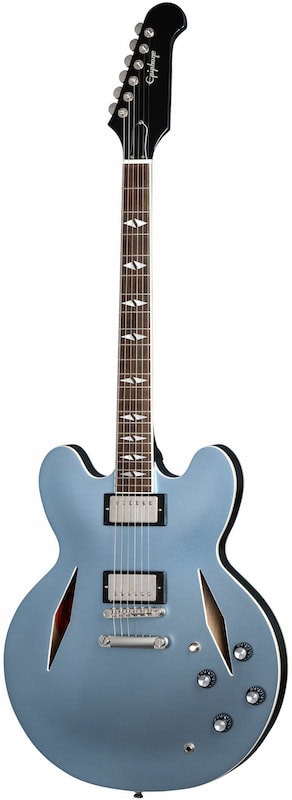
Epiphone DG-335
Dave Grohl needs no introduction (regardless of what instrument he’s playing). Well, legions of his fans requested an affordable version of his most iconic ax, the Pelham Blue Trini Lopez guitar he’s rocked for stadiums across the globe.
Fans’ dreams came true, and this guitar won’t disappoint them in any way.
First off, I have to say this guitar’s sound shocked me. It’s equipped with the same USA-made Burstbuckers his original Custom Shop version has. These pickups are kind of magical in the sense that they pack the bite and the punch but aren’t so gainy. Therefore, you have quite a lot of edge, the kind of edge Grunge, punk, and alternative music need.
Secondly, CTS pots, Switchcraft components, and Mallory capacitors make this a top-notch guitar ready to tour the world. Furthermore, the fact that this six-stringer has a single-piece (kinda chunky, IMO) mahogany neck is mind-blowing at this price point. Although it’s joined by a laurel fretboard, it’s a feat found on much more expensive guitars.
Finally, and speaking about expensive guitars, this sounds like one. I tried it all, from “Monkey Wrench” to “Everlong” to some Robben Ford and George Benson (with all due respect) and it all sounded fantastic.
This is not just a guitar for Dave Grohl’s fans but for whoever wants a semi-hollow guitar that can do it all and then some.
Epiphone Riviera
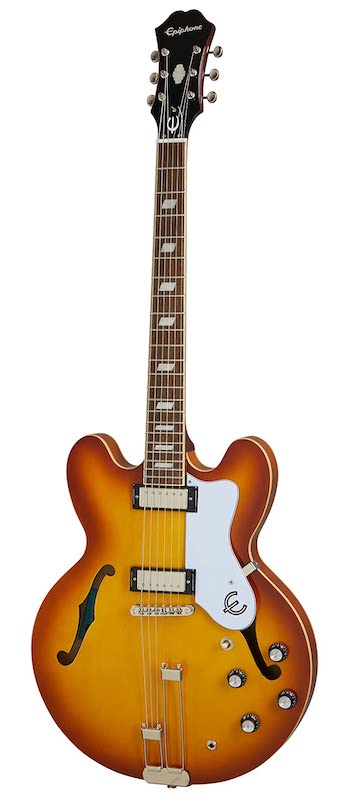
Every time I plug in a guitar with mini humbuckers, I can’t believe they’re not the most popular pickups in the world. They have the kind of non-humming punch a humbucker offers but in a much more articulated, clear-sounding package.
This guitar offers exactly that kind of tone but with lots of low-end and a nice midrange. To my ears, at least, it’s way clearer than any of the humbucker-equipped guitars in its price line.
Speaking of which, the Riviera is essentially a Casino with a center block and different pickups. You might be tempted to think they sound similar, but they don’t. The center block makes a huge difference and helps with feedback a lot.
I’m a big Kings of Leon fan and Caleb Followill plays a Gibson ES-325 with a pair of mini-humbuckers. So, I’ve been hearing this tone for many years.
Well, let me tell you that I’ve tried all the KOL songs I know with this guitar and it stood up to the test perfectly. Furthermore, the CTS pots and the overall craftsmanship are spotless.
So, if you want something that’s more rocking and feedback-resistant than the Casino with an articulate, open, punchy, and robust tone, try out the Riviera, it might be the guitar for you.
Gretsch Japan vs Epiphone USA
One of the things that needs clearing before ending this piece is what happens with US-made Gretsch guitars and US-made Epiphone guitars.
Can they compare? Why is the price tag of USA-made Gretsch guitars twice as high?
Well, the explanation is simple, the guitars Epiphone makes in the USA are what we know as production-line guitars. This means the guitars go through a set of steps carried out by specialists in every department inside a big facility where many other guitars are being made.
For example, some people take care of the neck shaping while other people do fretting, others put tape around the body for the binding others finish the fretboard, and so on.
Well, the Custom Shop works in two different ways, on one hand, you have team-built projects. These are carried on by the best of the best in every department, handpicked because of their uncanny talent and vocation for perfectionism.
The second way is masterbuilt guitars made entirely by a single person (over CNC-made bodies, of course). These are the highest tier of guitars you can request from Gretsch, following a true “Sky's the limit” motto.
So, when you compare Gretsch Japan, you can compare it to Epiphone USA and Gibson USA. When you compare Gretsch USA, you can only compare it to the Custom Shop guitars made by Gibson or Fender.
Some Sound Recommendations for the Tones in Your Head
Get an EQ Pedal
This is the most important recommendation to give you if you’re stepping on a stage with a hollow or semi-hollow guitar; get an EQ pedal. You need to take out the untamable frequencies from the spectrum so you can enjoy your guitar to its fullest. Just spend some time working with the guitar, the pedal, and the amp, and I guarantee you’ll improve your tone drastically.
Mind the Pedal’s Tone Knob
The Casino in particular, but all these hollow-body mahogany-neck guitars tend to have a certain darkness to them. Therefore, if you push the overdrive’s pedal tone knob beyond noon, you might be able to “open up” the guitar’s tone. Furthermore, you’ll be driving the guitar away from that hollow-body low-pitch feedback rumble noise that’s so common.
Don’t Fear the Neck Pickup
This is especially true for Gretsch guitars, but some Epiphones work this way too. The twangy, sparkly high-end, and the massive low-end tend to shy players away from the boominess of the neck pickup. Well, don’t be afraid of it, just try to find its sweet spot with the volume knob. The brightness of Gretsch guitars shines proudly through the neck pickup and the body of the Epiphone guitars gets to a colossal size, ready to play the blues.
Work the Sweet Spot & the Master Volume
This last piece of advice is Gretsch-only. Most of these guitars come with a master volume that affects the entire circuit, and then a volume knob for each pickup. If you work the sweet spot of each pickup with their individual knob, you can simply go up and down with your master volume.
Bonus Track: Acoustics!
Gretsch
Gretsch Jim Dandy Deltoluxe Parlor
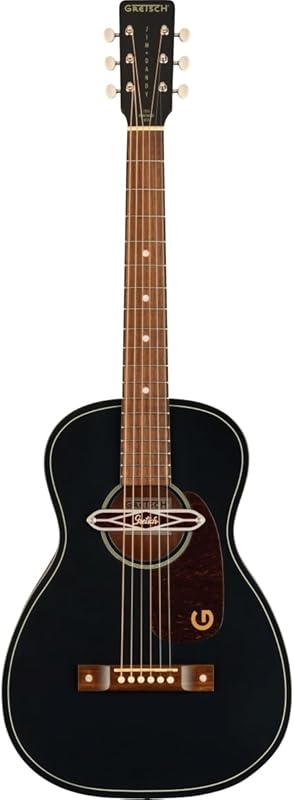
I love parlor guitars. These are the perfect companions for a short trip, bonfire singalong, or the stage. Moreover, this guitar comes with the Deltoluxe soundhole pickup to make everything louder. Speaking of which, the frequency response for this guitar is based upon middle and mid-high frequencies with a little sweetness but not all that much low-end.
If you’re an occasional strummer or an avid player wanting a casual guitar, this is a must-check.
Gretsch G5024E Rancher Dreadnought
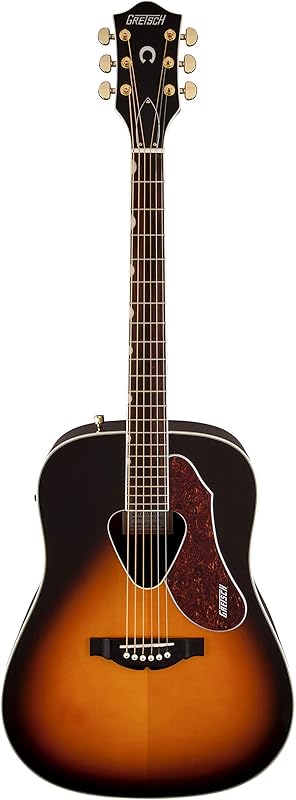
Dreadnought guitars have dominated the market since Martin came up with the shape. Well, this guitar features Gretsch’s trademark pick-shaped soundhole and a generous body that creates a big, boomy, focused acoustic tone that can shine through the mix. Whether you play it unplugged or with the Fishman pre, the sound is snappy and mid-high oriented with generous lows from the big dreadnought body.
Gretsch G5022CWFE-12 Rancher Falcon Jumbo
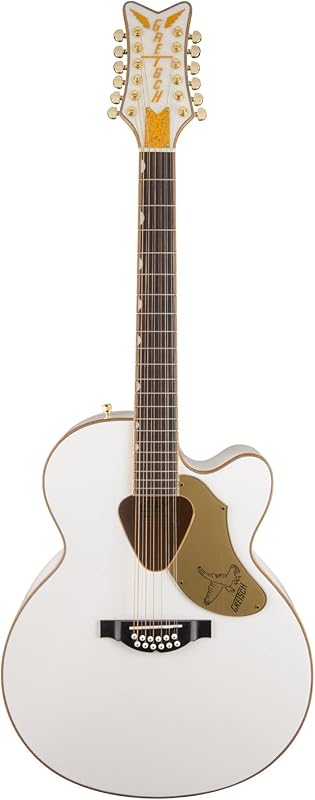
I’m not here to tell you what’s cool and what isn’t but looking at this guitar you have to agree with me it looks absolutely fantastic.
Well, this is a huge jumbo guitar that sounds exactly like one but with an uncanny high-end and a chime-like treble response that’s just delightful. Yes, playing simple open chords with this guitar sounds and feels different because of the huge lows and sparkling highs.
I did my favorite trick and detuned the extra 6 strings just slightly to get that magnificent natural chorus sound and had a blast playing this guitar.
Epiphone
Epiphone USA Frontier
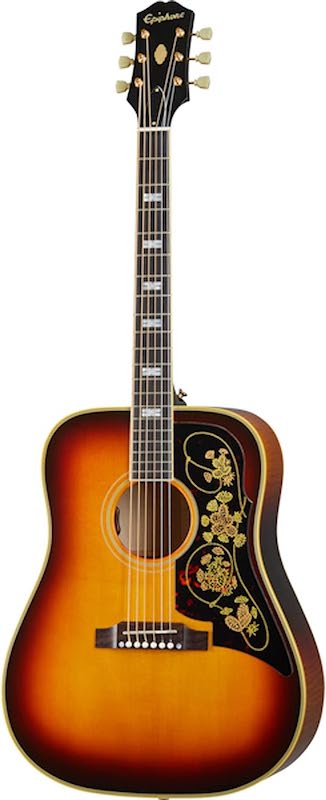
The Frontier is the glorious return of Epiphone acoustics to the USA. This is a guitar that’s au pair with Gibson acoustics (sound and price-wise) and that features premium woods and accessories. For example, it’s made of figured maple with a solid Sitka spruce top and a solid mahogany neck with a rosewood fingerboard.
Let me tell you that it plays as well as it sounds with the real bone nut and saddle and the X-bracing treatment. It’s got a nice high-end like any maple guitar would and an amazing projection thanks to the bracing.
Finally, everything sounds HD when plugged in thanks to the LR-Baggs VTC electronics. If it fits the budget, it’s a terrific guitar.
Epiphone 1957 SJ-200
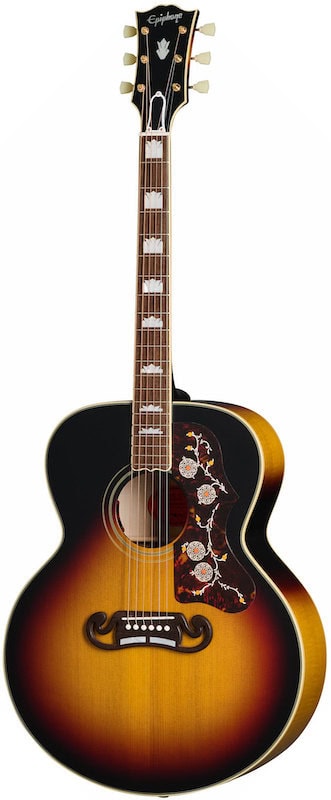
Everyone from Elvis Presley to Sheryl Crow has strummed a Jumbo at a certain moment in their careers. These guitars tend to be very full and boomy because of the size of the body. The catch is that they’re made of maple with a laurel fingerboard and a Sitka spruce top.
Therefore, the first thing that hits you with this guitar is that you seem to be strumming a giant treble machine with some nice low mids and a perfectly defined upper midrange.
If it’s within your budget, this LR-Baggs-equipped giant guitar might just be the way to go.
Epiphone Dove Studio
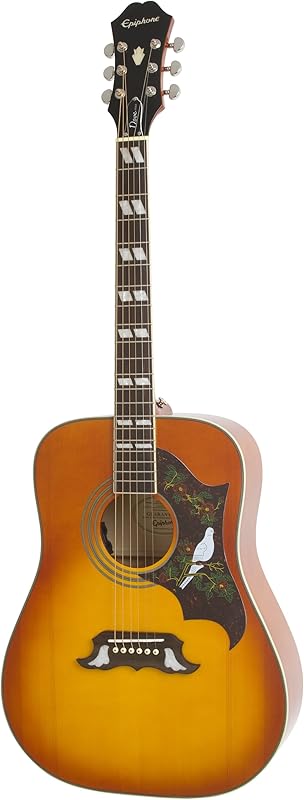
This guitar packs an impressive bang for the buck for acoustic guitar players out there. Firstly, it comes with a solid spruce top that helps resonance and tone a lot despite the laminated back and sides.
Secondly, it’s got the neck-twisting, mind-blowing, amazing ‘60s looks the Dove is known and loved for.
Thirdly, it comes equipped with Fishman electronics making the stage appearance an easy endeavor that sounds accurate every night.
After saying all of that, this is an entry-to-mid-priced acoustic that lacks the majestic resonance and definition of the models above. Nevertheless, if you’re a casual strummer, a player on a tight budget, an aficionado, or a hobbyist, this might be the guitar you were looking for.
The Bottom Line
Gretsch and Epiphone are two of the best-known semi-hollow and hollow-body guitar manufacturers in the world.
While Gretsch guitars tend to appeal to rock, rockabilly, ska, punk, jazz, country, and hillbilly players for their twang, spank, and high-end resonance, Epiphone aims for a different tonal palette. The tone of the Epiphone guitars is darker, with more of a round bottom-end that has made it rock and rollers, blues players (like Gary Clark Jr.), and jazz players’ favorites.
Both brands have a history, mojo, vibe, and tone of their own. Furthermore, there’s an option for every budget in the hollow and semi-hollow collections. So, there are no more excuses, go out and try the one that resonated with you the most.
Perhaps, the future of your guitar-playing adventures has a couple of F-holes to the sides and a whole lotta bottom end!
Happy (hollow and semi-hollow) playing!

Its all about the models. Each brand offers some guitars that can grab ‘the sound in your head’. It’s true that top end Japanese Gretsch and some USA vintage builds are more fairly compared to Gibson or USA Fender (given pricing, etcetera). That said – I have found some of the budget Gretsch makes to have surprisingly good setups and generously broad sound palettes (right out of the box!). In general – Asian Epiphones have more traditional tone palettes that represent classic jazz, blues, and roots tonalities. They may require a bit more adjustment from the factory. Try each, and see what you think.
I think when it comes to playing you should choose a guitar based on feel. A lot of your sound and tone comes from your own fingers and depends much more on what Amp you’re using and your amp/gain settings. Most guitarists you’re hearing that have tones you just can’t seem to dial in no matter how hard you’re chasing them are also likely using compression and some subtle delay as well.
My next guitar is going to be a gretsch junior jet because it’s a fabulous guitar that plays and sounds great for dirt cheap.
And lastly, the fact that people think a guitar can be shipped across the pacific and not need any tweaks out of the box truly believes in miracles…
I have owned both brands epiphone and Gretsch. Both are disappointing in quality out of the box. I have a Gibson less Paul and a made in Mexico Stratocaster. Both guitars exceeded Gretsch and Epiphone.
The only real downsides to Gretsch is their compulsion yo slap god-awful Bigsby bridges in everything.
Also, if you have a white falcon and are playing big rooms. You’re pretty much got stuff the thing for foam at the start of the tour to kill some of that feedback you’re gonna have a few move around the stage at all. otherwise I love those guitars.
I have owned many epiphonesin the past. 50′ LP, 60’s LP the tuxedo and a few more Epiphone LP’s. I have also owned many of their acoustic electrics including the ej200sce. I now own 3 Gretsch guitars. The 5655tg, rancher falcon and 5420t. My next will be the nick 13 5320. Epiphone makes a great guitar but in mho not as good as Gretsch
This comparison should be called the best guitars under the $800.00 mark, from Epiphone and Gretsch. Gretsch’s higher end models from Japan are not in the same class with Epiphones but more in line with Gibson and Fender. Gretsch makes wonderful guitars for under a grand. The streamliners are their entry point guitar and the electromatic line a step up from there. Epiphone also makes great guitars and I own a couple of those, firebird and a Les Paul versions. It is hard to choose between the two brands, depending on your style and genre. I switch back n forth between the Les Paul and my Gretsch g5222. The Gretsch is lighter in weight and when I am wanting to get my Malcolm Young vibe on that’s my choice. I then pick up my Epiphone Les Paul and remember why I like it, tough decision. I like both brands as I am more of a Gibson guy (flavor radius) over the Fender style. If you want to get even more confused try a PRS. I have a PRS angelus acoustic that I love playing. I would choose it over the Epiphone or Gretsch acoustics. These are just my opinions though. Enjoy!
In march of this year I bought a custom LP from Epiphone, about 800 bucks. Worst mail order guitar I’ve ever seen. Every fret, every single fret treble, bass, up neck down neck would cut into your hand and fingers and do some damage to your hand. The nut at the 6th string was 3/8 inch from the fret board and about an 1/8 inch at the 1st string. When I removed both strap buttons, paint chipped off both, they were obviously installed while the paint was still wet, and there were 3 high frets that needed attention, 2 on the B string and 1 on the low E. Epiphone has never ever ever ever made a decent sounding pickup, and no matter what the specs say they all sound exactly alike, shrill and grimmy tone, just a cheap pickup and the worst pots and wiring on the market. In june I bought a 2622t Gretch for 500 bucks, it was flawless, pulled it out of the box installed some flatwounds on it, 9 gauge, and it is awesome, even compared to my 3,000 dollar Heritage LP it holds up to the test! Epi’s are just pure garbage and waaay over priced.
What type of Gretsch is the one in the picture under playability?
It’s a Gretsch G6659TG Broadkaster Jr
Im looking at a Gretsch G503FT Rancher or Epiphone EJ200SCE Cutaway Vintage sunburst Acoustic – love the look of both guitars – but as older guy, fairly new to playing, I want the easier fretboard but with the rich deeper tones.
Do I lose either way – or am I on a good thing ?
Currently own a Tanglewood Sundance premier.
Hi Chris, I’d go with the Epiphone for not much more than ease of playing and lower cost. The Gretsch Rancher is a more well rounded guitar in other aspects.
I just tried the epi 200. Save your money on that one. It’s all about looks.,,. Not tone.
I own both brands. They both need serious setups and fret work after purchase. Once that is done either one is a fine choice. It’s just a question of taste.
which guitar is better suited for a lower mellow tone?
Hi Anthony, although it’s hard to say without talking about specific models, I think a Gretsch guitar will be better suited for your needs.
Which guitar is better suited for a lower mellow tone? Thank you rich. I am 72 and like paying the old mellow songs. Today’s guitars seem to have that twangy sound. I am always changing strings to a thicker gauge to try and get that mellow sound.
I see!
It’s inspiring to see that you’re still playing with enthusiasm and looking to achieve that vintage mellow sound. 🙂
For under $700 (currently), you can’t go wrong with a Gretsch G5230T (or similar models).
the gretsch has better tone and playability, I have both. Quality are both very good
Hello Anthony. The p90 on a Casino has the vintage sound, as humbuckers were not available till 1958. Gretsch uses humbuckers, as do many Epi and Gibsons models Pure nickel strings go way back as well.