
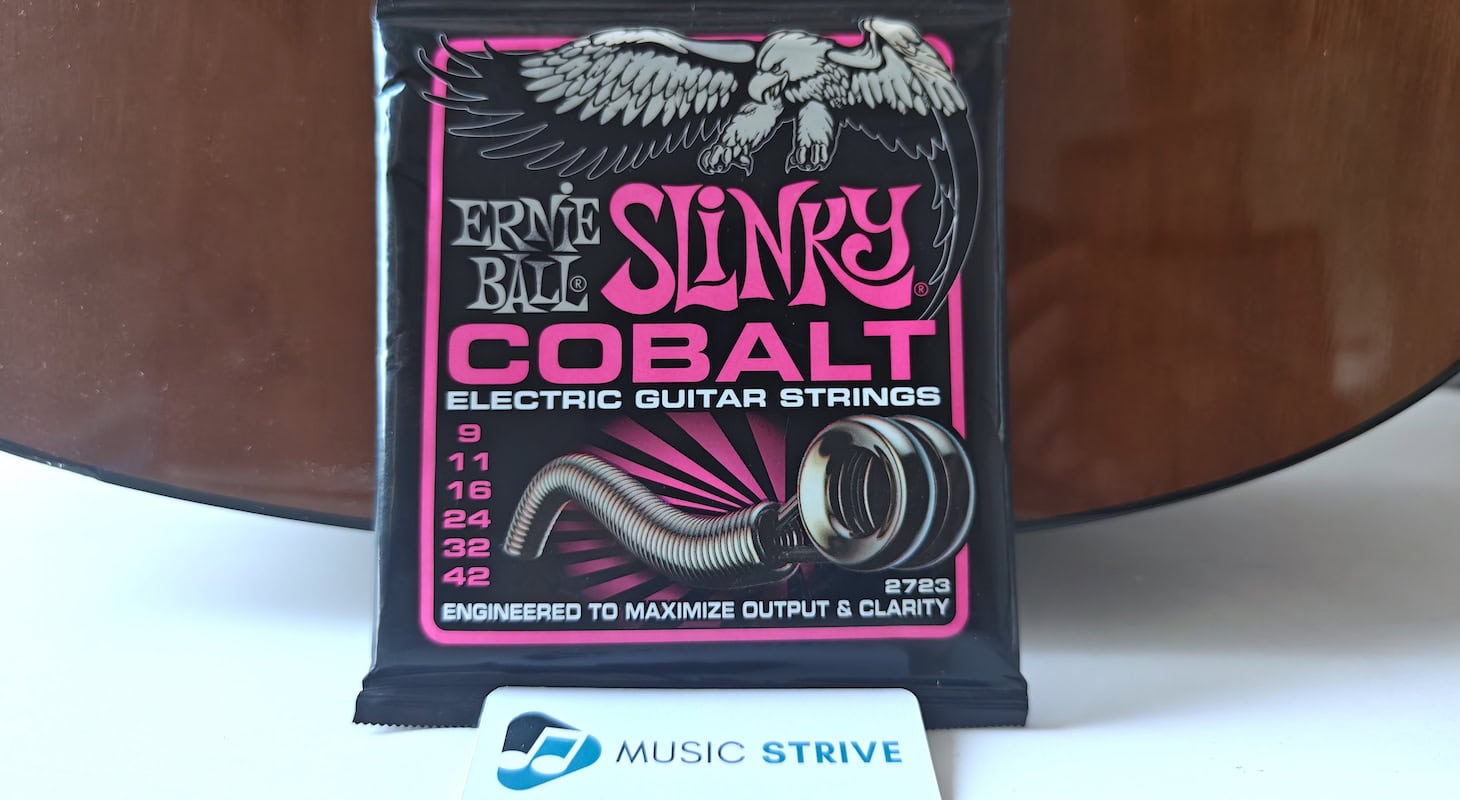
The string market is flooded with countless products of all kinds that claim to improve your tone. At the end of the day, tone is always subjective. Plus, once you think you found it, the grass becomes greener somewhere else.
Well, good news is that strings are among the most affordable tone experiments you can undergo.
String Snapshot
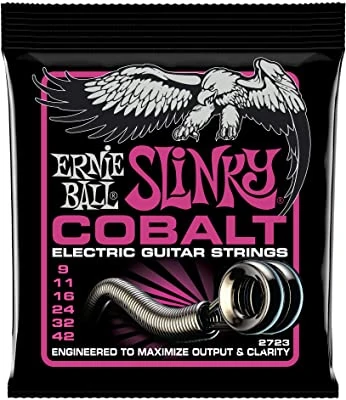
These aren’t your typical Slinkies — expect tighter bass, piano-like clarity, and a hotter feel under your fingers. Ideal for taming mid-heavy guitars, fattening Tele/Strat tones, and unlocking monstrous drop-tuned riffs.
I don’t want to blow the scoop for you, because I played many instruments to write this thing (tough job, I know!). But one thing I can tell you from the get-go is this: These strings sound and play differently from everything else.
Let’s dive in.
Why Bother Making Cobalt Strings Anyways?
Ernie Ball’s R&D department tested over 350 alloys before settling for cobalt and iron. Hey, they’ve been making top-notch rock and roll strings since the days Jimi was around. I mean, we’ve all played a pack of Slinkies in our lives.
They tested the string with the cobalt in three moments: when the pick hits, the output peak, and the decay. What they found out was that this new material outdid nickel and steel in all three categories.
They sent packs with no other explanation than “please try them” to people like Slash, Tony Levin, John Petrucci, Metallica, and others. The feedback pushed them into bothering to make cobalt strings at a large scale.
Yes, I know, they also come with some cons. Let’s look at the whole spectrum.
First Impression
When you’ve been playing for decades, and you’ve changed a few string sets in your life, you know they all look pretty much the same. Well, not cobalts. While most guitar strings have that shiny, polished look we love so much, these strings look dull, with a kind of matte finish.
Before I put them in, I noticed that cobalt felt a little rough to my fingers. They also had a strong metallic smell right out of the bag. This is, of course, for the top three strings; the bottom three are regular carbon-steel Slinkies.
Extended Dynamic Range
The alloy gives these strings a unique sound. I’m telling you; this is the farthest borders of how dramatically strings affect your tone. It’s something you notice immediately.
To begin with, the low end grows. These strings are specifically engineered to punch heavily in the bass. The midrange is focused on a different frequency than what one is used to. They feel like scooping mids as we did in the wild old days. At the same time, the treble response is full, with rich harmonic overtones.
They can seem a little odd because of the midrange scoop but feel fuller and bigger most of the time. If you’re an acoustic player, it’s like going from 80/20 to Phosphor Bronze.
Higher Magnetic Pull
Ernie Ball tried 350 combinations, and this Cobalt-iron alloy was the most responsive to the guitar’s magnetic pickups. This is not hype or a marketing strategy; it feels different. I’m going to get into this topic in detail below, but right from the first note, you notice they have more attack. Your guitar seems to have more gain.
Although it’s more of a feel thing, something only a discerning player would notice, if you’re very used to your rig, you’ll feel the difference. Small but real.
Hey, it’s a pack of strings. It doesn’t magically turn your Peavy transistor amp into a Mesa Boogie head and cab. But it pushes you forward stronger than most other brands.
Maximum Clarity
One thing I have to say, and again I will go into this in detail below, is that the scooped mids do clean up some of the range. You get a piano-like feeling. Ultra-clean chords with every note ringing loud and proud.
On the other hand, the boomy low end can be too much depending on the guitar you’re playing. I would say that for guitars that already carry a big low-end, these might be too much.
They work wonders to thicken the tone without sacrificing note-for-note transparency.
The rich, natural harmonic overtones are very present and become an integral part of your tone, even when you’re using high-gain settings. I was plucking screaming pick harmonics as if I were Zakk Wylde on every string before I could even notice. The tone remained laser-focused, powerful, and musical.
Feel & Tension
Since Ernie Ball Cobalts have a slightly smaller core, they have less tension than a regular pack of slinkies. This isn’t game-changing, but it’s noticeable in bends, for example. You feel like you’re fighting it less.
These strings have a thicker wrap on a smaller core. As a result, it has fewer wraps per string. This is very technical, but our fingers are sensitive enough to feel that roughness (yeah, even with those gross calluses of ours).
That said, after a while playing them, I noticed the coarseness had disappeared and in its place was a kind of silky softness that made these strings a great experience.
The one thing to say here is that, if you’re very picky and sensitive, you’ll notice that the bottom three strings are out of balance with the top three strings. They feel, sound, and play differently and not just because of the wrapping, but because of the materials.
Feel-wise, Ernie Ball Cobalts are awesome once you get used to them. Tension-wise, well, that’s a matter of taste. I just loved them.
Let’s Talk about Tone!
Well, enough with the feel, the mathematics, the mumbo jumbo, and the hard data. It’s time to have some well-deserved fun. I put these strings on three of my guitars to tell you exactly how they behave when pushed to different scenarios.
Let’s talk about tone!
On My Telecaster
I’m the proud owner of a Custom Shop Telecaster. I put the Cobalts on and noticed the whole thing grew in the lower-mids section. It has a rosewood board, so the sound is already kind of sweet and tamed.
I tried big chords, and the natural clarity of the guitar was enhanced. The top-end became more musical, and the low end was rich and big.
Perhaps, the only thing that these strings can’t handle so well is the mid-infused rock and roll tones of a pushed amp. I tried it with my Deluxe Reverb, going straight in, and although it sounded great, I didn’t have that punchy mid-section that’s so needed to pull off the rocking trick.
Moving to cleaner, textural, heavily modulated tones swimming in lush delays and shimmering reverbs, the results were great. Every note was clearer than usual because of the scooped mids.
Finally, I went for some distorted tones and played Green Day, Bad Religion, and The Offspring, and these strings just killed it. They’re great to beef up a midrangey guitar like the Tele.
With P-90s
There’s one word I love to use for P-90s and that’s “Bite”. Yes, this ancient technology is as ferocious today as it has always been. My ’68 SG Jr. is a mid-machine ready to cut your throat with soaring, wild tones.
As soon as I put the Cobalts in, I noticed the overall gain was higher, but the sound was kind of tamed. Yes, the midrange that’s so characteristic in these pickups was not as present anymore. This was a good and a bad thing.
On one hand, rolling off volume I was able to get cleaner tones from my guitar. Yes, these strings react better to the pickups, making the overall result hotter. Yet, since the midrange is somewhat scooped, you get the feeling the guitar doesn’t push the amp into overdrive as easily. So, complex chords became piano-like.
On the other hand, when engaging gain stages, the bottom-end and the powerful harmonic content of the mid-highs transformed this rock and roll machine into a powerful, heavy-hitting guitar. The bottom end allowed me to play early Sabbath stuff because tone gravitated more toward that kind of sound than AC-DC.
I would say these work wonders to tame a guitar like this and to make it meaner in heavy-gain settings.
What About Humbuckers?
I thought I was going to get a punchy, hot, powerful tone out of these pickups. I was as wrong as I could be.
These strings were designed for hot pickups and amps. They pack a strong punch in the low-end that can drive most amps into a muddy swamp if you don’t EQ correctly. Also, highs have so much harmonic content, your guitar comes alive while playing leads, and you can get a soaring tone that will cut through anything.
The one thing I was expecting with my humbucker-equipped guitar was the tone to be punchy and powerful, but instead it was scooped and heavy-hitting. For a moment, my hair went big, and my jeans turned to spandex.
So, I moved a decade to drop-D, and that’s where these strings shone the brightest. The bottom end was tighter, bigger, and more menacing than it was before the Cobalts.
Humbucker guitars grow to mammoth proportions with these strings.
Who Are These Strings for
If you want to tame the midrange of a guitar, add body, or definition, these strings are perfect. Heavy tones as well as Tele/Strat-type guitars will get the most benefit. Bear in mind the tension difference; they might feel a little too gummy or floppy on shorter scales.
Who Aren’t These Strings for
These strings are not for rock and roll lovers who rely heavily on the midrange to make the guitar pop in the mix. Also, if you have a boomy setup with your current guitar and amp, these strings might accentuate that problem.
The Bottom End
Ernie Ball Cobalt Slinkies are a great addition to the Ernie Ball family. They deliver top-notch, modern tones, an extended dynamic range, more power, and good durability.
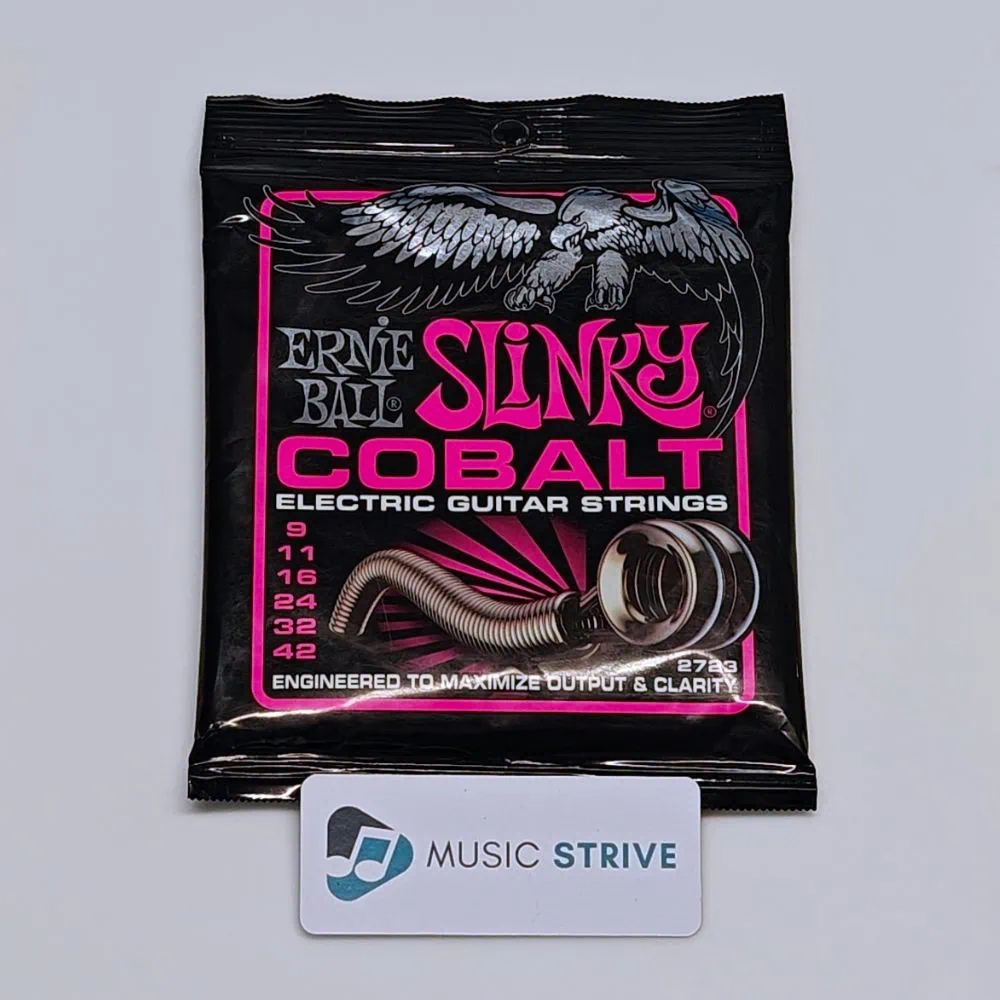
Ernie Ball Cobalt Slinky
The thing is that they are designed with a scooped-mid tone that works great with modern metal, clean tones, and complex chords, but withdraws that midrange we need to make tones cook in a vintage, rock and roll style.
They’re a good, affordable tone experiment that might improve your current tone. Just don’t expect to make “Jumping Jack Flash” sound like the original. That said, they will have you playing “Gets me Through” in a loop, enjoying that huge low end.
Quick Verdict
A bold twist on the classic Slinky feel—Cobalts add muscle, scoop, and sparkle where it counts. Killer for modern tones and heavy riffs!
Happy (scooped and big) playing!
PS: RIP Ozzy, you legend.
