
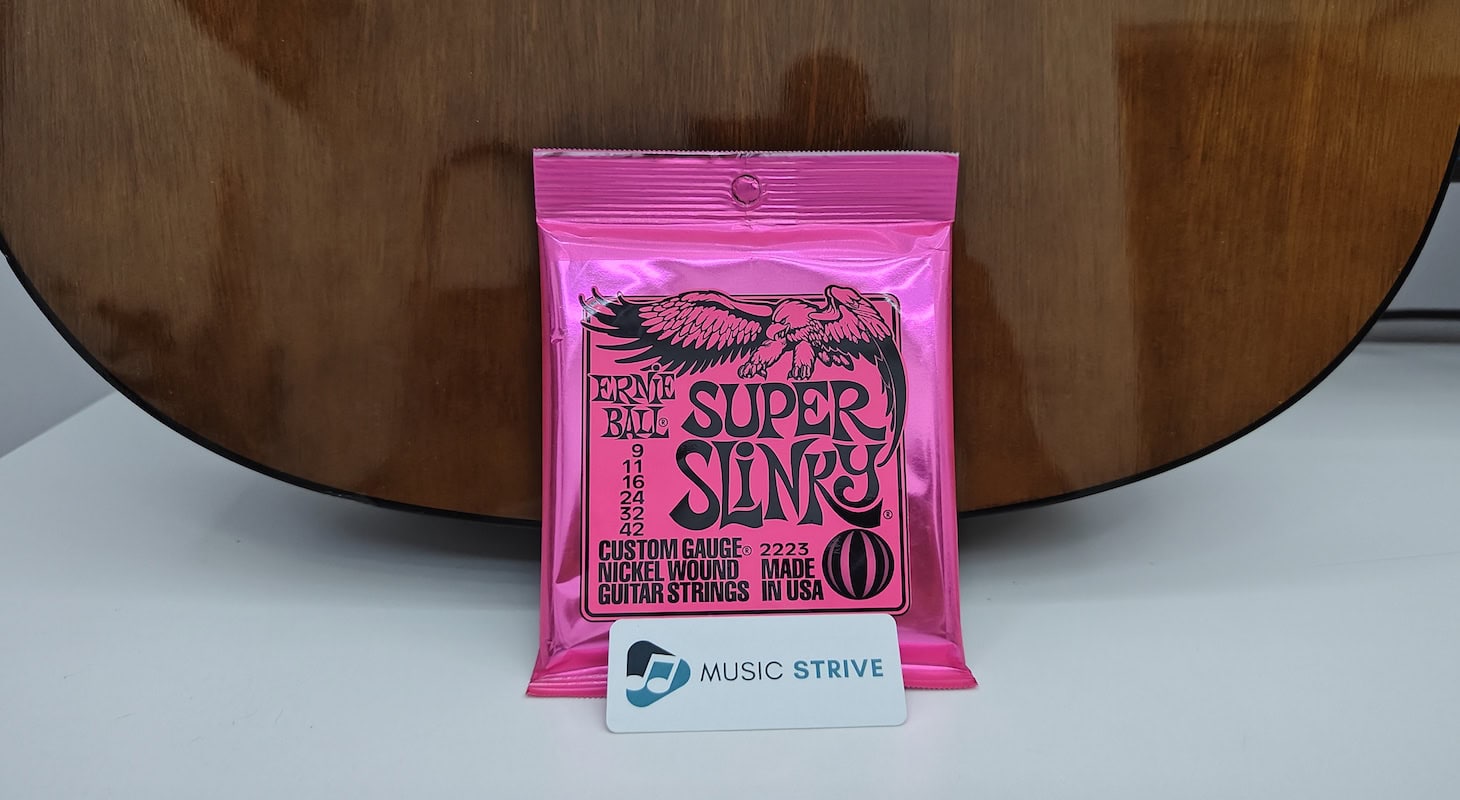
When I was a teenager, first learning to play guitar, I picked up a packet of Ernie Balls. It only set me back about ten dollars, but on my McDonald’s wage, that felt like a lot of money to spend on guitar strings.
On the back was the list of guitarists who used these famous strings. All my heroes: Slash, Ace Frehley, Zakk Wylde. Just about every player I could name was on that list.
I even used to pick names I didn’t recognize and look them up: to my mind, if they were good enough to feature on the back of a pack of Ernie Balls, they must be great!
I spent a long time exclusively playing Beefy Slinkys, with a .22 unwound G string, because I was in a hard-hitting rock band that played exclusively in E flat tuning.
These days, I do more versatile stuff, and play a lot of country lead guitar. My different guitars feature different strings depending on what I’m playing. For ease of bending, and less muscular tones, I prefer the shredder’s choice: Super Slinkys.
I’ll outline what I love, and what I could love more about these strings, below.
Quick Overview
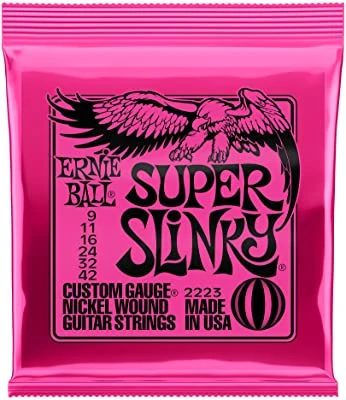
Feather-light feel, smooth bends, and excellent articulation — Super Slinkies are a shredder’s and country picker’s dream. Perfect for clean, precise lead work and expressive vibrato, as long as you’re not too heavy-handed.
Thinner Strings, Bigger Tone?
Ordinarily, I subscribe to the notion that thicker strings means thicker tone. You can hit the strings harder, really digging in, without risking playing too hard and thinning out the sound. For some playing styles, where I have to play very aggressively, or use dropped tunings, I still like heavier strings.
However, I’m playing much more versatile music these days, and had to adjust my playing accordingly.
About five years ago, when I started playing music that demanded more nuanced playing (as well as faster, more precise lead work), I realized my heavy strings were holding me back. I read that ZZ Top’s Billy Gibbons was playing extremely light strings gauged .007 to .038. I couldn’t imagine anyone describing his tone as thin, so I thought I’d try Super Slinkies.
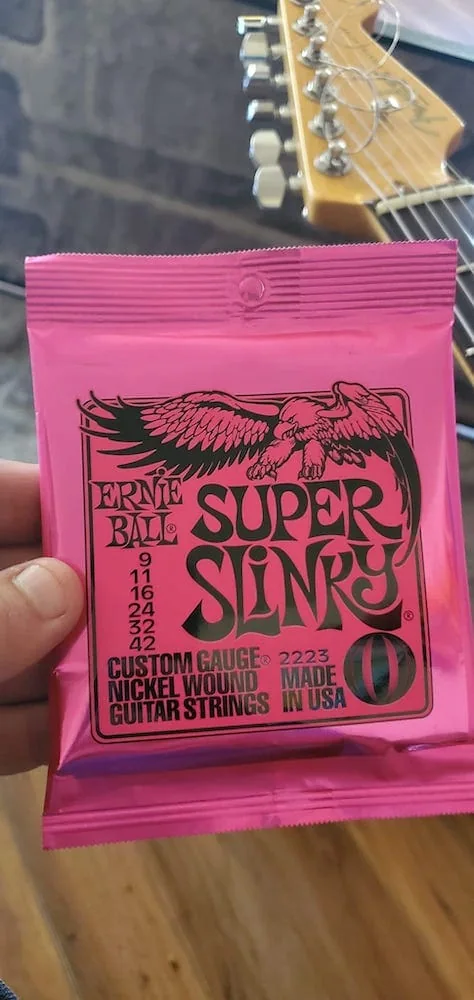
Ernie Ball Super Slinky Strings - as you can guess from the background, I tried it on my HSS Strat.
The first thing I noticed was how much more responsive these strings were to my touch. I really had to control my left hand pressure as well as my picking strength to get the most out of them. I had far more control over my vibrato and bends, and, with subtle variations in picking power, was able to control the guitar’s attack and decay more tightly, too.
It turned out that, when I wasn’t playing at 100% power all the time, I could get a dense, articulate tone with plenty of room to maneuver by adjusting my technique. This is a lesson I keep learning, over, and over, to this day.
The secret was to work out the absolute maximum push I could get from these strings, and work backwards. How much could I dig in without the string sounding too tense and thin? How aggressively can I apply vibrato without the string fretting out?
From there, I worked backwards to playing as softly as I could, and realized there is a whole range of pressure and power to be found in the middle.
Slinky and Strong
I really found my feet with Super Slinky strings when I started dabbling in the world of country lead guitar. While with rock guitar, my aggressive Gary Moore-inspired vibrato and big bends were appropriate, or even encouraged, when I started playing country lead, neither did me any favors.
Big vibrato, for a start, sounded much worse on a clean, compressed guitar tone than with overdrive or distortion. Likewise, I needed to become much more precise with my bending.
I learned that bending for country music is more about emulating the sound of a pedal steel than anything else, and that country players rarely head into the '70s classic rock style bends as I learned copying Ace Frehley, Eric Clapton, and Tony Iommi. I needed to bend whole tones or more, nailing the target tone, or unleash double stop bends without any notes being out.
“Slinkiness,” as defined and epitomized by these Ernie Ball strings, is a measure of a string’s flexibility and durability when bending. There’s really no point in a string that easily bends, but goes out of tune just as easily.
For me, getting slinkier strings, made playing big, clean major-chord country bends much easier. It shallowed out the learning curve on these songs, and, in doing so, made me a better guitar player.
I specifically picked these strings because I wanted to play clean, articulate lead guitar like Brent Mason.
What Could Be Better?
My worst habit as a guitar player — aside from occasionally throwing picks at the audience and running out on stage — is that I tend to, in the excitement of a rowdy live show, play too hard.
With these Super Slinkies, that means two things. One, I have knocked a set of fresh strings right out of tune more than once on my guitar. The D, G, and B strings feel particularly prone to stretching out of tune, although that may be a product of my preference for Gibson-style guitars with three-a-side headstocks.
Broadly, these strings stay in tune very reliably, but the occasional overzealous windmill can push them out of tune pretty easily.
Similarly, I’ve managed to break the A and D strings in particular with alarming regularity while playing live. It’s not a huge deal — I can put another string on in a minute or two, usually — but it’s annoying. I don’t usually get more than one or two gigs out of a set of strings before they become duller and more prone to breakage.
I compare that to the longevity of D’Addario’s coated strings, and when I have a heavy weekend of gigging ahead, it’s hard to justify buying several sets of Super Slinkies as opposed to one or two sets of D’Addarios.
Final Word
I, like countless other guitar players, enjoy Ernie Ball strings (here's our detailed take on their various lines of strings) for what they are. You can buy them pretty much anywhere in the world. They’re awesome for touring guitar players. Their quality control, in my experience, is strong enough that the playing experience of Super Slinkies is virtually the same whether you’re in Melbourne or Manchester.
I love their reliability for big, clean bends, and the pleasant, feather-light feel under my fingertips. I’d love it if they lasted a little longer, though.
Regardless, I’m a big fan of Ernie Ball’s strings.
My Verdict
These strings offer a light and responsive feel. They're ideal for smooth country bends, precise lead work, and light-touch players who love expressive dynamics. But they’re not the most durable option for heavy gigging. So, you shouldn't expect coated-string longevity.
