
Gold foil pickups are something from a different era. It’s like picking up a piece of retro-futuristic furniture, or a catalog guitar from the ‘50s and ‘60s.
We all know what happened to the Supros, Nationals, and such after the White Stripes and the Black Keys made it big. Well, it seems that Fender found a new way to convey new sounds to guitar players by creating a brand-new line of guitars with gold foil pickups on them.
But, is it just a line of traditional Fender guitars with swapped pickups or do they hide more under the hood? Well, without any scoop-blowing desires, let me tell you these guitars are a completely new standard on their own. They yield tones not found anywhere else in the Fender catalog.
Follow me into this trip to the past, a past that never existed, but could have.
Table of Contents
Newsflash! Retro Never Left
Retro rock had its time back at the beginning of the 2000s. Yes, a plethora of bands merged into a music wave or trend that took the world and the music business like a storm.
Although these bands are no longer occupying the first positions at the Billboard 200, they left behind a legacy that never really went away. Yes, I’m talking about the quirky guitars, fuzzed-out tones, and, of course, a ton of retro flavor.
Well, Fender has been trying to enlarge its customer base by releasing new, surprising, and, in most cases, weird models with a retro twist. Such is the case of their Paranormal series and also the Noventa series, in which Fender played around with traditional P-90 pickups on their most famous models.
Plus, let’s be honest here, Fender is, by definition, a traditional, retro, cool guitar brand.
So, the retro flavor in music making and instrument making never really left, it just morphed into different incarnations bringing mojo to every stage.
What Are Gold Foil Pickups Anyway?
The modern guitar market is quite a puzzle. You can look at it from different perspectives and acknowledge that technology and guitar playing have come a long way.
Yes, we have noiseless single-coil pickups, Evertune bridges, active preamp systems, and much more. That being said, there are some pieces of the puzzle that seem to remain there while others are added.
Gold foil pickups are one of those stubborn old pieces that won’t leave the table.
But why have they endured the test of time if they’re just regular pickups with a gold foil? Well, because they’re single-coils, P-90s, and humbuckers with a visual twist. Thus, they occupy a space of their own. You might like them or hate them, but they are a different option for your instrument.
But let’s rewind a little, these pickups can be traced back to the ‘30s, ‘40s, and ‘50s, when the electric guitar revolution started. The thing is that they used to belong to cheap, student-oriented guitar brands like Harmony and Teisco. Therefore, people associated them with cheap-sounding instruments that were nowhere near Gibsons, Fenders, and such.
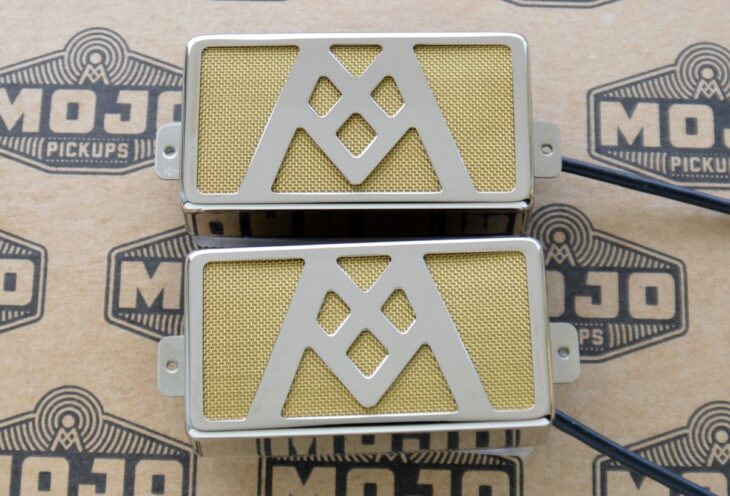
Yet, the cool factor and the mojo of having the gold foil on top of them made them a sought-after piece after the retro-rock revolution. Therefore, brands like Mojo Pickups are bringing them back to life.
The Gold Foil Series
Now that you know what gold foil pickups are and why they have endured the test of time, let’s dive into the new Fender line that features these pickups as the center of attention.
Let me tell you, before we start, that these guitars and bass are a whole different instrument besides the pickups and can offer the player a wide variety of uncanny tones.
But let’s go through them one by one.
Gold Foil Jazzmaster
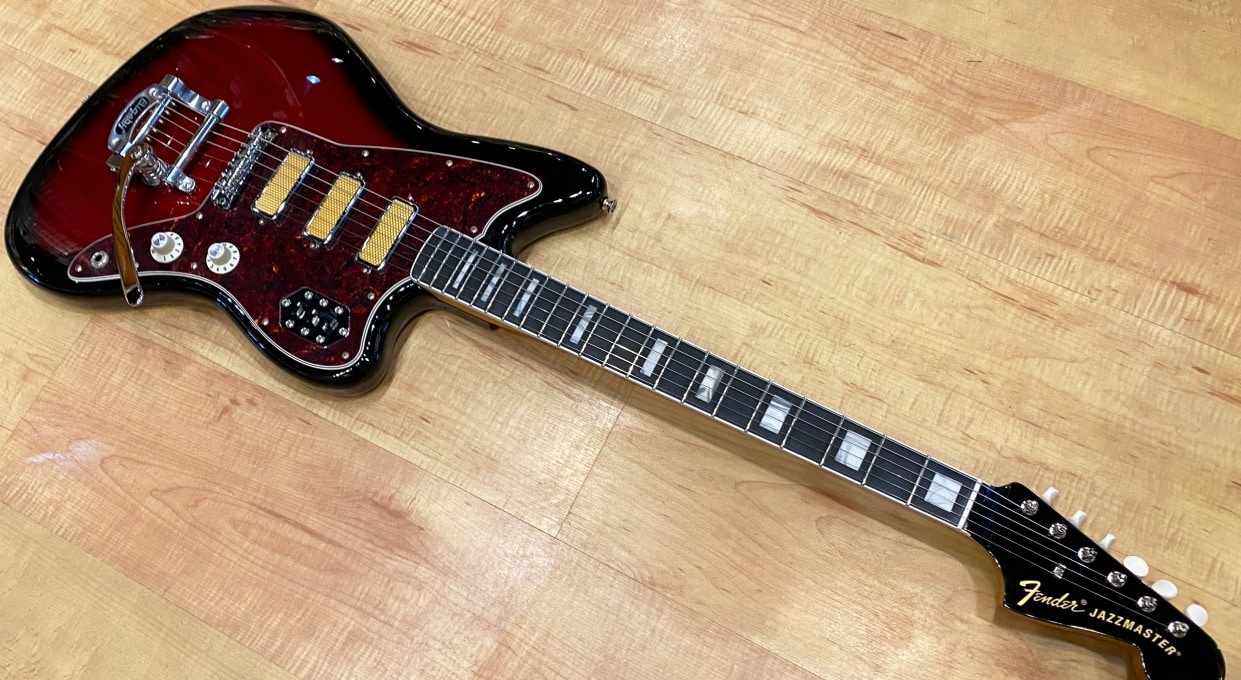
The gold foil Jazzmaster is a stunning instrument from the visual side. Yes, the moment you take it out of the deluxe gig bag it comes in, especially the golden one with the matching headstock, it makes a statement even before you play it.
To begin with, let me tell you that this is a heavy guitar. The reason behind its weight is that it’s made of mahogany and it features a Bigsby tremolo system. So, you can imagine that the Jazzmaster’s big offset body in a dense, heavy, thick-sounding wood like mahogany and all the metal make it a substantial guitar to strap on.
The guitar features a Jaguar-like control plate with three toggle switches that turn on and off the three golden foil pickups. Yes, you can create any combination you want including those of a Telecaster (or a regular Jazzmaster) and those of a Strat (like bridge and middle, for example).
Other than those, you get a volume and a tone control, and that’s about it for the electronics.
Moving on to the neck, it’s made of maple but it features a gorgeous bound ebony fingerboard with block pearloid inlays. Yes, I know, I thought about it too; this guitar has some serious Gibson vibes.
Although the 21 tall narrow frets follow the same line, the 25.5” scale and the 9.5” radius are both clearly in Fender territory.
But how do the gold foil mini humbuckers sound? Well, to begin with, this guitar is dead silent. There’s no hum or noise of any kind when you plug it in. Speaking of which, it does have a generous amount of gain and can give you clean tones and distorted ones as well.
I started my test on the bridge pickup and a clean amp. This combination gave me the spank and kick of a Fender with some of the roundness and warmth of a Gibson. You can play clear, bell-like chords and also go full-on mayhem and the guitar remains clear and cutting through.
The middle pickup gives you that push that can cut through the mix. This was great for soloing and melodic playing. Speaking of which, the neck pickup resembles the neck pickup on a Strat, but on steroids.
Finally, the in-between positions, bridge + neck, bridge + middle, and middle + neck have a distinct quack you would expect from a Strat or a Tele, but always on steroids and with a meaner, fatter low end. I didn’t find the three-pickups-on position so usable.
Gold Foil Telecaster
The gold foil Telecaster shares some of the appointments the Jazzmaster has. To begin with, both sport a mahogany body with a maple neck and an ebony fretboard. Yet, the feel of the guitar and the sounds it can produce differ drastically from one to the next.
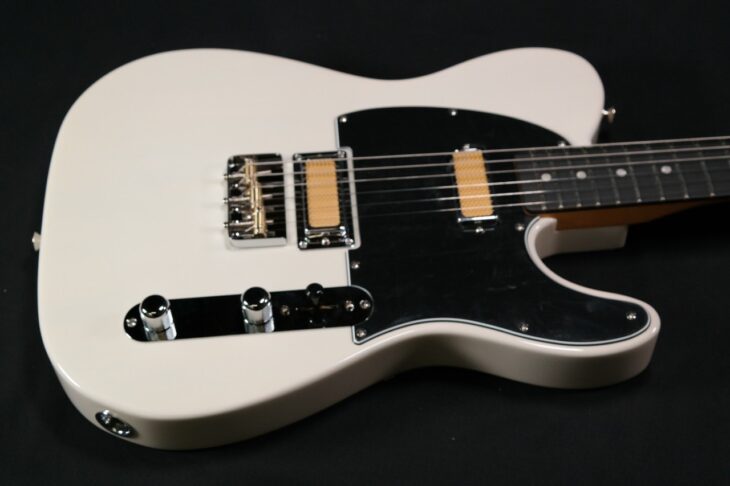
The Telecaster I tried was white with a black pickguard and a matching headstock. I thought it looked not only smart but also kind of luxurious given the gold shimmer coming from the pickups and the brass saddles.
Yet, let me warn you, besides the way it looks, this guitar is as far from my Custom Shop ’60 Custom Telecaster as my Gibson SG Jr. is. But I don’t want to get ahead of myself.
The bridge on this guitar is a hybrid invention that allows you to do a string-through-body setup or load the strings from behind the bridge. I wish Fender would have used single-string saddles to improve intonation, but they decided to go for the vintage original and keep in a two-strings-per-saddle configuration.
Speaking of the bridge, it’s a cut-off design that’s as short as a Strat bridge and is a perfect match for the gold foil mini humbucker.
Perhaps, the biggest difference between this guitar and the gold foil Jazzmaster (and any other vintage-style Telecaster) is that you get a huge Gibson vibe from the 12” radius and slightly bulkier C-shaped neck. The flatness on the front and roundness on the back aren’t so much in Tele territory but are super comfortable to play.
Speaking of playing, the moment I plugged this guitar in I was completely amazed. It’s a true do-it-all guitar that can twang, bark, bite, and scream. The key here is to learn how to use the tone knob to tame the Tele-approved high-end and get more chug from the mahogany’s bottom end.
I tried going from Brad Paisley to Black Sabbath and then some White Stripes and it all sounded very big and round. I can see myself going to any live show or session with only this guitar and getting all the tones effortlessly.
Gold Foil Jazz Bass
My mind was blown when I took this bass out of the gig bag and saw that beautiful sonic blue finish with the tortoise pickguard, the matching headstock, and the gold foil pickup. This jazz bass does look like the lost link between the 21st century and the groovy ‘60s.
The first thing I was expecting was a heavyweight instrument because all the line is made of mahogany. Well, that’s not the case with this bass that sports an alder body which gives it more of a quintessential Fender tone.
Despite having just one single coil gold foil pickup, the body is that of a Jazz Bass, not of a Precision. Weirdly enough, though, it has no control plate, and the single volume and tone white knobs are mounted on the pickguard.
Also, it’s not a string-through-body design but a top-loader bridge.
Let me tell you that upon plugging it, I got a distinctive spank from the ebony fretboard because it works great adding more bite to the mixture of alder and maple.
So, starting out with my favorite Sting bass lines, the instrument retained the massive low-end a P-Bass can have but added some of that top-end and definition you can find in a Jazz Bass.
Then, I moved on to some Pino Palladino moves rolling off the tone control and I was in bass heaven. Notes came through loud and clear with a mellow quality that just kept me playing.
Finally, I went for some more aggressive Steve Harris moves and also played it with the pick. The result was tight, clean, and powerful. A great bass to replace a P-Bass but not as versatile as a Jazz Bass.
What Music Style is the Gold Foil Line Great for?
The Gold Foil line is made of very versatile, great-sounding instruments that have a retro look and a rocking tone. I mean, don’t get me wrong, they’re very capable of doing the “Fender thing” and covering the sonic ground you’d expect a Telecaster or Jazzmaster to cover. Yet, they can do much more than that.
I played quite a bit of rock and roll with them and these guitars just love distortion. Maybe they’re not quite as bright as a regular Telecaster would be, and hence don’t cut the mix as much, but they’re generous in the midrange and the low-end. In my opinion, the combination of a maple bolt-on neck, a mahogany body, and an ebony fretboard really brings out the quality of the pickups.
Speaking of which, mini humbuckers have edge, bite, and snarl, but also a generous low-end, no noise, and that great humbucker punch.
So, in my opinion, the gold foil Jazzmaster and Telecaster are great for all branches of rock, I wouldn’t say they’re metal material (not enough gain on the pickups) but can definitely make percussive, funk, hip-hop, neo-soul, and pop sounds.
The gold foil Jazz Bass is a great instrument to replace a P-Bass but with a little more bite and clarity and less of that boomy low-end. That said, it’s not as versatile and bright as a Jazz Bass. Therefore, to me, it’s a great rock and roll machine that can be used to play anything including metal.
That said, I would stay away from it if you’re looking for a bass with a tamed low-end that doesn’t flood the mix with those frequencies.
The Bottom End
Fender is a company that never stops pushing the boundaries of their own catalog. They’re coming up with new products all the time; hit or miss. I remember talking to my boss when I worked for a Fender dealership and asking why the brand continued to put out weird new models instead of focusing on the classic stuff. He smiled and said, “They have that market; they’re going for the new players.”
That answer remained with me and it’s great to explain why this series of new, great-sounding instruments with a unique tone and feel are a part of the Fender line.
Will they withstand the test of time? I hope so, because they sound amazing.
Happy (gold foil) playing!
