
I was born in the early eighties, which means Grunge hit me like a truck. I was a Nirvana fan from moment zero, and I still listen to bands like Soundgarden, Pearl Jam, Melvins, Stone Temple Pilots, and Alice in Chains regularly.
However, beyond being a music fan, Kurt Cobain didn’t just make me love his tunes; he made me want to play the guitar. He showed me it was possible for a guy like me to make songs and play them with a band. I didn’t have to learn how to shred; I had to learn power chords, simple hooks, and melodies.
His simplicity, ferociousness, and pop sensibility are a part of me to this day.
So, you can imagine what I felt when I picked up this guitar for the first time. I had seen it before on so many posters and videos, having it in my hands was a dream. I mean, it’s a musical version of the Holy Grail, Grunge’s Excalibur if you like.
But is this a fan-only guitar or an all-around amazing instrument? I played it a lot in a plethora of scenarios, and the results might shock you.
Let’s do this!
Sneak Peek
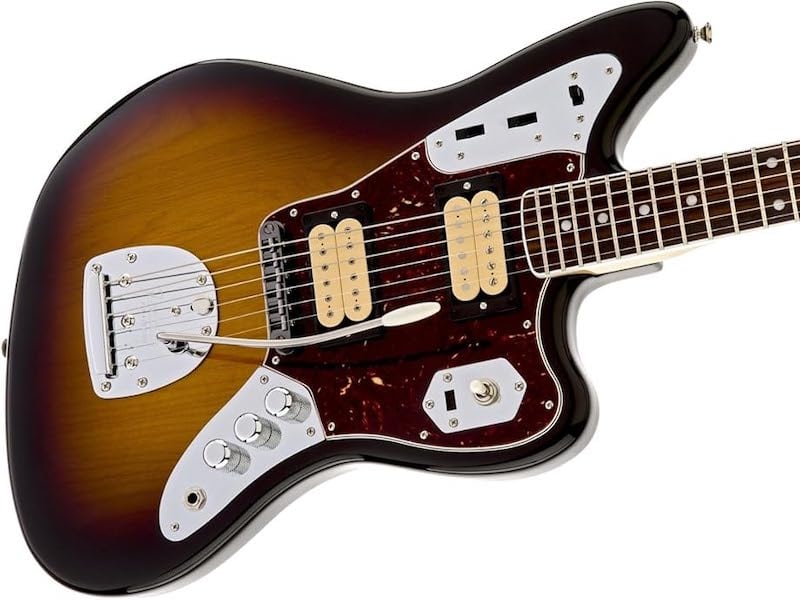
A short-scale, heavily-modded Jaguar loaded with DiMarzios. Quirky neck feel and weight need some getting used to, but the tonal range is wider than you’d expect.
A Fender Jaguar Spirit in a Heavily-Modded Guitar
Although you can now see Fender offset instruments on most stages worldwide, this wasn’t always the case. On the contrary, in the late ‘80s and early '90s, Fender and Gibson were struggling to make people buy classics like the Les Paul, the SG, the Strat, and the Tele.
You can imagine what happened with offsets when people didn’t even look at Strats. Well, that was the case of this heavily-modded Jaguar Kurt found and bought at a pawn shop early in his career.
We’re going to go through some of the modifications made to this guitar, but first, let me tell you that it keeps that same jangly higher midrange that’s so common in the original. You can think of The Smiths for that razor-like tone to play chorus-soaked arpeggios with a clean amp. You can also think of John Frusciante’s rhythmic, percussive, single-note riffs sounding big and bright.
Well, the main thing about this guitar isn’t the pickups, nor the controls. It’s the spirit. Despite its massive alder body giving you enough midrange to find gold in the Himalayas, the bright, raucous, fenderesque presence is always there. I mean, if you’ve been a Nirvana fan for long, you’ll recognize the clean tones in songs like “Drain You”, “About a Girl”, or even “Smells Like Teen Spirit”. They ooze brightness and body at the same time.
Well, that’s exactly what you get when you play this Jaguar.
The DiMarzio Super Distortion in the bridge position, even when played clean, sounds huge but never loses its bright (never brittle or harsh) quality. Furthermore, the neck pickup, a DiMarzio PAF 36th Anniversary, is as bright as it gets (for a neck pickup). I had a lot of fun playing with it alone and was able to get some very usable tones to play songs like “Heart-Shaped Box”.
However, as I said at the beginning, this is a heavily-modded guitar. I do mean this in a good way, because it delivers more than an original Jaguar ever could.
Let’s go deep into the versatility of this great-sounding instrument.
A Versatile Instrument
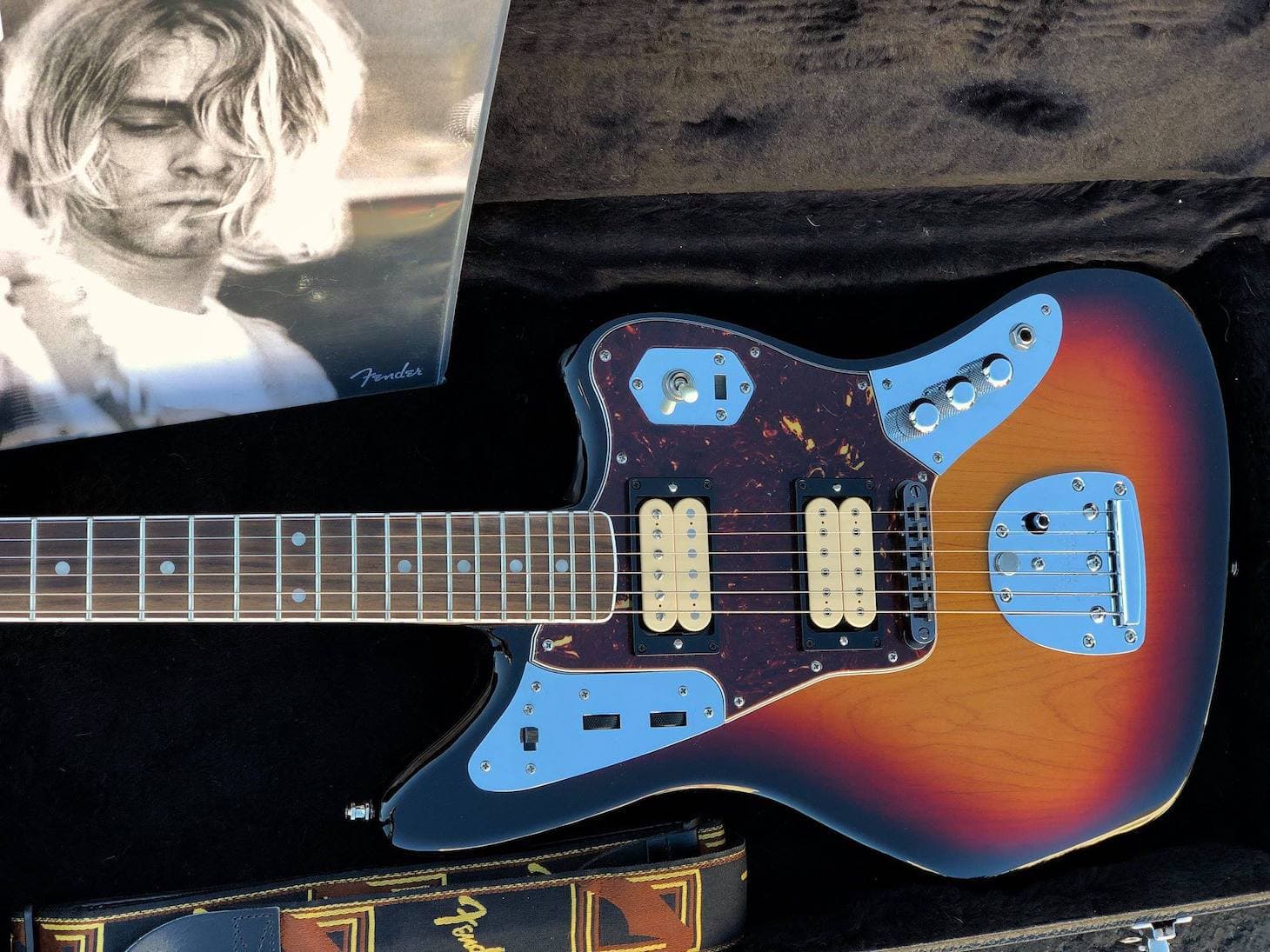
Fender Kurt Cobain Jaguar - Up Close
A two-humbucker guitar is usually a rock machine. I mean, if you look at it from a historic position, most rock gods made their way to the top of Mount Olympus playing a two-humbucker guitar (except for Jimi, of course, but aliens don’t count).
The key here is the Jazz Bass-like control plate. It hosts three knobs instead of two, allowing you to dial a volume for each pickup and have a master tone. If you set the pickups with different gain levels, you can have a distortion pedal in your 3-way toggle switch.
For example, I played “Rape Me” with the selector on the neck pickup with the volume knob halfway up, leaving the bridge pickup wide open for the bombastic chorus tones.
Hey, but that’s not all, because remember that Jaguars and Jazzmasters have two circuits. The top circuit works only for the neck pickup, and it also comes with volume and tone controls.
You can go fully into Tom Morello or Jack White territory and use the slider as a kill switch by setting volume to zero, or you can have it full on and have a fourth sound ready to go at the flick of a selector.
You might be scratching your head and going, “Hey, wait a minute there, Brainiac! What do you mean by four tones? We talked about three!” And you’d be right, my fellow guitarist. The thing is that the middle position of the three-way switch gives you even more edge in the midrange using one coil of each humbucker. That’s definitely another available tone.
So, you can have four sounds ready to go, or you can also have three sounds and a kill switch.
Moreover, the clean tones you get by setting the volume all the way up and the tone all the way down on the rhythm circuit (the upper controls) are great for jazz and somber arpeggios with some reverb and delay. I’m telling you, this guitar can scream and engage a football stadium but can also whisper and hum.
I also loved the middle position on the 3-way switch in the lead circuit (the bottom controls) with a low-gain setting on my TS-808. You get a raunchy, percussive, edgy tone perfect to play some blues, some Chili Peppers, or even some Hendrix with a little extra push in the gain knob of the pedal.
I just can’t believe the number of tones I could get from this guitar. I mean, I know Jazzmasters are versatile instruments, but the added volume knob in the control plate is a game-changer in my book.
Nailing Classic Nirvana Tones
I know, it’s all cool with the versatility and making this guitar make all kinds of sounds, going from jazz to funk to heavy, but what about Nirvana-ready tones? Well, this guitar isn’t short on that either. You get an infinite supply of those playing this Jaguar.
To begin with, I’m a fan. So, I have a Boss DS-2. I played Nevermind bottom to top and then added In Utero songs, and everything sounded just perfect. You get that mammoth, stale, jangly, treble-oriented tone when playing it clean, and that huge, ferocious, punchy, and powerful distorted tone that’s so important to play Grunge and Alternative music when you step on the distortion.
Let me also tell you that, being a long-time fan, I played these songs with all my guitars at one moment or another of my playing career, and I could never replicate that amazing edge and brightness with any of them. It’s completely uncanny. My attempts always felt heavier, rounder, fatter; the upper mids of the original recordings were nowhere to be found.
Plugging this guitar solved it all in a nanosecond. I can’t tell you how big my smile was because I wasn’t in front of a mirror, but I’m sure it exceeded my entire face.
This guitar made a fan super happy. So, you can definitely check that box, because this guitar can deliver Nirvana tones perfectly.
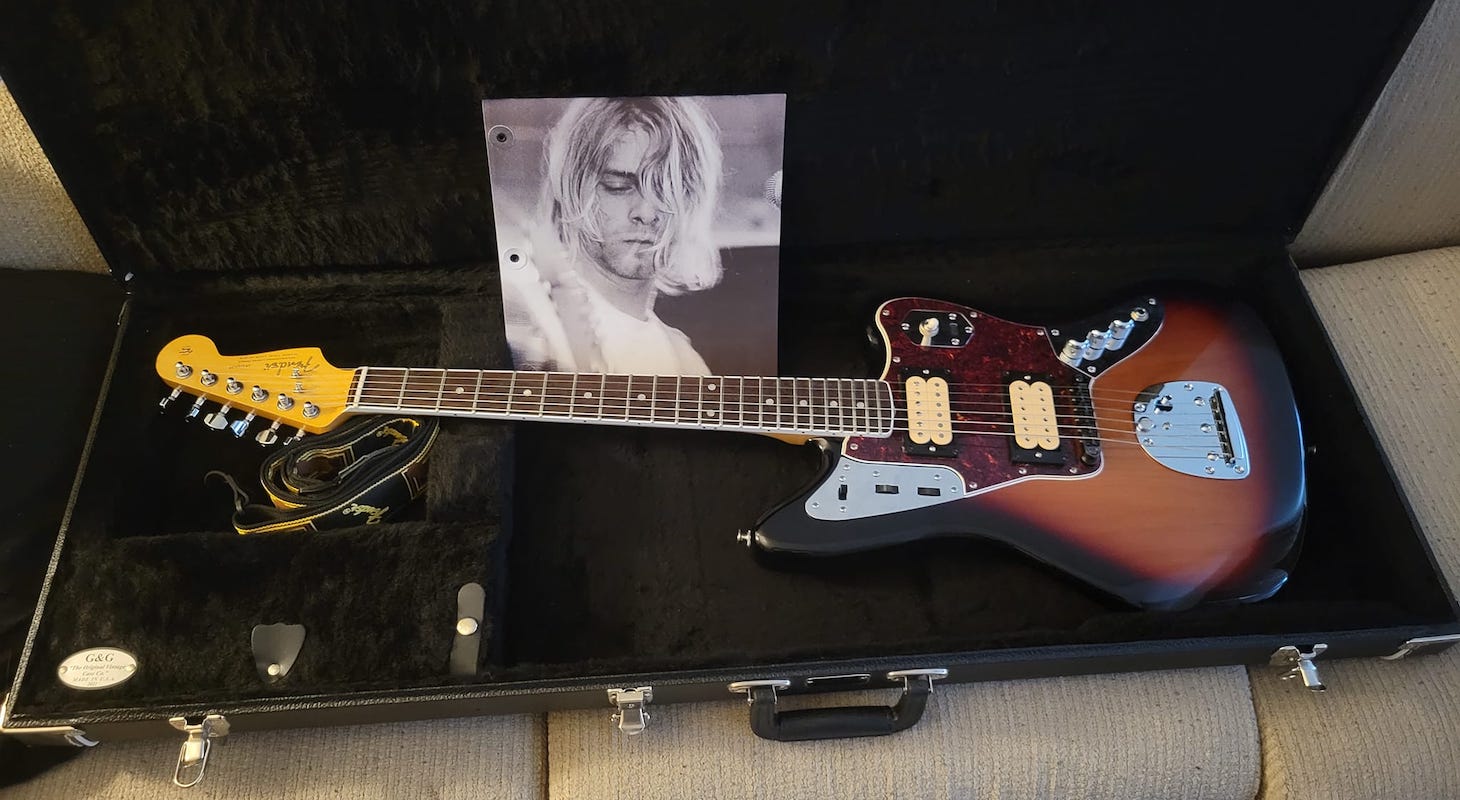
Oh, and let me also add that this guitar comes inside a hardshell case with a lengthy book about Kurt and Nirvana with notes from Kurt’s guitar tech. That’s exactly the kind of material that makes us fans weep.
Let’s Talk About the Short-Scale Neck
Beyond the statements I made above sound-wise, how does this guitar feel? Well, I have to say offsets, especially Jags and Jazzmasters, aren’t for everyone. Not everybody feels comfortable playing a guitar that’s this big. Furthermore, the fact that it has so many metal parts makes it a heavy instrument to run around with.
However, that’s not all, because what feels the oddest is the neck. I’ve been playing my beloved ’66 Mustang for a long time, so I’m not a stranger to the 24” scale, but most Fender lovers will only feel at home playing a 25.5” scale.
What’s the difference between them? Well, it’s quite remarkable in terms of string tension. I don’t think you’d feel your fingers are crammed or that there’s not enough room for complex chords or riffs. In that sense, this C-shaped, bound Stratocaster neck feels and plays great.
Where you might notice it the most is while bending, because you have to sort of retrain the hand to nail the tone you’re going after. Otherwise, you’ll go beyond a semitone or full tone, depending on what you’re going for.
In my opinion, if you play 10s on all your guitars, 24” scales scream for 11s. I did just that with my Mustang and improved my playing experience drastically. That’s especially true if you go back and forth from guitar to guitar during a performance.
So, I installed some 11s on this Jaguar, and things got much easier from a player’s perspective. So, if you’re out trying one and it feels odd or weird when bending, don’t blame it on the guitar. There’s a way around it, just install thicker strings and you’ll be good to go.
My Verdict
As a confessed Nirvana fan, I was beyond moved the first time I saw myself holding this guitar in the mirror. By the time I finished playing Nevermind for the first time, I was almost in tears; I could finally nail Kurt’s tone.
However, as a guitarist who has been doing it for almost three decades, I was also amazed I could get that many tones with simple switch and knob turns. I mean, going from clean to mayhem, stepping on no pedal, or going from jazz to grunge by just flicking a switch was great.
Also, the C-shaped neck with its 9.5” radius feels and plays like butter to do anything you want. From shredding to chords, and from riffs to arpeggios. I especially liked the big bottom with a sharp edge in the upper mids. That’s the ultimate alternative rock tone I had been after for years.
So, if you’re a Nirvana fan or just a guitarist in search of a great instrument, this guitar is worth trying for the price, the specs, and the sounds.
Just don’t blame me if you weep the first time you play “About a Girl” on it.
Happy (grungy) playing!
My Verdict
As a Nirvana fan, it’s surreal to finally get those exact tones straight out of the box. But even beyond the fandom factor, this Jaguar proves surprisingly versatile — capable of clean shimmer, raunchy edge, and full-on grunge power with just a flick of a switch.
