
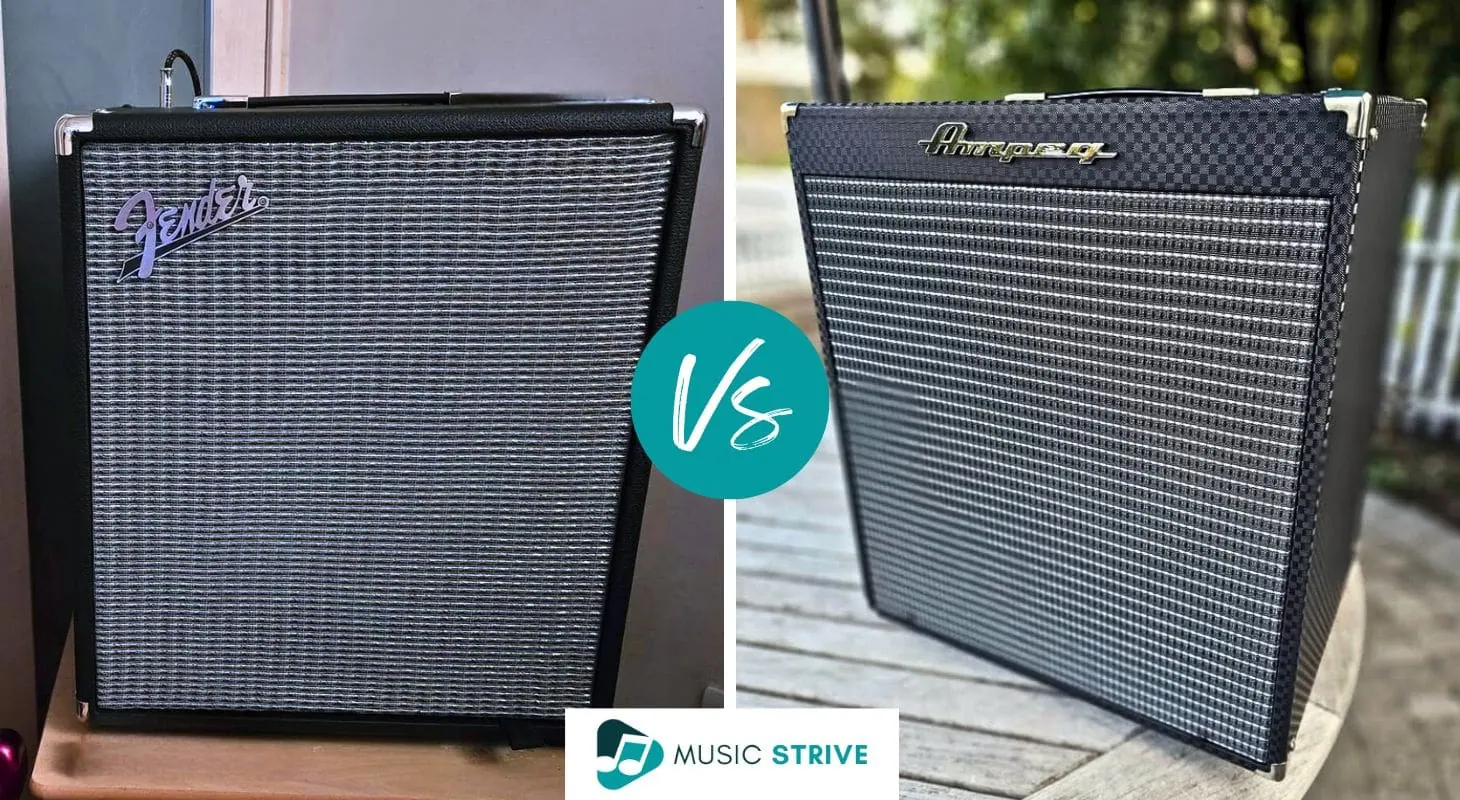
Long gone are the days one would walk on stage to find a tower of speakers with shiny aluminum cones waiting for you. In fact, physical amplifiers are a species at risk of going extinct.
The industry took notice of this threat and bass combos are at their all-time greatest moment. They’re portable, lightweight, sound amazing, and can help you a lot when you get a stubborn or careless sound engineer (more on that in a bit).
So, here we are, two of the biggest names in musical instrument amplification competing head-to-head. I’m going to be talking mostly about their 1x12, 100w models, the Fender Rumble 100 and the Ampeg RB112. I had fun trying the whole family on both sides and have a ton to tell you.
Let’s do this!
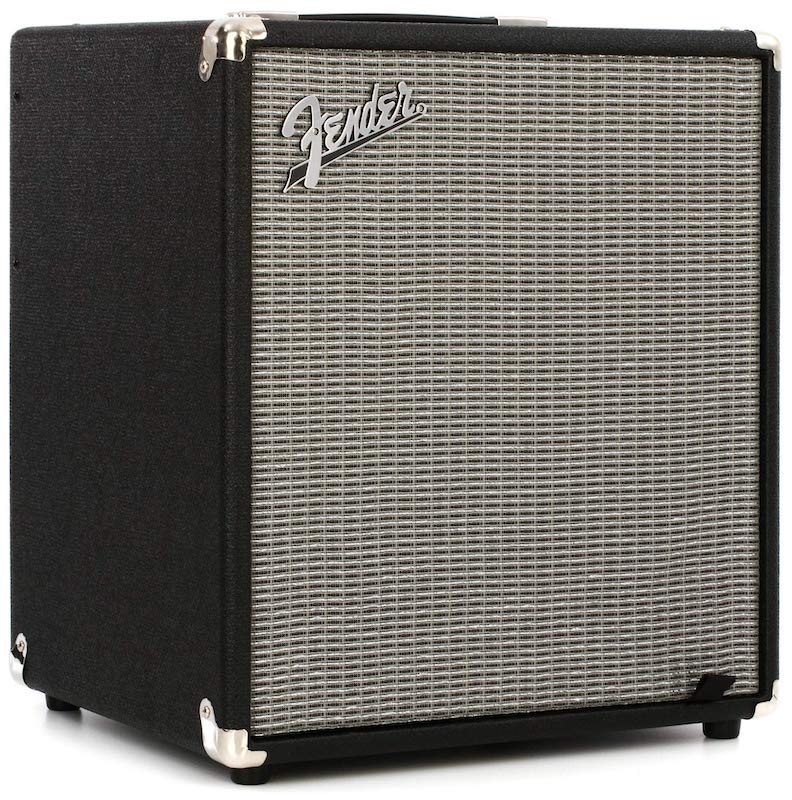
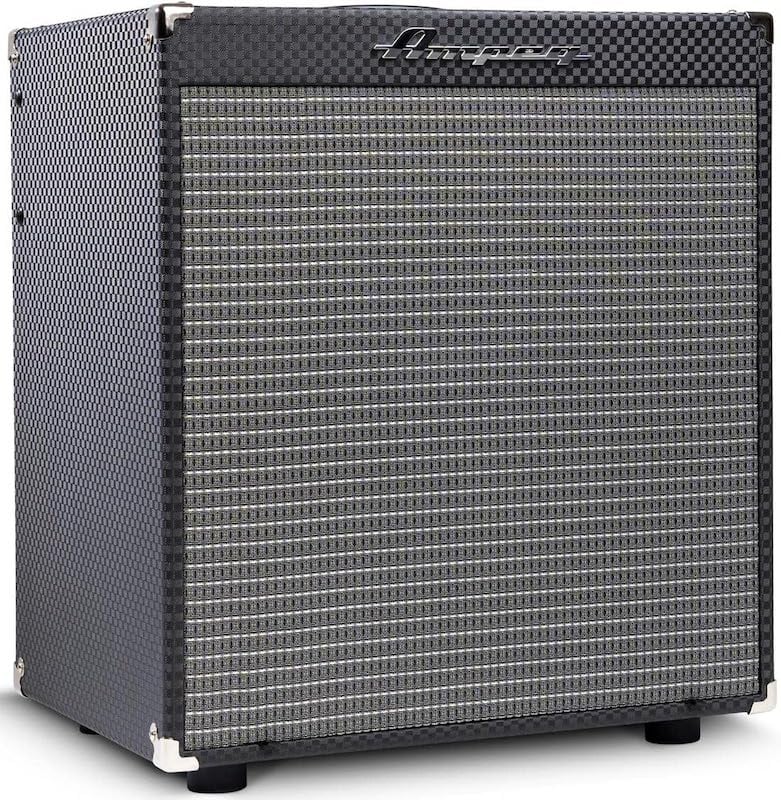
Fender Rumble 100
Vs.
Ampeg RB112
The Fender Rumble Line
Fender is well-known for being a revolutionary brand that gave birth to the uncanny P-Bass unleashing the electric bass mania we live to this day. Well, in that innovative combo (no pun intended) there was also a legendary amp, the Bassman.
The company still propels the rumble of big arena acts with almighty all-valve Bassman heads. Yet not all of us play at Madison Square Garden every night, right? Well, for those of us who aren’t so lucky, we get the Rumble, a very capable digitally powered line of combo amps that go from bedroom to stage to world tour sizes.
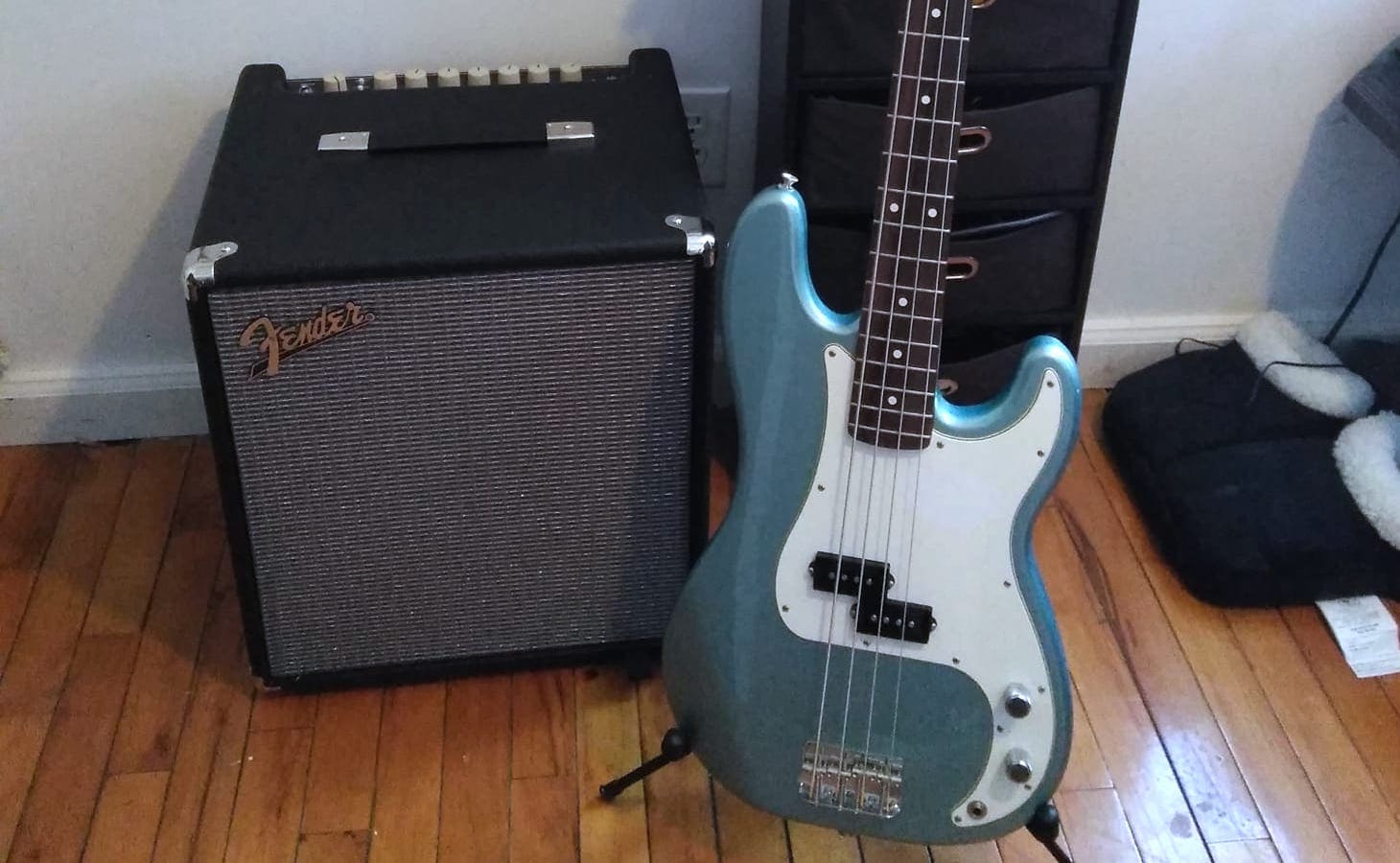
Fender Rumble 100 next to a Fender Precision Bass.
These amps share certain characteristics like their lightweight, straightforward controls, and tone-shaping options, and range from 15 to 800 watts. Also, they sport speakers going from 1x8” to 2x10”.
Finally, the bigger combos in the line have useful stage features like a DI out with ground lift, an effects loop, a footswitch for the distorted channel, and an aux-in to play along with your favorite songs.
The Ampeg Rocket Bass Line
Let me begin by saying that it’s very difficult for a line of bass combo amps to ever look better than the Rocket Bass. Yes, that amazing, checkered, dark-blue tolex meets the Ampeg logo in shiny silver and the traditional Ampeg grill cloth to make these amps classy and expensive looking.
The line goes from the RB-108, a 30-watt 1x8” combo for home practice to the 500-watt RB210 sporting dual 10” speakers. Although the line offers more features as you go up in wattage, all the models share the lightweight, the stellar looks, and the traditional Ampeg tone.
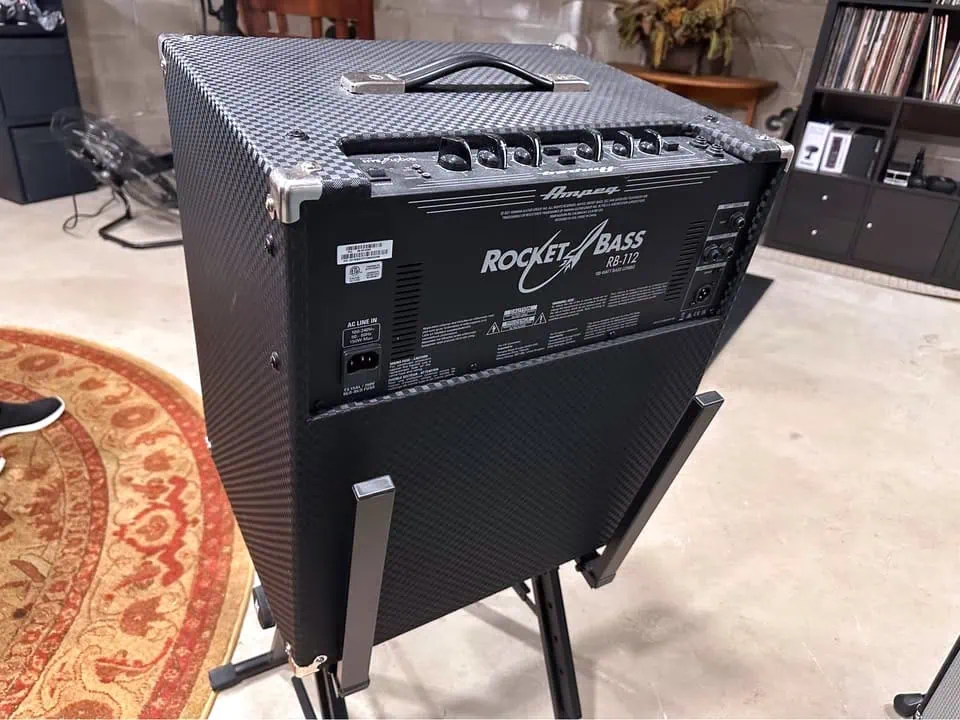
Ampeg Rocket Bass RB-112
Yes, if Fender was the company behind making the first Bassman amps, Ampeg is responsible for some of the most recorded bass tones in music history with their legendary all-tube SVT heads and cabs.
Although these amps don’t sound like their valve-driven kin, they don’t have a similar price tag or weight either. They do share the DNA of the quintessential Ampeg bass tone, and, via the SGT technology, some of the natural organic overdrive you get by cranking a stack.
Finally, they share much of the Fender Rumble specs like the XLR line out (with ground lift), footswitch jack, aux-in, headphones jack, and an effects loop for the bigger models. The smaller models offer a stripped, minimalist approach.
Controls and Layout
I’m centering this piece around the 100-watt 1x12 model of each of these lines. Of course, I’ll be talking about the rest of the models, but only marginally.
Fender Rumble Line
Let’s begin with the Rumble line. The control layout is very straightforward, you get a few knobs and a few buttons to sculpt your tone.
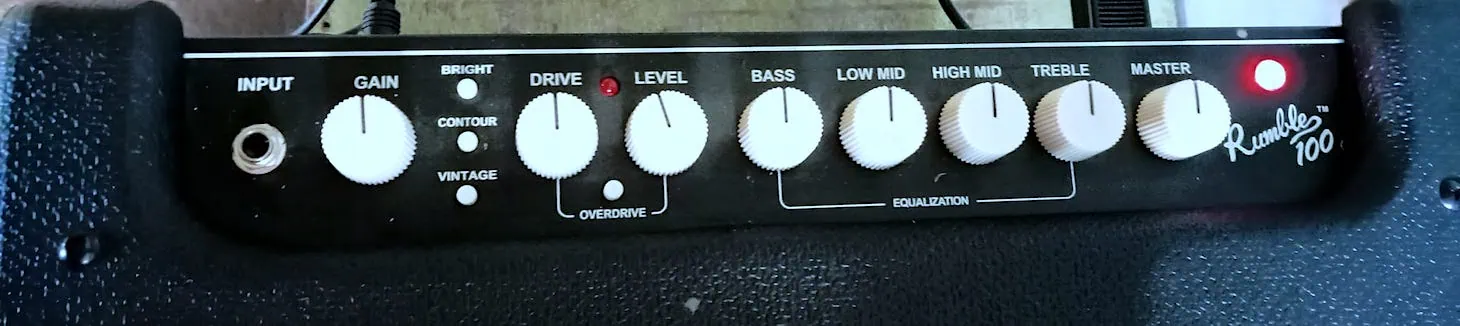
Fender Rumble 100 - Controls
To me, the best part of this amp’s controls is the 4-band EQ. This amp allows you to modify the lower mids as well as the higher mids. This way you can dial in oomph or edge with each knob.
Other than this very usable EQ the amp offers an overall master volume and a separate gain knob for the clean and dirty channels. Moreover, this last one also offers a Level knob so you can set your amp to go from clean to mayhem or use it as a clean boost. The Drive channel is accessed with the button between the controls or via footswitch.
There’s a single input with no attenuation pad, so you’ll have to fiddle with controls if you go back and forth between active and passive basses. Finally, the amp’s layout is complete with three buttons:
- Bright - Adds high end
- Contour - Gives you that ‘80s scooped sound
- Vintage - Rounds out the low end
The back panel features the effects loop send and return, aux and phones in (1/8”), a footswitch jack, and a built-in DI Box complete with a ground lift control.
These controls are present starting in Rumble 40, the 15 and 25-watt versions only feature a three-band EQ and a volume in the 15 and an added contour and overdrive buttons for the 25. Also, the headphones and aux-in jacks are mounted over the control panel above.
But going back to the 100, there’s a lot you can do with that many controls. In my opinion, it’s a great amp to play any musical style.
Ampeg Rocket Bass Line
The first thing that hits you about the Ampeg Rocket Bass is just how cool it looks. The checkered blue tolex and the traditional grill make it a one-of-a-kind tone machine and retain all that classic Ampeg vibe from the ‘60s.
The RB112 features a straightforward control layout and many of the same features the Fender Rumble 100 does.
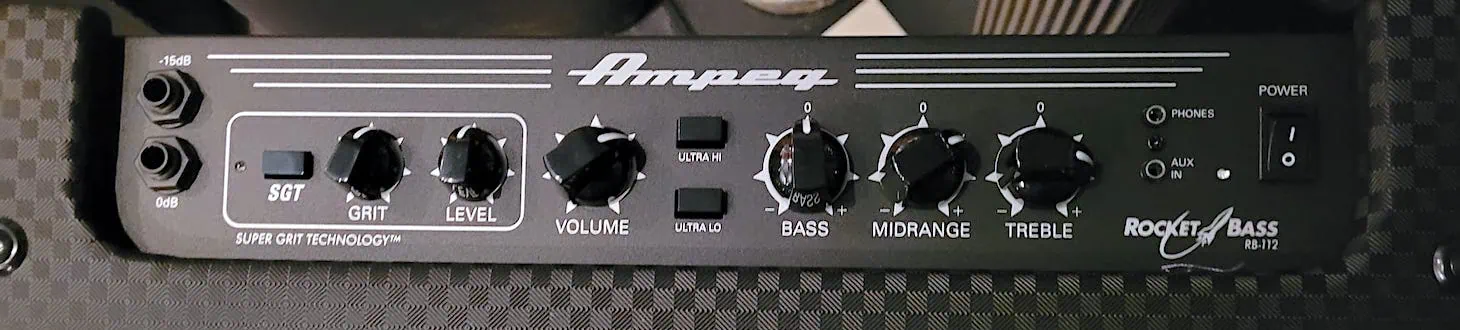
Ampeg Rocket Bass RB-112 - Controls
The first difference is that, while the Fender has one input, the Ampeg offers two that can be used simultaneously. Do you teach? Great for your student to plug in with you. They’re labeled 0 and -15db for passive and active basses.
Another big difference is that the Ampeg offers a 3-band EQ with the traditional bass, middle, and treble controls. Next to it, there’s an overall volume knob and a pair of knobs dedicated to the overdrive channel called SGT.
In case you’re wondering, yes, SGT or Super Grit Technology is a derivative of the company’s revolutionary SVT or Super Valve Technology. You can dial in the level and gain of this channel separately and engage or disengage it with a dedicated button or the footswitch.
The top panel is finished with an aux and headphones inputs, and two large buttons for the Ultra Hi and Ultra Lo modes. If you’ve been playing Ampeg for a while, you’ll be familiar with the bass and treble boosts, if not, they boost those frequencies.
Don’t let the name confuse you, though, what they do is very musical.
The control layout simplifies for the 30-watt version (RB108) including just the 3-band EQ and an overdrive button. The 50-watt version (RB110) features level and gain for the SGT channel and an XLR DI with ground lift, too.
If you like the Ampeg sound, I can’t think of something this amp can’t do.
Trying Some Tones
Passive Bass Sounds
To begin with the test, I plugged in my Jazz Bass in the Fender Rumble and the slapping sound with the mids at noon and the bright switch on was just record-like.
Moreover, I went to the bridge pickup and engaged the Vintage switch and things got instantly edgy but with a full-bodied sound. Playing with my fingers in such a setting sounded like an instant ‘70s classic with the right dose of power and edge.
Moving to the neck pickup and rolling off some of the high-mid control, adding some low-mids and bass gave me a groovy sound that benefited a lot from the Contour button.
I played all kinds of classic riffs in that setting and then I went to both pickups with the bright button engaged and the result was instantly edgy and with enough midrange to cut through the densest mix. Slapping became almost an addition in this setting.
So, to steer away from being a slapping junkie, I activated the drive channel. Let me tell you that it can get quite aggressive.
I loved it with the mids scooped and playing my P-Bass with a pick with the drive at about 2 o’clock and the volume matching. It’s also a great clean boost with the drive close to zero and the level maxed out.
With the same setting in my P-Bass, I moved to the Ampeg to see what it could do. So, I started the test the other way around, trying to make the Ampeg dirty and mean. The tone of the distortion channels between the amps is quite different.
While the Fender is more midrange-oriented, Ampeg tends to have a bigger impact on the low end. I mean, the Ampeg had that punchiness the brand is worldly known for, but the overdrive didn’t cut anything from the low end to add to the midrange.
Lowering the drive to zero, the amp turned into a roaring beast with huge horsepower and punch but with no grit. I felt it was good to play melodic lines on the higher frets or make that groovy part extra seismic.
I changed basses and went for that Jazz Bass and set all EQs at noon. The sound was, as you’d expect, full, round, and punchy with generous lows and not so much in the high end of the frequency spectrum.
First, I killed the mids, flatted the low and treble, and the resulting sound was instantly ‘80s mayhem with a huge low end and enough definition to understand everything. By lowering the lows, zeroing the treble, and bringing up the mids, I got this beefy, edgy tone ideal for playing with a pick or doing some lead work, especially in the bridge pickup of the Jazz.
The Ultra Hi and Ultra Lo buttons are something I was tempted to always keep engaged. The first gives you that string sound that tails the low-end and that makes everything closer to rock and roll. The second gives you a mammoth low-end you never want to get rid of. Again, it’s always musical and punchy with zero mud.
I think that keeping the lows cranked, the midrange at around 2 o’clock, and the treble at noon with both switches on and the middle position of the jazz makes another fantastic slapping sound I could play for days.
Active Bass Sounds
I tried my active Music Man with the Fender Rumble first. Mine comes equipped with a mighty humbucker that can drive anything you put in front of it. Let me tell you that the low-mid knob was just as handy as knobs ever get to avoid the rumbly low end becoming a menacing ball of low-end trying to crush us all.
My Music Man has a maple neck and fretboard which means that the midrange is a given anywhere you plug it in. Well, it did wonders for the slapping and the picking, but it wasn’t just as musical when playing with my fingers. I felt it was a little too much and, although the Vintage button helped a lot, it was hard to get rid of the frequencies around 200 to 400Hz.
The drive channel gave me a whole lot to play with, but I had the same experience that I had with the other channel, it doesn’t really fatten the active bass sound but draws from the low end to give it to the midrange for the overdriven, quite dirty tone you get.
The Ampeg, in contrast with the Fender, was a much better match for the active bass. I plugged into the -15db input first and tried everything at noon. The result was enhanced punchiness in the low mids and enough edge to cut the mix.
I just loved the scooped sound with the bass and treble all the way up and the mids in zero. It was the perfect setting to play some groovy bass lines with lots of attack and a round low-end. The brightness that’s natural in a maple-neck bass became a massive punch to the face.
The Ultra Lo and Ultra Hi buttons begged to be pushed in all the time, and I did miss them when disengaged. They just make everything better and more powerful.
When I went to the dirty channel, what I did was to plug the bass to the 0db input and the grit available to play with became way more than it was initially. In that scenario, my bass moves became monstrously big and the intro to “Around the World” by the Red Hot Chili Peppers sounded very close.
The Ampeg RB112 and the Music Man StingRay are a match made in heaven.
Weight & Portability
Before I finish this piece, let’s talk about weight and portability. I remember working at a music store and receiving Made-in-USA ‘90s Fender bass combos that sounded terrific and trading them for made-in-China lighter combos with digital power like these.
Although neither the Rumble line nor the Rocket Bass line feature neodymium speakers, the 100-watt versions I centered my review on were 22 lbs in the case of the Fender and 26 lbs in the case of the Ampeg. Both are light enough not to be a burden to carry around or a menace to aging beautifully without back pains.
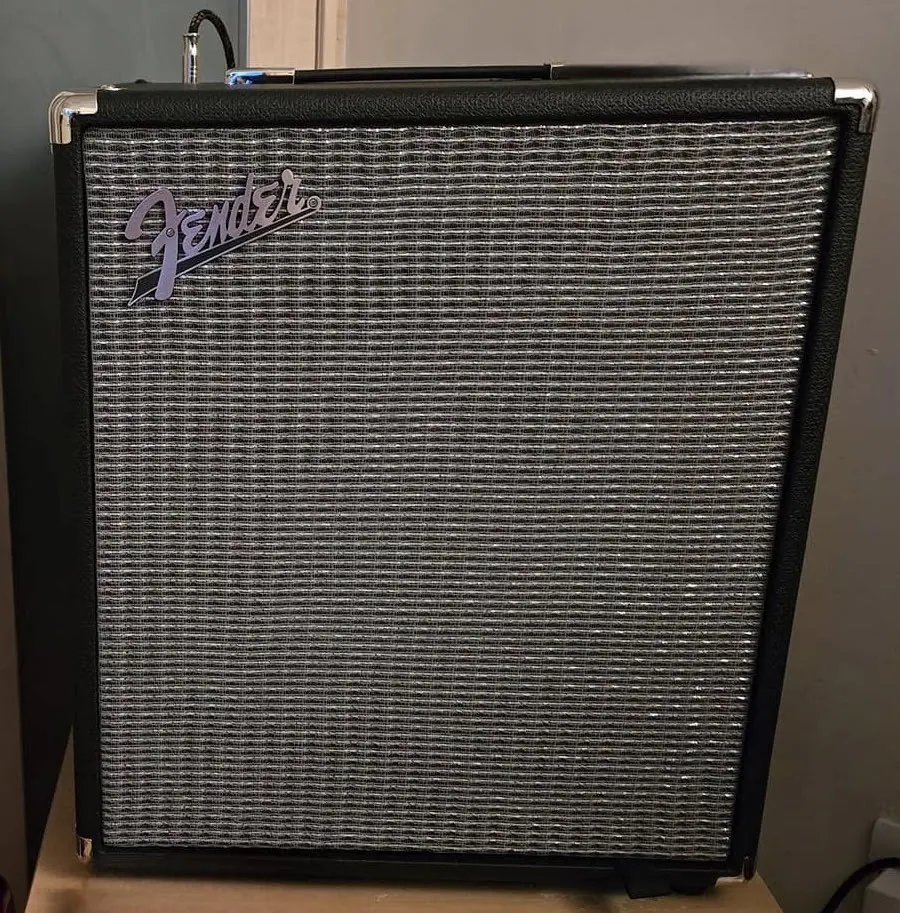
Fender Rumble 100
This is common to the entire line, in the case of Ampeg, since it replaces an old version, we can say that it weighs half of what its predecessor did.
So, weight and portability are top-notch in both these amps.
My Verdict
Playing these amps was quite a lot of fun. They can take my rock chops, my funk vibe, some neo-soul moves, slapping, and my metal shredding easily. Both make outstanding platforms to build your sound and are portable enough to go from bedroom to stage without breaking your back or the bank.
My Pick for Passive Basses
I like the Fender Rumble better while playing with my passive basses. The dual midrange knobs, the tone-modifying buttons, and the overall tone of the amp seemed a little friendlier in that scenario. It enhances the edge and boldness of the single-coil pickups and sounds big and proud with the P-bass split coil.
My Pick for Active Basses
The Ampeg, on the other hand, became a beast with the active bass and shone past the Rumble in that scenario. It can just propel that low-end boominess and the punchiness of the active preamp further and can also handle the lows and highs much better. Finally, plugging it into the 0db input made the grit channel a dirtier, meaner, more powerful vessel to pour my heavy chops on.
So, my verdict is that if you want a broader scope of tones at your fingertips and more tone-shaping tools, the Fender Rumble is the way to go. On the other hand, if you want the punchiness of the quintessential Ampeg tones in an easy-to-carry, lightweight, loud and proud combo amp, the RB112 is an excellent choice, especially if you’re playing active or passive humbuckers most of the time.
That’s all folks, stay tuned for more reviews!
Happy (amplified) bass playing!
