
One of my earliest formative experiences as a guitar player was seeing KISS axeman Ace Frehley on my TV. He staggered around the stage, smoke pouring out of his three-pickup Gibson Les Paul Custom.
I turned thirteen that year, and really fell in love with music for the first time.
As I did, I noticed that the guitar players I loved the most tended to play this particular single-cutaway instrument. Ace? Les Paul. Slash? Les Paul. Gary Moore, Jimmy Page, Scott Gorham, Justin & Dan Hawkins. All Les Paul players. Even Noel Gallagher bashed away on a Japanese Epiphone before he could afford custom-painted hollowbodies.
At the ripe old age of thirteen, I only knew three things. I loved playing guitar. I wanted to make that kind of hard, brash rock and roll. I knew that the instrument that would make that sound was a Gibson Les Paul.
Other guitars have come and gone since, but I bought my first Les Paul a year later: a Slash signature Epiphone model, with Seymour Duncan pickups. I worked at McDonald’s all summer to pay for it.
When I finished college and got my first full-time job, with my very first paycheck, I bought my dream guitar: a 1990 Gibson Les Paul Standard in wine red.
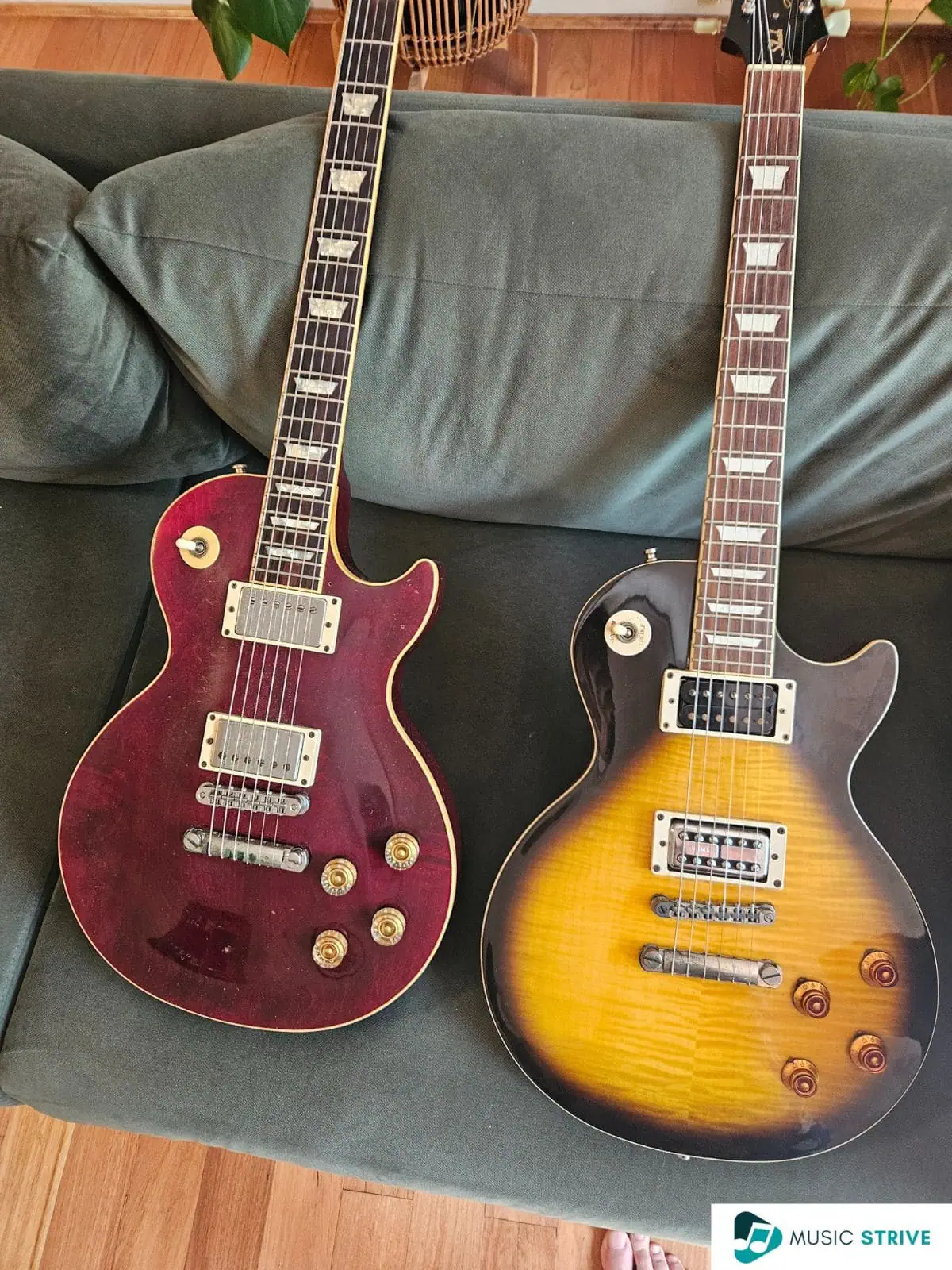
Gibson (left) and Epiphone (right) Les Paul guitars (my prized possessions!) - side by side.
I still own and play both of those guitars to this day. One of the questions younger players often ask me (and one I often asked as a younger player) is what the difference really is between the two, apart from the price point.
In this article, I’ll run through the major differences between the two instruments. I've personally noticed these over the years, a tiny part of it when playing others' Les Pauls on different occasions, apart from my own.
Who’s this Les Paul Guy?
If you’re reading this, odds are you’re broadly familiar with Gibson’s flagship model. If not, the brief history is that Les Paul was a legendary jazz guitar player.
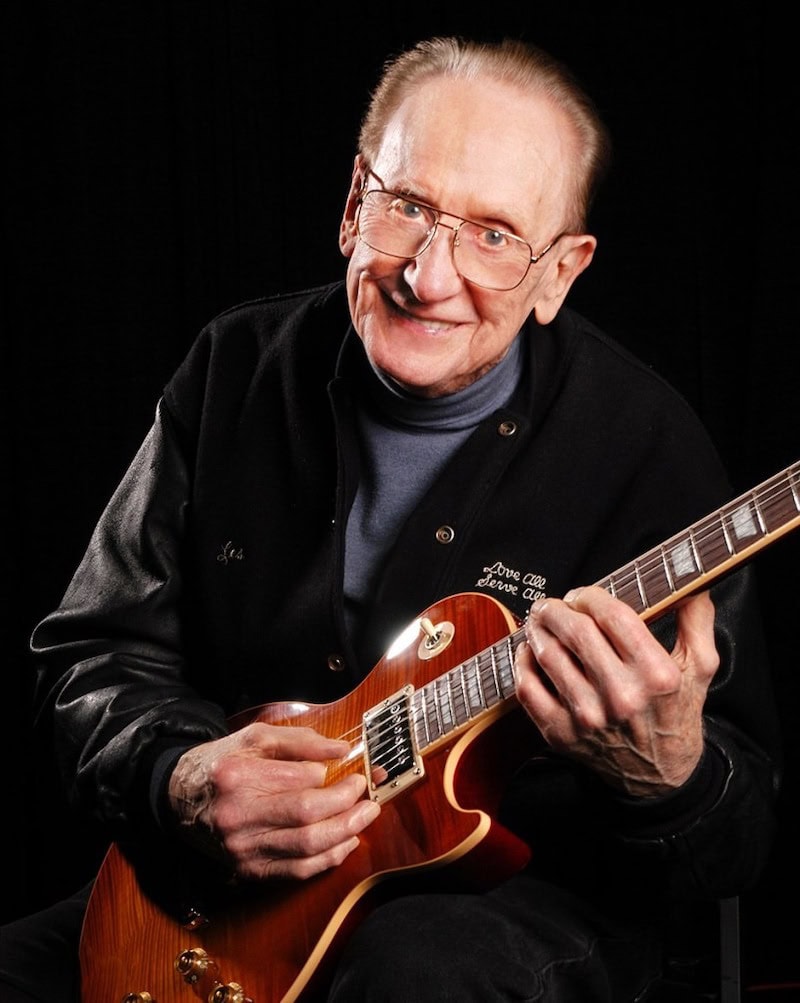
Les Paul with a Les Paul Guitar.
He wanted a solid-bodied electric guitar with a warm, friendly tone and virtuoso playability.
In conjunction with the Gibson guitar company, they came up with the single-cutaway slab of mahogany that bears his name.
Early Les Paul models included P90 pickups and “trapeze” bridges. I appreciate these guitars for what they are.
To most players, however, the Les Paul was perfected in the late 1950s. Twin humbucking pickups, a Tune-O-Matic bridge, solid mahogany neck, and a solid mahogany body with a maple cap.
The basic Les Paul formula follows this blueprint. There have been innovations since, with improved materials, different types of humbuckers, and a range of finishes.
Les Paul copies exist in a range of brands, from those that earned their makers lawsuits (like Tokai and Greco) and those that come very close to doing so (like ESP and PRS).
For most Les Paul aficionados, there’s really only the Gibson family of brands, which includes Epiphone.
An honorable mention should go to the short-lived Japanese brand, Orville (and Orville By Gibson), which produced excellent guitars for the Japanese market in the late 20th century.
These days, however, the trademarked Les Paul shape and signature exist only on Gibson and Epiphone instruments.
What is an Epiphone?
Epiphone was once its own separate factory and brand, producing guitars like the Casino.
However, Epiphone was absorbed by Gibson, and began producing budget alternatives to Gibson’s main line of instruments.
If you head over to your favorite retailer’s website, you’ll see Epiphone Les Pauls listed at a wide range of prices. There are entry-level guitars for a few hundred dollars all the way up to signature upscale models that will set you back a few thousand.
I remember walking into my local guitar store as a kid, looking at the expensive Epiphones on the wall next to the really expensive Gibsons and wondering what the difference really was. They looked identical to me, but one was a quarter of the price!
Why are Epiphones So Much Cheaper?
Epiphone guitars have lower costs associated with their production. They’re made in more inexpensive countries, often using cheaper materials, and with less stringent quality control than the Gibson factories in the United States.
Epiphone guitars cover a broad range of prices. There are the bare-bones entry-level instruments like the Epiphone Les Paul Special, generally under $300 .Then there’s Epiphone’s high-end signature models like the “Greeny” Les Paul or the '59 Standard, both of which command prices over $1,000 but less than $2,000.
A Gibson Les Paul Standard, on the other hand, will command twice the price of even the most expensive Epiphone Les Paul, easily retailing for up to $3,000. Higher-end Gibsons, like signature models, limited releases, and custom-shop instruments such as the Les Paul Supreme are priced over $3,000.
Guitar players looking at these brands might be baffled by the massive leap in price for what looks like a simple difference in the logo on the headstock.
The main difference between the two isn’t in looks, but in the finer details.
Place of Manufacture
Today, Epiphone guitars are built either in China or Korea. In recent years, Epiphone has relaunched a line of made-in-the-USA guitars, which rival Gibson as far as price goes.
Most modern Epiphone guitars are built at Epiphone’s Qingdao factory in China.
Worker wages in these countries are much lower than those in the US, and these factories are cheaper to run than Gibson’s American facilities. Accordingly, the company can sell these guitars at a lower price point.
Tonewood and Hardware
Gibson USA operates under stricter quality control measures than Epiphone does, and this extends to the materials used in their factories.
While there is some debate as to how much a guitar’s wood affects its tone, Gibson aims to use higher-quality woods in the construction of their guitars.
Generally speaking, they aim to build their Les Paul bodies from one or two solid blocks of mahogany. They also age the wood to dry it out, making it more resonant.
Epiphone guitars tend to be made with younger, less dense wood.
Take the '50s Les Paul Standard model, which appears in both the Gibson and Epiphone lineups.
While both are made from mahogany and maple, the mahogany and maple used for the Gibson will be of higher quality. Likewise, the Gibson features a more expensive rosewood fingerboard, compared to the cheaper Indian laurel fingerboard of the Epiphone.
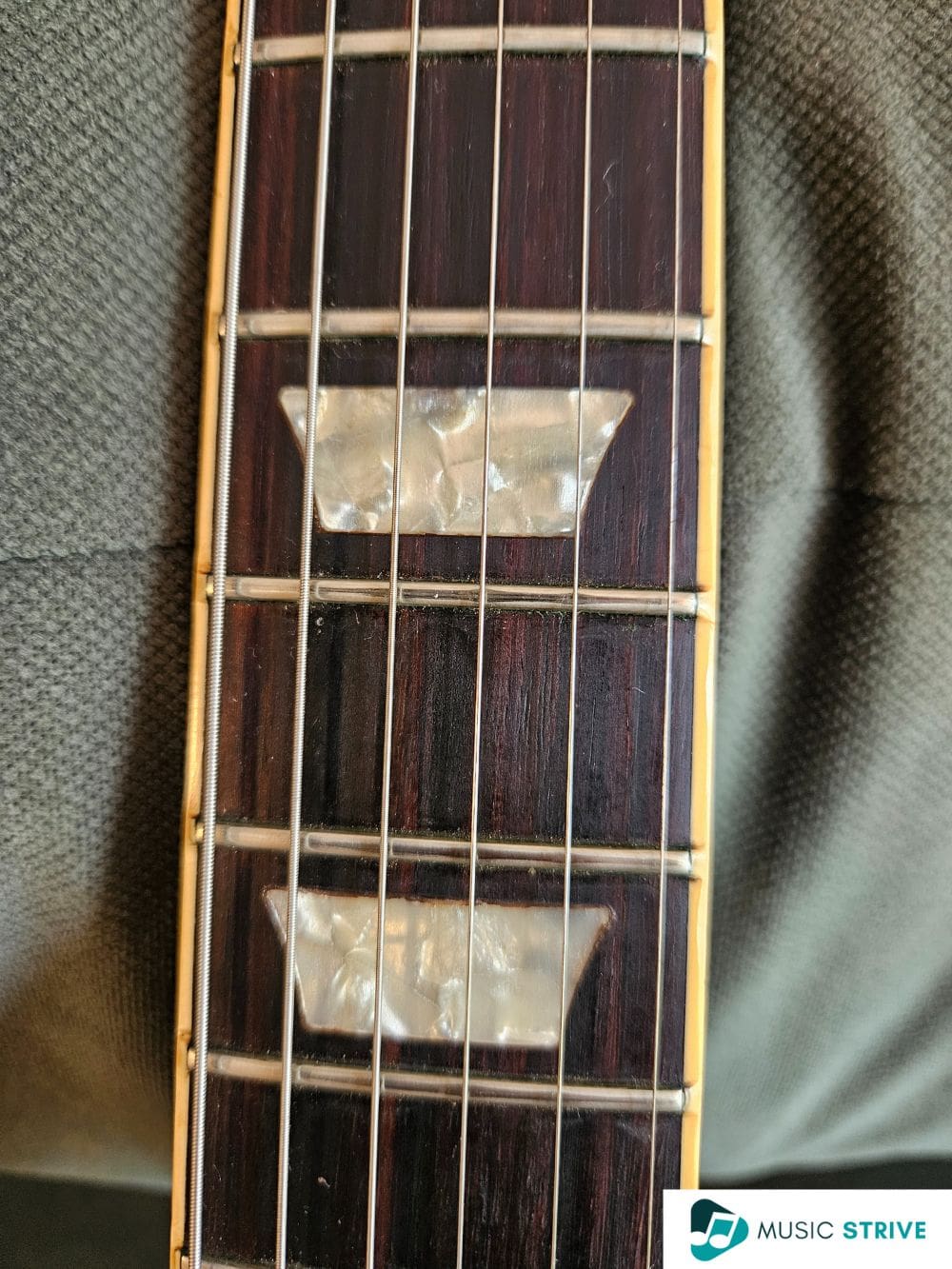
My Gibson Les Paul Standard's Rosewood Fretboard - Up Close
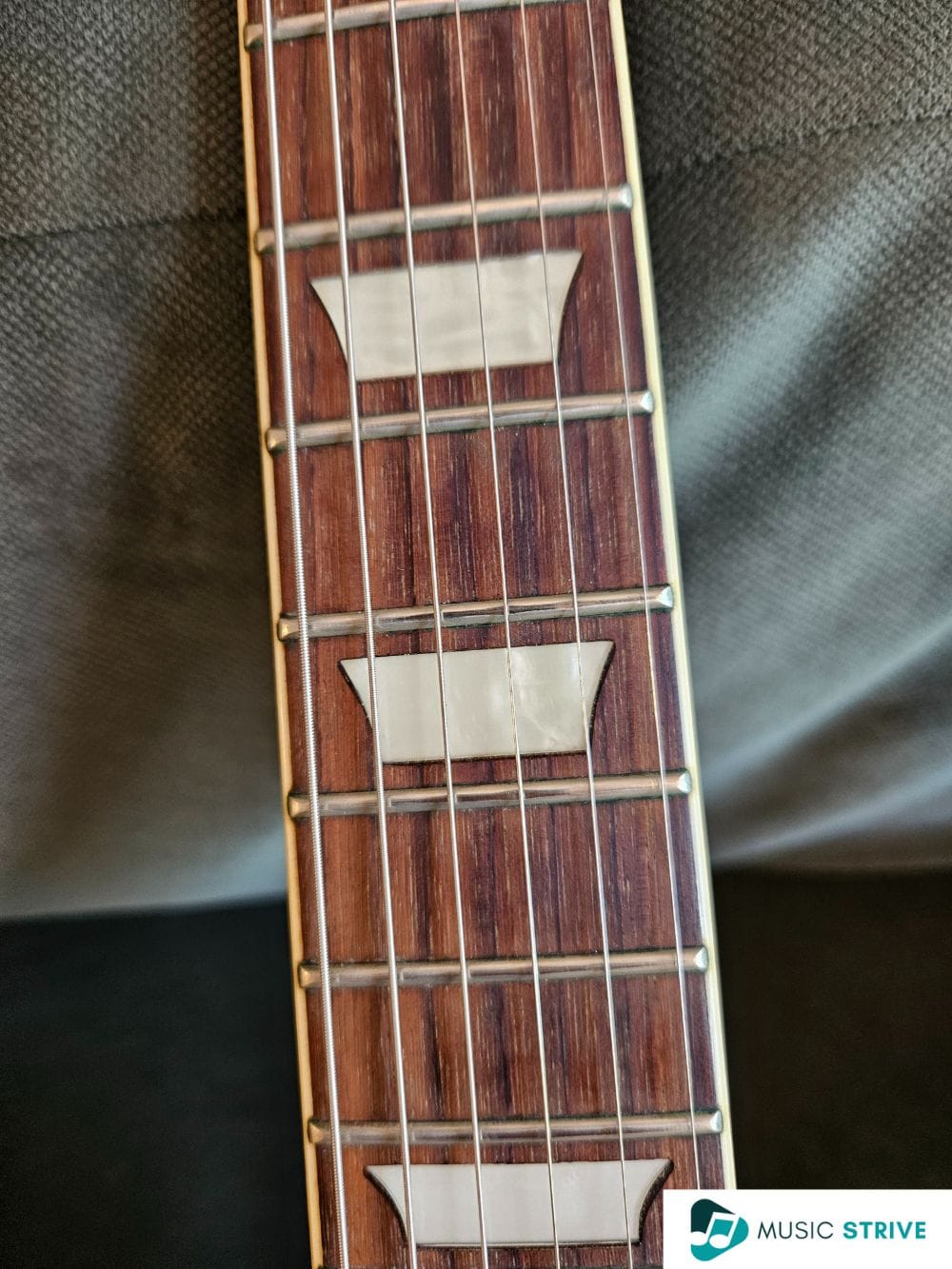
My Epiphone Slash Les Paul's Indian Laurel Fretboard - Up Close
Guitars aren’t just made out of wood, either. The electronics and metal hardware in the guitar make a huge difference to its longevity and playability.
Modern Gibsons come with a lightweight corrosion-resistant aluminum bridge, for example, compared to the cheaper, more reactive zinc of an Epiphone bridge and tailpiece.
Construction
Higher-quality Les Pauls are made with a set neck glued to the body. This offers superior resonance and sustain compared to a bolt-on neck, but is more expensive to construct.
While higher-end Epiphones will be made with set necks, their cheaper entry-level models feature sustain-killing bolt-on necks.
One of the defining, most attractive features of the Les Paul is its legendary sustain, so I prefer a set neck for this reason.
Tuners
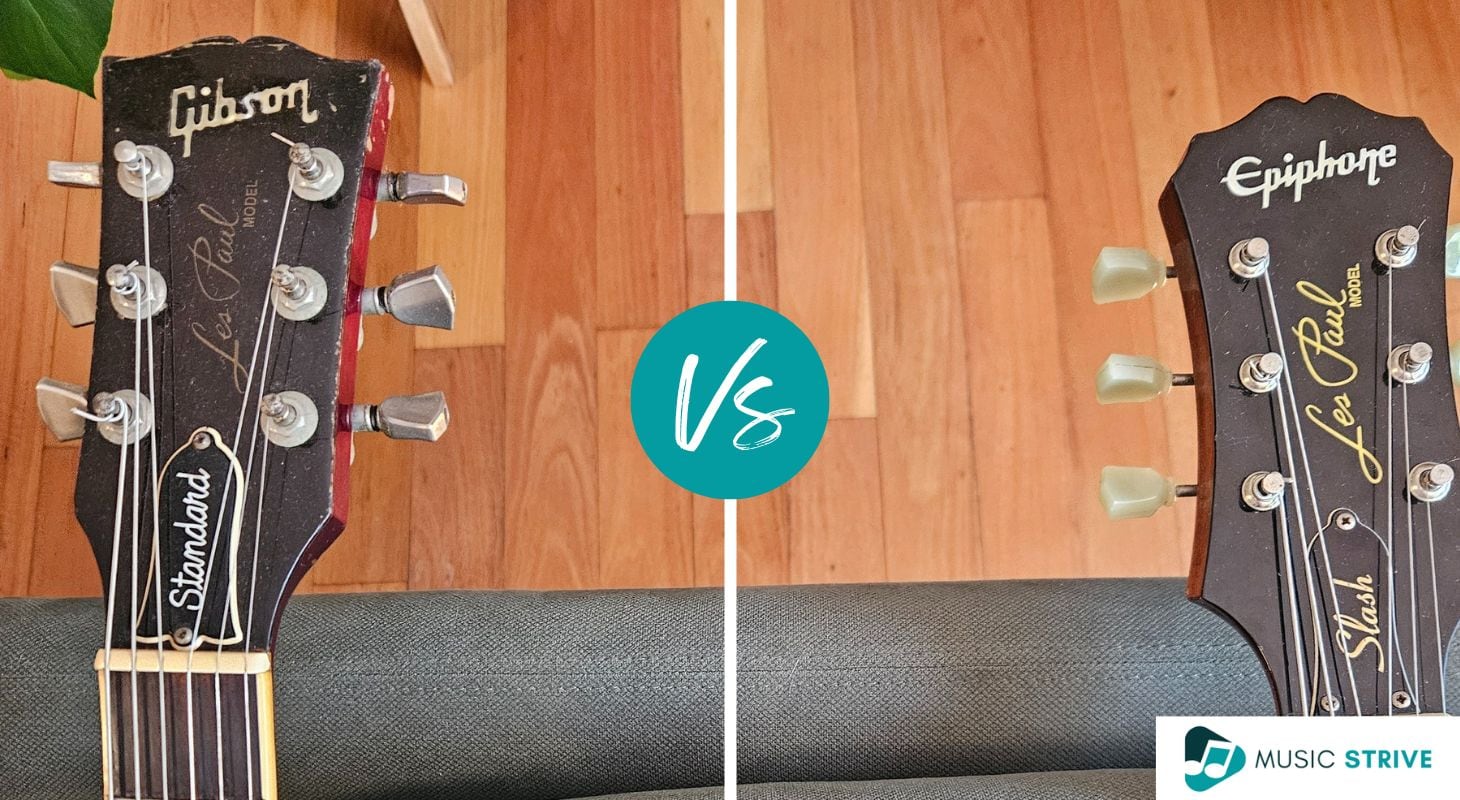
The tuning heads on a Gibson, too, are usually superior to those on an Epiphone. A Gibson Les Paul straight from the factory will include tuning heads from Grover or another reputable brand, while the Epiphone equivalent will typically have cheaper unbranded tuning heads.
Of course, there are exceptions (my own Epiphone 'Slash' Les Paul came with Grover tuners, for example).
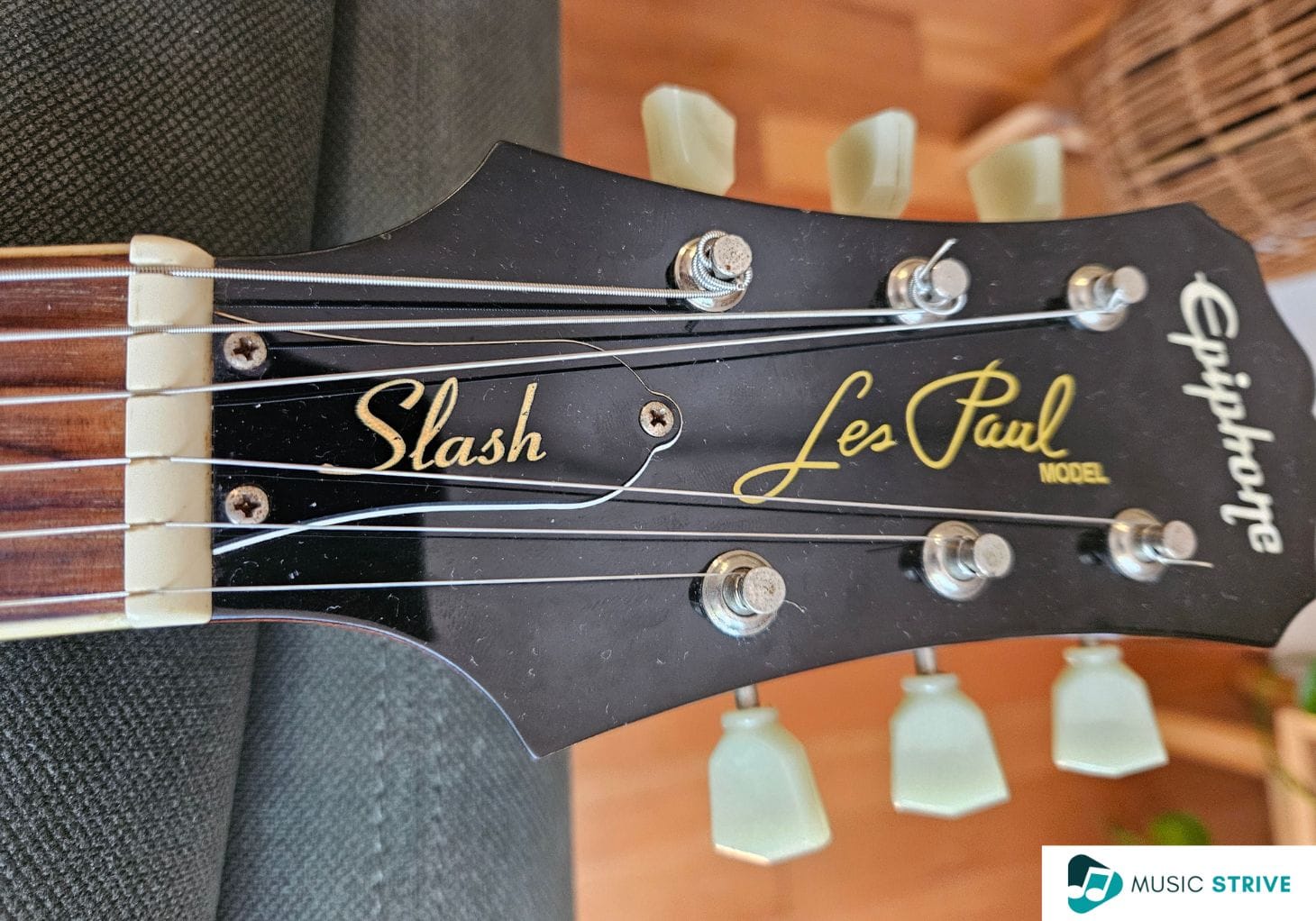
Headstock of my Epiphone Slash Les Paul - it features Grover Kluson tulip-style tuning heads.
Pickups
Gibson’s stock pickups are of higher quality than Epiphones. The legendary PAF pickup, which many pickup builders strive to replicate to this day, was a Gibson in-house innovation. Epiphone stock pickups, to my ear, sound muddy and inarticulate, compared to Gibson’s clearer, warmer pickups.
This is not a blanket rule, however. Many higher-end Epiphone guitars, particularly signature models, come with non-Epiphone pickups, such as the Seymour Duncans found in my old Slash signature model.
Electronics
I’ve also found that the electronic components of the guitar wear out faster on an Epiphone than on a Gibson. I’ve owned two Epiphone guitars in my life, and had to replace the pickup selector on both. My Gibson Les Paul, on the other hand, is older than me, and has demanded no electronic maintenance whatsoever.
Frets
Similarly, Epiphone fret wire is often of lower quality, and wears out more quickly than on a Gibson. The frets aren’t as well-finished in my experience, either, often with sharper, squarer edges.
Neck Binding
As a final note, I’m a big fan of the neck binding on a Gibson Les Paul going over the frets. It looks classy and refined to me. On an Epiphone, the neck binding is done before the frets go on, so the fret goes over the binding. That’s just a personal note, but it’s one I appreciate.
Poly vs Nitro
To my hands, the finish on an Epiphone feels thicker and stickier than on a Gibson. The polyurethane finish on an Epiphone is denser than the thinner nitro finish on a Gibson. I particularly feel the difference on the neck of the guitar. Of course, some guitars have different finishes, like satin, or the unfinished look of the short-lived Gibson BFG (Barely Finished Guitar).
Pricing Breakdown
When I was a teenager, you could pick up the Gibson/Epiphone catalog from your local guitar store and browse through the models in different price ranges. I used to go through the catalog with a ballpoint pen, circling my dream guitars.
To really understand what’s going on with Gibson and Epiphone guitars, it’s important to understand where the two brands cross over and even compete with each other.
I tend to follow the general rule outlined below when considering guitars, using my favorite guitar, the Les Paul Standard, as a benchmark.
$500 and Below
Entry-level Epiphone guitars, such as the Special E1, Special, Studio, and all-in-one packs such as the Slash pack. This price range is really only for beginner guitarists or those who want an inexpensive instrument to practice using a soldering iron.
$500 to $1,000
Midrange Epiphone guitars. At this price point, you see the production-line models such as the Les Paul Standard or Classic. This is where you’ll find Gibson-lite guitars as well as Epiphone-only offshoots like the Muse. As you get towards the $1,000, some affordable signature models with superior parts, particularly improved pickups, enter the fray, like the Gold Glory or Joe Bonamassa signature model.
This is the price range I recommend to late-beginner and intermediate players who need a higher-quality instrument to reflect their newfound guitar skills.
$1,000 to $1,500
This is the high end of Epiphone Les Pauls, and includes signature models like the Matt Heafy 7-string and the Epiphone Les Paul Custom, with an ebony fingerboard and all-mahogany body.
Around $1,500 is where the most affordable Gibsons enter the market.
This is, in my opinion, the best price range for intermediate players or gigging guitarists who need an affordable, reliable instrument.
$1,500 to $2,000
You won’t find many Epiphones above $1,500. This is the starting point for Gibson’s low-end models, like the Les Paul Studio or Junior.
These guitars lack the full suite of features that you find on more expensive Gibsons. A Les Paul Junior might have only one pickup, for example. Likewise, the Gibson Les Paul Studio lacks binding, has acrylic fret markers (rather than more luxurious pearloid or mother-of-pearl), and the Gibson logo is painted on the headstock rather than inlaid.
The irony of these guitars is that, in my opinion, although they are more expensive than any Epiphone, some of the Epiphones look and sound just as good as these Gibsons.
$2,000 to $3,000
Starting at $2,000 you’ll find the flagship Les Paul range, with various iterations of the Les Paul Standard. This is where you get the full Les Paul experience: twin humbuckers, neck and body binding, and quality craftsmanship.
This price range also sees Les Paul variations, those with different pickups such as the mini humbuckers in the Deluxe or the dual P90s found in the early '50s model.
I wouldn’t recommend buying a Gibson Les Paul in this price range to anyone but a serious guitar player. You don’t have to be an advanced shredder, but you should be a confident player spending plenty of time in studios and on stage.
$3,000 and Above
At around $3,000, you start seeing Gibson’s finest array of instruments. This is the price range that includes custom shop Gibsons, one-off guitars, aged instruments, reissues, and limited-edition signatures.
In my opinion, this price range is really only for very wealthy people and collectors. These go all the way up to $10,000 and beyond. I’d be too worried about damaging or losing a $10,000 instrument if I took it on the road.
Is Gibson or Epiphone better?
As I always say with guitars, the best instrument is the one that’s best for you.
I wouldn’t recommend that a total beginner drop $1,500 on a new Gibson Les Paul. Likewise, for an advanced pro player, there’s no reason to consider a $300 entry-level guitar.
It should go without saying that a $10,000 Gibson Les Paul is a much nicer guitar than a $200 Epiphone Power Player. The Custom Shop guitars also offer a much nicer playing experience than even the higher-end Epiphones. I actually had the chance to compare the two when, years ago, I visited the old Custom Shop in Memphis, Tennessee.
I really felt a tangible difference between them. However, that difference didn’t feel like $10,000.
A beginner guitarist really shouldn’t look anywhere near a Gibson Les Paul, unless they find one at a garage sale for $200, something my dad swears actually happened in the '70s.
For beginners, Epiphone guitars are probably best. They allow you to build your skills without a significant financial investment.
Where I find the most competition between Gibson and Epiphone instruments is around the $1,500 mark.
This is the intermediate-to-pro price range. Some of the Epiphone guitars in this range, particularly the signature models, are excellent instruments. For me, the most important addition in this price range is the frequent appearance of Seymour Duncan or Fishman Fluence pickups.
I personally prefer Seymour Duncan pickups to most Gibson stock pickups.
If an Epiphone is more affordable than the nearest-priced Gibson, and it has pickups that I like better, I’m buying the Epiphone.
As a side note, I know many guitar players refuse to play a signature model, but I look at this this way: Epiphone signature models are aimed at players who are still learning, and still take heavily from their favorite players.
A well-priced signature model, like my old Slash Les Paul, offers intermediate players an instrument with features typically only found on higher-end instruments, such as better pickups. It didn’t make me sound like Slash, or play like him, but it made me sound, and play, a lot better.
For intermediate players, a high-quality Epiphone offers better bang-for-buck than a low-end Gibson. The real value of a guitar is how much you want to play it.
This is doubly true for intermediate players, who need inspiration and practice time far more than advanced guitarists.
When I was a teenager, I had an affordable, great-sounding Epiphone that looked like the guitars on the posters adorning my bedroom wall. It made me want to play. If that’s the case for you, too, the right Epiphone guitar would be my recommendation.
In short: for beginner and intermediate guitarists, I simply couldn’t justify spending the extra thousand dollars on a low-end Gibson as opposed to a high-end Epiphone.
However, if you have the budget for a Gibson Les Paul Standard, and you’re regularly playing live and in the studio, you won’t regret buying the real thing.
Customization
One thing many Epiphone owners (myself included) enjoy with Epiphones is the capacity to customize them.
By far the most popular modification is swapping out the stock Epiphone pickups for something a little more upmarket.
An electric guitar’s pickups are, in my opinion, the most important piece of its tonal makeup.
About a decade back, I bought an old Epiphone Les Paul Custom in black from a former bandmate. I had long, curly hair and thought it would make me look, or perhaps even play, like Brian Robertson from Thin Lizzy.

That's me performing with that black Epiphone Les Paul Custom.
Of course, its stock pickups sounded awful. Nothing like what I wanted. However, I bought myself a set of Seymour Duncan humbuckers: one JB for the neck pickup, and one ‘59 for the bridge pickup. Armed with a soldering iron and a long Sunday afternoon, I replaced the covered Epiphone pickups with uncovered Seymour Duncans, plugged it in, and as if by magic the guitar sounded infinitely better.
Over the next year or so, I upgraded that guitar, replacing the bridge, tuning heads, and the pickup selector. It sounded great, and beat pretty much every other Epiphone I played. I got compliments on the tone from that guitar at almost every show we played. We nicknamed it “The Les Paul of Theseus” for how much of the guitar wound up being replaced.
I wound up selling that guitar to another bandmate to help pay for my Gibson Les Paul. By the time I sold it, we used to joke that only the wood and frets were left from the original.
Once I had my Gibson, I didn’t feel like I needed another Les Paul.

My Gibson Les Paul Standard.
After borrowing a Duo Jet for a studio session one day, I desperately wanted a Gretsch-like tone for my arsenal. I didn’t exactly have the budget for a new guitar, but I did have the budget for a new pickup.
I wound up replacing the bridge pickup in my Slash Epiphone Les Paul with the TV Jones Powertron, and still use that guitar for recordings to this day. When played through my Marshall Plexi combo, it sounds enough like Malcolm Young to convince most listeners that it’s a genuine Duo Jet.
In the middle position, with the Seymour Duncan neck pickup and TV Jones bridge pickup both activated, it has a strong, biting tone not unlike a Telecaster Custom. It’s perfect for lead guitar, and only cost me a tenth of the price of a new guitar!
For players looking to get into customizing their instruments, Epiphone Les Pauls are an excellent point of entry. I’m terrified of messing up my expensive Gibson. It gets enough wear and tear just from me playing it! However, with cheaper guitars, I feel more comfortable trying out different upgrades.
The difference in craftsmanship that accounts for much of the price differential between Gibson and Epiphone Les Pauls can be bridged somewhat with your own efforts.
As I said, the most popular upgrade is pickups, but with enough time and effort, you can install aftermarket upgrades to the entire instrument.
Exceptional Epiphones
My first Epiphone, and my first serious guitar, was the 2008 Slash Les Paul. It featured Seymour Duncan Alnico 2 pickups, an extended-tenon mahogany set neck, flamed maple top, and Epiphone-branded Grover Kluson tulip-style tuning heads.
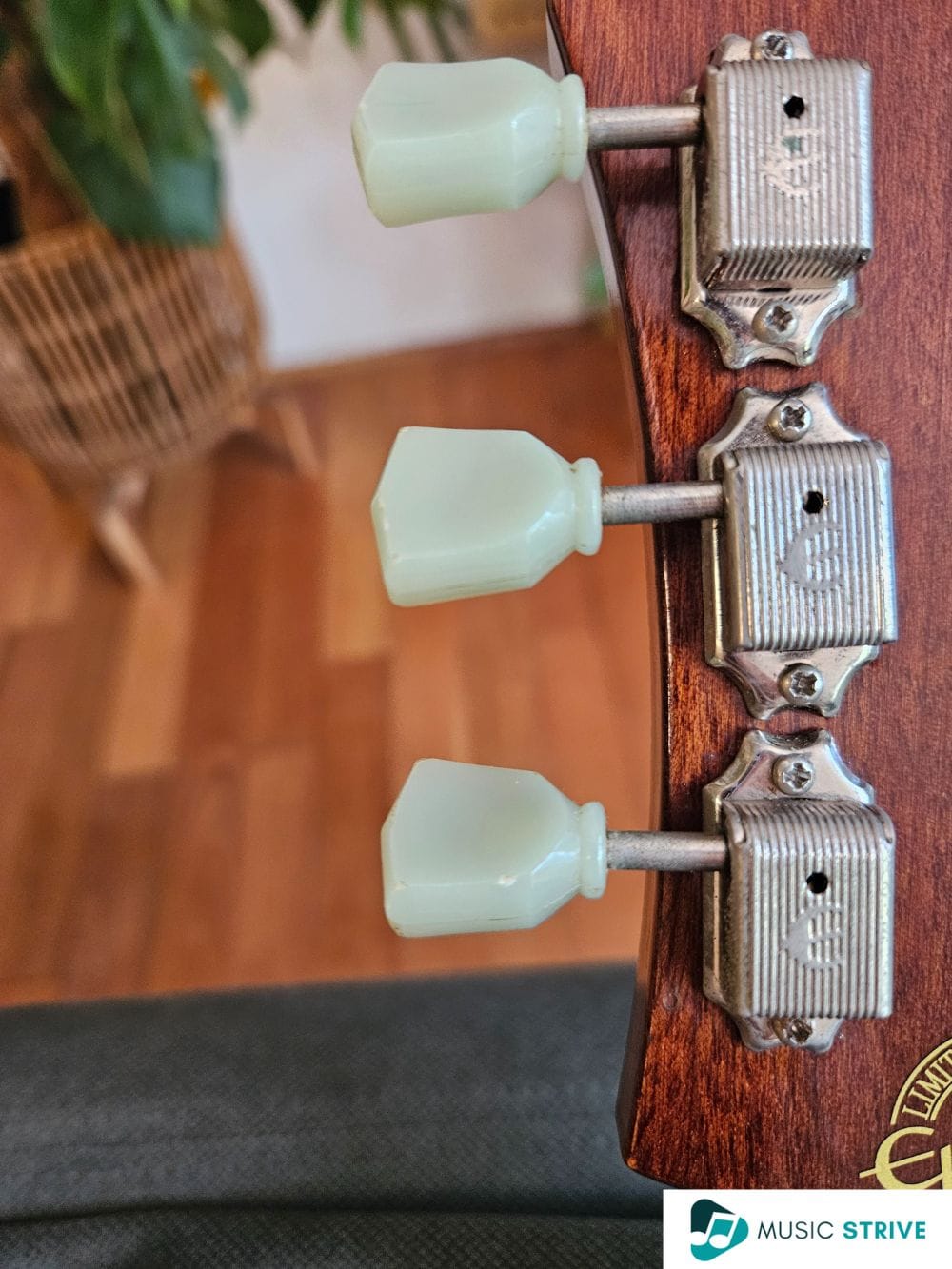
Grover Kluson Tulip-style tuners on my Epiphone Slash Les Paul.
The neck, too, was modeled after the neck profile of Slash’s own Les Paul, with a hefty, '50s-style radius.
At the time, it was a bargain, especially compared to other Epiphone Les Pauls. The other Epiphone Les Pauls on the market, and those wielded by many of my guitar-playing friends, boasted far inferior hardware and pickups, and didn’t have the nice flamed maple top of my Les Paul.
It was my first realization that high-end Epiphones rivaled Gibson guitars for quality. This is still the case. Many higher-end Epiphones, particularly signature models like those crafted for Matt Heafy, Jared James Nichols and, of course, Slash, feature high-quality components. These elite pros often play their Epiphones live: I’ve seen Nichols playing his single-pickup Les Paul Customs onstage many times.
I’d strongly recommend the high-end Epiphones to any guitar player. I do feel like my Gibson Les Paul Standard is a superior instrument to any Epiphone I’ve played. I also feel like it’s superior to most Gibsons I’ve played. 1990, it seems, was a particularly good year for Les Pauls.
My Closing Thoughts on Gibson vs Epiphone Les Paul
The old blanket rule that all Gibsons are better than all Epiphones simply isn’t true any more.
Sure, a $5,000 custom shop Les Paul sounds, looks, and plays better than an entry-level Epiphone with a bolt-on neck.
However, Epiphone guitars start getting very good around the $1,000 mark. When it comes to guitars, you really do get what you pay for.
Many Epiphone Les Pauls are awesome pro-quality guitars.
A Gibson Les Paul Standard is, in most cases, worth the extra thousand dollars compared to the most luxurious Epiphone. A Gibson Les Paul Studio probably isn’t.
Of course, there are noticeable differences between the two. If you have the budget for a Gibson Les Paul - particularly if you can find one from a high-quality production era - I’d say go for it. However, a great Epiphone Les Paul is still an awesome investment for any guitar player, especially those looking to get into customization.

Just as I was about to leave a guitar show I still had an unheard of sum of $330 disposable cash in my pockets. Well as luck would have it on my VERY LAST walk through I fell in LUST with a hot pink burst Epiphone Twisted Sister Les Paul in a booth. Well it was about $20 less than what I had, but thought I’d see, probably wouldn’t go for it but…? Anyway asked the booth guy as nice as I could: Hey, I think this is guitar is gorgeous with the Custom Shop sticker(?) on it and is probably worth every dime you want for it but I’m on my way out and I got a few bucks less in cash would you consider… Head shakes, I say well was worth a shot. Well before I hit the door he said you look like the kinda guy that would give this a good home, buy a case for it, and I’ll take it, just don’t tell anyone you got it from me, please. Kept it for five years, bought a case for it the following week. Never had the LP tone in my head and before I learned to FIGHT the tone out of it, or wanted to learn it. As luck would have it a student fell in love it and saved me $900 in upgrading to make it spectacular!
Have an Epi Classic Worn (2019) as well as a Squier Sonic Strat and am building a Tele partscaster. Have owned an Epi ES-339 Pro in the past. I rarely touch Fender or Gibson models simply because I see no point since I am going to modify them anyway. This is a place where it makes a lot of sense for a gigging musician/pro to buy budget guitars, if they want something to mod as a workhorse without worrying about a stolen or damaged guitar.
MMM, Fender players are not going to like that bolt on neck comment !
I got two Gibson Les Paul’s, a heritage ’80 and a standard. Recently got an Epiphone Alex Lifeson Axcess. In my opinion you are correct when it comes to the top of the line Epiphones. In terms of playability I actually like the Epi Axcess better because of belly cut and shaping where the neck joins the body.