
Being an artist nowadays means you need to do several things to keep up with the vertiginous, fast-paced music market.
Singles every couple of months, a record a year, and many, many promotional gigs to get your songs across the swarm of data the world is today.
So, yes, I took the matter into my own hands and created a bulletproof rig that allows me to move smoothly and not only sound great everywhere but also play comfortably, knowing I can hear myself perfectly.
It took me several years to put together something that’s truly invincible, so I want to share it with you. Maybe you’re not exactly in my artistic line, but I guarantee many of these tips will resonate with you, too.
Table of Contents
The Problem(s) I Wanted to Solve
Let’s start from the beginning, shall we? What are the typical problems you encounter when you show up for your gig at the bar? Let’s narrow down the selection.
The True Story of Minimal Space
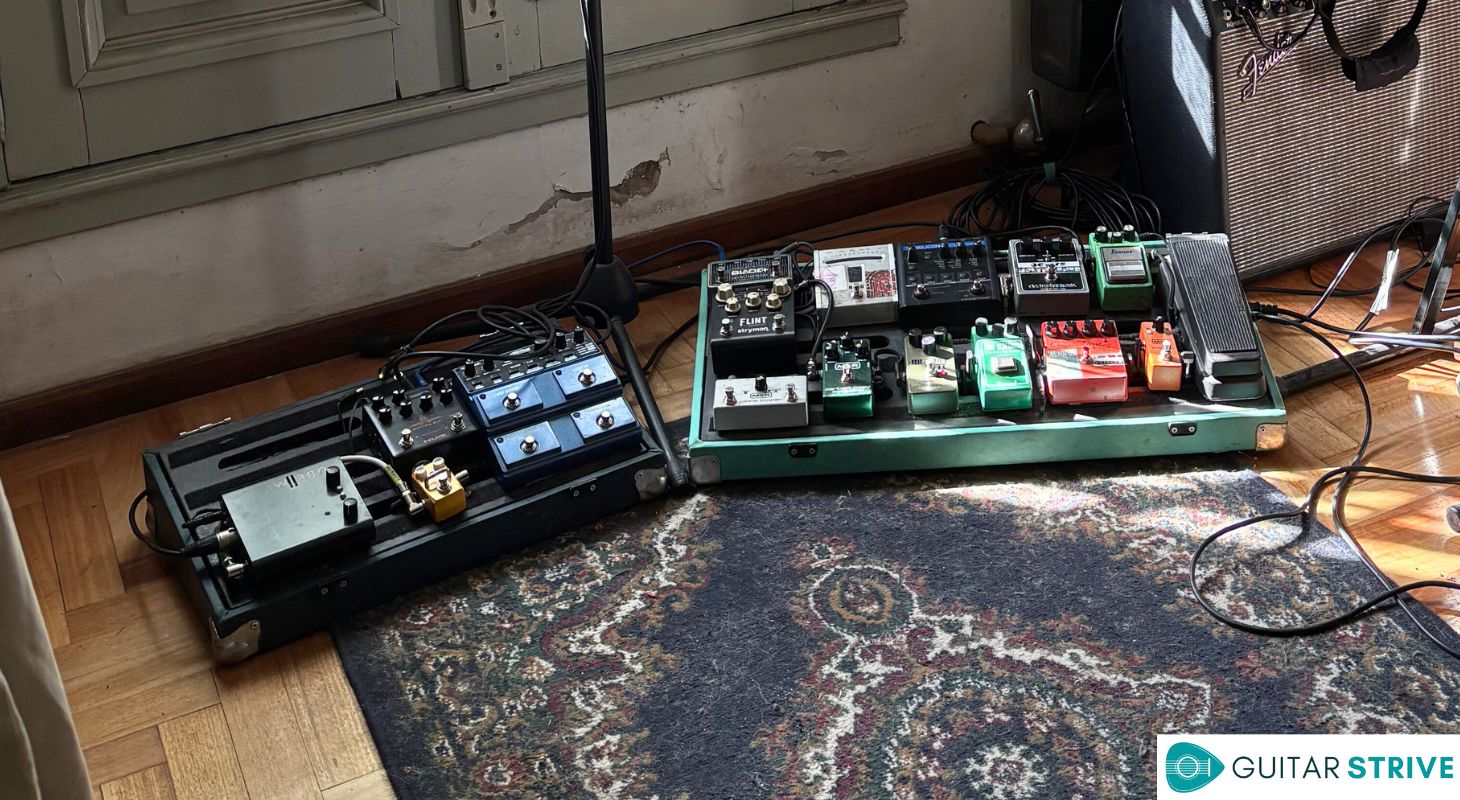
Once, I arrived at a coffee shop where I was supposed to perform and was directed to the corner to set up my gear. I’m not lying, the place was about 2 square meters, being very, very generous. I’d brought my entire rig for the set and ended up playing without the big pedalboard and improvising half the show. It was nerve-wracking. So, mind the space.
The Sound Person Is Used to His or Her Gear
The first thing you encounter after the physical space is the person in charge of the in-house PA. I’m not going to go for the cliché that they’re all careless and the same. I found great people and wonderful professionals on the road, too. The thing is that when you have the slightest deviation from what they already know, it’s like messing up their day. That initial look could melt the North Pole.
Feedback, Monitoring, And Other Screeching Issues
Besides performing for an audience (big, small, or even for the bar staff), you need to perform for yourself. This means you must hear what you’re playing. If you’re playing acoustic guitar, that can translate into a million problems of its own. Luckily for you, I found a great way to get around that.
So, read on and we’ll tackle these issues one by one.
How My Rig Solves these Problems
Space
Space is one of the main things that you’ll have to sort out. Every venue is different, and not every venue is prepared to have you and all your gear set up while people actually enjoy the place with you.
So, what I came up with to solve this issue is a small-sized pedalboard that doesn’t take up much space. Furthermore, if I’m sitting on a stool, the pedalboard can truly occupy my space if I were standing.
Another thing I did was work my set in a way I could get away with it, using minimal effects, if any. I mean, reverb is non-debatable for a live performance, but I got a gadget on this board that makes up for that.
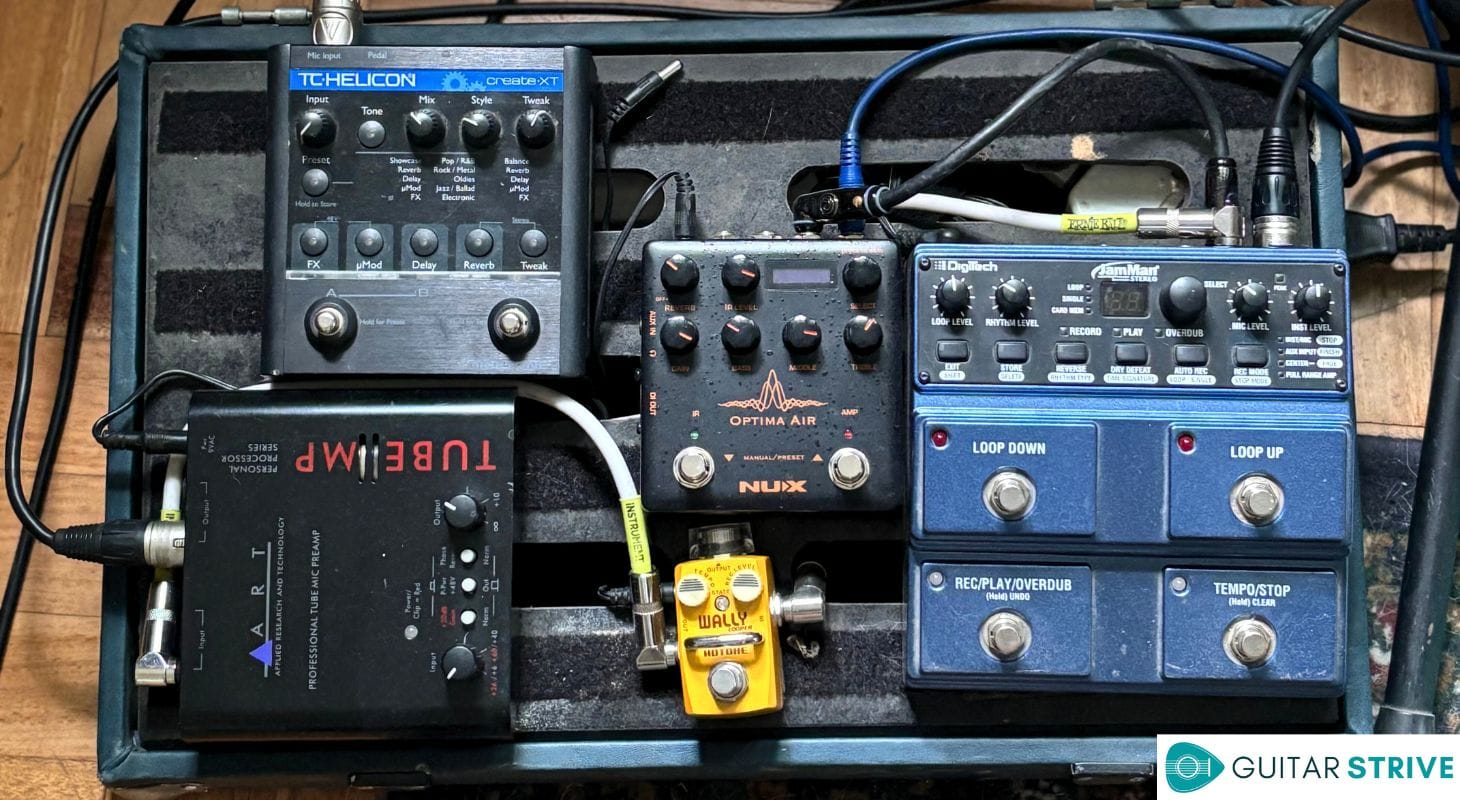
In this picture, you can clearly see that everything is taken care of, and it occupies minimal space.
Connections
I’m a singer-songwriter, besides being an instrumentalist. What I do is play songs with some live looping to keep it more interesting, going from one instrument to another. I play acoustic and electric guitar, open-G guitar, and Ukulele. If I have space to bring the full show, it includes a big pedalboard and a Korg M1 synthesizer.

So, I plug the guitar into an IR device. I play through the IR of a Martin D28, and it sounds beyond glorious for the front of house. It turns my Baby Taylor into a roaring monster. Especially for the slide-driven bits.
This little box (I use the NUX Optima AIR) isn’t just an acoustic IR, because you can upload any IR you want to it. I also have a Deluxe Reverb and a souped-up Marshall head with a 4×12 in it. I can move from acoustic to electric and to distortion without changing more than the bank.
Oh, and that’s where the reverb comes from, too.
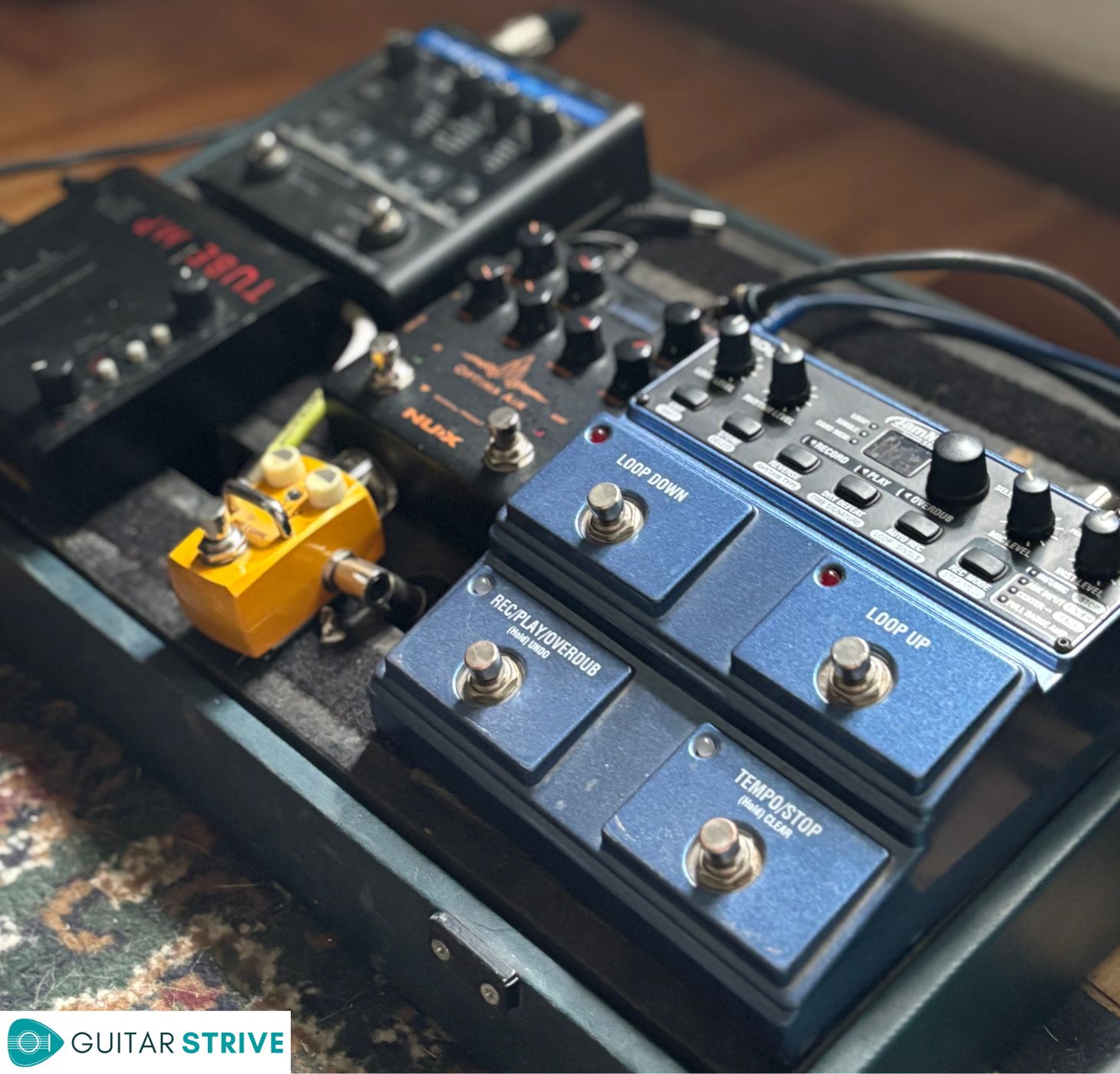
From there, I go into the looper (JamMan Stereo), then the second looper (Hotone Wally), and finally to a studio preamp that makes everything sound punchier, rounder, and clearer. I know the ART device there belongs to a studio, but it’s as sturdy as it gets. Plus, you have enough juice to give the PA people a line hot enough not to add noise to their side.
Finally, the vocals are taken care of by my TC Helicon Create-XT. From there, I get compression, effects, de-essing, and a bit of pitch correction (hey, I play a lot!).
So, I go from the studio-grade preamp and the vocal processor to the PA, but also to my own monitoring system.
Monitoring
For monitoring, I use an old Soundcraft mixer, the Notepad 12FX. I use the second output of the vocal processor and the studio pre to go to my own mixer, and I connect my in-ear monitor system to it.
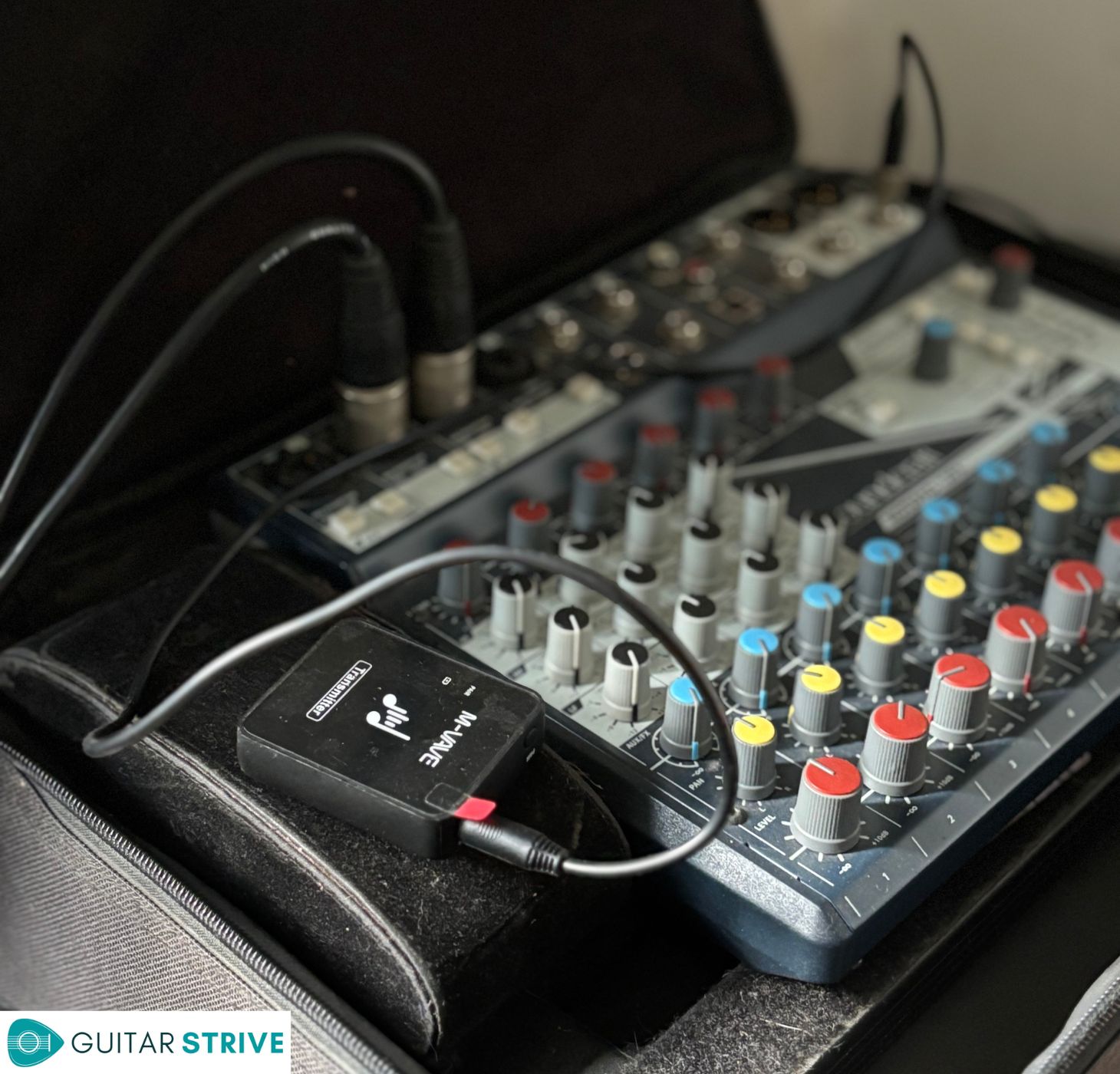
I use a very cheap M-Vave Bluetooth system because I’m usually the only one on in-ears, so it works perfectly. Also, by using my own mixer for this, I don’t have to stretch the BT signal the entire venue and hear it cutting out on me half the time.
Another option, if in-ear monitoring fails, I have a small, 10” powered speaker I can place behind me and looking up, so it won’t mess with the microphone or the acoustic guitar.
I just keep the mixer near and make all adjustments myself. Whether I want more vocals or whatever I need. I mean, it’s not rocket science either; I’m handling only two lines here. But it sure means the world to me being able to adjust it to my preference.
Just a quick addition here, this mixer records straight to USB, so if I’m feeling like it, I’ll just bring the computer, record the gig, and then go through it to find mistakes and fine-tune my playing.
Electricity
This is one kind of connection most people tend to minimize. Most of us go to the gig with multiple 9-volt adapters that end up being noisy, and you need a million connections just to get going.
My rig only needs two sockets. I’ve arranged everything inside the pedalboard to need only one socket. Also, the mixer occupies only one socket. So, I’m done with two sockets.
Oh, and I always bring a multi-socket extender just in case the venue’s default one looks suspicious or is nonexistent.
The Floor
I learned this one the hard way. I always bring a rug like this with me if I’m taking the car to the gig. I had to perform over a slippery floor in this fancy bar once, and the pedals would slide away from me as I stomped on the pedalboard. I had to move behind it to finish every song. Good thing I wasn’t wearing my boots but sneakers. Otherwise, it would really have been a disaster.
If I can, I’m bringing the rug to every gig, and you should too. Even if it’s small enough to fit your tiny pedalboard.
Brands & Models
I just gave you a list of what I use, but it doesn’t have to be the same for you. If you respect what each of these pedals does, you can replace them with your favorite option.
So, instead of thinking about a TC Helicon or NUX pedal, or an ART preamp, fill those spots with what you like the most (or can afford). Just think of them for what they do, not their brand or model.
The Bottom End
Small gigs are a great way to make ends meet. Performing those with minimal effort will help you get more gigs and grow your artistic persona.
This rig is the result of endless tinkering to solve the problems we all have when playing live. The more you do it, the more you can spot the small holes and do something about them.
Now, when I leave for a gig, I know exactly what’s going to sound in my ears, and I leave the rest for the sound person at the bar. I just make sure they receive a good, punchy, powerful, great-sounding signal from my end. The rest is their work.
Take what works from my approach and turn every gig into a great experience. Music isn’t a destination; it’s a wonderful journey, so make sure you’re traveling comfortably and always going at full speed toward the future.
Happy (live) playing!
And finally, you can see this rig in action in the video below.
