
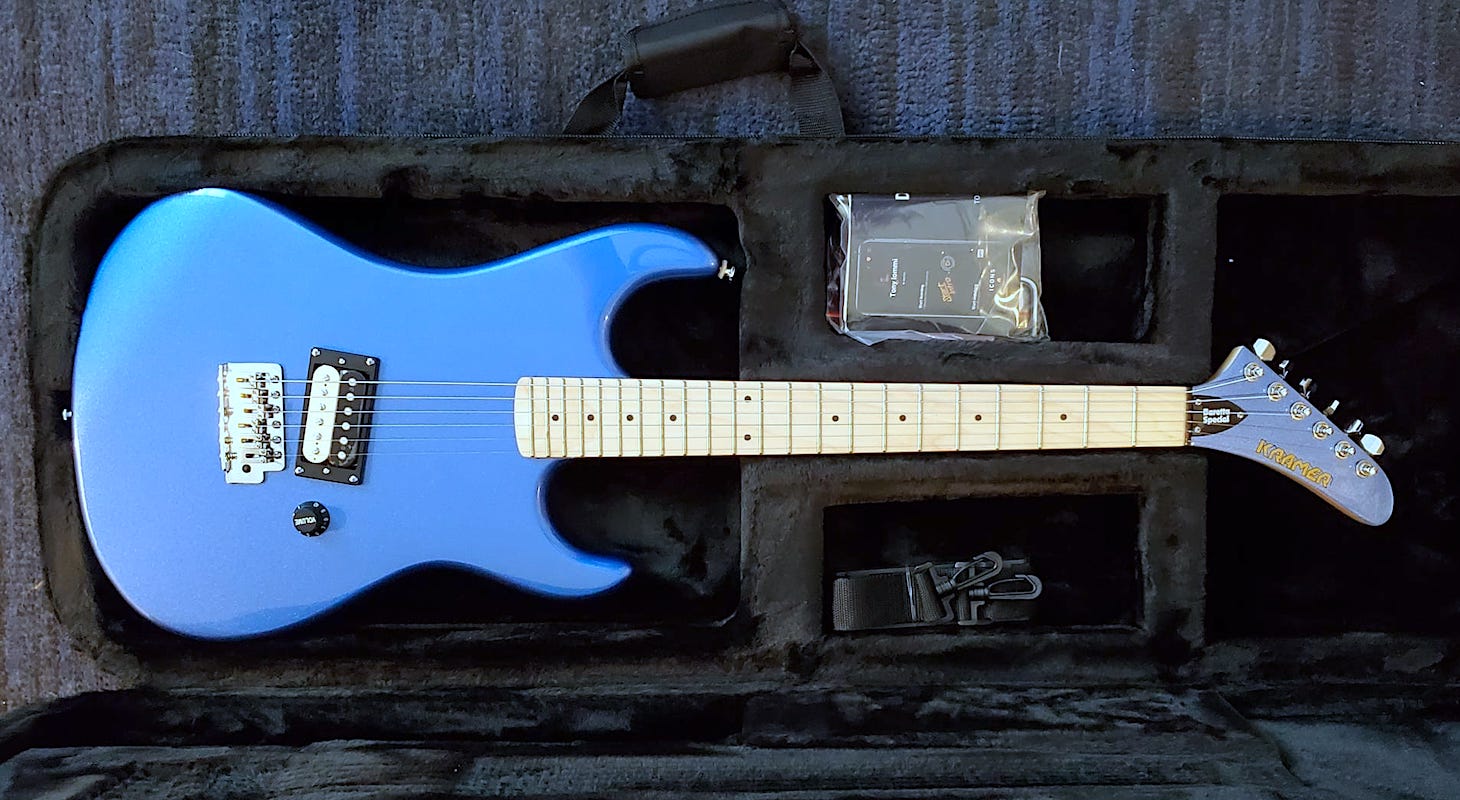
I know, this guitar and its banana headstock, quirky-cut body, and maple fingerboard scream ‘80s in all directions. Moreover, the moment you plug it in and let it roar, you confirm your suspicions: This is a metal machine.
I road-tested the Baretta Special for a little over a week, and the results were absolutely flabbergasting. I just couldn’t put the thing down for a minute!
Quick Overview

The simplicity of the layout, the nastiness of the maple fingerboard, and the growl of the spicy humbucker make this a bombastic guitar for rock, heavy metal, punk, or even hardcore.
I had a lot of fun playing this and found good and bad things to tell you about. So, let’s not keep this affordable beast waiting and get right into it.
An Epic Bang for the Buck
This Kramer Baretta Special is one of those guitars you have to check and double-check the price tag as you’re playing it. It’s an absolute steal that you get this much guitar for the price; something you won’t likely find in any other brand.

Kramer Baretta Special
Now, since Kramer was purchased by Gibson in 1997 and rescued it from bankruptcy, and re-launched in 2020, they’ve worked hard to put the name of these ‘80s shredding machines where it once was.
I’m sure you know about Eddie’s 5150 Kramer guitar. Well, this Baretta Special takes on that spirit and simplifies it to the extreme to deliver a no-frills guitar ready for heavy tones. Yes, in the early ‘80s, when Van Halen shocked the world by inventing a new way of playing the guitar (much like Jimi did in the late 60s), he did it with a heavily-modified Kramer.
At that point, Kramer was one of the world’s biggest guitar brands.
Well, you can definitely hear and feel that rich heritage in this extremely affordable guitar that costs less than a boutique pedal but plays like a beast.
So, let’s get started. The Baretta Special comes in a box (no gig bag included, sorry) with all the accessories you need, including the tremolo bar and some cool stickers. You get one zebra slanted humbucker that’s generic but comes loaded with Alnico V magnets, giving it the push it needs to distort anything you plug it into.
That humbucker is wired directly to the volume knob and then to the output jack. This utter simplicity gives the guitar not only a fool-proof layout but also a raw, powerful, audacious tone to play with.
One thing you should know is that, out of the factory, the guitar comes with a capacitor attached to the volume pot that basically transforms it into an ON/OFF switch. What I mean by this is that you can’t clean up the signal by rolling it down. It remains the same until it cuts off the volume entirely.
Well, all you need is 15 seconds, a screwdriver, and a pair of pliers. Once the capacitor is removed, the volume knob becomes your best ally to find overdriven sounds that won’t go into mayhem status right away. Moreover, you can do that classic, old, eighties trick and move around the stage, going from dirty to clean using only the volume knob.
I have to say it, I reached out for a pickup switcher more than once and ended up flicking the air. This guitar would benefit from another pickup tone-wise, but a more complex layout would be a complete mojo killer, making it just another metal guitar to add to the list.
So, the epic simplicity and bodacious tones make this the perfect axe to go to every gig with and play confidently without being super worried your huge investment might be harmed.
The Mahogany Body & Maple Neck Combination
One of the cons of this guitar is that it’s quite heavy. I mean, a chunk of mahogany the size of a Stratocaster body might be a little too much for some backs. Furthermore, because of the price tag, I wouldn’t think that this body was specially selected to be lightweight. On the contrary, I guess the mahogany that was left out of pricier builds ended up being this guitar’s body.
As you might know, mahogany has a very specific growl and bite that has made generations of players swear by its tonal properties. Moreover, every heavy-hitting Les Paul tone out of the Gibson factory is packed with that mahogany punch.
That said, the maple neck adds to the combination a healthy dose of higher midrange that’s enough to turn this guitar into a dangerous weapon on stage. I mean, I played it with my band, and I just couldn’t believe how effortless it was to cut through the mix and be heard.
I’m not going to say I played “Eruption” in it, I don’t have those chops. However, I did play some classics like “Running with the Devil”. Moving from verse to chorus with the volume knob was super easy. Yes, I was pleased to find out it’s conveniently placed at a finger’s reach.
With my hopes high after nailing that song, I went for some “Panama,” and that dry, nasty, midrange-infused tone for the power chords was right there. I could swear my hair grew big and my pants got tighter for a minute as I was doing the helicopter with my picking hand.
Also, the natural harmonics sounded perfectly clear through the dense mix.
The neck, while not super thin, has a nice 12” radius that makes it flat enough for leads and curvy enough for chords. Although the guitar comes with 22 frets, these are medium jumbo, not quite a shredder’s dream. Perhaps some higher frets and a slightly thinner neck would have made this guitar even faster to play.
In my opinion, the wood combination, despite being heavy, gives you the best of both worlds. You can growl, bark, bite, cut, and shred easily.
The Slanted Humbucker
I know Eddie would have been proud of us all playing with a slanted humbucker. Even more if it’s a zebra, open-coil one like the ones he used in his heydays.
I have to tell you, I had zero faith in this pickup knowing the guitar’s price. I thought it was going to be one of those wimpy, thin, squealing pickups that I would just have to swap out day one. Well, I was as mistaken as a guitar player can be. This pickup breathes fire and stays defined. I didn’t hear any muddiness or harsh, brittle treble that most cheap pickups tend to have.
Plus, I think there’s something very punk rock, metal, and rule-breaking about it being slanted. It just sounds so nasty when you play a big chord with enough distortion that clarity becomes of secondary importance when a guitar packs this heavy a punch.
From what I could recollect online, this pickup was made by Epiphone. Well, while it’s true that Slash is an Alnico V genius, let’s say that this pickup feels hotter than that. It drove my amp and pedals into a distorted paradise from moment zero and gave me a big, chunky, powerful tone to play with.
If you want to remove dirt from your signal, it’s not enough to turn off pedals; you have to dial the volume down as well. Otherwise, you won’t have a pristine signal to play with.
This is Where They Cut Corners
OK, now that we have established this is a lot of guitar for the money, let’s talk about cutting corners. Because they did cut them, and they cut a few.
To begin with, the tremolo is as cheap and generic as a tremolo can be. The metal block underneath it has half the mass of a Fender Mexican trem. This causes the guitar to lose some of its natural sustain. I mean, the book says: The bigger the metal mass, the more the sustain. So, it’s just doing the math here.
In the same vein, the tuners are very cheap, and so is the nut. You might find yourself struggling to keep the guitar in tune because of these two elements. Although changing tuners is optional, either applying graphite or swapping out the nut is a must. You’ll get a much more stable and therefore usable instrument that way.
Finally, the guitar’s neck isn’t exactly silky on the edges. You can notice some roughness in the way frets are dressed and finished. It’s not like you’re going to hurt your fingers or anything like it, but it’s galaxies away from beautifully rolled edges like you’d get on a pricier, elite-level super Strat.
Other than these things, this guitar is so simple that it’s absolutely bulletproof. With so few things that can go wrong, this is a heavy-hitting, metal machine ready to rock right out of the box.
The changes in the nut, the tuners, and the tremolo will have a positive impact on performance, but the rocking mojo and menacing tones are available from the factory.
My Verdict
A guitar like this might go under the radar for seasoned players because of its outrageous price tag. Nevertheless, it offers way more than its price indicates.
Yes, there are some shortcomings like the fretboard edges, cheap hardware, and limited tone options, but once you get it in its comfort zone, it will rock your world entirely. I mean, I could easily see myself pulling it off night after night with this guitar, a little graphite, and a distortion pedal. That is, of course, playing in a metal/hard rock/punk rock band.
Can you imagine doing a nightclub tour with just a $200 guitar and a few pedals? Well, this guitar can be exactly that. Furthermore, it could be an outstanding backup for your main axe. Yes, if you have a gig in a sketchy side of town, just pack the Baretta and gig confidently; it won’t break the bank to replace it, and it will surely deliver tones for the night at ease.
Finally, although the neck of the guitar isn’t as tiny as Ibanez’s Wizard III, it’s got a nice profile that fills the hand but lets you play fast.
My Final Take
The Kramer Baretta Special might be the best deal in the market right now for those after a no-frills approach to a cutting heavy tone. If that sounds like the kind of guitar you’re looking for, don’t pass up on this guitar; it’s the Gibson Family of Brands’ best-kept secret so far.
Happy (banana headstock) playing!
