
I’m not a casual strummer, I’ve been playing guitar for well over 2 decades. Most of that was on an electric, and, while learning, on a nylon-string guitar.
I had my acoustic guitar with steel strings because, well, you should have one, right? But my perception of acoustics changed entirely when I got my hands on my Martin D15M. This isn’t an event that happened in the past year; I’ve had this guitar for almost ten now.
The profound impact of buying the Martin out of an impulse and a love for beautiful guitars was huge on my playing style. I even began a solo project that took me to play that guitar on many stages and have more fun playing acoustic gigs than I would have ever thought.
Can a guitar change it all? Well, in my experience, that’s the Martin D15M.
But let me tell you all about that journey and why the 15 series by Martin might be the best bang for the buck in the market right now.
Table of Contents
Why Do I Love It So Much?

Let me blow the scoop here as much as I can from the first paragraph. I just love my D15M from an aesthetic point of view, but I also can’t get enough of it from a playing perspective. It’s one of those guitars you just can’t put down. Let’s address this one thing at a time.
A No-Frills Approach to Tone
When I bought this guitar, I was working at a music shop, and it was part of a batch of Martin guitars that arrived to be sold. In my opinion, opening boxes for new guitars is the best part of working at a music store.
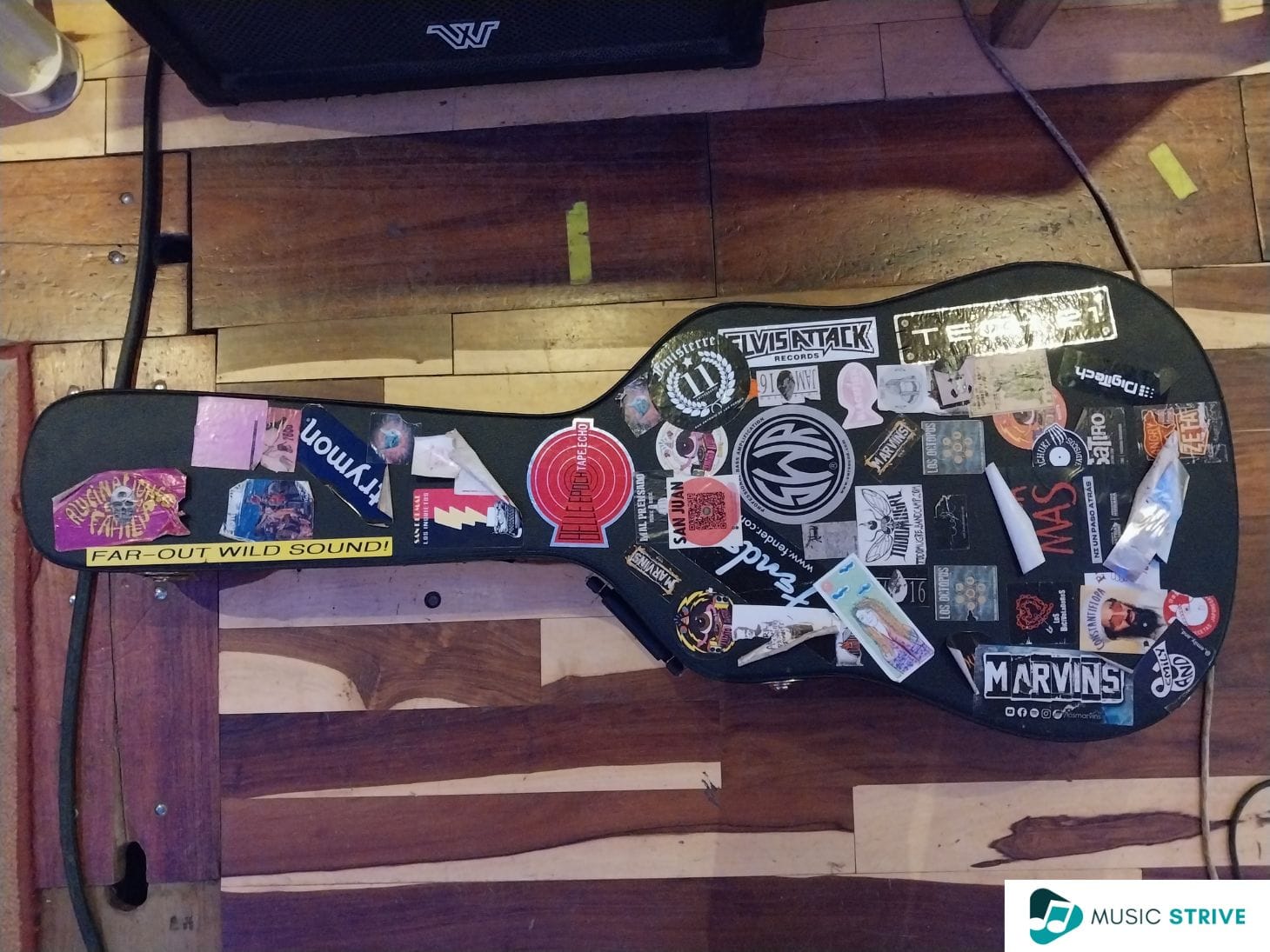
I remember clearly opening the box, taking out the hardshell case (yes, the D15M comes inside a premium Martin case that’s built like a tank), and undoing the three golden locks.
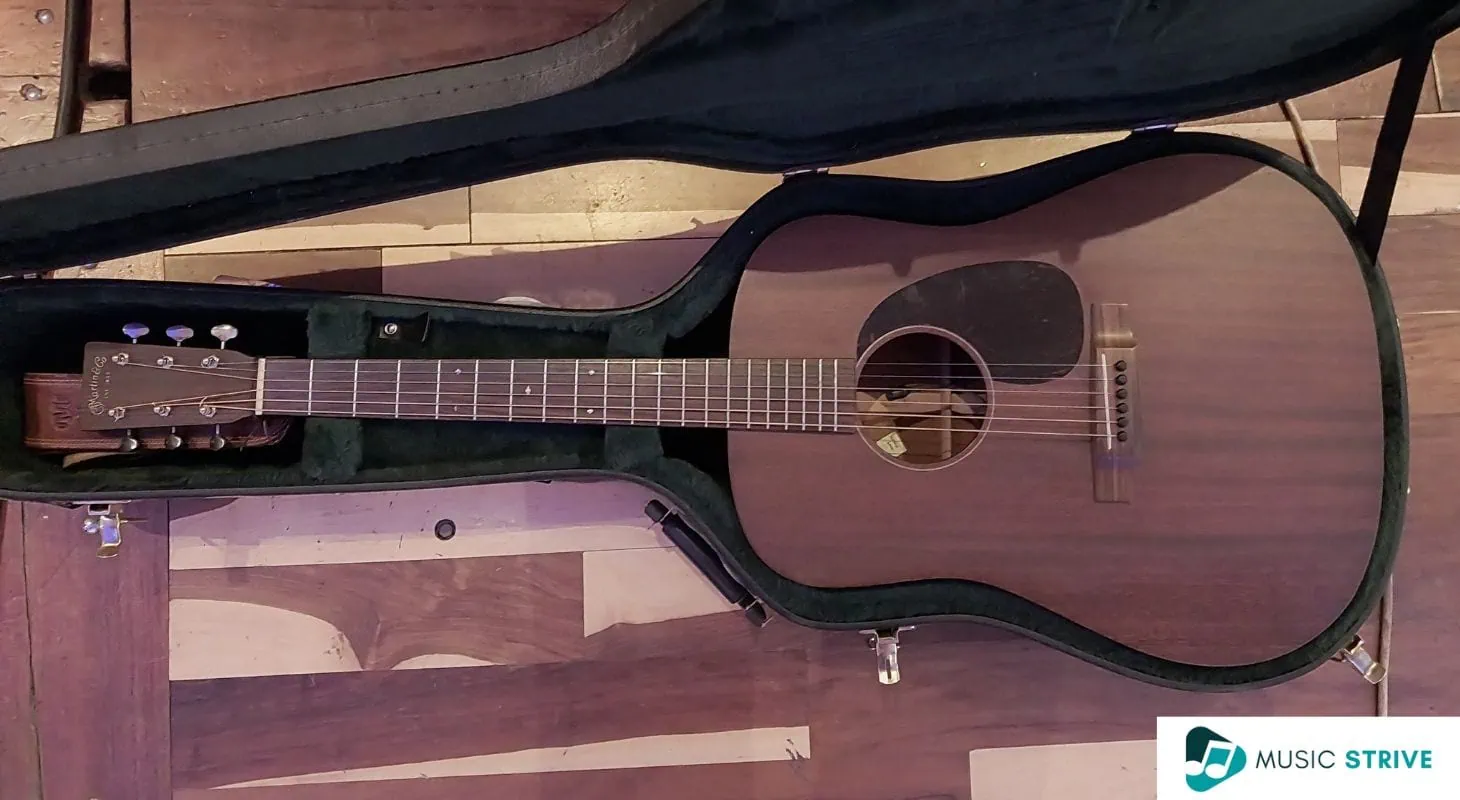
What I found inside was a puffy green interior and a very dark, beautiful all-mahogany guitar. I was supposed to find a place for it to be shown at the window but as soon as I put it out of the case and strummed my first C major on it, I just couldn’t.
The guitar had to be mine.
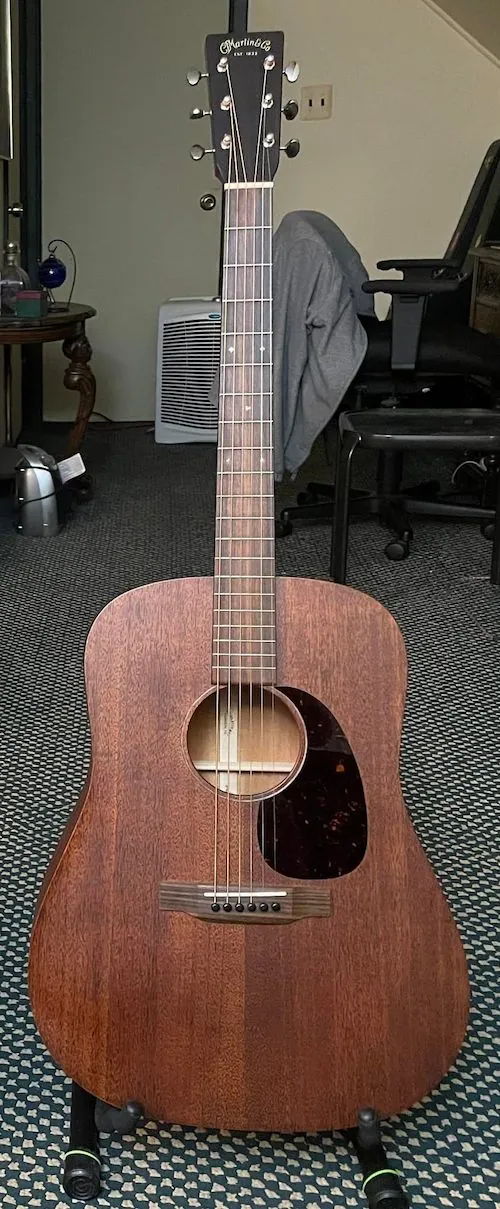
This is not because it has any ornaments or fancy appointments, on the contrary, the minimalist approach with the slight purfling adorning the rosette is elegant and sober. The D15M is an all-tone, no-frills approach.
The setup was not the best, the strings were sky-high, and the guitar was obviously out of tune. Yet, the dark, bass-friendly, round and beautiful, and organic tone was enough to open a new need in my brain.
That Legendary Martin Sound (with Twice the Warmth)
After that initial encounter, I talked to my boss and found a way to afford the instrument by trading in my Chinese-made Ibanez ArtWood Series acoustic.
Let me tell you I was pleasantly surprised when I found out about the price tag of the guitar.
That same day, I took the guitar home with me.
The next day sent it to my trusty luthier for a good setup. The results were mesmerizing. I was in complete awe. I started playing it so much at home that I eventually decided I was going to play it live because it just sounded too good.
The one thing that got me the most then and that still gets me is the low end. Nothing can compare to this guitar when you work your dynamics. That’s a great way to try a guitar out. If you can go from fingerpicking to full-on strumming and the guitar goes from mellow to a wild beast, then you’re with an organic, great-sounding instrument.
That was exactly my sensation with this Martin D15M; it’s the closest to speaking. The inflections of the voice going from whisper to shouting are close to what you get playing this instrument with different approaches.
That said, the low end stays consistent throughout that spectrum. You can fingerpick, strum, or even play leads, and the dark heart of this guitar will follow you relentlessly.
If you’ve been playing one of those thin-sounding, laminated acoustic guitars and switch to the D15M, you’ll notice the entire guitar vibrates evenly because it is all solid mahogany.
If you’re familiar with that dark, generously bassy, beautiful tone that Martin is well-known for, then this guitar adds the warmth of the solid mahogany top to the mix. As a result, the tone gets bigger, milder, mellow, and more balanced than spruce-top Martins.
Tales of Mahogany and Gigs
After playing it for countless hours on my couch, I went out shopping for the best pickup system for it. I wanted something that would help others have a similar experience. I wanted something that would capture the guitar’s dark tone coming from the all-mahogany dreadnought body.
I bought one of those that has a condenser microphone as well as piezo crystals for the bridge and a blend control. As a result, I played countless gigs with just the guitar and my vocals.
This is not a minor detail, the low-end and the mild tones that come from the mahogany top sit perfectly well around the frequency of the human voice. Moreover, since the guitar is all-solid construction, if you pick harder, the whole body resonates bringing more life to what you’re playing and allowing you to play verses and choruses in a clean/distorted manner with no pedals.
Finally, I was also able to test the endurance of the instrument since I went on a mini tour of six gigs in very different climate and humidity conditions and the guitar played flawlessly in every scenario.

The fact that it comes with a hardshell case makes it perfect for the gigging musician.
Also, you don’t feel like you’re taking out a precious guitar on the road since it’s not at all an ornamented instrument. My feeling was playing a working man’s guitar that sounded like an instrument with a much heftier price tag.
Some Important Technical Data
Now that I’ve told you why I love my Martin D15M so much, it’s time to tell you why it produces the sound quality that it does. Yes, I did this the same way you’re doing it right now; I went from tone to theory.
I first fell in love with it and then found out why.
Solid Mahogany
The Martin D15M is entirely made of solid mahogany except for the fretboard and the bridge.
This is very important because, and this is something I always do when trying out a new guitar, if you put the D15M to your chest and strum it, the entire guitar vibrates.
It not only vibrates, but it also does it organically. Thus, what you get is a natural decay that sounds just like a record. Also, the mahogany in the neck gives it an extra layer of darkness to the sound that you wouldn’t get with maple, for example.
Finally, the all-mahogany approach is only broken by the X-bracing under the solid mahogany top. These bracings are made of Sitka spruce and add a beautiful ring to the top end and increase volume as well as sustain.
That was the tone of the Martin as I picked it up for the first time and is still there ten years later, just getting better.
Rosewood
Rosewood is a precious tonewood, and after the CITES regulation, it’s on its way to costing more than gold if you compare it by the gram. The D15M offers a fretboard and a bridge made of rosewood and they add a part of the gloomy sweetness to the tone.
In case you didn’t know, the fretboard material affects tone drastically. In acoustics, the same thing happens with the bridge material.
As a result, the Martin D15M adds the right amount of sweetness to darkness. No, I’m not a fan of The Cure, but when it comes to that quintessential Martin tone with lots of lows, this guitar is perfect.
Dreadnought Size
The second gig that I played with this guitar was in a venue that, as I was to find out upon arrival, had no sound system. It was all a misunderstanding between the organization and the bands and there was no sound system at all.
That day, I was able to really put the dreadnought size and the X-bracing to the test.
Believe me, there wasn’t a single soul in that place that was left out of my guitar monkey business and my vocals. I strained my voice and bled my fingers, but I could pull that gig off even without anything to amplify my instrument.

Martin invented the dreadnought size to make an acoustic guitar be heard. They nailed it, this guitar is loud and proud.
Satin Finish
The purple-ish lines of the mahogany are beautiful to look at. I sometimes place this guitar on a stand and leave it there in the studio to walk in and just admire its beauty.
But the satin finish isn’t just an aesthetic thing, the feel of it is perfect for those of us who don’t like sticky guitar necks. You can literally play this guitar in any kind of humidity and be perfectly comfortable.
Well, things get better because the matte finish starts wearing out when you have more contact with your instrument. It becomes glossy in those sections, which I think looks great and feels extra smooth.
Mine is where I rest my arm and in the back of the neck. It’s making it even more comfortable and is looking better than ever.
My Taylor, My Martin, and the Differences
Although I’m totally in love with my Martin D15M, it’s not my only acoustic guitar. On the contrary, I own a nylon-string guitar, a tango luthier made in the ‘60s, and a Baby Taylor that’s been around with me for almost ten years as well.

There’s a big difference in tone between Martins and Taylors. To me, it’s a difference that has to do with the place the acoustic guitar occupies in modern music.
Martins have a specific low end that’s perfectly tuned to sit under your voice and accompany the register of most human voices that’s very mid-infused. Therefore, Martins make terrific acoustic guitars for singer-songwriters needing a single instrument to fuel their songs.
Now, if you want to go for an acoustic sound that can fit the mix of a big band, perhaps including beats and other instruments big in the low end, Martins can be a little too much. In that scenario, closer to modern music, the Taylors tend to work better.
Unplugged Sound Differences
I couldn’t say that my Baby Taylor has less volume unplugged than my Martin. They sound close in loudness, but frequency-wise, there’s absolutely no comparison. The low end and the lower midrange that the Martin can generate are uncanny in Taylor’s world.
Again, for those who want to play the guitar as the main instrument in the mix (or even the only one besides the voice), the Martin is the guitar you’ve always dreamt of. Nevertheless, if you’re part of an ensemble and want to be the one adding the details here and there, then the Taylor works better.
Finally, and this is my appreciation, Taylor guitars tend to work better with tunings like open G, for example. That said, open chords on the Martin can tear the fabric of reality to fit because they’re that big.
What’s It Like in the Studio?
I don’t know if you know your way around the frequency spectrum. But if you do, you’ll probably know that the mid frequencies, from 500 Hz to 2 KHz, are where the human voice lives and shines.
That’s also the most important and populated area in a recording. There is where you’ll find the snare drum, the upper register of the bass, the vocals, and most harmonic instruments.
Well, the Martin sits right there big, loud, and proud, taking up a big part of the recording’s main frequencies. This is something that has made the brand big and famous; part of the reason why it’s such a popular choice for singer-songwriters.
Well, I’ve made many recordings with my guitar in various scenarios and studios and the result is always the same; huge.
Well, if you mic it up with a small-diaphragm condenser pointing at the 12th fret and either a dynamic microphone pointing at the rosette or a big-diaphragm condenser placed 12 inches away from the bridge, you get the best of both worlds.
That said, if you’re just using it for some melodies and doubling electric parts, it’s like jumping on a Ferrari to go grocery shopping two blocks away.
Let’s Talk Neck and Playability
Before getting into the 15 series by Martin, let’s talk about something most guitar players find a deal maker or a deal breaker, yes, I’m talking about the guitar neck.
The neck on the D15M is what Martin calls a “modified low oval” which doesn’t say much on its own. Yet, the truth is that, if you like, for example, Fender’s “Modern D” or Gibson’s “Slim Taper” rather than those bigger-than-life baseball bats, this neck is perfect.
Having owned some Ibanez guitars, especially acoustic ones, this neck isn’t as slim and fast as those but sits comfortably between the neck of a modern Tele or Strat and a rounder, more C-shaped one you’d find on a vintage-profile guitar.
To be honest, I don’t even notice the change between acoustic and electric when I play my solo shows (I’ve incorporated loops and an electric guitar for more fun).
So, in my case, the neck of this guitar was more of a dealmaker rather than a deal-breaker. If you like modern, regular necks, you’ll feel at home. If you love baseball bats or lightning-fast necks, on the other hand, you might be out of your league.
Finally, Martin uses a PLEK machine on all their guitars, therefore, the finish of the frets and the overall feel of the fretboard is superb.
What’s the 15 Series by Martin?
The 15 Series by Martin is what you’d call the working man’s Martin series. Yes, although Martin guitars aren’t on the cheap side of the spectrum, especially when they’re built in the USA and all-solid woods, the 15 Series is a no-frills approach to tone.

Indeed, the lack of purfling, fancy binding, the simple rosette design, and the lack of woods like rosewood or Sitka spruce make it a huge bang for the buck delivering all the tone with a much smaller price tag.
That was the idea Martin had when it first came out and also the one they had when they brought the design back out in the late ‘90s. A guitar ready to make history without breaking the bank.
Speaking of history, let me tell you a little about it.
The Early Days
The Martin 15-series can be traced back to the 1940s. Back then, the company was making the Cadillac of acoustic guitars with their D-45s and D-28s. I’m talking about guitars with heavy ornaments and rosewood back and sides that sounded like a train about to hit you.
Yes, those are today’s holy grails of acoustic tones that the entire community is crazy about these days. Well, the first 15-model guitar made it to the Martin catalog in 1940 with the 0-15. That same year it was introduced, that guitar outsold all other models selling a whopping number of 578 units that year only.
That guitar was the plainest, simplest, most common guitar Martin did back then. It had the same minimalist rosette and satin finish with no other ornament it has today. Yet, the balanced tone of the all-mahogany body made it a favorite for fingerpicking as well as flatpicking and it became a favorite among players.
It was Woody Guthrie who put the guitar into the mainstream spotlight. After he was photographed with it, the Martin 0-15 became the common man’s Martin. It was a non-pretentious instrument delivering tone in a small package.
Yet, if you open up a D-45 and a 0-15 from 1940, you can clearly see that the craftsmanship in the interior is the same. That is bearing in mind that the D-45 is 10 times more expensive than the 0-15.
The Comeback
The 0-15 was in Martin’s catalog until 1961. That year, Martin decided to discontinue all their all-mahogany guitars. Sadly, that was the end of the popular 0-15.
We had to wait 36 years to play one of those again when the series was brought back to life in 1997. The odd part of the story is that Martin reissued the series including the D15M, the 000-15M, and the 000-15SM but has yet to release the original 0-15.
Luckily for us, the company decided to take the idea of the all-mahogany instrument and apply it to their dreadnought shape to give us the Martin D15M, my favorite acoustic in the world.
Why is It an Amazing Bang for the Buck?

Before finishing this piece off, let me tell you why I think that, beyond my love for it, the D15M makes a great bang for the buck (Check Current Price: Sweetwater | Guitar Center). If you are in the market for an acoustic under $2000, it’s a must-try-before-you-buy kind of scenario.
To buy an all-mahogany guitar in Martin’s biggest competition, Taylor, you have to talk about at least $1000 more. To find something similar, you should go to Guild Guitars, who offer the Guild D-20, a very close copy of the D-15M that was issued in 1967, right when Martin discontinued all-mahogany guitars.
Even being a kind of copy of the original, the Guild model is retailed at the same price and offers a less ornamented fretboard.
In my opinion, if you like the balanced tone of the all-mahogany construction mixed with a little of the sweetness of the rosewood fretboard and bridge (also present in the D-20, of course), then there’s no beating the Martin D15M.
The Bottom End
Martin guitars have a specific sound that has made the brand the go-to option for world-class musicians in the past almost two centuries. Yes, the brand was founded in 1833 and never stopped making guitars since then.
Therefore, when you purchase a Martin, what you get is the leverage of two centuries of pushing the boundaries of music in search of the perfect acoustic instrument.
That quintessential Martin tone is in the D15M (Check Current Price: Sweetwater | Guitar Center) in all its glory, but it’s not for all the palates and ears. It’s a legendary tone that has been the backbone of acoustic music for the longest time, but the music landscape has changed drastically in the past 50 years.
So, my recommendation is to go and try one and see how that tone sits with what you want in a guitar. You might discover a whole new universe like I did, or not. If it suits you, though, it’s a terrific bang for the buck you should take advantage of before Martin decides to retire the line again.
Happy (all-mahogany) acoustic playing!

Nice write-up man! Really great story about your guitar. Fellow D15m owner here, mine is a 2018 model which I got second hand for a great price. I also own a Gibson SJ-200, which I also got preowned, and a wonderful Dowina Cabernet. I got the Martin as I always loved an all mahogany sound and the Martin sound too and I was really missing a big dreadnought tone. It’s such a great guitar. Love the satin finish too. D15s are brilliant guitars
I have a ‘97 D-15 that sounds exactly like yours. They didn’t use the suffix “m” back then but it’s all beautiful solid mahogany. It’s also worn to a “shiny” finish in all the same places as yours and is now a deep reddish brown. I get numerous comments about that. Your description of the vibration when played is spot on and is partly due to the very light weight, but obviously very strong construction. The tone is wonderfully middie with pure ringing note separation and lovely resonance. Overtones are just a bonus. I have the same beat up Martin hard case and I love my D-15 too. I think I’ll have it cremated with me!
Except my boys both want it.
Nice review. I have a OMC-15ME, which is OM size, but with a cutaway and Fishman electrics. The Fishman sounded dreadful and was very harsh and trebly compared to the warmth of the Mahogany, so I replaced it with an LR Baggs Anthem (under saddle piezo and internal condenser mic) and it sounds much better. What pickup did you put in yours?
It’s a very easy guitar to play, especially compared to my D28. It doesn’t cut through as much, but has a nicer tone for certain styles.
I own a 2002 C 000 15 E and love it