
Why do we play through a fuzz box? Well, to bring mayhem to this world through our six-stringer (or four-stringer if you may). Can you add some molten lava, fire, and explosions to that action? Well, in my experience, you can add more mayhem to doomsday with some simple tools.
Yeah, I went down that spikey road that goes to the heart of the monster, and I’m back to show you the map.
But beware before stepping into the unknown, because this is not for the faint of heart. Are you ready to unleash the beast with some simple tools and haunt the audience to the back row?
Let’s turn it up to 11 and do this!
Table of Contents
What Happened with My Fuzz Tone?
I’ve been playing through a fuzz pedal for way over fifteen years. I’m not going to go deep into the different types of fuzzes I went through, but I’m going to tell you this: fuzz tones are delicate.
Yes, contrary to what most people think, there is a method to the madness, and if you don’t understand the rules, the fuzz pedal will swallow your guitar entirely. That’s right, it’s the opposite effect: instead of bolting to the front of the stage, you disappear in the low-frequency swamp.
I remember I was playing with a hard and fast post-punk band at the time I bought my first Big Muff Pi, and the result was nothing close to what I expected. When I turned it on, my guitar would disappear completely.
I had to avoid disappearing from the mix; I was determined to make my investment count.
Stay tuned, and I’ll reveal that in a bit. First, let’s talk about the frequency range.
Let’s Talk About the Frequency Range
Everything your guitar pours out of the speaker is part of the band’s frequency range. Even if you’re playing solo, you’ll always be limited by a frequency range.
As you might know, the midrange is a tough category because three important things fight for it: The snare, your guitar, and the vocals.
On top of that (moving higher in the Hz spectrum), you’ll find stuff like cymbals, keyboards, sometimes backing vocals, and tambourines. Below the midrange, you’ll find the bass, the kickdrum, and the toms.
Back in the day, I was engaging my fuzz pedal and moving from the midrange to the bottom end of the spectrum and was swallowed entirely by the bass and the drums. This wasn’t entirely a bad thing; the lows were mammoth-like, and I could create a thick sonic wall. But I was absent from the midrange, and thus, my guitar went MIA to my ears every time I hit that pedal.
This is the solution I found; it might work for you.
My Solution: An ABY Box and An Overdrive Pedal
The solution I’m about to describe didn’t come to me after a choir of angels sang and the sky opened in two. On the contrary, it was born from an accident, as many of the best things are.
Let’s tackle this, one item at a time.
Dual-Amp Solution for a Frequency Problem
First, let me say that this isn’t something that everyone can do. Yet, it’s feasible enough to be doable in most scenarios.
In my case, it happened simply because there was an extra bass amp on stage, and I was playing through my guitar amp and happened to have an extra cable in my gig bag. I decided to hook up both amps using my Strymon FLINT (featuring a stereo output, now replaced by an ABY box), and when I stepped on the fuzz pedal, the guitar suddenly became a huge monster ready to wipe out the world around us.
The two things that I did to the bass amp to step out of my bandmate’s frequencies were:
- Cut the highs and the lows – You don’t want to go into muddy territory more than you need to. Plus, you don’t want to fight the kickdrum and the bass guitar for those frequencies in the spectrum. Also, you want your high-end coming from your guitar amp, so no need to push it from here.
- Go for the 15” speaker – If you can choose, having a 15” woofer will help you get rid of the midrange and keep the sound more focused on the lower-mids. Believe me, this creates a huge new universe of tone to play with right below where you might expect it. If it’s a 10”, the trick will work too, but with a 12” it’s more difficult.
The guitar amplifier will take care of the midrange and the upper midrange, so you need to equalize it so it will be the opposite to the bass amplifier. This means cutting off most of the low-end of the guitar from the EQ: I would set it to anything below three.
The treble EQ, on the other hand, was always above seven.
When doing that, my guitar amplifier takes care of not losing my guitar’s tone in the mix, while the bass amp helps me push the nasty fuzz low-end to the front of the stage.
It’s a killer combination and it never, never fails.
Why Do You Need an Overdrive Pedal?
Although that day I learned a big lesson about playing with two amps (something I do to this day every time I can), I was far from mastering my fuzz tones. They felt like they lacked something, especially in the midrange. They went from muddy to shrill.
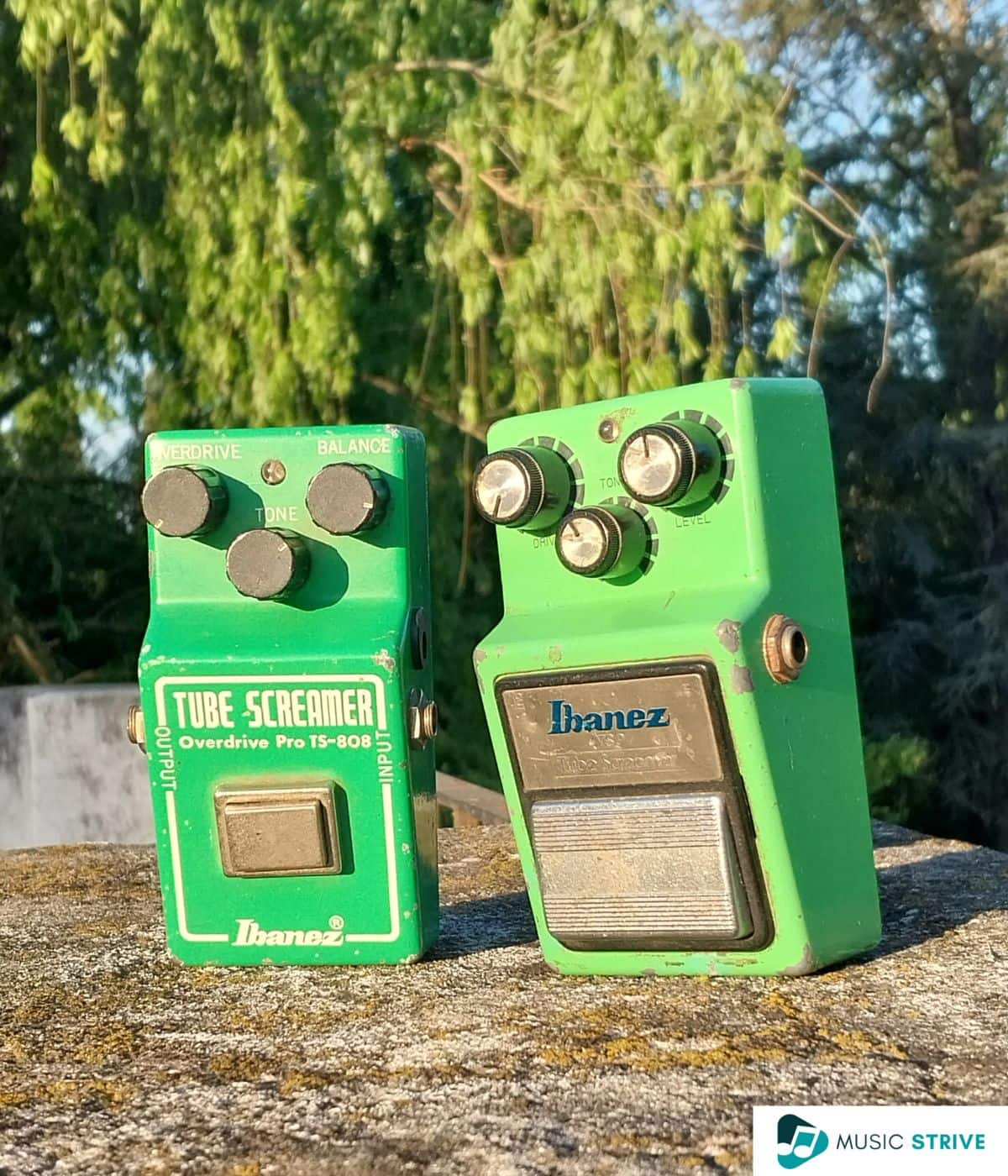
I’m a first-grade Tube Screamer fanatic. I’ve been playing my TS-9 for 20 years and have had an early ‘80s TS-808 for another 15. So, you can say I’m well-versed sonically in the overdrive world.
With this in mind, let me tell you a little story.
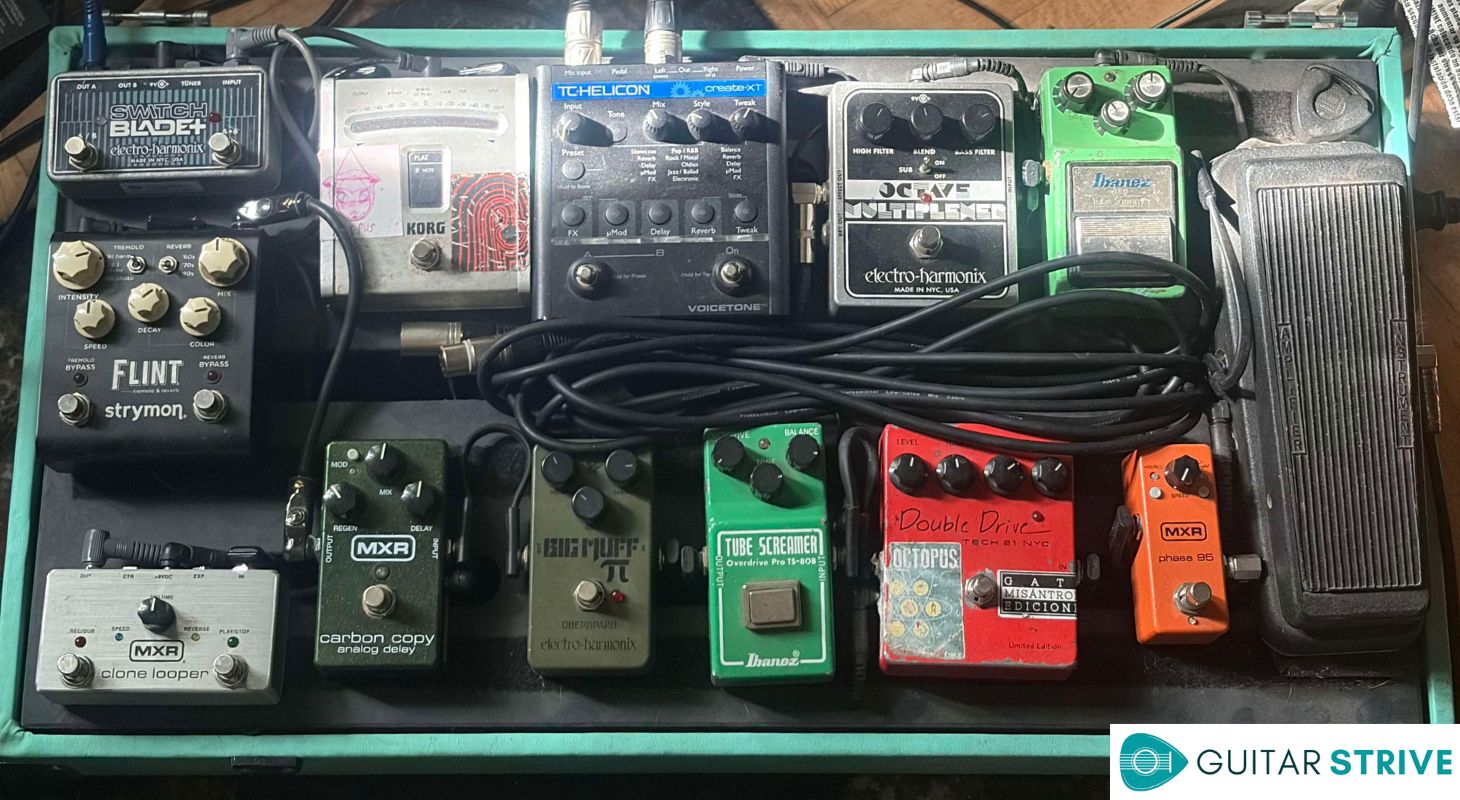
I was putting together a pedalboard for this post punk-band. We were going to play to a neighboring country for the first time. I was beyond anxious. So, I figured I had to have a pedalboard to leave the country. I bought the wood and the Velcro, and, as I laid every pedal I had at the time, and put together the whole thing, I had my TS-9 before the Big Muff and after the Wah.
It was just by chance; there were no cool articles like this to learn from online back in the day.
When I stomped on both together, I realized the overdrive could fill the space that the Big Muff had in the midrange. I know, I think about it now, and it seems like a no-brainer to me, too, but back then, it was a big eureka moment.
Nowadays, I have both Tube Screamers on my board, one before the distortion and one before the Fuzz. Oh yes, boy, mayhem is my middle name.
Triple Gain Staging & Boost
Let me expand a bit on the three-gain staging & boost situation I have on my board right now. It might be helpful to you, too.
I have four pedals, a TS-9, a Tech21 Double Drive (fantastic distortion), a TS-808, and a Big Muff Pi (the small, modern version).
TS-9
The guitar goes first into the TS-9, which has gain at zero, volume at noon, and tone a bit cut back when I play the Tele, and a bit forward when I play the SG. This is ON most of the time.
Tech21 Double Drive
That pedal feeds the first distortion, which is layered, organic, thick, and hits very hard. The small push in the midrange from the TS-9 makes this my number one distortion tone. Everything that’s rhythmic, riffy, or chugged goes through this pedal combination.
TS-808
Next in line is the TS-808, but this time the gain is at 9 o’clock, the tone is at 3 o’clock, and the volume is at 2 o’clock. This is my main boost. It works with the other Tube Screamer, with the combination I just named, and also by itself. Moreover, when I switch from a beast like the SG to a low-gain guitar like the Mustang, I go from the TS-9 to the TS-808 to compensate for volume loss.
EHX Big Muff Pi
Finally, the Big Muff Pi. This is set with volume at 11 o’clock, sustain at 2 o’clock and tone anywhere between 10 o’clock and noon. I step on it always with the TS-9 on and use the TS-808 to boost it when soloing. I only use it when I want to unleash hell, and distortion is no longer enough. This is heavy riffing, medleys, soaring leads, and big chords.
What’s beautiful about gain staging is that you can have many tones with just a few pedals.
The Bottom End
Playing through a fuzz pedal is nothing short of an art form. It’s something that has a learning curve, and you get better at it with the hours invested in the craft. Yet, I hope someone would have given me these solutions when I first became frustrated with my fuzz pedal. I mean, I know I’m one stubborn guy, and I pushed and pushed until I found a way, but if I can spare you from going through that, I’d love to.
So, go ahead, dust off that good ol’ fuzz pedal of yours and give it a new life. Believe me, there’s a method behind the madness, and once you find out about it, you can go loco with your tone.
Happy (fuzzed out) playing!
