
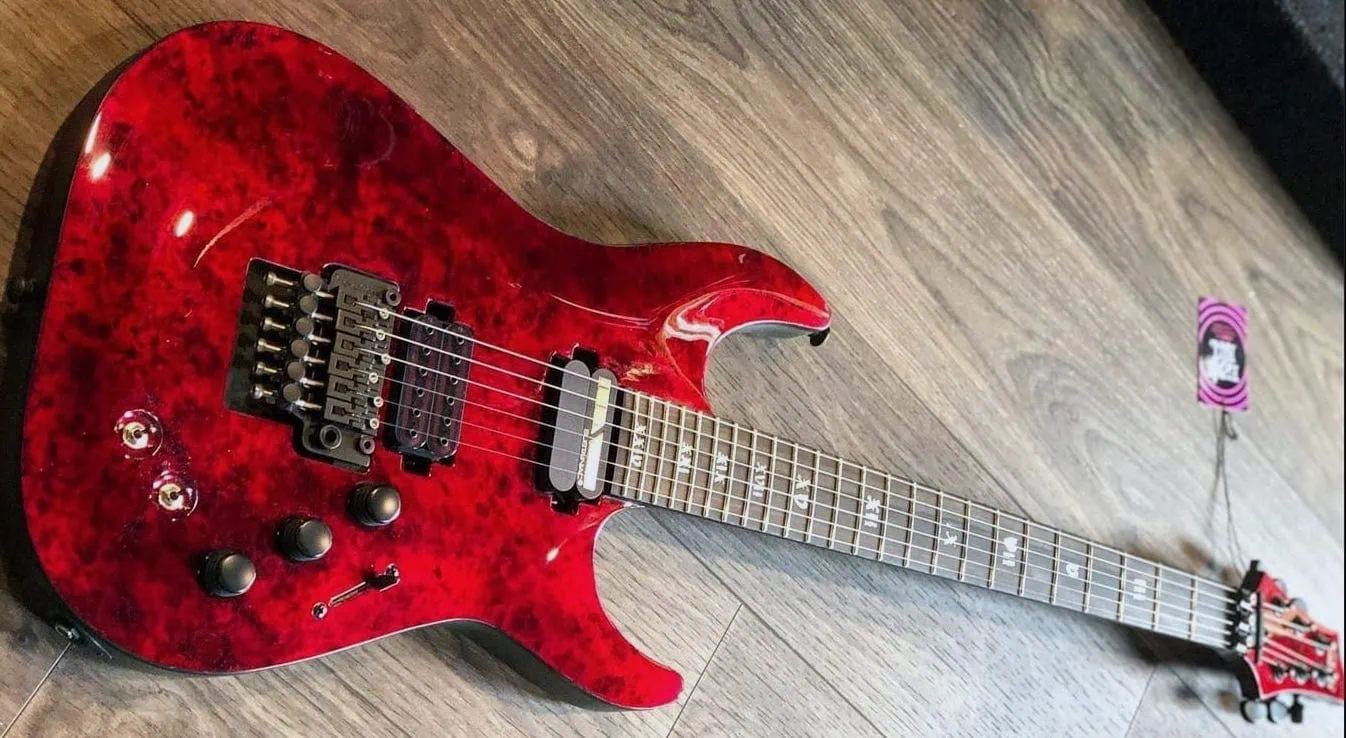
This guitar screams metal from a mile away. I mean, mother-of-pearl Gothic crosses, a fire-red finish, and the shiny, proud Floyd Rose? It almost begs you to shred it. Oh, and, believe me, there was shredding alright.
Sneak Peek
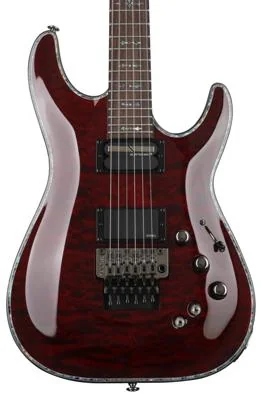
I tried this Schecter Hellraiser C-1 FR-S and was blown away by what it can do. It’s one of those instruments that can easily change the way you see a certain category of guitars.
But that’s just the summary, the scoop, the snippet. Come on, let’s get to it so I can tell you in detail why this is a great guitar.
(Impeccable) Construction & Finish
Upon reaching out for this instrument, I was instantly taken by how it felt. I mean, I’m no stranger to elite-level guitars, and, while this guitar doesn’t have Custom-Shop-grade rolled fret edges, it’s completely impeccable in every aspect.

Schecter Hellraiser C-1 FR-S
To begin with, the thing that caught my attention the most was the neck joint. This is a set-neck construction, but the contoured surface (there’s no heel) feels like a highway right to the 24th fret. It’s easily the easiest guitar to play up there I’ve tested.
The neck is made of three stripes of mahogany and coupled with a rosewood fretboard, 24 extra-jumbo frets, and some menacing gothic crosses in mother of pearl. It’s a thin-C profile with a 14” radius and a lovely volute showing behind the headstock.
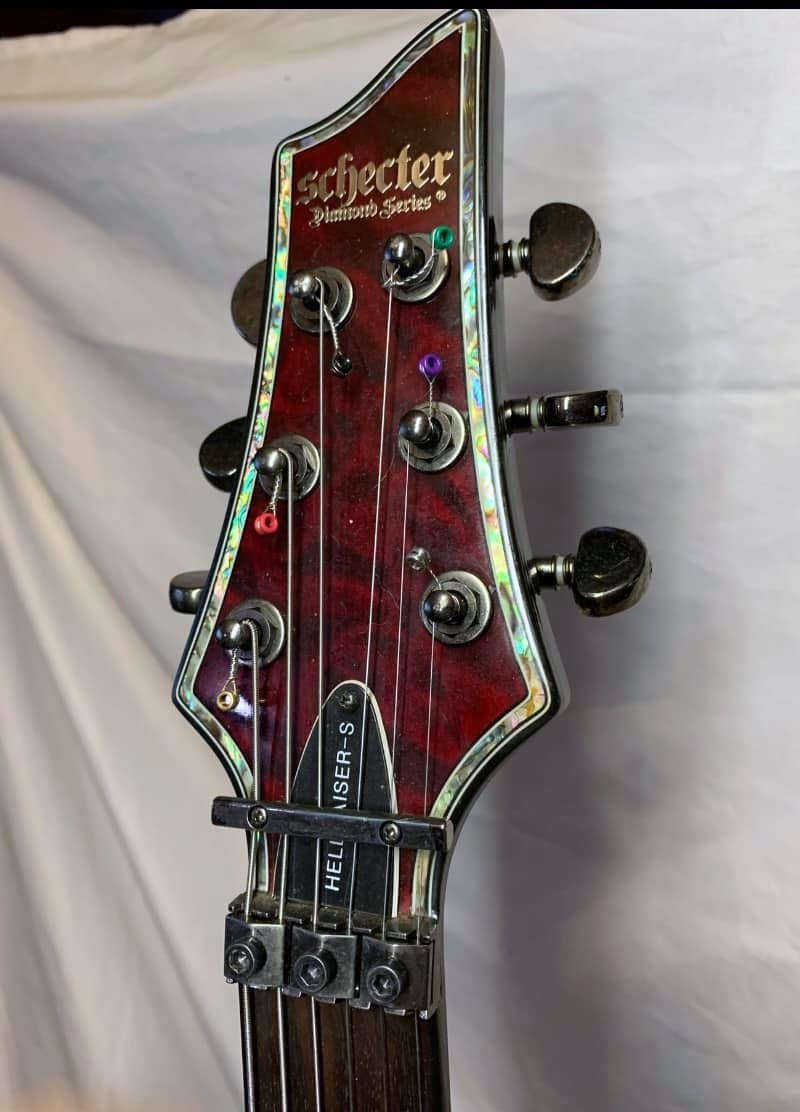
Schecter Hellraiser C-1 FR-S - Headstock
How does it all feel? Well, it feels fast. In fact, the entire guitar is like that. I mean, if you’re used to Teles, Les Pauls, or Strats, when you grab a Super Strat like this one, it feels like jumping inside a Formula 1 car. It’s prepared for speed, technologically advanced, ergonomic, and ready to be taken to the extreme.
I guess my only complaint here is that they didn’t make it a satin neck. My hand felt a little sticky after playing for a while, but I live in a very humid area.
Back to the action, I did some quick drills, and the neck was fast and smooth. You know how it goes: You try something, it works out, you want to go further. Well, let me tell you, I was shredding on this thing way before plugging it in and unleashing the true demon.
I mean, it says Hellraiser in its name! Wasn’t this thing a magic, blood-red key to raise hell?
Well, we sure did raise hell together. Follow me into this guitar’s sound test.
Definitely, A Metal Guitar
I went straight to the distortion channel of my valve head and chugged my first chord. I felt like Marty McFly picking the note in front of the giant speaker. I mean, the good-old recipe works wonders here. It’s an all-mahogany guitar with a maple top (veneer, of course) and a rosewood fretboard with an EMG-81 in the bridge position.
It sounds exactly as you would expect: a growling sound with a tight bottom end and enough high mids to pierce through reality and get to the Twilight Zone. I’m telling you, just chugging with this guitar wants to make you play Rammstein’s “Keine Lust” or Deftones’ “Bloody Cape”.
I just had to play both, and this guitar sounded huge, fat, punchy, and bold.
I know I’m not saying anything new by saying that this guitar sounds absolutely killer in the bridge position. But this isn’t, by any means, a one-trick pony.
I dialed back the gain on the distortion channel but kept it on to make it percussive and raunchy, and was pleasantly surprised by the sound in the middle position with the volume rolled back a bit. I’m telling you, it doesn’t have tele sparkle, but it does a good biting, rocking, broken-amp sound too.
Moreover, I cleaned the signal entirely and went for some complex finger-stretching jazz chords. You know the kind, a bunch of numbers and symbols orbiting around the letter. The good news is that the guitar responded perfectly, staying not only clear but also sounding articulate.
While on the clean channel, I played some funk and pop, and I had so much fun going for rapid drills on the fast neck that I came up with a handful of ideas. I must have spent half an hour alternating between double stops and bar chords, using a little compression.
This guitar makes time fly.
Before moving on to the Sustainiac system and all that magic, I went back to the full distortion mode and got some creamy leads with the neck humbucker. To finish it off, though, I played some Maiden, Metallica, and Slipknot riffs, and it all sounded thunderously great.
I’m telling you, this guitar is more than that, but it’s definitely a metal machine.
Why is the Sustainiac System a Game-Changer?
This guitar comes equipped with a Sustainiac System in the neck pickup as a factory feature.
But what does it do for you? Oh, it gives you this instant Satriani/Vai/Santana infinite sustain that’s great for solos or riffs. It’s controlled using two little toggle switches on the guitar’s body. One is for on and off, and the other is for the modes:
- Fundamental – This is the simplest mode. The system takes the note you’re playing and sustains it indefinitely. You can also do it with a chord.
- Harmonic – This mode adds a higher-octave harmonic to the sound. It’s similar to amplifier feedback trying to go into squealing mode, but maneuverable.
- Mix – In this mode, both of the above are engaged. This is cool to experiment with once you’ve got your head around what does what.
I have to say that when I read about it, I was as puzzled as you are. But bear in mind your picking hand has nothing to do because the infinite sustain comes from the way the system makes the string vibrate, which is then picked up by the bridge pickup.
So, once you practice with it a bit, you can go from harmonic to fundamental modes and control the feedback using the toggles and the fretting hand.
If you don’t know how to get started, use the third string only. That’s where this is the most effective. Once you’ve mastered that, try moving around a bit; it’s a lot of fun.
What I did was dust off my Whammy and go for that iconic “Like a Stone” solo by Tom Morello. I could copy it to perfection; it sounded just like on the record with a little delay.
After that, I left it on to play some faster leads and went for shredding solos just to find out that it makes everything better. You can just leave it in fundamental mode, shred away, and reach out for the harmonic mode whenever you want to emphasize a note or make it go up to the sky.
What comes really handy to play the Sustainiac is the original Floyd Rose 1000 tremolo system on this guitar. I have to say it; I’m not a fan of putting two bolts through the neck and having those clamps before the first fret. That said, having infinite freedom for the picking hand and using it to trigger the tremolo does open a whole palette of new sounds. You can hit it and have that trembling effect, go slowly up, or do a dive bomb. I mean, imagination is the only limit.
Also, the volume and tone knobs are accompanied by an intensity dial that tailors how much of the Sustainiac you get in the final sound. This is great to bring it in and take it out in swells as if it were your volume knob.
Remember, your picking hand is free; the pickup keeps the note going.
Also, I discovered that clean tones with shimmering reverb, generous delay, and the Sustainiac can help you paint interesting soundscapes.
So, yes, after trying so many things and having so much fun with it, I’m totally sold. It’s a game-changer that’s very uncommon at this price point. I looked for some other guitars that could be possible options, but none of them offer this many quality components at this price point.
To find such a feature in the competition, you have to either go to a basswood-and-laurel Cort guitar for a little less or way up to a 3K Ibanez or a Reverend.
For example, the Ibanez JS2480 and JS1GD Joe Satriani signature guitars feature the Sustainiac System but are priced well above the 3K mark.
The Reverend Reeves Gabrels signature model also retails a little above the Schecter and doesn’t offer a Floyd, and is definitely not a fast, shredding axe.
I would say that, without the Sustainiac, this Schecter C-1 FR-S Hellraiser is a great guitar. With it, it’s an arsenal of great tones ready to take you to unexplored sonic territories.
My Verdict
This guitar is a great bang for the buck, an outstanding instrument, a great studio tool, and a perfect vessel to explore new paths. I’m telling you, once you engage the Sustainiac, all these ideas rush to your fingers. Yes, it’s a wonderful new source of inspiration.
But beyond that, this C-1 surprised me in the best way with perfect craftsmanship, top-notch shredding appointments, and tone to spare.
My Final Take
For those in search of a great rock guitar that won’t break the bank, offer you a plethora of options, and give you countless hours of playing fun, this Schecter is a must-try.
Happy (infinite sustain) playing!
Further reading: our selection of the best guitars featuring whammy bars.
