
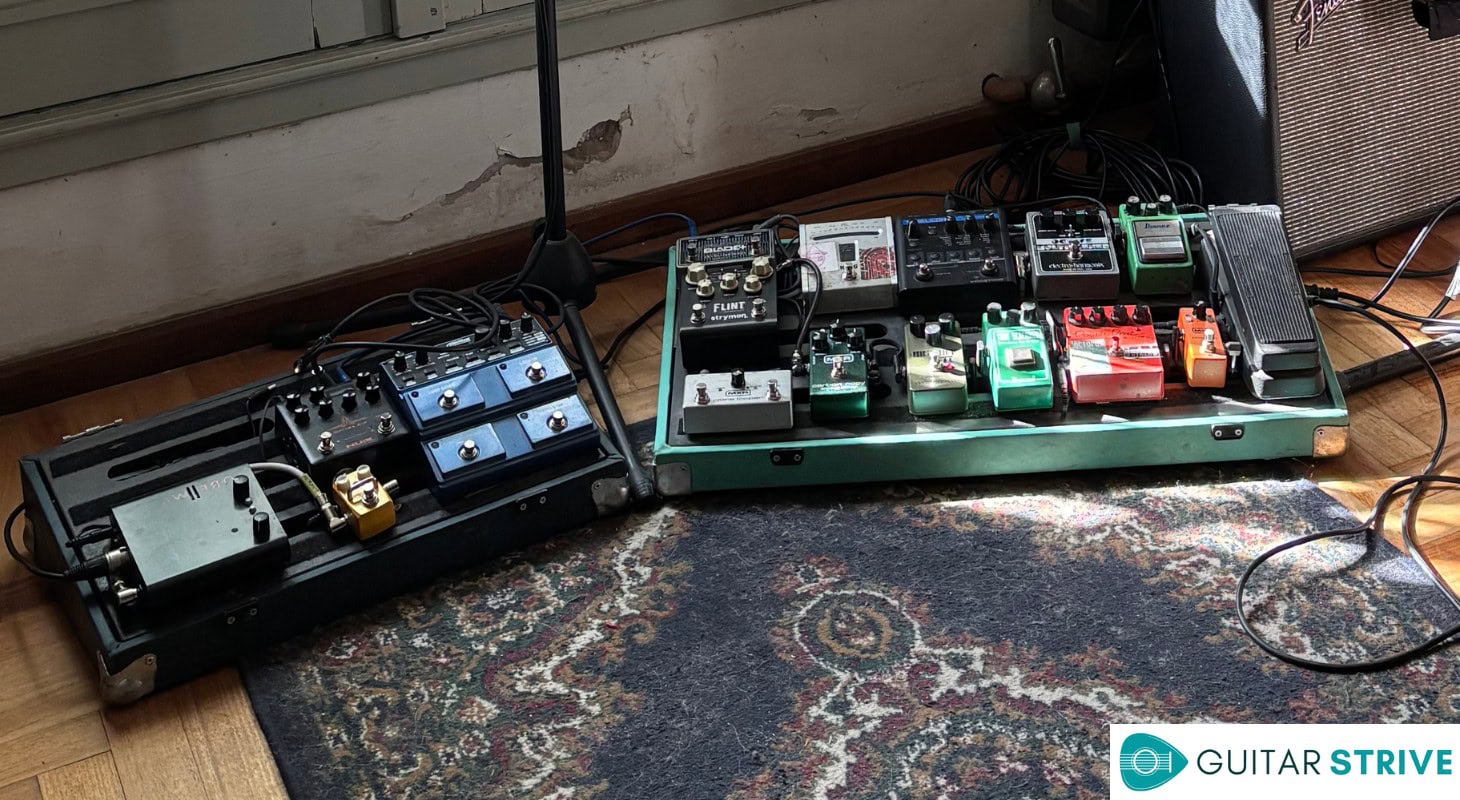
If you’re playing out, you’ve got to plug in. I know, it sounds like a cheap Ovation slogan from the ‘80s, but it’s as true as it can be.
Now, plugging in might amplify your sweet voice and great musical skills, but it surely requires a different kind of care. Yes, when electricity is involved, many bad things can happen to you, your gear, and your band mates.
In this piece, I’ve compiled the lessons learned after decades of touring and playing in every kind of venue; from coffee shops to theaters. I played them all, and here’s how I kept safe, sound, and alive after hundreds of shows.
It’s time to get serious and protect our lives from the most hazardous threat on the road, electrical power.
Table of Contents
Let’s Get Serious, Electrical Hazards are Real
Let’s begin with a simple story. I was playing in an underground café. It was a solo show, just me and the guitar, the audience, and the soundman. There was no sound check or anything, but the moment I got on the stage and pressed my lips to the battered and old SM58, I got an electrical discharge to my lip. It wasn’t too strong to hurt me, but it was something I felt every time I put my mouth there to sing.
By the end of the gig, I went home with a swollen lip.
That was my first but not my only encounter with electrical hazards in venues. But this isn’t just about me, it’s about all of us.

No Statistics Available, But Cases Rack Up
Although there are no formal statistics about this issue in the USA or any other country, the cases pile up.
From Ace Frehley, who put his hands on a rail and got electrocuted, sparking a new song, “Shock Me,” to Keith Richards being blown by a blue light on stage to Les Harvey, Agustin Briolini, and Barbara Weldens, who died electrocuted on stage, these are all avoidable catastrophes.
I mean, electrical power, when properly maintained and supervised, is paramount to making music, but if it’s not, it can be a double-edged sword.
Twenty Years on Stage Helped Me Put Together a Strategy
After that initial lip shock in the basement, I had electrical power run through my body on a couple of different occasions. Luckily for me, they were lessons and didn’t cause me any permanent harm.
So, here are some of the rules that I use when playing live, electric, and on stage.
My Number One Rule: If It Looks Unsafe, Don’t Use It
This is the first thing I use when playing live: My common sense. I know, I’m walking on thin ice here trying to ask you to use it; everyone has a different one! Nevertheless, we all have a survival instinct that tells us what to do and what not to do in our heads.
Use that instinct to stay alive and away from electrocution. Believe me, no gig is more important than your life. So, if it causes you doubts, it looks unsafe, and that inner alarm goes off, just back away from the whole thing.
Furthermore, a good thing to do is ask around the venue as soon as you walk in if the power is grounded and where’s the socket you need to use to plug in your stuff.
More on that later.
Keep the Fuses
Once I walked into a theatre to play a show after sound checking and I saw the sound man and one of my bandmates working on my open amplifier on the first row of the empty building. They were performing some kind of surgery on it, and I had no idea why.
It turned out that someone had been wise enough to plug my amp into the socket reserved for the lights of the venue. Of course, it ran at 320 volts, causing my amp to fry instantly.
Luckily for all of us, the fuse blew up, and the amp was safe and sound. So, what’s important? Keep extra fuses, you never know what can happen to your amp minutes before stage time.
What to Check in the Venue?
You can work on your end and make sure your equipment is in perfect working conditions and that you won’t have an electrical discharge because of a malfunction on your end.
But that’s not the whole picture; on the contrary, that’s less than half the tale.
Here are some of the things you should check out whenever you arrive at the venue.
Don’t Be Afraid to Ask
Having properly grounded, working, reliable, and isolated electrical power is a must for any venue. Safety is a main concern for all those involved. So, don’t be afraid to ask if these things are in working order. Furthermore, you can always ask them to show you.
Some might look at you with an awkward face, but hey, safety comes first. It’s like asking someone to put on a seat belt in the 21st century. If they find it odd, that’s their problem.
Plus, they should be interested too. if anything happens to you or any of the members of your band, they’re going to regret not taking care of the electrical installation for as long as they live. Believe me.
Does All Power Come from the Same Socket?
Electrical power generates heat. If you plug everything in the same socket and try to run the PA, the lights, and your gear using a single power extender, for example, that’ll be way too much, and it might melt the thing causing potential electrical hazard for all involved.
So, my suggestion is to make sure not everything is plugged in the same socket and use a power strip or power extender with surge protection. This will help you safeguard your gear from any tension peaks or other electrical problems that might melt or burn things.
A Few Bucks that Can Save Your Life
A great DIY solution to avoid getting killed on stage is using an inexpensive, easy to use small element called “mains tester”. This little device looks very much like a screwdriver but it’s usually transparent and comes with a small light inside.
Most of the time, when someone is electrocuted on stage, it happens because they play an instrument that’s earthed, like a guitar with steel strings, and then touch the microphone. The thing is, if the earth on the PA or the amplifier goes live, and you complete the circuit with your own body, the results can be nothing short of catastrophic.
So, to check this is not the case before you start playing and singing, just use this tester and put its blade to either the guitar’s strings or the microphone and touch the other with your finger.
If the little light inside goes on, then you just saved your own life. If it stays off, then you were safe all along and can have a safe show.
Believe me, doing this easy test with an inexpensive piece of equipment can be a lifesaver.
Mind the Voltages When on Tour!
One more thing to bear in mind when you’re playing out and touring a lot is to pay special attention to voltage changes between countries. For example, voltage in the US is 110 volts, while Europe and South America use 220 volts.
Needless to say, if you plug your tube amp wired for 110 volts to 220 volts socket, you’ll very likely blow up a transformer. If you happen to have a classic Marshall head with an almighty Drake transformer inside, you just flushed your investment down the toilet.
So, always, always, always, check voltages before plugging anything in.
The Golden Rule for Live Music is to Always Use Rubber-Sole Shoes
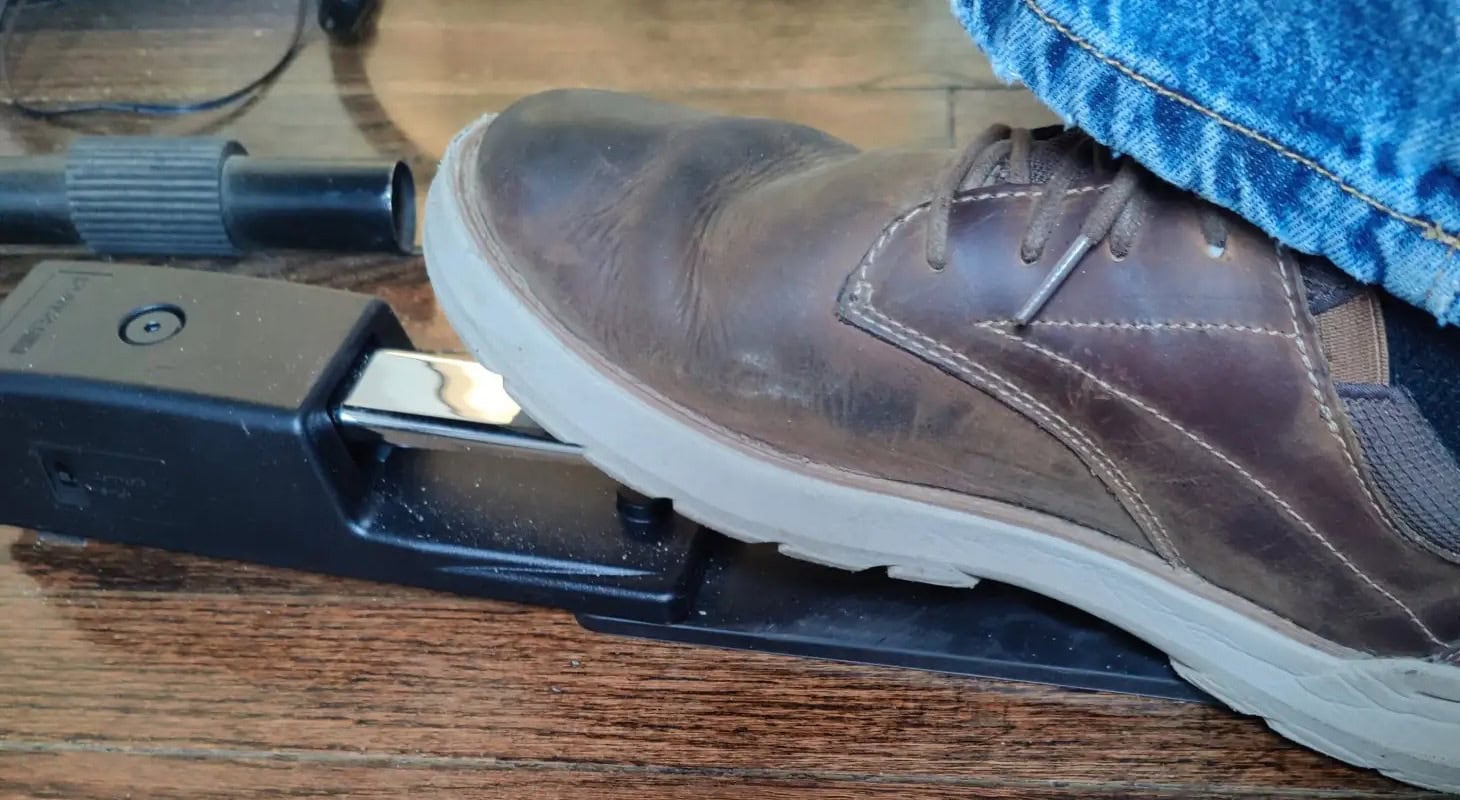
I know we’ve all seen numerous artists performing shows on their bare feet. I mean, from Janis Joplin to Joss Stone to Shakira to Florence Welch to Steven Wilson to Ronnie Van Zant, we’ve all seen them spread their magic barefoot.
Well, Barbara Weldens was one of the members of that club until the night of July 19, 2017. While playing a show in the south of France with no shoes, she accidentally stepped on a piece of malfunctioning gear and was electrocuted. She was only 35 years old at the time and was promoting her successful first album. She was pronounced dead on the spot.
So, no matter how cool it looks, or how many people do it, always wear shoes with rubber soles so they can isolate electrical currents. It might be a matter of life and death.
The Bottom End
Electrical safety is a must for you, your bandmates, your equipment, but also for venues. It’s not a taboo subject you shouldn’t talk or ask about. After all, it can be a matter of life and death for you, and might be the last gig ever produced in that venue if anything happens.
Safety is always a collective effort.
So, make sure you follow some of these rules.
Oh, and avoid electrical discharges on your lip as you sing, always make sure you bring a simple wind filter. Yes, that foamy, inexpensive, little thing can be enough to protect your mouth.
I know, you’re welcome!
Happy (grounded & isolated) electric playing!
