
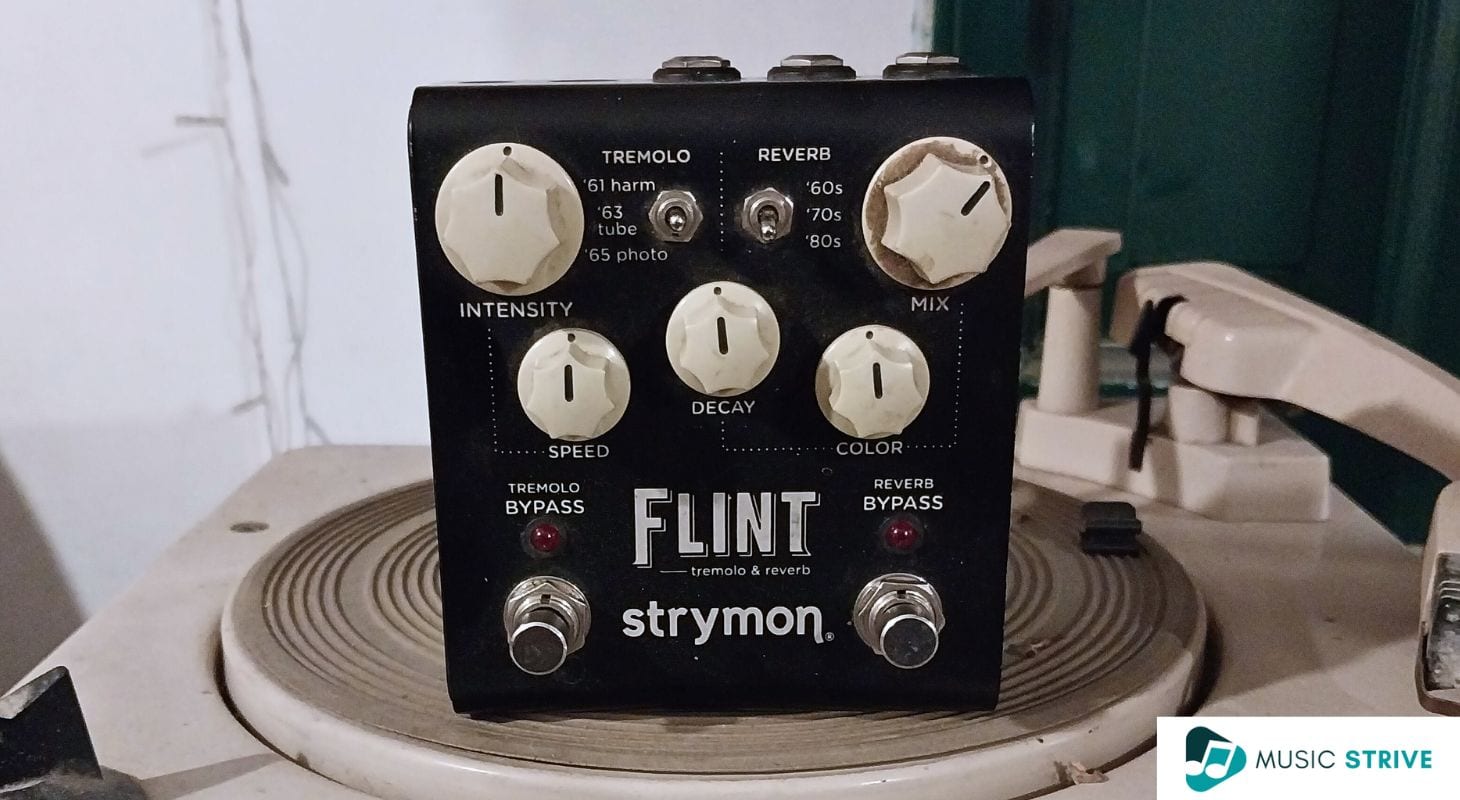
Ever since I sold my old and trusty Boss TR-2 Tremolo pedal (the nice old green box) I’ve been experimenting with the Strymon FLINT. Although I didn’t know much about it when I bought it, it’s grown in me and now I don’t see myself taking it out of my board anytime soon.
I’ve used it to get amazing, subtle tremolo sounds and gigantic reverb sounds.
It doesn’t outdo my Fender Deluxe Reverb Amp, of course, but it does a great job taking some of those sounds on the road for a lot less.
Read on and learn why you need to get yourself a Strymon FLINT and Fenderize all amps coming your way.
The FLINT Fenderizes Your Sound
One of the main characteristics of Fender amps is that they have a one-of-a-kind approach to reverb. Yes, although reverb wasn’t invented by Fender, it’s a natural phenomenon, when you think of dripping reverb tones, you mostly think of the brand with the big F.
Well, the same thing happens with Tremolo. You might not know this, but classic combo amps by English brands such as the Marshall Bluesbreaker and the Vox AC-30 came equipped with a tremolo unit built straight into the amplifier’s circuit.
Yet, again, if you think of Tremolo tones, you think of Fender amps.
Well, the Strymon is a one-pedal solution that has three options of reverbs and tremolos to play with and get some classic tones out of it as well as some new, groundbreaking ones.
Let’s dive into it.
What Does Strymon FLINT Do?
Fenderize Your Amp!
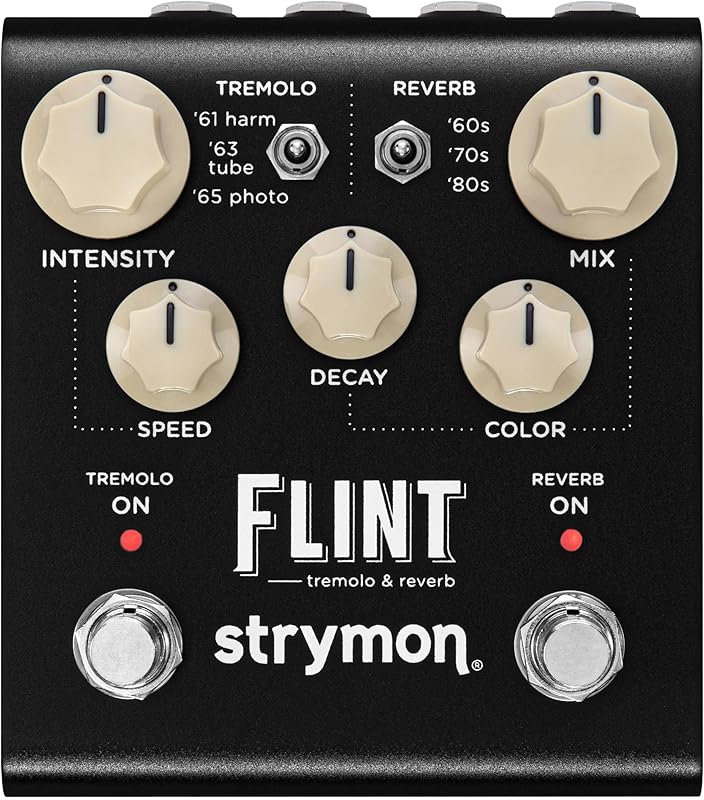
The Strymon Flint is a dual pedal offering reverb and tremolo in the same pedal. Each effect has modes and controls entirely of its own. Moreover, you can engage and disengage any or both with a separate footswitch.
The newer version (V2), released 10 years after the original sports a USB-C port, is MIDI compatible, and, if you use a stereo TRS cable, it’s a stereo IN and stereo OUT pedal. You need to have a Y-cable with a stereo TRS connection for the input because, while it features left and right outputs, it doesn’t feature left and right inputs. Shame on Strymon because that’s definitely a flaw for this pedal.
That said, the stereo outputs open the door for lush, beautiful, mesmerizing stereo sounds. Furthermore, if you use it at the end of your signal chain, you can use it to transform your mono rig into a stereo one.
But, perhaps, what the FLINT does best is to give you a sound that’s beyond the sum of its parts. Yes, the resulting tone from the combination of reverb and tremolo, when perfectly dialed in, is instant Ennio Morricone territory. You can get that amazing Spaghetti Western sound effortlessly with a single pedal.
Let’s dive into some of the sounds this pedal can help you create.
The Reverb Side
The Strymon’s Reverb side isn’t suitable for ambient music. Although you can crank the “Decay” knob and make it virtually infinite, the company offers the Blue Sky, Big Sky, El Capistan, and many other products that can go into that territory.
This reverb is more of a classic effect, close to what you’d find in a tube amp.
To me, the controls are great because they allow you to create very diverse sonic landscapes easily.
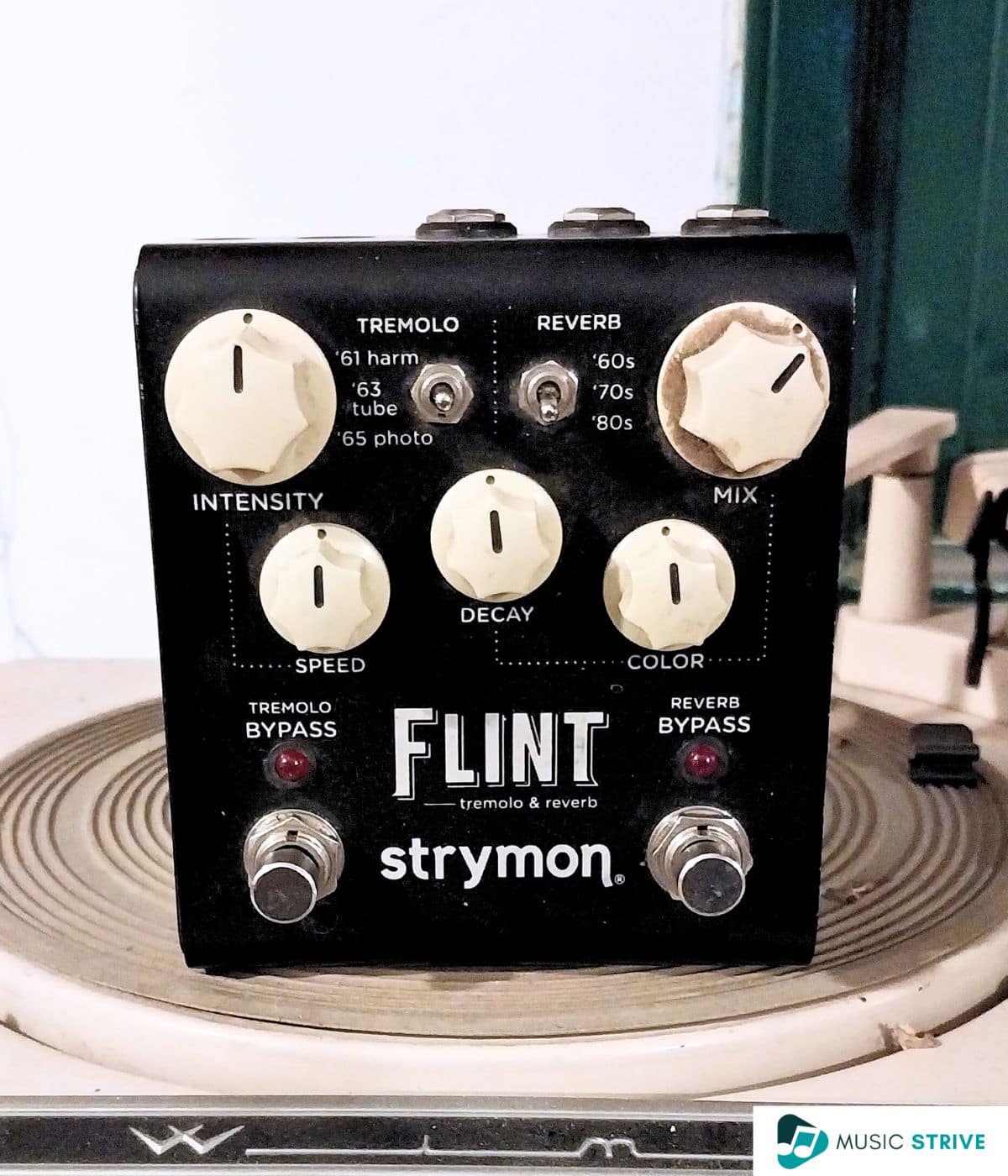
Furthermore, the “Mix” knob goes from a completely dry to a completely wet signal so you can dial in just how much Reverb you want without modifying your tone.
Playing with a cranked decay and a low setting in the mix knob creates a beautiful trail behind your playing that’s not overwhelming; just beautiful. In the same vein, the color knob allows you to adjust the brightness or darkness of the reverb which is perfect to accommodate more than one guitar live and in the studio.
By the way, this is an awesome addition to any studio equipment, you can put any and all instruments through it and it makes them shine.
Let me tell you what I use each mode for:
Sixties-Style Reverb
This is by far my favorite Reverb. It’s got that beautiful complexity that makes tube-driven spring reverb so interesting. In the original (like you’d find in a Twin Reverb) each spring has a different decay time, making it all complex and beautiful.
This is a faithful recreation of that lovely mess. The only con, though, is that it doesn’t “drip” even with all controls maxed. In other words, you can’t do the Dick Dale dripping surf reverb sound with it.
That said, I love it as a nice enlargement of everything I play.
Seventies-Style Reverb
This setting emulates the plate reverb that was so famous in the seventies. The original circuit had multiple delay lines in parallel making the sound smooth but super rich. This pedal recreates that embracing tone perfectly and you get this lush mattress of reverb you can take risks over.
If you crank the decay knob you get almost infinite trails. The decay knob maxed and the mix knob at 3 o’clock is my favorite setting for big chords.
Eighties-Style Reverb
Ah! The glory of early micro processing and the shortcomings of that rising technology. Because of the limitations of the microprocessors back then, companies were forced to be creative and add modulation and all kinds of filters to the processed signal.
This mode emulates those old digital reverb rack units to the detail with all shortcomings included.
What you get are crisp early reflections followed by a trail of slow-building reverberation. I use it for arpeggio work and lead lines with a clean neck pickup and it’s a killer tone.
Again, when maxing out the decay, you get close to infinite decay.
The Tremolo Side
I have to confess I have always been a tremolo guy. It’s an effect I just love, so I’ve been playing with tremolo most of my adult life. I love it when I can get that Spaghetti Western sound. If you play some minor open chords, like Am, Dm, or Em, you instantly grow a cowboy hat and a pair of boots.
But that’s not all, because you can also crank the intensity knob and get that beautiful Hendrix-approved tremolo sound that’s closer to a vibe than a tremolo.
Furthermore, if the reverb has three distinct and beautiful flavors, the difference between each of the tremolo modes is way more noticeable. You can go from Hendrix to Johnny Marr with just the flick of a switch.
Speaking of which, let me tell you a little more about the modes.
’61 Harmonic Tremolo
With a structure that works with dual filters cutting high and low frequencies in alternating fashion, this tremolo type is a rarity. Yes, it was only available through a short period (mostly late brownface amps) and has a signature sound not found anywhere else.
The slightly detuned trail is very Hendrix-inspiring and it’s also my favorite tremolo setting to play Western motifs. You can do one thing you can’t with an amp and that’s lowering the speed to zero and getting a nice modulation, beautiful to play with reverb and delay. Mellow melodies get mellower, and everything sounds like a lazy Sunday afternoon.
Finally, a slow speed and high intensity is great for Hendrix-like vibes.
’63 Power Tube Tremolo
With an LFO that changes the bias of the power tubes, the power tube tremolo effect is less drastic than the harmonic tremolo. If it sounded like mumbo jumbo, changing the bias of the power tubes is to modify how much electric current they receive.
This is the closest I get to my Deluxe Reverb’s tremolo. It’s very beautiful, lush, musical, and it builds up very nicely as you increase the intensity knob. If you play with that knob below noon, you get a very subtle effect that’s barely noticeable but nice to add movement.
This is a great tremolo setting for strumming chords rather than playing arpeggios.
’65 Photocell Tremolo
This is the most drastic type of tremolo, it sounds very much like The Smiths hit “How Soon is Now”. This technology used a neon bulb and light-dependent transistors to change the amplitude of the guitar system.
Perhaps, the best way to describe it is to say it’s “choppy” because it feels like it chops the signal and goes from sound to nothing alternately. This is very different in feel and sound to changing the tone with filters.
It comes closer to something like the difference between a square signal versus a round one. In my book, this is perfect for power chords and very drastic effects. I use it when I need a very harsh tremolo that can really make a difference.
How Do I Use It?
I already told you a few scenarios for the modes, but I don’t usually bend down to change settings between songs playing live. Those are mostly tricks I can pull off in the studio rather than in a live scenario.
When playing live, what I do is leave the reverb side ON the whole show in the sixties-style reverb with all controls at noon. This is very close to playing with the reverb knob on 3 in my Deluxe Reverb ’65 Reissue. You get some more body in the low end and some extra space in the high end.
It makes cleans lusher, overdrive has more of a rock and roll vibe, and lead and distorted tones become bigger, with more bottom end.
If I have the luck of playing with my Deluxe Reverb and the FLINT, then I’ll set the amp’s reverb to “dripping wet”, around 8 or 9, and use it when I need that extra reverb for the surfy lead tone.
The tremolo in my FLINT is in the ’63 power tube tremolo mode and I play it with the intensity at 3 o’clock and speed at noon. I don’t use it on the entire show, but add it in only a couple of songs that need that specific Western sound.
When compared to the tremolo in my DR, I can say it’s deeper and more dramatic. Also, it handles distortion and fuzz great, because it’s last in my chain so I can plug into more than one amp.
For example, going to my Marshall-style Sovtek MIG-50 head and the Deluxe Reverb with the left and right outputs allow a beautiful stereo sound. There’s the massive low end of the Sovtek and the magical high end of the DR. It makes you think that it’s a beautiful gift to be alive and experience that great tone.
Secondary Functions
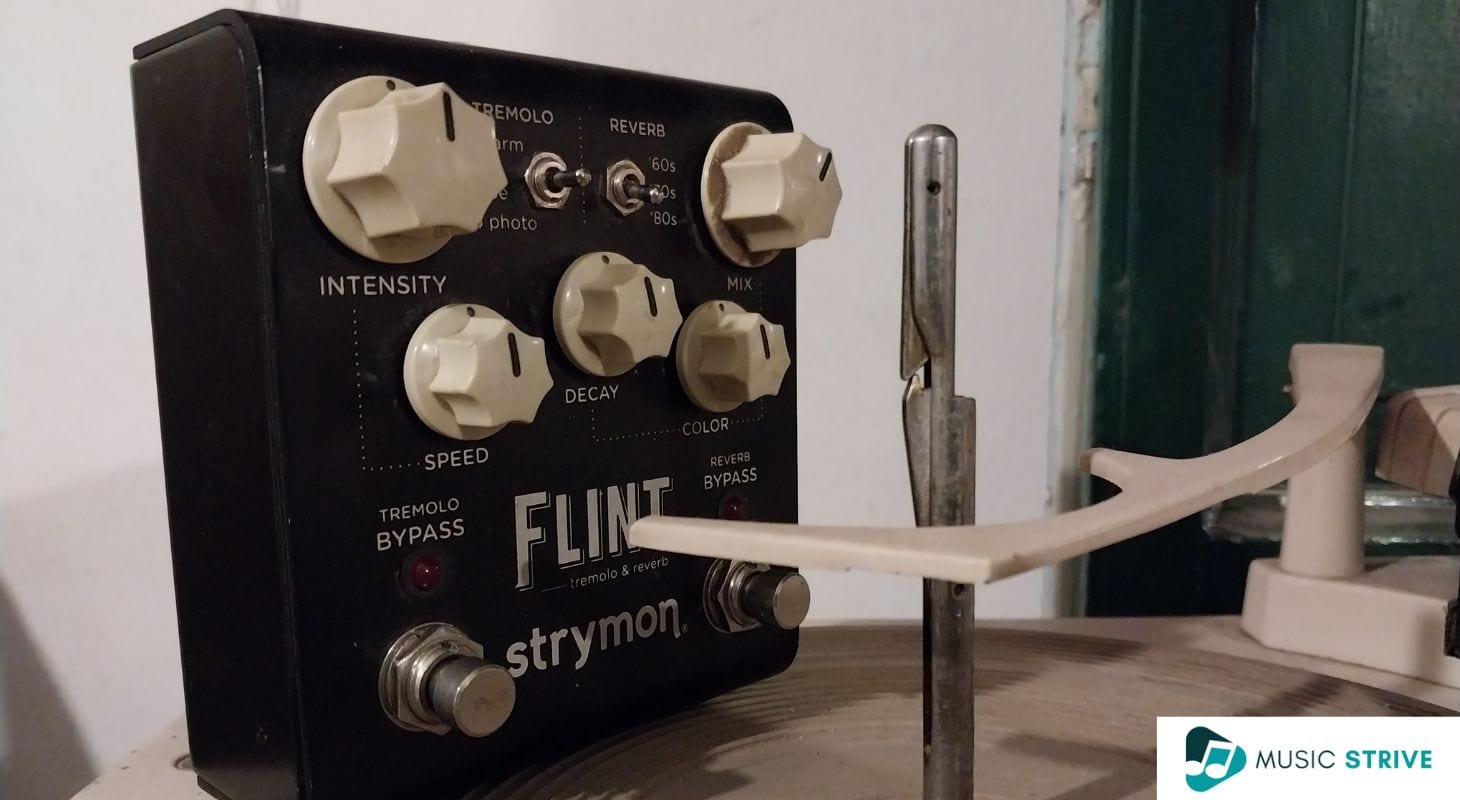
Strymon FLINT - Controls
By holding down both footswitches, you can make the FLINT go into a different mode and access the secondary functions. These are:
- Tremolo Boost/Cut – Vintage amps have a bad reputation for lowering their volume when you engage the tremolo. This is perfect to prevent that, it goes up and down 3db.
- Reverb Boost/Cut – This is the same as the above but for the reverb side.
- Effect Order – Hitting the tremolo with the reverb is what you get in most amps with both effects; this is the standard setting. You can invert it and what you get is the trail of the reverb slowly fading rather than the envelope of the tremolo.
- Tap Subdivision – If you have a tap tempo footswitch connected to this pedal, you can choose the tap tempo with it.
The Bottom End
The Strymon FLINT is a very small, affordable, and convenient way to Fenderize any amp. If that’s what you’re after, then I doubt you can find a more complete and better-sounding option than this Strymon pedal in the market today.
But beyond that, you can use it as a very powerful tool in the studio to get many different tones. These go from the infinite reverb settings in the ‘70s and ‘80s mode with a cranked decay to the choppy, drastic tremolo sound in the photo mode.
All these sounds can also be applied to different instruments, including vocals.
Fenderize Your Amp!
The Strymon Flint is a dual pedal offering reverb and tremolo in the same pedal. Each effect has modes and controls entirely of its own. Moreover, you can engage and disengage any or both with a separate footswitch.
I hope that, if you had any doubts whether the FLINT was the pedal you needed, by now you know the answer to that question.
As for me, it’s not leaving my pedalboard anytime soon.
Happy (fenderized) playing!
Oh, and BTW, here’s guitar icon and legendary bluesman John Mayer using his FLINT live.
